

Ancient Egypt was the world’s first territorial state, extending nearly 1,000 km along the Nile Valley by 3,100 BC.
As one of the earliest civilizations in human history, several exotic theories have been advanced for the origins of the ancient kingdom, which portrayed it as a foreign transplant that had appeared suddenly along the Nile.1
Recent archaeological evidence now paints a different picture. The origins of ancient Egypt should be sought within its North-East African context, where several complex societies emerged during the 5th-4th millennium BC, some of which competed with the predynastic rulers that united the early kingdom of Egypt.
These ancient societies were regional variants of broader traditions of the Nile Valley and Eastern Sahara, where a continuum of agro-pastoral communities initiated complex patterns of exchange, settlement, and social organisation within the Nile Valley and surrounding desert.
A growing body of archaeological research from this pre-dynastic period has enabled Egyptologists to trace the developments which led to the formation of the ancient Egyptian state, including the rise of kingship, the creation of the first hieroglyphs, as well as the iconographic art and pyramid architecture of Egypt.
This essay examines the history of ancient Egypt from the prehistoric to the early dynastic period, situating its development within the broader context of Northeast Africa.
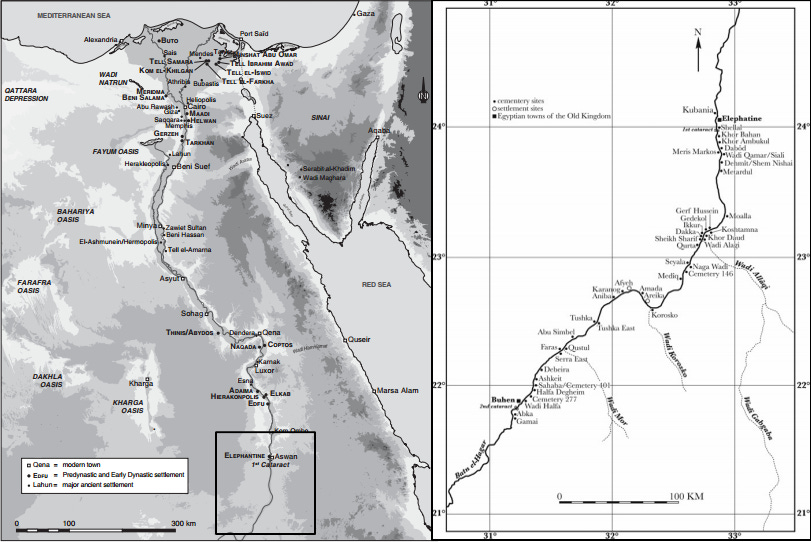
Map showing the pre-Dynastic sites of Egypt and Lower Nubia (inset).
Support AfricanHistoryExtra by becoming a member of our Patreon community, subscribe here to read more about African history, download free books, and keep this newsletter free for all:
The Neolithic period in North East Africa.
In Egypt, the earliest ‘Neolithic’ cultures (ie; Late Stone Age, food-producing communities) emerged in the Western Desert, based on the early occurrence of pottery and cattle herding.2
This era is divided into the Early (8800-6800 BC), Middle (6500-5100 BC), and Late Neolithic (5100-4700 BC). The earliest sites were at Nabta Playa and Bir Kiseiba (see map below), where there’s evidence for cattle herding as well as sheep and goats. Material culture includes lithics, pottery, ostrich eggshells, and grinding equipment for processing wild grasses and sorghum.
Permanent occupation begins in the Middle and Late Neolithic period, including slab-lined houses, wattle-and-daub constructions, and a massive megalithic complex, with human and cattle burials surmounted by stelae. In the late phases, Pottery transitions from the broader Saharo-Sudanese tradition to a localised style of burnished and smoothed wares.3
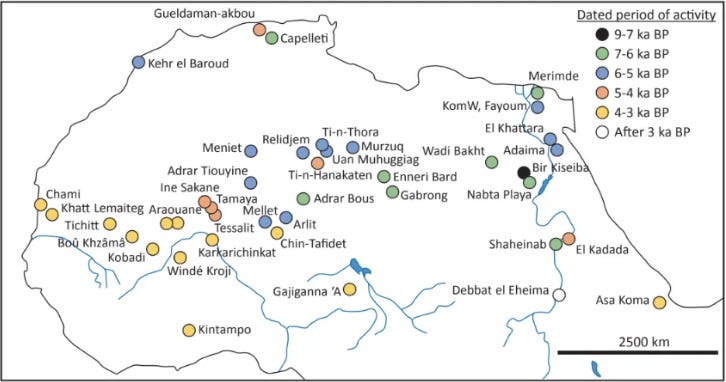
‘Map of early sites for cattle in Saharan Africa’4
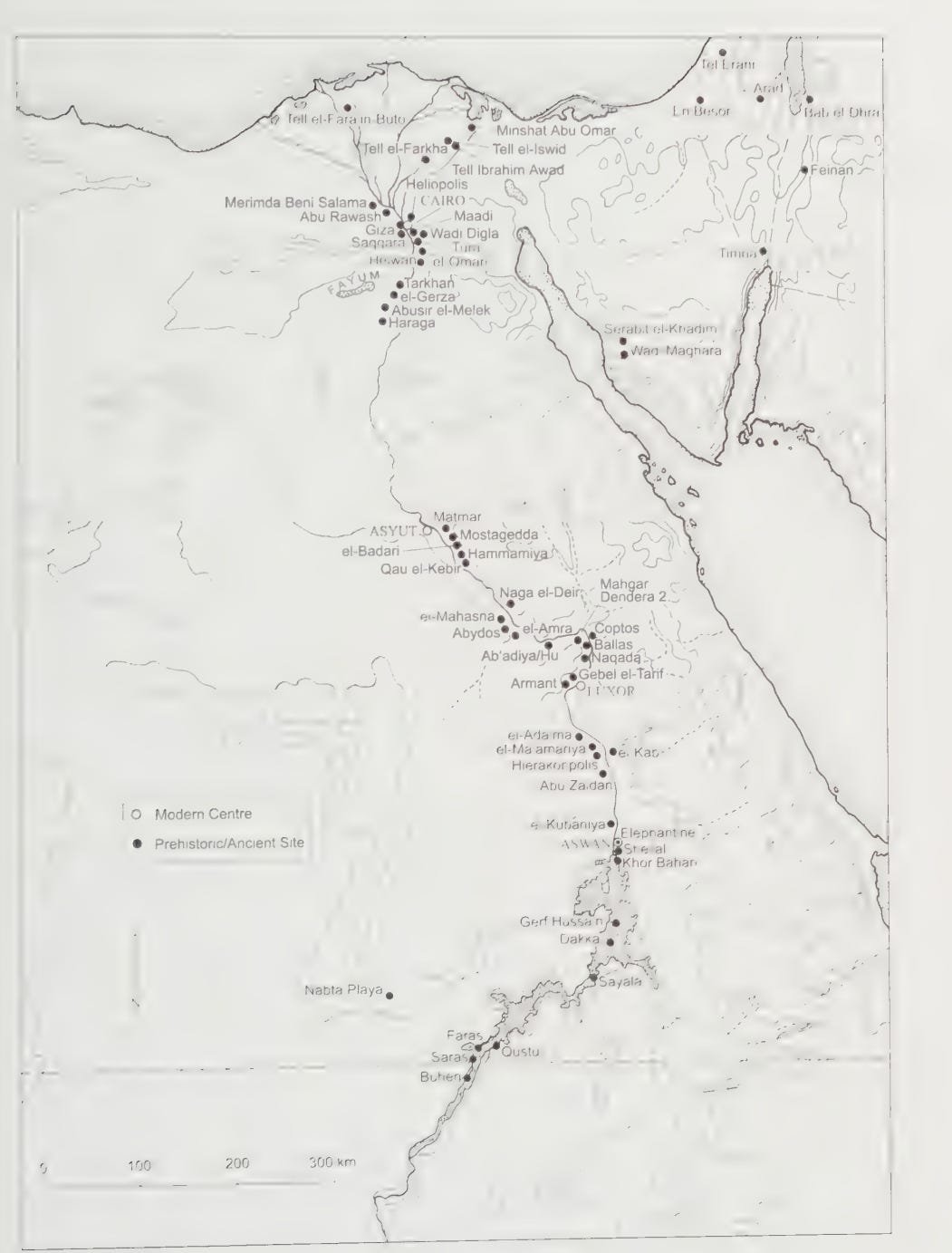
Map of Egypt by D. Wengrow, showing prehistoric and early dynastic sites
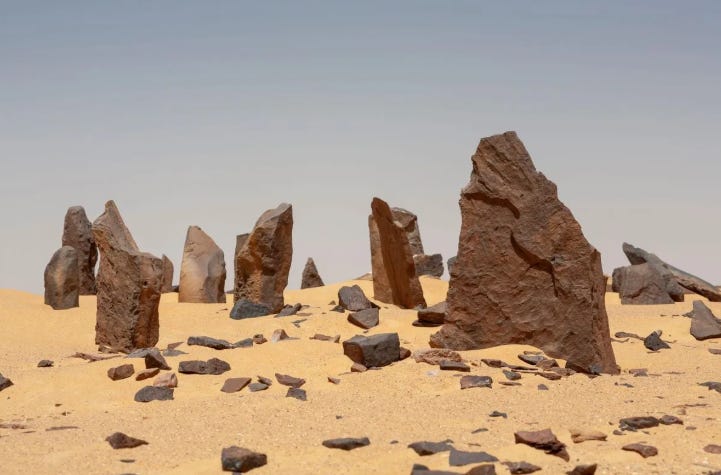
Nabta Playa, Alamy Images.
After c. 4900 BC, the desert became less and less inhabitable because of the onset of the arid climate that continues up to the present day, forcing more populations into the Nile valley and surrounding oases.
In the Nile Delta region, one of the oldest preserved Neolithic sites was at Merimda Beni Salama, which was occupied before 5,000 BC with evidence for herding cattle and goats. From 4500 to 4000 BC, archaeological remains are related to the Saharo-Sudanese Neolithic cultures that are attested at the same time in the Western Desert. The last phase of occupation from 4000 to 3800 BC is closely related to the Faiyumian culture.5
The Faiyumian culture (5450-4400 BC) in Lower Egypt provides the earliest securely dated evidence for cultivation of six-row barley, emmer wheat, and flax. Indirect links with distant places have been inferred from seashells of both Mediterranean and Red Sea species, as well as cosmetic palettes of Nubian diorite and beads of green feldspar. Settlements consisted of large villages of mud dwellings, round huts, and work spaces.6
In Upper Egypt, the Badarian culture (4400-4000 BC) provides the earliest evidence for agriculture in this region. It’s mostly known from cemeteries that consisted of simple pit burials, which also display the earliest evidence for hierarchization in the form of unequal distribution of grave goods (mostly pottery).
Badarian pottery consisted of handmade, black-topped red wares with a rippled surface. This type of pottery is considered a local development of a Saharan tradition, extending southwards to the Khartoum Neolithic of Sudan, eg at Kadruka, whose burial traditions and material culture are broadly similar. The Badarian culture was widespread, in the south at Armant, Elkab, and Hierakonpolis, where it was intertwined with the Naqada culture, into which it evolved.7
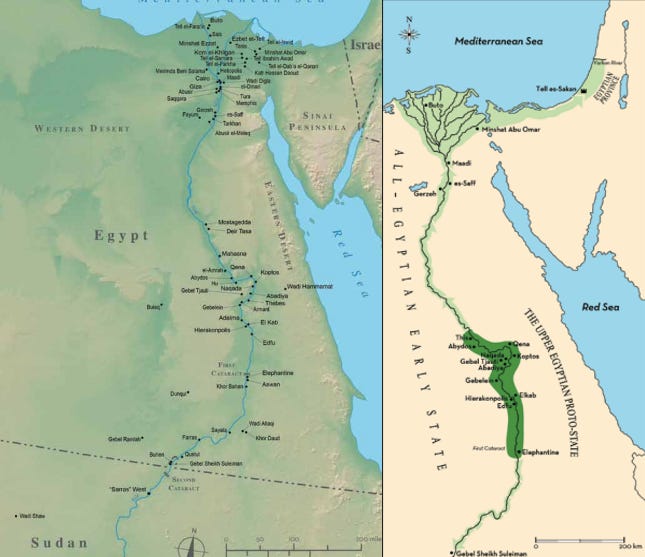
Map of the Naqada sites in Egypt.8
The Naqada culture of Upper Egypt in the 4th millennium BC.
The first Naqada phase (Amratian) lies between 4000 and 3500 BC, followed by the second phase (Gerzean), from 3500 to 3200 BC, and the final Pre-dynastic phase runs from 3200 to 3000 BC.
Naqada I sites are known from funerary remains that mostly consisted of simple pit graves furnished with a variety of grave goods. Larger burial places are also attested, e.g. at Hierakonpolis, provided with coffins of earth or wood. Some burials contained funerary statuettes, but weren’t rich in other grave goods, suggesting social diversity rather than increasing hierarchization at this time.9
The black-topped wares of the Badarian period gradually became less common, and surface decoration now included geometrical, animal, and vegetal motifs, as well as boat scenes and human figures of hunter-warriors and vanquished captives. Precursors of pharaonic iconography, such as the red crown and the bird above a sacred building, and the ruler smiting his enemies, first appear during the Naqada I period.10
The making of Egyptian faience and the techniques of stone working were developed during this period, including greywacke, granite, porphyry, diorite, breccia, limestone, and Egyptian alabaster, mostly used for funerary equipment. The production of bone and ivory objects, as well as copper artifacts, expanded.11
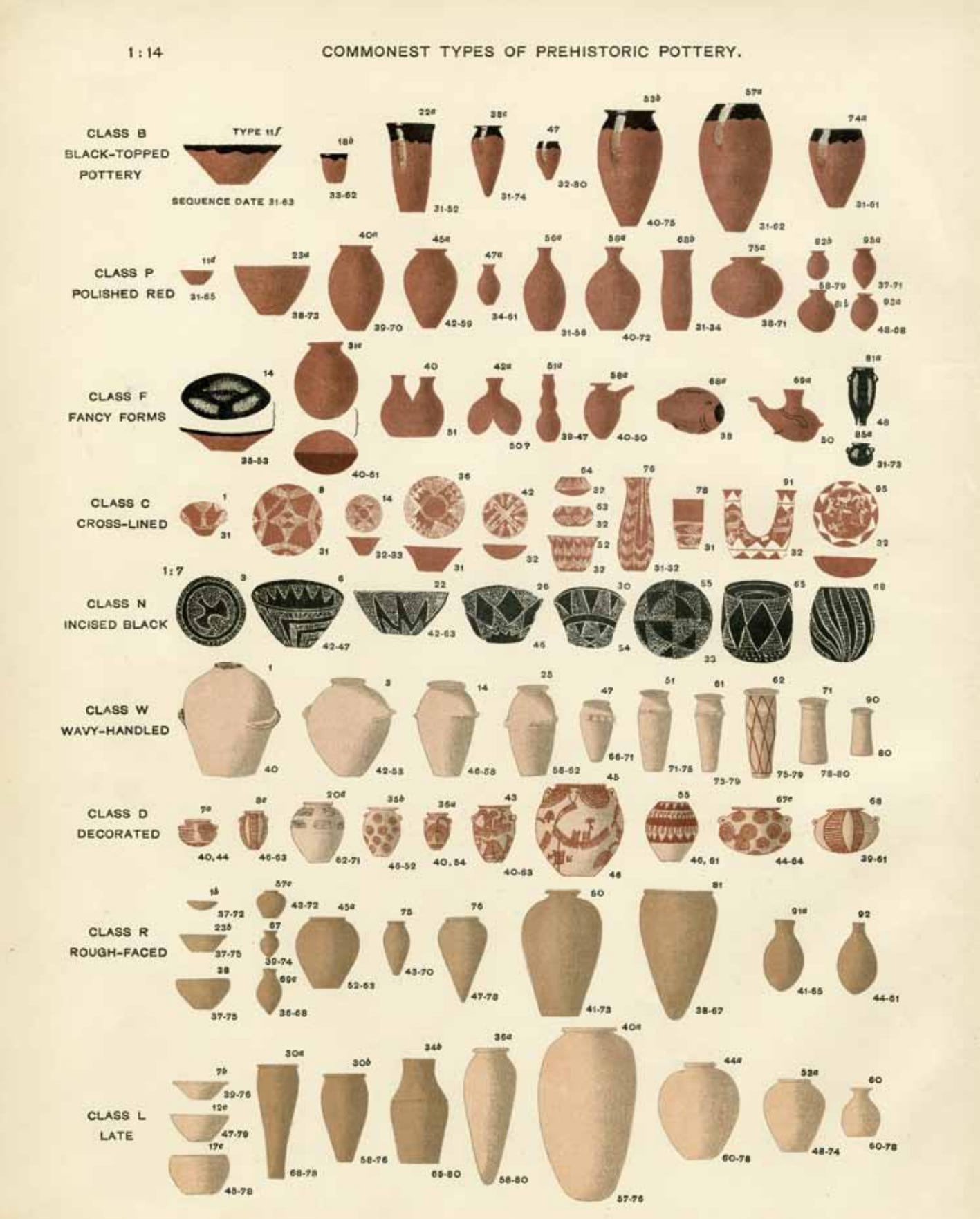
‘Frontispiece from Petrie’s Diospolis Parva: The Cemeteries of Abadiyeh and Hu, 1898-9 (1901b) illustrating his Predynastic pottery sequence (courtesy of the Egypt Exploration Society)’ “Although modern pottery specialists would not organize their corpuses of material in this way, the terminology introduced by Petrie remains the common reference point for Predynastic studies to this day.”12
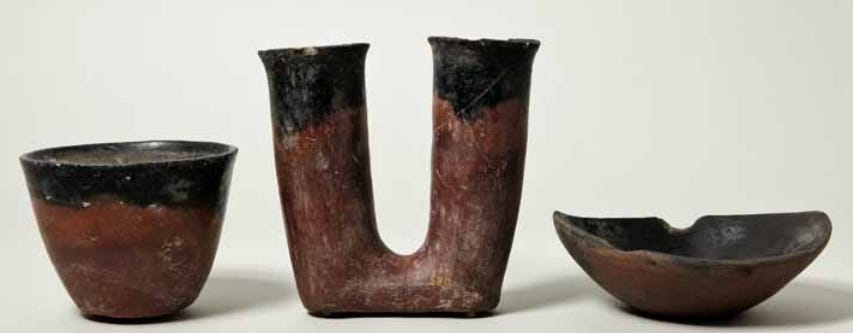
Black-topped bowls and beaker, Naqada I-II period, ca. 4000-3600 BC. Image by Emily Teeter et al.
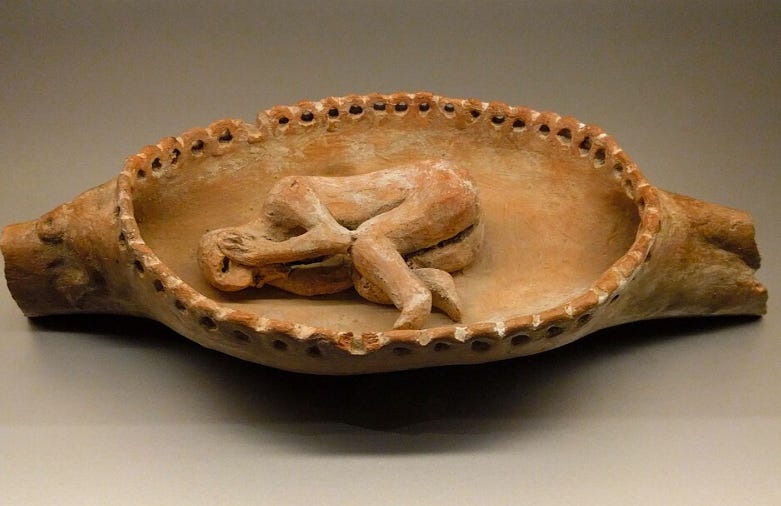
Clay figure, Asyut, Naqada I period, c. 4000 BC, Egypt. National Museum of Antiquities, Leiden.
The Naqada II phase was characterized primarily by expansion of its material culture northwards towards the Nile delta and southwards to the A-Group culture of Nubia.
Increasing hierarchization is evidenced by the emergence of larger graves for a few individuals, containing richer and more abundant offerings, eg Cemetery T at Naqada and Tomb 100 ( Painted Tomb) at Hierakonpolis, which depicts a procession of boats and images of rulers and vanquished foes. Funerary rituals became more complex, including evidence for the wrapping of mummified bodies in strips of linen.
There was an increase in decorated pottery and other media featuring boat scenes, further development in techniques of stone working (limestones, alabasters, marbles, serpentine, basalt, breccia, gneiss, diorite, and gabbro), copperworking intensified to substitute stone objects ( axes, blades, bracelets, and rings), and maceheads became a symbol of power.13
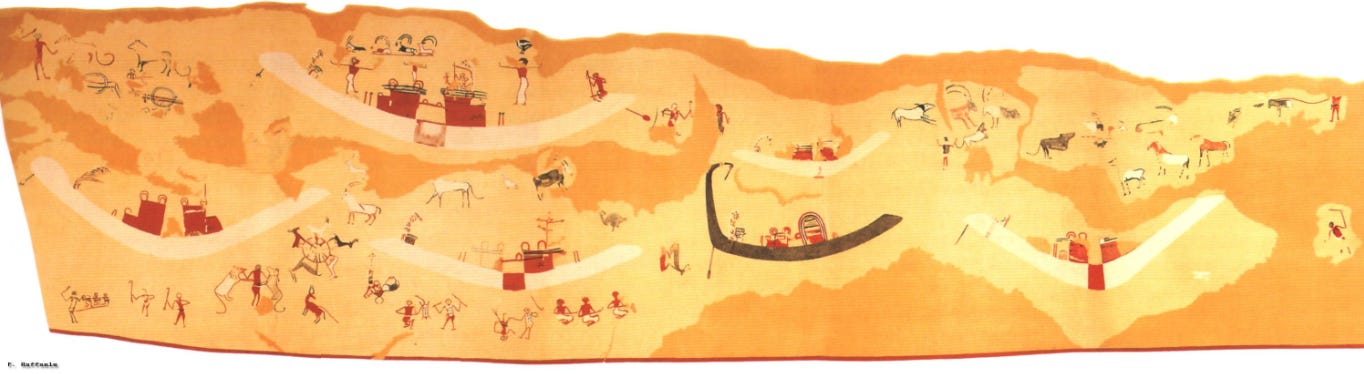
‘Painting in tomb T100, Hierakonpolis. Fragment in the Cairo Egyptian Museum, ca. 3500 BC.’ Wikimedia Commons. The illustration in the center of the image below is taken from the bottom left corner of the above painting.
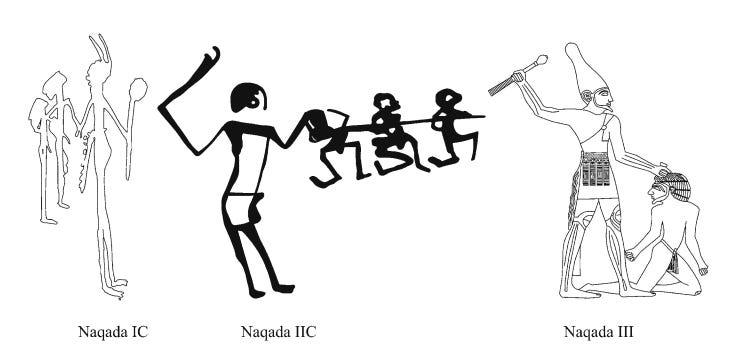
‘Continuing iconography of power: (left) motif of smiting the defeated and often tied enemies represented on a Naqada IC jar from Abydos grave U-239, (center) Naqada IIC wall painting from Tomb 100 at Hierakonpolis, and (right) late Naqada III Narmer Palette’ Image and Captions by Emily Teeter et al.
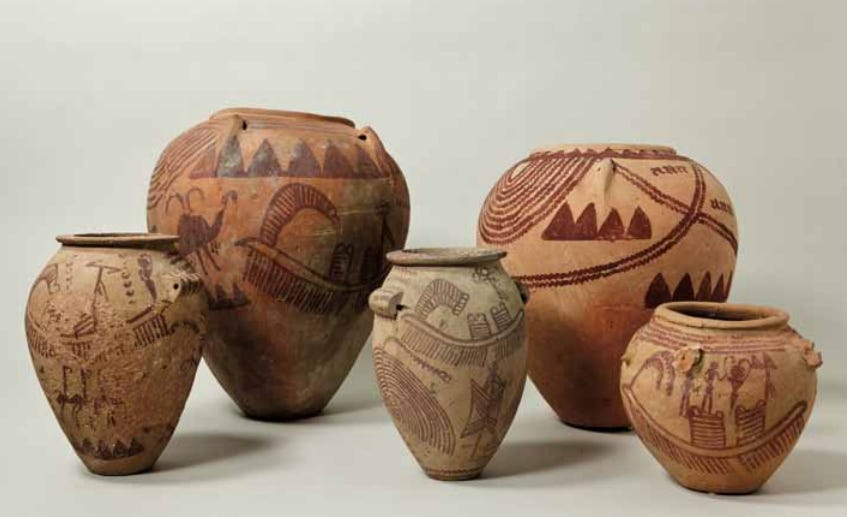
‘Group of Decorated vessels (D-ware). OIM E26240, E10782, E10762, E10759, E10581 (photo by Anna Ressman)’ Image by Emily Teeter et al.
The entire Nile Valley was covered by a string of villages, with three large centers at Naqada, the ‘gold town’; Hierakonpolis, and Abydos.
At Hierakonpolis, a large ceremonial centre excavated on the low desert and dating back to the early Naqada II period has been interpreted as a temple. At the end of Naqada II, a circular stone revetment and an adjoining paved area represent the earliest temple, where the Dynastic 0 kings (‘Scorpion’ and Narmer) dedicated votive palettes and maceheads to honour the local god, Horus of Nekhen.14
The earliest evidence for elite architecture comes from Hierakonpolis in the Naqada I period, represented by an earthen rectangular house with an oven, all partially enclosed by a wall, measuring 4.00 x 3.50 m. By the Naqada II period, similar structures appear at Naqada itself, represented by a rectangular mud-brick structure in the ‘south town’ measuring 50 x 30 m that’s possibly a temple or palace, south of which are several rectangular houses and an enclosure wall.15
In the Nile delta, the Maadian cultural complex near modern Cairo was contemporaneous with the Naqada I and II period. It is distinguished by the presence of six subterranean stone-built structures, with both curvilinear and rectilinear layouts, and the earliest evidence for mudbrick architecture which later spread to Upper Egypt.
Maadian pottery was decorated with impressions reminiscent of ‘Saharo-Sudanese’ pottery. Links with Upper Egypt include imported black-topped sherds, greywacke cosmetic palettes and combs. Links with Early Bronze Age Palestine account for the presence of distinctive footed ceramics. Maadian stone objects were soon replaced with copper, but graves remained relatively simple. In later phases, there is an increase in Naqada pottery styles, while Maadian pottery progressively disappears.16
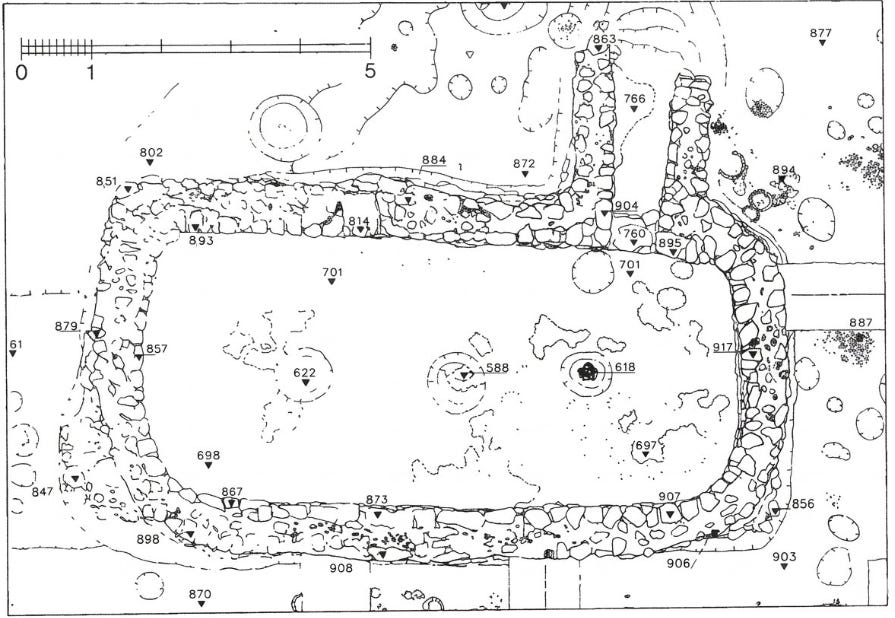
‘Stone built architecture at Maadi, N. Egypt’ Image by D. Wengrow.
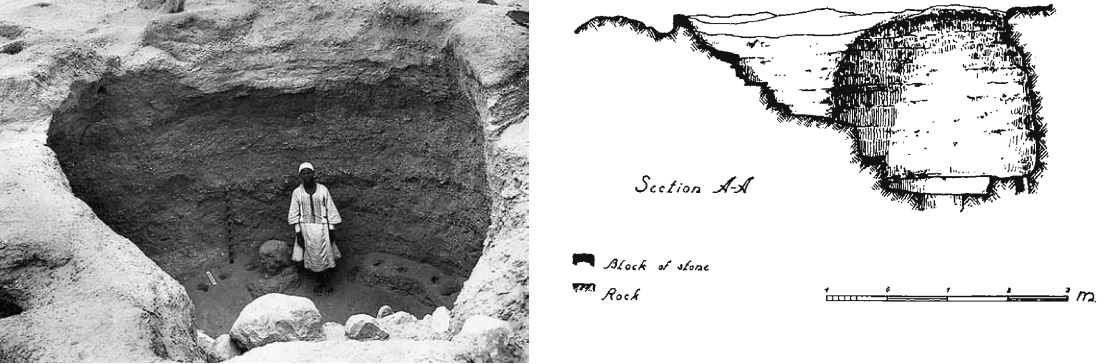
‘Subterranean dwelling, photograph and sketch.’ Image by Emily Teeter et al.
The A-Group Culture in Lower Nubia.
In Lower Nubia, the A-Group culture (3800-3100 BC) is contemporaneous with the Naqada I-III periods. Knowledge of prehistoric Nubia is comparatively well documented as a result of the rescue excavations carried out in the 1960s, before most of the area was flooded under Lake Nasser.
Climatic deterioration in the 5th millennium BC forced changes in settlement patterns of pastoral communities from the neighbouring desert, who moved to the Nile Valley.17
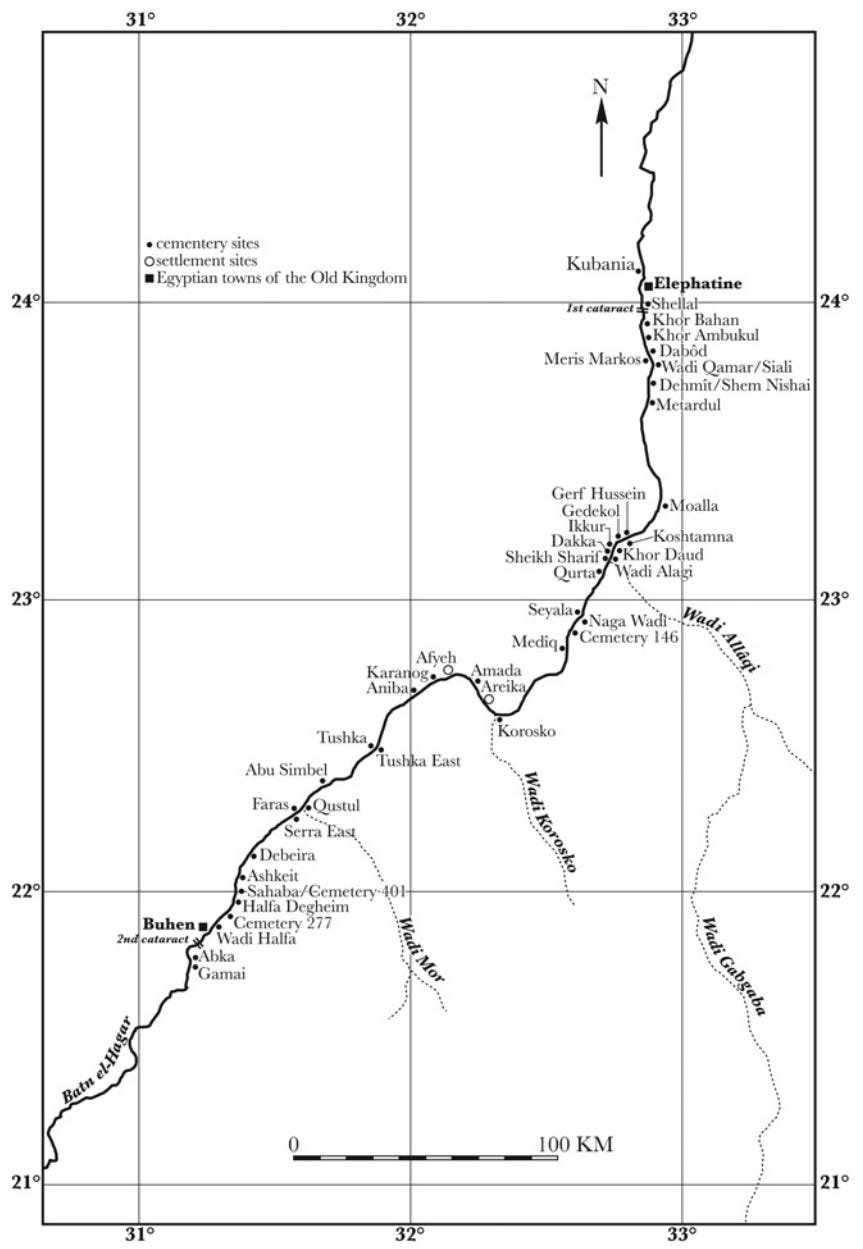
Map of Lower Nubian A-Group sites by Jane Roy
In Lower Nubia, a dense settlement system was in place by the 4th millennium BC, displaying hierarchical differentiation, whose architectural remains include stone hut foundations, alongside post-holes of wattle-and-daub structures.
At the A-group site of Afyeh near Dakka, the remains of several large stone houses (16,146 sq ft) were excavated, the largest of which had 8 rectangular rooms in a space of 200 sqm. The walls were built with sandstone slabs bound with Nile mortar, and floors were paved with pebbles.18
The material culture of the A-Group sites displays a degree of hybridization with the Naqada sites that decreases southward. There are thus no sharp boundaries between the two cultures, making it difficult to distinguish which settlement belonged to which tradition.
Sites like Nag el-Qarmila, north of Aswan, contained predominantly Naqadan ceramics and lithic traditions, as well as objects typical of the Nubian tradition, such as black-topped rippled wares and lunates made of quartz or agate, as well as graves with both human and cattle burials surmounted with stone slabs. At Elephantine, 20% of pottery was imported from A-group Nubia, and in less significant amounts at Hierakonpolis and several other sites.19
In the late A-group period, settlements became more clustered, leading to the rise of regional centers like Dakka and Afyeh, whose stone buildings are dated to this period. Material included lithic, bone, and copper tools, grinding equipment, ceramic containers, personal adornments such as beads and rings, spindle-whorls (for textile manufacturing), and stone vessels.20
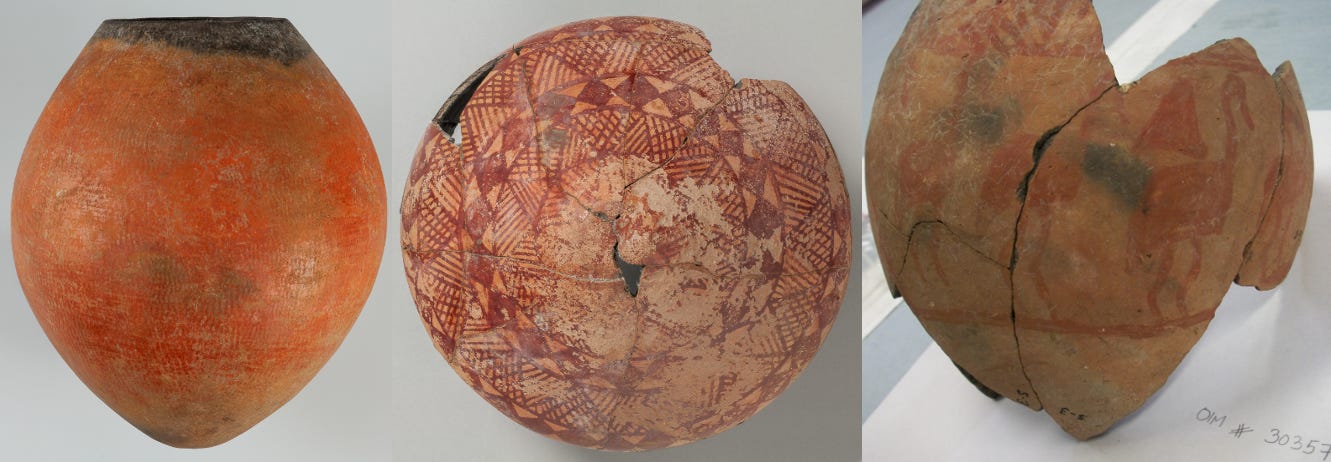
(left) Black-topped, ripple-burnished jar from Qustul. (center) Jar decorated with cross-hatched and diagonal-striped triangles between rows of diamonds in red, from Qustul. (right) Vessel painted with Bird and Triangle design, from Qustul. Oriental Institute of Chicago
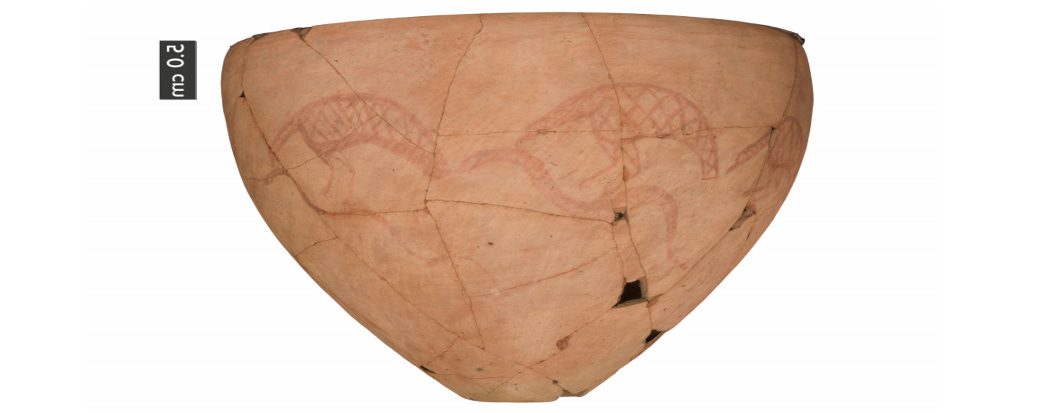
‘The monumental-sized bowl from Cemetery L, tomb 23, has unique painted decoration of a shrine with a man before it, a tree, with plover in the branches, antelope and crocodile below, and a row of vultures attacking serpents followed by another plover to the left. Height ca. 38 cm. OIM E24119’ Image by Emily Teeter et al.
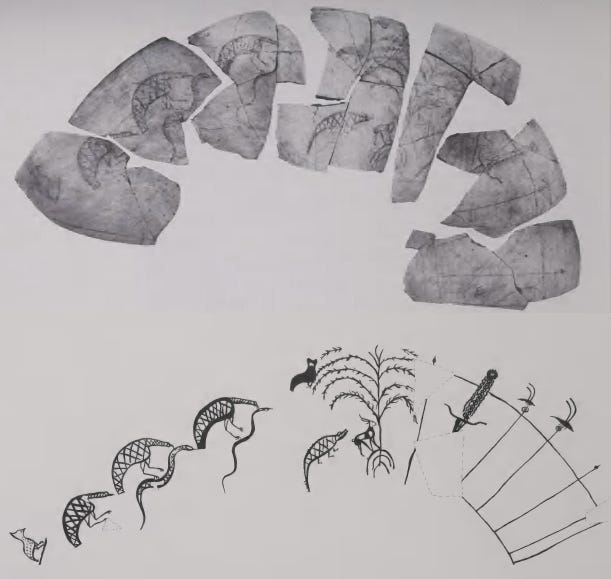
‘Painted Bowl L.23 from Group X.X. Scale 16.1’ Illustration by B. Williams (Plate 84-85)
At Qustul, cemetery L was a monumental grave complex, with large rectangular shafts and a lateral niche containing remains of funerary beds. The tombs are equivalent in size to the largest predynastic royal tombs of Upper Egypt such as Tomb U-j in Abydos. The graves had numerous pottery vessels, mostly of local production with a few imports from Egypt and Palestine. A unique form of painted pottery developed at Qustul was distributed across Lower Nubia.
Other items included lip plugs, clay tokens, sculptures, seals, stone vessels, and incense burners; the last of which had no counterpart in Egypt or Lower Nubia, except in the pre-Kerma culture of Upper Nubia. Upto 4,700 items of personal adornment were found in one burial, including armlets and beads, some made with gold. At the A-Group site of Sayala, a cache of copper objects was found, along with sheet-gold casings of two mace-handles decorated with an embossed animal frieze.21
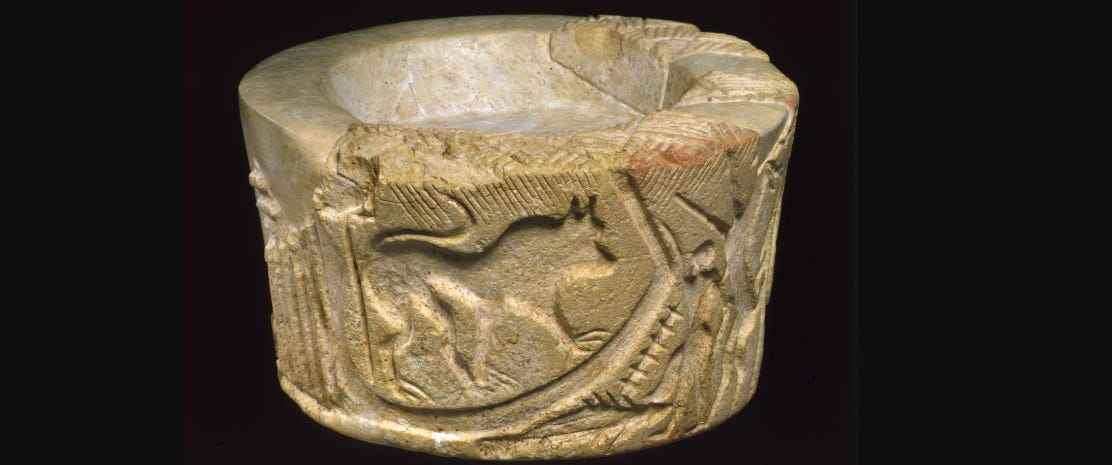
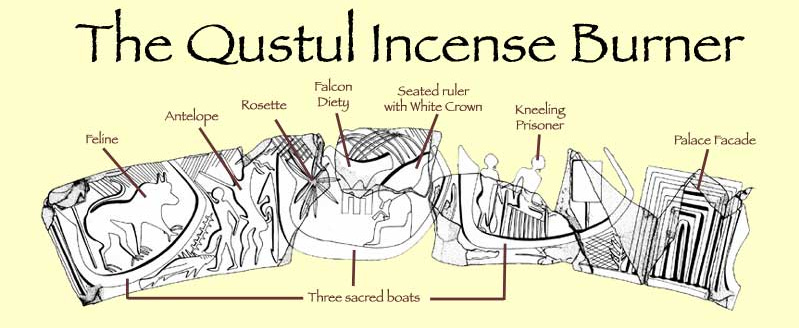
Qustul incense burner. c. 3200 BC. Oriental Institute of Chicago
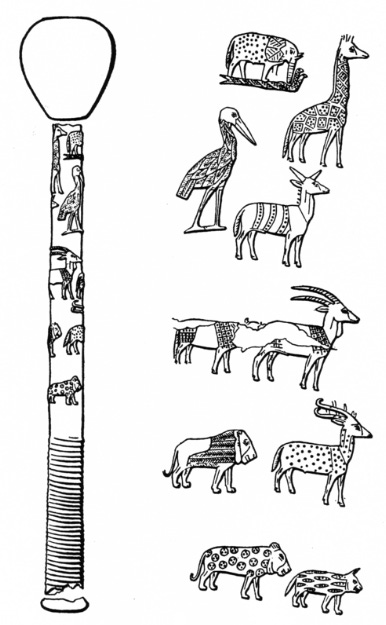
‘Gold casing of mace-handle with embossed ornament, Sayala, Lower Nubia, Middle-Late A-Group’. Caption by D. Wengrow.
Incense burners were objects of high symbolic value in the new Nubian political narrative as attested by the unique scenes engraved on two of them found in Qustul.
These depict iconographic elements associated with the Naqada sites, such as the serekh (palace facade) and falcon, with Nubian symbols such as the burner itself and the line of burners with pointed flames, as well as the bows and the bovine figure. The burner also displays one of the two earliest depictions of the “white crown”, the other being an ivory handle of a flint knife from Upper Egypt.22
This points to the presence of “shared traditions and cultural practises, denoting power” between the A-group and Naqadan societies. Such shared traditions are also attested in the presence of potmarks on Lower Nubian pottery that may have constituted a form of proto-writing, as in the predynastic tomb U-j in Egypt.
One depicts a falcon perched on a rectangle, below which is kɜ sign. The mark resembles potmarks of tomb U-J at Abydos (discussed in the section below), which show a falcon perched on an r sign and read as Iry-Hor. The latter is a predynastic ruler who is sometimes cited as the earliest-living historical person known by name. The sign from Qustul has been read as the royal name of a Lower Nubian king, Pe-Hor, who was contemporaneous with King Iry-Hor.23
This suggests the presence of two kingdoms at Abydos (Egypt) and Qustul (Nubia) that were in contact by c. 3200 BC, exercising power in different regions and perhaps in competition with one another
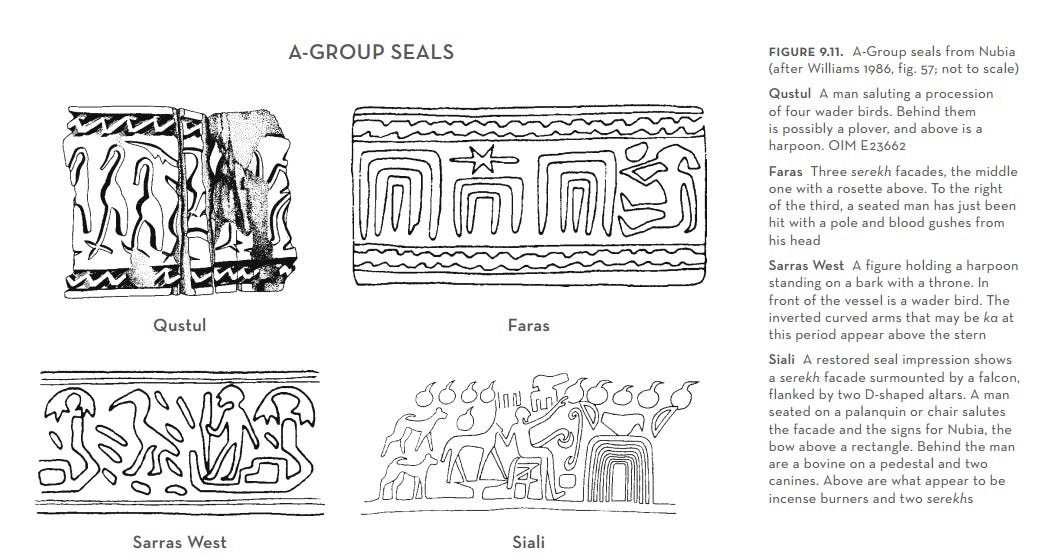

(top) A-Group seals in lower Nubia (bottom) Archaic Horus Incense Burner incised with two river processions that end in serekh facades. Qustul, Cemetery L, tomb 11. Images by Emily Teeter et al.
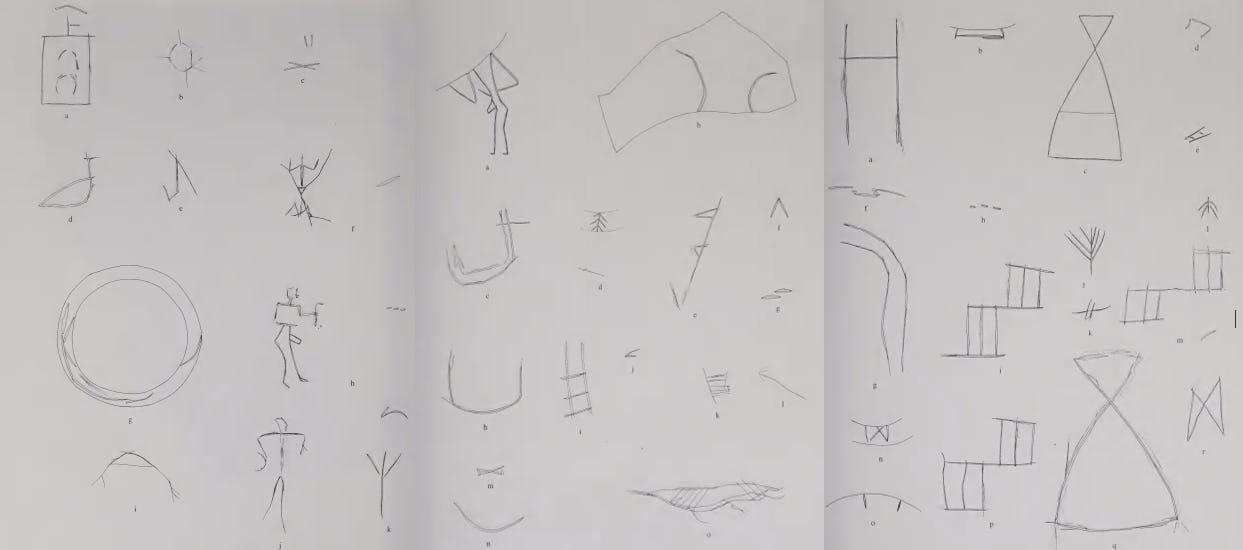
Potmarks on A-group pottery. Images by Bruce B. Williams. (Plate 78, 79, 81)
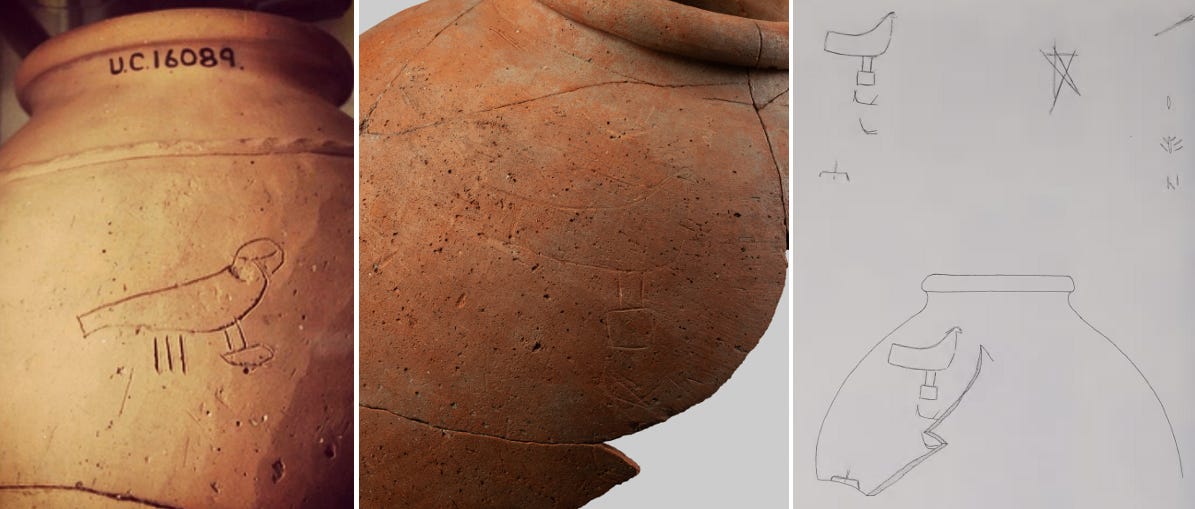
(left) Serekh of Iry-Hor on clay jar. Petrie Museum. (centre) Vessel from Qustul with the name of Pe-Hor. Oriental Institute of Chicago. (right) ‘Pe-Hor, incised mark on L 2, Form Group X, J’. Illustration by B. Williams (Plate 76)
The archaeology of Upper Nubia is beyond the scope of this essay, but a relevant summary of its comparative development shows increasing complexification during the 4th millennium BC with the rise of the pre-Kerma culture (3500–2500 BC) which preceded the Kerma civilization (2500–1480 BC).
Pre-Kerma sites extend from the 4th to the 2nd cataract region, with material found as far north as Elephantine. Pottery, of which no imports are found in the south, consisted of black-topped red wares, some with rippled decoration; graves contained an ivory incense burner, quartz palettes, and a copper alloy awl. It had been suggested that A-Group and pre-Kerma formed a single cultural entity.
By 3,000 BC, a large proto-urban agglomeration was founded near the eastern cemetery of Kerma that displays increasing hierarchization, with numerous oval houses as well as two rectangular buildings, one with large uprights and an apse that resembles Kerma-era temples. North of this site was a massive rectangular fortress belonging to the pre-Kerma period that was constructed centuries later (2500-2400 BC). Both the elite temple structure and the fortress directly antecede the religious and defensive architecture of the later city of Kerma.24
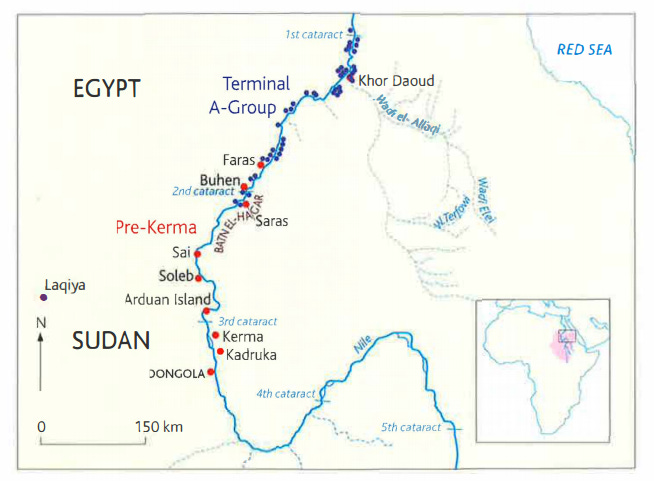
Map showing the pre-Kerma sites in Upper Nubia.
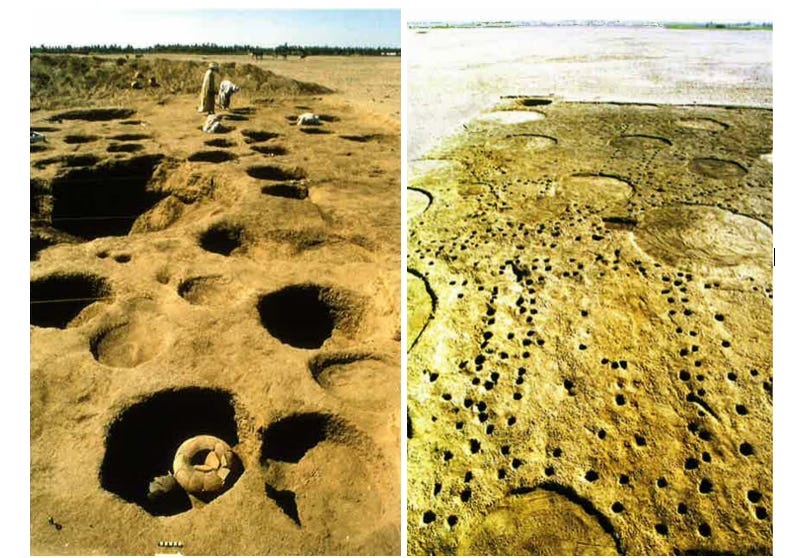
Pre-Kerma settlement remains: “(Right) Storage pits during the course of excavation. In the foreground are two jars in a pit. (left) Reclangular building rebuilt three times. ln the background are three palisades. The round structures correspond to the Kerma period tombs” Images by Honegger Matthieu25
Naqada III and the rise of Ancient Egypt.
The Naqada III phase, 3200-3000 BC, is the last phase of the Pre-dynastic Period, and the emergence of the kingdom of ancient Egypt in what is called the Early Dynastic state.
In the predynastic cemetery at Abydos, graves evolved from undifferentiated burials in the Naqada I period, to an elite cemetery in late Naqada II, to the royal burial place of Dynasties 0 and 1. Tomb U-j, dating to 3150 BC, consisted of twelve rooms covering an overall area of 66.4 sq m. It contained many artefacts, including 150 small labels inscribed with the earliest known hieroglyphs, and an ivory sceptre. At the site of Naqada, the impoverishment of later graves suggests that the site had been eclipsed by its southern peers at Abydos and Hierakonpolis.26
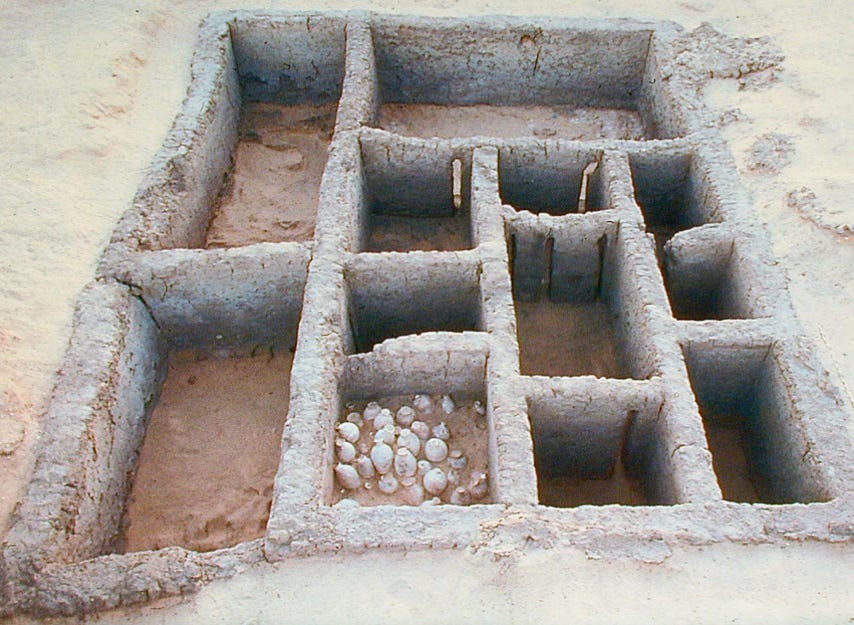
Tomb U-j at Abydos, showing one of the chambers filled with wine jars before excavation.
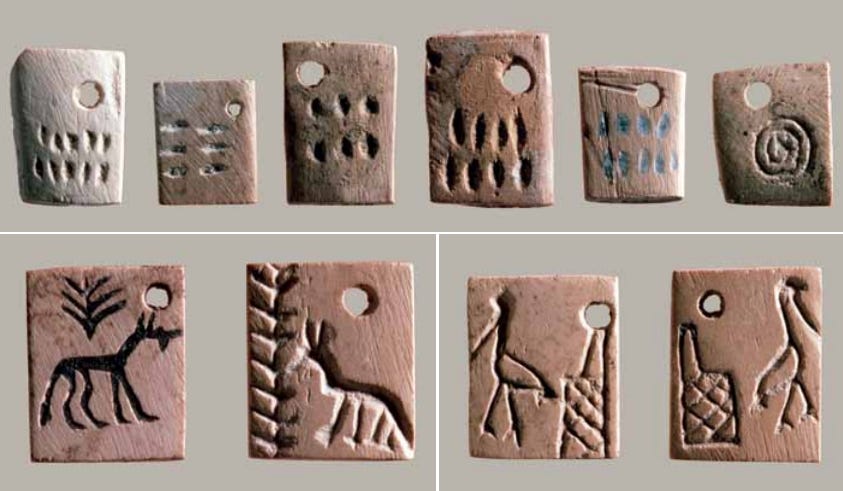
(Top) Tags with numbers from Tomb U-j (bottom left) Tags with notations indicating origin from an agricultural estate (bottom right) Tags with notations indicating they originated in Bast (Bubastis). Image and Captions by Emily Teeter et al: “Tags were found mainly in the southwest chamber (11) of the tomb. They always have a small drill hole indicating that they were attached to containers or individual objects as labels. A great number of them have only numbers that probably indicate the sizes of fabrics and quantities of grain”27
At the elite cemetery HK6 in Hierakonpolis, ongoing excavations have uncovered very large tombs delimited and large, pillared buildings dated to the early Naqada II period, c.3700 BC. They also contain secondary cattle burials similar to those found at Qustul in Lower Nubia and other southern sites.
By the early Naqada III period, the dominant position of Hierakonpolis had disappeared, and Abydos had taken over. This change is thought to represent a shift in the political capital of the Early Dynastic state, since Hierakonpolis remained a major religious center.28
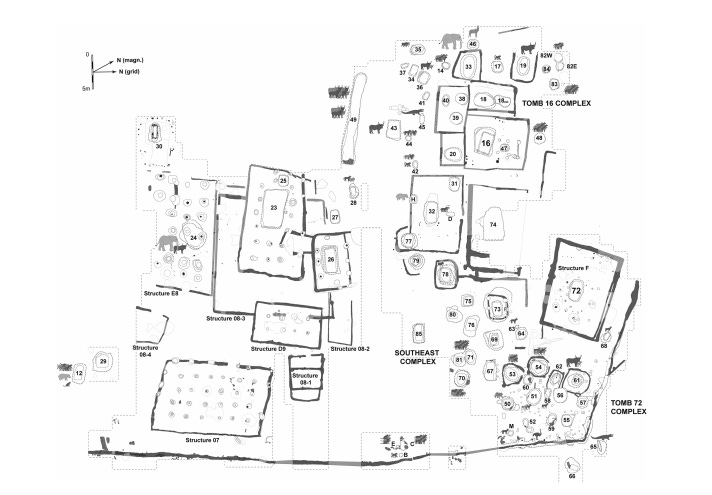
Hierakonpolis, elite cemetery HK6, map after the 2019 excavations. Courtesy of the Hierakonpolis Expedition, cartography by X. Droux.
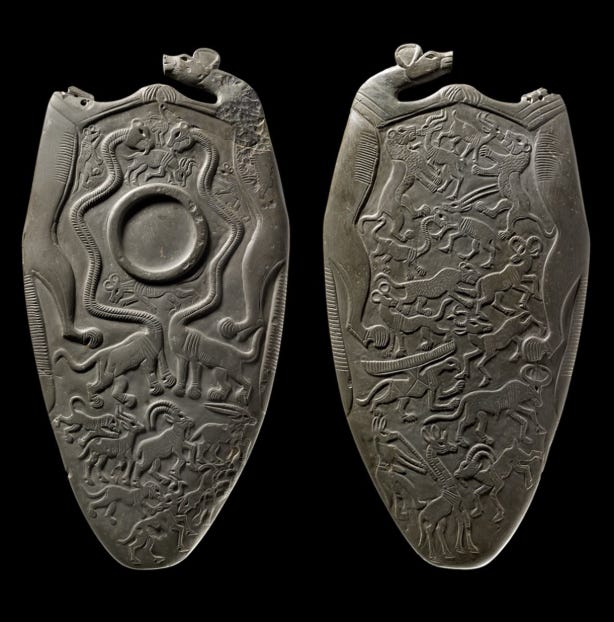
‘The Two Dog Palette (left: grinding side, right: non-grinding side), from the Main Deposit, Hierakonpolis, Naqada III.’ Ashmolean Museum. The significance of this and similar objects is discussed by D. Wengrow.29
In the early Naqada III period, the local material culture of Lower Egypt had been replaced by material culture from the Naqada culture of Upper Egypt. This archaeological evidence has sometimes been interpreted as an indication of the political unification of Egypt by this time, but the material evidence does not necessarily imply (unified) political organization, and a number of alternative socio-economic factors might be proposed to explain this change.30
The use of mud-brick in constructing subterranean chambers, first practised at a handful of sites in the Naqada II era, was adopted for most elite burials by Naqada III. By the 1st Dynasty, brick-built tombs are documented at numerous cemeteries from Minshat Abu Omar in the north to Hierakonpolis in the south.31 At Tell el-Farkha in the eastern Delta, a massive tomb dated to Dynasty 0 is the oldest known Egyptian mastaba, a type of funerary architecture that eventually birthed the monumental pyramids.32
The final unification of Upper and Lower Egypt may have been achieved through military conquest, although evidence for this is limited to depictions of battle scenes on ceremonial palettes and maceheads belonging to King Scorpion and Narmer. The scenes depict vanquished captives, suggesting that warfare played a role at some point in the forging of the early state in Egypt. However, literal interpretations of the scenes as representing historical events are now generally regarded as old-fashioned.33
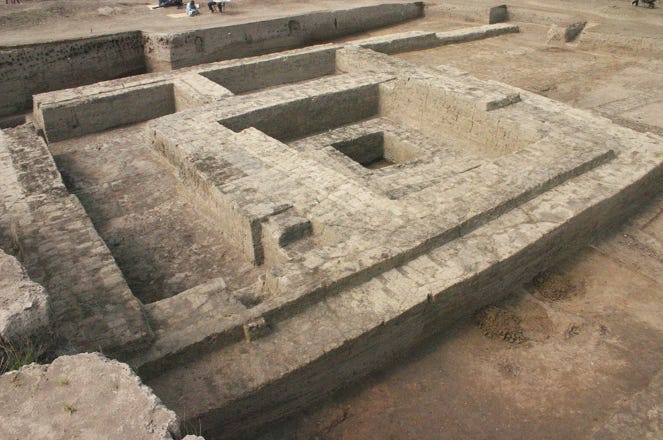
‘The oldest Egyptian mastaba (fot. R. Słaboński)’ Image by Polish Centre of Mediterranean Archaeology, University of Warsaw
By 3100 BC, the Early Dynastic state had emerged in Egypt, controlling a territory of 1,000 km along the Nile Valley from the Delta to the first cataract at Aswan. With the 1st Dynasty, the center of the kingdom shifted to the north at Memphis.
The power of the elites was expressed through their ability to control scarce resources and Long-distance trade in high-status goods. However, it should be emphasized that a ‘multiplicity of causes’ explain the emergence of the early state in Egypt, of which trade was only one among several factors34
As demand for imports grew, so did the intensity of foreign trade through middlemen such as the inhabitants of Minshat Abu Omar in the north, where pottery from Palestine was found in pre-dynastic contexts. The presence of the predynastic Egyptians in southern Palestine was limited to trading settlements. Imported wares from Palestine were concentrated at the emerging political capitals of Abydos in Egypt and Qustul in Lower Nubia, the latter of whose rulers derived their wealth from supplying African goods such as ebony, ivory, and other exotica in exchange.35
In Lower Nubia, the source of A-Group wealth was the trade in exotic goods coming from southern regions through Upper Nubia. With the unification of predynastic Egypt into a large territorial state, the rulers most likely wanted to control this trade more directly, which resulted in military incursions into Lower Nubia.
At least two predynastic rock engravings from the 2nd cataract region indicate a military campaign by the 1st Dynasty kings into Lower Nubia. A fortress was built at Buhen in the 2nd cataract region by the late 1st Dynasty or early 2nd Dynasty, possibly to mark the frontier with the emerging states in Upper Nubia.36
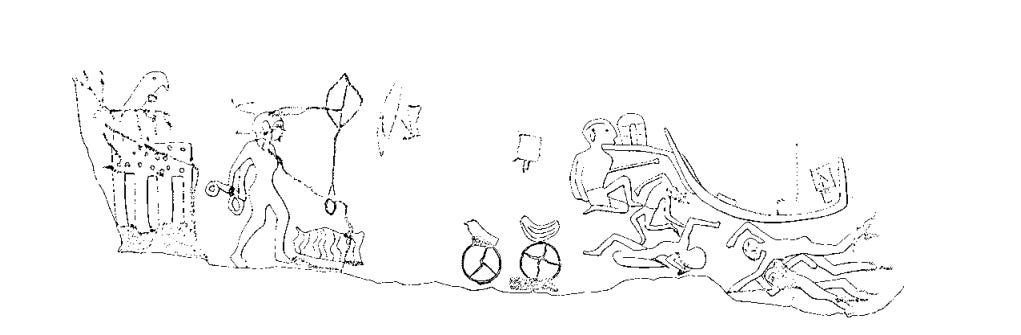
Rock inscription at Gebel Sheikh Suleiman, 2nd cataract region. Illustration by B. Williams.
The end of the A-Group polity forced changes in settlement patterns and political organisation of Lower Nubia.
The elites appear to have moved north to Upper Egypt, where A-group-type cemeteries were found at Armant near Luxor, and at Wadi Kashab and El-Arib in the Eastern Desert, containing pottery of Lower Nubian and pre-Kerma style, as well as graves surmounted with stone stelae with human and cattle burials. In Lower Nubia itself, temporary sites in the 3rd millennium BC suggest that populations became more mobile, and sections of Lower Nubia became part of the pre-Kerma culture.37
The early rulers of this period also extended their political influence into southern Palestine, during the Naqada II-III period, as indicated by the imported wine vessels at tomb U-j at Abydos of Dynasties 0 and 1, and the presence of Upper Egyptian material culture and possibly colonies in the southern Levant. The 1st (and 2nd) Dynasty kings also carried out campaigns in West Asia, although Egyptian presence diminished thereafter, with trade concentrated at the city of Byblos.38
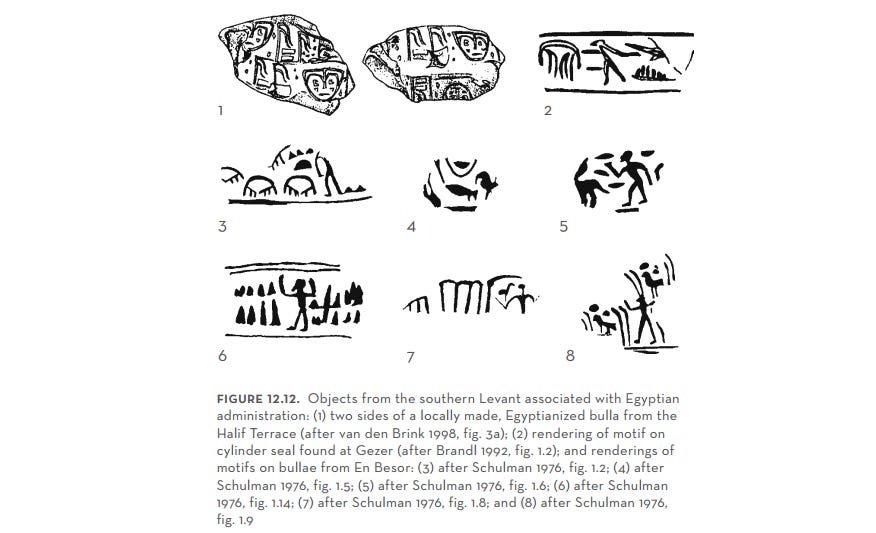
‘Objects from the southern Levant associated with Egyptian administration’ Image by Emily Teeter et al.
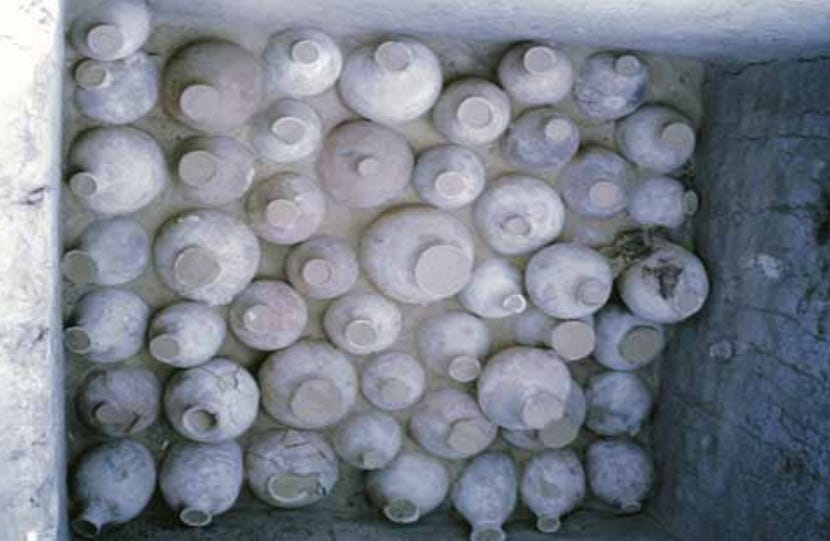
‘Imported wine jars in situ. Tomb U-j, chamber 10’ Approximately 173 Canaanite import vessels with wine stacked in four layers. Image by Emily Teeter et al.
Direct evidence for external contacts of the Predynastic polity is thus restricted to Lower Nubia and Palestine. Earlier theories positing a Mesopotamian origin of the pre-dynastic rulers of Egypt have been discredited by most archaeologists, “not least because not a single Mesopotamian sherd has yet been found at any Predynastic site.”39
As the Egyptologist Toby Wilkinson explains:
“The recognition of the indigenous roots of classic Egyptian civilisation emphasised the continuities between Predynastic and Early Dynastic culture. The achievements of the First Dynasty, it was realised, were the result of a long period of cultural and political development, rather than a radically new order imposed from outside. This change of perception undoubtedly influenced the course of Early Dynastic scholarship, and has now totally replaced the discredited ‘dynastic race’ theory.”40
Statecraft in Egypt before the Old Kingdom.
The process of state formation in Egypt was by no means monolithic, but very complex. Given that most of the archaeological evidence for the 1st Dynasty is mortuary, inferences about socio-political and economic organization are mostly drawn from these data.
Royal funerary complexes symbolised both political power and communal leadership; they ‘advertised and embodied the objectives of the…state’. The funerary enclosures at Abydos and Hierakonpolis were impressive constructions that consciously resembled the royal palace and court.41
After centuries of increasing social complexification, Hierakonpolis and Abydos became dominant centers of an early state in the second half of the 4th millennium BC. The kingdom that emerged at Abydos by the late 4th millennium BC would eventually become the nucleus of the unified Egyptian polity; that is arguably the first territorial state in World History.42
What is clearly evident in the Abydos royal cemetery is the ideology of kingship, as symbolized in the mortuary cult. The development of monumental architecture symbolized a political order on a new scale, with a state religion headed by a god-king to legitimize the new political order.
In the area to the north-east of the royal cemetery, called Cemetery B, are tombs of the last three kings of Dynasty 0: Iri-Hor, Ka, and Narmer, as well as the tomb complex of the first king of Dynasty 1; Aha. Also at Abydos were seven tomb complexes of the 1st Dynasty kings: Djer, Djet, Den, Anedjib, Semerkhet, and Qa’a, as well as Queen Merneith.
They also contained subsidiary burials of other persons, who are thought to have been the king’s retainers who were sacrificed to serve their king in the afterlife. The practice was discontinued after the 1st Dynasty, to be replaced by small servant statues and shabtis (funerary figurines).43
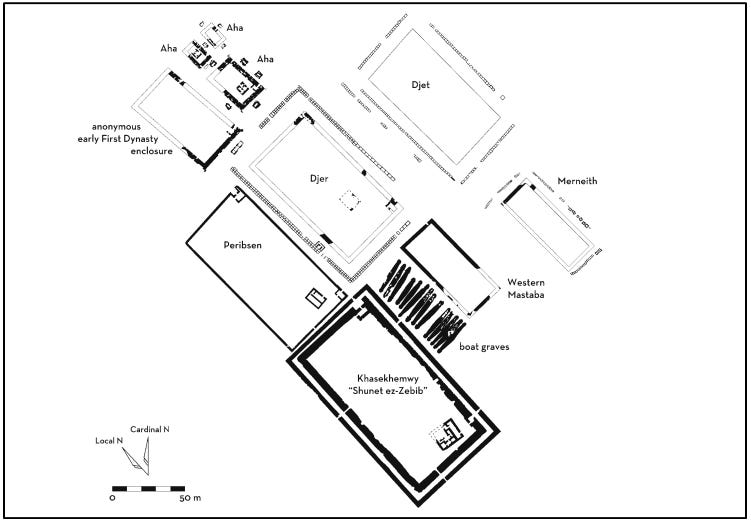
‘Plan of the Abydos North Cemetery showing all known funerary enclosures.’ Image by Emily Teeter et al.
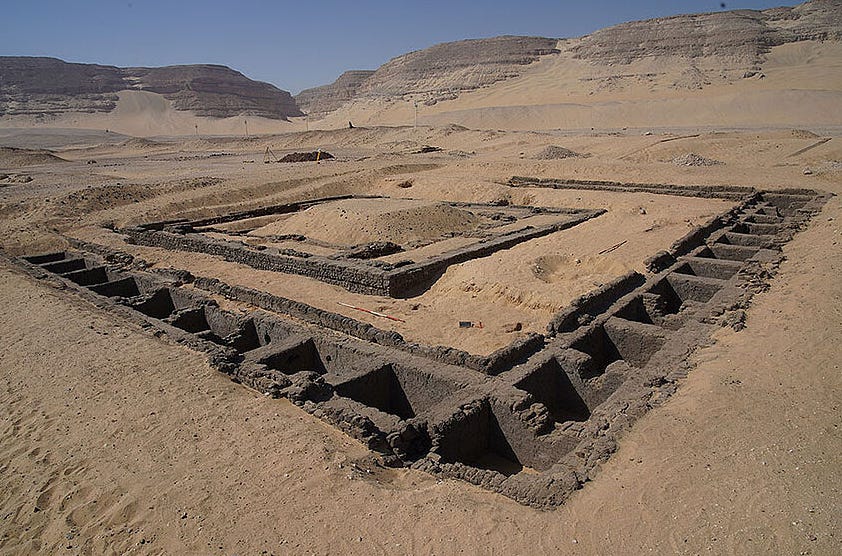
‘Meret-Neiths tomb, looking from the north-eastern corner (Photo: E.C. Köhler)’
The earliest codification of written signs occurred in Naqada III/ Dynasty 0 period.
The discovery of early writing in tomb U-j at Abydos stimulated the study of evidence for early writing in Egypt. Like Egyptian writing in the Dynastic Period, these early hieroglyphs consist of elements of ideographic and phonetic signs. It’s suggested that these symbols were executed by those who participated in the funerary rite, as a way to represent group identity.44
By Dynasty 1 (ca. 3100–2800 BC), writing was being used for economic and administrative purposes and in royal art. Hieroglyphs appear on royal seal impressions, labels, and potmarks, as well as on seals of officials of the state, and on royal serekhs, which contain the king’s name in hieroglyphs. Later, a more complex message of identification developed that may represent a system for recording regnal years.45
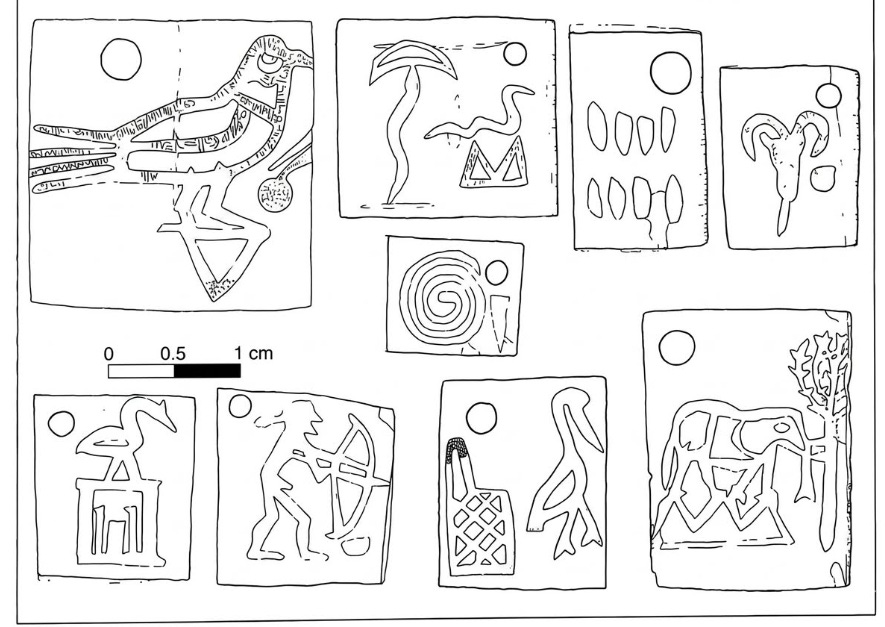
‘Inscribed tags from tomb U-j, Abydos, c.3300 BC.’ Image by D. Wengrow.
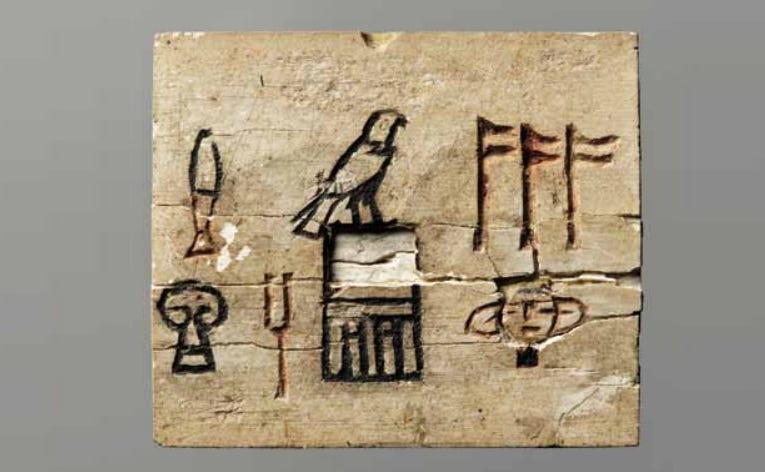
‘Ivory, pigment. Dynasty 1, reign of Djet, ca. 2950 bc Abydos, Umm el-Qaab, tomb of Djet. ’ Image by Emily Teeter et al.
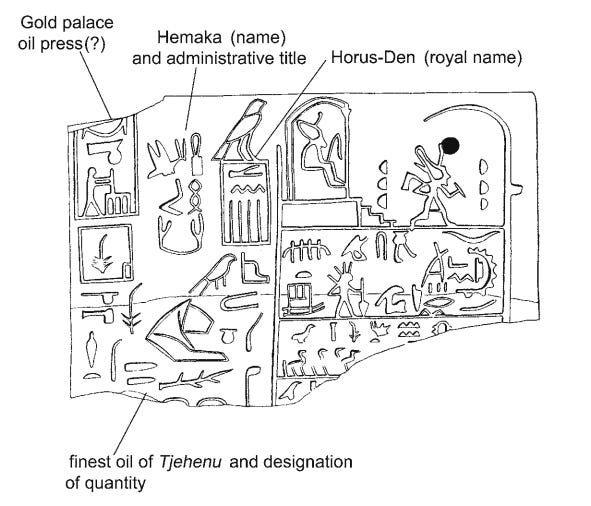
‘Wooden label from Abydos with the serekh of King Den.’ Image by Emily Teeter et al.
There’s evidence for the existence of administrative offices with titled figures, e.g., the ‘vizier,’ the ‘mayor’ of Upper Egypt, and the ‘desert administrator,’ among numerous other titles. Besides these, lower officials include the 1st dynasty official Meriiti, whose burial is among the over 10,000 graves at Helwan. Another early official is the scribe named Wus, whose funerary stele at Abydos described him as ‘sealer of the bjtj-king, friend and scribe.’
Associated with this bureaucracy was the division of the territory into administrative units (nomes), the establishment of Royal estates and foundations associated with the court; and the centralisation of taxation and craft manufacturing. An Egyptian pantheon was gradually developed, including deities such as Ptah, Anubis, Bastet, Hathor, Seth, and Horus, the last of whom was especially associated with kingship and the site of Hierakonpolis.46
The iconography of power is clearly seen within the context of such royal art and includes the use of several important conventions, including ‘attributes of otherness.’ A hierarchy of social classes is also evident, from the large-sized king and his officials, who are shown in the special dress of their offices, who is followed by his smaller sandal-bearer, to his even smaller officials, to the smallest figures of conquered enemies, farmers, and servants.47
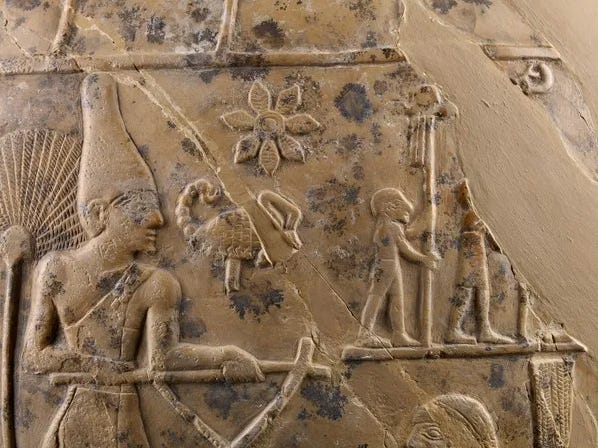
The Scorpion Mace-head, from Hierakonpolis. Ashmolean Museum, Oxford.
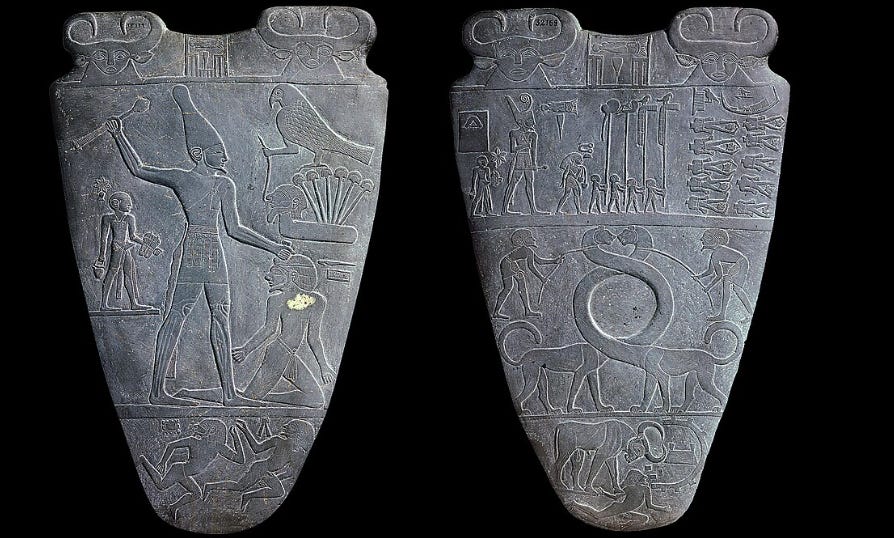
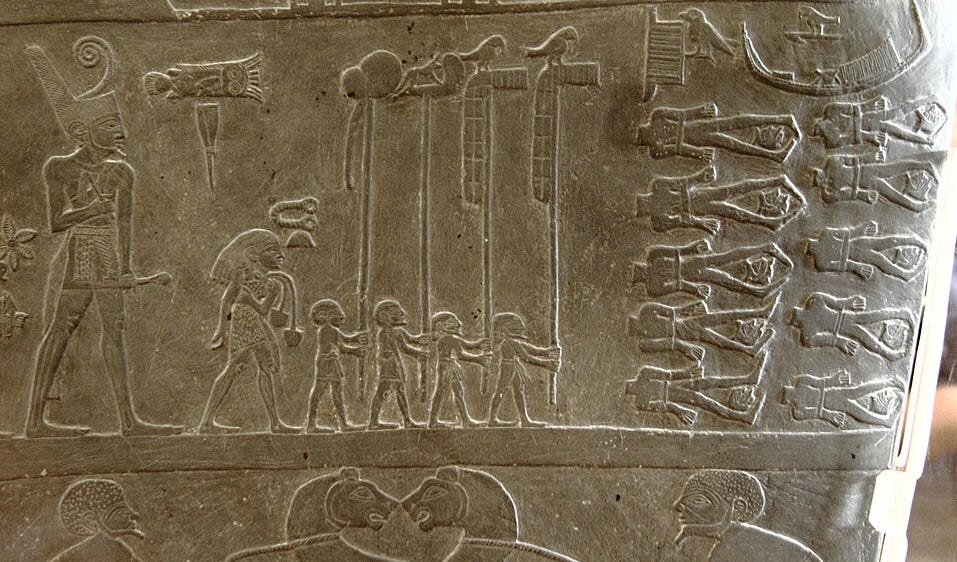
Palette of Narmer, ca. 31-30th century BC. Egyptian Museum, Cairo.48
The Palermo Stone (c. 2450 BC), which includes the Early Dynastic kings alongside the rulers of the Old Kingdom (dynasty 3-5), shows a line of kings wearing the “double crown” that combines the “red crown” from Naqada with the white crown from Hierakonpolis. This, along with the adoption of the god Horus of Nekhen (ie; Hierakonpolis), has been interpreted to represent the political unification of Upper Egypt that preceded the unification with Lower Egypt by the rulers based at Abydos.49
Excavations on Elephantine Island revealed the remains of a shrine dating to the Early Dynastic period, a fortress built during the 1st Dynasty. The early shrine is a relatively simple mud-brick structure less than 8 m wide, nestled into natural granite boulders. Hundreds of small votive artefacts, mostly from the Old Kingdom but with some from the Early Dynastic period, suggest a craft workshop associated with this temple where worshippers and/or petitioners could obtain such artefacts to leave during their visits.50
Excavations at multiple sites that were major religious centers during the Old Kingdom uncovered evidence, albeit fragmentary, for pre-dynastic and Early Dynastic shrines and temples, eg at Gebelein, Armant, Coptos, Badari, Heliopolis, Buto, and Abydos.
Early Urban settlements were identified at Elephantine, which contained a Dynasty 0 mudbrick structure, a 1st Dynasty fort and a 2nd Dynasty city wall; at Hierakonpolis, which contained a walled settlement with a large palace and monumental gateway, and Buto, which contains a 1st Dynasty mudbrick structure. Other early towns include Abydos, Elkab, Naqada, and Memphis, most of which contain settlement debris and the remains of both round and rectilinear structures as well as town walls.51
Historical data for the kings of the 2nd Dynasty (c.2890–2686 BC) is less abundant than for their predecessors.
Hotepsekhemwy, the first king of the 2nd Dynasty, opened the royal cemetery at Saqqara, to the south of the 3rd Dynasty King Djoser’s Step Pyramid near Memphis, where some elite tombs (Tomb 3357 and 3038) had been built during the 1st Dynasty. This royal cemetery was likely continued by his successors, some of whose tombs have not been identified and may have only ruled over Lower Egypt, ie; Nebra, Ninetjer, Sened, and Nubnefer.52
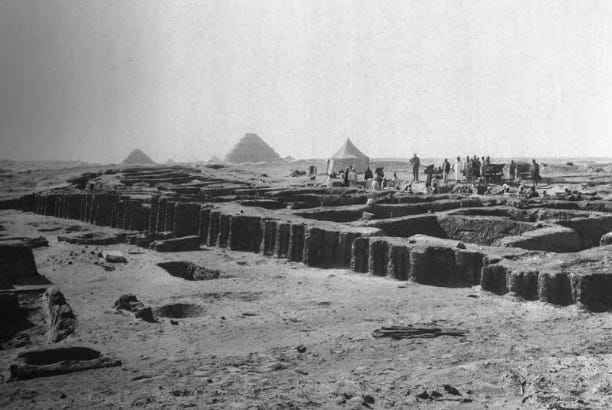
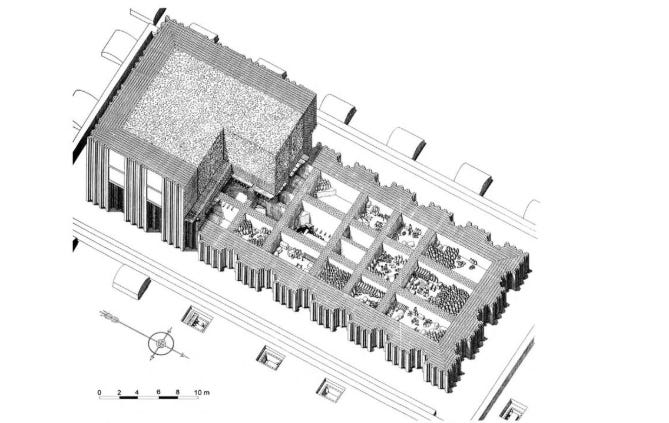
‘East facade of tomb 3357 at Saqqara with Step Pyramid of Djoser in background; idealised reconstruction of a First Dynasty mastaba tomb.’ Image by D. Wengrow
High officials of the state were also buried at North Saqqara in the 2nd Dynasty. Near the pyramid of the 5th Dynasty ruler Unas, excavations uncovered five large subterranean gallery tombs carved into the limestone bedrock, which are thought to represent houses for the afterlife. The largest of the five, Tomb 2302, consisted of twenty-seven rooms beneath a mud-brick superstructure, covering an area of 58.0 x 32.6 m.53
A late 2nd dynasty king named Peribsen shifted the royal burial ground back to Abydos, even though his mortuary cult was attested at Saqqara. He also chose to replace the Horus-falcon surmounting the serekh with the Seth-animal. His successor, Khasekhemwy, retained Abydos as the royal burial but placed both the Horus-falcon and the Seth-animal atop his serekh.54
Peribsen ‘s tomb is fairly small, measuring 16.1 x 12.8 m, while Khasekhemwy's tomb is much larger, comprising one long gallery, 68 m long and 39.4 m, divided into fifty-eight rooms with a central burial chamber made of quarried limestone. The constructed burial chamber, measuring about 8.6 x 3 m. and preserved to a height of 1.8 m, is the earliest known large-scale construction in stone.55
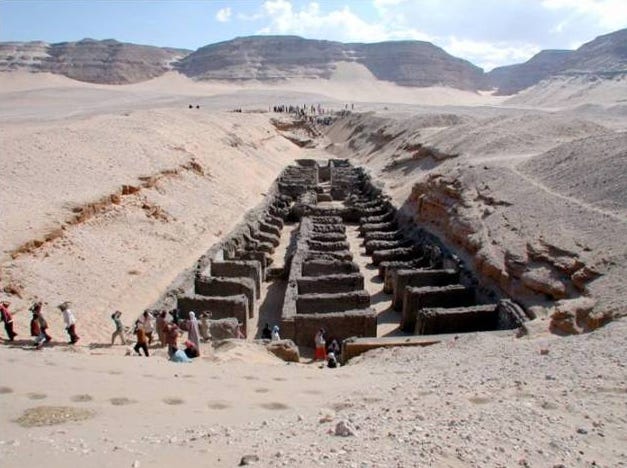
Khasekhemwy’s tomb
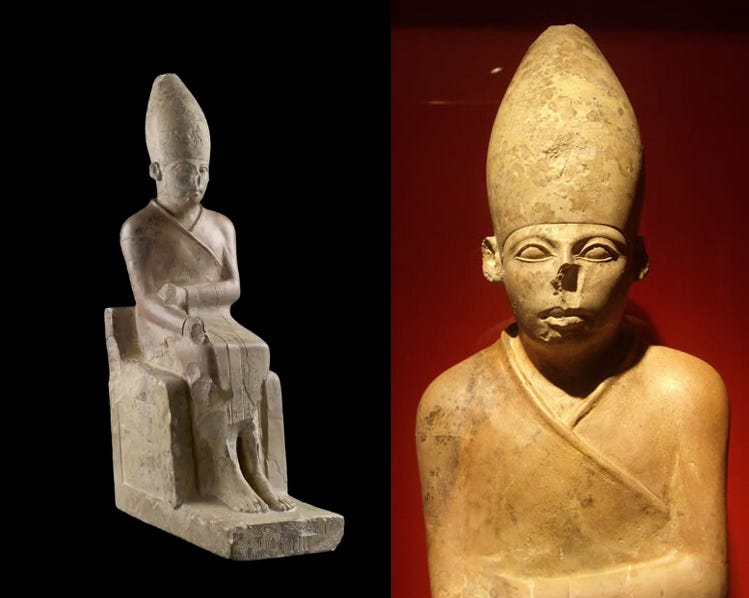
Seated statue of King Khasekhemwy. Ashmolean Museum
Fragmentary sources point to conflicts and competing claims of power during Dynasty 2 that may explain the shift in royal burial grounds.
An inscription on the statue of Khasekhemwy refers to the subduing of ‘47,209 papyrus-people’, which, combined with inscriptions referring to the ‘year of fighting the northern enemy ’, suggests a new unification of the kingdom after what may have been a north–south divide under Peribsen. He also undertook significant temple-building activity at Gebelein, Elkab and Hierakonpolis.
Some monuments of Khasekhemwy appear to refer to wars against Lower Nubia and ‘Asia’. In addition to the creation of the title ‘overseer of foreign lands’ associated with the north-eastern borderlands during his reign, evokes the idea of active foreign politics. After his reign, the kings of the 3rd Dynasty shifted the royal burial back to Saqqara, where the famous pyramids would be built, beginning with King Djoser’s Step Pyramid that was constructed by his vizier, Imhotep.56
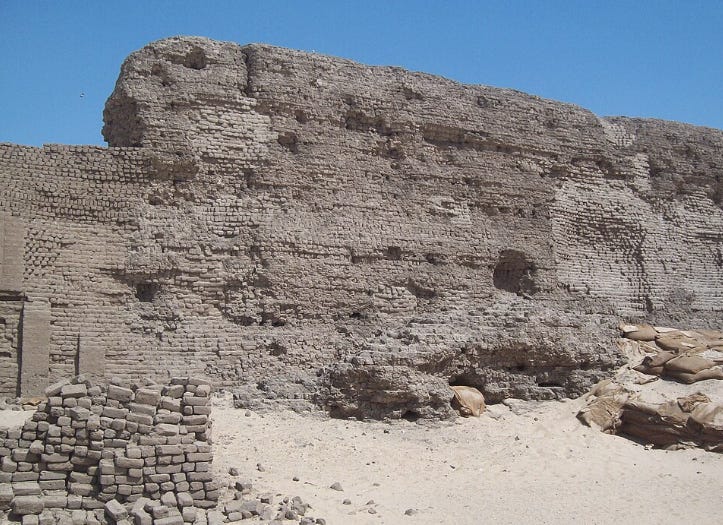
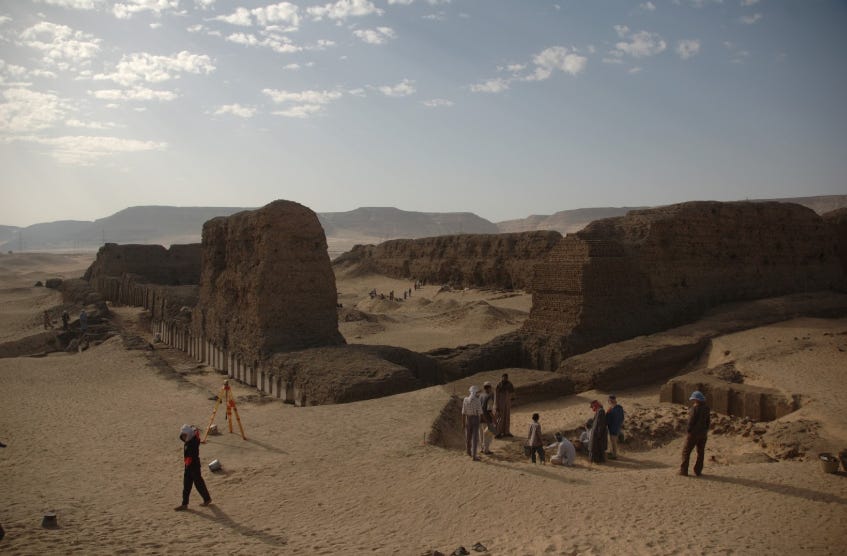
Shunet el-Zebib, the “Fort” at Hierakonpolis, built by King Khasekhemwy, 2nd Dynasty. Considered the oldest freestanding mudbrick structure in the world.
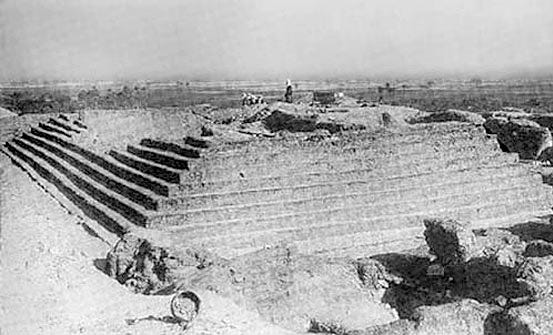
Saqqara Mastaba, Tomb 3038, 1st Dynasty. Image by Walter Bryan Emery, 1949.57
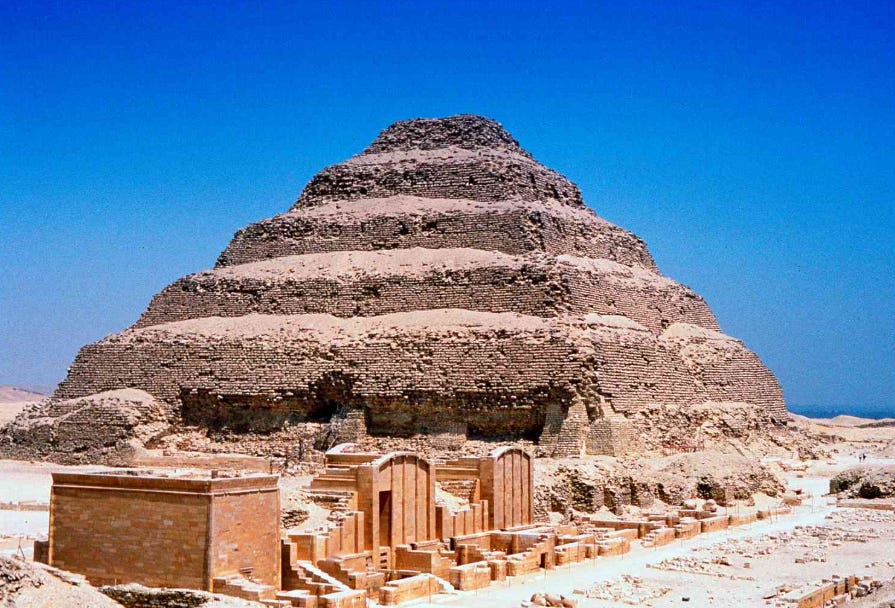
Step Pyramid of Djoser, 3rd Dynasty.
Epilogue.
The reign of Khasekhemwy marks a turning point in ancient Egyptian history, linking the early development of the Early Dynastic state with the start of the ‘Old Kingdom’ which begins with the 3rd Dynasty. His mortuary constructions foreshadow the pyramid age, and his political achievements re-established the internal stability and prosperity needed for the great cultural achievements of his successors.
Given what is known about the early Old Kingdom in the 3rd Dynasty, the 2nd Dynasty must have been a time when the economic and political foundations were put in place for the strongly centralized state, which developed with truly vast resources.
The flowering of early civilization in Egypt was thus the result of major transformations in the pre-dynastic period. Increasing social stratification, the development and expression of an ideology of rule, the spread of Upper Egyptian cultural innovations, the concentration of power, the intensification of foreign trade, the invention of writing, and the emergence of a state bureaucracy —none of which were sudden developments.
The success of these transformations in the Early Dynastic Period was remarkable. While neighboring societies in Lower Nubia and West Asia also witnessed the rise of complex polities, their political authority was generally confined to smaller territories. What distinguished the Egyptian polity was its unprecedented integration of rule across an extensive stretch of the Nile Valley, creating the world’s earliest territorial kingdom and laying the foundations for a political tradition that would endure for millennia.
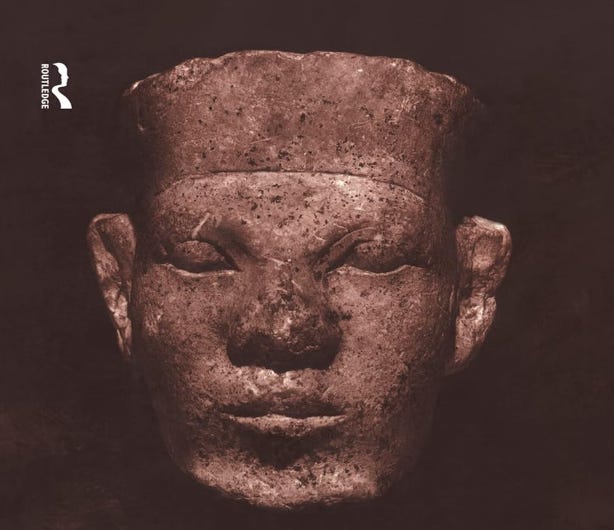
Limestone Head of a King. Pre-Dynastic or Early Dynastic, c. 3100 B.C. “Bought by Petrie in Cairo; thought by Petrie to depict King Narmer.” Petrie Museum of Egyptian Archaeology, UCL. UC 15989. Image taken from cover photo of Toby A.H. Wilkinson’s ‘Early Dynastic Egypt’
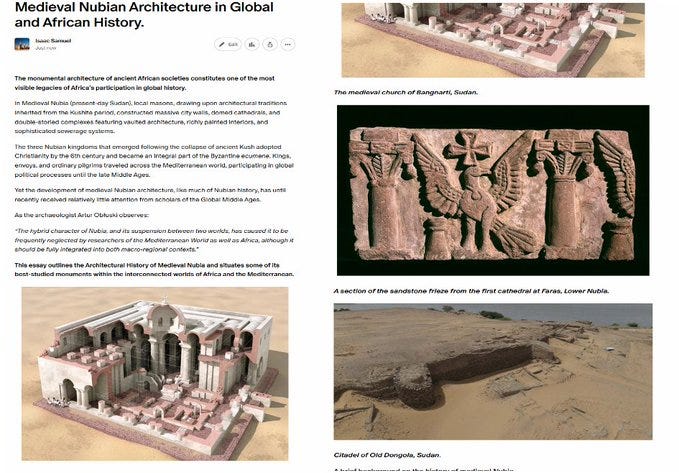
My latest Patreon article examines the hybrid character of Medieval Nubian Architecture, whose massive city walls, domed cathedrals, and double-storied complexes with sophisticated sewerage systems are a legacy of its participation in the interconnected worlds of Africa and the Mediterranean.
Please subscribe to read about it here and support this Newsletter:
The theory of a “Dynastic race” coming from the Near East to found Ancient Egypt was still popular in the 1960s, but has since been abandoned by professional specialists
“Neolithic and Predynastic Egypt.” by Stan Hendrickx and Dirk Huyge, pg 240-244, in ‘The Cambridge World Prehistory’ edited by Colin Renfrew.
“Prehistory: From the Palaeolithic to the Badarian Culture (c. 700,000–4000 BC)”, by Stan Hendrickx and Pierre Vermeersch, pg. 28- 29, in ‘The Oxford History of Ancient Egypt’, edited by Ian Shaw. Nabta Playa and Its Role in Northeastern African Prehistory By Romuald Schild, Climate Change. Nomadic Pastoralism and Astronomy at Nabta Playa, Southern Egypt By Kim Malville and J. McKim Malville
Landscapes and Landforms of the Central Sahara, edited by Jasper Knight, Stefania Merlo, Andrea Zerboni
Before the Pyramids: The Origins of Egyptian Civilization, edited by Emily Teeter, pg 46-47.
The Oxford Handbook of Egyptology edited by Ian Shaw, Elizabeth Bloxam, pg 575-576. The Oxford History of Ancient Egypt, edited by Ian Shaw, pg 31-35. The Archaeology of Early Egypt. Social Transformations in North-Africa, 10,000 to 2650 bc. By David Wengrow pg 23-25, 29-30
The Oxford Handbook of Egyptology, edited by Ian Shaw, Elizabeth Bloxam, pg 578. The Oxford History of Ancient Egypt, edited by Ian Shaw, pg 36-40. Early Dynastic Egypt by Toby A.H. Wilkinson, pg 23-24. The Archaeology of Early Egypt. Social Transformations in North-Africa, 10,000 to 2650 bc. By David Wengrow pg 49-54. On the Neolithic black-topped pottery and burials of Sudan, see; Atbai Enclosure Burials: Monumentalism, Pastoralism and Environmental Change in the Mid-Holocene East Nubian Deserts, by Julien Cooper, Marie Bourgeois, Maël Crépy & Maria Carmela Gatto. Black-Topped Ware in Early Dynastic Contexts by Karin N. Sowada.
Before the Pyramids: The Origins of Egyptian Civilization, edited by Emily Teeter, pg 29
“Prehistory: From the Palaeolithic to the Badarian Culture (c. 700,000–4000 BC)”, by Stan Hendrickx and Pierre Vermeersch, pg. 44-47, in ‘The Oxford History of Ancient Egypt’, edited by Ian Shaw.
The Oxford Handbook of Egyptology, edited by Ian Shaw, Elizabeth Bloxam, pg 581-584, 601. The Archaeology of Early Egypt. Social Transformations in North-Africa, 10,000 to 2650 bc. By David Wengrow, pg. 90- 96
“The Naqada period (c. 4000-3200 BC)” by Beatrix Midant-Reynes pg 48, in ‘The Oxford History of Ancient Egypt’, edited by Ian Shaw.
Before the Pyramids: The Origins of Egyptian Civilization, edited by Emily Teeter, pg 66-67
Early Dynastic Egypt by Toby A.H. Wilkinson, pg 26-29. The Archaeology of Early Egypt. Social Transformations in North-Africa, 10,000 to 2650 bc. By David Wengrow, pg 109-120. Before the Pyramids: The Origins of Egyptian Civilization, edited by Emily Teeter, pg 75-81
Early Dynastic Egypt by Toby A.H. Wilkinson, pg 30-32
“The Naqada period (c. 4000-3200 BC)” by Beatrix Midant-Reynes pg 49-52, in ‘The Oxford History of Ancient Egypt’, edited by Ian Shaw.
The Archaeology of Early Egypt. Social Transformations in North-Africa, 10,000 to 2650 bc. By David Wengrow, pg pg 84-87. The Oxford History of Ancient Egypt, edited by Ian Shaw pg 54-56. Before the Pyramids: The Origins of Egyptian Civilization, edited by Emily Teeter, pg 48-52. On mudbrick architecture, see; The Archaeology of Urbanism in Ancient Egypt From the Predynastic Period to the End of the Middle Kingdom By Nadine Moeller, pg 62-70
The A-Group Royal Cemetery at Qustul: Cemetery L by Bruce B. Williams
“The A-Group and 4th Millennium BCE Nubia Maria Carmela Gatto” by D. Fuller, pg 129. In ‘The Oxford Handbook of Ancient Nubia’ edited by Geoff Emberling, Bruce Beyer Williams. Ancient Nubian Art: A History By Rita E. Freed, Gates, Jr, pg 48
The Oxford Handbook of Ancient Nubia’ edited by Geoff Emberling, Bruce Beyer Williams pg 127-130, The Politics of Trade: Egypt and Lower Nubia in the 4th Millennium BC, by Jane Roy pg 202-210, 213-17, 310-311)
“The A-Group and 4th Millennium BCE Nubia Maria Carmela Gatto” by D. Fuller, pg 132-133. In ‘The Oxford Handbook of Ancient Nubia’ edited by Geoff Emberling, Bruce Beyer Williams.
The Oxford Handbook of Ancient Nubia, edited by Geoff Emberling, Bruce Beyer Williams, pg 133-134. The Archaeology of Early Egypt Social Transformations in North-East Africa, C.10,000 to 2,650 BC, by D. Wengrow, pg 166-171. Before the Pyramids: The Origins of Egyptian Civilization, edited by Emily Teeter, pg 83-90
The Oxford Handbook of Ancient Nubia, edited by Geoff Emberling, Bruce Beyer Williams, pg 134-135. Early Dynastic Egypt by Toby A.H. Wilkinson, pg 40.
The Politics of Trade: Egypt and Lower Nubia in the 4th Millennium BC, by Jane Roy pg 214-238
“The Pre-Kerma Culture and the beginning of the Kerma Kingdom” by Matthieu Honegger, pg 145-153. in The Oxford Handbook of Ancient Nubia, edited by Geoff Emberling, Bruce Beyer Williams
“The Pre-Kerma period” by Matthieu Honegger, in ‘Sudan: Ancient Treasures : an Exhibition of Recent Discoveries from the Sudan National Museum’
Early Dynastic Egypt by Toby A.H. Wilkinson, pg 33-34, 39-43. The Archaeology of Early Egypt Social Transformations in North-East Africa, C.10,000 to 2,650 BC, By D. Wengrow, pg 198-200
Before the Pyramids: The Origins of Egyptian Civilization, edited by Emily Teeter, pg 135
The Oxford Handbook of Egyptology, edited by Ian Shaw, Elizabeth Bloxam, pg 585-587
The Archaeology of Early Egypt Social Transformations in North-East Africa, C.10,000 to 2,650 BC, By D. Wengrow, pg 176-187
The Archaeology of Early Egypt Social Transformations in North-East Africa, C.10,000 to 2,650 BC, By D. Wengrow pg 38-40, 88-89
The Archaeology of Early Egypt: Social Transformations in North-East Africa, C.10,000 to 2,650 BC, By D. Wengrow, pg 171-172
Before the Pyramids: The Origins of Egyptian Civilization, edited by Emily Teeter, pg 61-63
Early Dynastic Egypt by Toby A.H. Wilkinson pg 40-41, The Oxford Handbook of Egyptology, edited by Ian Shaw, Elizabeth Bloxam, pg 589-599, The Archaeology of Early Egypt: Social Transformations in North-East Africa, C.10,000 to 2,650 BC, By D. Wengrow pg 41-44
The Archaeology of Early Egypt: Social Transformations in North-East Africa, C.10,000 to 2,650 BC, By D. Wengrow, pg 138-142. Early Dynastic Egypt by Toby Wilkinson, pg 37-39
Early Dynastic Egypt by Toby Wilkinson pg 34-36, 128-130, The Politics of Trade: Egypt and Lower Nubia in the 4th Millennium BC, by Jane Roy pg 249-285
Early Dynastic Egypt by Toby Wilkinson, pg 150-153. The Politics of Trade: Egypt and Lower Nubia in the 4th Millennium BC, by Jane Roy 217-227
The Oxford Handbook of Ancient Nubia, edited by Geoff Emberling, Bruce Beyer Williams, pg 137
Early Dynastic Egypt by Toby Wilkinson, pg 131-133, 135-6. Before the Pyramids: The Origins of Egyptian Civilization, edited by Emily Teeter, pg. 112- 121
The Oxford Handbook of Egyptology, edited by Ian Shaw, Elizabeth Bloxam, pg 585
Early Dynastic Egypt by Toby Wilkinson, pg 12
Early Dynastic Egypt by Toby Wilkinson, pg 193-197. The Archaeology of Early Egypt Social Transformations in North-East Africa, C.10,000 to 2,650 BC, By D. Wengrow pg 243-245
The Oxford Handbook of Ancient Nubia, edited by Geoff Emberling, Bruce Beyer Williams pg 608
The Oxford History of Ancient Egypt, edited by Ian Shaw pg 67-68. Early Dynastic Egypt by Toby Wilkinson, pg 56-68, 200-205, 229-231
The Archaeology of Early Egypt: Social Transformations in North-East Africa, C.10,000 to 2,650 BC, By D. Wengrow 198-206
The Oxford History of Ancient Egypt, edited by Ian Shaw pg 75. The Oxford Handbook of Egyptology, edited by Ian Shaw, Elizabeth Bloxam, pg 610. Before the Pyramids: The Origins of Egyptian Civilization, edited by Emily Teeter, pg 101-103
Early Dynastic Egypt by Toby Wilkinson, pg 95-122, 225-228, 242-257. The Archaeology of Early Egypt: Social Transformations in North-East Africa, C.10,000 to 2,650 BC, By D. Wengrow pg 220-223. Before the Pyramids: The Origins of Egyptian Civilization, edited by Emily Teeter, pg 28-31.
The Oxford Handbook of Egyptology, edited by Ian Shaw, Elizabeth Bloxam, pg 598-600, 606-607
The Archaeology of Early Egypt: Social Transformations in North-East Africa, C.10,000 to 2,650 BC, By D. Wengrow, pg 207-212
Early Dynastic Egypt by Toby Wilkinson, pg 41-42. The Archaeology of Early Egypt: Social Transformations in North-East Africa, C.10,000 to 2,650 BC, By D. Wengrow, pg 133
The Oxford History of Ancient Egypt, edited by Ian Shaw, pg 77
Early Dynastic Egypt by Toby Wilkinson, pg 269-278, 284-296. On predynastic urbanism, see: The Archaeology of Urbanism in Ancient Egypt From the Predynastic Period to the End of the Middle Kingdom By Nadine Moeller , pg 75-109.
Early Dynastic Egypt by Toby Wilkinson, pg 70-75, 207-211
The Oxford History of Ancient Egypt, edited by Ian Shaw, pg 80
Early Dynastic Egypt by Toby Wilkinson, pg 75-79, 211-212
The Oxford History of Ancient Egypt, edited by Ian Shaw, pg 79-80
Early Dynastic Egypt by Toby Wilkinson, pg 76-79, 133, 213, 267-269
Great Tombs of the First Dynasty: Excavations at Saqqara, Volume 1 By Walter Bryan Emery, pg 34-35
Good read
Thank You for Sharing Mr. Issac Samuel