

Africa was a haven for religious minorities (“heretics”), political exiles, and other refugees from beyond the continent during Late Antiquity.
In 615, following the persecutions in Mecca, the Prophet sent some of his followers to seek asylum from the Najāshī (King) of the Christian kingdom of Aksum in Ethiopia.
In the earliest account of this migration, preserved by the biographer Ibn Isḥāq (d. 767) and copied by Ibn Hishām (d. 833), the Prophet chose Aksum because its king was a just ruler:
“If you were to go to Abyssinia (it would be better for you), for the king will not tolerate injustice and it is a friendly country…”1
The account then lists those who migrated to Aksum and describes how the Najāshī protected the exiles, refusing to return them to Mecca after their persecutors sent a delegation demanding their extradition.
Although the historicity of these events remains debated among modern scholars,2 the tradition of religious minorities and political exiles seeking refuge in Africa is supported by other historical accounts of the continent during Late Antiquity.
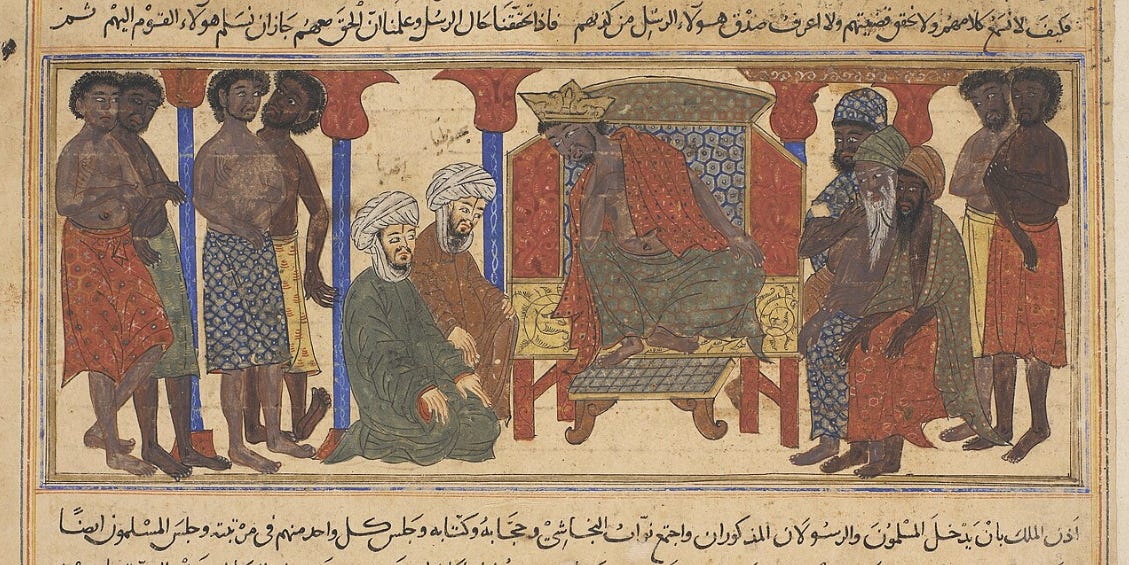
The Messengers of the Prophet to Abyssinia, under the leadership of Ja’far ibn Abi Talib, and the Negus’ refusal to hand them over to the Quraysh messengers. Jame’ al-Tawarikh. Or Ms.20, page 52r. Edinburgh.1306
When Aksum declined, and pirate activity in the Red Sea disrupted maritime trade, the Umayyads, under Caliph ʿAbd al-Malik (r. 685–705), occupied one of the Dahlak Islands off the coast of Eritrea.
Control of the islands subsequently oscillated between the Aksumites, Arabs, and local chieftains, while their strategic position made them a haven for political exiles, independent merchants, and pirates.3
Besides the exceptional ruins of a Nestorian Church and ancient cisterns similar to those found along the coast, the island’s necropolis contains hundreds of stelae, the earliest of which date to 864 CE.
The stelae refer to various tribes from as close as Suwakin (Sudan) to as far as Byzantium and Persia. Some reflect the influence of the minority Ismail sect, and the presence of merchants from Kwiha in Tǝgray (northern Ethiopia) by the 9th century.4
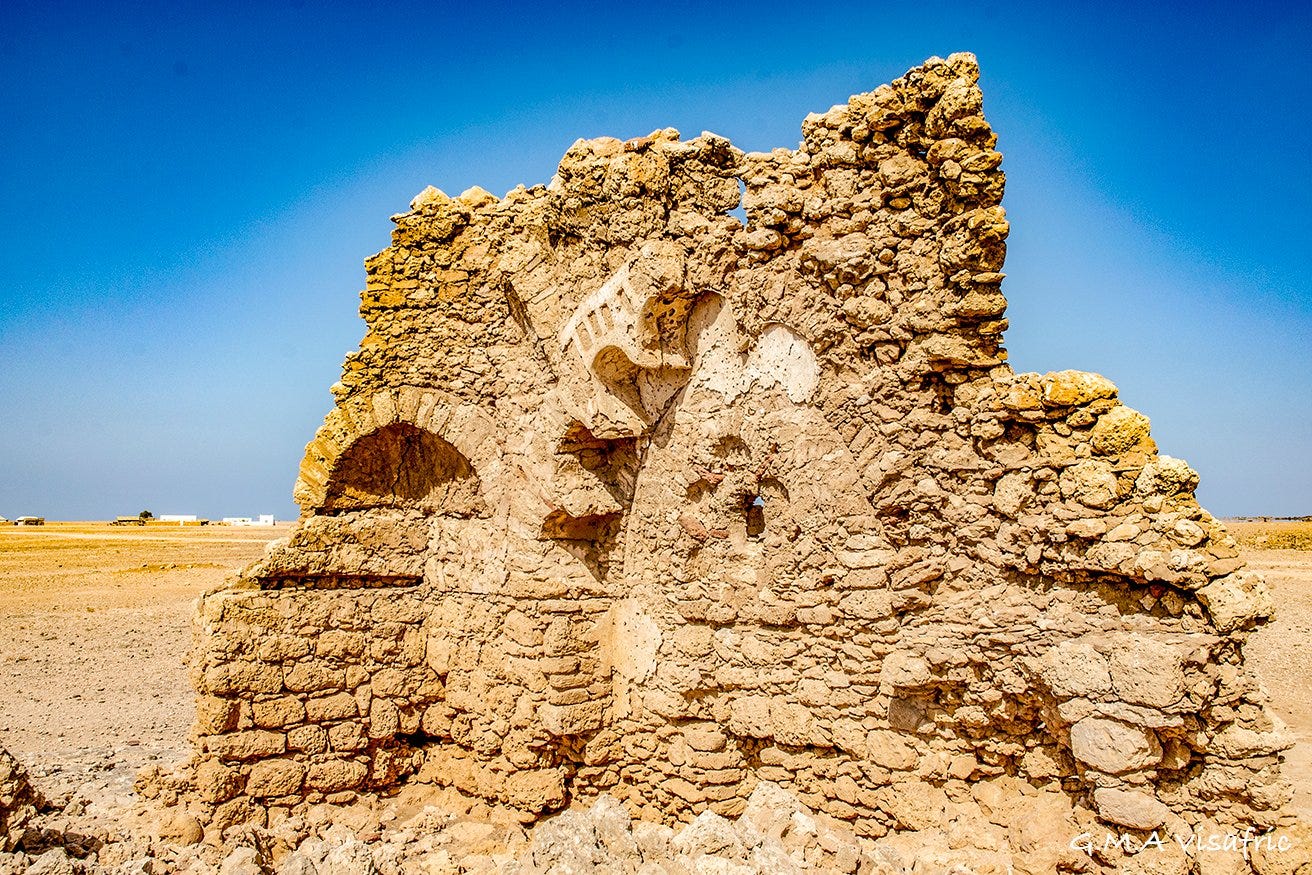
Ruins of a medieval mosque at Dahlak.
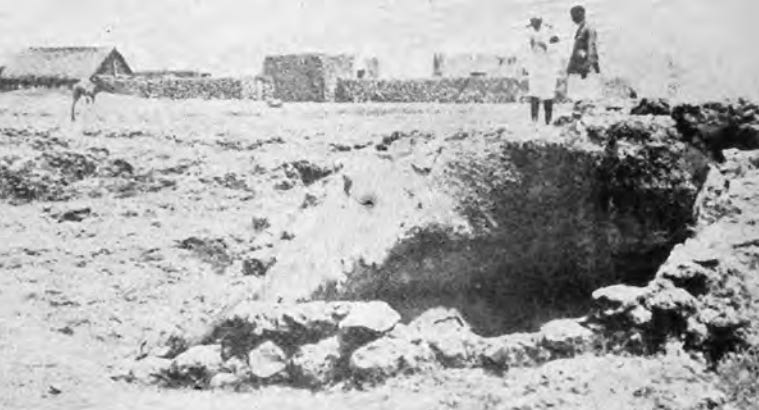
‘Cisterns attributed to the “Furs” (Persians) on the main Dahlak island; from CRStor, pl. lxvii’ (Encyclopædia Aethiopica, Vol 2)
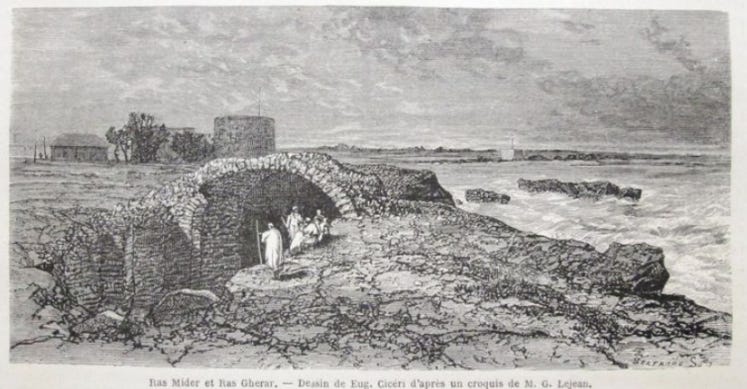
Ras Mider and Ras Gherar. Ancient cisterns near Masawa, Eritrea. ca. 1873. by Guillaume Lejean.
During the 7th century, a section of Umayyads known as the Hunayhín was reportedly sent to the medieval Ghana Empire (present-day Southern Mauritania), where they decided to settle and adopt “the religion of the people of Ghana.”
Al-Bakri, who recorded this account in 1068 CE, mentions that the capital of Ghana was populated by both polytheistic and Muslim communities, and that some of the King’s ministers were Muslims, although the King and most of his subjects weren’t.5
Some of the polytheistic West African religious systems described by al-Bakri were centered around serpent deities that were widespread across West Africa during the Middle Ages, and were later transplanted to the Americas.
[ see: The serpent deities of the African Atlantic ]
In North-West Africa, the independent Imazighen (Berbers) who refused to accept the mainstream Sunni Islam of their Umayyad enemies adopted the “heretical” Ibadi and Sufri sects by 740 CE, which were considered relatively egalitarian. Many withdrew into the deserts and mountains, where they established a Sufri state at Sijilmasa (Morocco) and an Ibadi imamate at Tahert (Algeria), among others.6
Ibadism spread southwards to West Africa, and is attested at Essouk-Tadmekka (N.E Mali) by the 9th century. Ibadi documents concerning Essouk and Tahert during this period also link them with the medieval city of Gao (Mali), whose ruler and subjects the geographer al-Muhallabi (d. 990) described as “pretend[ing] to be Muslim.”7
Nearly a century later, al-Bakri in 1068 records that the majority of Gao’s population remained polytheists.
Additionally, the presence of inscribed epitaphs associated with Sunni traditions at both Essouk and Gao reveals the religious pluralism of medieval Mali, where “paganism,” “heresy,” and Islamic “orthodoxy” coexisted.8
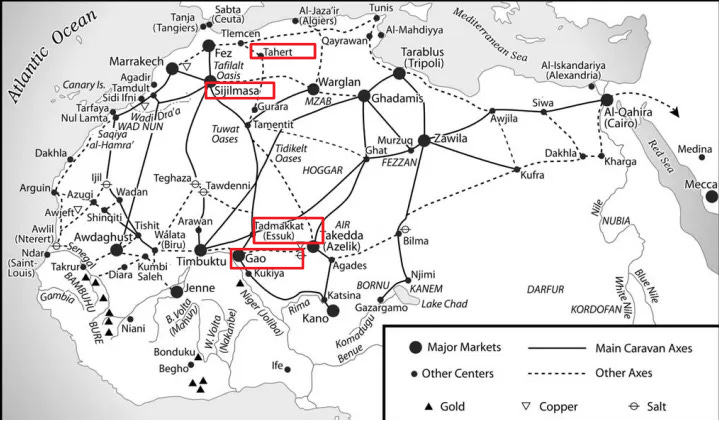
Location of Sijilmasa, Tahret, Essouk and Gao.
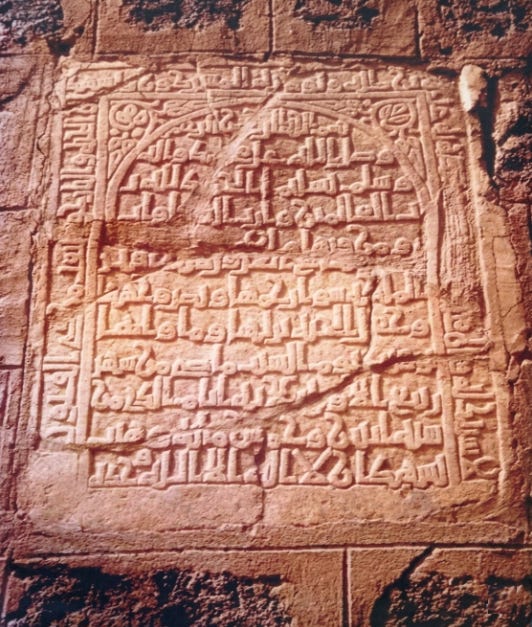
Commemorative Stela for Queen (Malika) S.wa of Gao, d. 1108. In situ at the Dyula quarter of Gao, Mali.
In the mid-11th century, Ghana, Tadmekka, and Gao became the target of the more reformist Almoravid movement, which ended the influence of Ibadism, facilitated the adoption of Islam by the Ghanaian royal court, and popularised the Maliki school of Sunni Islam that remains the dominant tradition across the region today.9
While some aspects of religious pluralism survived in the former territories of Ghana and Gao up to the late Middle Ages, traces of Ibadism disappeared across West Africa. However, the influence of Ibadi architecture can still be seen in some of the religious architecture of the region.10
Among the clearest evidence for religious pluralism in medieval Africa comes from Eastern Africa, where African traditional beliefs, Persian Zoroastrianism, and Islamic minority sects coexisted.
For centuries, African societies across the region stretching from present-day Somalia to Madagascar harbored religiously diverse populations as well as refugees who had fled Western Asia during periods of political upheaval and religious persecution.
These disparate communities found asylum in the emerging coastal towns, where traditional African religious systems were extensively documented in external accounts until the 13th century.
Records by visiting Chinese, Arab, and Persian travellers between the 8th and 10th centuries describe mixed religious communities; maritime links between Madagascar, the Swahili coast, and Somalia; as well as political upheavals and persecutions in Southern Arabia and the Gulf that forced many groups into exile in Africa.
Recent discoveries of Zoroastrian constructions in Madagascar and Ibadi mosques along the East African coast provide archaeological evidence for the presence of religious minorities across the region, whose existence has until now been known primarily from written sources.
My latest Patreon article examines the history of these mixed communities of “pagans”, “heretics,” and foreign refugees in Africa from the 8th to the 13th centuries.
Please subscribe to read more about it here
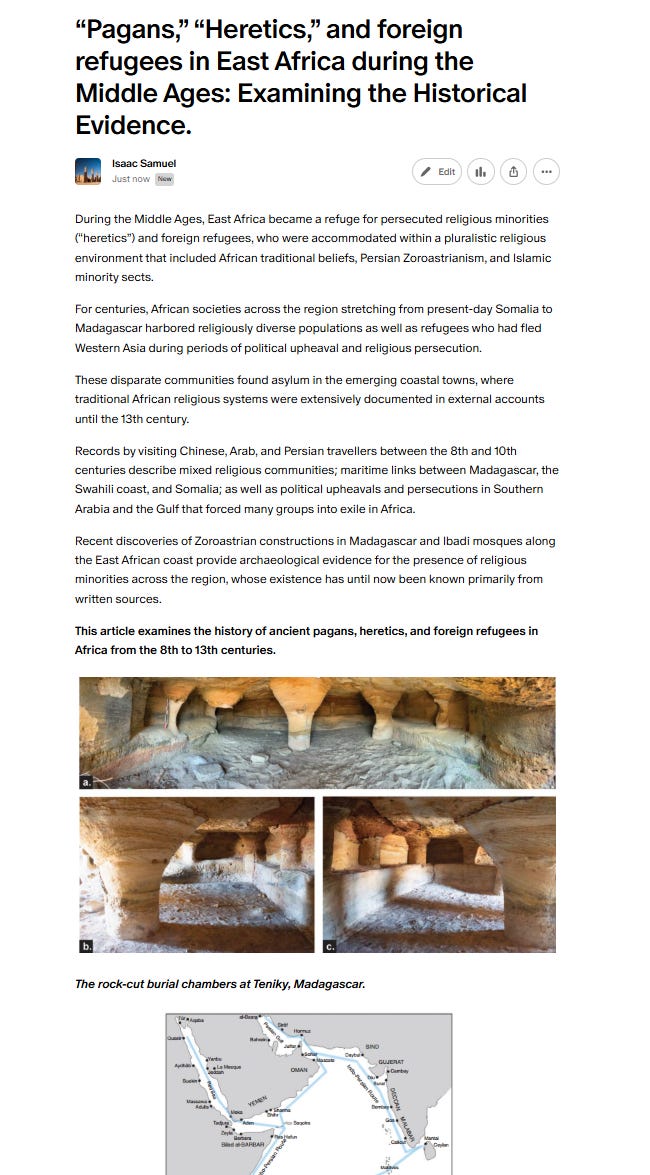
Weeping Christians and the First Hijra to Ethiopia by Gabriel Said Reynolds pg 64
The First Muslims in Africa? Sources and Methods Regarding the Hijra to Abyssinia by Torsten Hylén. In ‘Africa as Method: A Handbook of Sources and Epistemologies’ edited by Karin Pallaver, Uoldelul Chelati Dirar.
Encyclopædia Aethiopica Vol 3, He-N, edited by Siegbert Uhlig, pg 202. A Companion to Medieval Ethiopia and Eritrea, edited by Samantha Kelly pg 89-90. “Thieves or Sultans? Dahlak and the Rulers and Merchants of Indian Ocean Port Cities, 11th-13th Centuries AD” by Roxani E. Margariti.
Encyclopædia Aethiopica, Vol 2, D-Ha, edited by Siegbert Uhlig, pg 65. Encyclopædia Aethiopica Vol 3, He-N, edited by Siegbert Uhlig, pg 186. A Companion to Medieval Ethiopia and Eritrea, edited by Samantha Kelly pg 91-92
Medieval West Africa: Views from Arab Scholars and Merchants, edited by Jay Spaulding, Nehemia Levtzion, pg 20, 15-17
Kanem, Bornu, and the Fazzan: Notes on the Political History of a Trade Route, by B. G. Martin, pg 17-18. Authority Beyond State and Tribe in the Early Medieval Maghrib, by Chloé Capel pg 59-60.
Essouk-Tadmekka: An Early Islamic Trans-Saharan Market Town, pg 275, 284. Medieval West Africa: Views from Arab Scholars and Merchants, edited by Jay Spaulding, Nehemia Levtzion, pg 8. Land and Trade in Early Islam: The Economy of the Islamic Middle East 750-1050 CE , edited by Fanny Bessard, Hugh Kennedy, pg 329.
Arabic medieval inscriptions from the Republic of Mali. Epigraphy, chronicles and Songhay-Tuareg history by Paulo Fernando de Moraes Farias pg cxxii-cxxiii, cxliv-cxlv, cxlv-cxlvii, cxliv-cxlv.
Medieval West Africa: Views from Arab Scholars and Merchants, edited by Jay Spaulding, Nehemia Levtzion, pg xiii-xiv, 21-22, 23.
see: The Conquest that Never Was: Ghana and the Almoravids, 1076 by D Conrad
Historic Mosques in Sub-Saharan Africa: From Timbuktu to Zanzibar by Stéphane Pradines pg 112-113
Great post. This also inspired me to look into Mauritania, a country I knew very little about. Thank you for writing.
Forever illuminating.. Always a breath of fresh air to my dusty historical knowledge of the continent.. 🙌🏽