

Before the discovery of petroleum, the Industrial Revolution was powered by Palm Oil, an ancient West African commodity whose trade drove a period of remarkable economic growth during the 19th century.
African producers, middlemen, and migrant traders concentrated in the oil-rich Delta region of present-day southern Nigeria, where they established a thriving commercial network.
They pioneered the adoption of steamship services in the region, and some African merchants acquired their own sail ships to transport oil directly to Britain, bypassing European intermediaries.
Competition between African traders and European intermediaries sparked an intense trade war over the marketing of the oil, which ended with the displacement of the African traders and the imposition of colonial rule.
The European traders who usurped and monopolised the Oil trade saw their fortunes rise during the early colonial period, leading to a series of mergers that created Unilever, one of the world’s largest consumer brand conglomerates.
This “century of palm oil” foreshadowed some of the challenges that would later characterize the crude oil industry in the postcolonial era, as Africans attempted to retain control of their resource wealth in the face of foreign commercial interests.
This article examines the history of Palm Oil trade in 19th century West-Africa and its enduring influence on the region’s modern economy.
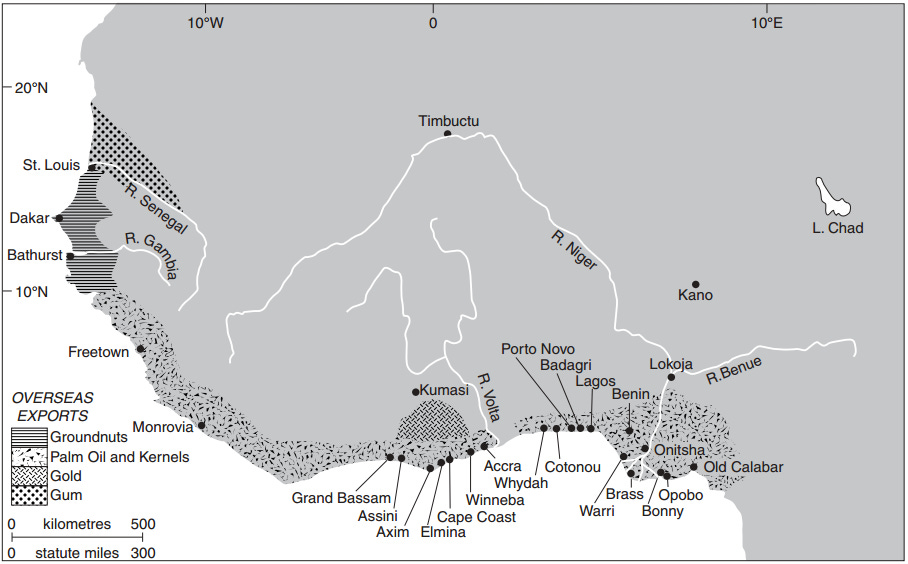
Map of the West African Coast in the nineteenth century, showing the major sources of commodities.1
Support AfricanHistoryExtra by becoming a member of our Patreon community; subscribe here to read more about African history, download free books, and keep this newsletter free for all:
A brief history of palm oil before the 19th century
The earliest reference to West African Palm oil comes from the Venetian Sailor Alvise Cadamosto’s description of Senegal in the 1460s: “In this country they use a certain oil in their food, [the making of which I do not know]. It has three properties, the scent of violets, the taste of our olive oil, and a colour which tinges the food like saffron, but is more attractive.”2
The Portuguese captain Pacheco Pereira, writing of visits to West Africa in the 1480s, referred to palm oil being offered for sale along the Forcados River in the Niger Delta (southern Nigeria). As early as 1522, the kingdom of Benin (S.W Nigeria) was exporting Palm Oil to European traders, who noted that besides its consumption, Palm oil was used to light lamps in the city.3
Writing in the 17th century, Jon Barbot reported that ‘This palm oil is of great use to the inhabitants [of Guinea] in several respects, for besides its serving to season their meat, fish, etc., and to burn in their lamps to light them at night, it is an excellent ointment against rheumatick pains, winds and colds in the limbs, or other like diseases.’4
While Barbot was describing the coastal and near-coastal regions, Oil lamps were of significant antiquity in the West African Savannah and Sahel; some of the earliest were found in the medieval city of Gao, dated to 780-1000 CE.5
Mande blacksmiths and other groups such as the Senufu, Bambara, and Dogon made and used a variety of lamp forms since the Middle Ages. Most of these lamps used shea-butter oil, although some Mande groups used palm oil as they moved south to the forest region, or imported it from the near-coastal regions.6
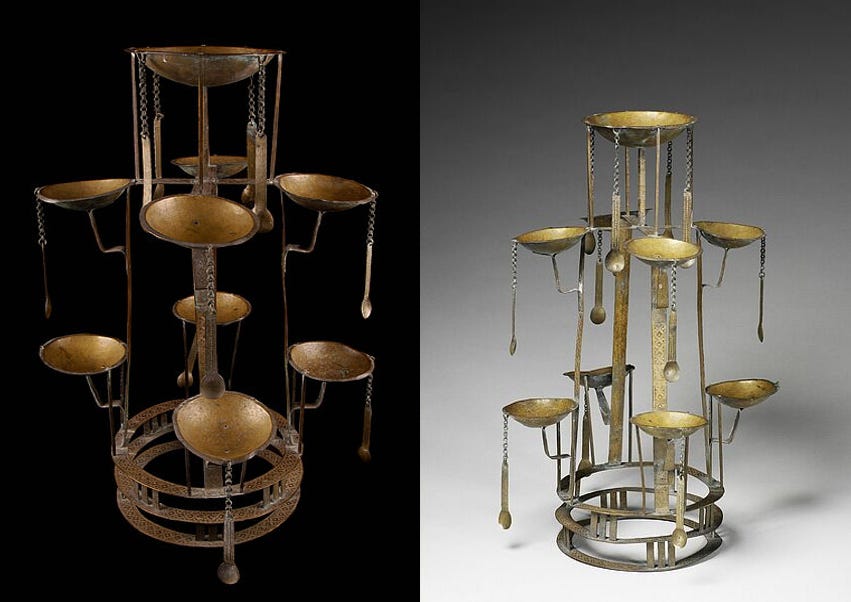
Copper oil lamp. Kogi, Lokoja, Nigeria. ca. 1883. Quai Branly
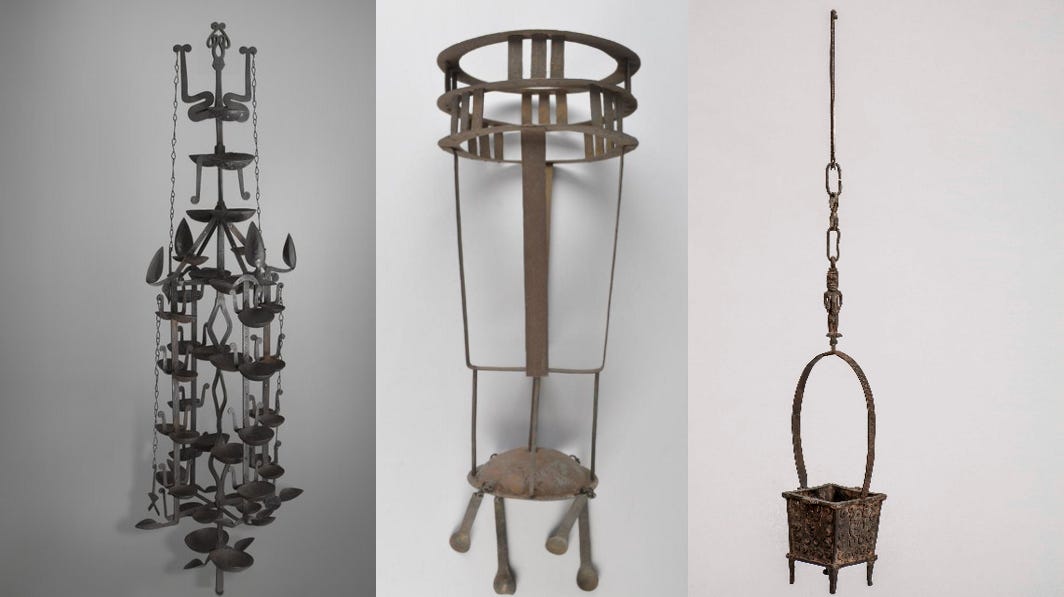
(left) oil lamp. Bozo, Mali. 19th century. Yale University Art Gallery (center) standard lamp. Northern Nigeria, ca. 1883-1895. British Museum. (right) Oil Lamp, Benin City, Nigeria. 19th century. MARKK Museum.
Initially, the export of palm oil, while moderate, expanded with the growth of the Atlantic trade, the oil being used for provisions on the voyage to the Americas. During the subsequent centuries, an increasing quantity of the oil was traded to Europe.7
It was in the early nineteenth century, following the abolition of the British slave trade, that palm oil exports from West Africa began to increase significantly. Thereafter, palm oil was to become the quintessential commodity of the era of so-called ‘legitimate trade’ for large parts of the West African coast.
The general pattern that has been discerned for the geographical development of the palm oil trade in Africa over time has been that the trade centred on the Niger Delta area during the late 18th century, first at Calabar on the Cross River and then at Bonny at the mouth of the Rio Real.8
By the middle of the 19th century, ports like Badagry and Ouidah in the Bight of Benin, and regions such as the Gold Coast (Ghana), the Windward Coast to Sierra Leone, and the Cameroon-Gabon-Angola coastal region in the south were developed as important entreports in the Oil trade.
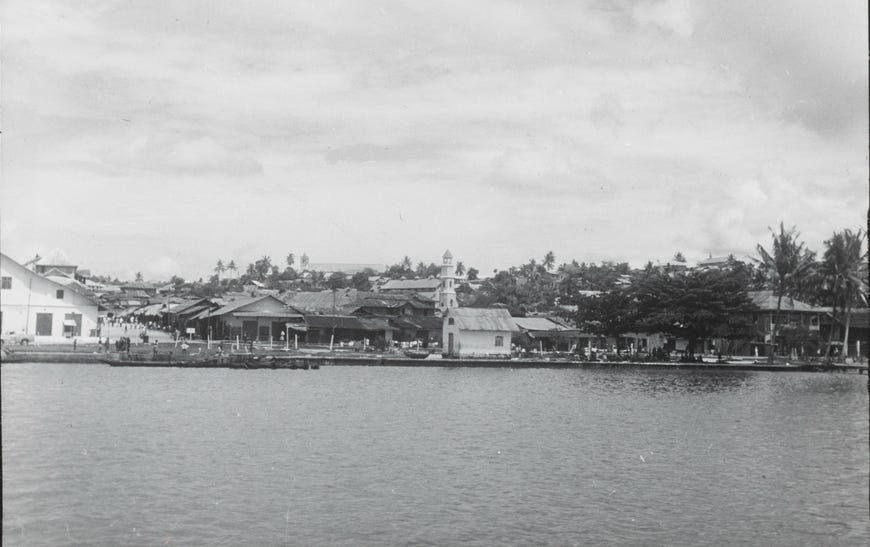
Calabar, Nigeria. ca. 1930-1939. MAA, Cambridge.
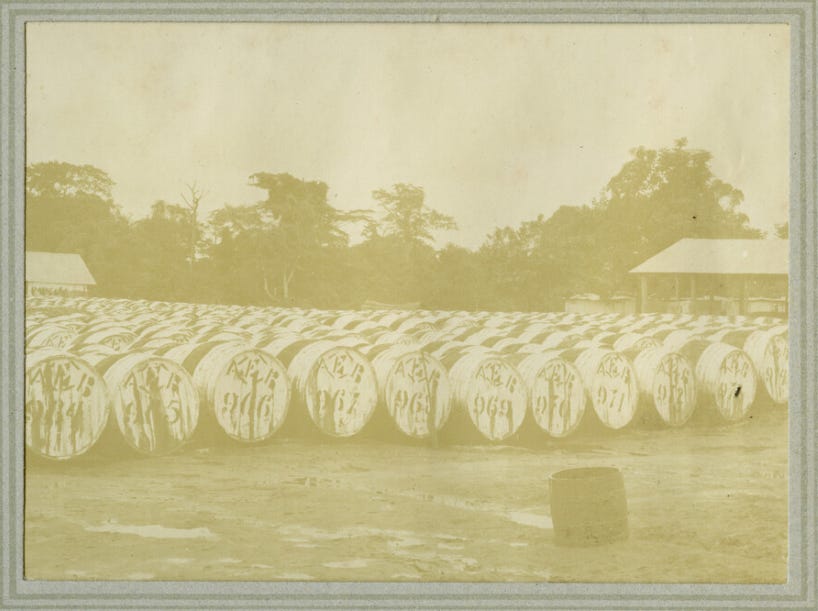
Rows of metal oil barrels with iron sheds in the distance. Niger River, Nigeria. ca. 1913. Pitt Rivers Museum
Cultivation, Processing, and Trade of Palm Oil before the early 19th century.
The palm oil is derived from the fruit of the oil palm (elaeis guineensis). The tree is native to West Africa’s forest region and grows in a belt parallel to the Atlantic coast in West and Central Africa, extending from Cape Verde to Angola
Excavations from the Neolithic site of Bosumpra in Ghana recovered Botanical samples of various domesticates, including endocarps of oil palm (Elaeis guineensis) from the 6th millennium BC (8410 ± 40 BP), indicating that it was one of the earliest plant domesticates in West Africa's forest region.9
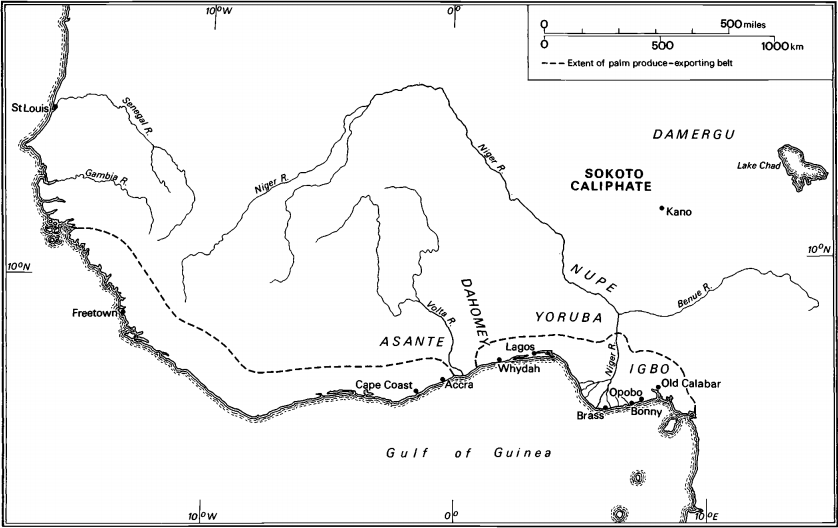
West Africa in the nineteenth century, showing the extent of the palm produce exporting belt. Map by R. Law.
The nuts produced by the oil palm contain a fleshy outer pericarp, from which palm oil is produced, and an inner kernel from which palm kernel oil is derived.
The latter is a colourless, translucent oil, similar to coconut oil, while palm oil itself is a bright orange-yellow colour, with an odour often compared to violets. The tree can live for up to two hundred years and bears fruit for at least sixty.10
They were harvested by cutting the bunches of nuts from the tree, a highly skilled and sometimes dangerous task. Most producers relied on their own labour to do this, but in some areas labour would be provided by outside specialists such as the Isuama, Urhobo, and the Aboh Igbo, who travelled among neighbouring peoples during the season for this purpose.
The fruits would be left to store for a period, in pits, canoes, or in piles, in order to encourage fermentation and loosen the nuts from the bunch. Depending on the type of oil to be produced, the fermented fruits are later mashed or pounded, and boiled in water, with the oil floating to the surface to be skimmed off.11
The typical Yoruba oil mill (eku) was a large circular container built on an open rock surface, with the rock surface for its base. Inside it, the boiled palm nuts were pressed to extract the oil. The process, plus other ancillary processes, yielded not only the edible oil and fats, but also the palm kernel oil used for medicine and cosmetics and various fuels for lighting, for cooking, and for use in high-heat furnaces.12
The oil was then collected in earthen pots in loads of about five gallons, and taken to the markets.
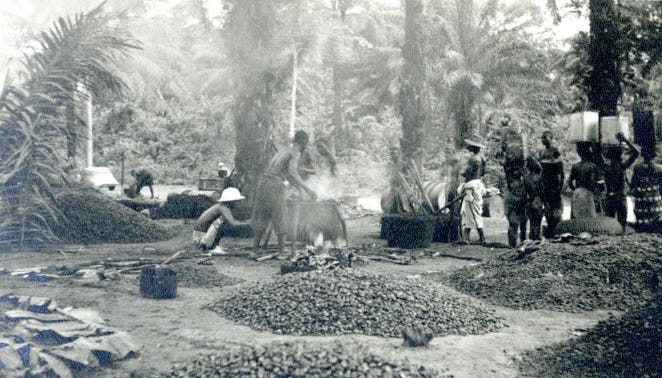
Scene of palm oil production. Côte D’ivoire. ca. 1936. British Museum
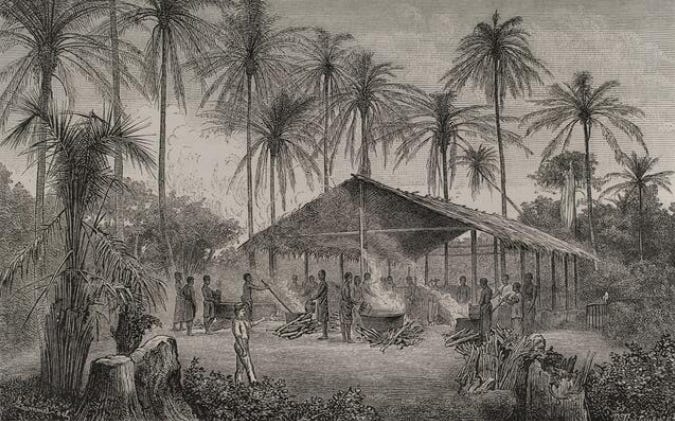
Palm oil clarification. Taken from ‘The Congo and the Founding of Its Free State’ by H.M.Stanley, 1890
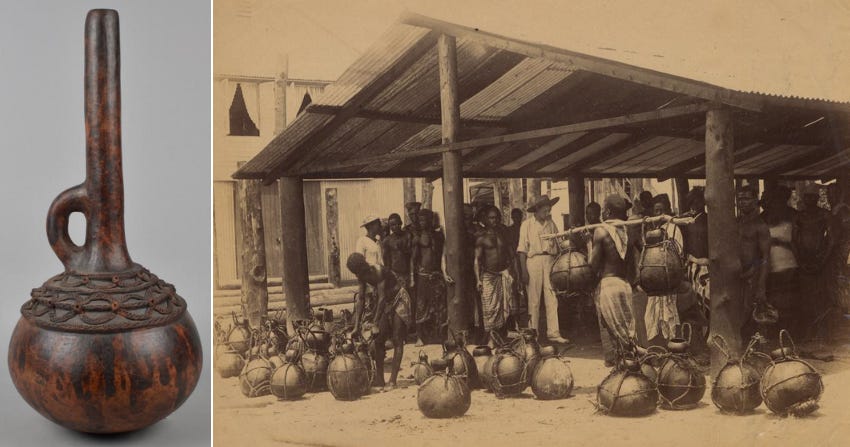
(left) Clay palm-oil container. Cameroon, 20th century. British Museum. (right) Market scene: calabashes containing palm oil strung with rope, on ground in front of an open structure with a corrugated iron roof. Akwete, Nigeria. ca. 1895-1905. British Museum
Initially, wild palms were the basis for production, though in time deliberate cultivation became common, especially in Yorubaland and Dahomey where the bulk of the oil came from small-scale farmers and was supplemented by that derived from estates worked by captives and client farmers.
Yorubaland had an extensive distribution of oil palms. By 1892, it was claimed, there were some 15 million palm trees in Yorubaland being used to produce oil for export, of which 15,000 tons a year were exported by the Egba of Abeokuta in 1856.13
The reason for the sharp rise in the trade lay in the increasing industrialisation of Britain during the nineteenth century and the demand this generated for tropical products. Palm oil was used as a lubricant for industrial machinery and railway stock as well as being an essential ingredient in the manufacture of soap and candles. It was valued too as an important source of glycerine and in the processing of tinplate.
During the nineteenth century the volume of palm oil imports into Britain from West Africa grew from 2,233 cwt (111 tons) in 1807 to reach a peak of 1,058,989 cwt (53,000 tons) in 1895. By the 1850s, this trade in palm oil was joined by trade in palm kernels, whose imports rose from 592 tons in 1855 to 34,186 tons by 1895. These supplied the mass market for cheap margarine, with the residue being used as cattle food.14
Equally important was the response of African producers to demand, sparked by the sharp shift in the terms of trade between Europe and Africa in this period.
According to Eltis and Jennings, the terms of trade between Africa and the Atlantic world moved in favour of Africa from around 1680 to 1870 as prices for African exports rose relative to manufactured goods. Although the export trade remained relatively marginal for West Africa as a whole, the coastal enclaves and intermediaries were greatly affected by changes in external trade.15
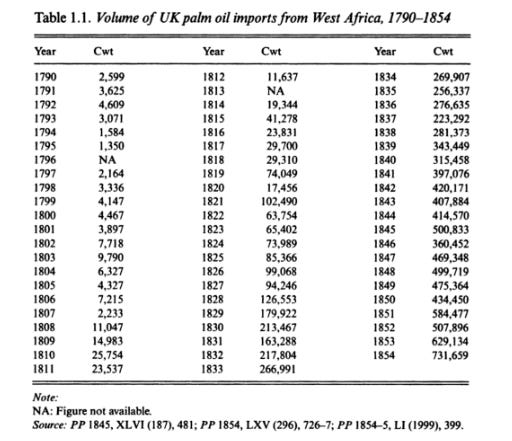
Palm Oil trade in the first half of the 19th century. Table by Martin Lynn
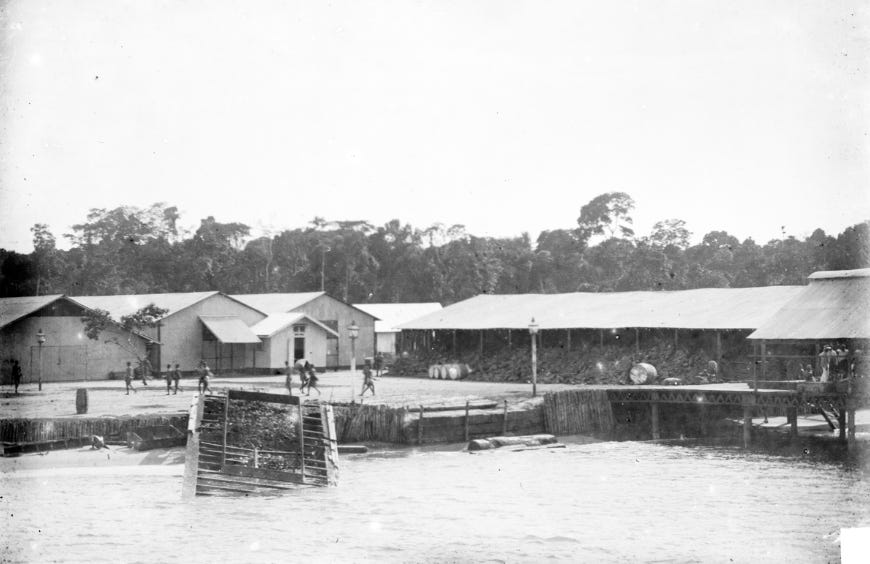
Warehouses along the River Niger used for storing palm oil. ca. 1886-1895. MAA, Cambridge.
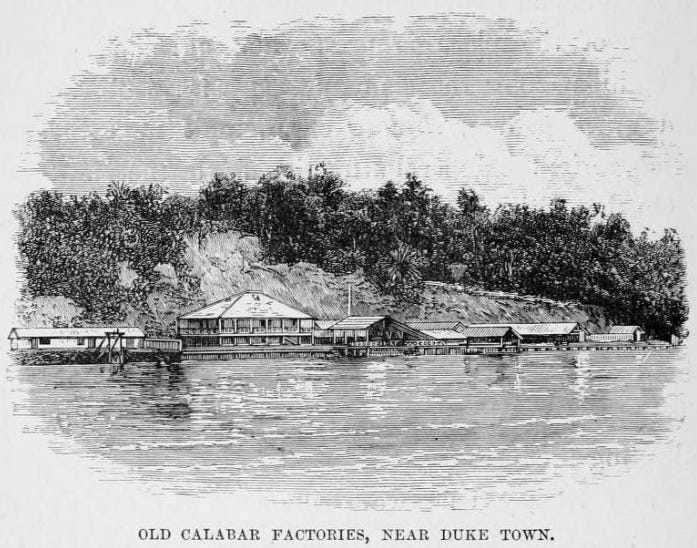
Old Calabar Factories, Near Duketown, 1885. H.M.Stanley.
Operation of the Oil Trade: Major Entrepôts and African Traders.
In general, little oil was produced within the coastal entrepôts themselves. Rather, it was their hinterland that became the major oil-producing area in the early 19th century.
In South-Eastern Nigeria, the combination of the dense clusters of oil palms and the availability of waterways for transport was crucial for the development of export oil production.
[see my previous article on Navigation, trade and civilization on Africa’s second Nile]
In the Bight of Biafra, much of the oil came from the Igbo-speaking societies in the interior, as well as the Ibibo farmers up the Cross River. Riverports such as Umon and Ikpa served as markets where Uruan-Ibibio and Igbo producers brought the oil for purchase by intermediaries, such as the Ikpa and Enyong-Ibibio, before sale to the Efik traders of Old Calabar.16
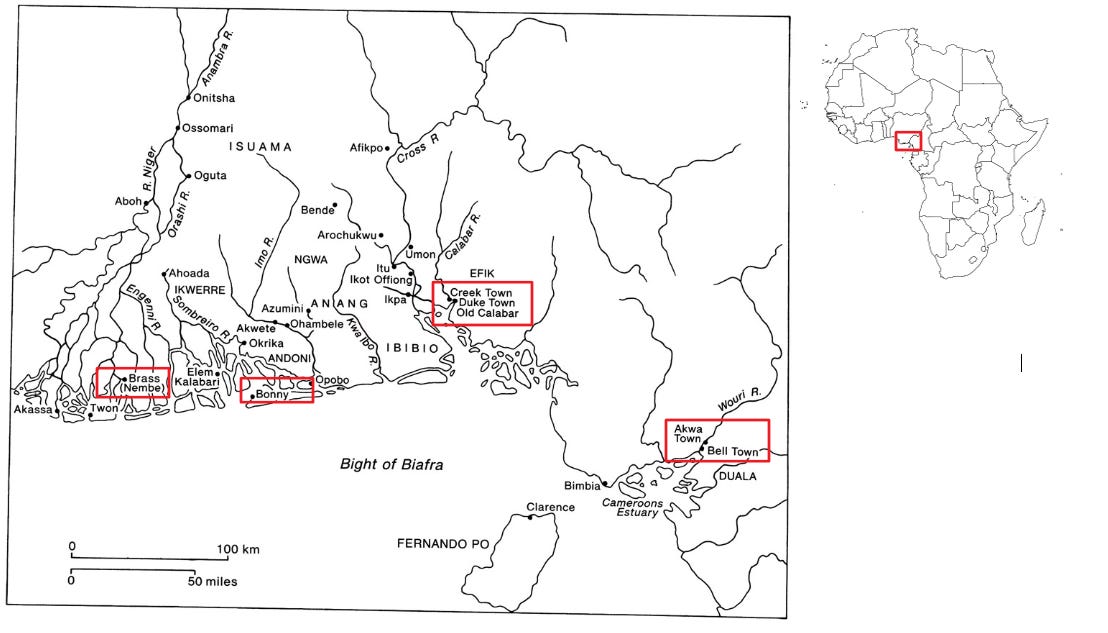
The Bight of Biafra in the 19th century, highlighting the major oil-exporting ports. Map by Martin Lynn
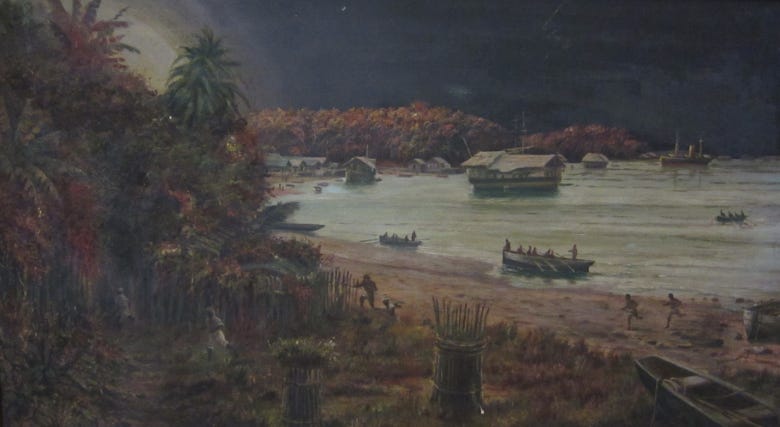
‘Old Calabar Port, painting by John Hughes, (c. 1880) (Source: National Museum, Calabar, Nigeria)’ Reproduced by Joseph Godlewski.
The lower Niger was a major artery for oil supplies, with markets at Ossomari, Onitsha, and Aboh collecting oil to trade down the river to Delta ports like Nembe.’ Oil from the Nri-Awka on the Anambra River passed into the trading system on the Niger and thence into the Delta; similarly, Oguta traders tapped supplies in the west of Igboland before selling to Kalabari who transported it to the Delta.17
Transportation was the major constraint to the expansion of the Oil trade outside the Bight of Biafra, where a dense network of waterways greatly reduced the costs of moving bulk goods from the interior. Producers in the Gold Coast region, the Bight of Benin, the coast of Cameroon, and the Southward coast used a combination of head porterage and riverine transportation.18
The canoes used by African oil traders/brokers for transportation were immense, with the largest carrying up to eight or nine tons or 2,400 gallons in twelve casks/puncheons of oil at a time. These canoes represented huge capital expenditure for the traders involved.
Massive fleets of canoes, each requiring up to forty paddlers or ‘pullerboys’, would set out from Bonny up the creeks of the interior to visit the oil markets. King Eyo of Old Calabar was said to have 400 canoes in his fleet in 1847; the king of Aboh 300 in 1841.19
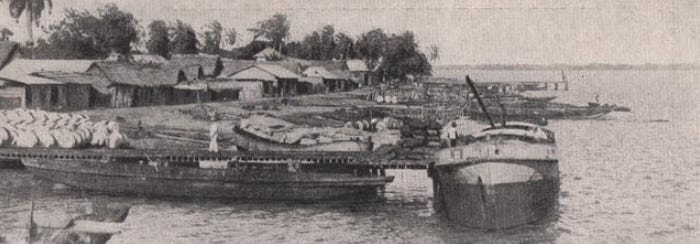
Palm oil casks ready for shipping on Badagry Beach. Nigeria (1923). Alamy Images
Where water transport was not available, headloading provided the means of conveying oil to the coast. It is estimated that headloading was twenty times as expensive as water transport in the Sierra Leone area. Therefore, caravans of porters only reached as far as the nearest riverport, or used alternative methods like rolling casks, eg in the Gold Coast region and the Bight of Benin.20
Both the volume of trade and prices of palm oil rose sharply during the first half of the 19th century, entered its heyday in the 1850s, after which it stagnated as prices fell steeply. In the second half of the 19th century, West African producers began exporting palm oil and kernels to Germany, the USA, and France, although Britain remained the biggest market.21
In the first half of the century, most British traders relied on their ships’ captains to trade for them. Trade focused on individuals, where personal contacts and experience were at a premium.
This was particularly so for the negotiations over ‘coomey’, a payment for permission to trade, paid by the British trader to the King and/or his major trading chiefs, as well as for the other charges, including payment for pilots, and the numerous payments to maintain goodwill and contacts.22
It was the ports of the Bight of Biafra that led the way in the expansion of oil exports in the early 19th century. Old Calabar was the major initial exporter of oil since the 18th century, with oil exports rising from 700-800 tons per annum before 1807, to 4,000-5,000 tons p.a in the 1830s, where they would remain for much of the century.23
Central to this growth in Old Calabar’s oil trade was the role of Duke Ephraim, who effectively created a monopoly of the oil trade and attracted credit based essentially on his personal reputation and his unprecedented tenure simultaneously of several key offices. After his death in 1834, the main Efik traders at Old Calabar relied on pre-existing institutions such as the Ekpe society to regulate trade.24
Those who had traded under the auspices of the Duke now carried on business in their own right, and negotiated their own credit. By the 1850s, there were at least ten major traders, including men of slave origin such as Black Davis, Yellow Duke, and Bassey Henshaw. These advanced in social rank by managing the businesses of their former masters, who were more concerned with political affairs, and later took control of the latter’s business after his death.25
During this period, wealthy Oil merchants who also held important political offices in Calabar commissioned the construction of prefabricated iron and wood houses that were shipped from Liverpool, some of which are still extant. They include Chief Egbo Bassey’s House from 1886 on Boco Street; the houses of Prince Edem Archibong at Offiong Street, as well as the houses of Obong Eyo Honesty IX and Chief Ekpo Udo Iko in Creektown.26
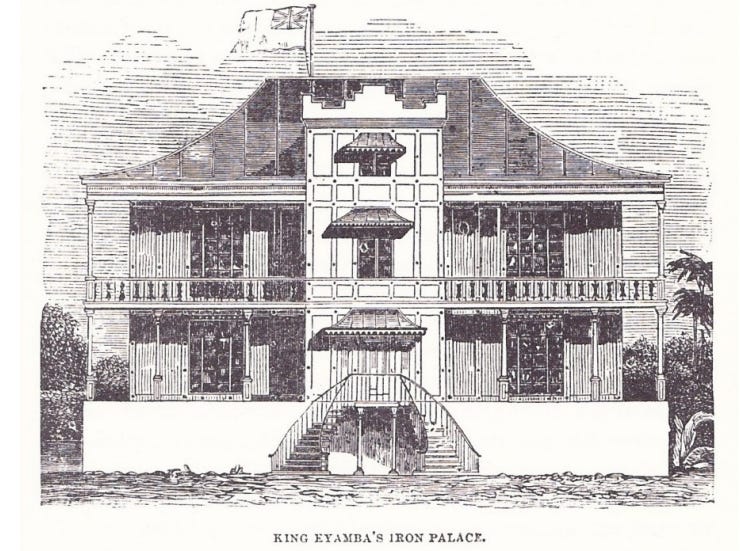
“King Eyamba’s Iron Palace”. (Eyamba V, r. 1834-1847) Old Calabar (Source: Hope Masterson Waddell, Twenty-Nine Years in the West Indies and Central Africa 1829-1858. 243) Image reproduced by Joseph Godlewski.
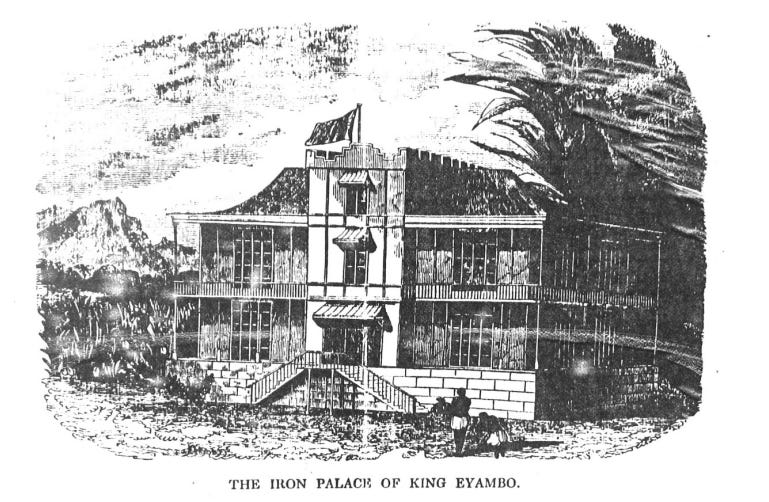
The Iron Palace of King Eyambo, Old Calabar, (Source: The Builder, 1843, May 13, 1843. 171). Image reproduced by Joseph Godlewski
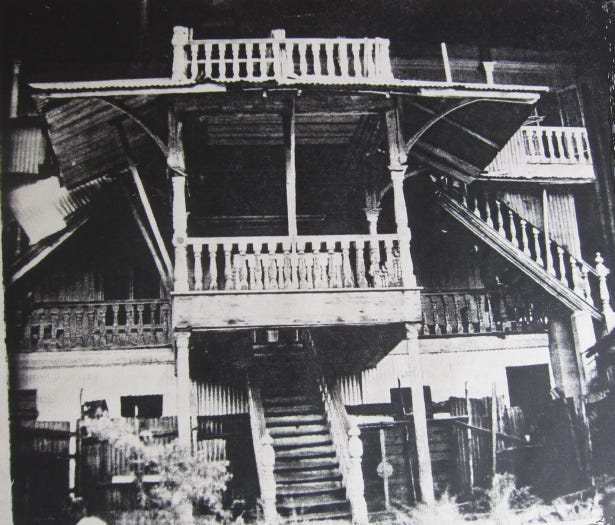
Prince Archibong’s House, Duketown, Calabar, undated photograph (Source: National Museum at the Old Residency, Calabar, Nigeria). Image reproduced by Joseph Godlewski
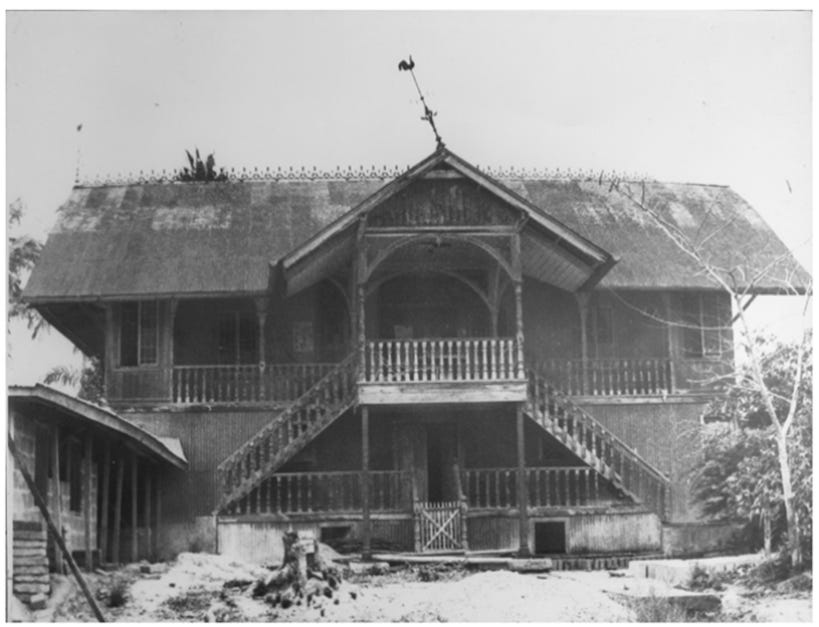
House of Chief Ekpo Udo-Iko, Creek Town, Calabar, photograph, 1898, NCMM Archive.
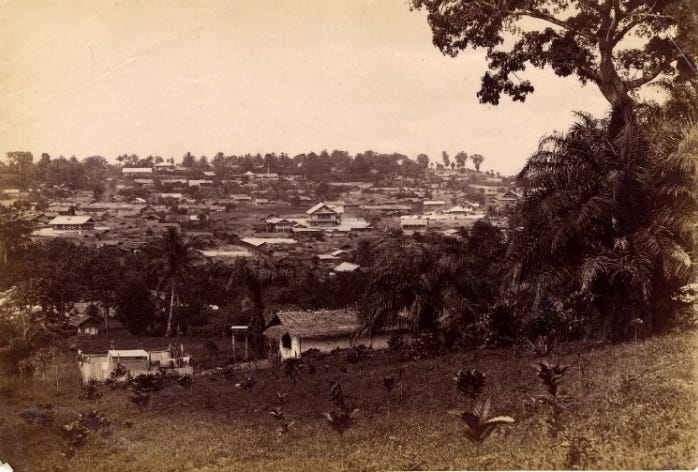
‘Native Settlement, Old Calabar. View of Government Hill from Mission Hill (1890-1905) (Source: The British Museum, Af,A47.7). View of native town of Old Calabar showing a settlement of thatched rectangular shelters and corrugated iron shelters with two to four stories’ Image and Caption by Joseph Godlewski
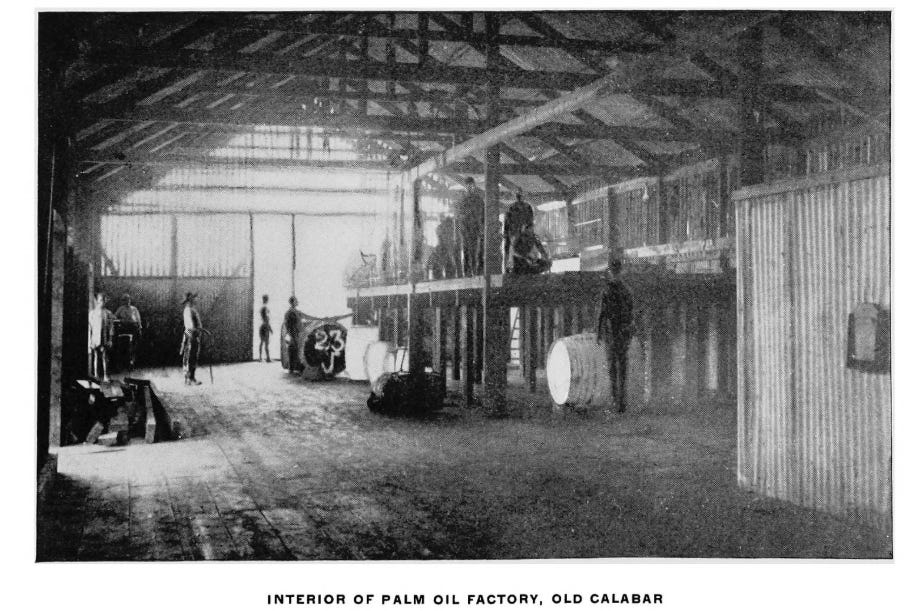
Interior of a Palm Oil factory, Old Calabar, ca. 1890. Joseph Hankinson Reading.
Old Calabar’s share of the export trade was later reduced by the emergence of Bonny, whose exports rose from a few hundred tonnes in 1812-17 to 7,000-8,000 tons by the late 1840s, and 12,421 tons by 1851.27
At the heart of the Oil trading system of Bonny was the ‘canoe house,’ a lineage system that was transformed for trading, military, and political purposes. At its simplest, it was a house able to maintain a war canoe, which in turn absorbed non-lineage members including migrants, clients, and slaves, who rose in seniority on the strength of their abilities.
The Amanyanabo (King) William Dappa Pepple, who ascended the Bonny throne in 1837, is remembered as an immensely successful oil trader who opened new inland markets for the oil trade. His reign was marked by a great rivalry between the two major Houses of Manilla Pepple and Anna Pepple, and between them and his own House. He controlled the external trade, including the credit/trust contracts with the European traders and the taxes/coomey they paid.28
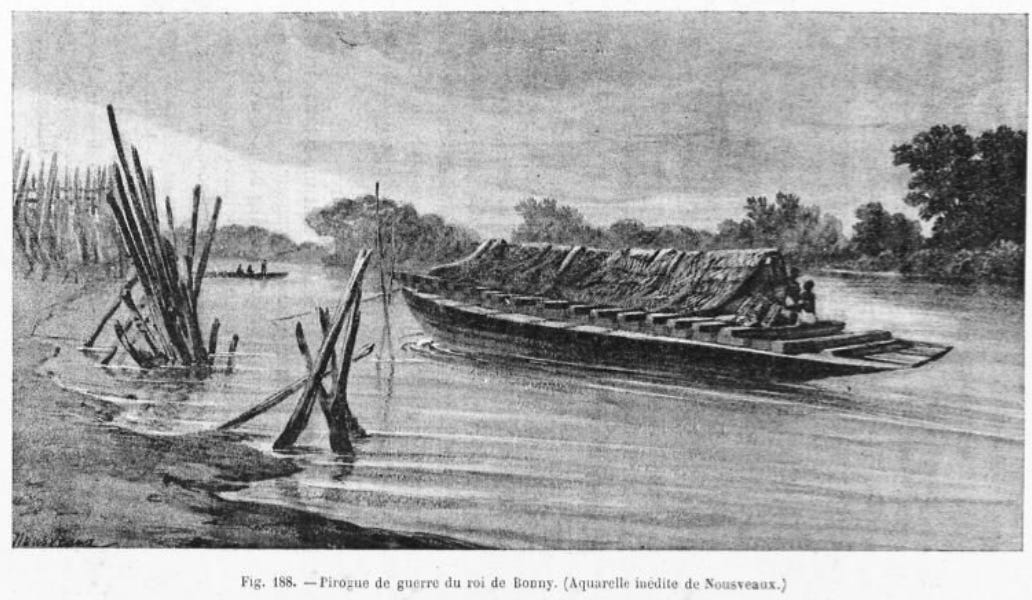
King of Bonny’s War Canoe. taken from ‘Côte occidentale d’Afrique : vues, scènes, croquis’ ca. 1890
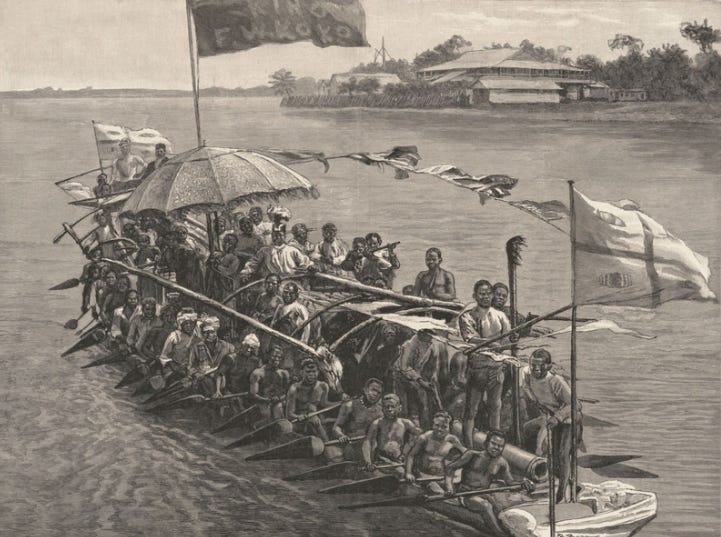
King Koko of Nembe (Brass) in His War Canoe on His Way down the River, from The Daily Graphic of March 30, 1895
Three other ports in the Bight of Biafra were to develop important roles in the trade as it expanded during the 1830s and 1840s. One of these was Brass, which exported about 2-2,500 tons by the 1850s. Another such port was Bonny’s neighbour, Elem Kalabari (New Calabar), whose market was served by the same traders operating at Bonny. The last was the coast of Cameroon, whose export trade grew from just 50-60 tons pa in 1810s to 1,000-2,000 by the 1850s.29
The Bight of Biafra ports remained the heart of the trade from its first growth in the 1810s through to the middle of the century and beyond, providing over half of British imports. Yet the Bight of Biafra’s proportionate contribution to West African exports declined as the expansion of this period brought new ports into the trade, particularly after 1830.
In the hinterland of Cameroon, the quintessential precolonial middlemen were the Duala of the Wouri estuary who monopolised trade with the interior, and controlled the provision of trust from European coastal traders. ‘Kings’ such as Bell and Akwa emerged by the 19th century as the major traders of the area with their own capitals in the estuary; from these they organised their trade up the Wouri, Dibombe, and Mungo Rivers into the interior to collect oil.30
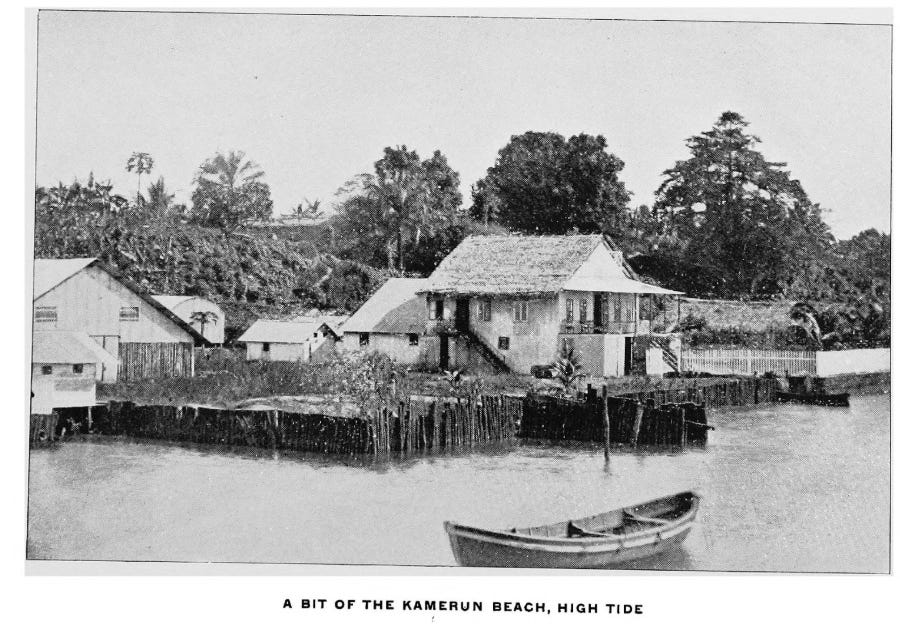
Cameroon, ca. 1890. Image by Joseph Hankinson Reading.
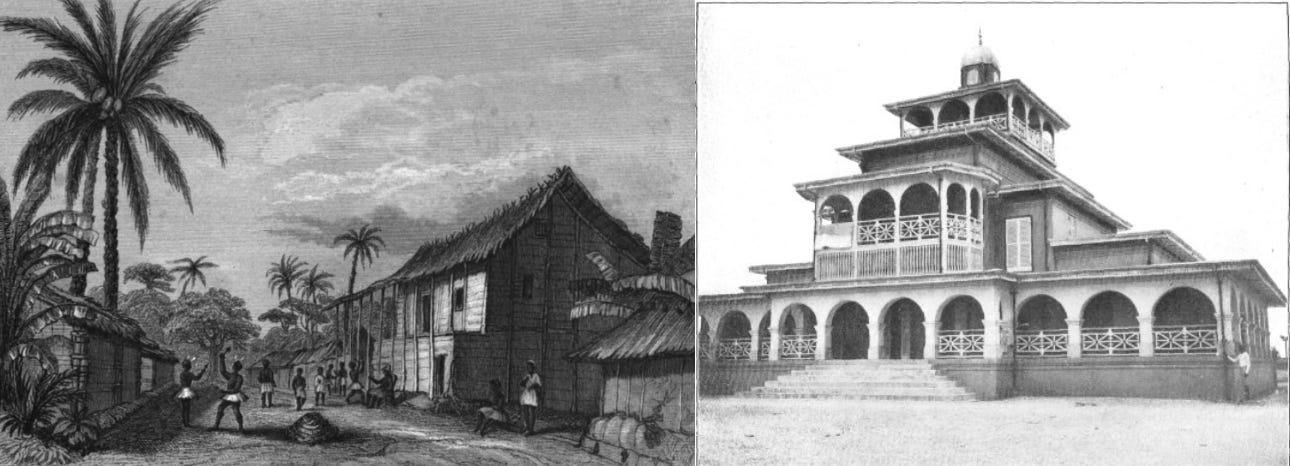
Palace of the Doula King Bell in 1841 and its 1905 reconstruction.
The Bight of Benin began to contribute considerable quantities from the 1830s, rising to 30% of British imports by the 1850s. Exports mainly came through the ports of Itsekiri and Badagry, while the inland kingdom of Dahomey sold as much as 2,000 tons pa through Ouidah. From the 1840s, the Gold Coast was providing around 10%, some coming from the inland kingdom of Asante, with exports rising from 248 tons in 1810 to 2,228 tons by 1845.31
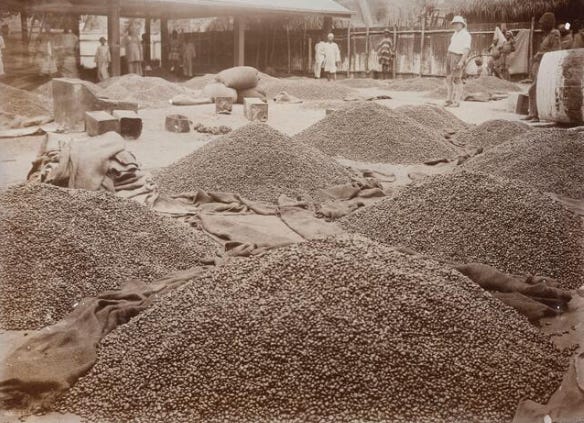
‘A.O.N. yard Badagry Sept 1927. Showing palm kernels down for inspection before buying’
Elsewhere, the Windward Coast ( Sierra Leone, Liberia, Côte d'Ivoire), and the South Coast from Gabon to Angola were late to develop and provided less than 5% each to British imports by the mid-19th century, although significant exports were sent to France and other regions.
In Sierra Leone, a long-established trading network existed whereby Temne, Limba, and Mende traders brought produce to the coast. This system operated around ‘landlord/stranger’ relationships whereby African traders on the coast would provide hospitality for traders arriving from the interior. By the 1840s, Krio traders from Freetown became more settled in markets in the interior, replacing local traders in the produce and oil trade of this area.32
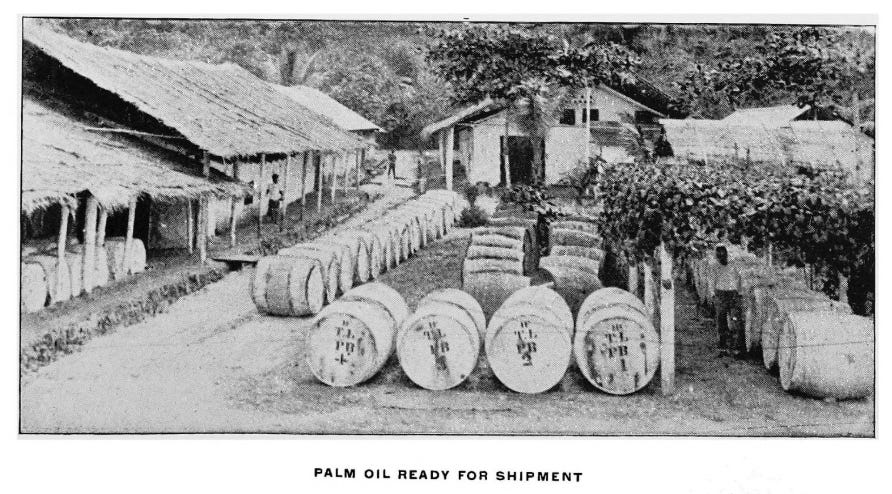
Palm Oil ready for Shipment. Gabon, ca. 1890. Joseph Hankinson Reading
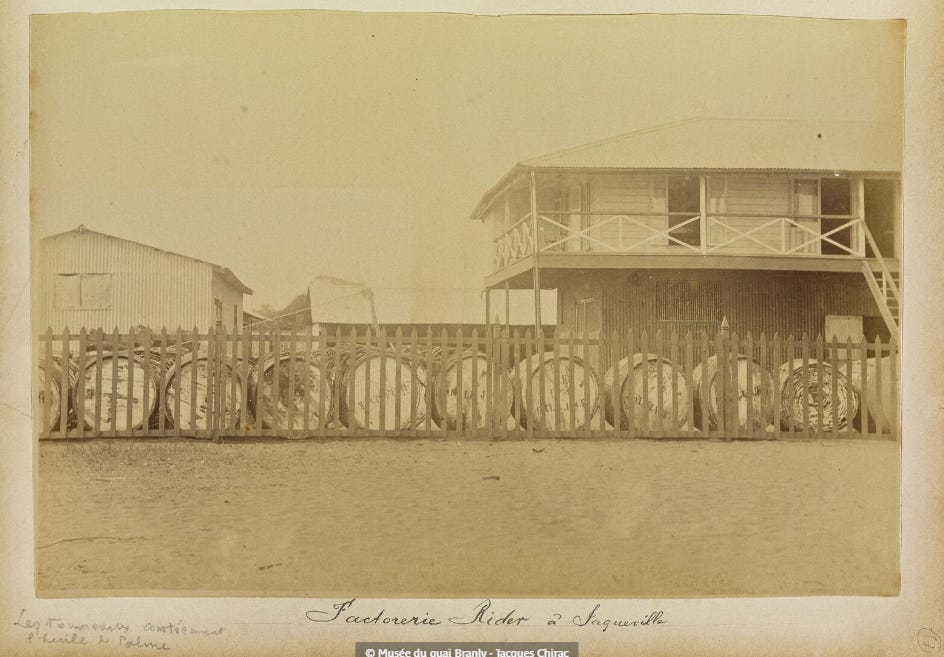
Rider Trading Post with barrels of palm oil, ca. 1893-1925. Jaqueville, Côte D’ivoire. Quai Branly
Trade wars and expansion of credit in the Oil economy of the late 19th century.
Coastal trade in most parts of the delta operated on the basis of ‘trust’, ie; credit in goods given by the European trader to the African middleman to sell in the interior markets for oil, which he would then deliver to the waiting agent on the river.
Large sums of credit could be involved in trust, often provided in the form of trade goods. In some of the Delta ports, individual traders received from between £3,000 and £5,000 worth of credits. At Bonny in 1855, British goods given on trust to Bonny traders were over £80,000. Old Calabar was an area where trust appears to have become particularly inflated: over £200,000 was owed in trust in 1851 and reportedly over £400,000 by 1857. 33
(** £1,000 in 1855 is equivalent to approximately £140,000 today)
The types of trade goods demanded varied from area to area, including cowrie-shell currency, especially in Yorubaland and Dahomey, cotton textiles (initially from India, later from Britain but also local West African cloth), and other items such as firearms, salt and copper, especially in Calabar, where it was used in the making of brass artworks.34
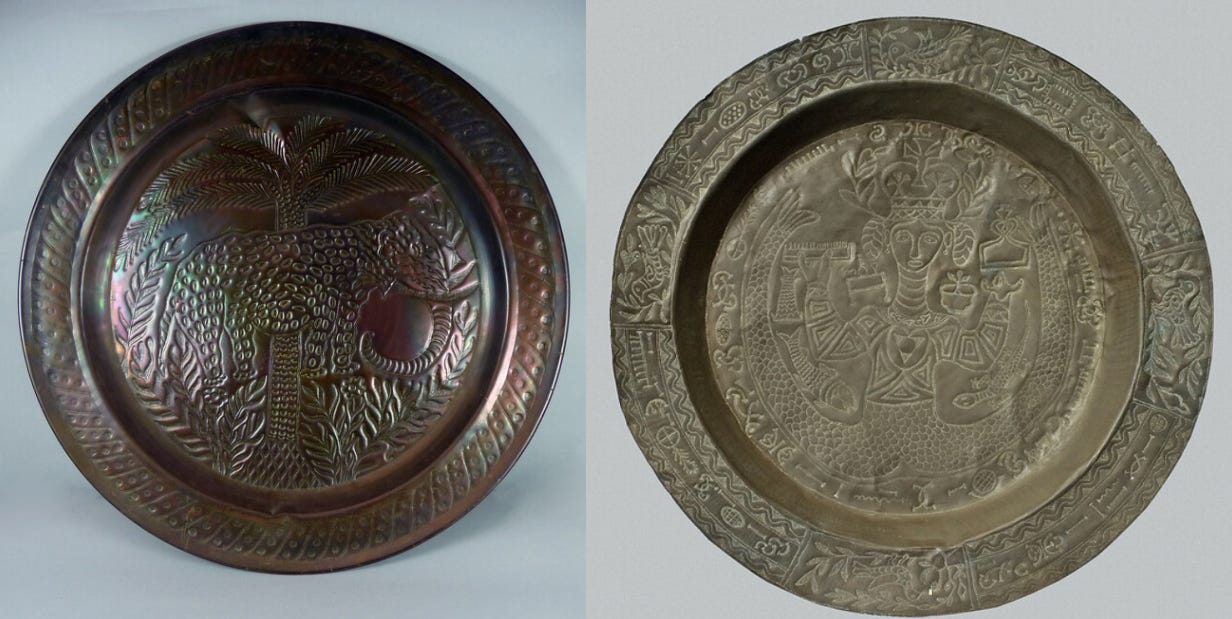
(left) Circular brass tray decorated with an elephant standing in front of a palm tree (right) Brass dish decorated with a punched design featuring a mermaid in the centre with a bifurcated scaly tail and wearing a crown, encircled by Nsibidi symbols. Early 20th century, Pitt Rivers Museum.
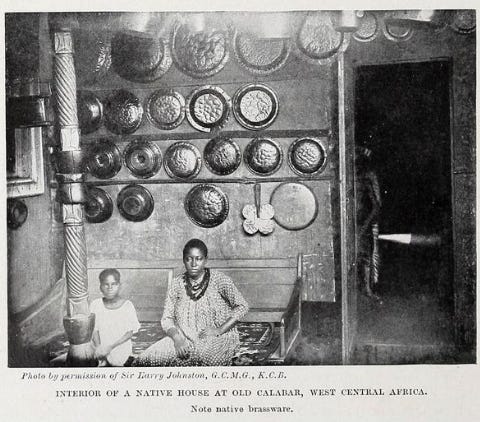
Interior of a Native House at Old Calabar, West Central Africa. Note Native Brassware. Taken from ‘The living races of mankind’ ca. 1902
The oil trade in the Delta involved a mutually beneficial relationship between African and European traders that was recognised as benefiting both. Various mechanisms developed to cement these ties, such as the use of ‘pidgin’ (a modified form of English) and the sending of the sons of traders to England for education. All of these methods had been in place before the 19th century.35
While it was in the interest of both parties to maintain the trade, the system of trust could lead to considerable friction, as markets at times ended up with far more credit than could ever be returned in oil in several years.
The consequences of this credit inflation were, at best, considerable delay, at worst, violence, as some European traders at times seized oil they felt was owed to them, and, in the later years, called for direct political intervention by consuls (representatives of their governments at the coast).36
The transition to oil exports in the 19th century from the slave trade of the preceding period was initially thought to have marked a break in West Africa’s economic history. Mass-produced imports became accessible to large numbers of people, and production came to include non-elites and smaller-scale producers, generating linkages that spread widely in the interior.37
However, more recent scholarship has shown that it was mostly established elites, rather than new entrepreneurs, who could take advantage of the economies of scale in the organisation of labour; transportation using large canoes, and the marketing of oil to European buyers. There was therefore no crisis of adaptation to the new trade, since these economic changes occurred within pre-existing patterns of exchange.38
Although the second half of the century saw continuing growth in the volume of the oil trade between West Africa and Britain, these increases in volumes did not compensate for the fall in prices of this period. The value of British imports of palm oil fell over the period from £1,697,803 in 1855 to £872,588 in 1899.
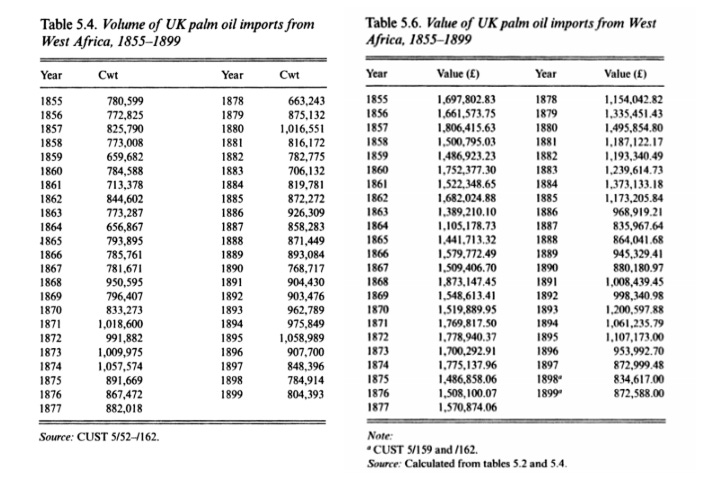
Palm Oil trade in the second half of the 19th century. Tables by Martin Lynn
This was largely due to the introduction of the new freight services via the steamship, which opened the oil trade to new, smaller traders, both European and African, and increased competition within it.
Ultimately, the main threat on the supply side came from the discovery of major sources of mineral oil (petroleum) in Pennsylvania in 1859. Petroleum, together with its derivative kerosene, was rapidly to replace other oils in the illumination and lubrication market, first in the US, and later in Britain.39
These pressures had important effects on palm producers, squeezing their incomes and obliging farmers to develop new strategies to deal with them.
The decline in prices was partially offset by the growing trade in palm kernel oil, which had previously been discarded as a byproduct of the oil processing. Other traders moved into new commodities like Cocoa and rubber, while those who stayed in the oil trade initially attempted to increase supplies to offset the slump in prices.
European traders now moved inland, establishing “floating factories” that were essentially old, disused ships (hulks) run by resident agents, and on which oil could be bulked while waiting for the steamers. Burton estimated that up to 1,000 Europeans were living in the Delta in 1864.40
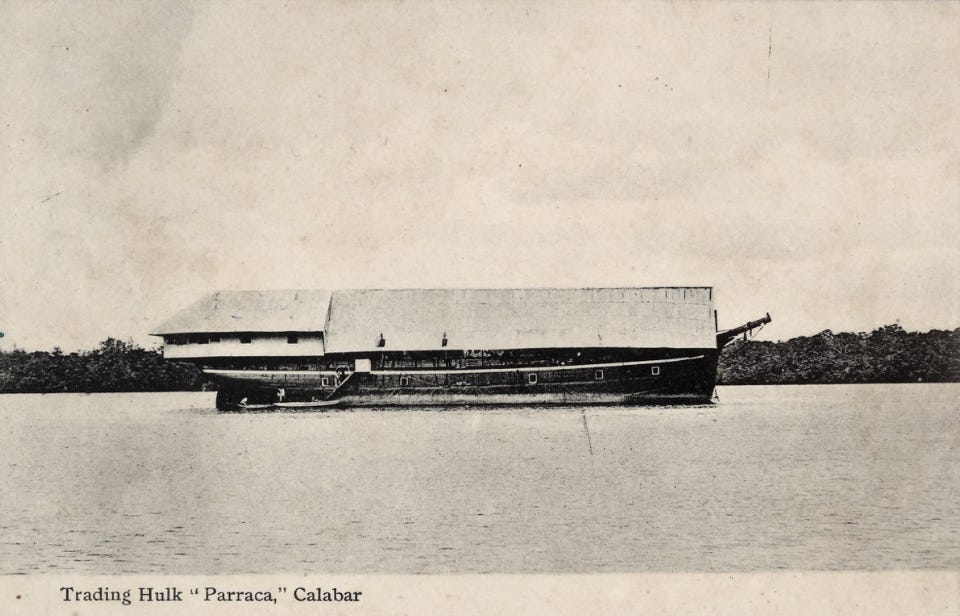
Trading Hulk ‘Parraca’, Calabar. ca. 1919 - 1932. MAA, Cambridge.
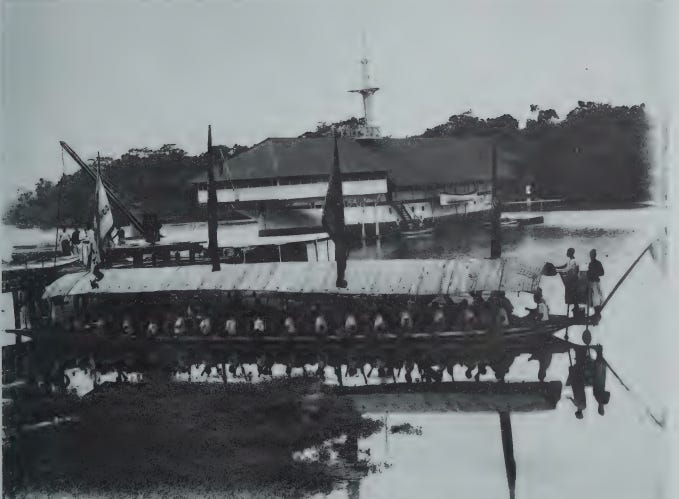
Comparative size of the Delta War Canoe and a trading Hulk: ‘Chief Dore’s canoe and the government hulk, Sapele, 1896. Rhodes House Library, MS. Afr. R239 No. 2. Photograph © Bodleian Library, Oxford, UK.’
The reputation of these European traders, often called “palm oil ruffians,” was decidedly negative;
According to one report, the whites in the trade were “ignorant, brutal men with a crew of ruffians who, when drunk, were like dangerous wild beasts —a crew that had to be ruled with a rod of iron and were only kept under control by threats of having their brains blown out by the ever ready pistol.” adding that “The way in which those traders treated the natives was simply regulated by the power of the natives to avenge ill-treatment.”41
Another report noted that British officials castigated the European palm oil traders specifically in Cameroon for “showing them [local Africans] every day examples of fraud, drunkenness and violence accompanied by the most infamous and abusive language.’’42
Their floating factories became centres of large expatriate African communities such as the Krio from Sierra Leone, estimated at 2,000-3,000 in the Delta area in 1871. Some of the Krio traders competed with European traders, who inturn, thwarted the former’s attempts to utilise the steamships to export oil directly to Britain.
Incidentally, the increasing populations of European traders resulted in the decrease of social interactions with their African counterparts beyond the trade, and attempts to undermine African authorities, who in turn greatly restricted their stay and movements outside the ships, at times violently.43
At the beginning of the intense competition between African and European traders in Old Calabar, King Eyo II of Creek Town began sending oil directly to Britain on the steamer service between 1855 and 1857 using the Krio as his agents. European traders, threatened by this alliance, seized the cargo, claiming that the oil involved represented unpaid debts.
In 1857, Eyo chartered a brig (two-mast sailing ship) from Liverpool, the Olinda, which shipped oil directly to Britain in his own name. European traders again claimed that the oil represented unpaid debts, blaming the Scottish Presbyterian missionaries for encouraging Eyo. Unfortunately, Eyo II passed away in December 1858, a few months after his brig had returned.44
Similar attempts by West African traders to ship oil directly to Britain, or purchase steamboats to transport larger quantities of oil down the rivers, were frustrated by opposition from European competitors or bankruptcy, as in the case of John Ocansey of Ghana.
Ocansey famously travelled from his native Ghana to England in order to collect a bad debt of £2,678 ( £416,000 today) from the Liverpool-based trader named Robert W. Hickson, who had misappropriated the money meant for the purchase of a steamboat.
[ see my previous article on ‘Chasing English debtors: the travel account of a West African trader in 19th-century England’ ]
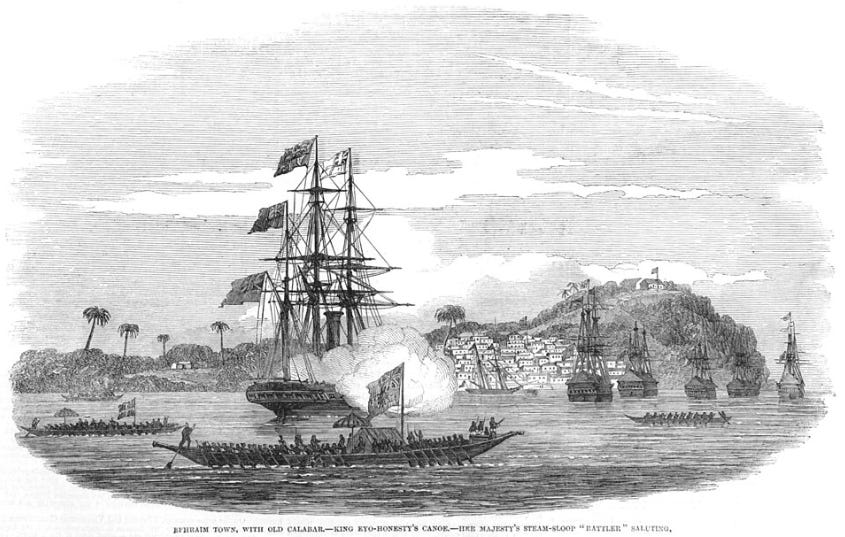
Ephrahim Town, with Old Calabar. King Eyo-Honesty’s canoe. Her Majesty’s Steam-sloop Rattler saluting. Illustration for The Illustrated London News, 22 June 1850.
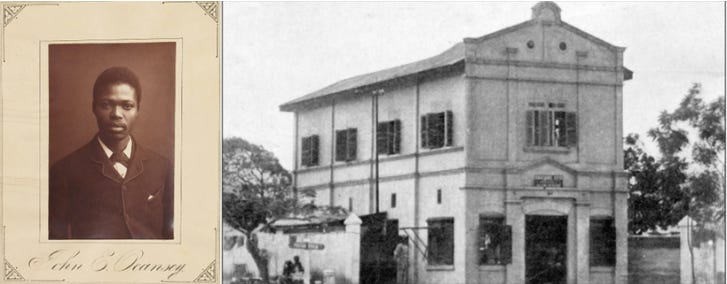
Portrait of John E. Ocansey in Liverpool and one of the family properties in Ghana.
Eyo’s failure meant that the role of intermediaries and producers was to remain circumscribed; the frontier of the trade war was to remain in Africa rather than being brought to Britain, and Africans were not to be allowed to get a footing in the oceanic trade of these years. The coastal traders of West Africa were not to become the capitalist class that would transform the region’s economy.
As the trade began to change under the impact of the steamer services, violent clashes between British and African traders and authorities became much more common, especially over taxes, credit, and the conduct of trade.45
British traders increasingly appealed to the consul, whose authority, often in the form of treaties, began to encroach upon the authority of the African sovereigns. African traders responded by forming alliances to stop trade and cut off provisions to the floating factories until they could obtain favorable terms. As a last resort, African armies halted the advance of the European competitors inland, often by shooting at the latter’s ships, or simply by putting on a show of force during negotiations.46
The severe fall in produce prices and the adverse shift in the terms of trade of the 1880s and 1890s were a new kind of threat and were seriously to affect the incomes of African traders. Attempts were made by African traders in Bonny and Brass in this period, and, most famously, by King Jaja of Opobo between 1885 and 1887 to use steamer services to trade directly with Europe.
Jaja seceded from Bonny in 1869 to establish Opobo state, becoming one of the most consummate oil African traders of the Delta. When new European traders tried to undercut his trade by moving inland and operating a price ring against Jaja to force prices down, Jaja attempted to ship his oil directly to Britain.
The companies compelled the British consul to intervene, initially by refusing to pay coomey, and later by a failed attempt at forcefully moving inland. Jaja was kidnapped, taken to Accra, and deported by the British vice-consul Harry Johnston in 1887.47
During his absence from Opobo, Johnston and successive British consuls tried in vain to break up his commercial organization by using gun-boats to beat down local opposition and escort British merchants to the inland sources of Jaja’s supplies of raw materials without the benefit of the services of Jaja’s commercial organization. The effort failed after six years of losses, and the British firms sold out to Jaja’s men in 1893 and were forced back to the coast.48
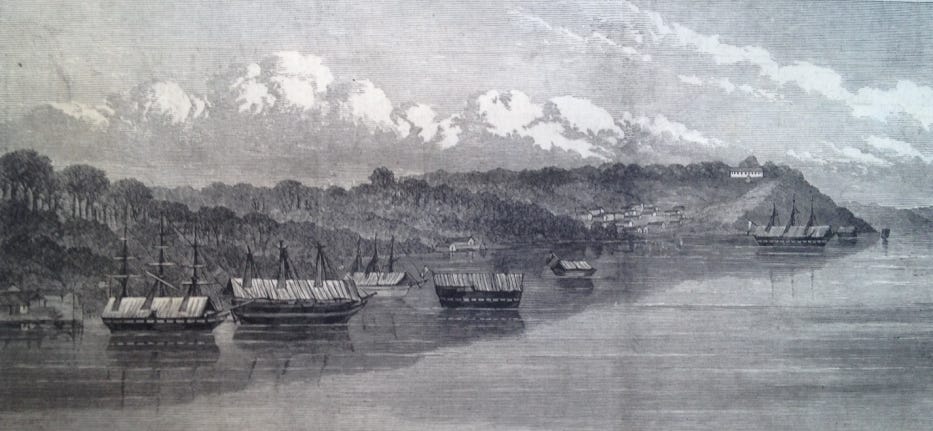
Old Calabar, West Coast of Africa (1873) (Source: Illustrated News of London, October 18, 1873. 376). Image reproduced by Joseph Godlewski
Epilogue: Twilight of the Palm Oil industry, Colonial rule and the rise of Unilever.
In the last decade of the 19th century, European traders at the coast came to see political intervention as a solution to the economic problems facing their side of the trade. This push for intervention was intensified by the colonial scramble as French and German interlopers competed with established British firms along the coast for both territory and market share.49
In 1891 the Oil Rivers Protectorate (from 1893 the Niger Coast Protectorate) was established, with its headquarters at Old Calabar. Among its first actions were to set duties on imports into the protectorate and to abolish the coomey tax paid to African authorities, replacing it with subsidies to chiefs. Over the following years, the colonial administration pushed deep inland, culminating with the invasion of Nembe in 1895.50
The imposition of colonial administration — British, French, and German — in the coastal regions of West Africa during the 1890s marked the end of an economic era.
While it would take several years before the powerful coastal African traders disappeared, their role in the oil trade had ended. Their financial power was usurped by European commercial agents, who became the principal beneficiaries of the early 20th-century oil boom, at least until the interwar period and the Great Depression of 1929.51
The most prominent among these European firms were the conglomerates U.A.C. and Lever Brothers, which eventually became Unilever in 1930 after merging with the Dutch company Margarine Unie.
As these businesses merged and became multinational, they became increasingly detached from the African peasants from whose labor their wealth was extracted.
These companies’ fortunes were originally built on the trade in southern Nigerian palm oil and palm-kernels. William Lever, the founder of Lever Brothers in 1885, was one of the European traders who took over the markets previously dominated by African traders like Jaja. 52
Near the end of the colonial period, South-East Asia became a major competitor in the global market for palm oil, after the introduction of high-yielding varieties from West Africa in 1917, and the neglect of the palm oil industry in colonial Nigeria.
By 1966, Malaysia had overtaken Nigeria as the world’s largest exporter of Palm Oil, and the latter’s share of global production steadily declined in the post-colonial period, as focus was directed to the nascent trade in Crude Oil.53
The emergence of the palm oil trade illustrates the broader development of international commodity markets during the 19th century and the crucial role of West African tropical products in the Industrial Revolution.
It also highlights the integration of African producers and traders into that world market; one in which attempts by Africans to benefit from their resource wealth were curtailed by foreign commercial interests, colonial conquest, and the asymmetrical economic relationships that continue to the present day.

Adapalm, Imo State, Nigeria.
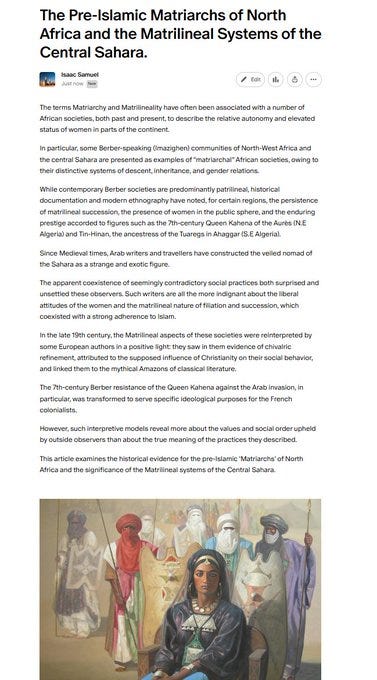
In pre-Islamic North Africa, powerful historical figures like Queen Kahena of the Aurès (N.E Algeria) and Tin-Hinan, the ancestress of the Tuaregs in Ahaggar (S.E Algeria), greatly shaped the cultural traditions of Berber-speaking groups.
My Latest Patreon Article examines the historical evidence for the pre-Islamic ‘Matriarchs’ of North Africa and the Matrilineal systems of the Central Sahara.
Please subscribe to read about it here:
Map by A.G.Hopkins
The Voyages of Cadamosto and Other Documents on Western Africa in the Second Half of the Fifteenth Century, by Alvise Cà da Mosto, pg 43
Esmeraldo de Situ Orbis by Duarte Pacheco Pereira, pg 128. Benin and the Europeans, 1485-1897, by Alan Frederick Charles Ryder, pg 58, 64, 201-202
Commerce and Economic Change in West Africa: The Palm Oil Trade in the Nineteenth Century, by Martin Lynn, pg 1
Excavations at Gao Saney: New Evidence for Settlement Growth, Trade, and Interaction on the Niger Bend in the First Millennium CE by Mamadou Cissé, Susan Keech McIntosh, pg 177, 235
The Mande Blacksmiths: Knowledge, Power, and Art in West Africa by Patrick R. McNaughton, pg 114-120. African-American Exploration in West Africa Four Nineteenth-Century Diaries, edited by James Fairhead, pg 324
Benin and the Europeans, 1485-1897, by Alan Frederick Charles Ryder, pg pg 133, 221, 235-238. Ouidah: The Social History of a West African Slaving ‘port’, 1727-1892 By Robin Law pg 84. Old Calabar, 1600-1891: The Impact of the International Economy Upon a Traditional Society by A. J. H. Latham, pg 55-56
Maritime Empires: British Imperial Maritime Trade in the Nineteenth Century, edited David Killingray, Margarette Lincoln, Nigel Rigby, pg 14
Bosumpra revisited: 12,500 years on the Kwahu Plateau, Ghana, as viewed from ‘On top of the hill’, by Derek J. Watson. pg 459
Commerce and Economic Change in West Africa: The Palm Oil Trade in the Nineteenth Century, by Martin Lynn, pg 1-2
Commerce and Economic Change in West Africa: The Palm Oil Trade in the Nineteenth Century, by Martin Lynn, pg. 47- 49
A History of the Yoruba People by Stephen Adebanji Akintoye, pg 42
Commerce and Economic Change in West Africa: The Palm Oil Trade in the Nineteenth Century, by Martin Lynn, pg. 41-43
Commerce and Economic Change in West Africa: The Palm Oil Trade in the Nineteenth Century, by Martin Lynn, pg 3, 14-17.
Trade between Western Africa and the Atlantic World in the Pre-Colonial Era, by David Eltis and Lawrence C. Jennings, pg 942-959
Commerce and Economic Change in West Africa: The Palm Oil Trade in the Nineteenth Century, by Martin Lynn, pg 35-37. Old Calabar, 1600-1891: The Impact of the International Economy Upon a Traditional Society, by A. J. H. Latham, pg 86
Commerce and Economic Change in West Africa: The Palm Oil Trade in the Nineteenth Century, by Martin Lynn, pg 37
Ouidah: The Social History of a West African Slaving ‘port’, 1727-1892 By Robin Law pg 213. Commerce and Economic Change in West Africa: The Palm Oil Trade in the Nineteenth Century, by Martin Lynn, pg 39-40.
Commerce and Economic Change in West Africa: The Palm Oil Trade in the Nineteenth Century, by Martin Lynn, pg 66
Wheeled Transport in Pre-Colonial West Africa by Robin Law, pg 255. Commerce and Economic Change in West Africa by Martin Lynn, pg 66, Afro-European Trade in the Atlantic World: The Western Slave Coast, C. 1550-c. 1885, by Silke Strickrodt, pg 215-217
Old Calabar, 1600-1891: The Impact of the International Economy Upon a Traditional Society, by A. J. H. Latham, pg 69. Commerce and Economic Change in West Africa: The Palm Oil Trade in the Nineteenth Century, by Martin Lynn, pg 14-17
Old Calabar, 1600-1891: The Impact of the International Economy Upon a Traditional Society by A. J. H. Latham, pg 58-59. Change and Continuity in the British Palm Oil Trade with West Africa, 1830-55 by Martin Lynn, pg 333
Old Calabar, 1600-1891: The Impact of the International Economy Upon a Traditional Society, by A. J. H. Latham, pg 65-66
Maritime Empires: British Imperial Maritime Trade in the Nineteenth Century, edited David Killingray, Margarette Lincoln, Nigel Rigby, pg 27-28
Old Calabar, 1600-1891: The Impact of the International Economy Upon a Traditional Society, by A. J. H. Latham, pg 84, 96-102
Emergent Protozones: A Genealogy of Zoning Architectures in Calabar, Nigeria By Joseph Michael Godlewski pg 116-127. Reconstructing the Historical Layers of a Colonial Prefabricated Wooden House in Old Calabar (1886–2012): Evidence-Based Workflow for Architectural Restoration by Obafemi A. P. Olukoya
Old Calabar, 1600-1891: The Impact of the International Economy Upon a Traditional Society, by A. J. H. Latham, pg 67
Maritime Empires: British Imperial Maritime Trade in the Nineteenth Century, edited by David Killingray et al., pg. 25- 26. Commerce and Economic Change in West Africa: The Palm Oil Trade in the Nineteenth Century, by Martin Lynn, pg 62
Commerce and Economic Change in West Africa: The Palm Oil Trade in the Nineteenth Century, by Martin Lynn, pg 21-22
Middlemen of the Cameroons Rivers: The Duala and Their Hinterland, C.1600-c.1960 By Ralph A. Austen, Jonathan Derrick
Afro-European Trade in the Atlantic World: The Western Slave Coast, C. 1550-c. 1885, by Silke Strickrodt, pg 210-214. Commerce and Economic Change in West Africa: The Palm Oil Trade in the Nineteenth Century, by Martin Lynn pg 22-24.
Commerce and Economic Change in West Africa: The Palm Oil Trade in the Nineteenth Century, by Martin Lynn pg 24-25, 64
Trade and Politics in the Niger Delta 1830-1885: An Introduction to the Economic and Political History of Nigeria By Kenneth Onwuka Dike, pg 102-103. Commerce and Economic Change in West Africa: The Palm Oil Trade in the Nineteenth Century, by Martin Lynn pg 68-70
From Slave Trade to ‘Legitimate’ Commerce: The Commercial Transition in Nineteenth-Century West Africa edited by Robin Law, pg. 199. Afro-European Trade in the Atlantic World: The Western Slave Coast, C. 1550-c. 1885, by Silke Strickrodt, pg 218-220. Old Calabar, 1600-1891: The Impact of the International Economy Upon a Traditional Society by A. J. H. Latham, pg 69, 73-74, 76-78.
Commerce and Economic Change in West Africa: The Palm Oil Trade in the Nineteenth Century, by Martin Lynn pg 73-74
Old Calabar, 1600-1891: The Impact of the International Economy Upon a Traditional Society, by A. J. H. Latham, pg 50-62
Trade and Politics in the Niger Delta, 1830–1885, by Kenneth O. Dike. The Compatibility of the Slave and Palm Oil Trades in the Bight of Biafra, by David Northrup
From Slave Trade to ‘Legitimate’ Commerce: The Commercial Transition in Nineteenth-Century West Africa edited by Robin Law. Commerce and Economic Change in West Africa: The Palm Oil Trade in the Nineteenth Century, by Martin Lynn, pg 58-59, 78-80)
Commerce and Economic Change in West Africa: The Palm Oil Trade in the Nineteenth Century, by Martin Lynn, pg 110-117
Commerce and Economic Change in West Africa: The Palm Oil Trade in the Nineteenth Century, by Martin Lynn, pg 118-127, 128-134. An Economic History of West Africa By A. G. Hopkins, pg 182-183
Proceedings of the Royal Colonial Institute, Volume 20, by Royal Commonwealth Society · 1889, pg 107
Middlemen of the Cameroons Rivers: The Duala and Their Hinterland, C.1600-c.1960 By Ralph A. Austen, Jonathan Derrick, pg 62
Commerce and Economic Change in West Africa: The Palm Oil Trade in the Nineteenth Century, by Martin Lynn, pg 134-135, 140-144. Old Calabar, 1600-1891: The Impact of the International Economy Upon a Traditional Society, by A. J. H. Latham, pg 109-111
Old Calabar, 1600-1891: The Impact of the International Economy Upon a Traditional Society, by A. J. H. Latham, pg 61, 120-121. Trade and Politics in the Niger Delta 1830-1885 By Kenneth Onwuka, pg 122-124. Dike Commerce and Economic Change in West Africa: The Palm Oil Trade in the Nineteenth Century, by Martin Lynn, pg 159-160
From Slave Trade to ‘Legitimate’ Commerce: The Commercial Transition in Nineteenth-Century West Africa edited by Robin Law, pg 71-72
Commerce and Economic Change in West Africa by Martin Lynn, pg 161-168. Old Calabar, 1600-1891, by A. J. H. Latham, pg 80-83. Middlemen of the Cameroons Rivers, By Ralph A. Austen, pg 74-75
Commerce and Economic Change in West Africa: The Palm Oil Trade in the Nineteenth Century, by Martin Lynn, pg 179-180
King Jaja of the Niger Delta: His Life and Times, 1821-1891, By Sylvanus John Sodienye Cookey
Old Calabar, 1600-1891: The Impact of the International Economy Upon a Traditional Society, by A. J. H. Latham, pg 140-143. An Economic History of West Africa By A. G. Hopkins, pg 205-206
Commerce and Economic Change in West Africa: The Palm Oil Trade in the Nineteenth Century, by Martin Lynn, pg 182-183
Peasant Agriculture, Government, and Economic Growth in Nigeria, by Gerald K. Helleiner pg 5–7. The Changing Pattern of Palm Oil Production in Nigeria by Aminu Bakari Buba & Misbahu Sa’idu.
Commercial Revolution in the Niger Delta: A Review Article “King Jaja of the Niger Delta: His Life and Times, 1821-1891 by S. J. S. Cookey; The Trade Makers by P. N. Davies; Oil Rivers Trader by R. G. Clough,” Review by: Walter Ibekwe Ofonagoropg 139-154 Trade and imperialism in southern Nigeria, 1881-1929 by Walter Ibekwe Ofonagoro ·
Chapter 6: Diversification success and failure: Malaysia and Nigeria. In ‘From Reversal of Fortune to Economic Resurgence: Industrialization and Leadership in Asia’s Prosperity and Nigeria’s Regress’ By Banji Oyelaran-Oyeyinka, Oyebanke Abejirin.
Chapter 5, in ‘Technology, Adaptation, and Exports: How Some Developing Countries Got it Right’ by Vandana Chandra.
Thank you for this.
Africa is, indeed, and remains the cradle of civilisation.
We should learn from our rich history and rally around a purpose that restores our dignity.
When we do this, I believe, we will become the cynosure around which a world of good morals fashioned on our Ubuntu principles will be fashioned to achieve universal socio-economic transformation.
Keep up the good work.
Your sourcing and attention to detail are impeccable.