

The invasions of the mysterious “Sea Peoples” have long been regarded as the principal cause of the Late Bronze Age collapse around 1200 BC.
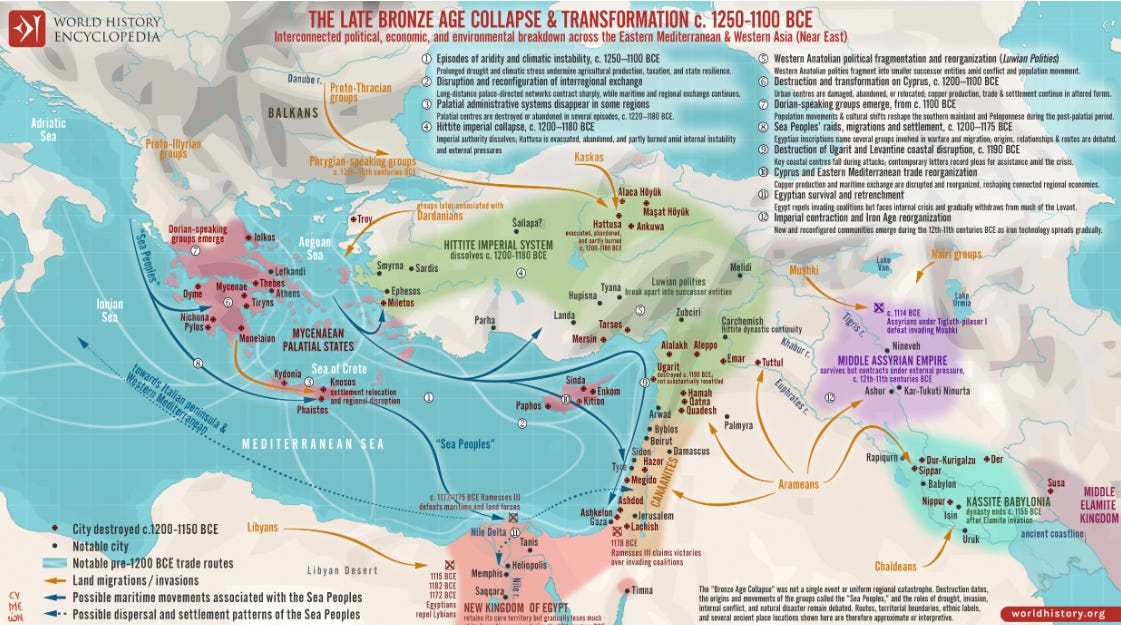
Populations displaced by conflict and drought moved across the region, leaving destruction in their wake. Trade, writing and the construction of monumental architecture declined, as the old civilizations reeled from the upheaval.1
In 1177 BC, during the eighth year of the reign of the Egyptian pharaoh Rameses III, a confederation of “foreign countries” identified as the Peleset, Tjeker, Shekelesh, Denyen, Sherden and Weshesh, invaded the Nile Delta by land and sea.
Then the armies of Rameses defeated the invaders and restored order:
“they were dragged in, enclosed, and prostrated on the beach, killed and made into heaps from tail to head. Those who reached my frontier, their seed is not, their heart and their soul finished forever and ever.”
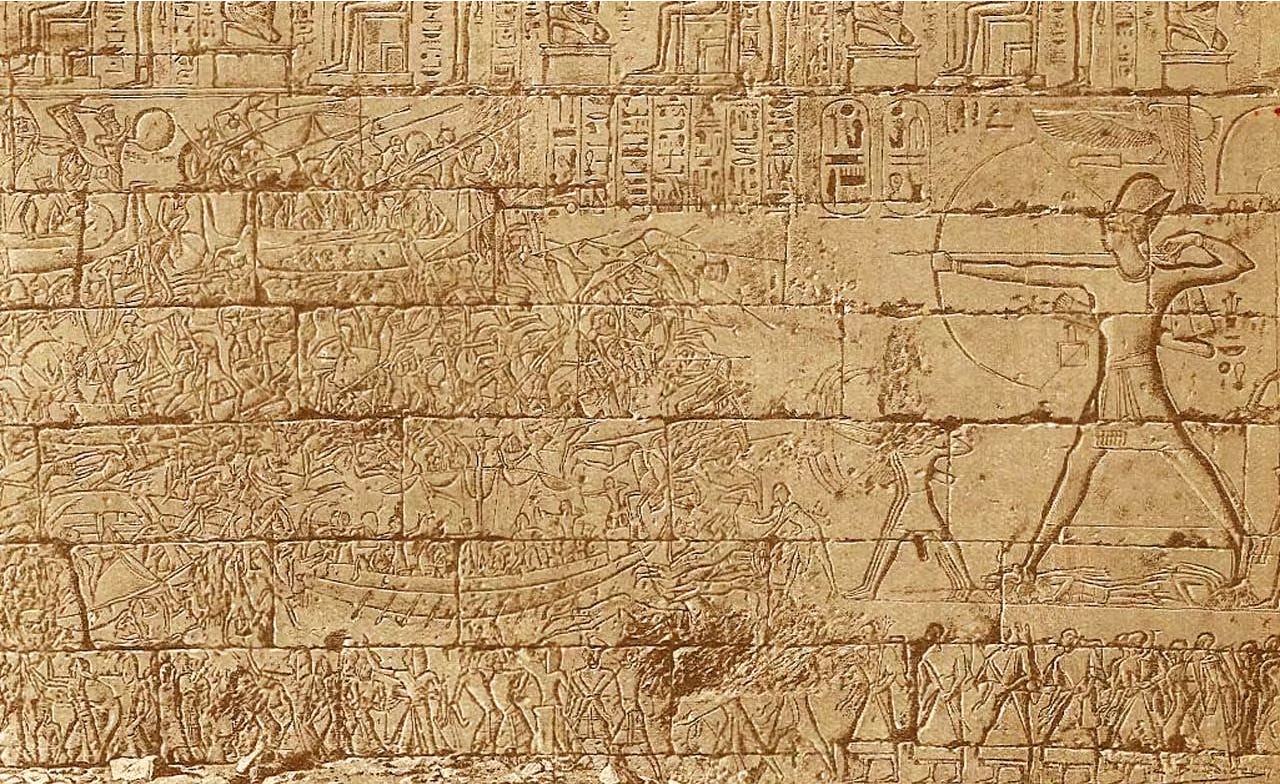
The Medinet Habu relief depicting the naval battle between Ramesses III and the Sea Peoples.
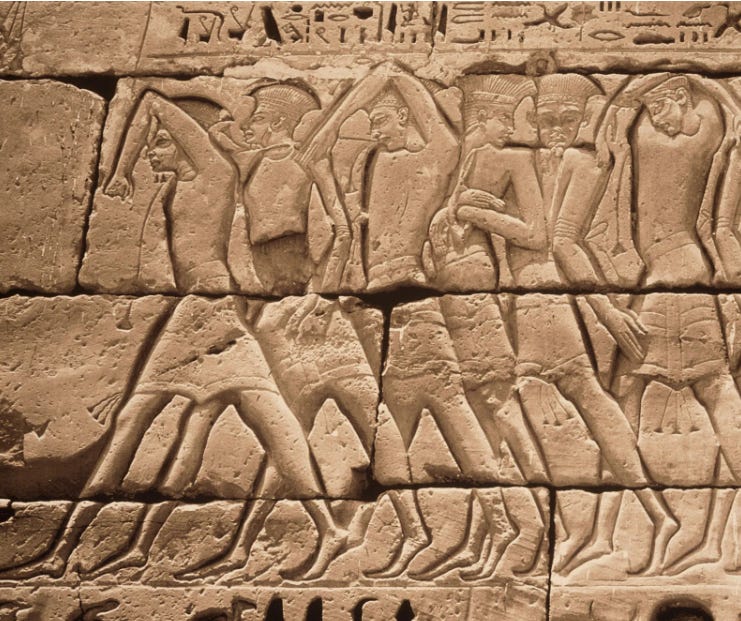
Captive Sea People being led away after an unsuccessful battle against Egypt, from a relief at Ramses III’s mortuary temple at Medīnat Habu, Thebes, Egypt. Werner Forman Archive
The Bronze Age collapse has received much scholarly attention but has never found satisfactory explanation.
While invasions of the “Sea Peoples” from southern Europe and the Mediterranean Islands were an actual historical phenomenon2, it is not clear whether their appearance represented a cause or effect of widespread destabilization that sparked a mass movement of populations.
Modern scholarship has shown that a “perfect storm” of nearly simultaneous calamities brought down the flourishing and interdependent cultures of this period, from the Mycenaeans and Minoans to the Hittites, Cypriots, Mitannians, Canaanites, and even Egyptians.3
According to Rameses’s inscriptions, no country was able to withstand this invading mass of humanity.
However, the collapse did not affect all civilizations equally, and the archaeological record suggests that it unfolded over more than a century rather than in a brief period of chaos lasting only a few decades.4
The Hittite Empire virtually disappeared from history, while Egypt survived, albeit in a considerably diminished form.
Scholars also point out that the inscriptions of Ramesses provide surprisingly little direct evidence for the destruction of most of the places associated with the Sea Peoples, beyond the accounts of the invasions themselves.5
Recent studies emphasize that groups like the Sherden/Shardana were already integrated into the Egyptian army as loyal and reliable mercenaries of the Pharaohs nearly a century before Ramesses repelled an invasion that included the same people.6
‘While the seafaring nature of the Sherden is clear, an effort seems to have been made to downplay the nautical affinities of those who had entered Egyptian service and society. The Sherden in the Egyptian military and society are never referred to as being “of the Sea,” an epithet that appears to be reserved for those fighting against Egypt.’7
Some of the Sea Peoples, therefore, were already established within the very societies in which others of their kind were later identified as invaders. Furthermore, in a continuation of earlier practice, defeated Sea Peoples were not simply expelled but resettled in garrisons across Egyptian territories.8
While a number of technologies were lost, the Sea peoples are credited with the introduction of new naval technologies, such as the brailed rig and loose–footed sail, which was an improvement on the square sail.9
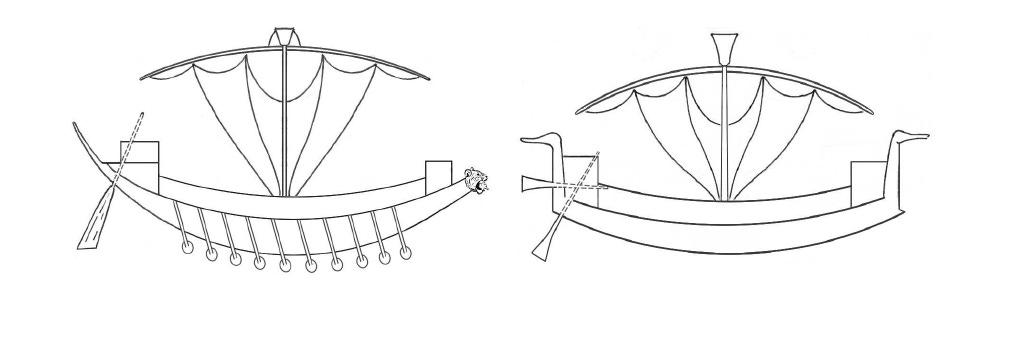
(left) Egyptian ship from the medinet Habu naval batle. (right) Sea peoples ship from the medinet Habu naval batle. Images by J. P. Emanuel.
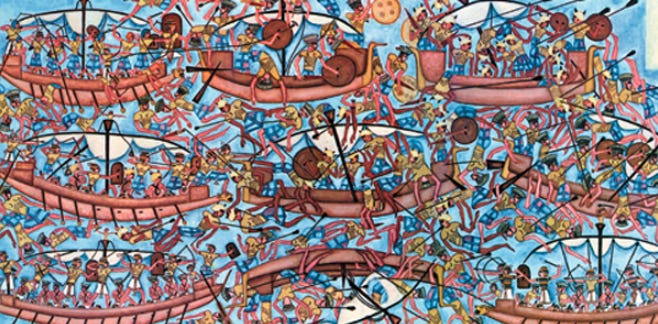
An artist-colored copy of the depiction of the naval battle at Medinet Habu.
The Mediterranean sea thus facilitated the movement of traders, mercenaries, and invaders whose impact on the ancient societies of north-eastern Africa was varied.
The Sea Peoples represented a unique phenomenom in both Global and African history, with few comparable examples of large-scale maritime movements in the ancient world.
Yet such movements were not confined to the Mediterranean. A similarly enigmatic episode unfolded along the East African coast during the Middle Ages, when another group of maritime peoples from across the ocean arrived as raiders, settlers and traders.
Between 1500 BC and 1500 CE, in the largest dispersal of its kind prior to the European “Voyages of Discovery,” Austronesian-speaking groups settled numerous islands over some 26,000 km of ocean, expanding eastwards across the Pacific and westwards across the Indian Ocean to Madagascar.
Beginning in the 9th century, Arab and Persian geographers describe a brief but intense period of Austronesian ascendancy in the Western Indian Ocean, which reached the shores of East Africa in the form of raiders, settlers and traders from Southeast Asia.
They sacked and occupied a number of coastal towns across the western Indian Ocean, and their presence is documented from Sofala (Mozambique) in the south, to Aden (Yemen) in the north.
The Austronesians later became integrated into coastal societies and maritime networks, contributing to the development of local naval traditions. They purchased iron and gold from African traders for export to India, while establishing loose political ties with distant maritime states.
But around 1200 CE, the emerging African coastal polities of Kilwa (Tanzania) and Mogadishu (Somalia) drove back these sea peoples, subjugating some of their settlements and taking control of their trading routes.
This brief period of Austronesian ascendancy bears some resemblance with the Sea peoples in the ancient Mediterranean.
The invasions of these maritime groups triggered the collapse of several medieval coastal towns. Some were looted, while others were abruptly abandoned as their residents moved to larger cities that were better defended.
A layer of destruction dated to the 11th century has been found in a number of archaeological sites along the coast, although only some of them have been attributed to the invasions.
Memories of this period survived in ‘garbled legendary histories’, recounting the violent irruption of the tyrannical ‘Debuli’, who were defeated by Swahili rulers.
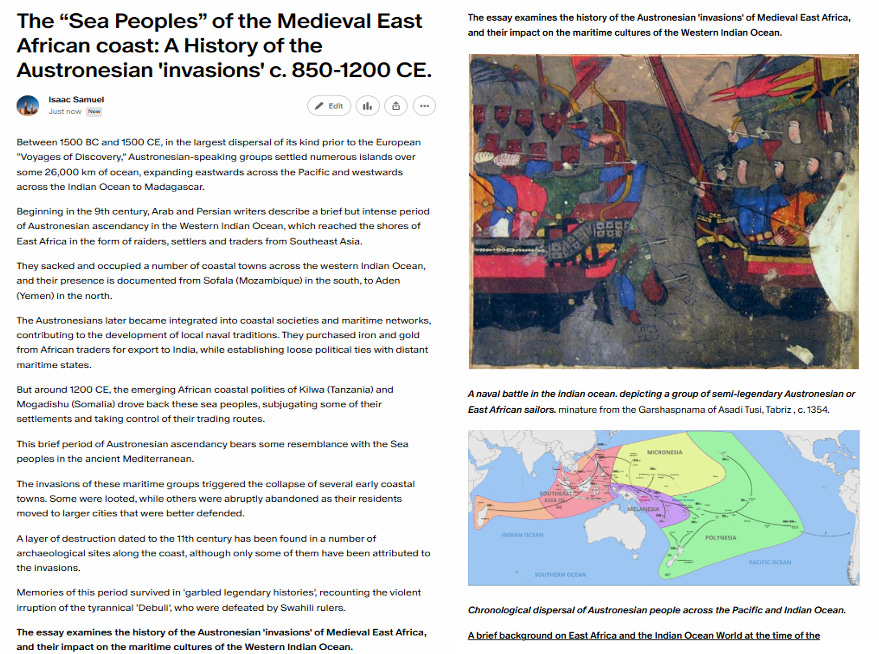
The history of the “Sea Peoples” of Medieval East Africa is the subject of my latest Patreon article:
Please subscribe to read more about it here:
The Sea Peoples and Their World: A Reassessment by Eliezer D. Oren. 1177 B.C.: The Year Civilization Collapsed, by Eric H. Cline. After 1177 B.C.: The Survival of Civilizations by Eric H. Cline.
The Genomic History of the Bronze Age Southern Levant, by Agranat-Tamir et al. Ancient DNA sheds light on the genetic origins of early Iron Age Philistines, by Michal Feldman et al.
Migration Myths and the End of the Bronze Age in the Eastern Mediterranean, by Arthur Knapp. The Sea Peoples: Raiders Who Shattered the Bronze Age World by Murat Smith.
Exchange, Destruction, and a Transitioning Society: Interregional Exchange in the Southern Levant from the Late Bronze Age to the Iron I by Jesse Michael Millek
Destruction and Its Impact on Ancient Societies at the End of the Bronze Age By Jesse Millek.
Mercenaries of the ancient world by Serge Yalichev, pg 22-23, 41-50
Sherden from the Sea: The Arrival, Integration, and Acculturation of a Sea People (Journal of Ancient Egyptian Interconnections 5, pp. 14-27), 2013, by Jeff Emanuel
The Sea Peoples: Warriors of the Ancient Mediterranean, 1250–1150 B.C, by Nancy K. Sandars, pg 165
Sea Peoples, Egypt, and the Aegean: The Transference of Maritime Technology in the Late Bronze–Early Iron Transition (LH IIIB–C) by Jeffrey P. Emanuel