

Among the most refined works of African art are the distinctive white masks of southern Gabon in Central Africa.
Characterized by their kaolin-whitened faces, almond-shaped eyes, elaborate hairstyles, and serene expressions, these masks have long attracted the attention of art collectors and scholars.
Western collectors first encountered them in the late 19th century. Their striking appearance soon captivated European artists, including Pablo Picasso, who prominently displayed one of the masks in his studio.
Many speculated about the sources of their exotic aesthetic and even proposed possible Asian influence based on their resemblance to Japanese masks, though the art form was in fact indigenous to southern Gabon.
Early explorers and missionaries documented their significance to local religious systems and secret societies, but also sought to destroy them and suppress the beliefs with which they were associated.
The few that survived these cultural purges were sold to Western museums, but were an enigma to curators and art critics. Their symbolic meanings remained poorly understood, leaving art historians to speculate about their original functions.
Today, these ‘white’ masks of Gabon are widely recognized and admired for their artistic sophistication. Produced by several different communities, they range from highly naturalistic portraits to extremely abstract forms.
This article explores the origins of the white masks of Gabon and the cultural meanings of the “foreign” features of these celebrated artworks.
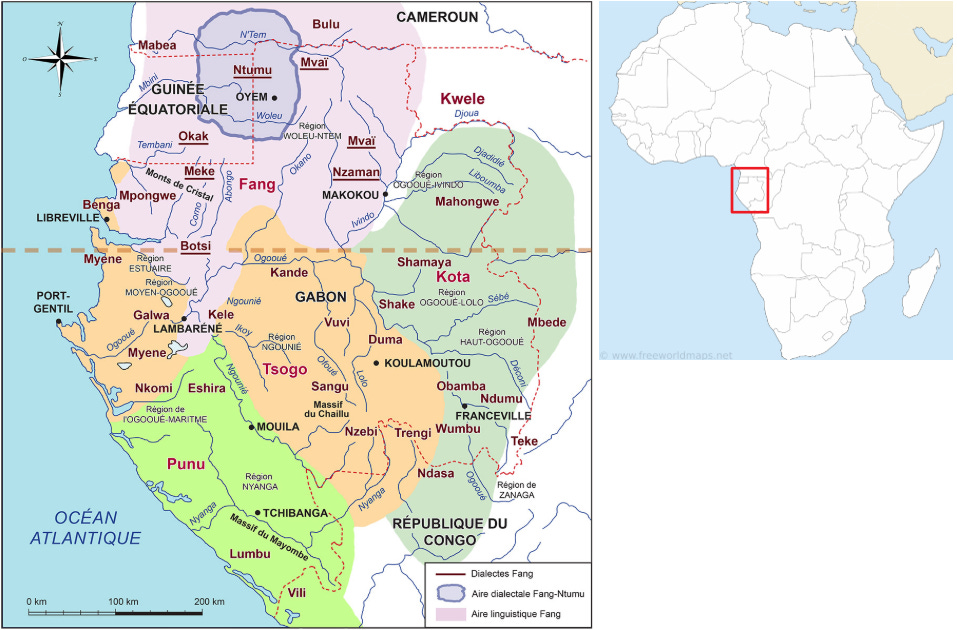
Languages and people groups of Gabon.1
Support AfricanHistoryExtra by becoming a member of our Patreon community; subscribe here to read more about African history, download free books, and keep this newsletter free for all:
From Gabon to Picasso: A brief background on the “white” masks before the early 20th century.
The white masks first appear in the account of the French traveler Paul Belloni Du Chaillu in 1864 during his stay among the ‘Apono’ (baPunu) in the interior of southern Gabon :
“They greatly enjoy the game of the Ocuya. A man carrying a large piece of wood carved into the shape of a giant, adorned and dressed in a bizarre manner, walks around and dances on stilts. This costumed figure wears a white mask with thick, open lips, revealing two rows of teeth in which the middle incisors are missing, following the fashion of the Aponos.
A long garment, dragging down to the ground, hides the stilts. What struck me most in this masquerade, as one of the most comical coincidences, was that the giant’s hairstyle looked unmistakably like a lady’s bonnet, at least before chignons came into vogue.”2
About a decade later, in 1873, the French traveler Victor de Compiègne described the funeral of a local ruler named King N’Combé in the same region:
“At eight o’clock in the evening, a famous priest arrived, destined to play the role of the iassi (a formidable and powerful spirit); he wears a white mask on his face and is clothed in a multitude of those little braids [platted raffia fringes] made by the Ivéia. His arrival is the signal for new ceremonies”3
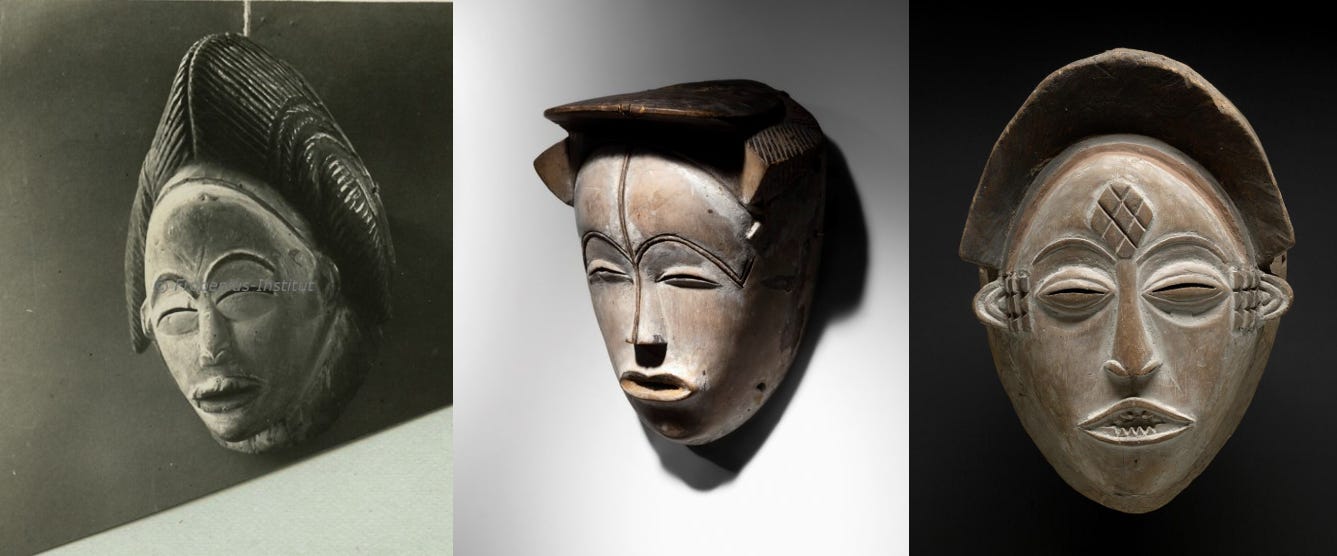
Masks resembling those described by the explorers; (left) White Mask, Ogowe. Congo, Brazzaville. Leo Frobenius, 1898. (center) Fang Mask, undated, Musée Barbier-Müller. (right) Wooden mask with filed incisors from the area north of the lower Congo. Mpongwe, Gabon. Acquired 1896. Number: III C 6306. Ethnologisches Museum, Berlin
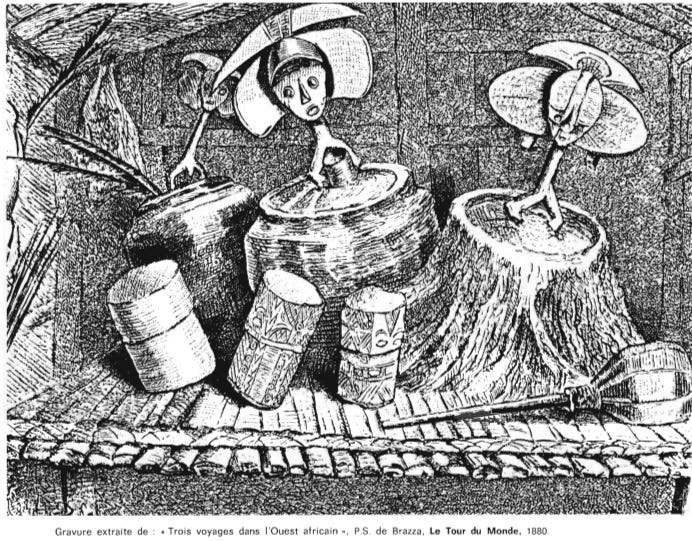
Ancestral figures in a Gabon household. Engraving taken from: ‘Three voyages in West Africa’, P.S. de Brazza, Le Tour du Monde, 1880
The missionary fathers of Saint-Pierre in Libreville, also refer to this spectacle, the dance of “Okoitkoué,” during the celebration of July 14, 1890.
According to Father Pouchet, who was active in the region during the 1940s to 60s, the Okoukwé is a dance on stilts, which is performed with great dexterity, by a man dressed in a raffia costume, holding a flywhisk. It is said to the uninitiated that Okukwé is a revenant, a young woman who has died and returned from the land of the dead, whose “cold beauty is sometimes associated with the moon.”4
The masked performance is the cultural signature of secret societies, which are found under across multiple groups under different names: the Yasi among the Galoa, the Ngil among the Fang, the Mwiri among the Bapunu.
They represent a sort of Freemasonry found throughout Central Africa. They play an important role in religious, political, and social affairs, especially at important festivals like initiations and funerals, as well as laws concerning marriages and infidelity.5
The secret societies represented the only form of overarching political institution over what were essentially acephalous societies.
They were initiation orders where the adepts learned to understand the nature of man, his exact place within the cosmos, the mysteries of life and the universe, and the transcendental character of the spiritual principle of human nature.
The initiates were divided into three categories: those who were masters of the temples and presided over the sessions; those who prepared the sessions and played the main roles; and the newcomers who only attended the sessions.6
Traditional religion in pre-colonial Gabon involved ancestral worship, in which living people gave offerings to the dead, who were considered capable in the afterlife of influencing the destiny of their descendants.
According to the ethnographer Louis Perrois (1979):
What struck observers, travelers, missionaries, and ethnographers alike was the profoundly religious sense of these populations. Philosophy or religion, one might say, in any case, an innate sense of the afterlife. The evidence of the duality of humankind, both flesh and spirit participating in the forces of nature and the cosmos, is common to all members of the group.
The appetite for religious beliefs and behaviors explains, for example, the spread of mask types between ethnic groups hundreds of kilometers apart and the development of syncretic sects like the Bouiti of the Fang (a complex mixture of Christian and animistic symbols).7
Each community had specific rites and ritual equipment consisting of sculpted figurines. Ancestor statues, placed on reliquary baskets or sewn bark boxes, were kept with all the ritual equipment in a small hut built for this purpose a little way from the village. The masks, on the other hand, were kept in the communal house, and frequently replaced since they were a highly temporary double.8
These secret societies, which are a cog in the wheel of social life, used statues, masks and other ceremonial instruments. These are the same objects that were brought back as souvenirs by missionaries, explorers and colonial administrators from the 19th century to the early 20th century.
The handful of masks from the late 19th century were acquired through intermediaries at the coast, since only interior groups used the masks, but these had little contact with European traders along the coast. Significant collections of masks were thus only obtained after the formal colonization of the interior regions during the 1910s.9
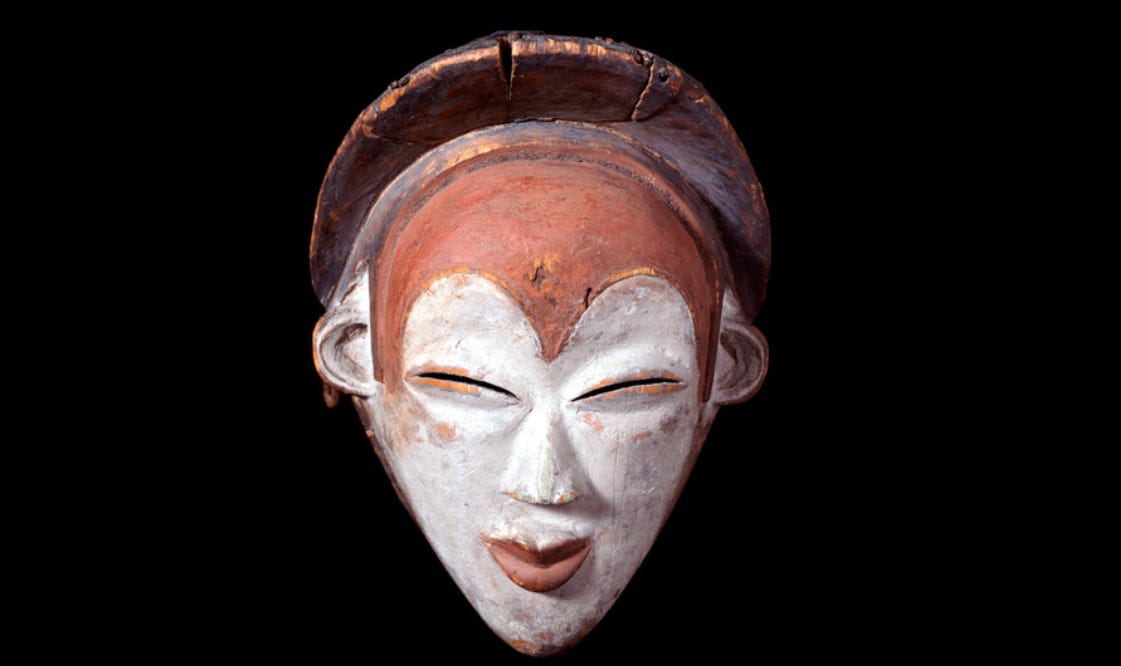
Wooden dance mask with very delicate features. Gabon, south of Ogooué River. Collected on 14th December 1875. Pitt Rivers Museum
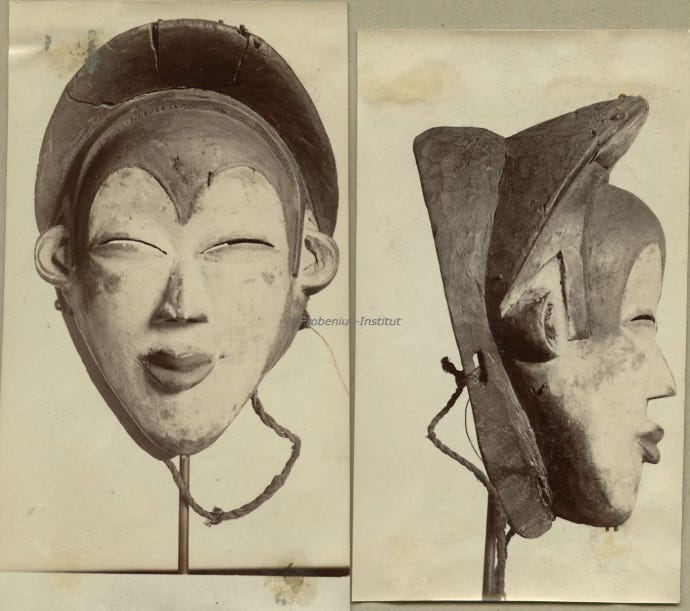
Mask, Villi, Congo Brazaville. c. 1898, Leo Frobenius.
The first known white mask was acquired by the English merchant Robert Bruce Walker for the Pitt Rivers Museum in Oxford before 1884, and others were catalogued by the German ethnographer Leo Frobenius in 1898, who awkwardly ascribed them to coastal groups like the Vili and Mpongwe. Later masks were collected in the early 20th century by intellectuals and artists such as Pablo Picasso, Vlaminck, Derain, and Matisse.
According to Fernande Olivier, Picasso’s early companion, he was especially fond of the white mask from Gabon, which may even have been the first mask he acquired. Olivier observed that “Picasso particularly loved a small mask of a woman, in which the white colour of the face contrasts with the wood color of the hairstyle, giving her a particularly soft expression.”10
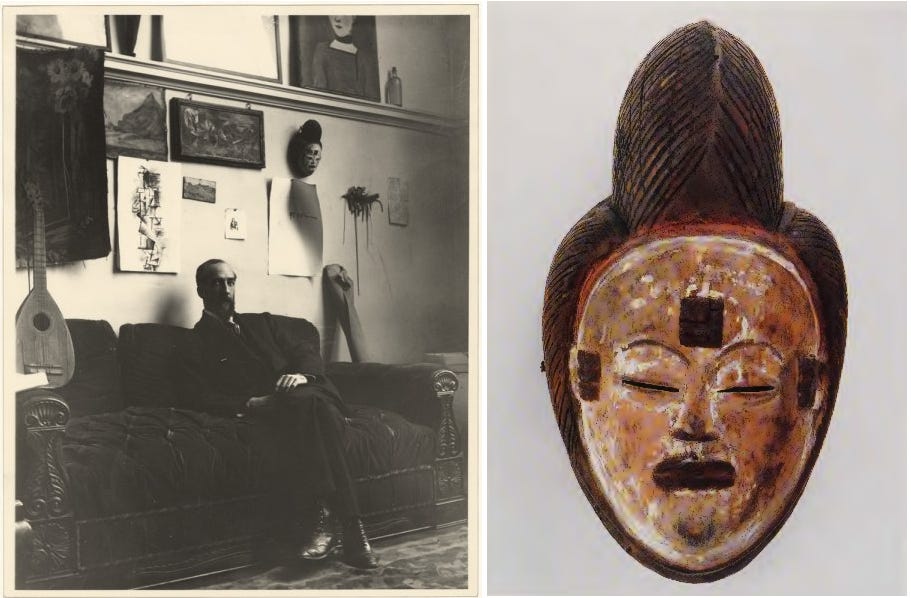
(left) Ramon Pichot in Picasso’s studio on Boulevard de Clichy, 1910, photo by Picasso .(right) the Punu mask on wall. Picasso Archives, Paris .
Examining the White Masks of southern Gabon and their “foreign” features.
The collection of white masks in Western museums isn’t representative of the sculptural genre, but may instead reflect the aesthetic preferences of Western collectors.
The aesthetic appeal of these masks, entirely devoid of zoomorphic traits, made them especially amenable to the European taste. As the Danish art collector Carl Kjersmeier (1938) observed: “The best of these masks belong to the most refined ever created in Africa, and make us instinctively think of the art of the Far East”.11
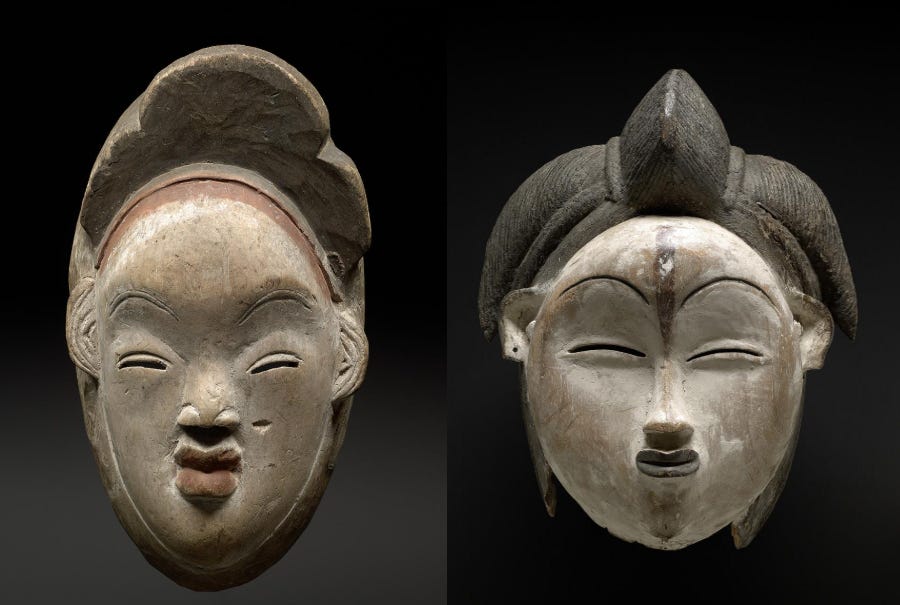
(left) Wooden mask. Gabon, acquired 1896. Number: III C 6298. Ethnologisches Museum, Berlin. (right) Wooden mask. Punu, Gabon, undated. number: III C 40171. Ethnologisches Museum, Berlin
Modern analysis of these masks by art historians instead reveals a great stylistic variety. Some are naturalistic/realistic while others are stylized; a significant fraction of them are black, ochre, or polychrome, and some are decorated with ornamental scarifications while others are plain.
The white masks, which are referred to by a variety of names including Okouyi/Moukouyi/Moukoudji/Mukudj are found among several groups in Gabon, including the Fang, Eshira, Bapunu, Baloumbou, Mitsogho, Bandzabi, Batsangui, and Mindassa. They are especially common in the south, making attempts to attribute their creation to specific ethnicities a difficult, if not superfluous, activity.12
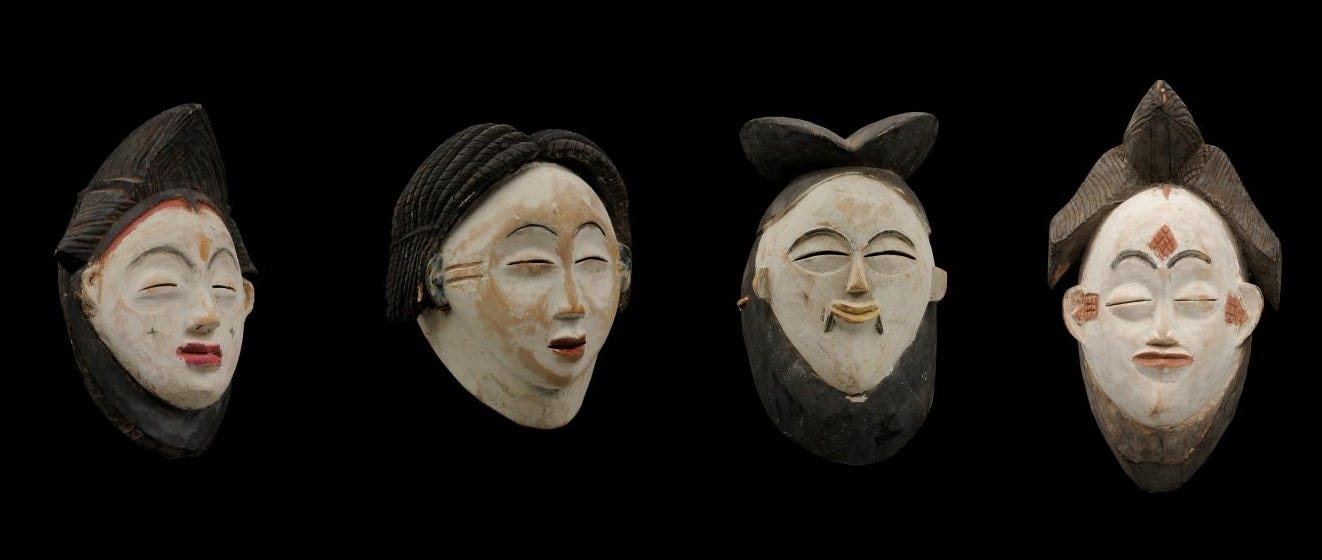
White masks. Punu, Gabon. Acquired; 1964. Royal Museum for Central Africa, Belgium
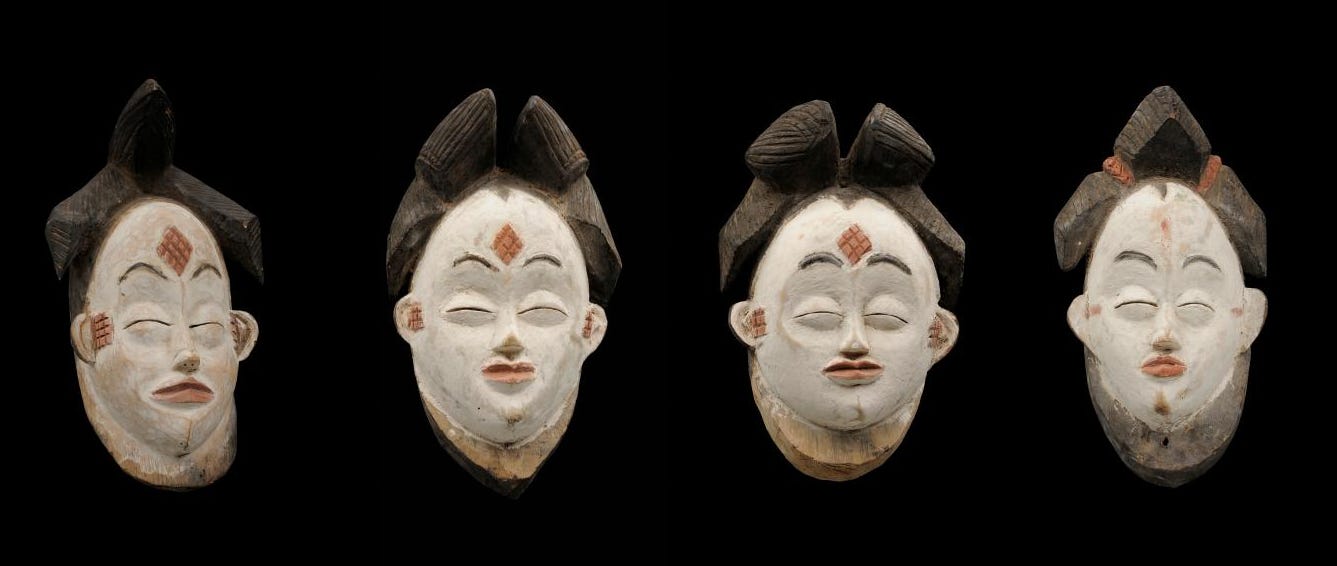
White masks. Punu, Gabon. Acquired; 1964. Royal Museum for Central Africa, Belgium.
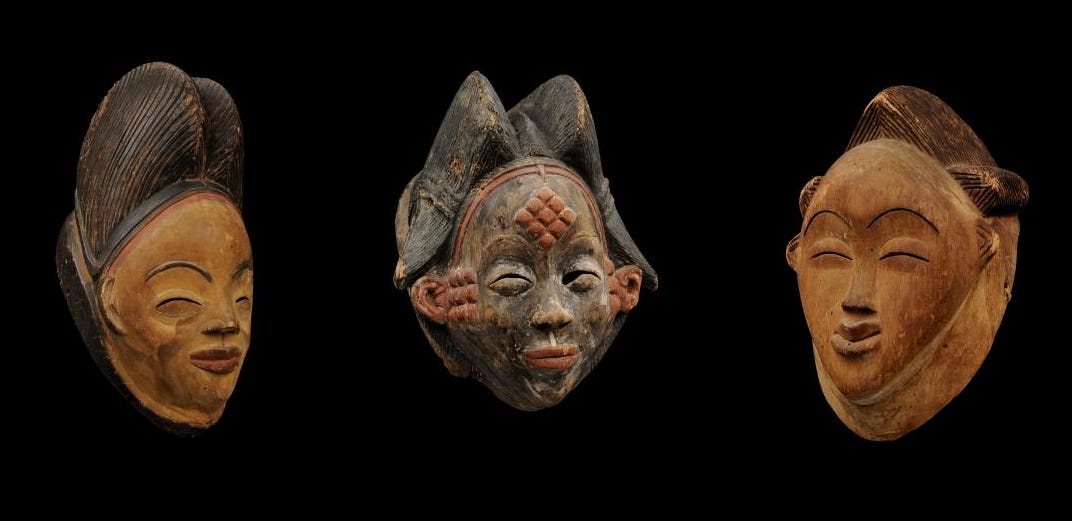
Polychrome masks. Punu, Gabon. Acquired; 1979, 1964, 1987. Royal Museum for Central Africa, Belgium.
The white masks feature a shell-shaped headdress, an oval face, almond-shaped eyes and arched eyelids; a realistic nose and full lips often painted red; prominent cheekbones; a pointed chin; and stylized ears and distinctive tattoos on the forehead and cheeks.
These features, such as the tattoos, hair, and white and red pigmentation, are noted in Du Chaillu’s description of the Aponos/Bapunu, whose masked dancer had hair like a ‘lady’s bonnet’ :
The women beautify themselves by tattooing their foreheads with a sort of scar. These are most often small round bumps, numbering nine, and about the size of a pea, arranged in a diamond shape between their eyebrows. Ornaments of the same kind stand out on their cheeks. They redden their skin with a certain powder extracted from the red wood of commerce. They dress their hair in different ways, but never in raised masses, according to the fashion of the Ashiras.13
In general, the masks often mirror the hairstyles, dress, and adornment of women in pre-colonial southern Gabon, albeit in a stylized rather than realistic/naturalist form.
In particular, some of the hairstyles can be matched with images and photographs of women from Gabon in the late 19th to early 20th century, although not many of these images are accessible, and few if any are of the interior groups that made these masks.
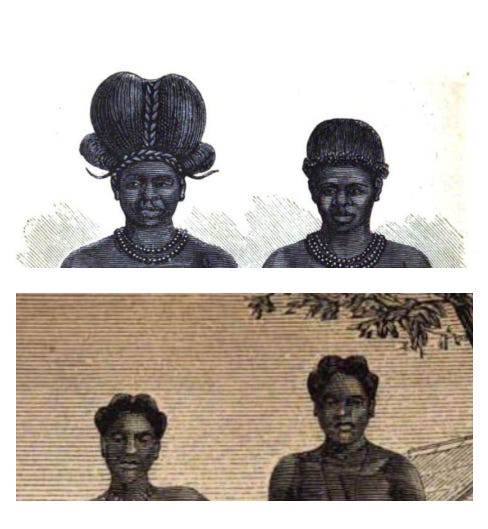
(top) Hairstyles of Okanda women, Gabon. (bottom) Gabonese women from Glass. ca. 1875 images by Victor Dupont Marquis de Compiègne.14
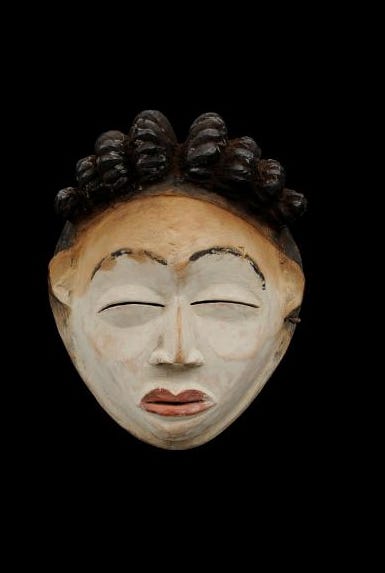
White mask, Gabon. Acquired 1964. Royal Museum for Central Africa, Belgium
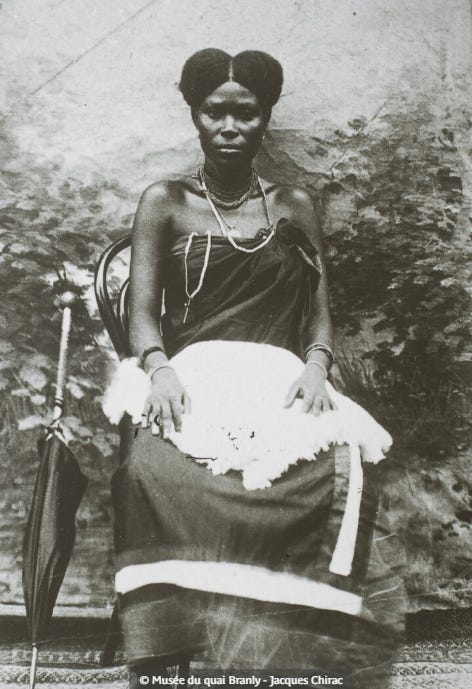
Femme Gabonnaise, ca. 1896. Quai Branly
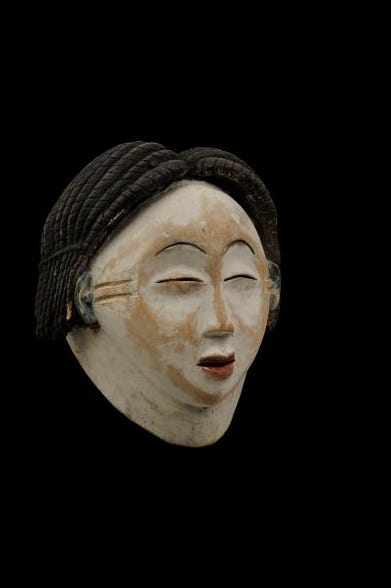
White mask, Gabon. Acquired 1964. Royal Museum for Central Africa, Belgium
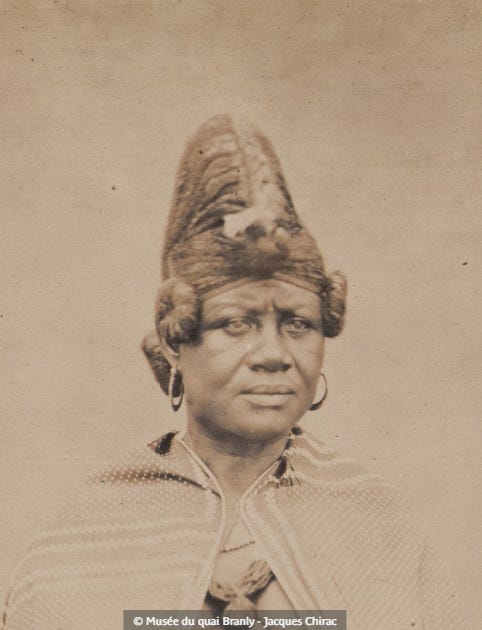
Portrait of the first wife of King Denis Rapontchombo (1780-1876), chief of the left bank of the Gabon River. ca. 1861-1862. Quai Branly
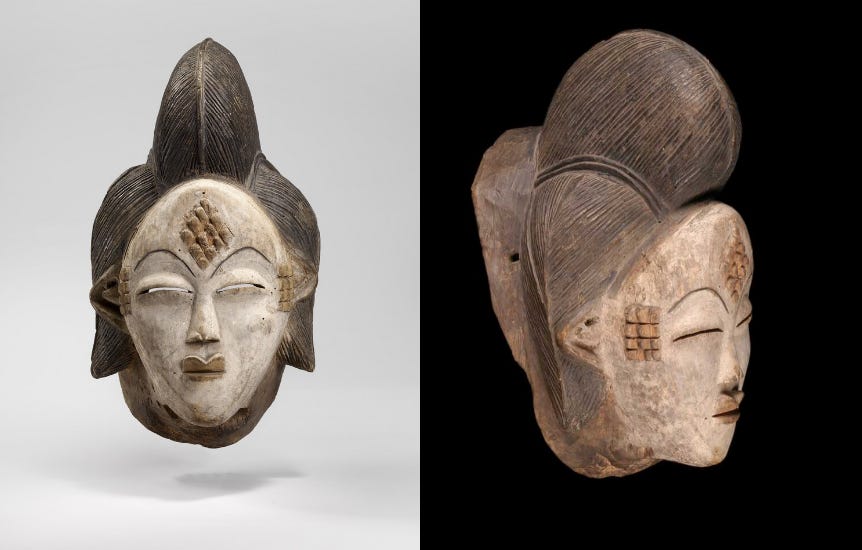
White mask. Gabon. 19th century. Quai Branly
In more recent times, carvers create mukudj masks as representations of specific beautiful women and may even ask them to sit for these portraits. When a mukudj is displayed, people often claim to recognize the person represented and compare it to a photograph. However, this practice may represent more recent influences of photographic portraiture on pre-existing traditions. Importantly, many of the older white masks include representations of men.15
Close attention to the origin of these white masks is tied to hypotheses about their apparent Far Eastern prototype, with speculated links to the Japanese Noh theater and European influence.16
Such speculative connections, especially to Japanese art, have been dismissed by professional Art historians and ethnographers, who note that the special features of these masks do not fall outside the limits of the morphological features of traditional African sculpture.
Louis Perrois compares this tendency to ascribe exotic origins to Central African art with the initial reaction to the arts of Benin and Ife, which clashed with Western collectors’ preconceived ideas of ”primitive art.”
He notes that those who advanced the idea that such artworks were too sophisticated to be produced locally “forget rather quickly that great kingdoms with flourishing crafts had occupied the heart of Black Africa even before the European Middle Ages.”17
Masks with these distinctive hairstyles, scarification marks, almond-shaped or slit eyes, and white pigmentation can be found among numerous groups in Gabon, as well as among distant groups such as the Chokwe of Angola/Congo, as examined below.
The rendering of the eyes in particular was not meant to reproduce the “phenotype” of living persons, but instead represented an idealized image of the dead;
“The mask is a portrait of a deceased ancestor, sometimes a woman. It is held in front of the dancer’s face, who can see through the slits for the eyes.
The triangular face, whitened with kaolin-pembe, has eyes barely open in arched slits, accentuated by heavy, coffee-bean-shaped eyelids. The gaze is veiled, giving an impression of serenity, the kind one wishes the dead possessed, since, quite often, they pursue the living with their malice.”18
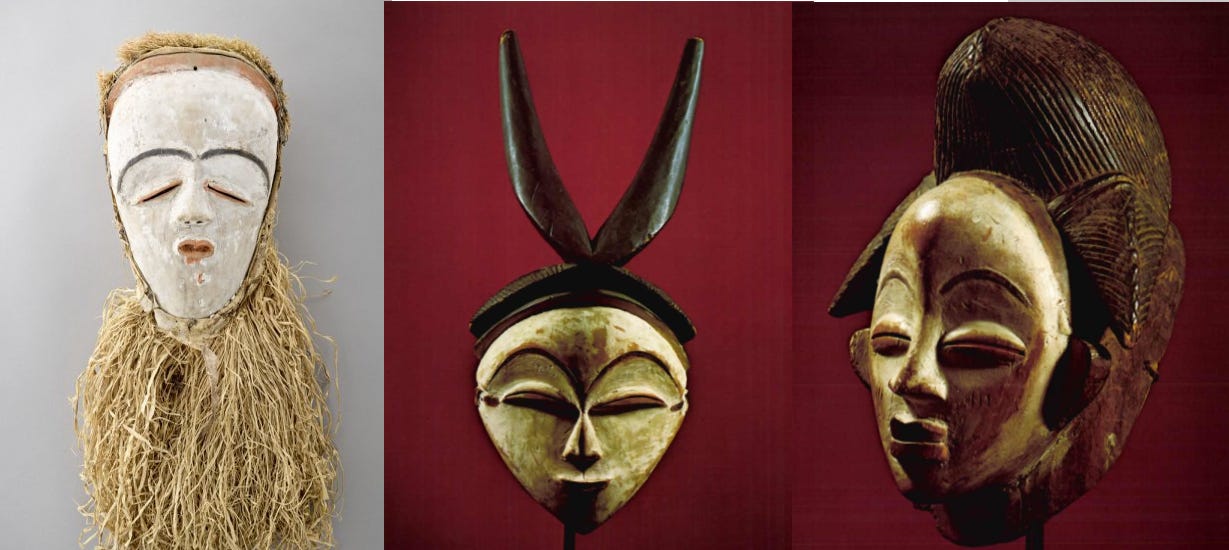
(left) Tsogho mask, Gabon, 20th century. Musée Picasso, Paris. (center) Kwele Mask, image by M. Itzikovit. (right) Loumbou mask. Southern Gabon. Image by Louis Perrois
The “Whiteness” of Gabon’s masks and race in pre-colonial Africa.
The historic masks of southern Gabon are generally painted in several colors, although white masks were the most common. White is obtained from white clay, kaolin; ochre from ordinary clay; black from charcoal, and red from padauk powder or small plant seeds. White is the color of the dead and the spirits of the dead. This form of colour symbolism is found in many Central and West African traditions.19
In the historiography of Central and West Africa, this color symbolism predates European contact. There is, however, speculation among art historians regarding the supposed ideological and visual links between the “white” artworks of African societies living near the Atlantic coast and the “white” foreigners who collected them.20
While a presumed link between the “white” European traders coming from the sea and the world of the dead is mentioned early in the 17th century on the Gold Coast (Ghana) and Kongo, 21this ideological connection doesn’t seem to have been attached to their skin colour, especially given the lack of linguistic evidence to support such claims
For example, the white colour in Kikongo languages is mpembe, like the colour of kaolin clay (ie; Kaolin-pembe), while “white”/Europeans were, since the 17th century, called mundele (bandele/bindele), derived from the word for ‘whale’, which refers to their ships. As the historian John Thornton explains: “It was their craft and not their skin color that marked them as different.”22
A similar etymology is inferred for the ubiquitous East African term ‘muzengos’ (Lacerda, 179823) and ‘ba-Zungu’ (Livingstone, 185724), which stems from the common Bantu word —zunga (Wilhelm Bleek, 185625) referring to the aimless wandering of European explorers, and is different from the words for the actual color ‘white.’
Like the term mundele in Kongo, the fact the term muzungu in East Africa was unrelated to the skin color of Europeans is evidenced by the fact that it first appears in an account from 1599 written by the Swahili ruler of Malindi (Kenya) referring to a semi-sedentary African ethnic group in the hinterland, who were known as the “Muzungulos” (Muzungulu/ Muzungulo), corresponding to the modern Mijikenda.26
Similarly, in 19th-century dictionaries for the languages of Gabon’s coastal populations, such as the Mpongwe and Bakele, the white color pumi/pimi is differentiated from the generic exonym for Europeans, ntangani, which Du Chaillu and later western travelers were called, and is thought to be associated with their ships/vessels.27
Ethnographers and anthropologists working in colonial and post-colonial Africa often assume that, ideologically and visually, the colour “white” was interchangeable with the western racial concept of “whiteness”.
But such inferences are based on an uncritical interpretation of historical and linguistic data, and the projection of modern racial concepts into the pre-colonial period.
As previously noted, groups living in the interior of Gabon had no direct contact with Europeans before Du Chaillu's visit in 1864, and even after, only had limited contact with them until the colonial occupation in the 1910s.
Therefore, colonial influence and feedback from external sources such as collectors and missionaries have muddied contemporary interpretations of Central African color symbolism.
This is particularly relevant for ethnographers studying these traditions long after their demise, especially with regard to the presumed contrast between the white (mukudj) and black or polychrome (ikwar) masks.
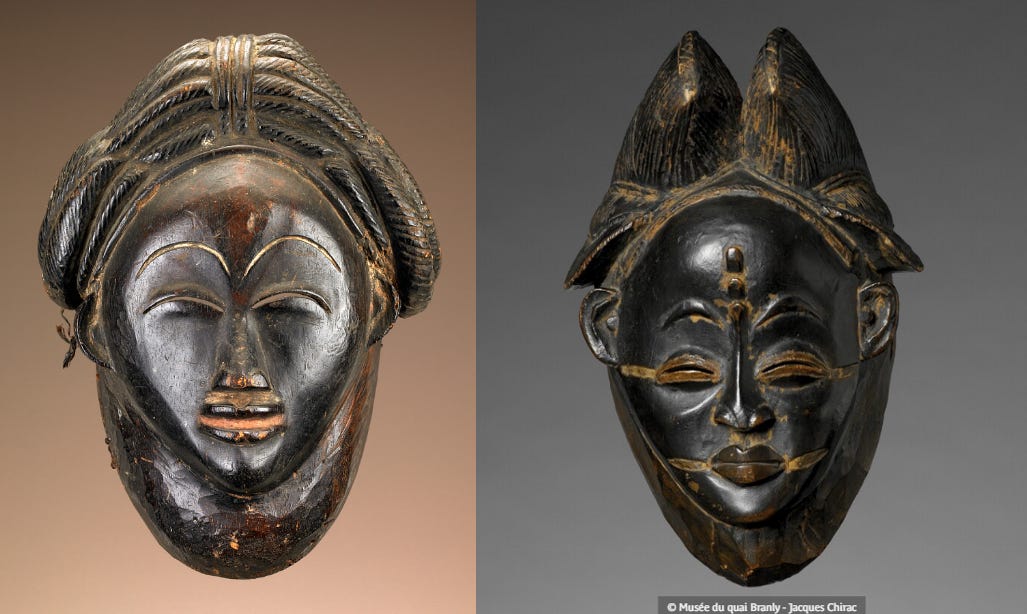
(left) Black mask with traces of red and golden pigment. Punu/Lumbo, Gabon. Late 19th-early 20th century. Smithsonian Museum. (right) Black mask with scarification. Gabon. 19th century. Quai Branly.
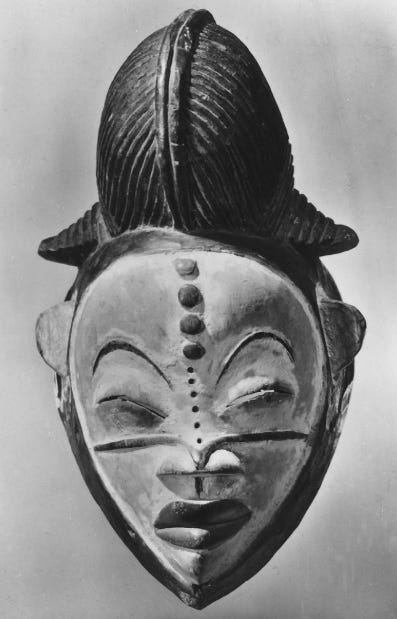
White mask with scarification. Gabon, undated. number: VIII A 9354. Ethnologisches Museum, Berlin
It’s not uncommon for art historians studying masks from Gabon to relate them to modern concepts of race, suggesting that the persons depicted were exotic, mixed, European, or even mythological like fairies. Such interpretations, at times obtained from modern sculptors, are reproduced uncritically, disregarding the effect of external feedback in local traditions.28
It’s important to note that these were originally ‘pagan’ objects associated with secret societies and traditional religions that had long been suppressed by Christian missionaries well before modern ethnographers conducted their fieldwork among populations who had by then given the masks new cultural meanings.29
For example, using information obtained from modern sculptors in the 1990s, the art historian Alisa LaGamma interprets the Mukudj/Ikwar contrast as a dichotomy between female and male, between idealized beauty and its subversion, between dances organized for the community and judgments to punish criminals/sorcerers. But she also notes that mask carvers claimed that such gendered iconographical parameters were not stringently adhered to before independence (1960).30
However, Louis Perrois, whose field research was conducted in the 1960s, made no mention of such a dichotomy, pointing out that white masks were “mourning masks” linked with death, and that the same masks could be painted black, transforming them into masks of justice, with the power to unmask sorcerers: “The same form, can take on different meanings through a simple change of color… Black masks do not constitute a separate stylistic variant: they are simply white masks that have been used in a particular way.”31
Both scholars nevertheless contend that their studies were conducted long after the demise of the sculptural tradition, more than half a century after the colonial occupation.
Regarding the hairstyles and scarifications, most scholars rightly reject associating them with specific ethnic groups since they are generally not exclusive to those groups. It is nevertheless possible, through the combined analysis of a number of morphological elements, to identify some major groups of objects that were at the time of their collection associated with a cluster of neighboring ethnic groups.32
For example, songs performed by the Punu people recount their migration and genealogy; the nine children of the founding ancestor Ilawu, and the origin of their nine clans.
Alisa LaGamma draws a correlation between the nine clans and the nine points arranged in a lozenge shape on the foreheads of the masks and designated by the term magumbi. These scarifications were indeed already observed by Du Chaillu in his 1864 account noted above, which identifies such tattoos on the foreheads and faces of baPunu women.33
However, many masks contain more points arranged in various forms, or none at all. Their meaning may be lost to modern researchers, but could represent a type of shared symbolism across central Africa where symbols are prominently displayed on the foreheads of masks made by the Chokwe of Eastern Angola.
Chokwe masks share a number of features with the white masks of southern Gabon, including elements of naturalism that are mostly representations of women, serene expressions with closed eyes that are almond-shaped, prominent eyebrow arches, elaborate hairstyles, and symbols on the foreheads resembling tattoos.
Their masks were also used by dancers on stilts, who represented an overarching secret society that played a prominent role in the social and political life of the region.
The significance of these features in examining the indigenous origins of the white masks of Gabon is explored in the next section.
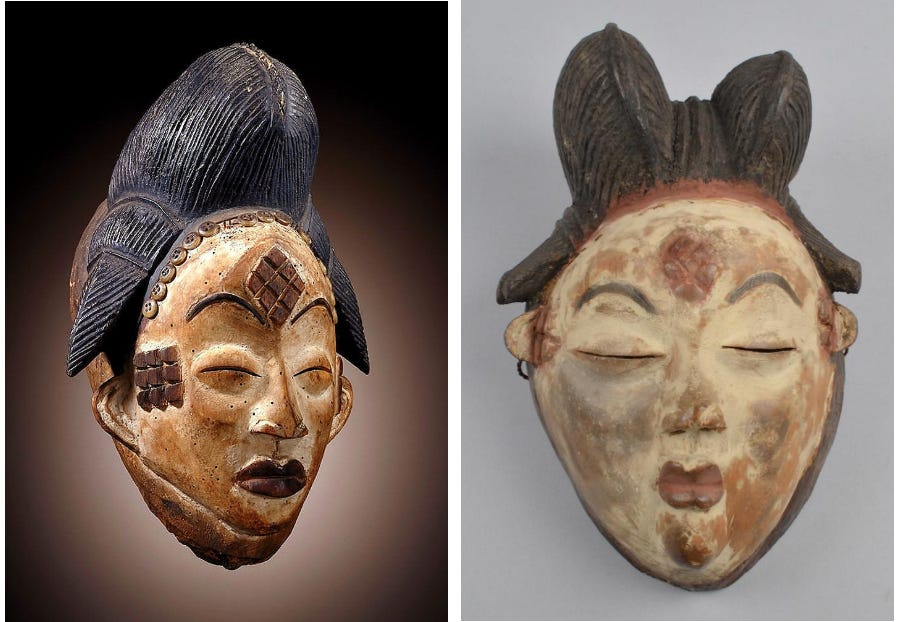
(left) White mask with 9-point scarification. Punu, Gabon. Late 19th-early 20th century. Smithsonian Museum (right). White mask with 6-point scarification. Lumbo, Gabon. Acquired 1951. British Museum.
THE MASKS OF THE CHOKWE: a shared cultural tradition
Like the mask-makers of Gabon, the Chokwe of eastern Angola had little contact with the Atlantic coast before the 19th century.
But, following the expansion of the commodity trade in ivory, wax and rubber during the 1830s, the Chokwe who exported these trade goods became one of the major economic and military forces of central Africa. Ambitious and affluent Chokwe rulers sought to heighten their standing by commissioning works that portrayed them as heirs to the legendary cultural icon Cibinda Ilunga, to enhance their royal ancestry.
Chokwe categories of art ranged from purely decorative objects, such as the wood sculptures, to religious paraphernalia, symbols of the power of chiefs, such as thrones, staffs, masks, ceremonial axes, musical instruments, and intricately carved household objects, such as combs, knives, and chairs.
[ see my previous article on: Revolution, Trade, and Art among the Chokwe of 19th-century Central Africa ]
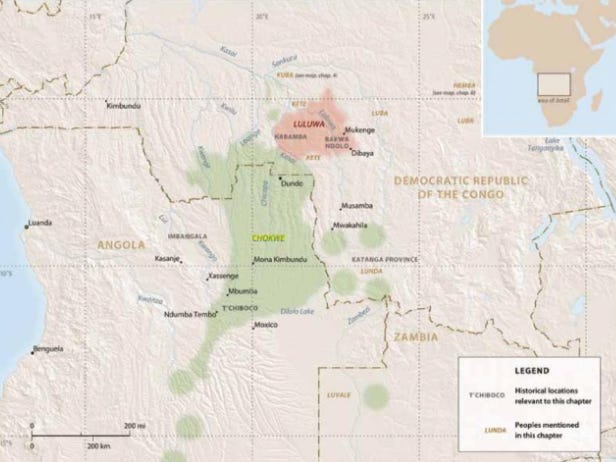
Modern distribution of the Chokwe. Map by Alisa LaGamma.
In 1878, the Portuguese naval officers H. Capello and R. Ivens, who left a detailed account of the Angolan interior in the Chokwe and Lunda territories, encountered figures wearing wooden masks and standing on stilts, called mu-quiche.
Like the priest-figures of pre-colonial Gabon, they represented an old, religious and cultural institution (secret society) found across many groups, although the European visitors only got to see them during public festivals.
“The office of a mu-quiche would appear to be a traditional one, retained in certain families among many African tribes. An absolute secrecy is observed respecting the person who fills it. He is known also to inflict prompt chastisement for grave offences.
It may therefore be assumed that the mu-quiche, not withstanding his special character of a fetish-man [priest], exercises utilitarian functions, such, for instance, as the castigating misdemeanants, the punishing shameless women, and the accusing criminals.
The mu-quiche has been more than once employed as a spy for special purposes ; and natives have been even known to adopt the costume with a view to discover any real or presumed infidelity of their wives. We have heard of husbands and wives at masked balls in Europe putting on dominoes for a somewhat similar purpose, showing how little difference after all there is in mankind, though ages of civilization may lie between them !”34
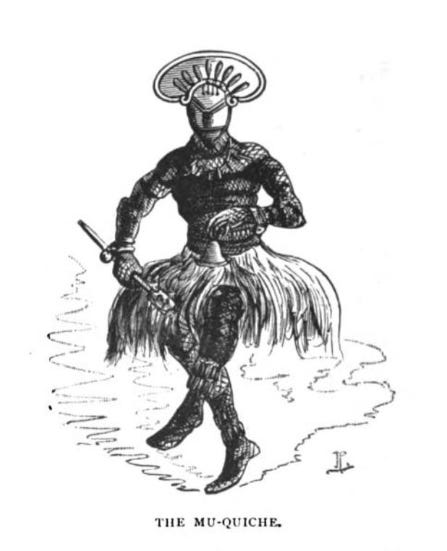
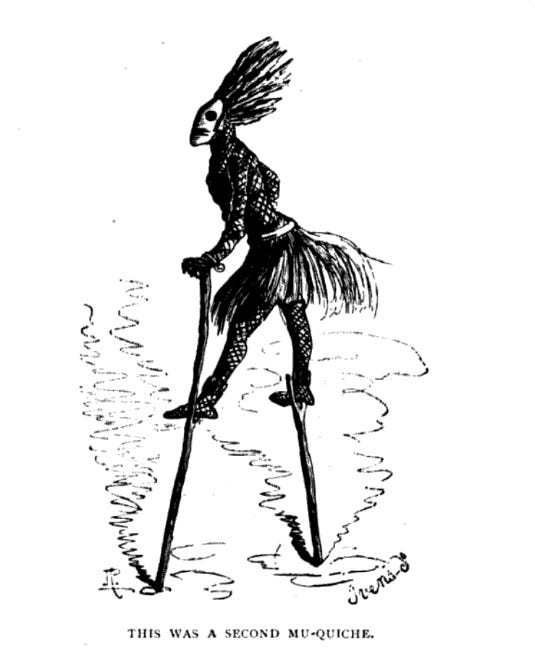
Images by H. Capello and R. Ivens, c. 1878.
Among the key mask genres of the Chokwe sculptural tradition is pwo, “woman,” or mwana pwo, “young woman.” Although pwo embodied the ideal of Chokwe womanhood and ancestry, it was worn by male performers.
Pwo, archetype of womanhood, is an ancestral female personage. The eyes closed to narrow slits are thought to evoke those of a deceased person.35
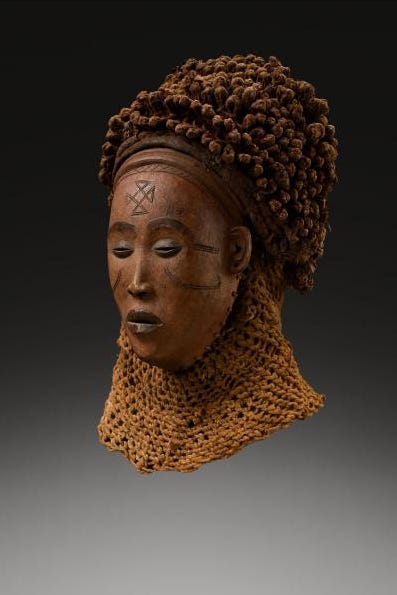
Chokwe mask, D.R.Congo. Acquired 1948, Inventory number EO.1948.20.165. Royal Museum for Central Africa, Belgium.
The ethnographer Hans Himmelheber (1938) observed that these masquerade ensembles were the property of individual elders, who wore them for public theatrical entertainments that were staged in the dancer’s own and neighboring villages in order to elicit remuneration from the audience.
According to Himmelheber, these masks were “half portraits” that were based both on a stylized image of an idealized beauty, as well as a naturalistic image of specific individuals known to the sculptor.36 It is, however, unclear whether this interpretation can be applied to the pre-colonial period, given the profound changes undergone by Chokwe communities since Capello’s account.
The masks feature several distinctive coiffures, some of which can be identified in the photographs of Angolan women taken in the early 20th century. One of these is the helmet-like hairstyle made up of carefully knotted tufts of hair that are worn close to the scalp and smeared individually with red earth37
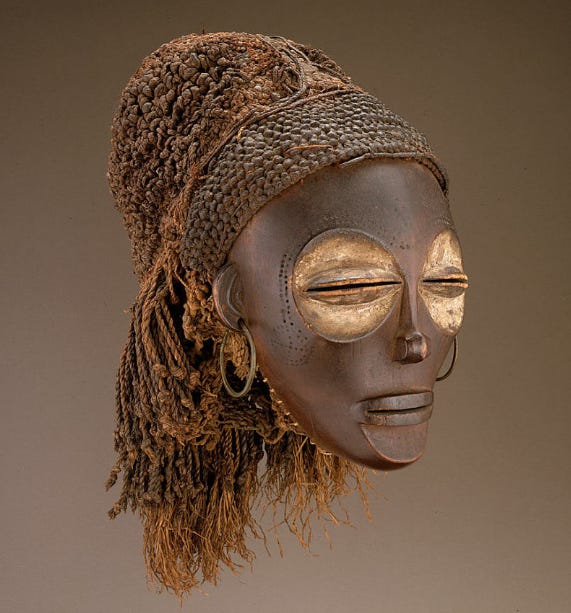
Mask of a woman adorned with tattoos, earrings and an elaborate coiffure. Chokwe, Angola. Early 20th century. Smithsonian Museum.
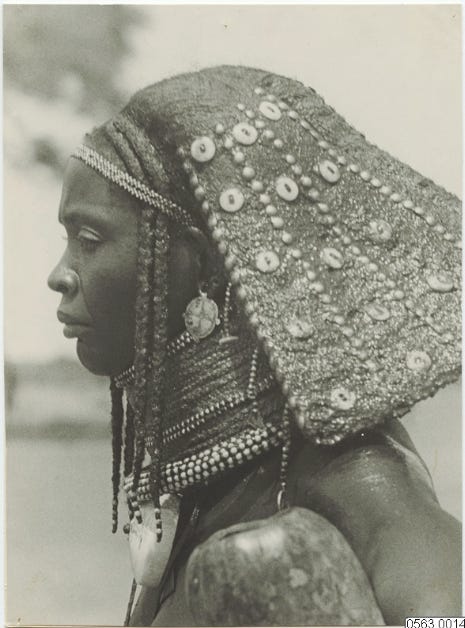
Portrait of a woman, Angola. ca. 1951, Angola. Etnografiska Museet, Sweden.
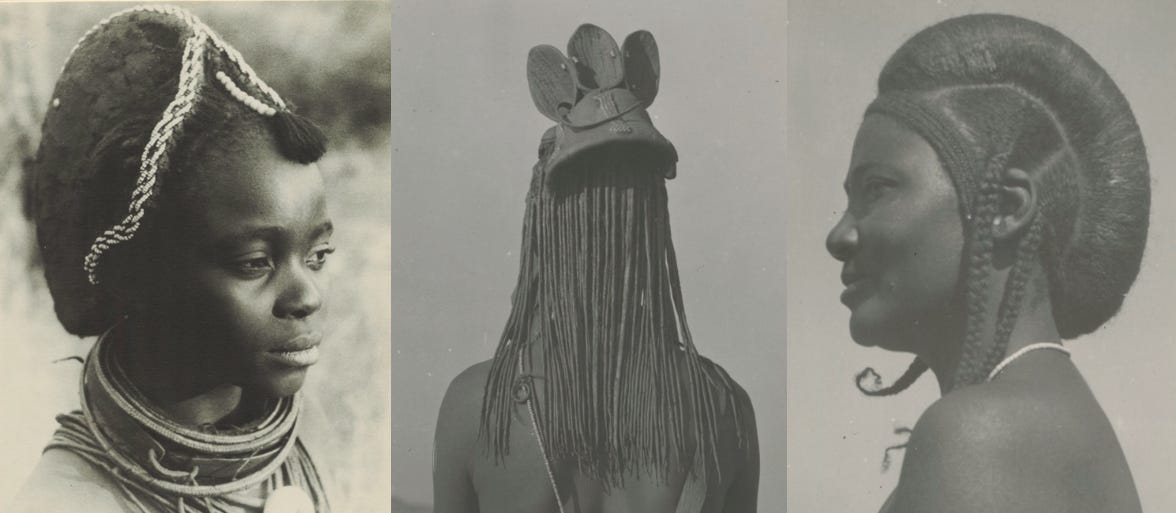
(left) Portrait of a girl (center) Woman from Gambos (right) Woman from the Luvando tribe. ca. 1951, Angola. Etnografiska Museet, Sweden.
“Foreign” crosses on Chokwe masks
One of the most distinctive features of the Chokwe masks are the tattoos/motifs found on the foreheads of the masks; some have a zig-zag shape, apparently resembling the Gabon viper, and others have a double-arc shape. Still others have a variety of symbols that have yet to be studied.
But the one symbol that captured the attention of Western art collectors is the dotted-cruciform motif, called cingelyengelye. There are many variations of this shape, which, according to art historians, is thought to have been introduced to the region in the 17th century by the Portuguese and is thought to denote divinity in Chokwe culture.38
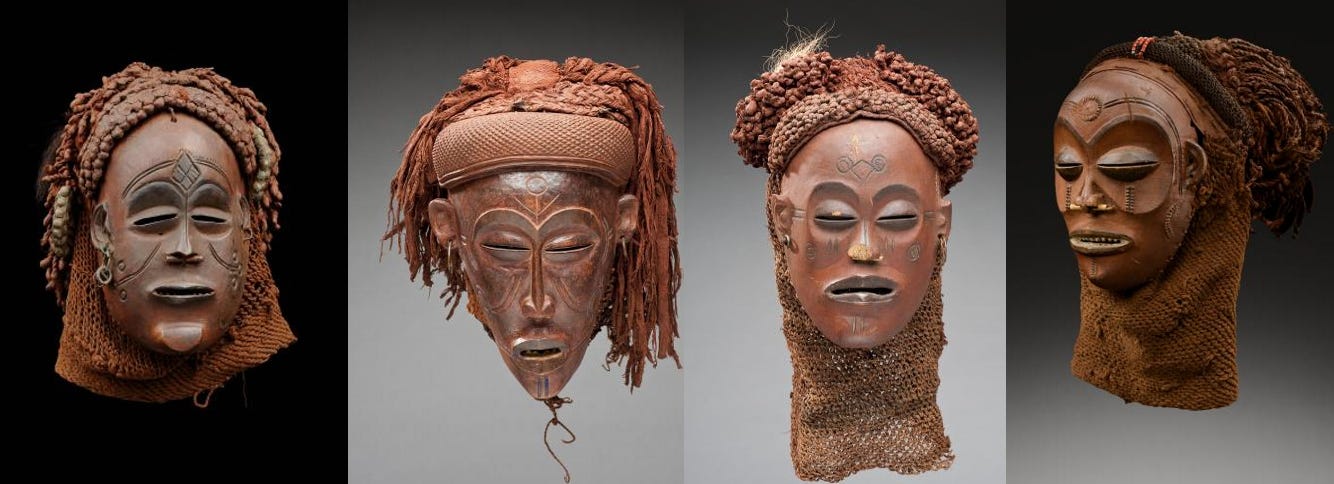
Chokwe masks with non-cruciform motifs on their foreheads. Acquired in 1946, 1979, 1939, 1939. D.R.Congo. Royal Museum for Central Africa, Belgium.
Note the motifs on the first mask, which resemble those found on Gabon’s masks, but is a 4-point tattoo.
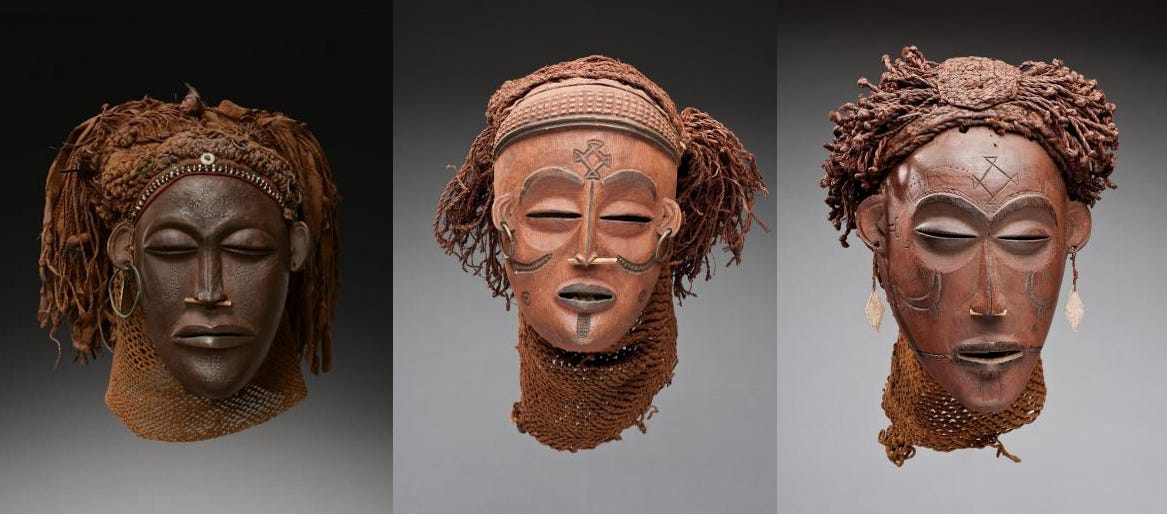
Chokwe masks with cruciform motifs on their foreheads. Acquired 1946, 1939, 1979. D.R.Congo. Royal Museum for Central Africa, Belgium.
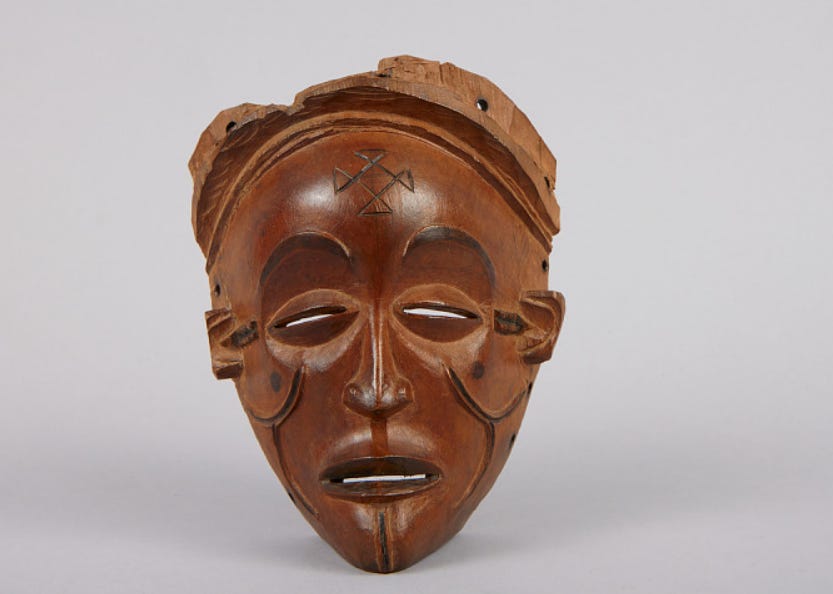
Mask with prominent cruciform motif. Chokwe, Angola. Acquired 1971. Smithsonian Museum.
Historical evidence for crosses in the African Atlantic, however, predates Portuguese contact.
Early Portuguese chroniclers noted the presence of the symbol specifically in the kingdoms of Kongo and Benin, but not in other kingdoms like Jolof (Senegal) or the Gold Coast (Ghana), which were encountered in the same period.
The Art historian Cecile Fromont notes that the sign of the cross played a central role in the visual, religious, and artistic encounter between Portuguese Christianity and Kongo worldviews in the early modern period, because the symbol preexisted Portuguese contact.
“At the time of the advent of Christianity, and independent from any European influence, the cross was already a predominant motif of Central African art.
Cruciform designs appeared in rock paintings, weaving patterns, and engravings in their simplest expression as two intersecting lines as well as in intricate geometric derivations inspired by weaving patterns.
Elaborate textiles and carved ivory tusks eagerly collected by the early modern European elite for their cabinets of curiosity as well as archeological material illustrate the prevalent Kongo visual syntax at the time of the entrance of the kingdom into European history.
Across the media, design patterns articulated lines, intersections, and overlaps in varied knot-like motifs organized around a central focus point and ultimately suggesting a diamond shape.”
Even after the adoption of Christianity in Kongo, the cross wasn’t exclusive to the religion, but was prominently displayed by adherents of traditional religions like the Kimpasi secret society, whose prominent display of cross-like signs on its temples, paraphernalia, and rituals enraged visiting Capuchin priests during the 17th century.39
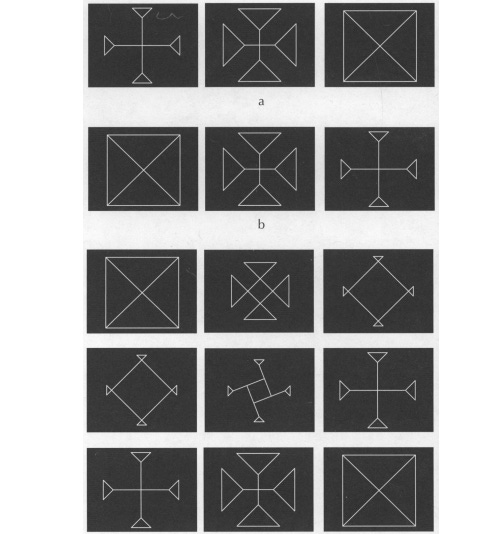
‘Schematics of Kongo rock painting and engraving designs. Drawings by the author based on Kongo rock paintings and engravings published by Raul Raymaekers in P. Raymaekers and H. van Moorsel, “Dessins Rupestres Du Bas Congo,” Image and caption by Cecile Fromont
Some ambiguity surrounds the crosses of the West African kingdom of Benin (Nigeria), which appear in its 16th-century artworks, and a few documentary accounts of the kingdom that associated them with traditional priests, who were strongly opposed to Portuguese missionary activity.
When the Oba (King) sent an embassy to Lisbon in 1540, the Portuguese chronicler De Barros, who recorded their visit, noted that one of the envoys was wearing a brass cross ‘a holy and religious emblem similar to that worn by the Knights of the Order of Saint John’ that the Oghene, a ruler of an interior kingdom, bestowed on those who visited him on the accession of a new Oba.40
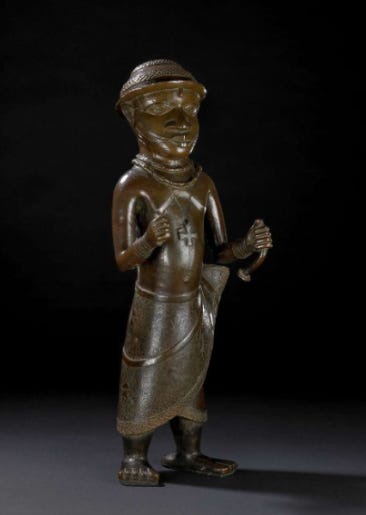
Figure wearing a cross, with a hammer in left hand and staff in the right hand. 18th century, Benin City, Nigeria. British museum
The identity of the Oghene (or Ógànẹ), who appears in 14th and 15th-century accounts as a ruler of an interior kingdom, is still debated, but scholars suggest it could be the medieval kingdom of Ife, whose famous artworks (c. 1200-1400) include depictions of crosses.41
It's nevertheless suggested that, like in Kongo, the significance of the pre-contact symbol of the cross in Benin may have been enhanced by the kingdom’s very brief adoption of Christianity during the early 16th century.42
Debates over chronology notwithstanding, the significance of the cross in Central African symbolism may have been similarly enhanced by its shared use by both Christian populations in Kongo and non-Christian groups in the interior like the Chokwe, who had limited external contact.
The cross was, however, only one of several motifs that appear on the Chokwe masks, and its apparent importance could reflect the aesthetic and cultural values of Western collectors who may have chosen to acquire and display certain masks over others that may not necessarily have been privileged by the Chokwe themselves.
Like the white masks of Gabon, Western collections of Chokwe masks may not be representative of the sculptural genre.
They were, after all, only temporary objects made from a perishable material that were intended to serve a specific function and discarded after short periods of use. Their aesthetic value was subsumed under this larger cultural utility.
This paradox, between the cultural value of the mask to its African creators, versus its artistic and economic value to Western collectors, is excellently summarized by the art critic and curator Roger Pierre Turine:
The ultimate goal of enthusiasts of non-European art is to find a lost style of original purity in an object that predates the arrival of the whites, or that at least wasn’t corrupted by their presence.
As a result, the plastic qualities sought after by the Western sensibility embody a form of rejection, a negation of Western identity. And yet it’s in the name of this same identity and its capacity to judge that African works are weighed in terms of aesthetic and market value: making business out of art.
Another paradox arises from the introduction to the market of works that were never intended to be considered for their stylistic qualities nor to be sold. It is nevertheless just these stylistic qualities of secondary importance which ended up being appreciated and even sought after by creator and user alike.43
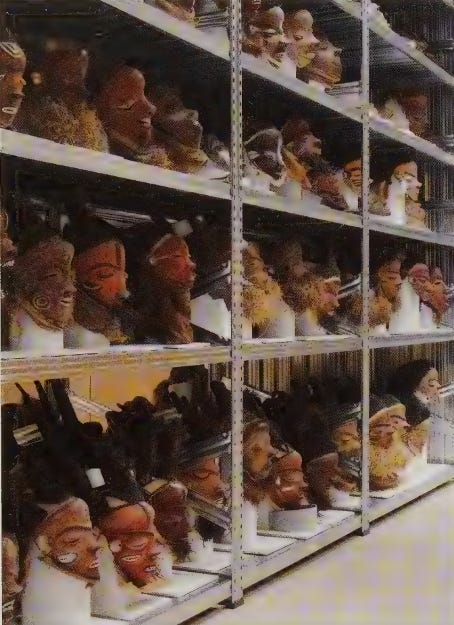
Pende masks in the reserves of the Royal Museum for Central Africa, Belgium.44
Conclusion: the white masks of Gabon in their historical context.
Traditional Gabonese sculpture today falls more within the domain of archaeology or art history than ethnology.
As early as 1934, authors noted that art had completely disappeared in Gabon, mostly due to missionary opposition to traditional religions. Masks, ancestor statues, and other “pagan” artworks were seized from the villages, collected, and burned, or thrown into the rivers.
The few that remained were collected by antique dealers and sold to Western museums, just as the last vestiges of the traditional religious systems and their sculptural traditions were dying out.45
Interpretations of these artworks are therefore constrained by the near-complete erasure of the cultural traditions in which they were produced.
Although their symbolism can now only be partially reconstructed, the historical context outlined above shows that these celebrated masks were only one expression of the dynamic religious and social institutions of pre-colonial Central Africa, long before they entered museums as masterpieces of African sculpture.
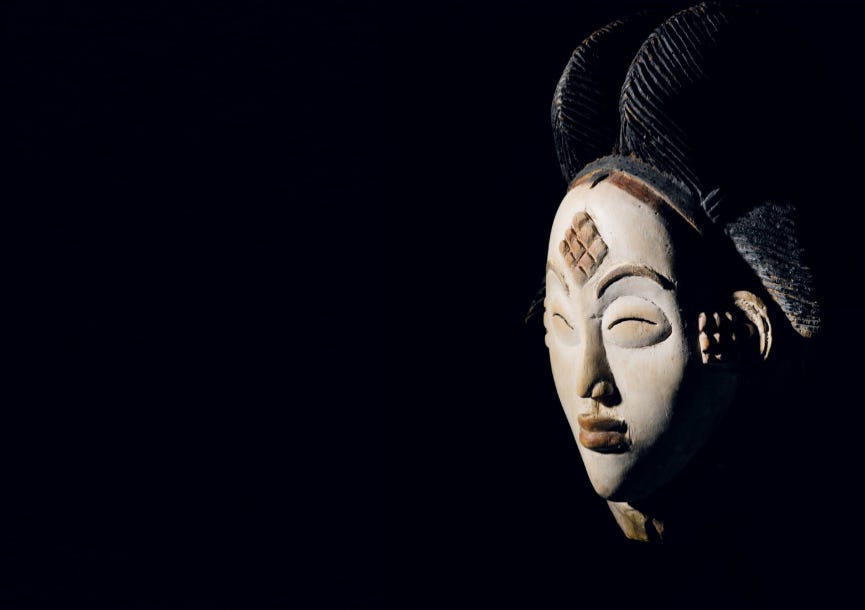
Mask, Punu, Gabon. Sothebys
Nearly two centuries before the formal abolition of Slavery, an African prince from the kingdom of Ndongo (modern Angola) spearheaded an international legal case against the kingdoms of Spain, Portugal, and Italy, accusing them of committing crimes against humanity.
My latest Patreon article explores the international travels and abolitionist case of Mendonça and the history of the Afro-Brazilian diaspora, concluding with a review of Nafafé’s research in the context of pre-colonial African slavery and abolition.
Please subscribe to read more about it here:
Map by Regis Ollomo Ella
L’Afrique sauvage: nouvelles excursions au pays des Ashangos By Paul Belloni Du Chaillu, published by M. Levy, 1868, pg 216
L’Afrique équatoriale: Okanda, Bangouens-Osyeba, Volume 2 By Victor Dupont Marquis de Compiègne, pg 64
De l’art africain dans une abbaye cistercienne: Histoire d’un masque Pounou de la «collection Mortain», à Langonnet, by Charlotte Grand-Dufay pg 96, 98
De l’art africain dans une abbaye cistercienne: Histoire d’un masque Pounou de la «collection Mortain», à Langonnet, by Charlotte Grand-Dufay pg 99-100
Arts du Gabon : Les Arts plastiques du Bassin de l’Ogooué, by Louis Perrois pg 25-26
Arts du Gabon : Les Arts plastiques du Bassin de l’Ogooué, by Louis Perrois pg 26
Arts du Gabon : Les Arts plastiques du Bassin de l’Ogooué, by Louis Perrois pg 35
Arts du Gabon : Les Arts plastiques du Bassin de l’Ogooué, by Louis Perrois pg 239-241
Picasso’s Collection of African & Oceanic Art by Peter Stepan pg 135
Picasso’s Collection of African & Oceanic Art by Peter Stepan pg 138
Arts du Gabon : Les Arts plastiques du Bassin de l’Ogooué, by Louis Perrois pg 29, 238
L’Afrique sauvage: nouvelles excursions au pays des Ashangos By Paul Belloni Du Chaillu, pg 212
L’Afrique équatoriale: Okanda, Bangouens-Osyeba, Volume 2, by Victor Dupont Marquis de Compiègne
Men Portraying Women: Representations in African Masks, by Elisabeth L. Cameron, pg 72. Arts du Gabon : Les Arts plastiques du Bassin de l’Ogooué, by Louis Perrois pg 242
Arts du Gabon : Les Arts plastiques du Bassin de l’Ogooué, by Louis Perrois pg 240-243
Arts du Gabon : Les Arts plastiques du Bassin de l’Ogooué, by Louis Perrois pg 240-241
Arts du Gabon : Les Arts plastiques du Bassin de l’Ogooué, by Louis Perrois pg 243, 46
Arts du Gabon : Les Arts plastiques du Bassin de l’Ogooué, by Louis Perrois pg 34. Religion and society in central Africa: the BaKongo of lower Zaire. by MacGaffey pg 52, 55
Imagining Otherness in Ivory: African Portrayals of the Portuguese ca. 1492, by Suzanne Preston Blier
Pieter Van Den Broecke’s Journal of Voyages to Cape Verde, Guinea and Angola, 1605-1612 By James D. La Fleur, pg 37.
for kongo, Fromont uses the example of albinism to suggest that such ideological links may have been developed in relation to the Capuchin priests, while MacGaffery relies on data from the colonial period
see: Under the sign of the cross in the kingdom of Kongo Religious conversion and visual correlation in early modern Central Africa by Cécile Fromont Pg 117. Africa & the West: Intellectual Responses to European Culture by James W. Fernandez, pg 55-57
The Kongolese Saint Anthony: Dona Beatriz Kimpa Vita and the Antonian Movement, 1684-1706 by John Thornton, pg 27. From Kongo Central to the Americas Via Europe: A Cultural Overview, by Adrien N. Ngudiankama, John M. Janzen, Wyatt MacGaffey, pg 59-60
Lacerda’s Journey to Cazembe in 1798 Translated and Annotated by R. F. Burton, By Francisco José Maria de Lacerda y Almeida, Richard Francis Burton, Antonio Candido Pedroso Gamitto, Murray, 1873, pg 48, n. 1.
“Bazungu, or Azungu, is a term applied to all foreigners of a light colour, and to Arabs; it probably means foreigners, or visitors,—from zunga, to visit or wander.”
A Popular Account of Dr. Livingstone’s Expedition to the Zambesi and Its Tributaries: And of the Discovery of Lakes Shirwa and Nyassa, 1858-1864 by David Livingstone, Transcribed from the 1894 John Murray edition by David Price.
This very common word first appears in the linguistic work titled ‘The Languages of Mosambique’, pg 328, by Wilhelm Bleek, meaning ‘to wander’ in the (presumably Chinyungwe ) language of Tete, Mozambique.
Les cités-États swahili de l’archipel de Lamu, 1585-1810 : dynamiques endogènes, dynamiques exogènes, by Thomas Vernet, pg 225-226
A Grammar of the Bakĕle Language, with Vocabularies By Preston (Missionary), Best (Missionary), by John Leighton Wilson, published by J. P. Prall, 1854, pg 116.
A Grammar of the Mpongwe Language: With Vocabularies. By John Leighton Wilson, published by Snowden & Prall, 1847, pg 72, 76, 90, 91, 93)
L’Afrique sauvage: nouvelles excursions au pays des Ashangos By Paul Belloni Du Chaillu, Pg 26, 88
The Art of the Punu Mukudj Masquerade: Portrait of an Equatorial Society By Alisa LaGamma, pg 65, 154, Arts du Gabon : Les Arts plastiques du Bassin de l’Ogooué, by Louis Perrois pg 100
Arts du Gabon : Les Arts plastiques du Bassin de l’Ogooué, by Louis Perrois pg 30-32, 285-287
The Art of the Punu Mukudj Masquerade: Portrait of an Equatorial Society by Alisa LaGamma pg 149-159.
Arts du Gabon : Les Arts plastiques du Bassin de l’Ogooué, by Louis Perrois pg 47-48, 243, 253. Punu: Visions of Africa Series By Louis Perrois, Charlotte Grand-Dufay, pg 49
Arts du Gabon : Les Arts plastiques du Bassin de l’Ogooué, by Louis Perrois pg 246
The Art of the Punu Mukudj Masquerade Portrait of an Equatorial Society by Alisa LaGamma, pg 75-80
From Benguella to the Territory of Yacca, by Hermenegildo Capelo, Roberto Ivens, pg 296-297
Traditional African Art: An Illustrated Study by Avner Shakarov and Lyubov Senatorova pg 115
Heroic Africans: Legendary Leaders, Iconic Sculptures by Alisa LaGamma, Museum Rietberg, pg 214-215
Heroic Africans: Legendary Leaders, Iconic Sculptures by Alisa LaGamma, Museum Rietberg, pg 218
Heroic Africans: Legendary Leaders, Iconic Sculptures by Alisa LaGamma, Museum Rietberg, pg 217
Under the sign of the cross in the kingdom of Kongo: Religious conversion and visual correlation in early modern Central Africa by CECILE FROMONT pg 115-117
Benin and the Europeans,1485-1897 by A. F. C. Ryder, pg 72. The Yoruba: a new history by Akinwumi Ogundiran pg 94
Art and Risk in Ancient Yoruba: Ife History, Power, and Identity, C. 1300 by Suzanne Preston Blier pg 6, 61
Royal Art of Benin: The Perls Collection in the Metropolitan Museum of Art by Kate Ezra, Metropolitan Museum of Art (New York, N.Y.), pg 68
Persona: Masks of Africa: Identities Hidden and Revealed by Roger-Pierre Turine, pg 46
Persona: Masks of Africa: Identities Hidden and Revealed by Roger-Pierre Turine, pg 16
Arts du Gabon : Les Arts plastiques du Bassin de l’Ogooué, by Louis Perrois pg 30-32, 287
God heard my cries in the labyrinthine ways of Substack and sent me an actually interesting read.
The off-white color of those Gabonese masks reminds me of ancient Egyptian paintings showing women with yellowish skin in contrast to the darker brown men. The traditional Eurocentric interpretation is that those women are less tanned due to spending less time in the sun, but the thing is even wealthy Egyptian men like the pharaoh are shown as dark brown despite spending less time in the sun as well. Furthermore, there are exceptions to the trend (particularly during the New Kingdom's Amarna period) that show women with a brown skin tone like the men.
I wonder if the "yellow woman" convention in ancient Egyptian art stems from a similar color symbolism to the white-colored female masks you see in these Central African culture?