

Africans were often well informed about the outside world, a fact that astonished many explorers who thought they were “discovering” an unknown continent.
In 1852, the explorer Heinrich Barth met Africans in Baghirmi (Chad) who had visited Basra (Iraq), read the works of Aristotle and Plato, and were as inquisitive about Europe as he was about Africa.
One of them was a traveler of Bambara origin from Tuwat (Algeria) who had been involved in the gold trade in Timbuktu (Mali), and later fought at Acre (Syria) during the Egyptian-Ottoman War in 1832, before travelling to Basra and Baghdad (Iraq).
The other was a Pullo (Fulbe) traveler and scholar, whose possession of Arabic translations of Plato’s works astonished Barth:
“I could scarcely have expected to find in this out-of-the-way place a man not only versed in all the branches of Arabic literature, but who had even read (nay, possessed a manuscript of ) those portions of Aristotle and Plato which had been translated into Arabic…
He was as anxious to obtain information from me with regard to the countries of the Christians [Europe], and those parts of the world with which he was less acquainted, as I was to be instructed by him.”1
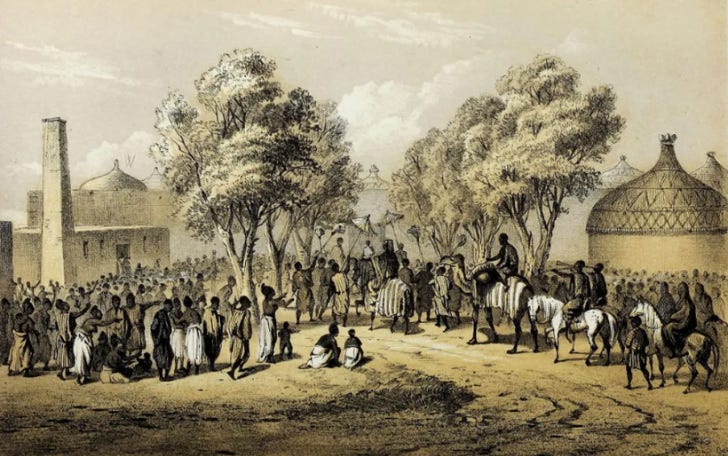
Más-eñá, Return of the Sultan from the Expedition, 4 July 1852. Engraving based on an illustration by H. Barth in the kingdom of Bahirmi, Chad.
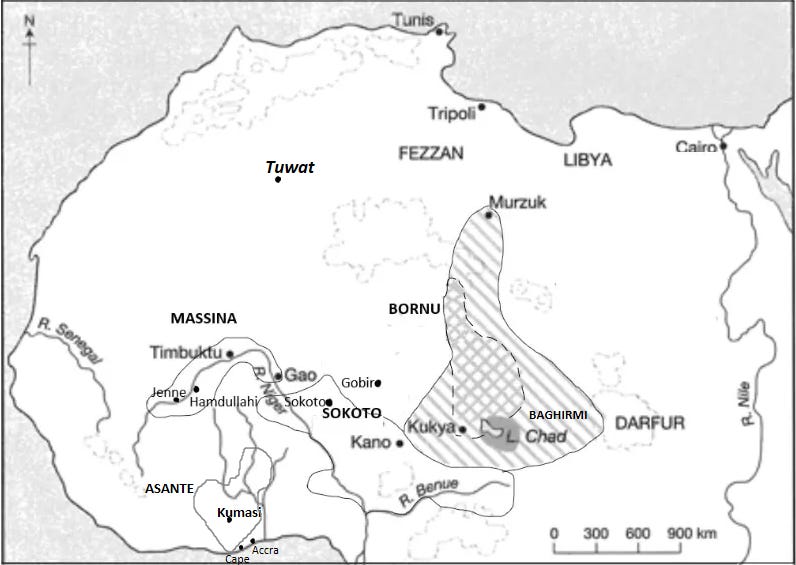
Map showing the kingdoms of Bornu, Sokoto, and Asante.
Barth was an agent of the British Government tasked with establishing commercial contacts with kingdoms in the African interior, including Bornu and Sokoto in present-day Chad and Nigeria. His predecessor in this role, some thirty years earlier, was Hugh Clapperton.
During Clapperton’s first journey in 1824, the ruler of Bornu had written to the ruler of Sokoto, advising the latter to execute the explorer for espionage, warning that:
“if the English should meet with too great encouragement, they would come into Soudan [West Africa], one after another, until they got strong enough to seize on the country, and dispossess him, as they had done with regard to India…
The English had taken possession of all India by first going there by ones and twos, until we got strong enough to seize upon the whole country.”2
Clapperton’s life was spared. However, another British agent, Thomas Bowdich, encountered a similar accusation when he visited the West African kingdom of Asante (Ghana) in 1817.
After Bowdich had explained the commercial motives of his mission to the Asante king, the latter pointedly asked:
“Now, how do you wish to persuade me that it is only for so flimsy a motive that you have left this fine and happy England … to put yourself prisoners in my hands with the risk of losing the head?”
The next day at a public assembly one of the King’s ministers asked Bowdich why, if Britain were so selfless, had it behaved so differently in India?. Bowdich was astonished that the Asante had heard anything about India and was at a loss for words.3
Yet African knowledge of European expansion extended back considerably further.
Two centuries earlier, Kongo’s King Garcia II Nkanga a Lukeni, who allied with the Dutch to expel the Portuguese from Luanda (Angola), proposed that the remaining Portuguese should be deported to Bengal (India), because “they are by nature an unruly people and prone to spreading discord.”
In a letter dated February 23, 1643, addressed to the Dutch council in Brazil, the Kongo King announced that he was sending an embassy to Brazil to present his case for removing the Portuguese. This embassy, led by the Kongo nobleman Dom Miguel de Castro, eventually arrived in the Netherlands in June 1643.4
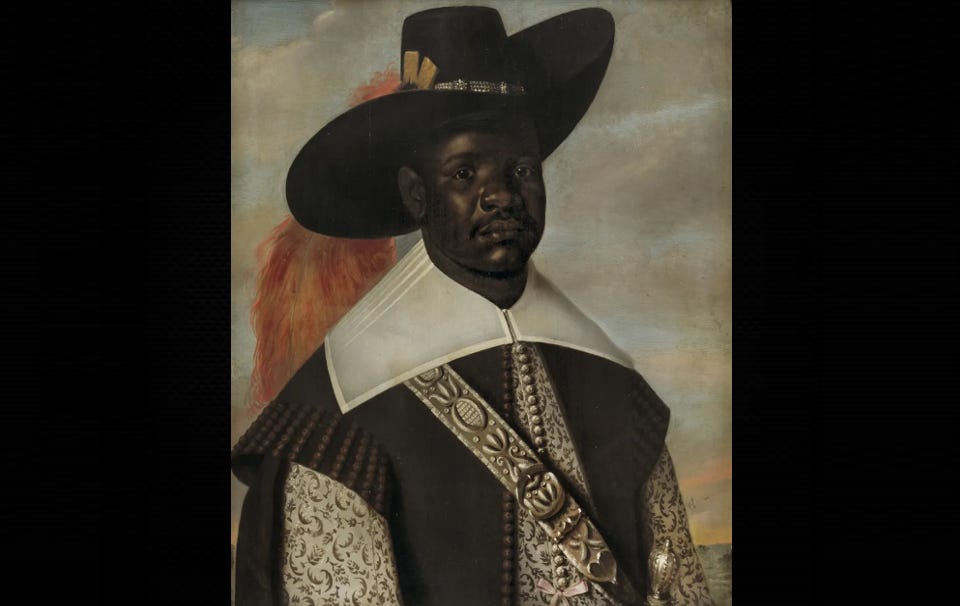
Portrait of Dom Miguel de Castro, Emissary of Congo, by Jeronimus Becx, 1643.
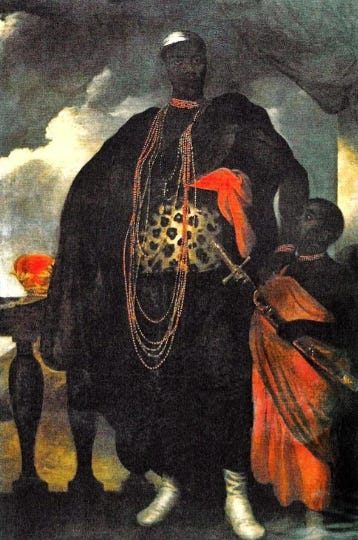
Portrait of King Garcia II Nkanga a Lukeni a Nzenze a Ntumba, by Albert Eckhout, c. 1641
These four separate accounts above provide a glimpse into the extent of Africa’s knowledge of the wider world, but are far from exhaustive.
In some of these cases, Africans obtained first-hand information about international politics from their own travelers and explorers, some of whom left written accounts of their journeys.
For example, the 1891 account of the Swahili traveler Amur al-Omeri provides some of the earliest Swahili words for European states, peoples, and rulers, such as WaReno [Portuguese], WaHolandi [ie; Amsterdam, Holland], WaNgereza [British], WaDachi [Dutch], mfalume wa Italia [King of Italy], etc
In other cases, Africans gathered information about the rest of the world from foreign envoys and travelers who visited their court.
When the British invaded the Asante capital of Kumasi in 1874, they found a collection of treasures and “curiosities” in the king’s stone palace that included prints from illustrated newspapers, as well as copies of the London Times and Bristol Courier.5
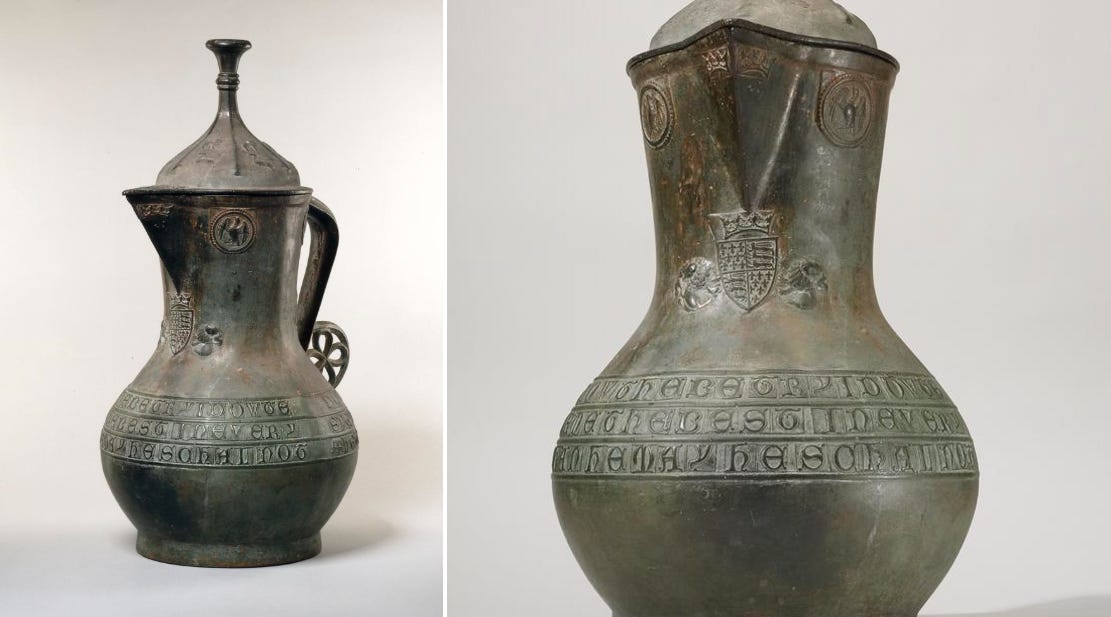
The Asante Ewer, a medieval English bronze jug bearing the royal arms of England as used in the period 1340 to 1405. Found at Kumasi, Ghana. British Museum 1896,0727.1. The jug likely came to Asante through trade or as a diplomatic gift, but was later looted from the royal palace in Kumasi after the Anglo-Asante War of 1895–96.
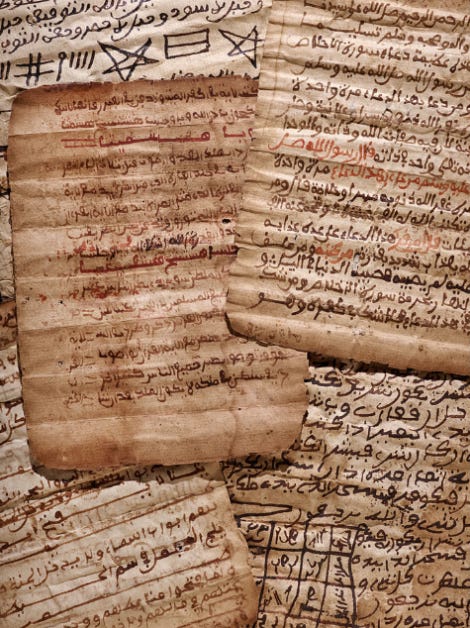
Arabic manuscripts from Kumasi, Ghana. 19th century. Musée d’ethnographie, Genève
Besides these were numerous Arabic manuscripts, written by the Muslim courtiers of the Asante King, who served as secretaries and Arabic translators in diplomatic correspondence with both the Muslim kingdoms of the interior and the European stations at the coast.
Among the King’s Muslim courtiers at Kumasi was a Hausa native of Katsina (Nigeria) “who had been at Tunis, and at Mecca; had seen many White men and ships; and described the method of travelling over the great desert [Sahara].”6
It was through such well-travelled Africans that the Asante king received information about the British colonisation of India.
In other societies along the West African coast, the literate class that kept local rulers abreast of international affairs was drawn from the small but influential communities of returnees (i.e., formerly enslaved Africans who had returned to West Africa).
Many returnees initially came from Brazil, but following the founding of Freetown, Sierra Leone, in 1792, and the Americo-Liberian colony at Monrovia in 1822, thousands of English-speaking returnees became integrated into the political and social fabric of West Africa.
[see: my previous essay on Contributions of Liberated Africans to the economic and cultural growth of 19th-century West Africa ]
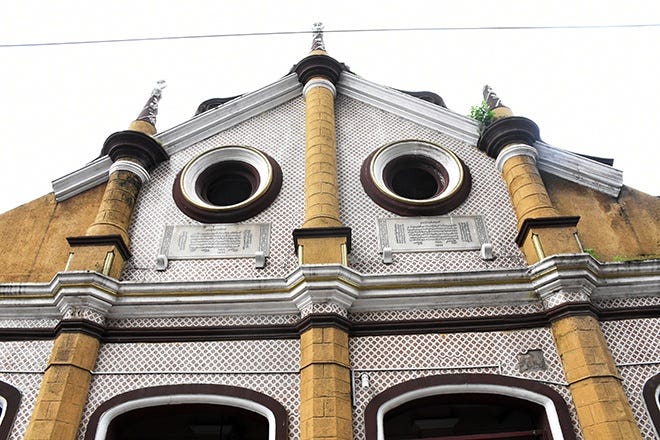
The Shitta-Bey Mosque in Lagos, Nigeria. Built in 1891 by Mohammed Shitta Bey (ca. 1824-1895), a son of a freed-slave from Freetown, Sierra Leone, who originally came from Brazil.
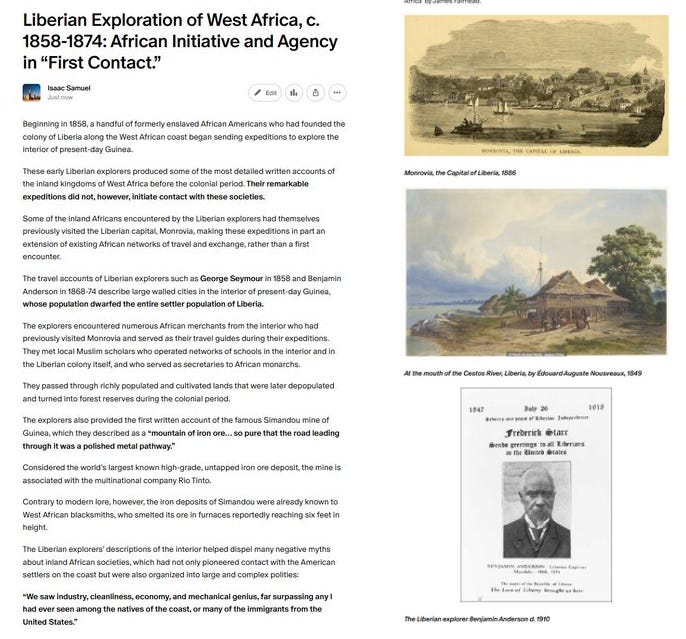
The Americo-Liberians, in particular, later produced some of the most detailed written accounts of the inland kingdoms of West Africa. Their expeditions did not, however, initiate contact with these societies.
Some of the inland Africans encountered by the Liberian explorers had themselves previously visited the Liberian capital, Monrovia, making these expeditions in part an extension of existing African networks of travel and exchange, rather than a first encounter.
The travel accounts of Liberian explorers such as George Seymour in 1858 and Benjamin Anderson in 1868-74 describe large walled cities in the interior of present-day Guinea, whose population dwarfed the entire settler population of Liberia.
The explorers encountered numerous African merchants from the interior who had previously visited Monrovia and served as their travel guides during their expeditions. They met local Muslim scholars who operated networks of schools in the interior and in the Liberian colony itself, and who served as secretaries to African monarchs.
They passed through richly populated and cultivated lands that were later depopulated and turned into forest reserves during the colonial period.
The explorers also provided the first written account of the famous Simandou mine of Guinea, which they described as a “mountain of iron ore… so pure that the road leading through it was a polished metal pathway.”
Considered the world’s largest known high-grade, untapped iron ore deposit, the mine is associated with the multinational company Rio Tinto.
Contrary to modern lore, however, the iron deposits of Simandou were already known to West African blacksmiths, who smelted its ore in furnaces reportedly reaching six feet in height.
The Liberian explorers’ descriptions of the interior helped dispel many negative myths about inland African societies, which had not only pioneered contact with the American settlers on the coast but were also organized into large and complex polities:
“We saw industry, cleanliness, economy, and mechanical genius, far surpassing any I had ever seen among the natives of the coast, or many of the immigrants from the United States.”
My latest Patreon article examines the historical significance of the 19th-century travel accounts of the Liberian explorers of West Africa.
Please subscribe to read about it here:
Travels and Discoveries in North and Central Africa Vol. III By Henry Barth, published by Antigonos Verlag, 2025, pg 372-375
Journal of a second expedition into the interior of Africa, by Hugh Clapperton, J. Murray, 1829, pg 197, 199
The Golden Stool Studies of the Asante Center and Periphery, edited by Enid Schildkrout, pg 86. The Fall of the Asante Empire: The Hundred-Year War For Africa’s Gold Coast by Robert B. Edgerton, pg 22
The Kingdom of Kongo and the Thirty Years’ War by John K. Thornton pg 212-213
Coomassie and Magdala: The Story of Two British Campaigns in Africa, by Henry Morton Stanley, Harper & Brothers, 1874, pg 189
Asante in the Nineteenth Century: The Structure and Evolution of a Political Order by Ivor Wilks, pg 259, 345-346
The great history of Africa, I hope, to give us an update of history Sultanate of Oudai in East of Chad.