

‘Narratives of Africa’s relation to global processes have yet to take full account of mutuality in Africa’s global exchanges.’1
The monumental architecture of ancient African societies constitutes one of the most visible legacies of Africa’s participation in global history.
The built environment of ancient societies in the eastern half of the continent, in particular, includes well-preserved ruins of temples, palaces, churches, mosques, and fortresses that reflect the region’s long engagement with the interconnected worlds of the Mediterranean and the Indian Ocean.
During the 1st millennium BC in the northern Horn of Africa (the pre-Aksumite period), several archaeological sites associated with the polity of “Dʿmt” were characterized by monumental architecture, inscriptions, and religious traditions resembling those found in the South Arabian kingdom of Saba.
The Pre-Aksumite sites in western and central Tigray, such as Yeha, which is home to a well-preserved sandstone temple, had been known to archaeologists since the early 20th century, who interpreted these foreign influences as the primary catalyst for the development of urbanism in the northern Horn of Africa.
Subsequent excavations at contemporaneous Ona sites in Eritrea and eastern Tigray, however, revealed the limitations of this interpretation, since no inscriptions, monumental architecture, or iconography were found that derive from the Ethio-Sabaean tradition.2
These Ona sites demonstrate that by 800 BC, local communities were living in fairly large and complex settlements composed of multi-room stone buildings, while exhibiting relatively limited evidence of social stratification.
Additionally, the site density of the Ona culture was higher than the western pre-Aksumite sites, with the largest settlements of Sembel and Mai Hutsa measuring over 9-15 ha, making them larger than the site of Yeha.3
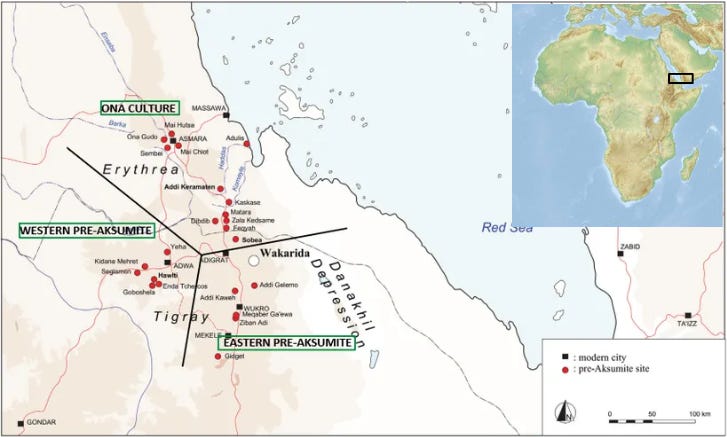
A map showing the distribution of pre-Aksumite sites in Ethiopia & Eritrea. Map by Anfray & Anne Benoist et al. Labels by author.
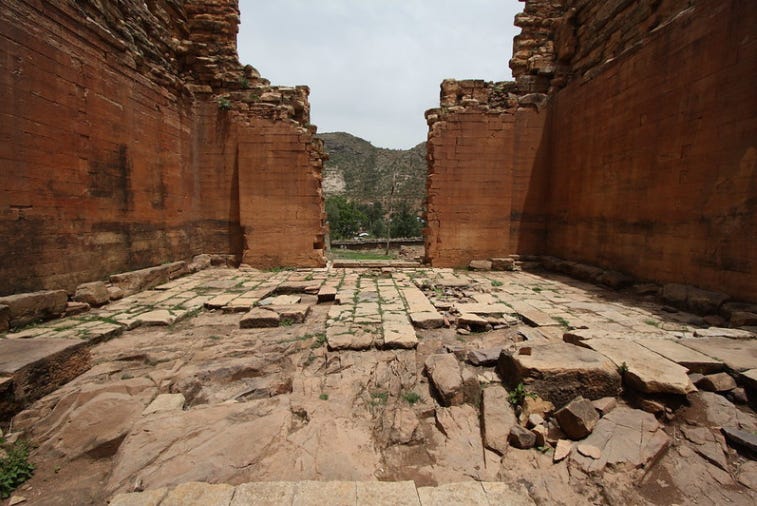
Interior of the Temple at Yeha. Tigray, Ethiopia.
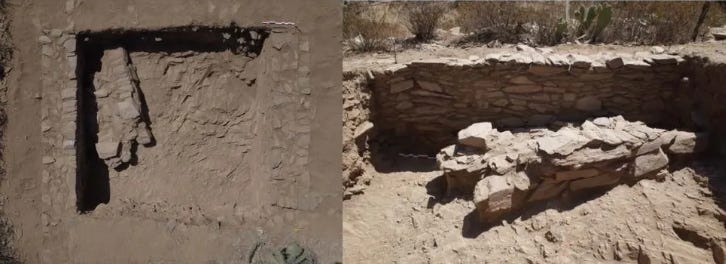
Pre-Aksumite structure at Alakile Daga. Wakarida, Tigray, Ethiopia. Image by Anne Benoist et al.
The Ona sites challenge the assumption that religious monuments represent the totality of pre-Aksumite architecture, and simultaneously reveal the predominantly African foundations of the region’s architectural development.
The archaeological evidence suggests that ancient communities in the Northern Horn of Africa were active participants in a wider network of exchange, selectively incorporating external elements into local traditions, while contributing to the development of a shared Red Sea ecumene.
As the archaeologist Matthew Curtis explains4:
Focusing on epigraphy, monumental architecture, and religious paraphernalia to the exclusion of other data creates a truncated perspective of interaction.
This truncation results in a narrowing and channelling of critical examination so that the products of cultural exchange, such as influence and innovation and the resultant transformations they generate, are portrayed as emanating and proceeding from a single source and direction across the Red Sea.
Global archaeology has shown that temples and other religious physical structures are parts of religious systems that are often interregional in scale, products of larger inter-ethnic and macro-scale world-views.
The non-elite, non-monumental architecture of the domestic setting may be less conditioned by an interregional world-view and more the product of adaptations and responses to localised, endogenous factors of settlement.
Similar patterns of external exchange and indigenous innovations contributed to the development of several unique architectural styles of the northern Horn of Africa in the later history of the region.
From the elite architecture of the Aksumite and Zagwe period during antiquity and the Middle Ages, to the Castles of the Gondarine period, and the dry-stone constructions of the medieval Muslim kingdoms of the Horn.
In Ethiopia, the monumental architecture of the Gondarine period became increasingly localised after the founding of Gondar in 1636, a development most clearly expressed in the city’s distinctive masonry style characterized by roughly dressed stone set in lime mortar.
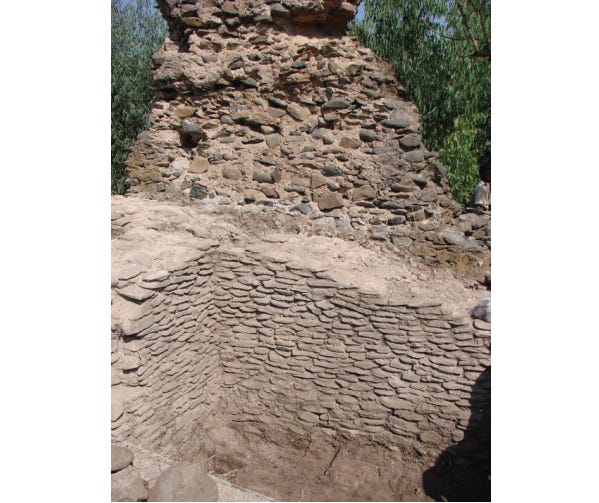
‘View from the south of the later Gondärine wall (top) and the Jesuit residence room A. Note the different systems of masonry layout, with irregular and flat stones.’ In Gondärine buildings, the stones vary in size and are laid in a slightly irregular way, in contrast to the tendency for flat stones to be laid horizontally in Jesuit buildings.’5
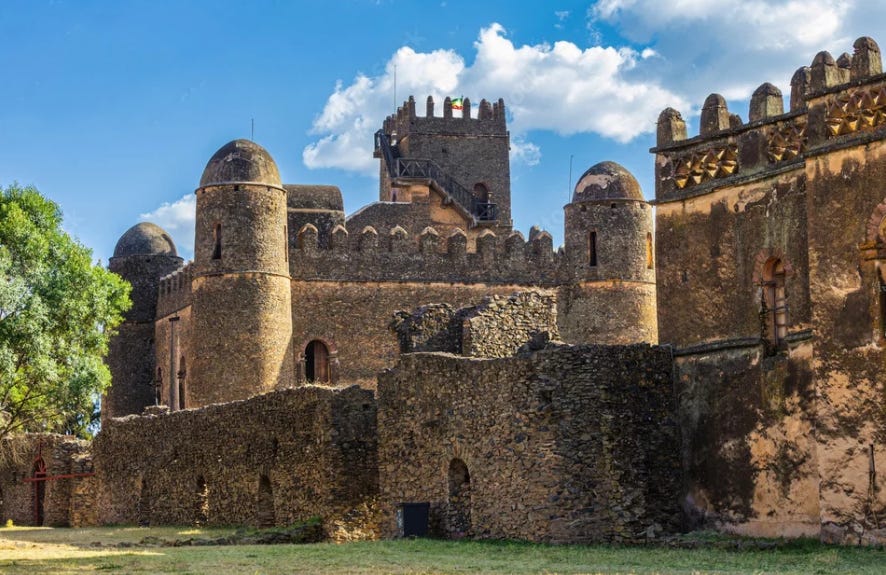
Fasiladas’ palace at Gondar, Ethiopia.
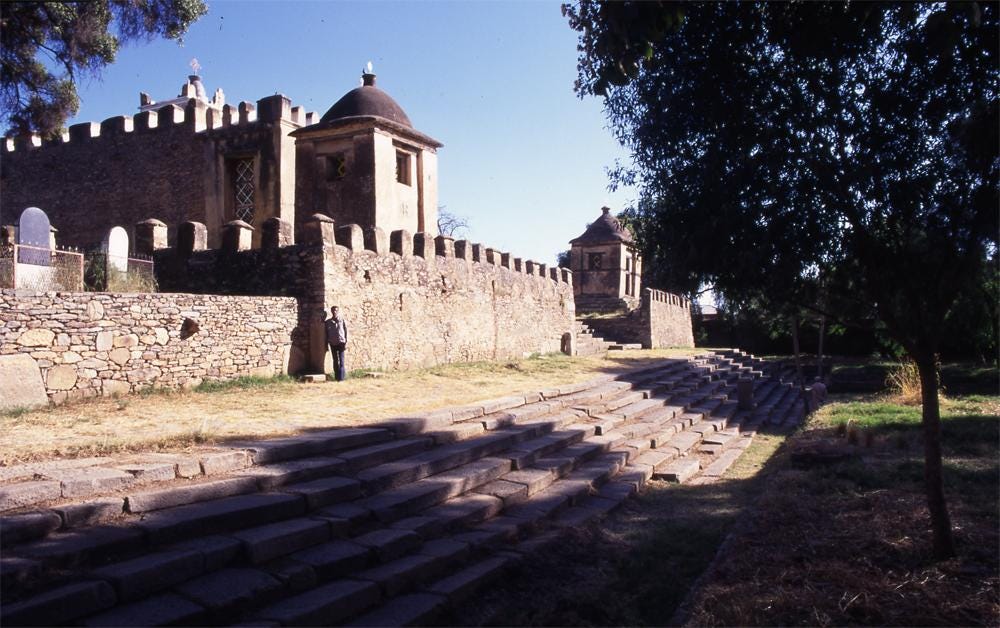
Fasilädäs’s 17th-century reconstruction of the Māryām Şĕyon church at Aksum.
Along the East African coast, the architectural monuments of the Swahili combined cultural influences from across the Indian Ocean world with those of their continental African roots.
Initially, all constructions were built with wattle-and-daub during the late 1st millennium CE. From around the 11th century the use of Porites coral was adopted on a limited scale, likely transmitted through connections with the Red Sea region or the Maldives. This was later replaced by coral rag after the 13th century as a result of local developments tied to increased demand for elite construction.
Most medieval Swahili ‘stone-towns’ typically contained only a handful of coral-stone structures (mosques and tombs), while the majority of domestic buildings remained rectangular wattle-and-daub houses with thatched roofs. It was only during the 14th century that houses of prominent elites began to be built with coral.6
This gradual emergence of a distinctive local architectural tradition is evident in the reconstruction of the Great Mosque of Kilwa during the early 15th century, where local masons used more suitable materials and techniques for constructing the pillars that supported its arches and domes.7
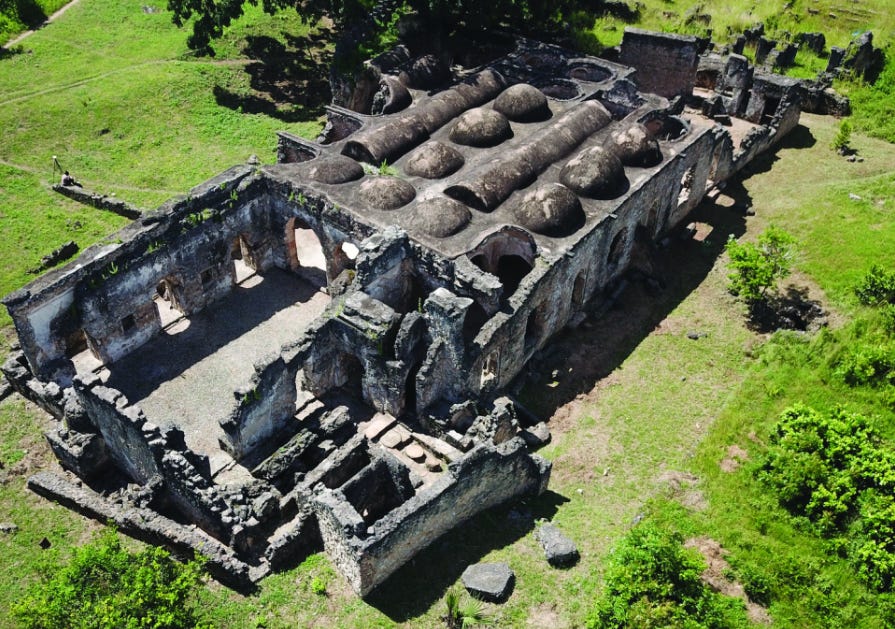
The Great Mosque of Kilwa; the domed extension. Discarded monolithic pillars visible on the eastern side of the structure. Image by E. Ichumbaki.
‘The picture that emerges of early fourteenth-century Kilwa as a real place is hardly complete or balanced, but it is nonetheless unparalleled in ‘medieval’ sub-Saharan Africa. Particularly interesting is the story of the collapse of the Great Mosque (notably its extension), during al-Hasan bin Sulaiman’s own reign (if the Chronicle is correct), and its eventual rebuilding using more suitable masonry materials and techniques for constructing the pillars that supported the arches and domes. From that one can deduce that the recruitment of the original architect from overseas had not married well with the traditional methods of quarrying and handling the coral stone with which the local masons and workforces were familiar.’8
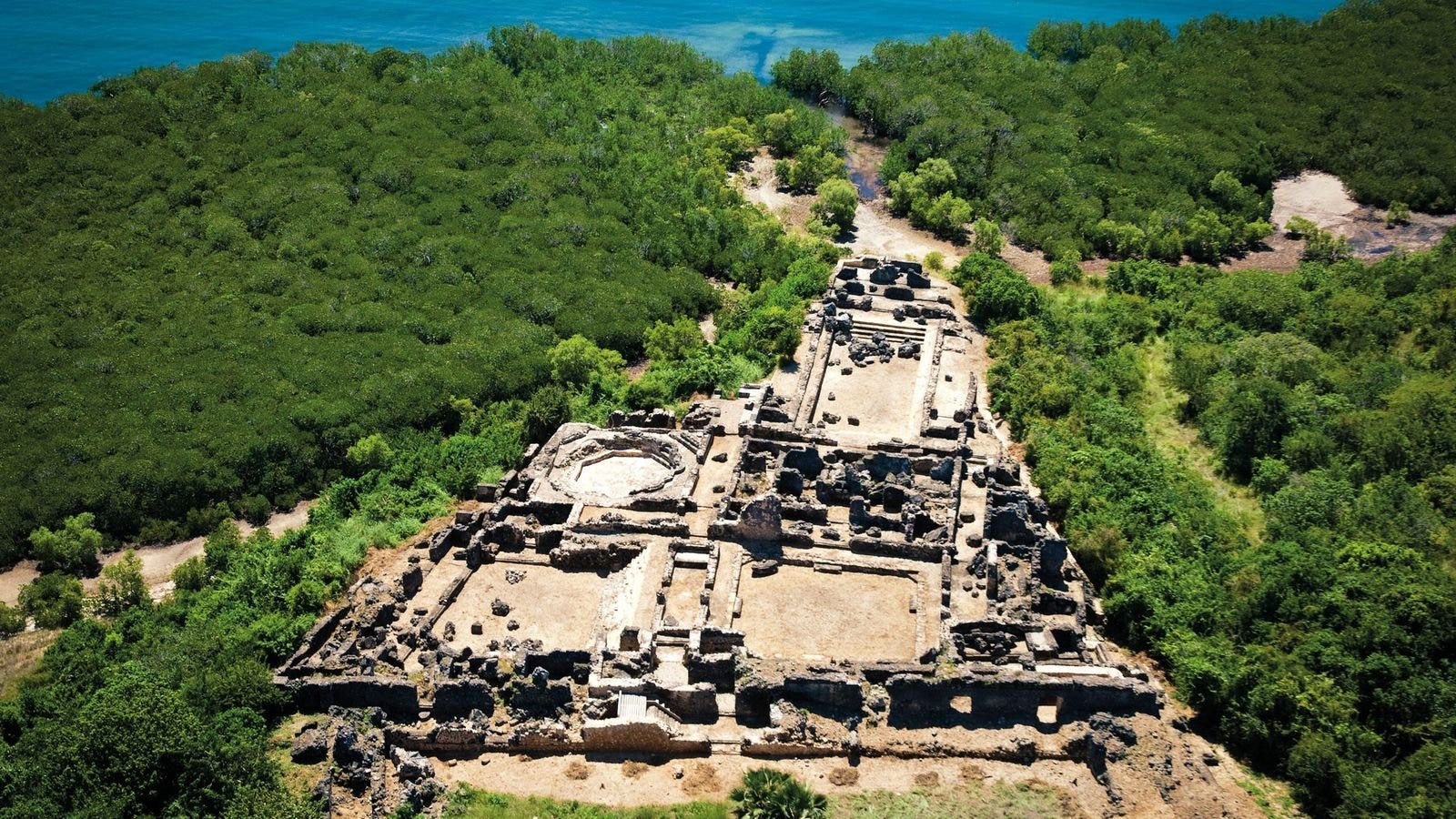
The 14th-century palace of Husuni Kubwa. ‘ In Peter Garlake’s judgement, Husuni Kubwa was the ‘fountainhead’ from which subsequent Swahili stone architecture derived. So, if the building of what was intended as a grandiose palace proved to be a wildly ambitious project, one resulting in a huge and pretentious monument condemned to decay so soon after it was opened, this brief but remarkable episode left a cultural legacy and a mark in the memory of Kilwa’s greatness.’9
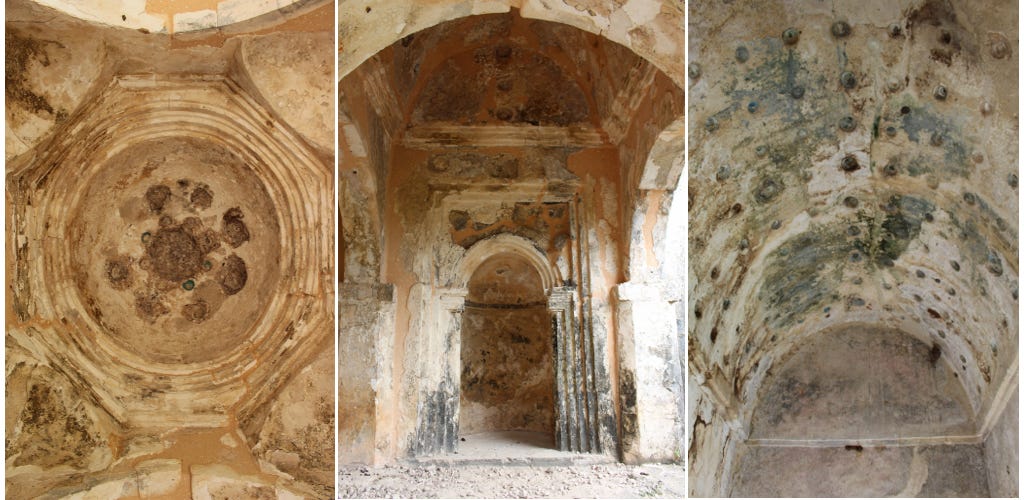
Dome and Mihrab at Kilwa, and Ceiling at Songo Mnara, Tanzania, with inserted ceramic bowls.10
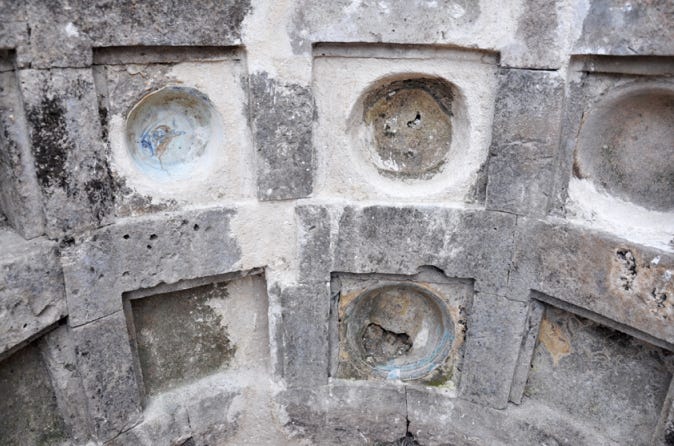
Fourteenth century mihrab of Kua and bowl inlays
‘ The fashion of buildings covered in ceramics must have come from Seljuq Anatolia (1219–1237), as we see in the town of Konya. Later, under the Timurids in the fifteenth century, covering tiles in ceramic reached their apogee. Certain Swahili cities, such as Mogadishu, were strongly influenced by Seljuq architecture. The use of inlay ceramics in the mosques of the East African coast was a part of this fashion and of a cultural movement peculiar to the Turco-Arab and Mediterranean world’11
These monuments reveal the overlooked contribution of African masons and architects to Global history, particularly to the religious and civic architectural traditions of the Red Sea and Indian Ocean worlds.
A similar dynamic is evident in the architectural history of medieval Nubia, whose monumental constructions, including Cathedrals, Palaces, Monasteries, and Fortresses, dominated the medieval landscape of present-day Sudan.
As the archaeologist Artur Obłuski observes:
“The hybrid character of Nubia, and its suspension between two worlds, has caused it to be frequently neglected by researchers of the Mediterranean World as well as Africa, although it should be fully integrated into both macro-regional contexts.”
After the fall of ancient Kush, three Nubian Kingdoms emerged along the middle Nile Valley, whose populations adopted Christianity by the 6th century and became an integral part of the Byzantine ecumene.
Nubian monarchs, envoys, and ordinary pilgrims traveled across the Mediterranean world, participating in global political processes until the late Middle Ages.
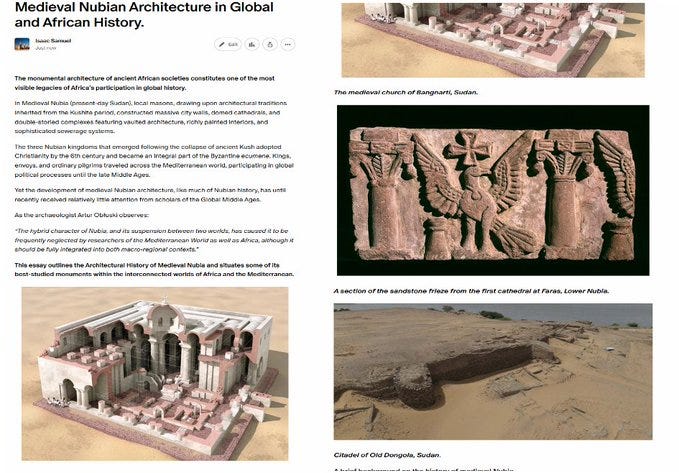
Medieval Nubian masons, drawing upon architectural traditions inherited from the Kushite period and influences from the Eastern Mediterreanean world, constructed massive city walls, domed cathedrals, and double-storied complexes featuring vaulted architecture, richly painted interiors, and sophisticated sewerage systems.
Medieval Nubian structures such as the Cathedral of Faras and the citadel of Old Dongola are some of Africa’s largest historical monuments, and their architectural development provides important insight into the continent’s participation in global historical processes.
The history of medieval Nubian architecture within the interconnected worlds of Africa and the Mediterranean is the subject of my latest Patreon article;
Please subscribe to read about it here and support this Newsletter:
Domesticating the World: African Consumerism and the Genealogies of Globalization by Jeremy Prestholdt, pg5
What was the South Arabian Impact on the Development of Ethiopian Margins in Antiquity by Anne Benoist et al. pg 4-14, On the nature of South Arabian influences in Ethiopia during the late first millennium BC by Anne Benoist et al. pg 23-31, Pre-Aksumite and Aksumite settlement of N.E Tigrai by AC D’Andrea pg 164-165
Relating the Ancient Ona Culture to the Wider Northern Horn: Discerning Patterns and Problems in the Archaeology of the First Millennium BC by Matthew C. Curtis, pg. 329- 351. Urban Precursors in the Horn: early 1st-millenniumBC communities in Eritrea by P. Schmidt and M. Curtis, pg. 850-860. The Archaeology of Ancient Eritrea, edited by Peter Ridgway Schmidt et al, pg. 109- 161.
Ancient interaction across the southern Red Sea by Matthew C Curtis, pg 59-60. In ‘Trade and Travel in the Red Sea Region: Proceedings of Red Sea Project I Held in the British Museum, October 2002, edited by Paul Lunde, Alexandra Porter
The Archaeology of the Jesuit Missions in Ethiopia (1557–1632) By Victor M. Fernández, Jorge De Torres, Andreu Martínez d’Alòs-Moner, Carlos Cañete, pg 136
The Swahili: The Social Landscape of a Mercantile Society by Mark Horton, John Middleton pg 116-120. The Swahili World, edited by Stephanie Wynne-Jones and Adria LaViolette pg 9, 196-197, 510-511.
Kilwa: a history of the ancient Swahili town with a guide to the monuments of Kilwa Kisiwani and adjacent islands, by John E. G. Sutton, pg 139-140
The Swahili World, edited by Stephanie Wynne-Jones and Adria LaViolette pg 56.
Kilwa: a history of the ancient Swahili town with a guide to the monuments of Kilwa Kisiwani and adjacent islands, by John E. G. Sutton, pg 151
‘Artistic Dynamics across the Seas: Architecture, Objects, and Ornamentation in the Medieval Port Cities Kilwa, Songo Mnara and Pisa’ by Vera-Simone Schulz
Historic Mosques in Sub-Saharan Africa From Timbuktu to Zanzibar By Stéphane Pradines, pg 210-211 ·
Super interesting how the historical narrative has constantly made an attempt to erase the influence the "Global South" has had on world affairs.
This article explores that process through architecture, in a post I wrote a while back I explored how this is also happens with sports:
https://writerbytechnicality.substack.com/p/the-northsouth-divide-in-sports?r=3anz55