

The terms Matriarchy (maternal rule) and Matrilineality (maternal ancestry) are at times used interchangeably in popular literature to describe ancient and contemporary societies where women have greater autonomy and social standing.
While the existence of “true matriarchies” or gynecocracies is still a matter of debate among modern anthropologists, the existence of Matrilineal kinship systems is well documented in several societies across the world, both past and present.
According to evolutionary theories of the late 19th century, which have since been largely discredited in modern anthropology, matriarchy and matrilineality represented an early stage of social development through which human societies passed before becoming patrilineal and patriarchal.1
These erroneous assertions were based, in part, on historical descriptions of matrilineal systems of succession and the elevated status of women, who at times occupied the highest political office, in societies at the periphery of the Greco-Roman world during the classical period, and the Arab world during the Middle Ages.2
Medieval Arab writers and travelers, such as Ibn Battuta (d. 1369) and Ibn Khaldun (d. 1406), reported, often with disapproval, about matrilineal succession systems in Medieval Ghana and Mali, the southern Berber-speakers of Air and Walata, the kingdom of Makuria/Nubia, and the Malabar coast of South-Western India.3
These customs attracted particular attention in communities that had adopted Islam, as they appeared incongruous with prevailing Islamic social norms.
The Arab writers were astonished by the importance of maternal ancestry, the deference shown to the mother and sister of the King, and the transmission of property and power to the King’s maternal nephew. Many expressed disapproval of the relative freedom enjoyed by women in their speech and conduct, as well as their refusal to veil their faces.
While some of these observations about the status of women in these societies are supported by modern ethnographic studies, other aspects, such as their ability to exercise political authority, vary considerably. In particular, the presence of women sovereigns reigning with full authority appears to be just as exceptional in African history as they were in World History.
Contrary to evolutionary theories, these African women sovereigns, like the Candaces of Meroitic Kush (250BC-360 CE) and the Queens who succeeded Queen Nzinga in the kingdom of Matamba (Angola, 17th-19th century), came to power only after long periods of male rule.
They typically ascended the throne during periods of political crisis, when the emergence of capable rulers could transcend established gender norms. Their successful reigns, in turn, strengthened the legitimacy of subsequent women sovereigns.
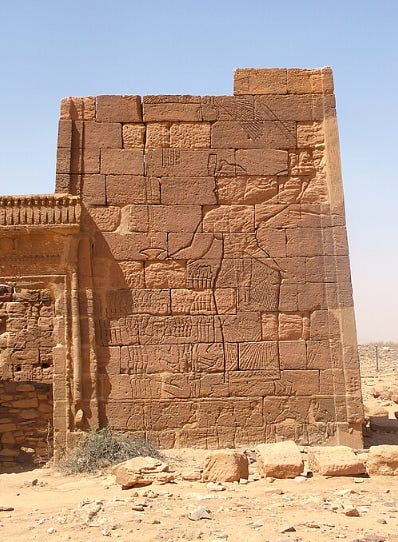
Queen Amanitore of Kush smiting her enemies. Temple of Naqa, 1st century CE, Sudan.

Queen Njinga with captured missionaries, late 17th-century illustration, Virgili Collection (Biblioteca Estense Universitaria).
In some African societies, women sovereigns are associated with the pre-Islamic period.
In the traditional histories of the Hausa kingdom of Daura (Nigeria), the rule of the first Muslim king was preceded by the reign of queens. These bore the title of Magajiya (Heiress) and succeeded each other presumably by right of matrilineal descent. The last of these queens was Daura, after whom the city-state was named. The throne was transferred to her son and his male heirs, while the Magajiya became the Queen Mother.4
Similar founding traditions in the Hausa city of Zaria were recorded in the early 19th century, which attribute the expansion of the city-state and the construction of its walls to the 15th/16th century Queen Amina. While the city-state was reportedly named after her less flamboyant sister, Zaria, many earthworks and ramparts in northwestern Hausaland are known as Amina’s walls (Ganuwar Amina).5
The historicity of Amina is in less doubt than the Queens of Daura and their matrilineal succession system.
But what is more significant is that these figures are associated with the transitional period preceding the adoption of Islam, and some of the legendary queens are deified among the traditional religious systems (Bori) of the non-Muslim Hausa.6
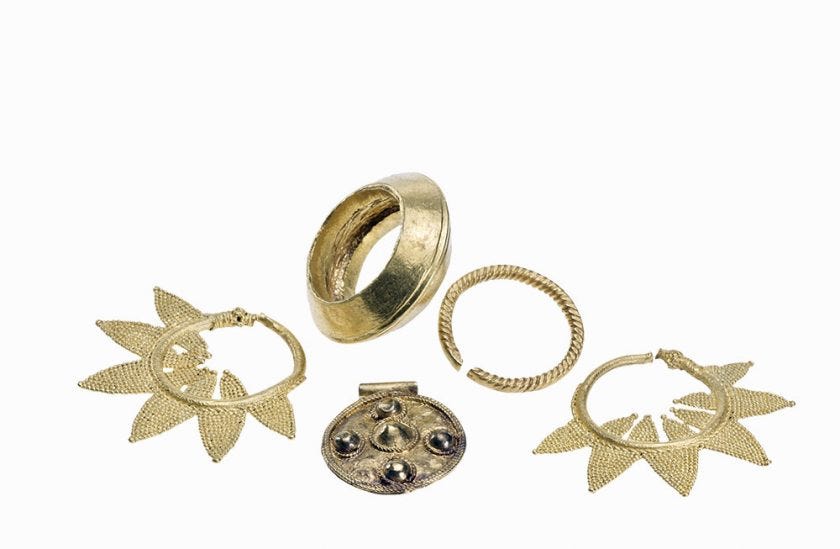
Gold earrings, pendant, and ring from a burial of an elite woman, 13th-14th century, Durbi Takusheyi, Katsina State, Nigeria. NCMM
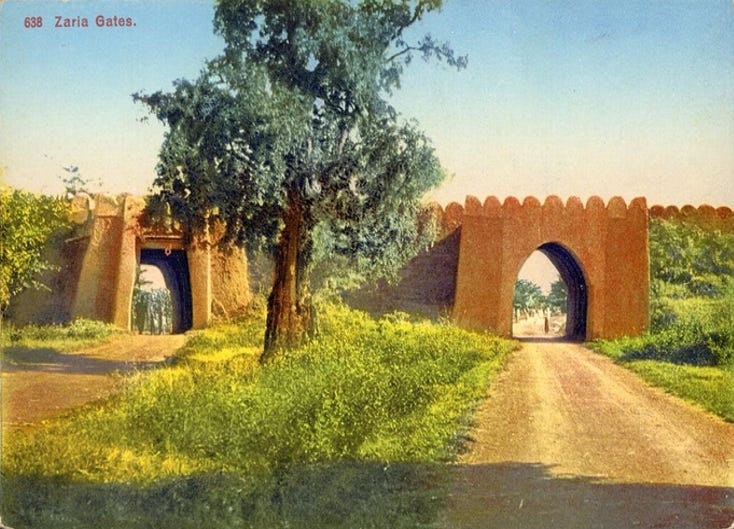
Walls of Zaria, mid-20th century.
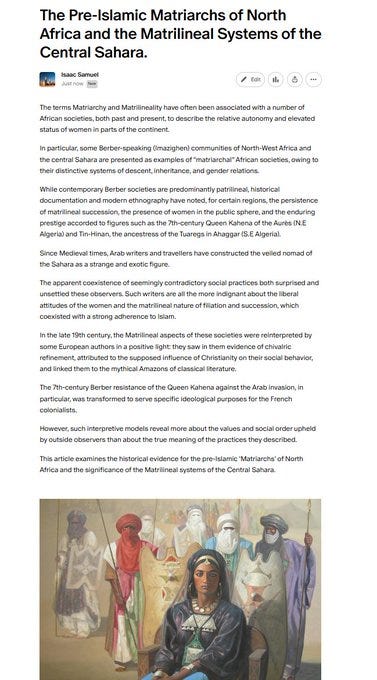
Arguably the most significant historical evidence for maternal succession and authority in pre-Islamic Africa comes from the Berber-speaking (Imazighen) communities of the central Sahara.
While contemporary Berber societies are predominantly patrilineal, historical documentation and modern ethnography have noted, for certain regions, the persistence of matrilineal succession, the presence of women in the public sphere, and the enduring prestige accorded to figures such as the 7th-century Queen Kahena of the Aurès (N.E Algeria) and Tin-Hinan, the ancestress of the Tuaregs in Ahaggar (S.E Algeria).
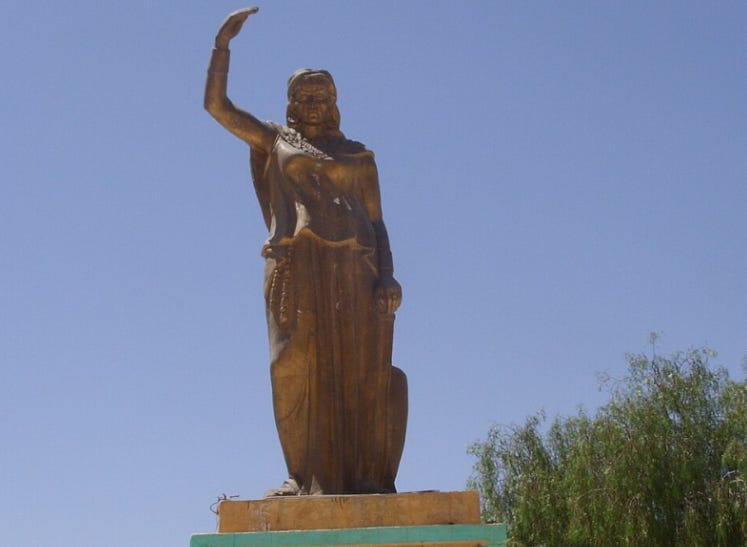
Monument to Dihya (Kahina), Baghai, Algeria.
Since Medieval times, Arab writers and travellers have constructed the veiled nomad of the Sahara as a strange and exotic figure.
The apparent coexistence of seemingly contradictory social practices both surprised and unsettled these observers. Such writers are all the more indignant about the liberal attitudes of the women and the matrilineal nature of filiation and succession, which coexisted with a strong adherence to Islam.
In the late 19th century, the Matrilineal aspects of these societies were reinterpreted by some European authors in a positive light: they saw in them evidence of chivalric refinement attributed to the supposed influence of Christianity on their social behavior, and linked them to the mythical Amazons of classical literature.
The 7th-century Berber resistance of the Queen Kahena against the Arab invasion, in particular, was transformed by French Colonialists to serve specific ideological purposes.
However, such interpretive models reveal more about the values and social order upheld by outside observers than the true meaning of the practices they described.
My Latest Patreon Article examines the historical evidence for the pre-Islamic ‘Matriarchs’ of North Africa and the Matrilineal systems of the Central Sahara.
Please subscribe to read about it here:
‘Matriarcat’ by Nicole Echard, in ‘Dictionnaire de l’ethnologie et de l’anthropologie’ edited by P. Bonte and M. Izard
An English translation of Bachofen’s Mutterrecht (Mother right) (1861) : a study of the religious and juridical aspects of gynecocracy in the ancient world by Johann J. Bachofen. The idea of Africa, by V. Y. Mudimbe, pg 87-92. Matrilineal, Matriarchal, and Matrifocal Islam: The World of Women-Centric Islam, edited by Abbas Panakkal, Naṣr Muḥammad ʻĀrif.
On West Africa, see: Was Royal Succession in Ancient Ghana Matrilineal? by Nehemia Levtzion, pg 91-93. African Dominion: A New History of Empire in Early and Medieval West Africa by Michael A. Gomez, pg 94,
On the Southern Berbers, see: The Travels of Ibn Battuta, AD 1325-1354. Volume 4, pg. 974- 975.
On Nubia, see: Medieval Kingdoms of Nubia by Derek A. Welsby, pg 249
The affairs of Daura: history and change in a Hausa state 1800-1958, MG Smith pg 53-57, 123
The beginnings of Hausa society by M.G. Smith pg 349
The Government in Kano, by M.G.Smith, pg 124. Towards a Less Orthodox History of Hausaland by J. E. G. Sutton, pg 197-198. The Pre-Islamic Dimension of Hausa History by Dierk Lange pg 184-185
This distinction between matriliny and matriarchy clears up so much confusion, thank you for laying it out with actual sources. The Herero communities I work with in Namibia are a useful footnote here: descent is reckoned through both lines at once, with ritual duties following the patrilineal oruzo and most cattle wealth moving through the matrilineal eanda. Double descent systems like that are impossible to place on any ladder from mother-right to father-right, which is one more reason the old stage theories collapsed.