

The ancient game of Mancala, described as “the national game of Africa”, is arguably the most mathematical game to have achieved a mass following anywhere in the world.
Often considered the world’s oldest board game, mancala has hundreds of names, dozens of versions of play, and is one of the widest distributed games in history. It is popular throughout nearly all of Africa, as well as in parts of the Middle East, South-East Asia, the Caribbean and South America.
It was played by kings on beautifully carved ivory boards embellished with gold, and by nomadic pastoralists who carved numerous game boards on rock faces across the arid landscapes of Eastern and Southern Africa.
European explorers who first encountered the game in the 17th century, favourably compared it to Chess and Backgammon. They found this highly mathematical game difficult to master, and like many African innovations, sought to attribute its origins to a supposedly more “civilized”, non-African race.
Consequently, studies of the game and its origins have long been clouded by these assumptions.
Yet the occurrence of graffiti boards on ancient African monuments, together with the game’s ubiquity across African societies, from the rock art of desert herders to the palaces of kings in great cities, suggests that Mancala is of considerable antiquity and was likely invented in Africa.
This article examines the ancient origins and history of Mancala in Africa.
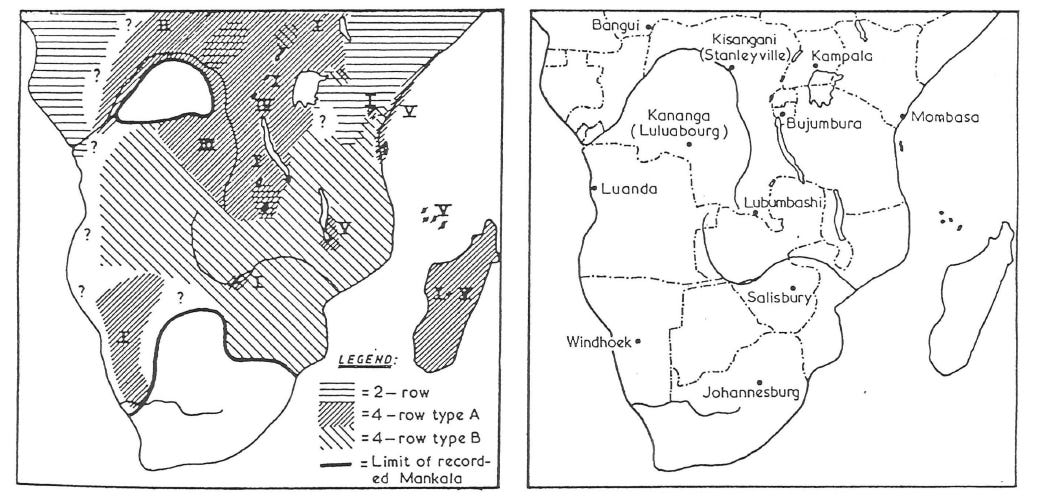
Approximate distribution of main types of Mankala in the twentieth century. Map by P. Townshend
Support AfricanHistoryExtra by becoming a member of our Patreon community, subscribe here to read more about African history, download free books, and keep this newsletter free for all:
A brief description of the game of Mancala
Mancala is the generic name given by anthropologists to a class of board games, that are known to Africans as Gabata, Bao, Warri, Omweso, Chisolo, etc. Each differ from one another with respect to the rules of game play, as well as the number of rows, which could be two, three or four rows.
Mancala is a two-person or two-team game, traditionally exclusively played by adult men. Each player owns half of the board, and all pieces are identical.
From a starting position determined by local convention the players move alternately, lifting the pieces from the store holes at either side of the board, or from one hole at a time and sowing them round the whole board (in the case of two-row and three-row games) or round the player’s own half of the board (in that of the four-row games).
Each move must begin from a hole on the player’s side and the direction of sowing is normally fixed, anti-clockwise being by far the most frequent. For the sake of brevity, the numerous directions and strategies of play will not be summarized here.
The aim in many two-row and three-row games is to capture a majority of the pieces and in rare cases to gain more holes, whereas the only object in four-row games (and in some two-row ones as well) is to make it impossible for the opponent to move, by leaving them with empty holes or with ‘singletons’ that cannot be moved.1
According to the anthropologist and game historian Alexander J. de Voogt, most mancala games are classified as “war games of implied destruction” similar to chess, since their primary purpose is capturing pieces and/or holes, which leads to destruction of the opponent.2
The History of Mancala: Examining the archaeological and documentary evidence.
The Mancala game appears to be of great antiquity, based on archaeological evidence of game boards. Written descriptions of the game and its rules appear much later in the 17th century, almost simultaneously in both African and European accounts.
The oldest extant example of an African mancala game board is the 3-row game board made of limestone that was discovered in Memphis, Egypt, and is estimated to be 3,500 years old.
Elsewhere in Egypt, graffiti of 2-row game boards have been found in Giza on building blocks fallen from the pyramid built for Menkaure (4th Dynasty, about 2613-2494 Bc), on roofing slabs at the Kūrna Temple (about 1400 Bc), and on the great pylon at the entrance to the Temple of Karnak (300-30 Bc).3
Some interesting finds on the exterior of the Meroe pyramids and on rock surfaces on Sai Island in Sudan include many mancala boards consisting of two rows of six holes.
The earliest record of mancala-type marks on the Meroe pyramids is found in a photograph taken during Professor Breasted’s expedition in 1906. The photograph shows two rows of six holes on the wall of a chapel belonging to pyramid 7 and defacing the Meroitic figurative . The North and South cemeteries have many examples of two-row mancala-type games, both carved boards and inscribed graffiti.4
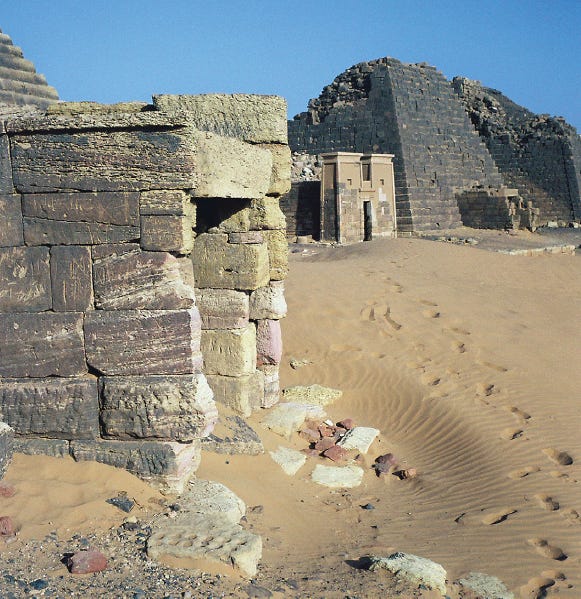
Mancala-like board next to the chapel of pyramid 3, North Cemetery (photograph: Alex de Voogt)
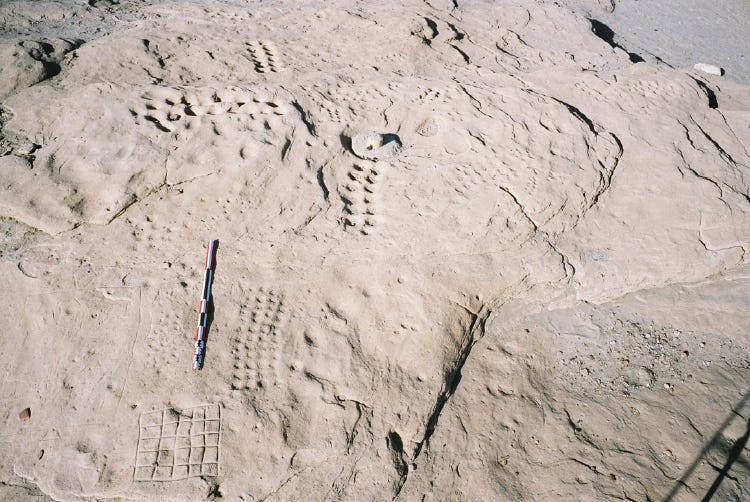
Games context with (from bottom to top) sija, ṭāb and mancala on Sai Island, Sudan. Photo: Alex de Voogt.
Ancient Egypt was the origin of a number of ancient board games, most notably mehet and senet, which appear extensively in its religious literature and artwork, and also spread southwards to Kush.
On this basis, and the examples mentioned above, several scholars have attributed the origin of mancala to ancient Egypt.
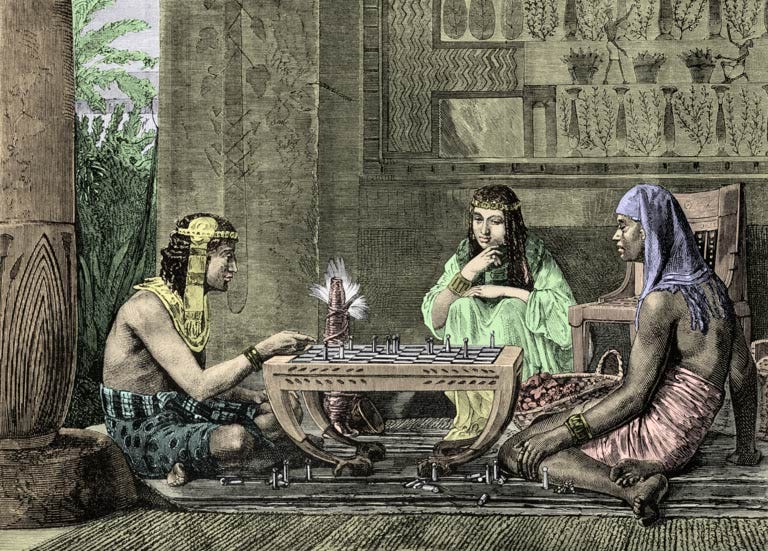
“Ancient Egyptian Chess Players”. Wood engraving, 1867, after a painting by Sir Lawrence Alma-Tadema (1836-1912). From: Illustrirte Zeitung, 49th vol., No. 1275, Leipzig, December 7, 1867, p. 392. Digital colouring. Berlin, Sammlung Archiv für Kunst und Geschichte.
However, the dating of the games is uncertain, especially for the two-row game boards, since the erection of the ancient buildings and pyramids may not necessarily be contemporaneous with when the game was scratched into its roof.
Voogt, who proposed an external origin of the two-row game, argues that the boards found on ancient Egyptian and Meroitic pyramids were added much later during the Ottoman period. He points out that some of these mancala boards, especially in Sudan, were found alongside a 5x5 board game called seeja/siga, which was popular in Egypt and the Middle East during the Ottoman period.5
The ancient three-row game board is currently unknown in modern Egypt, where players of mancala use a two-row game board, whose rules are similar to that found in Turkey and Syria. Its first description comes from Carsten Niebuhr in 1774, who mentions Maronites playing in Cairo, using a board with two rows of six holes.
In Sudan, Schweinfurth in 1874 mentions that the Muslim Nubians had only recently adopted the game from the Azande of Southern Sudan, using a two-row game board with two store holes at the end, a design and configuration unknown in the Middle East.6
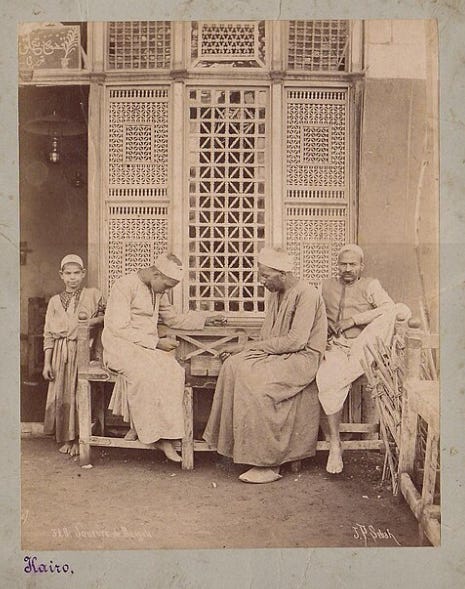
“Pascal Sebah (1823-1886) - Joueurs de Mangali - Kairo.” Wikimedia Commons. Note the tow-row boad game
While Voogt’s hypothesis that the two-row graffiti were added at a later date may apply to that type of game board, the unexplained presence of the three-row game board, which is still current in Ethiopia and was once attested in West Africa and Central Africa, as explained below, suggests that mancala may have been played in ancient Egypt as well.
Additionally, the widespread finds of two-row game boards across vast swathes of Eastern, Central, and Southern Africa, in remote places only accessed by pastoralist groups who still use those boards in modern times, contradict the attribution of such inscriptions solely to Ottoman-Egyptians, who, as Voogt admits, “are not known to use the rows of holes carved in rock and monuments.”
It’s important to note that none of the African groups examined below refer to the game using the Arabic word mancala, not even among the Muslim Africans (eg the Swahili) or those closest to Arabia (eg the Ethiopians) where Arabic words were liberally borrowed, including for games such as classic chess.
South of the Nile Valley, rock-cut game boards with two rows dated to the 6th-7th century CE have been found in Eritrea, and on decorated stelae from Ethiopia dated to the 12th century.7
Alex de Voogt argues that although it is possible these are mancala boards, there is no additional evidence such as depictions of people playing or other games.8
However, given the widespread use of two-row game boards in modern Ethiopia resembling those found on the stela, the identification of these images as representations of actual game boards remains convincing, just as the swords, sandals, and clothing shown were also used in medieval Ethiopia.
(see my previous essay on The Megalithic Landscapes of Ethiopia from Prehistory to the Modern Era )
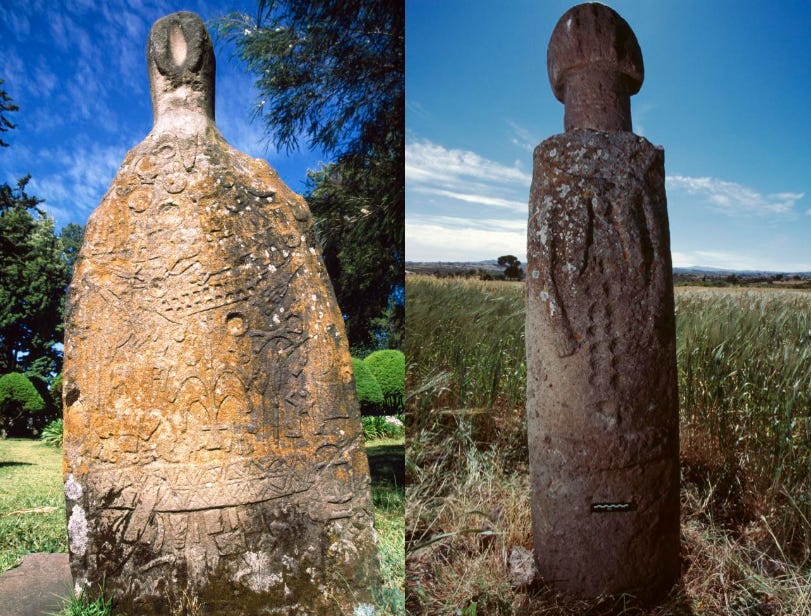
(left ) Two-row game board on a decorated stela. Addis Ababa, Ethiopia British Museum number 2013,2034.16387. (right) Two-row game board on a cylindirical stela from Goro Shino, Ethiopia British Museum number 2013,2034.16373.
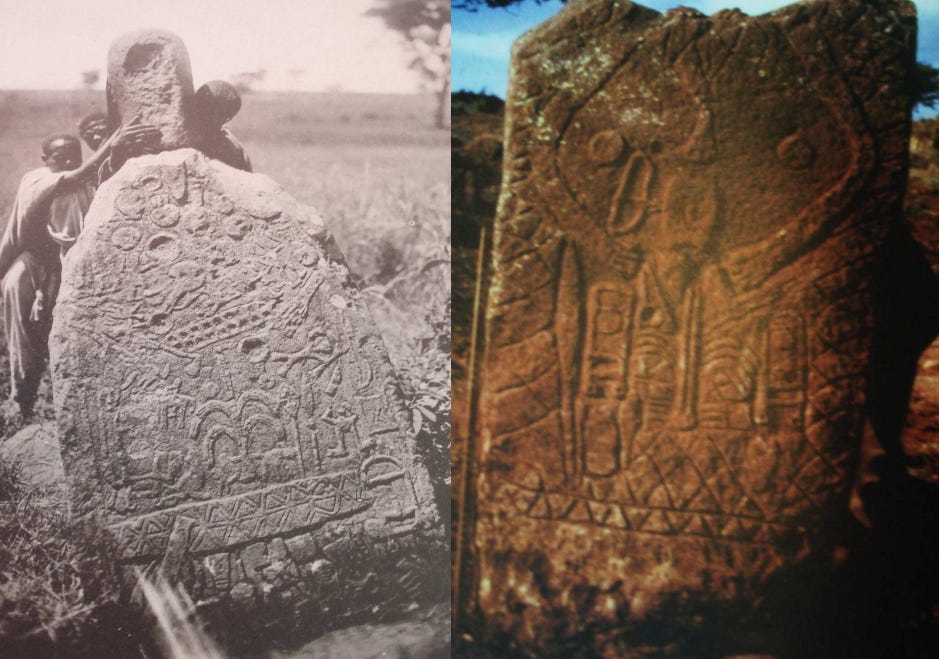
“Historiated” stelae at the Silté site in the Gurague. ca. 1931. Images reproduced by M. Monsillon
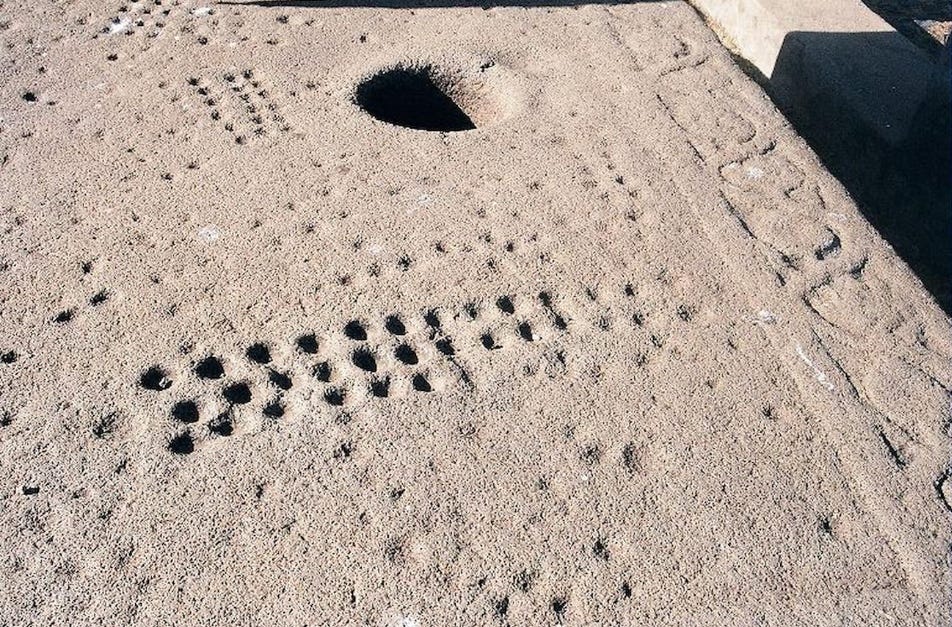
Three-row game boards carved in the rock in Ethiopia, during the Antiquity or the Middle Ages. photo by Indech on Wikimedia Commons
There are numerous images of four-row and two-row game boards cut into rocks at various sites in Ghana, Uganda, Kenya, Tanzania and Namibia, which are unfortunately difficult to date with any certainty.
Numerous mancala game boards carved on rock surfaces have also been partially studied in the Nakuru region of Kenya, where they are thought to be of a late 1st millennium CE date, based on the material culture found next to the sites. Traces of game boards dating to the 15th century have also been found during archaeological excavations in Zimbabwe.9
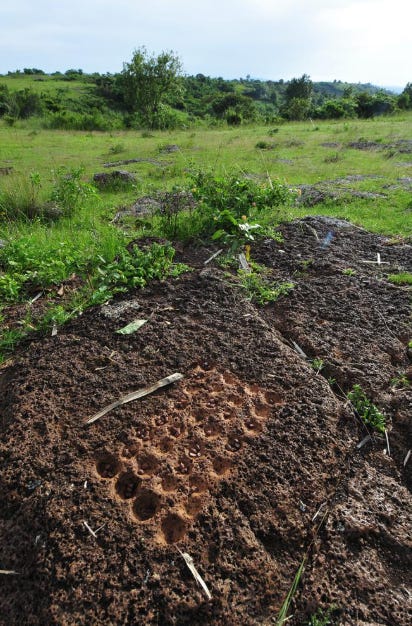
Mancala board carved into a rock. Mukono, Uganda. British Museum number 2013,2034.14693
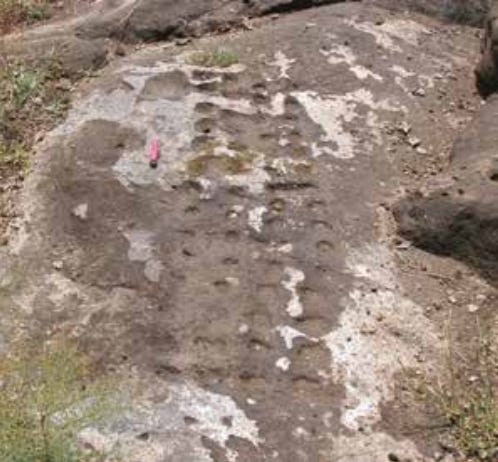
A four-row, 60-pit game board complex on exposed rock surface near Leshota, Narok County, Kenya (Ambrose, S. 2005). image by Mwanzia Kyule
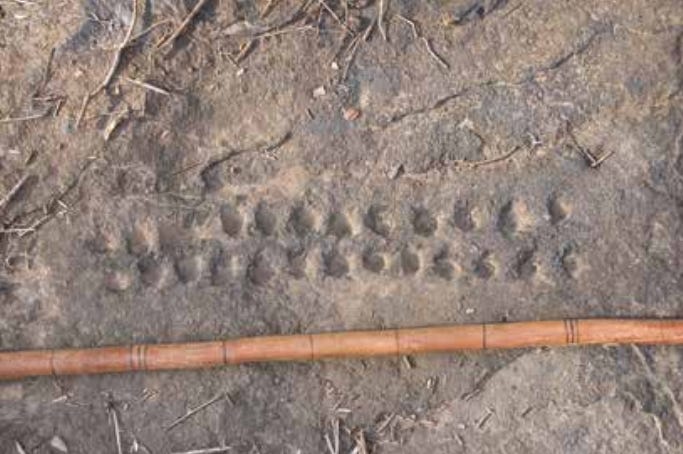
A two-row, 26-pit game board cut into natural rock formations at archaeological site GvJh115, Narok County, Kenya (Ambrose, S. 2005) image by Mwanzia Kyule
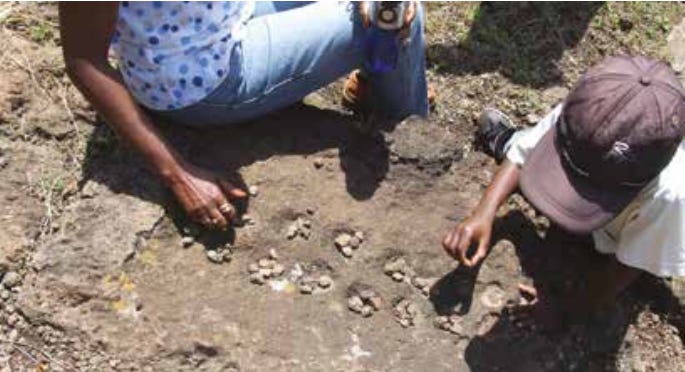
A prehistoric game board curved on natural rock formation at Hyrax Hill archaeological landscapes, Nakuru, Kenya (Kyule, M. 2012). image by Mwanzia Kyule
In historical accounts, the earliest written reference to a mancala game is found in the 10th-century Arabic text Kitab al Aghani, or ‘book of songs’, by Abu’l Faraj. However, this isolated account is not conclusive, as evidence abounds for the application of one name to various games.10
There’s another curious reference to an antiquated “game of mancal”/“manqual” that seems to have been used as a measure of distance at the time of Francesco Alvares report on Ethiopia in the 1520s.11
In Ethiopia, a 14th-century Ge‘ez text of the “Book of Mysteries of Heaven and Earth” prohibited priests from indulging in the pastime of qarqis, a term that in later contexts was used for both gabatu (ie mancala) and säntäräj, (Ethiopian name for classic chess).12
A 17th-century Ge’ez text, the “Faws Manfasawi” (‘Spiritual Medicine’) also forbids ecclesiastics from playing gabata. The German linguist Job Ludolf likewise notes in 1699 that he had been told by his Ethiopian informant, Abba Gregorios, that the latter’s compatriots had a game in which “small balls are placed in a table” and ‘by this kind of playing’ some people ‘wasted their time in fortunetelling’.13
Gabata was more fully described by Theodore Bent in 1873. The game board had two rows of eighteen holes, nine for each person:
“There are three balls, called chachtma, for each hole, and the game is played by a series of passing, which seemed to us very intricate, and which we could not learn; the holes they call their toukouls, or huts, and they get very excited over it”14
The actual game boards provided by Bent to the British museum consisted only of three-row games, which he says were universal among the Abyssinians “from the chief to the peasant”, including (and especially) the pastoralist groups in the south and west, whom he considered “primitive.” He also compared it to the games found much further south in Zimbabwe15
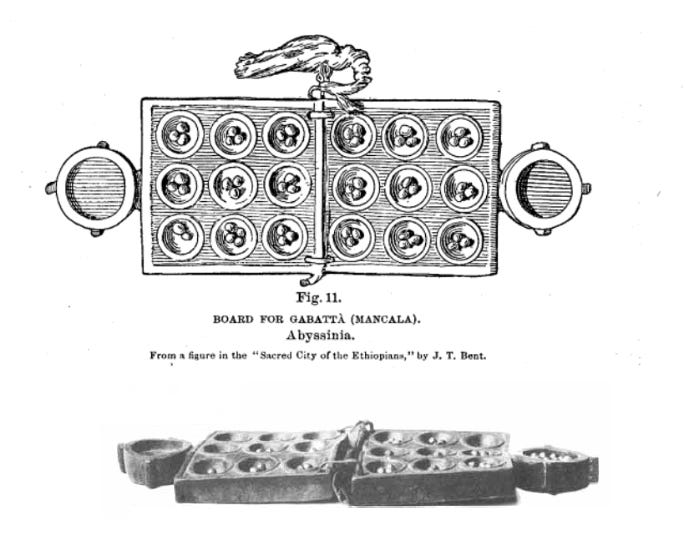
A 3-row board from Ethiopia, acquired by Theodore Bmt in the 1890s. British Museum. Image by P. Townshend
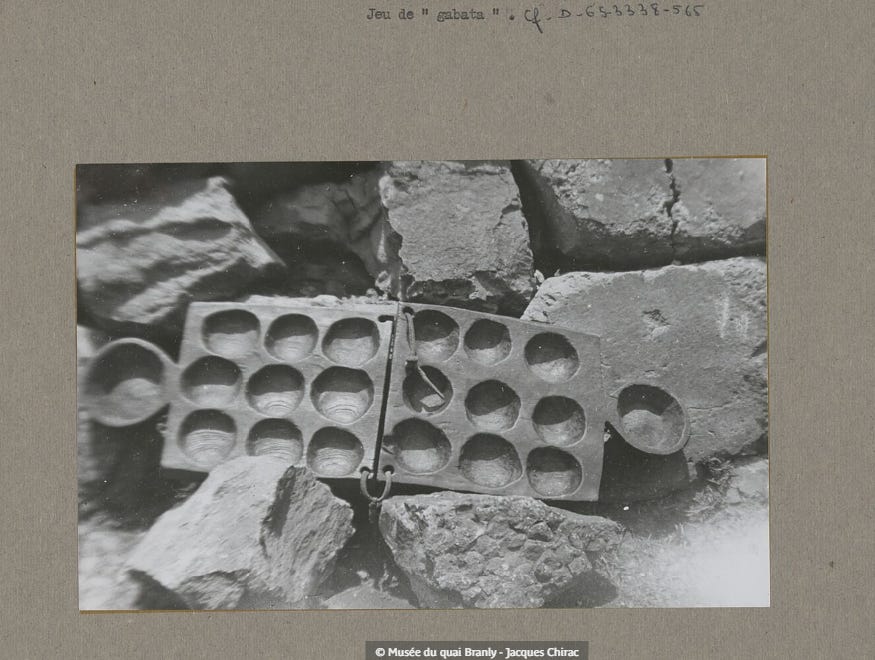
The “gabata” game. 1910-1911. Ethiopia. Quai branly
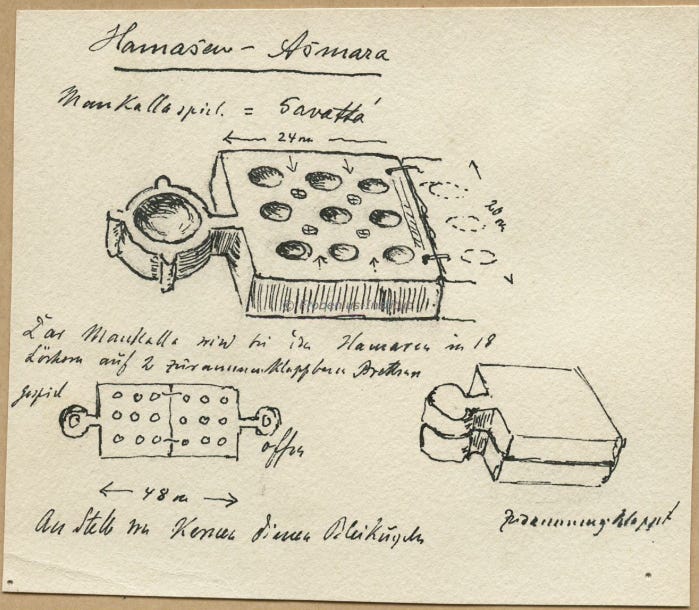
Mancala game. Hamasen- Asmara, Eritrea. Frobenius Institute. 1915
Ethnographic accounts from the early 20th century indicate that both the two-row and three-row games were played in Ethiopia by virtually every group, from the sedentary highland peoples in the north to the acephalous societies of nomadic pastoralists in the south, suggesting its long antiquity in the region.
Mancala seems to have entered Western consciousness in the 17th century, and accounts of the game by European travelers appear almost simultaneously on the coast of West Africa, the Middle East and Madagascar, with slightly later accounts from Namibia and Central Africa indicating that it was already widespread by then.
The English merchant Richard Jobson (1623) witnessed two men playing a game on a wooden board in Gambia, that would later be identified as warri:
“In the heat of the day, the men will come forth, and sit themselves in companies, under the shady trees, to receive the fresh aire, and there passe the time in communication, having only one kind of game to recreate themselves withall, and that is in a peece of wood, certaine great holes cut, which they set upon the ground betwixt two of them, and with a number of some thirty pibble stones, after a manner of counting, they take one from the other, until one is possessed of all, whereat some of them are wondrous nimble.”16
The 17th-century chronicle Tarikh al-Sudan (1665), mentions a Songhay infantry commander who was playing “Sudanic chess” (al-shitranj al-sūdānī ) during the reign of Askiya Bonkana (1531-1536).
Because the author specifies the game as “Sudanic” chess (i.e., chess of “black” West Africans), the Historian John Hunwick, who translated the chronicle, took this to refer to the mancala game of warri/Oware, not the classic Indian chess game.
This 16th-century reference also makes it the oldest internal account of the game in West Africa.17
Mancala, specifically the two-row game, is also first mentioned in the Middle East during the 17th century.
The first European traveler to notice the game in the Levant was Jean de Thévenot, who was there in 1657-9 and observed that ‘They play mancala very frequently, which is made in the shape of a box, about two feet long and half a foot wide, with six small holes in the box itself and six in the lid which is hinged to the box (for it opens like a chessboard).
Thomas Hyde (1694) later provides detailed descriptions of a two-row game resembling mancala played in Mesopotamia, Jerusalem, and a four-row game on the East African island of Anjoan/Nzwani (Comoros).18
Back in West Africa, 18th-century narratives of Bosmann (1705) and Isert (1790) identify the two-row game as Warri/oware played by the people of the Gold Coast and Benin. Golberry ( 1791) mentions that mancala is played by the Peulhs, Joloffs, and Mandigos, who call it “ouri”.
Winterbottom (1803) describes k’yungee-bel (game of palm nuts) being played on a 12-pit, boat-shaped board in Sierra Leone, while Bowdich (1819) observed that the game was played among the Ashanti people whose king, Osei Tutu, owned a game board made of gold.19
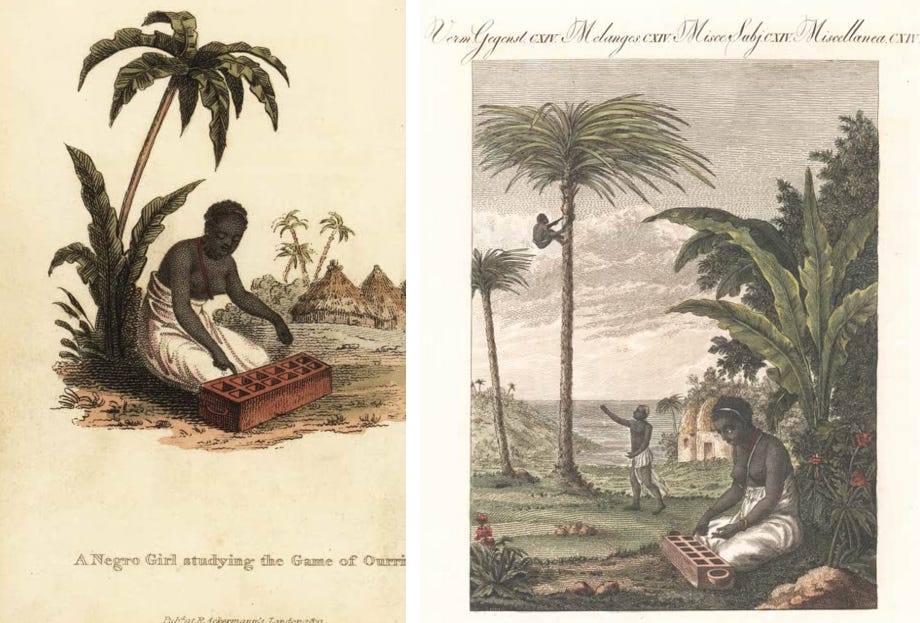
left: “A negro girl studying the game of Ourri.” engraving from Frederic Shoberl’s The World in Miniature 1821. right: African woman playing a pit and pebbles game called Uri, using 21 balls and a box with 10 compartments, while a man climbs a palm tree behind her using a sling, 18th century. engraving from Bertuch’s “Bilderbuch fur Kinder”, Weimar, 1807.
The narrative of John Steadman about the enslaved Africans of Suriname (on the continent of South America), in the 1770s, mentions a game known as “awaree” as “an innocent amusement, consisting in pitching with a large kind of marbles in defect of which they use the awaree nuts”20
Later ethnographic studies by Melville J. Herskovits (1932) indicate that this game, which likely originated in the coastal region extending from Ghana to Nigeria, utilised a board arranged in two rows of five to twelve cups each, and two large “ storagecups,” one at either end.21
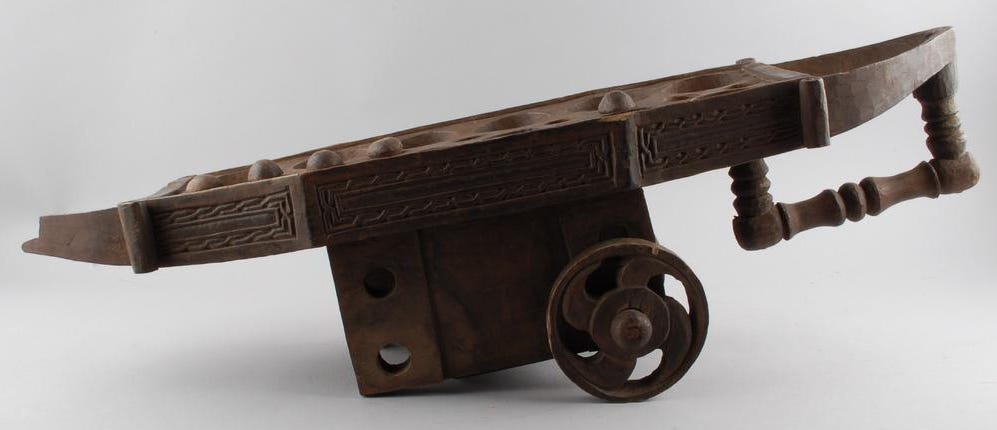
Mancala board; carved of wood; board in the form of boat on wheels. Sierra leone. British museum number Af1968,14.1
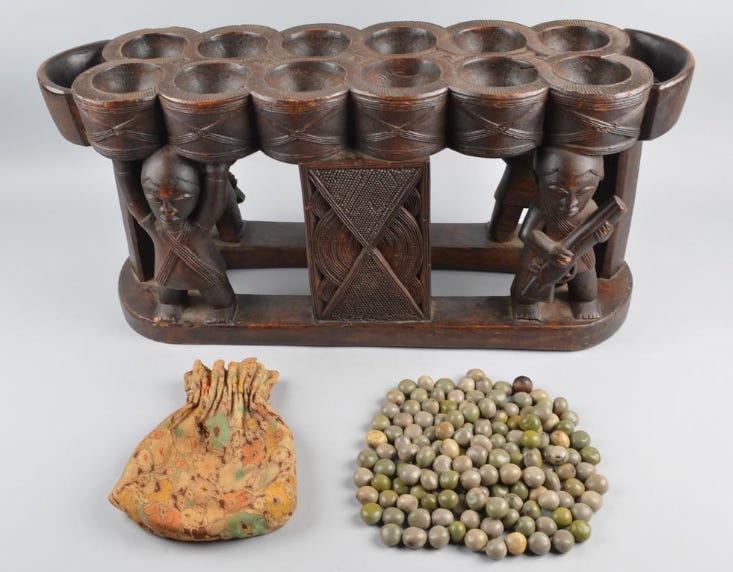
Game-board used for warri, made of iroko wood. The board has two rows of six holes and two end holes, and is supported by an openwork stand which has two central rectangular uprights decorated with geometric motifs, two square section columns at either end and four standing male figures at each corner. Two figures carry rifles, other two figures have raised arms supporting the board. 1933-1945
Kwara, Nigeria. British Museum number Af1996,01.9.a-ey
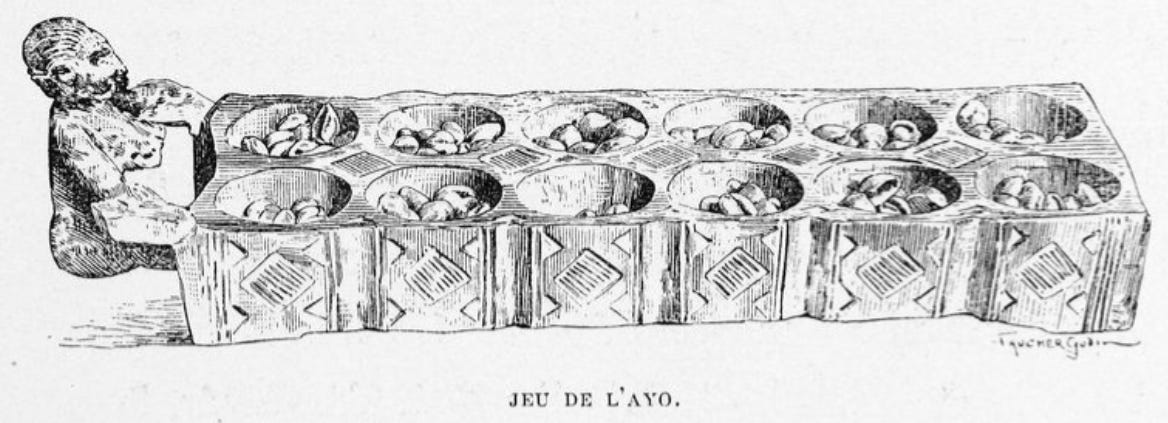
Game of ayo. La France au Dahomey. Date Issued: 1895
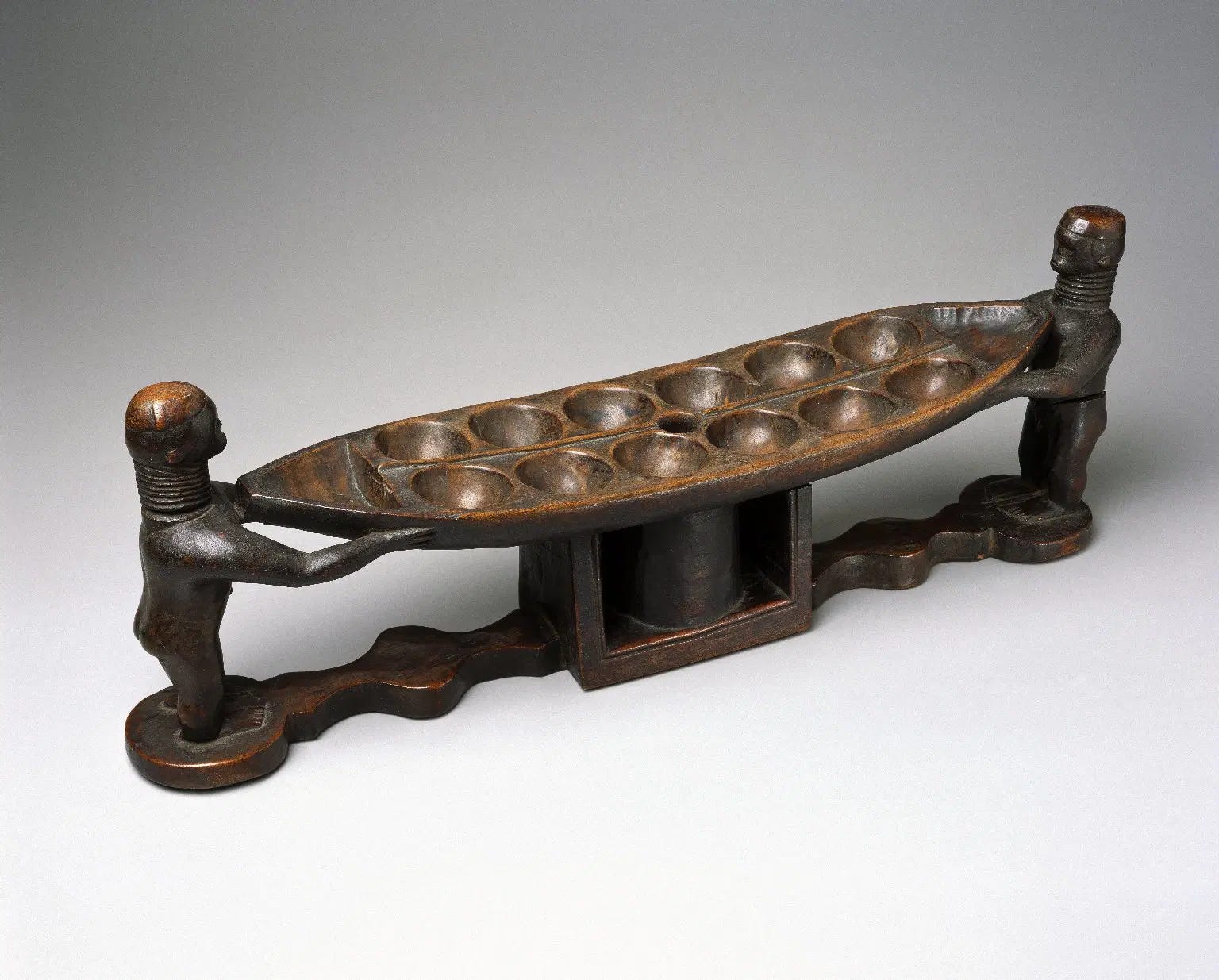
Mancala Game Board. Bullom artist, Guinea Bissau. 19th century. Brooklyn Museum
This board, like most, has twelve holes and two large cups to hold each player’s game pieces. The figurative carvings, however, are rare, and the board’s boat shape reflects the importance of canoes to the Bidjogo.
In the interior of West Africa, about two centuries after the Songhai account of “sudanic chess”, the explorer Dixon Denham, who visited the capital of Bornu (N.E. Nigeria) in 1822-4, observed that they “play a game resembling chess, with beans, and twelve holes made in the sand. The (Shuwa) Arabs have a game similar to this, but the Bornouese are far more skilful.”22
This is not a reference to the classic game of chess, which was in fact known in Bornu, as explained below. It is a local version of the popular two-row game, which is still played in the region today.
On the East African coast, Etienne de Flacourt (1661), the French governor of Fort Daughin in southern Madagascar, provided the earliest account of mancala on the island of Madagascar, where it had presumably been taken by mainland African groups of the maritime-trading Swahili community or other African groups.23
Flacourt’s account is the earliest recorded set of mancala rules, and the first record of a four-row mancala game. It was called fifangha, and described as “a game of the mind, similar to checkers or trictrac [backgammon].”
Flacourt’s account coincides by and large with the first stage of play as still practiced in the games of katra-be in Madagascar and Bao on the Swahili coast, and the numerous 4-row games found across the mainland of Southern Africa today.24
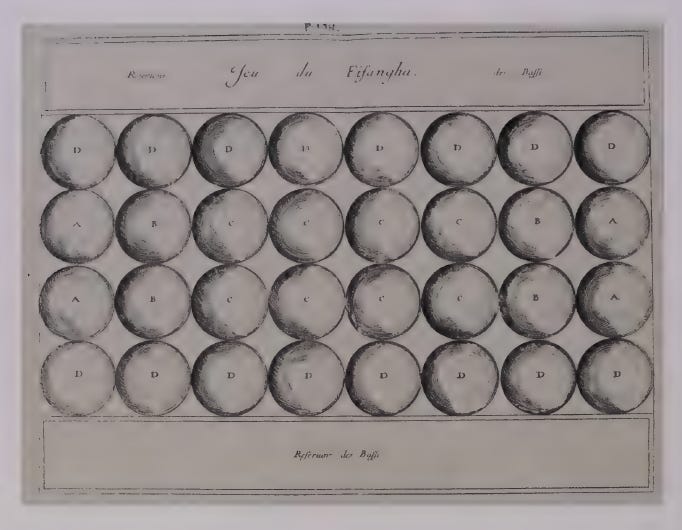
The mancala game fifangha, today known as katra-be in Madagascar and bao elsewhere in East Africa. Image by Alex de Voogt
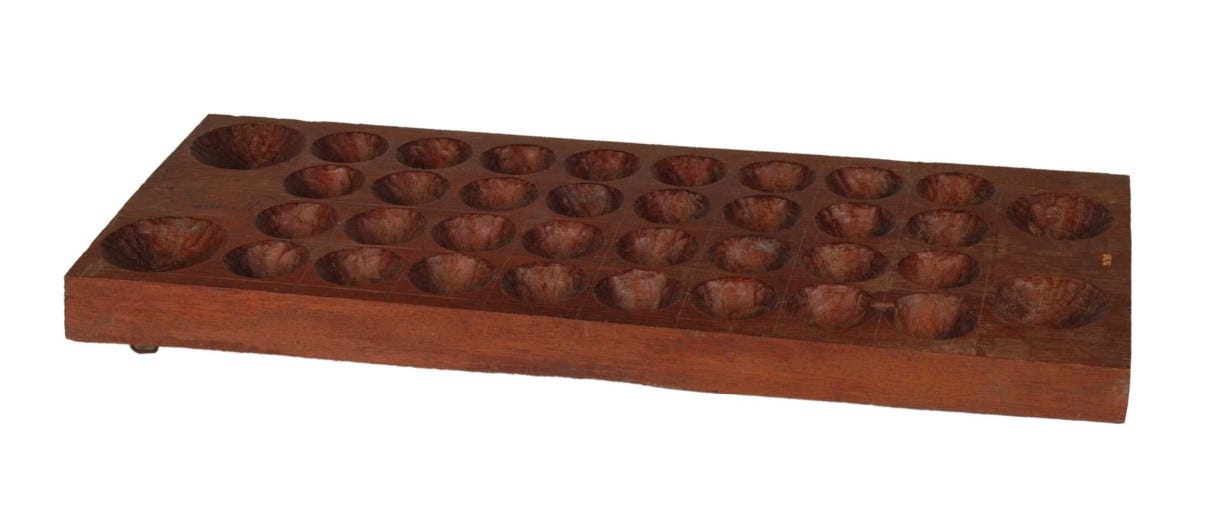
Katra Game. Vernacular name : Fifanga. Dates : before 1882. Betsimisaraka. Toamasina, madagascar. Quai branly Inventory number : 71.1882.63.6
As noted earlier, Hyde in 1694 mentions a four-row game among the “Hanzoannites” (inhabitants of Anjouan, Nzwani island, Comoros archipelago):
“a game which in their language is called morahha (as Abdallah Shah, their king’s son and envoy to the king of England told me) which is not unlike the preceding game (mancala) and is also played with pebbles. But in its plan, there are four rows of holes which lengthwise are eight in number; sixteen on each half of the board.”25
According to Townshend, the four-row (Type-B) game of Anjouan was quite unlike the two-row games of the Middle East, and more akin to the four-row games of the Swahili coast, Madagascar, and the mainland of Southern Africa, both in the rules of the game and its etymology. The name “morahha” also recalls the names of four-row games in southern Africa such as the Pedi (“moruba”).26
In Namibia, in 1792, the French traveler François Le Vaillant recorded a game of mancala played by the Namaqua (Khoisan-speaking herders) with a rectangular board divided into even numbers :
“An oblong square is traced on the ground, in which are made a certain number of holes, forming a sort of chess table. the holes are made in ranks, side by side but the number is not fixed. I have seen them varying from twenty to forty.”
The game involved sowing and capturing, but Le Vaillant admits to being “confounded by the movements,” comparing some to “some of our pieces at chess”27
The game of ǁHus, also known as Owela, is still played by the Nama, Dama, Herero, and other groups in Namibia on a four-row board of up to 6 to 36 pits. A little over a century after Le Vaillant, it was documented in greater detail by the ethnographer Leonhard Schultze in 1907.
According to Townshend, the Nambian games belong to both the Type-A, and the Type-B games of southern and Central Africa, and remain identical to them even though its isolated by hundreds of miles from its nearest relatives. The greater board length towards the south is explained by the habit of playing the game in teams.28
In the interior of Central Africa, historical traditions on the founding of the Kuba kingdom around 1650 credit King Shyaam aMbul aNgoong with the introduction of the board game called lela/lyeel, to substitute this intellectual pastime for the gambling games at which they had wasted much of their time.
Wood carvings of the king, which were first acquired by Emil Torday in 1909 directly from the reigning King, but are considerably older, show him seated with a game board with three rows, and a larger semicircular bowl at each end.29
Yet the ethnographer Emil Torday (1910) only found a 4-row type game, also called lyeel, during his visit to the Kuba court, which is still played today.
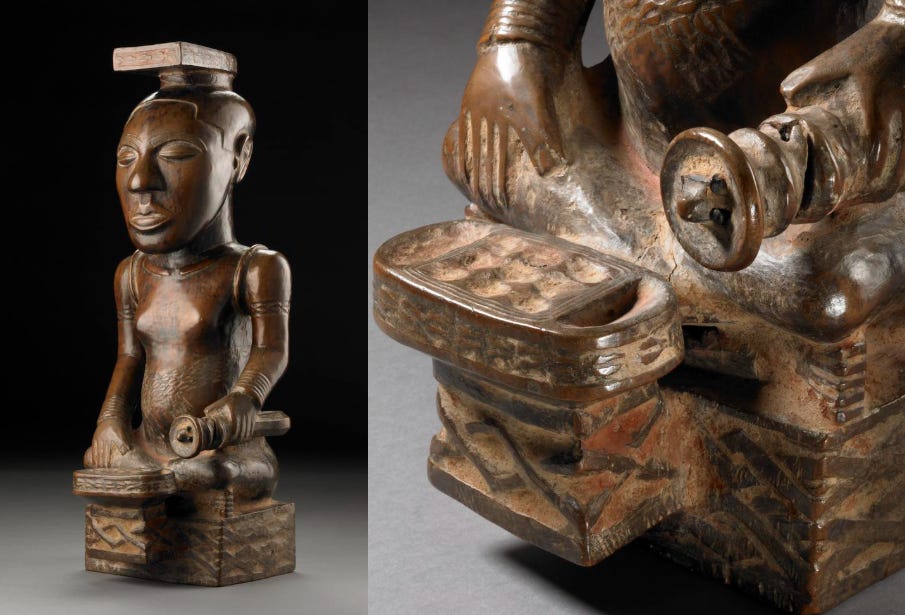
Representation of king Shyaam aMbul aNgoong with a three-row game board. c 1800 Kuba kingdom, D.R.Congo British museum number Af1909,1210.1
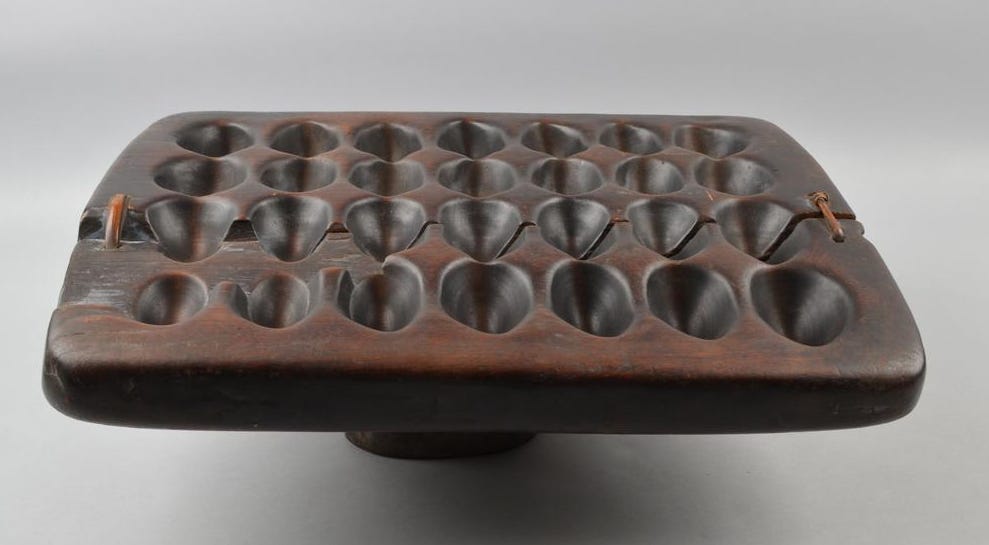
Mancala game board. Kuba kingdom, D.R.C. British Museum number Af1909,Ty.658
Based on linguistic evidence for a “warri” game in Kongo in a dictionary from 1652, the historian Jan Vansina suggests that the 3-row game board of Kuba originated from West Africa through the kingdom of Kongo.
However, Townshend argues that the game currently played in Kuba is a four-row game similar to that found across numerous communities in Congo and South Sudan (both in mode of play and linguistic terminology of the board and pieces) and is unlike the two-row games found among the baKongo at the coast and across West Africa. 30
He suggests that both the three-row board and the game itself underwent considerable evolution within Central Africa and West Africa well before the early modern period, which may explain the disappearance of the ancient three-row game across virtually all regions.
While travelling through the Bahr el-Ghazal (border region between South Sudan and D.R.C.), the explorer Georg August Schweinfurth (1878) mentioned the presence of two-row mancala games among the Niam-Niam (Azande) and many “black” African tribes, whom he credited with the northward spread of the game to the Muslim Nubians of the Nile Valley:
“The Niam-niam have one recreation which is common to nearly the whole of Africa. A game, known by the Nubians as “mungala,” is constantly played by all the people of the entire Gazelle districts, and although perhaps it is not known by the Monbuttoo, it is quite naturalised among all the negroes as far as the West Coast.
It is singular that this pastime should be so familiar to the Mohammedan Nubians, who only within the last twenty years have had any intercourse at all with the negroes of the south; but in all likelihood they received it in the same way as the guitar as a legacy from their original home in Central Africa.
The Peulhs devote many successive hours to the amusement, which requires a considerable facility in ready reckoning; they call it “wuri.” The game is played likewise by the Foolahs (Fulani), the Yolofs (Wolof), and the Mandingo, on the Senegal. It is found again among the Kadje, between the Tsad (lake Chad) and the Benwe (Benue).
The recurrence of an object even trivial as this is an evidence, in its degree, indirect and collateral, of the essential unity that underlies all African nations.
The “mungala” itself is a long piece of wood, in which two parallel rows of holes are scooped out. Nubian boards have sixteen holes, the Niam-niam have eighteen. Each player has about two dozen stones, and the skill of the game consists in adroitly transferring the stones from one hole to another.”31
H.M. Stanley, who travelled through the same region in 1887–1889 to rescue Emin Pasha, the governor of Equatoria (South Sudan), includes a drawing of a typical four-row “play table” ( 4x12 board with two store holes at each end) in his general description of the peoples of North-Eastern D.R.Congo.
In his description of the region of Kavalli near the S.W. shores of Lake Albert, he mentions games “similar to those of “marbles” and ball and backgammon.”32
The accompanying illustrations of the four-row game board of Stanley resemble the two-row board of Schweinfurth, and the numerous four-row boards collected from many different communities in the 1910s, suggesting that Schweinfurth may simply have failed to notice that both the two- and four-row game boards were in use.
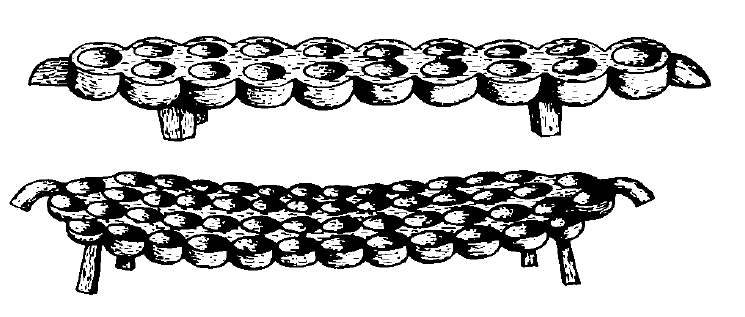
Top Illustration by Schweinfurth (1878) of a 2x8 board used by the Zande of Northern Congo.
Bottom Illustration by Stanley (1890) of a 4x12 board collected in north-eastern Congo, resembling the smaller board with two stores at each end.
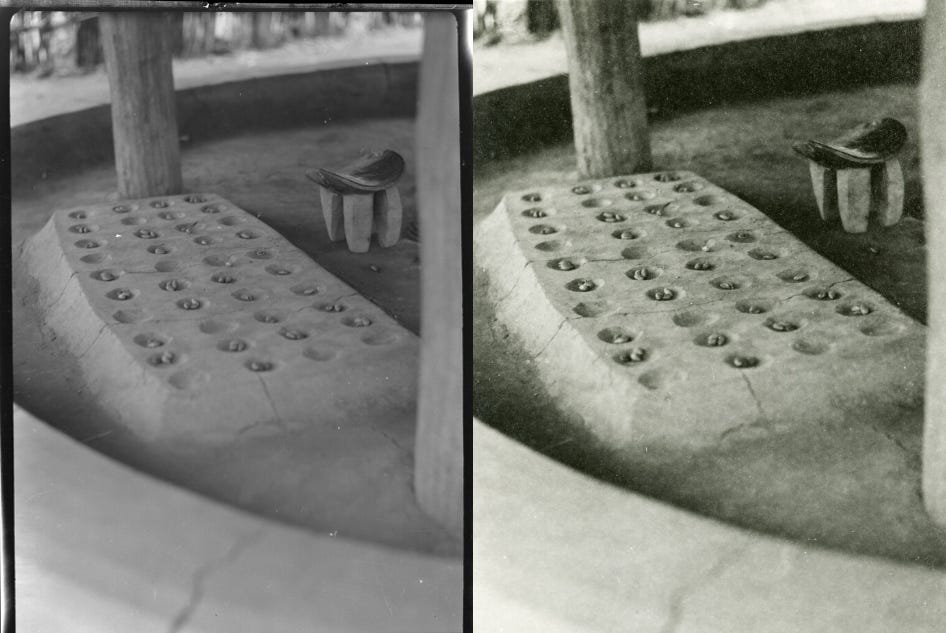
“A Zande version of the widespread African game often known as mancala. It was sometimes carved, but is here set in the earth with an old-style stool for a player visible beyond.” Yambio, Western Equatoria. South Sudan. 1927 - 1930. Pitt Rivers Museum.
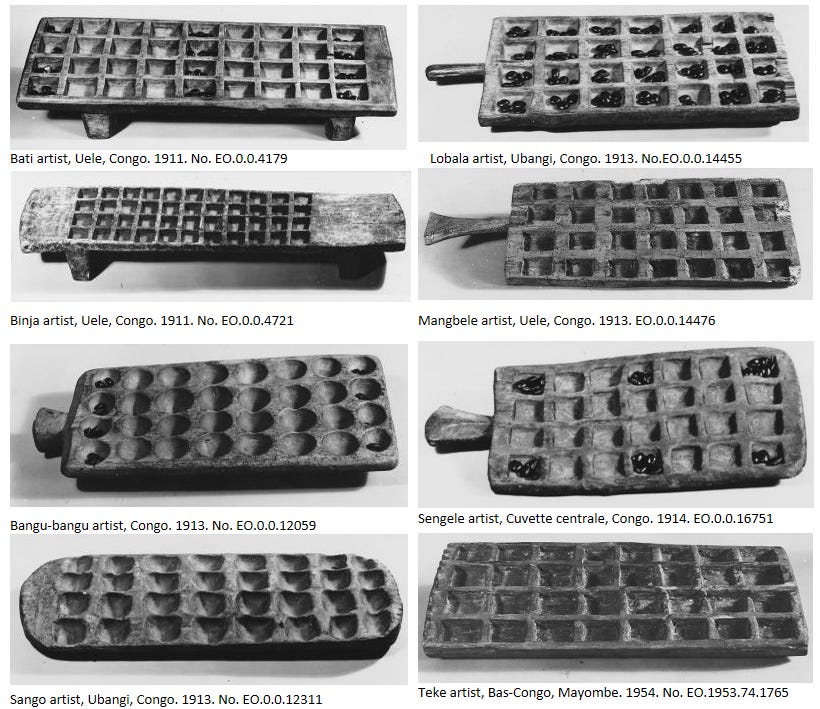
Mancala boards in the Royal Museum for Central Africa. from the north eastern, northern, and western provinces of the D.R.C
In the south-eastern region of Congo, Cameroon Lovett (1877) briefly mentions a “Bao game” known as “kisolo” (Chisolo) which was played by the Warua (Luba) using seeds known as “masoko.”33
According to Townshend, this is a four-row game whose unique type of rules are almost exclusively associated with the Luba, Lulua and Songye peoples. It constitutes its own sub-category under the type-A games. 34
Further east in the kingdom of Buganda, Emin Pasha (1888) found the four-row board, which he (mis) attributed to the Swahili’s Bao game, due to the resemblance of the game boards.
“Mangala, also called mweso, is the only game, properly so called, which the “Waganda know. It is played by two people, upon an oblong board containing thirty-two holes in four rows of eight each, the players having a certain number of counters, which may be either stones, beads, or coffee-berries.
Each player places a certain number of counters in his two rows of holes, and the game, which is a very complicated one, and requires a considerable amount of calculation, consists in trying to obtain all the stones belonging to the opposite player. It is a most fascinating game, and the people will sit for hours playing at it. It is so difficult, however, that I was not able to learn how to play it myself.”35
As discussed below, while both the Ganda game of Mweso and the Swahili game of Bao are Type-A games, their mode of play and game boards are dissimilar, and thus belong to different sub-categories. Townshend points out that the reverse moves which are found in the Ganda game are only found much further north among the Bari, Alur, and Acoli, rather than in the southern games similar to Bao.36
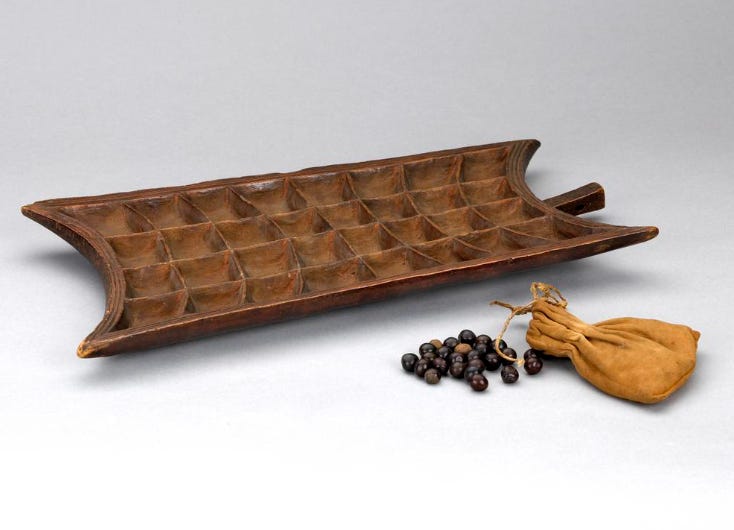
Mancala board. Uganda. British museum. Af1973,29.3.a
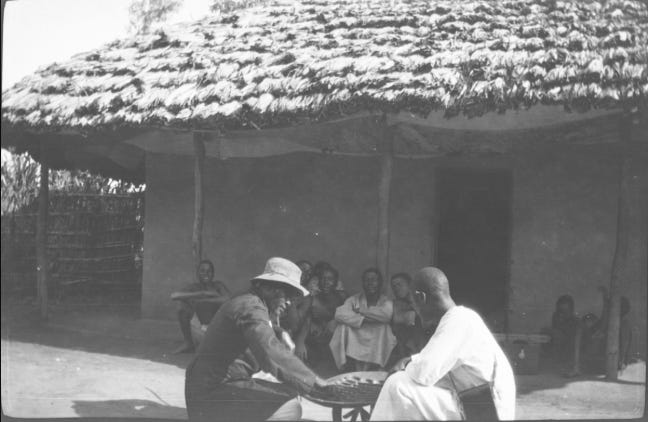
Two men from the Ankole region, Uganda, playing a game of mweso with a four-row board. Photo by John R. Roscoe. 1919. MAA Cambridge.
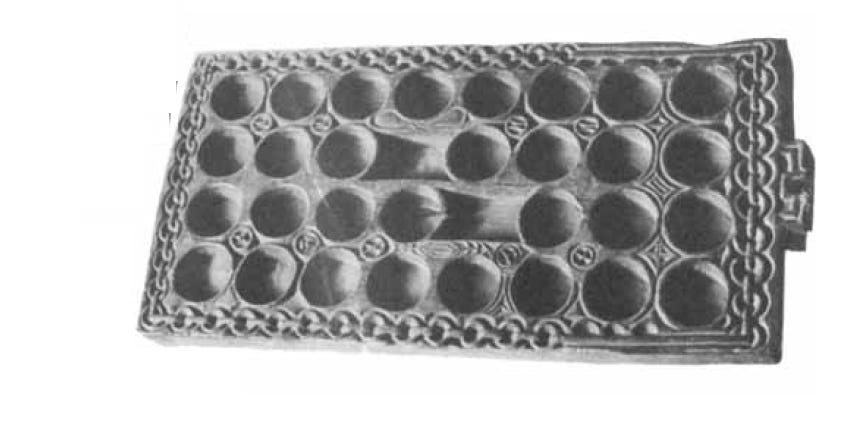
A decorated Swahili board from the Tanzanian coast, showing the two large ‘kuu’ holes. The store-hole at one end has been broken off: (Museum fur Vdlkerkunde, Berlin.) image by Townshend.
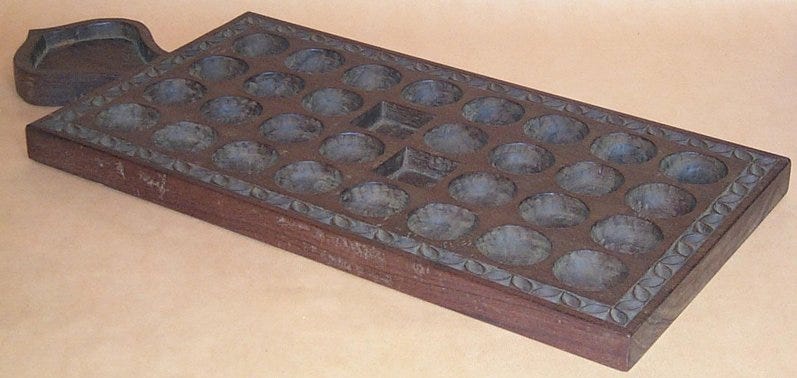
Traditional bao board from Zanzibar. As in most traditional boards, regular pits (mashimo) are round, while houses (nyumba) are square. Wikimedia Commons.
Much further south in Mashonaland (present-day Zimbabwe), the adventurer Theodore Bent (1892), who infamously misattributed the Great Zimbabwe ruins to an “ancient white race”, similarly considered the board game he found among the Kalanga (who actually built the numerous stone ruins of Zimbabwe) as evidence for “the former civilized race that dwelt here”
He notes that the “mysterious game of the Makalanga” was called “Isafuba,” it consists of sixty holes in rows, in the ground, played by ten men. He admits to trying and failing at learning the game, which he compared to chess: “we watched it scores of times while in the county and always gave it up as a bad job, deciding that it must be like draughts or chess.”37
This “mysterious” game of the Kalanga wasn’t in fact mysterious nor was it only played by the kalanga.
Besides its similarity to the 4-row games found among the Khoisan herders of Namibia found in 1792 account, it was documented in the early 20th century by various ethnographers in southern Africa, most notably Meredith Sanderson’s “native games of central Africa” (1913) among the Yao, Ngoni, Tonga, Kunda, and by Hugh Stayt in 1931 among Venda.38
The four-row games of southern Africa fall under the type-B category of games in Townshend’s classification.
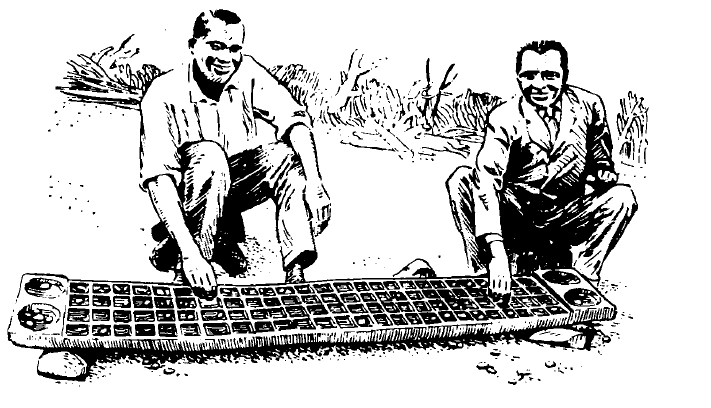
Illustration by Stayt (1931) of a 4x26 board used by the Venda of N. Transvaal, South Africa, with two stores at the end.
By the end of the 19th century, mention of board games in Africa was common in accounts of European ethnologists and other visitors.
The first study of the mancala games was published in 1894 by Stewart Culin, under the title: “Mancala, the National Game of Africa,” for the US National Museum (now the Smithsonian Institution)
The link between Mathematical games of strategy and Social complexity.
“Wari is not a game of chance,” writes the anthropologist Melvin Herskovits in 1932, “the nearest analogy in European culture to that which the natives take toward this game is that which we take toward chess.”39
Every observer has remarked upon the speed and skill exhibited by the contestants.
Since one is not allowed to pick up the contents of a hole to count, the good player remembers the number of their pieces, and those of their opponent.
According to Driberg (1927):
“A move may consist of several circuits of the players’ board and at each circuit the number of marbles in their respective holes varies. In considering the various moves possible to him and in assessing their respective merits, a player has to look several circuits ahead and has to bear in mind the changes in disposition which his board will constantly undergo. Yet a good player can do this almost instantaneously, and there is little pause for consideration between moves”40
Before these ethnographers, African scholars also commented on the game.
The Swahili scholar Muyaka bin Haji al-Ghassaniy composed the bao poem “Bao Naligwa” in the 1820s, in which he reflects lovingly on the way he would accumulate seeds in one hole and sow them to devastating effect.41
According to the ethno-mathematician Claudia Zaslavsky, if mancala is played with just thirty-six counters distributed in two rows of six holes, there are only about 10²⁴ (10 to the 24th power, or a million times a million times a million times a million) total possibilities.42
Initially, anthropologists such as Roberts, Arth, and Bush (1959) claimed that “simple societies” lacked the capacity to invent or play games of strategy. They argued that societies that were defined as lacking complexity were also showing a dearth of strategic games, which by their own definition included all known board games.43
As explained earlier, European explorers considered these mathematical games, among other examples of “high art”, to be evidence for the influence of a “more civilized” non-African race. These pseudohistorical Hamitic theories of scientific racism were popular in the colonial era, but still survive in some forms today.
These colonial-era theories associating social complexity to games of strategy were first criticized by the anthropologist Philip Townshend in the 1970s who demonstrated that the most complex version of the mancala game wasn’t found in Asia, or even in North-East Africa, but among the Nilotic-speaking peoples of present-day South Sudan and D.R.Congo, where it likely originated.44
This specific region isn’t traditionally associated with the historic centers of African civilizations, and had the least contact with the outside world before the late 19th century. However, it was the origin of several migratory waves of different populations of herders in the past, the most recent of whom were the Luo-speakers.
As Alex de Voogt contends: Mancala games in all their complexity have been connected with both non-hierarchical communities and centralized societies, dispelling the idea that the complexity of a state is somehow connected to the possibility of conceiving of complex games.45
Early anthropological studies of the game were constrained by the fact that the distribution and dating of the Mancala games was complicated by the absence of rule descriptions in the early records.
Certain similar forms of the game have a vast distribution, whereas major differences may occur in a very restricted area. For example, at least four utterly different variants of Mancala are played within 20 km of the Congolese city of Kisangani!46
According to Townshend, the classification of Mancala games can most conveniently be based on the mode of capture and the type of game board.
The four-row game, which is the most complex version of mancala, is exclusively found in Africa, specifically in East-Central Africa in present-day South Sudan, Uganda, Kenya, D.R.Congo, Tanzania, as well as in Namibia, Zambia, Zimbabwe, South Africa, and Madagascar. No 4-row games are recorded from East Asia or the Middle East.47
Townshend divides them into two categories, Type-A games where captured seeds are fed into the player’s own holes, and Type-B games where captured seeds are put aside out of play.
Type A games are the most complex mathematically and of much greater variety based on mode of play. They are subdivided into five sub-categories; the Soro, which is the largest, and the smaller classes of Mangolo, Cisolo, Kibuguza, and Bao.
Using anthropological studies from the early 20th century, Townshend identifies the first class of these games among the Nuer, Dinka & Shilluk (S.E. Sudan/S.W. Ethiopia); the Bari (S. Sudan); Nyangatom (S.W. Ethiopia/N.E. Uganda); Didinga, Topotha & Dodoth (N. Uganda); Karamojong (N.E. Uganda); Turkana (N.W. Kenya); Longarim, Lokathan & Lotuko-speaking Lango (S. Sudan, N. Uganda); Pokot (N.W. Kenya); Tugen (N.W. Kenya); Marakwet (N.W. Kenya); Lega (Rega; E.C. Zaire); Taabwa (S.E. Zaire); Sanga (S. E. Congo); Alur (Congo-Uganda border); Acoli (Uganda); Teso (E. Uganda, W. Kenya); Baganda (S.Uganda) and Banyarwanda; Shi and Hunde (Lake Kivu); Sukuma (S. of Lake Victoria); Bemba (N.E. Zambia); Nama, Herero and Dama (Namibia); Shambyo and Mbukusha (Okavango, N. Namibia); Taita and Digo (S.E. Kenya).48
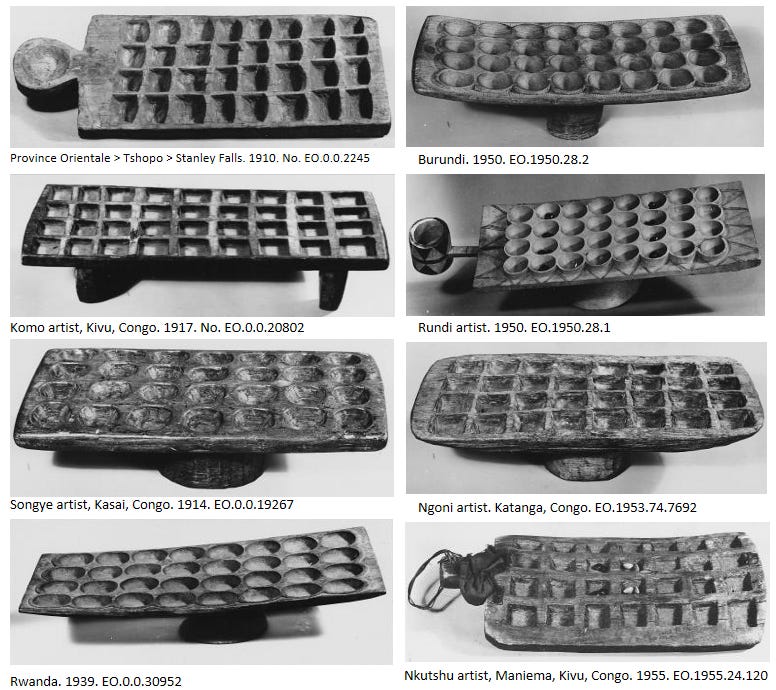
Mancala boards in the Royal Museum for Central Africa, from Eastern Congo, south-Eastern Congo, Rwanda, and Burundi.

Chisolo board, Luba, S.E. Congo. 1959. EO.1959.8.3
The vast distribution of the Type-A game among disconnected populations (such as the Dinka of S.Sudan and Herero of Namibia), as well as the absence of the game outside Africa, suggests that the 4-row mancala game was invented in Central Africa and is of considerable antiquity.
The other classes are less well represented across different communities.
Mangola is played throughout north, west and central Congo, and includes some of the groups mentioned above; Cisolo (or Kisolo) is mostly played in Congo by the Luba, Lulua and Songye; Kibugunza is only played in Burundi and is largely isolated; while the Bao game is played by the Swahili and is possibly the most intricate of all Mancala games.
Bao is distinct, but related to the Soro games of the northern regions of Central Africa listed above from which it is thought to be derived. It is fairly widely distributed in Tanzania and the East African coast where the Swahili were active.49
According to Townshend, “Bao, basically a four-row Type A game, has developed over the past centuries through borrowings from the main continent and is a game of indelible African stamp.” From the East African coast, it spread to Madagascar, the Comoros islands and beyond.”50
Type B games have a distribution at least as vast as that of type A games.
They are mostly found in the southern regions of central Africa, with one isolated pocket in the north-Eastern D.R.C.
Based on historical data from 1892 to the 1930s, these types of games are documented among the Digo (S.E. Kenya); Gogo (C. Tanzania); Turu (W. Tanzania); Konde (S. Tanzania, N. Mozambique); Yao (S. Malawi/Mozambique); Ngoni of Malawi; Nyanja of S. Malawi; Tonga of S. Zambia; Kunda of S. Zambia and Mozambique; Kalanga of W. Zimbabwe; Venda of South Africa; Pedi; Ronga and Thonga of the S. Africa/Mozambique border; Bemba of N.E. Zambia; Tonga of S.E. Zambia; Tumbuka of the Zambia/Malawi border; Kaonde and Ila of W. Zambia; Lozi and Toka of W. Zambia; Nkangela and Ngalangi of S.C. Angola; Cokwe and Bindi (Angola and Congo); Kuba of S.C. Congo; Logo, Alur and Hema of N.E. Congo; Lugbara of N.E. Congo; Marakwet (W. Kenya); Nandi (W. Kenya); Kipsigis (W. Kenya).51
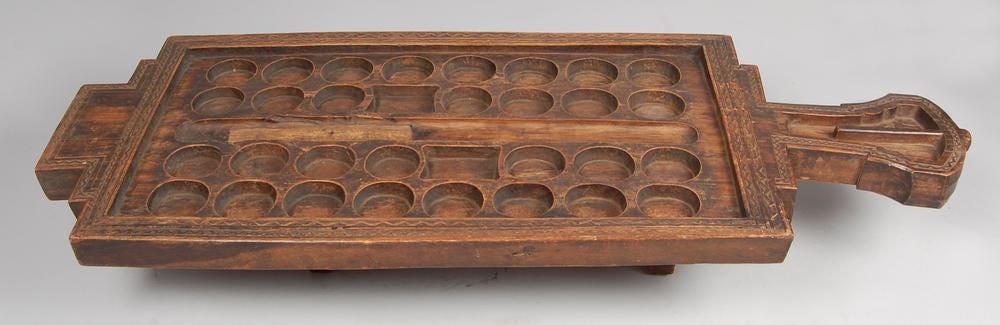
“Mancala board. Obtained in Zomba (Malawi). Possibly from the coast (Tanzania)” 1905-19. British Museum number Af1922,0413.132
Type B games usually have two or four stores on the side of the game board, which is rarely found in type-A games except of the Swahili Bao game that has one store hole.
The scattered nature of type-B pockets in the north (north-eastern Congo, south-eastern Uganda, west-central Kenya) suggests a southward advance of type-A games encroaching on a pre-existing type-B playing area before the arrival of2-row games in Kenya and Tanzania.52
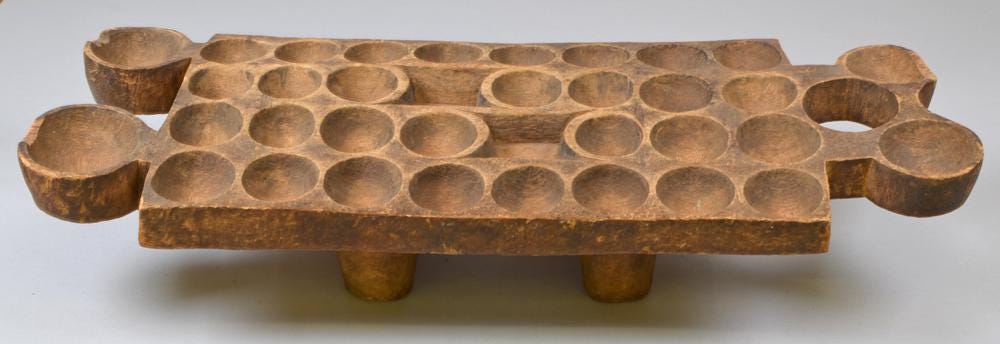
Mancala board carved in wood with 36 cavities (of which two are houses in the centre of the board. 1896. Malawi British museum Number Af1896,1223.1
According to Pankhurst and Townshend, the three-row game, which was found in ancient Egypt, is reported in Arabia in the 13th century and in the Congo basin (Kuba Kingdom) in the 17th century, but seems to have died out in all regions, and is now only found in northern and Southwest Ethiopia.53
The two-row game is the most common type of game, and is widely diffused throughout Africa, Asia, and the Americas.
They can be subdivided based on game play into five distinct types, labelled a; b; c; d; and e. Among these, it’s type “a” that is considered the most complex. It involves the capture of the adversary’s holes (houses/territory) and their exploitation by the winner.
This type of game is widely attested among pastoralist communities in Kenya, Tanzania, Somalia and Ethiopia, but isn’t found in West Africa or Egypt, and is only rarely found in Asia. 54
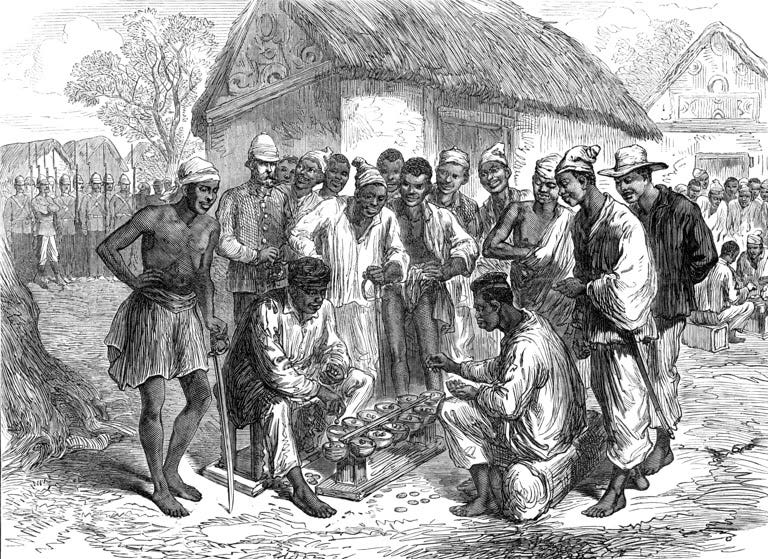
Gold Coast (Ghana): “Native soldiers playing the game of warry. Our Artist watched the game, but could not quite understand its rules. The winner is he who at the end holds most seeds in his cup. They are as intent and silent over this game as our chess-players” Illustrated London News, 1874.
The Origins and Spread of Mancala and Classical Chess in Africa and Asia.
It has often been asserted, usually with no evidence cited, that Mancala came to Africa
From Asia, but the historical data suggests that mancala travelled in the opposite direction; from Africa to parts of Asia and America.
In Oman for example, the mancala game currently played is known as hawalis, it consists of four rows of holes like the one found in East Africa. The game was introduced by an African diaspora during the 19th century period, when the Sultanate of Oman governed Zanzibar from Muscat. It displaced the two-row game associated with the Ottoman period, and now only found in archaeological contexts.55
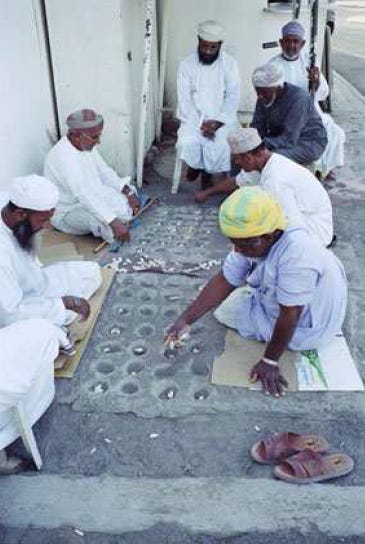
Omani men playing hawalis in Muscat, Oman (photograph by Alex de Voogt).
As explained earlier, enslaved Africans also carried the West African two-row mancala game to Suriname and the Caribbean as early as the 18th century.
A similar mode of transmission can be inferred for the spread of the two-row game in the Middle East and East Asia, but at a much earlier time when the historical record is admittedly very fragmentary.
While there’s only one type of mancala board in Asia, and with little variation in game play, Africa has all three types of the game, with the greatest variety and overlap being found in Central African regions that had the least contact with the outside world.
The African games differ at the level of mechanical rules and board length, even within the 2-row, 3-row, and 4-row types. This has resulted in the current Mancala map of Africa comprising vast blocks of single widely-known variants peppered with innumerable more esoteric local games.
The differences are so vastly distributed over space and at different points in history that no coherent relationship can be drawn between the type of mancala game and the ethnicity of the players (language groups), their occupation (herders and farmers), nor the level of social complexity (kingdoms, city-states, and pastoral societies).
The best example of this is the ancient three-row games, which seem to have been widely distributed in the past and may provide clues to the origin of the game.
There is evidence that the ancient three-row game, whose game board was first found in Egypt, but is today only played in parts of Ethiopia, was once widely distributed in the past, including in West Africa and Central Africa.
Some of the brass figures stolen by the British from Benin city in 1896 include 3-row boards that are dated to between the 16th and 19th centuries. A terracotta board with a similar hole arrangement from Djenne, Mali, has been dated the 12th or 13th century.56
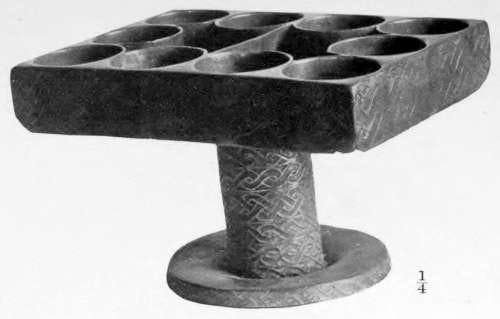
caption: “Fig. 116.—Bronze stand for the game of mancala, with ten holes and two irregular-shaped cavities in the centre. It is the same game as Figs. 184 and 185, Plate XXVIII, but with fewer holes. The sides are ornamented with interlaced strap-work, and the stem and the edge of the base with varieties of guilloche pattern.” from : Antique Works of Art from Benin By Augustus Henry Lane-Fox Pitt-Rivers (1900)·
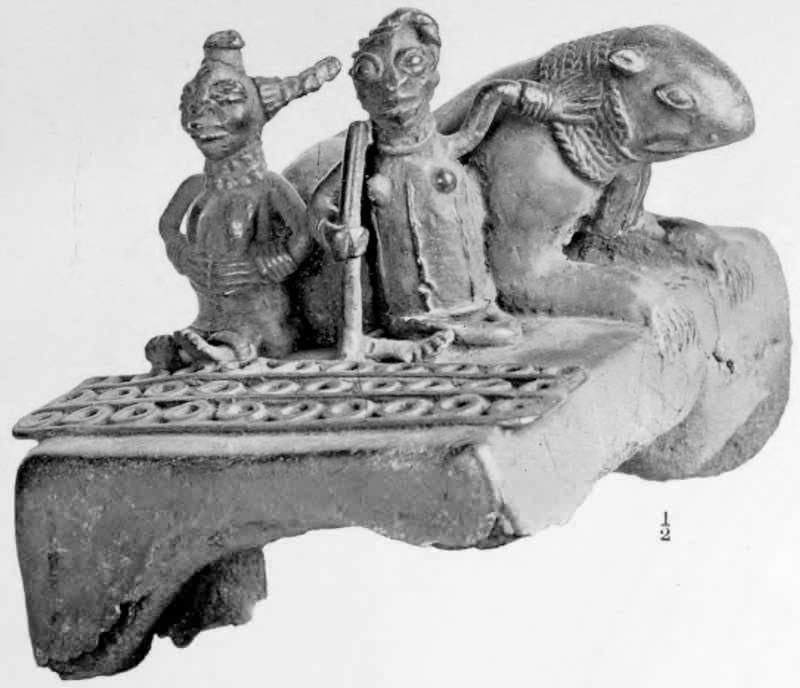
caption: “Fig. 134.—Figures in bronze, representing two rude human figures, male and female, attending an animal, probably a bear. A plate, or board, of three rows of circles with ten circles in each row, is laid out before the figures, and is perhaps a game of mancala, of which examples are seen in Plate XX, Fig. 116, and Plate XXVIII, Figs. 184 and 185.” from : Antique Works of Art from Benin By Augustus Henry Lane-Fox Pitt-Rivers (1900)
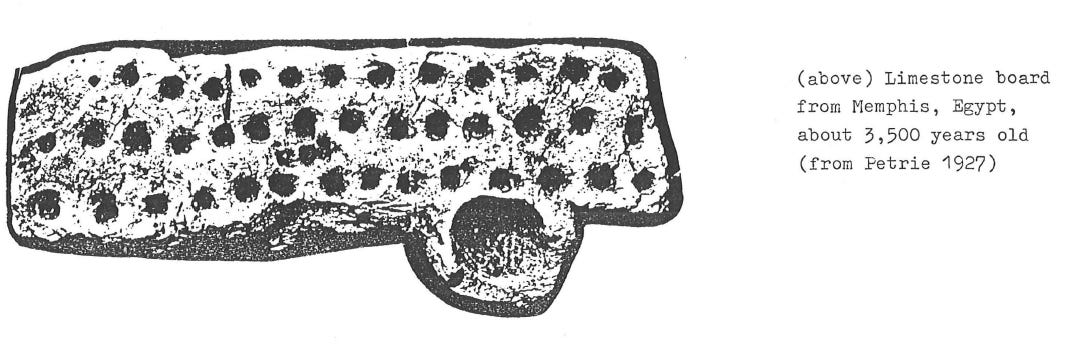
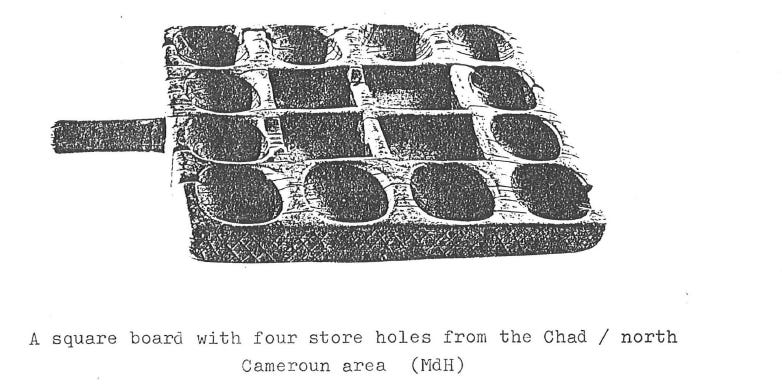
Ancient Limestone board from Ancient Egypt and a Mancala board with four square store holes. Images by P. Townshend.
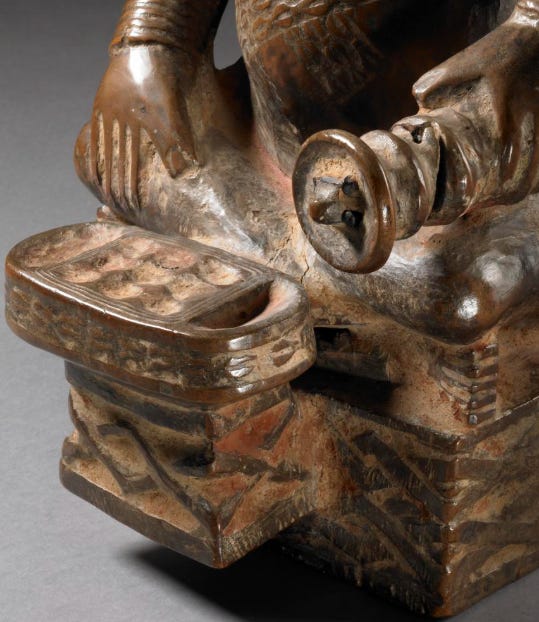
The three-row Kuba gameboard, c. 1800, Congo.
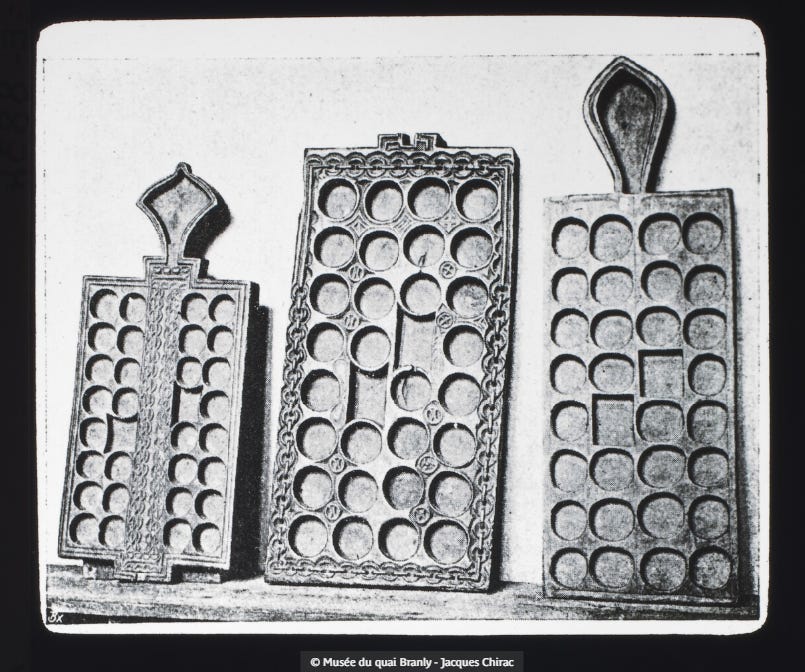
African gaming tablets. 1900-1928. Quai Branly. Likely obtained in East Africa.
Townshend proposes that unique types of square and circular boards, some featuring three rows, whose mode of play allowed for the participation of more than two players, may represent the remnant of a more archaic version of the game that has since been replaced by the two-row and four-row games that are more commonly played by just two people or two teams:
“It would be speculative to postulate any evolutionary development from round through square, oval, 3-row and 2-row to 4-row games, but they do form a gradation of increasing territoriality and decreasing suitability for multiple independent participation.
The nearest 4-row games can come to this is in the opposition of two teams of collaborators, while they almost alone embody territoriality to the extent of having each player sow only into his own holes.”57
Theories regarding the external origins of mancala were partly influenced by the history of the spread of chess, which originated in India before spreading across the Arab world, and to Africa and Europe during the Middle Ages.
There’s also a possibility of a direct transmission of chess from India to Ethiopia, through the Abyssinian mamluk prince Jayyash, who had become an avid chess player during his exile in India in 1088, before he returned to the throne in Yemen.58
It was from the Muslim traders that the Ethiopians learnt of the game, as is apparent from the Arabized form of the Ethiopian word säntäräj and the names of most of the Ethiopian chess pieces, as well as from the traditional mode of play employed in Ethiopia.59
Chess also spread across the Muslim kingdoms of West Africa, where it became especially popular in the empire of Bornu.
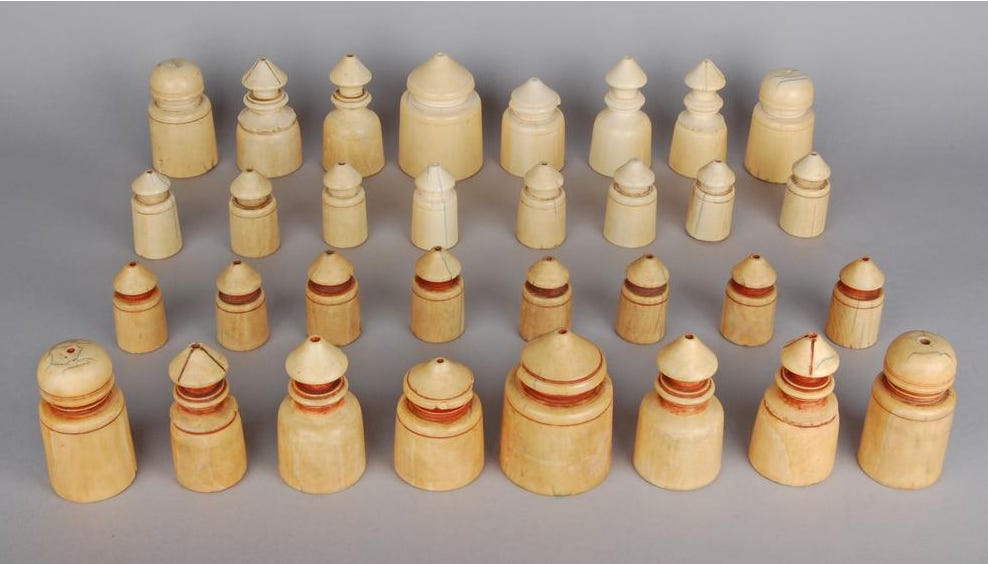
A complete chess set made of turned elephant ivory. 19th century, Tigray, Ethiopia British Museum number Af1853,0108.121
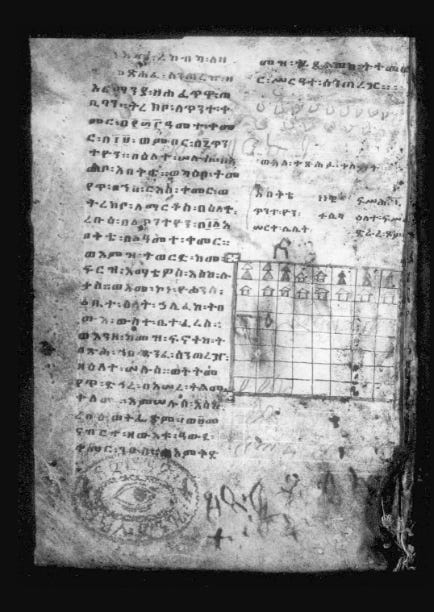
19th-century manuscript containing a drawing of a chessboard. Ankobar Mikā’ēl Church, Ethiopia (digitised by HMML)
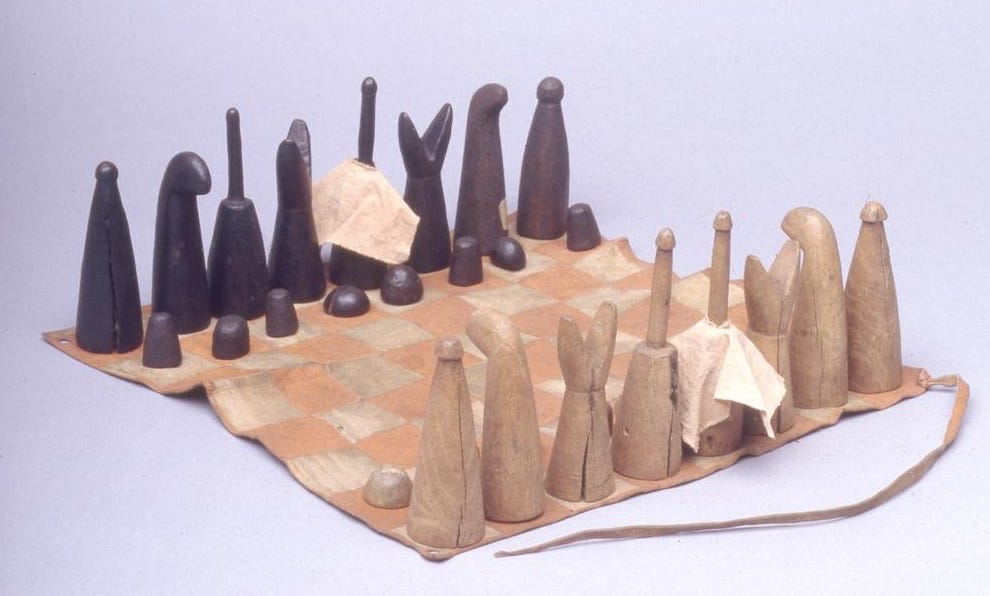
chess board and pieces. ca. 1912. Bornu, Nigeria. British Museum
“This board was acquired from an englishman who obtained them in Bornu in the 1920s, where two old men taught him a form of chess not played in the West since the 15th century . It was the original game played for 700 years throughout the Arab world
The kings and queens are similar, the kings being distinguished by a “robe” of blue stripped cotton. The form of the pawns goes back to early Islamic period. There is a goatskin board that came with the set, with squares demarcated by incised lines and dyed alternately cream and dark tan; it is slotted at the corners to allow it to be tied down.”60
As the map in the introduction shows, the distribution of mancala doesn’t correlate with the historical networks that linked Africa to the Islamic World.
For the four-row games in particular, one can speculate that they correlate with the expansion of pastoralism in ancient times in Eastern and Southern Africa, thus explaining the presence of the game in Namibia and its later adoption by the Bantu-speaking groups at the turn of the common era.
Mancala in African society.
Many customs and beliefs reported from all over Africa and the Americas attest to the reverence in which mancala was held.
In Central Africa, Southern Africa, and the Horn, both the four-row and two-row games was exclusively played by adult men, usually royals, titleholders and other elites, who monopolized possession of boards and knowledge of its gameplay.
The four-row game in Madagascar and the two-row game in West Africa and across Asia could be played by both men and women. The game was never accompanied by gambling, and players were usually reluctant to teach foreigners, including the Western ethnographers who recorded it.61
Boards were often costly works of art or family heirlooms, and mystical sanctions threatened those who abused the game, for instance, by overturning the board in a fit of rage.62
Game boards reflected the owner’s social status, and attimes approached the level of regalia,
Culin, in 1896, tells of Vai chiefs’ boards that were made of ivory ornamented with gold, thus contrasting with the simpler boards of ordinary people, while Tauxier in 1917, mentions chiefs playing with copper balls instead of the cowries or stones of the common populace.63
In Sierra Leone in 1910, Thomas Alldridge, observed that “warre” was played on a board that was carved to resemble a whaler or surfboat standing upon a broad pedestal. The game was played with small bean-shaped iron pieces made by blacksmiths on commission, which were expensive and could only be afforded by chiefs or ‘big men’.64
Such was the wealth of the Asante kings that they played war on gold “boards,” fashioned in the shape of the traditional sacred golden stool, symbol of the authority of the Asantahene, as the ruler was called. Some of the beautiful bronze weights of the Asante were formed in the shape of wari boards.65
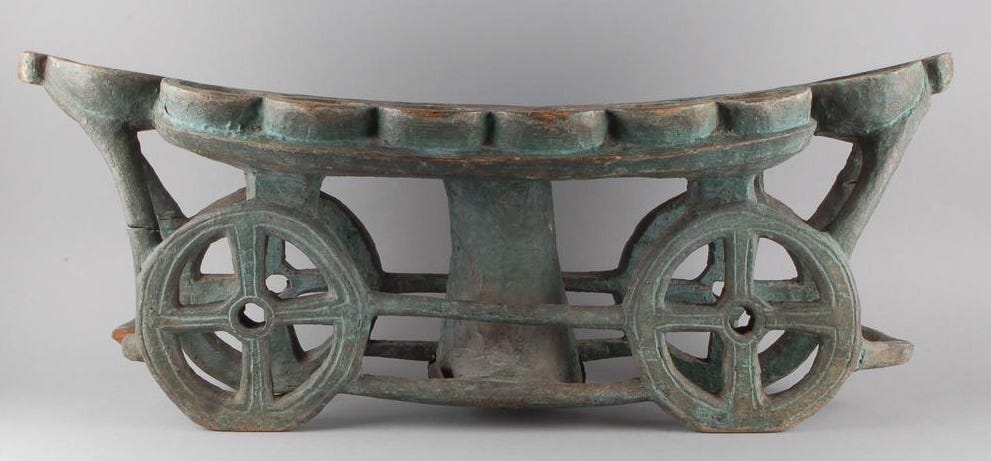
Mancala (’warri’) game board. Two-row board with six playing holes on each side, two large storage holes at either end. Central columnar storage compartment for the counters. The board is supported upon four fixed wheels. c. 1900-1910. Sierra Leone British Museum number Af1953,25.10
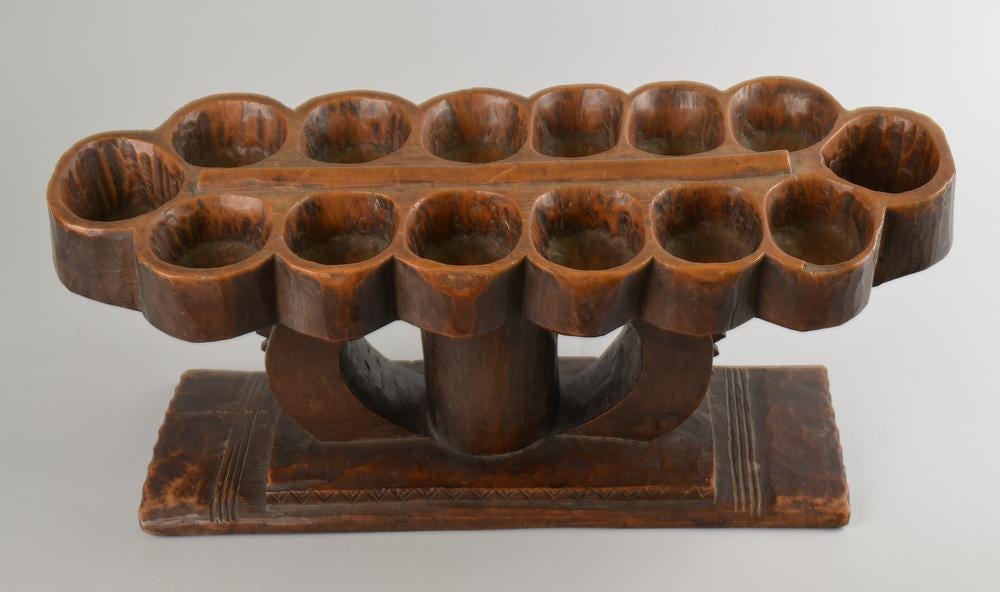
mancala-board. Asante, ghana. 1850-1927. British museum number Af1978,22.249
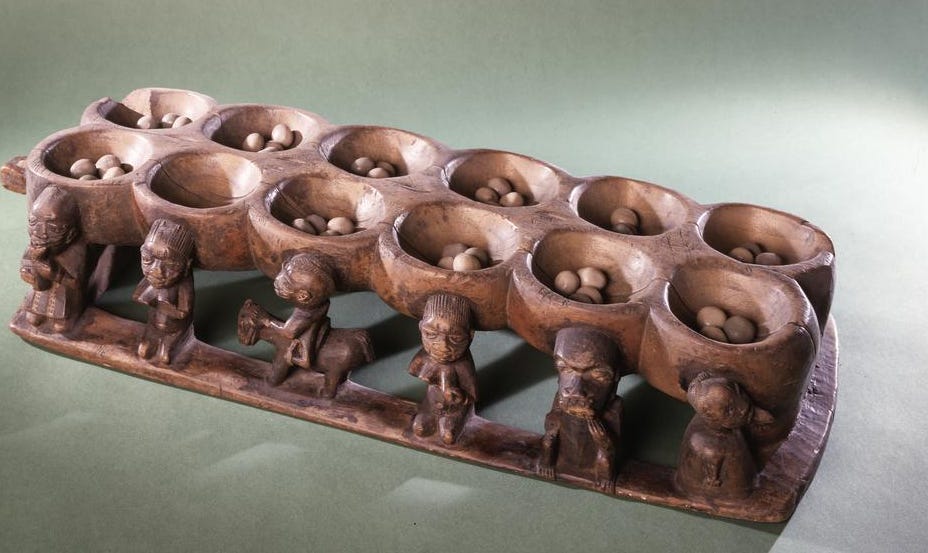
Wooden mancala board with figures around the sides. 1924 Yoruba, nigeria British museum number Af1928,0207.1
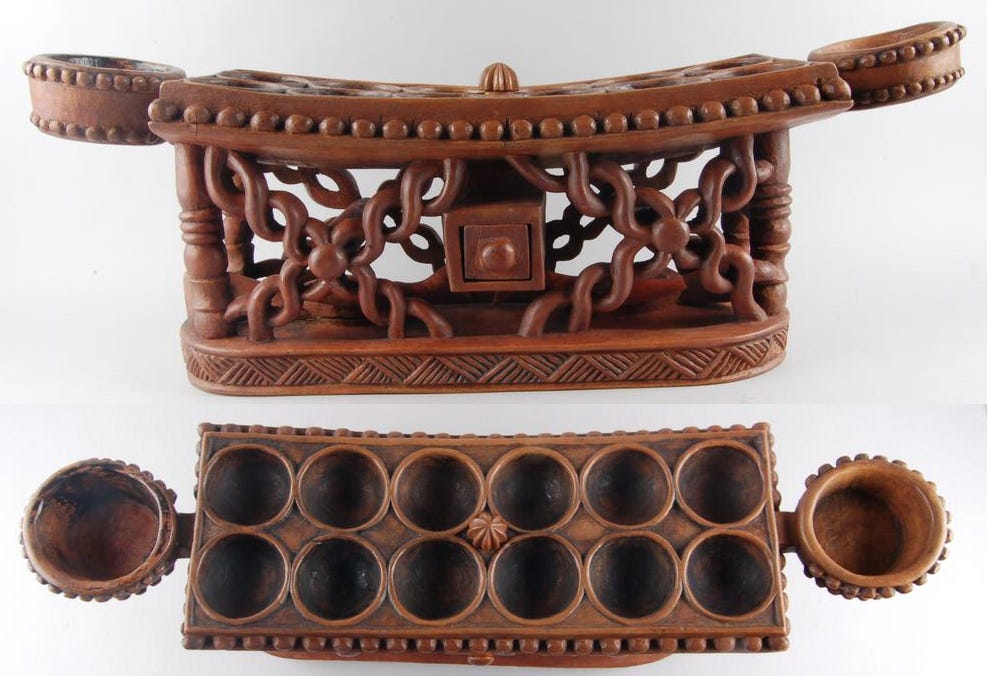
Warri-board; carved from wood; rectangular board with elaborately carved stand. Sierra Leone. British museum number Af1950,15.1.a
In Buganda, Omweso was the principal pastime in the courts of the king and enthronement ceremonies required the new king to play the game.
A certain prime minister was reputed to have the ability to “play the game and at the same time listen to the statements of two people in a suit. At the end of the statement he could repeat the plaintiff’s and the defendant’s statements with amazing accuracy and then give his judgement, which is said to have been often correct and fair”66
The 17th-century Songhai infantry commander mentioned above was busy immersed in the game of Sudanese chess despite the rapid approach of the enemy army.
In order to demonstrate the “cowardice” of his superior, Askiya Bonkana, who insisted that the commander quit his game immediately, the latter only stopped his game at the appropriate moment, attacked the enemy and broke their ranks.
Epilogue:
The colonial period has occasioned a great loss of popularity for the game: other board games, such as checkers and ludo, have competed with mancala for pride of place, especially in urban areas, and in some cases have almost killed the game altogether.
Whereas mancala was firmly embedded in the traditional social matrix and was synonymous with the prominent position of the elders, the imported games which have tended to strangle it have no fixed position in traditional society.
There are, however, cases of spreading mancala. Mangola, for instance, the most common form in northern Congo, has spread considerably in that country thanks to the movement of soldiers
Bao, the mancala of the Swahili coast, seems to have long had tendencies in this direction. Even before European penetration, it had spread as far as Maniema in eastern Congo, probably as an appendage of prestigious Islam.67
In 1966, the Chama cha Bao (Bao Society) was formed in Zanzibar, Tanzania to promote the game and for grand masters to train new players.68
Since the early 2000s, Mancala has been used in training artificial intelligence models.69 Different versions of the ancient African game have been programmed into computer applications and software and are today available online.
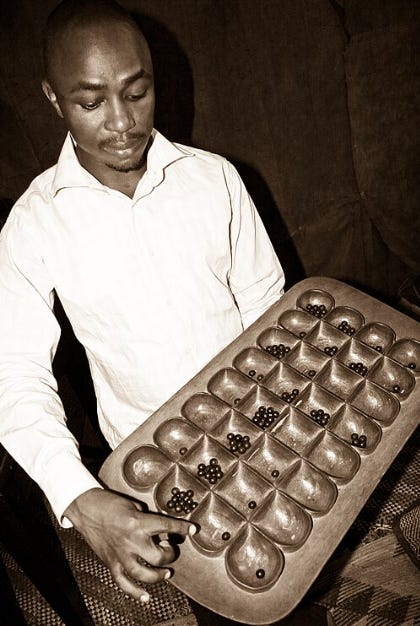
“Omweso board game (game of Kings) at Kasubi Tombs”, Kampala, Uganda. Wikimedia Commons.
Africans who were forcibly transported to the Americas during the Atlantic slave trade introduced cultural institutions and intellectual traditions that have been overlooked in hegemonic narratives of American history, which overwhelmingly emphasize external influences from Europe.
My latest Patreon article is about the spread of the Kongo Cosmogram and Central African divination in the Americas during the 17th and 18th centuries.
Please subscribe to read more about it here:
Games in Culture: A Contextual Analysis of the Swahili Board Game and its Relevance to Variation in African Mancala by Philip Townshend pg 98-106. Gabata and Other Board-Games of Ethiopia and the Horn of Africa by Richard Pankhurst pg 37-39
Limits of the Mind: towards a characterisation of Bao mastership by Alexander J. de Voogt pg 24-30
Ancient Board Games in Perspective, edited by Irving Finkel pg 250. Ancient Egyptians at Play: Board Games across Borders, edited by Walter Crist, Anne-Elizabeth Dunn-Vaturi, Alex de Voogt pg 160-161
Mancala at the pyramids of Meroe by Alex de Voogt
Ancient Egyptians at Play: Board Games across Borders, edited by Walter Crist, Anne-Elizabeth Dunn-Vaturi, Alex de Voogt pg 161-166
Ancient Egyptians at Play: Board Games across Borders, edited by Walter Crist, Anne-Elizabeth Dunn-Vaturi, Alex de Voogt pg 163-165
Gabata and Other Board-Games of Ethiopia and the Horn of Africa by Richard Pankhurst
Misconceptions in the History of Mancala Games: Antiquity and Ubiquity by Alex de Voogt pg 4.
The bao: a board game in Africa’s antiquity, by Mwanzia Kyule pg 100-103. Carved rock gaming-boards in western south nyanza, kenya by Michael G. Kenny
Mankala in Eastern and Southern Africa: A Distributional Analysis by Philip Townshend, pg 127
Narrative of the Portuguese Embassy to Abyssinia During the Years 1520-1527, by Francisco Alvares, Henry Edward John Stanley, Baron Stanley, 1881, pg 84,168
Gabata and Other Board-Games of Ethiopia and the Horn of Africa by Richard Pankhurst, pg 27
Gabata and Other Board-Games of Ethiopia and the Horn of Africa by Richard Pankhurst, pg 27
Africa Counts: Number and Pattern in African Cultures Claudia Zaslavsky pg 127
Mancala, the National Game of Africa. by Stewart Culin, pg 601
Board and Table Games from Many Civilizations, by R. C. Bell , pg 121
Timbuktu and the Songhay Empire: Al-Sa‘dī’s Ta’rīkh Al-sūdān Down to 1613 and Other Contemporary Documents, by John Hunwick, pg 128. African Dominion: A New History of Empire in Early and Medieval West Africa, by Michael A. Gomez, pg 325
A History of Board-Games Other Than Chess, by H. J. R. Murray pg 165-167
Games in Culture: A Contextual Analysis of the Swahili Board Game and its Relevance to Variation in African Mancala by P Townshend pg 260. The bao: a board game in Africa’s antiquity, by Mwanzia Kyule pg 101. A History of Board-Games Other Than Chess, by H. J. R. Murray pg 177
Narrative of a Five Years’ Expedition, Against the Revolted Negroes of Surinam in Guiana, Volume 2, By John Gabriel Stedman, 1796, pg 284.
Wari in the New World, by Melville J. Herskovits
Narrative of travels and discoveries in Northern and Central Africa, by Dixon Denham et al. Murray, 1826, pg 324
Games in Culture: A Contextual Analysis of the Swahili Board Game and its Relevance to Variation in African Mancala by P Townshend pg 147
“Flora, fauna and fifangha: Madagascar by Flacourt”, by Alex Voogt, pg 12-15 in “Natural histories: extraordinary rare book selections from the American Museum of Natural History library,” edited by Tom Baione
Voogt is incorrect in asserting that Flacourt’s account is the first Western record of any mancala game.
see; Games in Culture: A Contextual Analysis of the Swahili Board Game and its Relevance to Variation in African Mancala by P Townshend pg 147-150
A History of Board-Games Other Than Chess, by H. J. R. Murray pg 205-207
Mankala in Eastern and Southern Africa: A Distributional Analysis by Philip Townshend, pg 126, 117
New travels into the interior parts of Africa by Le Vaillant, François, 1753-1824, Vol. 2, Printed for G.G. and J. Robinson, 1796, pg 366-367
Mankala in Eastern and Southern Africa: A Distributional Analysis by Philip Townshend, pg 113, 118, 128
Africa Counts: Number and Pattern in African Cultures, by Claudia Zaslavsky pg 117-118
Games in Culture: A Contextual Analysis of the Swahili Board Game and its Relevance to Variation in African Mancala by P Townshend pg 262-268. Mankala in Eastern and Southern Africa: A Distributional Analysis by Philip Townshend, pg 134-135
The Heart of Africa Three Years Travels and Adventures in the Unexplored Regions of Central Africa by Dr. Georg Schweinfurth; Translated by Ellen E. Frewer, Volume 2, Sampson Low, 1873, pg 29
In Darkest Africa: or, The quest, rescue and retreat of Emin, Governor of Equatoria by Henry M. Stanley, Sampson Low, 1890, pg 99, 400
Across Africa by Verney Lovett Cameron, Harper & Brothers, 1877 pg 491.
Mankala in Eastern and Southern Africa: A Distributional Analysis by Philip Townshend, pg 115
Emin Pasha in Central Africa: Being a Collection of His Letters and Journals edited by Professor G. Schweinfurth, published by George Philip & Son in London (32 Fleet Street) in 1888, pg 519
Mankala in Eastern and Southern Africa: A Distributional Analysis by Philip Townshend, pg 111-112
Mancala, the National Game of Africa, Smithsonian Institution. United States National Museum. By Stewart Culin, pg 603
Mancala, the National Game of Africa, Smithsonian Institution. United States National Museum. By Stewart Culin, pg 117
Wari in the New World, by Melville J. Herskovits pg 32
Africa Counts: Number and Pattern in African Cultures, by Claudia Zaslavsky pg 124)
Bao (Mankala); The Swahili Ethic in African Idiom by Philip Townshend, pg 182
Africa Counts: Number and Pattern in African Cultures, by Claudia Zaslavsky, pg 118)
Misconceptions in the History of Mancala Games: Antiquity and Ubiquity by Alex de Voogt pg 7
Mankala in Eastern and Southern Africa: A Distributional Analysis by Philip Townshend pg 126)
Misconceptions in the History of Mancala Games: Antiquity and Ubiquity by Alex de Voogt pg 7
African Mankala in Anthropological Perspective by Philip Townshend, pg 794)
Games in Culture: A Contextual Analysis of the Swahili Board Game and its Relevance to Variation in African Mancala by P Townshend pg 110-112, 147
Mankala in Eastern and Southern Africa: A Distributional Analysis by Philip Townshend pg 110-114)
Mankala in Eastern and Southern Africa: A Distributional Analysis by Philip Townshend pg pg 115-116)
Bao (Mankala): The Swahili Ethic in African Idiom by Philip Townshend pg 185-186, Games in Culture: A Contextual Analysis of the Swahili Board Game and its Relevance to Variation in African Mancala by P Townshend pg 149-150
Mankala in Eastern and Southern Africa: A Distributional Analysis by Philip Townshend pg 117-118)
Mankala in Eastern and Southern Africa: A Distributional Analysis by Philip Townshend pg 132-133)
Gabata and Other Board-Games of Ethiopia and the Horn of Africa Richard Pankhurst, pg 28-29, Mankala in Eastern and Southern Africa: A Distributional Analysis by Philip Townshend pg 132
Mankala in Eastern and Southern Africa: A Distributional Analysis by Philip Townshend pg 119-121)
Games on the seashore of Salalah: the discovery of mancala games in Dhofar, Sultanate of Oman by Federico Borgi
Games in Culture: A Contextual Analysis of the Swahili Board Game and its Relevance to Variation in African Mancala by P Townshend pg 321-322
Games in Culture: A Contextual Analysis of the Swahili Board Game and its Relevance to Variation in African Mancala by P Townshend pg 322-325
A History of Chess, by Harold James Ruthven Murray · 1913, pg 201
History and Principles of Ethiopian Chess, R Pankhurst pg 149)
Chess Life Volume 45, Issues 7-12, United States Chess Federation, 1990, pg 449. Chess: East and West, Past and Present. A Selection from the Gustavus A. Pfeiffer Collection, by The Metropolitan Museum of Art, pg 36)
Games in Culture: A Contextual Analysis of the Swahili Board Game and its Relevance to Variation in African Mancala by P Townshend pg 285-287)
African Mankala in Anthropological Perspective, by Philip Townshend, pg 795
Games in Culture: A Contextual Analysis of the Swahili Board Game and its Relevance to Variation in African Mancala by P Townshend pg 279
A Transformed Colony, Sierra Leone, as it Was, and as it is Its Progress, Peoples, Native Customs and Undeveloped Wealth By Thomas Joshua Alldridge, pg 230)
Africa Counts: Number and Pattern in African Cultures by Claudia Zaslavsky pg 127
Africa Counts: Number and Pattern in African Cultures by Claudia Zaslavsky pg 128)
African Mankala in Anthropological Perspective, by Philip Townshend pg 796)
Limits of the Mind: towards a characterisation of Bao mastership by Alex Voogt
Mancala Games -- Topics in Artificial Intelligence and Mathematics by H. Donkers, J. Uiterwijk, A. D. de Voogt)