

During the late Middle Ages, a ‘pagan’ power from the interior of West Africa confronted the great empires of Mali and Songhai, and briefly extended its influence over the merchant towns of the Sahel, including Timbuktu.
The rise of the Mossi states during a period marked by the spread of Islam challenges older theories of state formation and trade in medieval West Africa, illustrating the development of complex societies with diverse religious communities under “traditional” authorities.
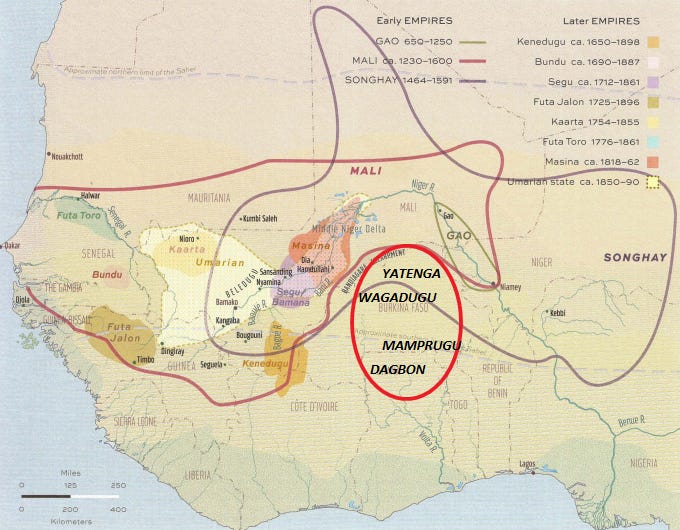
The Mossi kingdoms were a group of polities that extended across much of present-day Burkina Faso and northern Ghana. Despite the political and commercial transformations that reshaped neighbouring regions, these cavalry-based states retained many of their traditional institutions until the colonial period.
This essay outlines the history of the Mossi states from the late Middle Ages to the nineteenth century.
Map showing the Empires of the West African Savannah/Sahel and the Mossi states.
Support AfricanHistoryExtra by becoming a member of our Patreon community, subscribe here to read more about African history, download free books, and keep this newsletter free for all:
A brief background on the early history of the Mossi.
The traditional accounts of the Mossi, of which numerous versions have been recorded, diverge in many points of detail while displaying a broad convergence.1
The Mossi conceptualise the relationship between their various kingdoms in terms of the descent of the founders of the dynasties from the semi-legendary ruler Na Gbewa.
The latter had three sons: Tusugu, Sitobu, and Nmantambu, and one daughter, Yanenga. The princes are associated with the southern kingdoms of Mamprugu, Dagbon, and Nanumba, and the princess with the northern kingdoms of Yatenga and **Wagadugu.2
[**not to be confused with the medieval Ghana empire/Wagadu]
In these accounts, the founders of the Mossi kingdoms “entered” the region as conquerors. They were the nakomse, ‘possessors of political power’, a class of nobles who established their lordship by force of arms over the autochthonous fegbisi, ‘the owners of the land’, from whom they appropriated tributes.3
Initially thought to have come from the eastern bend of the Niger River, more recent analysis suggests an origin from northern Ghana. And, rather than a wave of immigrant warriors, the political revolution that gave rise to the Mossi states was a gradual process involving a shared effort between the established populations and the incoming warrior groups.4
The power of the early Mossi was based upon their possession of horses and their command of the techniques of cavalry warfare. This period of Mossi expansion is reflected in internal written accounts describing the late medieval period, when they competed for control over the northern merchant cities of Timbuktu and Walata, and occasionally drove off the armies of medieval Mali and Songhai.
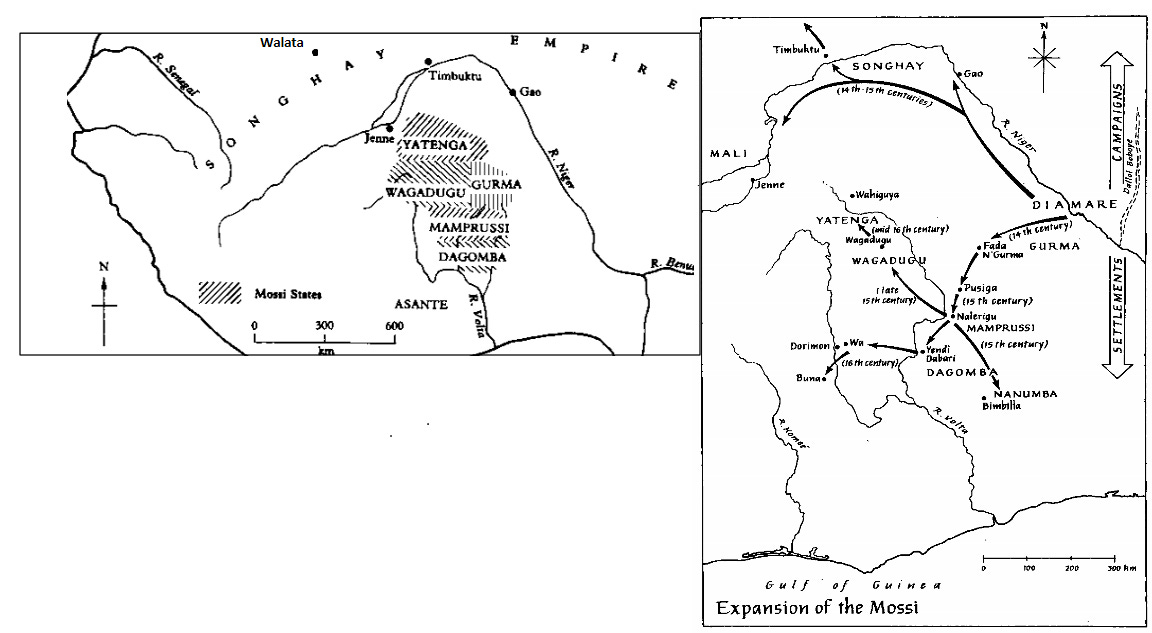
Expansion of the Mossi. Map by I Wilks.
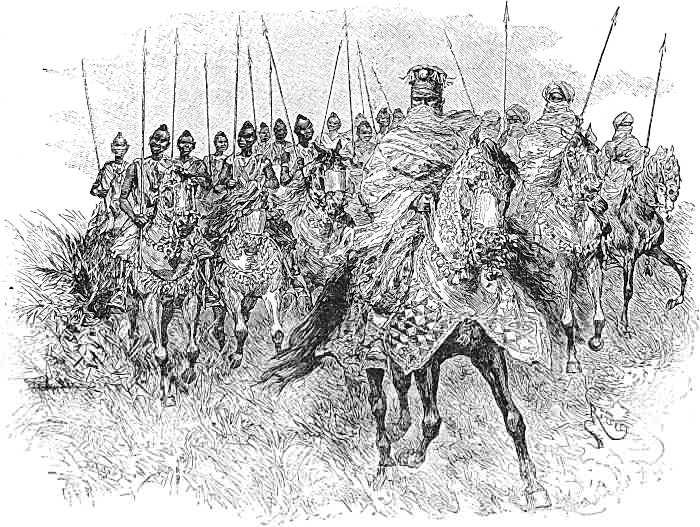
Boukary and his escort. In the vicinity of Wagadugu. Image by L. Binger, ca. 1888.
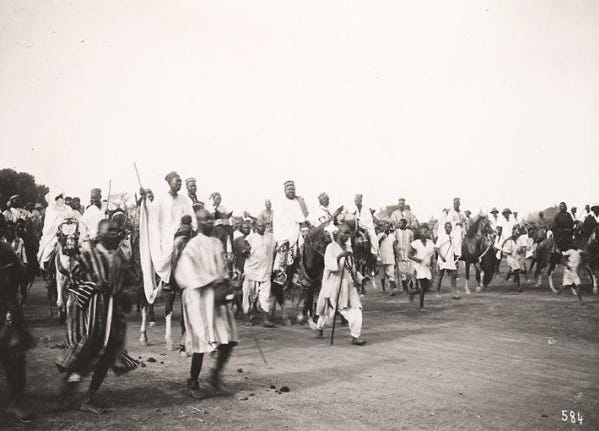
The Moro Naba of Wagadugu. ANOM. ca. 1930-1960.
The Mossi versus the empires of Mali and Songhai
According to the Tarikh al-Sudan, a chronicle written in Djenne (Mali) during the 17th century:
In 1343, the ‘sultan’ of Mossi set out for Timbuktu at the head of a large army. The armies of medieval Mali fled in fear and abandoned the city to them. The Mossi sultan entered Timbuktu, sacked the city, and looted it before returning to his land5
In the 1430s, the Mossi army came very close to Timbuktu but was driven back by a force made up mostly of the city’s residents and scholars.6
In 1480, the Mossi besieged the town of Biru/Walata (in Mauritania) for a month. The Mossi ruler asked the people of Biru for a wife, and they gave him in marriage the daughter of sayyid Anda-n-Allah ‘Ali b. Abi Bakr. At the end of the siege, the Mossi defeated the forces of Walata and took many captives, although some of these were later rescued.7
This battle is also referenced by the Genoese merchant Antonio Malfante, who travelled to Tuat (Southern Algeria) in 1447, and mentions the attack of a town called ‘Vallo’ (identified as Walata) by a ‘pagan’ king ‘with five hundred thousand men’.8
This battle at Walata coincided with the conquests of Sunni Ali (r. 1464-1492), founder of the Songhai empire.
Joao de Barros, writing in the reign of Joao II of Portugal (1481-95), told how the Portuguese had tried to establish contact with the king of Mossi, a country which, according to reports received in the Senegambia, ‘began beyond Timbuktu and extended towards the Orient’. At the time, the Mossi were said to be at war with ‘the king of Timbuktu Uli Mansa’, ie, Sunni Ali.9
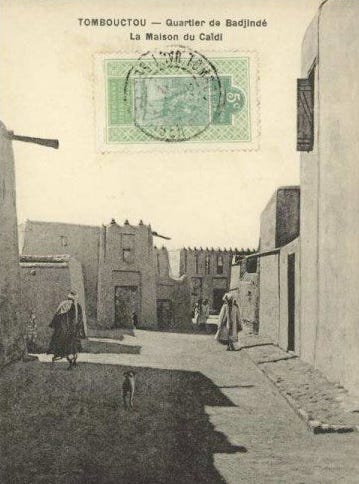
Street scene in Timbuktu, Mali.
In 1483, Sunni Ali defeated the Mossi ruler while campaigning in the direction of Walata.10
According to the Tarikh Ibn al-Mukhtar, another 17th-century chronicle, the Mossi ruler was nicknamed Kumdāghu. He pursued the ruler until the land of the Bambara, but the Mossi king managed to flee and establish his new capital at Arqum. Sunni Ali’s army later returned with an army from the direction of Gao, advancing south to Barkuna, which is described as a town that contains the palace of the Mossi king. He destroyed the palace and killed the Mossi.11
This battle marked a decisive shift in the balance of power in the region. While the Mossi had previously sought to control the rich trading cities of the north, the situation had changed by the end of the 15th century, as Songhai took the initiative in curbing Mossi ambitions.
In 1498, Askiya Muhammad of Songhai campaigned against the Mossi, ostensibly as part of a holy war (the only one of its kind according to the chronicler of the Tarikh al-Sudan). Initially, he sent his envoy, Mori Salih Diawara, to the Mossi ‘Sultan’ Nasiri with a letter urging the latter to embrace Islam. Nasiri responded that he needed to consult his ancestors.
The two then went with the ministers of Nasiri to the house of the priest, who compelled the king to reject Askiya’s offer to become Muslim and urged him to go to war with Songhai. The Mossi were defeated, and many were taken to Gao, where a special quarter for artisans was made for them.12
In 1549, Askiya Dawud campaigned against the Mossi. But by 1562, the Mossi had re-established their military and were able to repel a major assault from Songhai. In a third campaign in 1578, the Songhai retreated without taking anything. The Mossi are also reported to have briefly imposed themselves over the Fulbe kingdom of Masina, before they were ultimately expelled.13
THE exact relationship between the Mossi of the late medieval period and the Mossi of the early-modern period remains a subject of intense debate.14
Most historians and translators of the Timbuktu chronicles argue that the two are the same group. Ivor Wilks, who belongs to this camp, includes a tradition from the southern Mossi kingdom of Dagbon that points to an eastern origin of a hunter-founder from the direction of Lake Chad to Zamfara and thence to ‘Malle’; a country west of Hausaland and east of Gurma.15
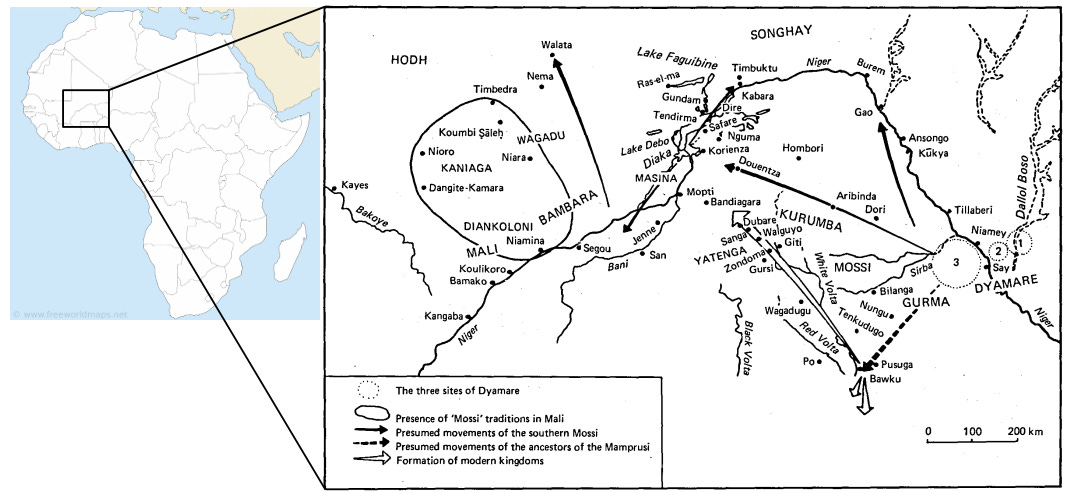
Origins of the Mossi. Map by M. Izard
Others posit a break between the written and oral tradition, pointing to two other chronicles (an obscure 15th-century text by Abkal Ibn Awdar and a 19th-century Hausa chronicle by Malam al-Hassan), which locates the Mossi origin in the eastern bend of the Niger River. The former identifies it as Diamare (east of Niamey, the capital of Niger) while the latter pushes it further east to Zamfara (N.W Nigeria).16
Michel Izard, on the other hand, argues that the two groups were not the same; based on a comparative analysis of the oral traditions of the northern and southern kingdoms that point to a common, southern origin, and the absence of references to conflicts with Songhai. He maintains that the proto-history of the modern Mossi, as far as it can be reconstructed, is a proto-history of Mamprugu in N.E Ghana, from where the other Mossi states emerged.17
The Mossi kingdoms from the 16th to 18th centuries
According to the king lists recorded by Izard, the southern Mossi kingdoms were in place by the late 15th century, followed later by the northern kingdoms of Wagadugu in the early 16th century and Yatenga by 1540.
He suggests that the two groups, the Mossi of the 17th-century Tarikhs, and the Mossi from Mamprugu, represent two separate historical traditions. The first came from the Niger Bend region around Gurma and established their hegemony westwards along the river until it was destroyed by the Songhai wars. The second came from the Mamprugu to eventually control the upper Volta. Any relationship between the two is in the distant past, in the vicinity of Gurma, where some traditional histories seem to converge.18
The pre-existing languages of the Upper Volta belong to the ‘Gur’ language family, including the Lobi-Dogon, Grusi, Gurma, and Mole-Dagbane, the last of which was adopted by the Mossi. The autochtons presumably lacked any centralised political institutions but were organised based on areas of ritual jurisdiction (‘parishes’), each with its tengasoba/tengdana (land priest) having custody of the earth shrines.19
These priests were often left in office and sometimes vested with symbols of political authority. The communities were integrated as tengdamba/tegbisi (commoners) and assigned roles in the army. Conversely, chiefly lineages that failed to secure office in time lost their entitlements and entered the ranks of the commoners.
Their economies were predominantly agricultural ones. Surpluses were appropriated, through various forms of tribute, by local village chiefs appointed from the ranks of the nakomse. Part of these tributes was transferred to district chiefs of higher rank, who in turn passed on a share to the king, the na or naba.20
Succession in the kingdoms of Wagadugu, Dagbon, and Mamprugu was limited to one royal family, while other kingdoms had polydynastic systems where kingship rotated between two houses, each with its own capital, subordinate officials, and patronage systems.21
To counter the threat of rebellious chiefly lineages, rulers assigned new administrative functions to palace officials recruited from outside the chiefly class, a process that seems to have begun in the early 18th century.
These changes are associated with the reigns of those rulers identified in the oral histories as strongly committed to political innovation, namely, Na Atabia of Mamprungu (r. 1690-1741), Na Zangina of Dagbon (r. 1700-1714), Naba-Warga of Wagadugu (r. 1737-1744), and Naba Kango of Yatenga (r. 1757-1787).22
At least one of these figures, Na Atabia, is known from a contemporary chronicle known as the Gonja chronicle: ‘in that year [A.H. 1154] Atabia king of Ghabagha died. He is said to have reigned for fifty-odd years.’ Ghabagha/Gambaga was the capital of the kingdom, which also appears in Binger’s account in 1888.23
The chronicle also mentions a war between the kingdom of Gonja and Dagbon in A.H. 1125 (1713 CE), in which the former was defeated at Tunuma, western Dagbon. The king, while left unmentioned, was Na Zangina, a contemporary of Na Atabia.
The kings of Dagbon are known in multiple written sources. Zangina’s successors, Na Gariba and Na Andani (Aldani), are known from written accounts from Asante; while the later kings, beginning with Na Ziblim Kulunku (Kirgangu in H. Bath’s account from 1853), are known from European sources, as are other Mossi kings of the late 19th century.24
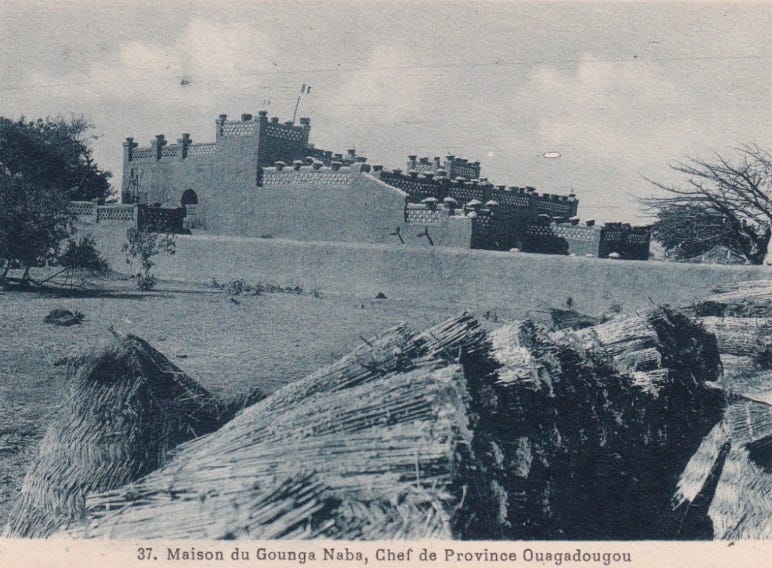
All of these rulers founded their own royal capitals. Na Atabia moved his court from Gambaga to Nalerigu, Na Zangina chose to establish his court at Agbande rather than at the older site of Yendi Dabari, and his successor Na Andani Sigili moved his court to Chele, the present-day Yendi. Na Kango of Yatenga is said to have founded Wahiguya and to have built there an imposing ‘soudanese’ palace that remained in place until 1895.25
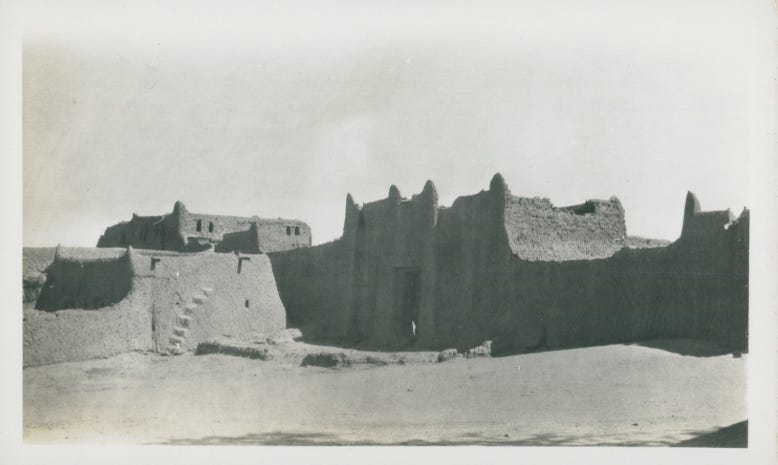
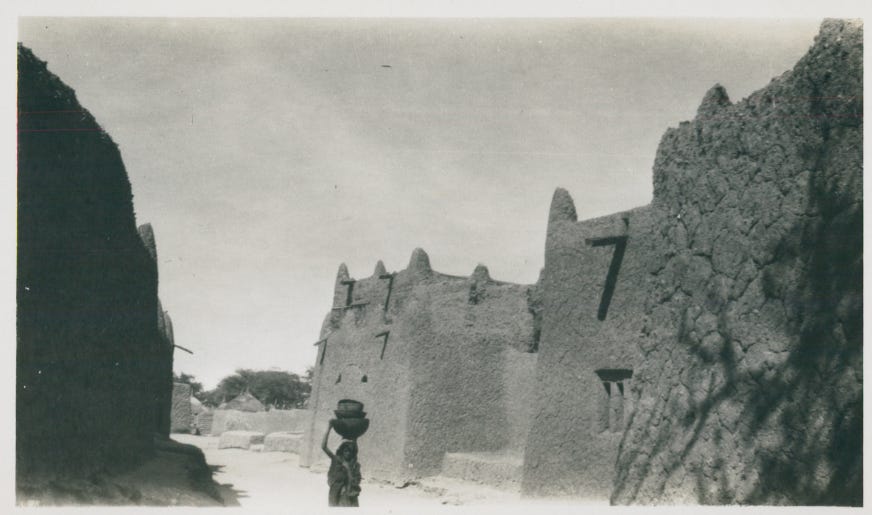
Burkina Faso, earthen houses. ca. 1930. This has been identified as a palace belonging to a royal Mossi family on the central plateau of Upper Volta.
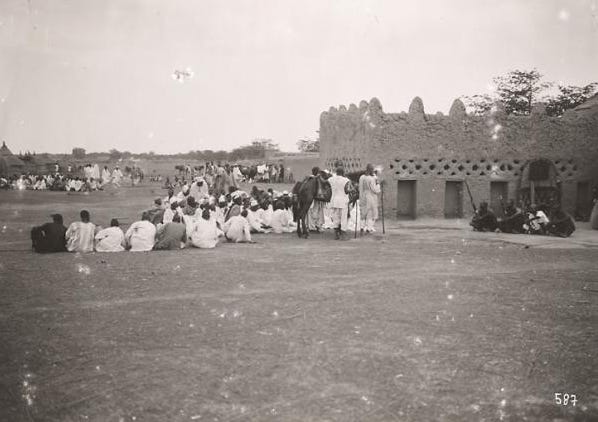
Outside the residence of the Moro Naba, Wagadugu. ANOM. ca. 1930-1960.
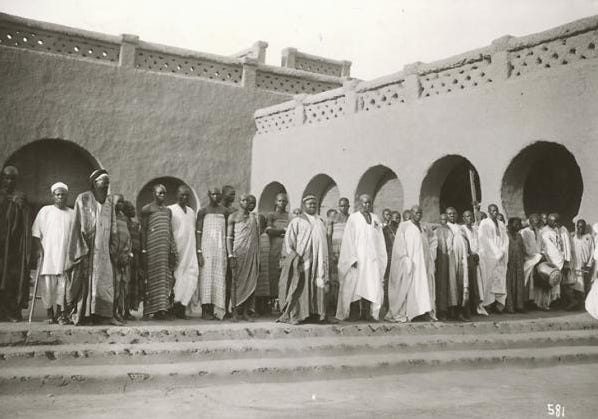
The Moro Naba and his court. Wagadugu. ANOM. ca. 1930-1960.
Trade and Islam in Mossi country
In the 18th century, there were about twenty Mossi kingdoms (Moogo) in what is today Burkina Faso, the principal ones being Wagadugu, Yatenga, Busuma, and Tenkodogo. There were two major zones of political influence: the Northwest, dominated by Yatenga, while the Central and Southern kingdoms recognised the nominal suzerainty of the ruler (Mogho Naba or Moro Naba) at Wagadugu, when it came to arbitrating conflicts.26
The Timbuktu chronicles and the early European/Portuguese reports suggest, by the very absence of comment, that in the 16th and 17th centuries, the Mossi kingdoms enjoyed little commercial importance.
It was only after the political reforms of the 18th century that an influx of muslim traders (Dyula from Mali, and Hausa from N.Nigeria) placed Mossi country at the crossroads of major West African trading routes. Most of these traders belonged to the Suwarian tradition of pacifism and were more concerned with trade in Kola and gold from the Vola basin than in proselytization.27
Dyula/Juula families, such as the Baghayogho, who were first established in Dagbon by 1660 CE and in Wagadugu by the 18th century, while Na Atabia of Mamprugu gave the imamate to the Hausa and Gurma immigrants in the latter half of the same century. Many of these merchants served as the kings’ commercial agents, while the bulk of Mossi society remained largely non-Muslim, including the royals, who resided in separate capitals away from the market towns.28
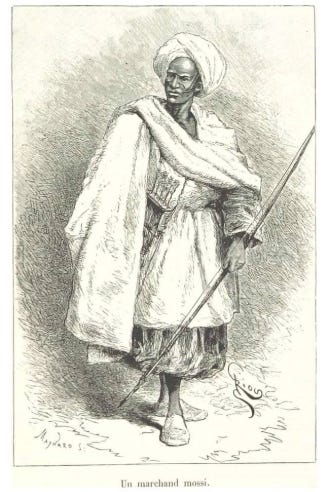
A Mossi merchant, ca. 1892.
The originally Mande-speaking merchants soon adopted the Mossi languages and were known locally as the Yarse. They dominated the trade routes extending from Timbuktu in the north to Salaga in the south, exchanging the usual staples of kola, donkeys, horses, textiles, captives, and salt. Barth in 1853 pointed to the importance of Mossi pack animals in the caravan trade.29
A number of Hausa dignitaries are also known, especially in the southern kingdoms of Dagbon and Mamprugu, where they provide arguably the only known internal written sources. One notable example was Malam al-Hassan, of Gobir, who translated the Qissãt Salaga Tãrikh Ghunjã into Hausa, and compiled the histories of Mamprugu, Mossi, Dagbon, and Grunshie in the 1890s.30
The Muslim influence appears to have been stronger in the southern kingdoms of Dagbon and Mamprugu, where Dyula and Hausa merchants were closely integrated in court politics, and capitals like Yendi developed into substantial trading towns.
According to information collected from traders in the Fezzan (Libya) by Simon Lucas in 1788/9, and by the British envoys Bowdich (1817) and Dupuis (1820) in Kumasi (Asante, Ghana), the city of Yendi, which was the capital of Dagbon, was four times larger than Kumasi and ‘enjoys great celebrity all over the African continent for its riches and manufactures.’31
Yendi’s fame as a commercial centre also carried the idea of Dagbon as a Muslim kingdom. Lucas called it ‘the Mahometan kingdom of Degombah’, but added that ‘there is reason to believe from the Shereef’s account that the Musselman and the Pagan are indiscriminately mixed’. In Asante, the British envoys’ reports that the king of Dagbon was sending muslim amulets to the Asante king have been confirmed by the discovery of an Arabic letter, now among the Copenhagen manuscripts, that was sent to the Asantehene by Na Andani of Dagbon.32
While Yendi’s importance as a merchant city was taken over by Salaga, its Muslim tradition left a deeper imprint than in other Mossi states.
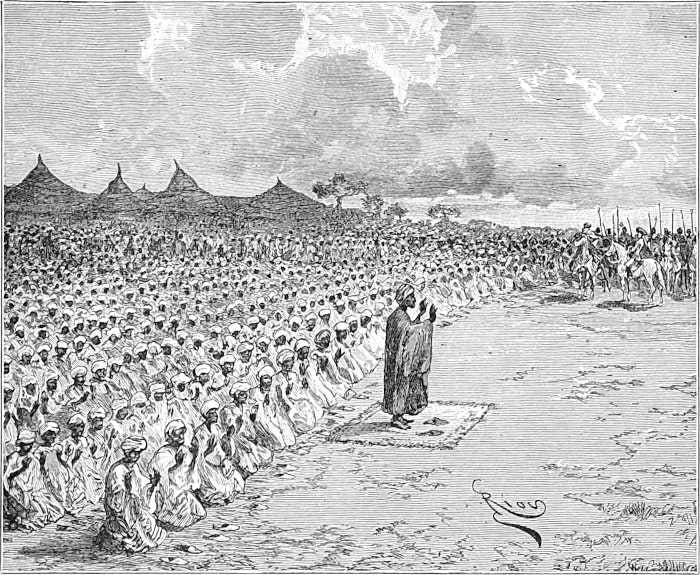
Prayer at Sakhaboutenga, a muslim town near Wagadugu. Image by L. Binger, ca. 1888: “The religious ceremony takes place in a plain to the east of the village; it is quite an impressive sight. A profound silence reigned in the assembly. The faithful, arranged in rows some twenty deep, prostrated themselves and rose with perfect unison and imposing slowness. From time to time, the imam’s voice rose, and in the deepest contemplation, an “amen” could be heard from the congregation. There were approximately three thousand people of both sexes present, almost all dressed in white. The burnouses, the chechias, and this collection of black faces gave the ceremony the grandiose character of oriental festivals.”
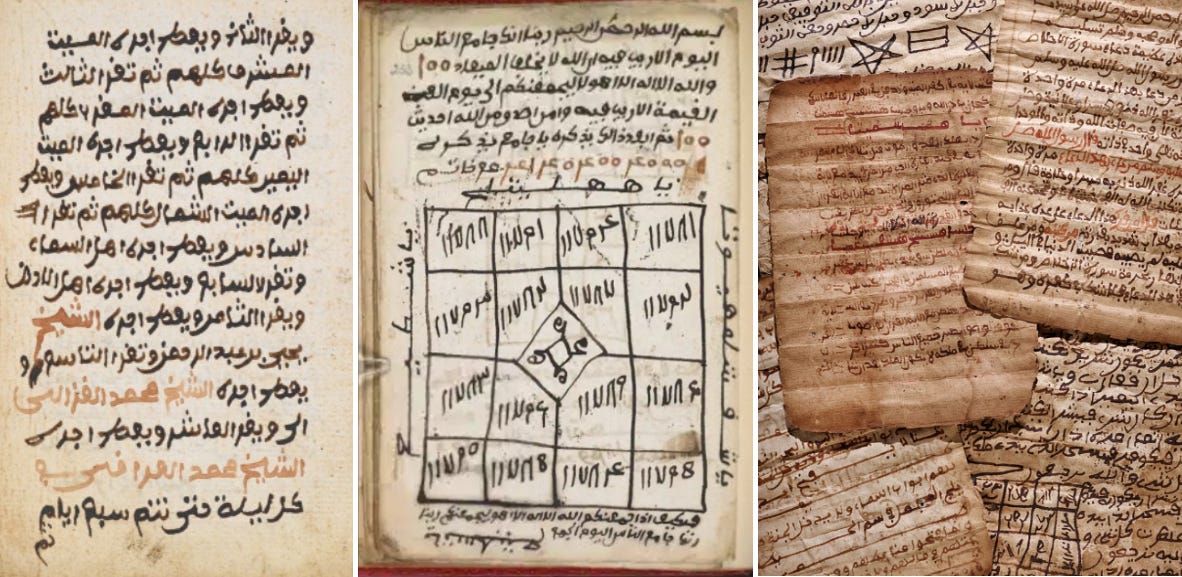
Various manuscripts from Asante, Ghana. (left) Instructions for reading the Kīmīyā-yi Sa’ādat (’the Alchemy of Happiness’) by Persian philosopher al-Ghazali. British Library. (center) number table and instructions on how to fill it. British Library. (right) talismanic manuscripts Musée d’ethnographie, Genève
The Mossi states in the 19th century
The centralizing processes that had defined Mossi politics in the 18th century broke down in the 19th century, as the military weakness of the dominant kingdoms allowed for the smaller kingdoms to assert their autonomy.
In Yatenga, the kingdom’s military organization had largely failed to incorporate the technological innovations adopted by its neighbours. Like a feudal military, each Nakomse/nobleman answered the king’s call to arms by bringing their own forces, mostly cavalry units, that remained under their command.
Its defense relied on a series of fortified settlements manned by Mossi lineages that had been excluded from power. According to the chronicle of Yigane, few of these frontier chiefs lived to fight more than a few battles, although peace prevailed at the center.33
In the mid-19th century, Wagadugu’s territory was reduced by the emergence of Busuma to the east and Lalle to the west, each with its own Naaba/ruler. In Yatenga, a long succession crisis followed the reign of Naaba Tuguri (1806-22) but ended with the ascension of Naaba Totebalbo (1834-1850) and Naaba Yemde (1850-1877). It was reignited under Naaba Bulli (1895-1899), devolving to such an extent that in 1894, he requested military assistance from the French.34
It was in this context of political upheaval and disintegration that the French captain Louis-Gustave Binger travelled through Mossi country in 1888.
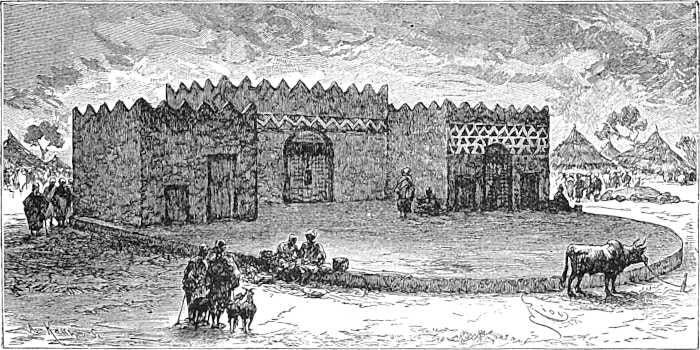
Waghadougou Residence. (Palace of King Sanom). Image by L. Binger. ca. 1888.
According to Binger, the Mossi capitals were substantial towns with a diverse population drawn from across the region.
Waghadougou (Wagadugu) had a population of about 5,000 inhabitants, while the other centers of Mani, Yako, Boussomo, Sakhaboutenga, Pisséla, Koupéla, and Ganzourgou have 3,000 inhabitants.
Waghadougou proper includes: the residence of the Naba, the group of Muslim villages (of Mandé origin), the group called Zang-ana, inhabited by Marenga (Songhay), of the Zang-ouér’o or Zang-ouéto (Hausa), some Tchilmigo (Fulani), and other non-Muslim Mossi groups.35
The ruler of Wagadugu was Naba Sanom/Sanem (r. 1871-1889), who had won the succession dispute against his brother Boukary. Apparently, the Muslim Mossi, who referred to Sanem as Alassane, claimed that the king is a Muslim and that he does his prayers hidden from the eyes of his subjects. The traditionalists, however, “say the opposite and speak with pride of their naba, who drinks dolo (beer) like them.”36
Most of the horses in Wagadugu came from Yatenga, which had two breeds of horses: an ‘Arabian’ type, and a ‘Yatenga’ type standing at up to 1.62 m, which Binger favourably compares to the French dragoons’ mount. Donkeys were bred in most Mossi regions and sold for about 30-35,000 cowries, equivalent to 60 gold francs in Kong and Bobo-Dioulasso. These were exchanged in Salaga (Ghana) for kola, cowries, and textiles.37
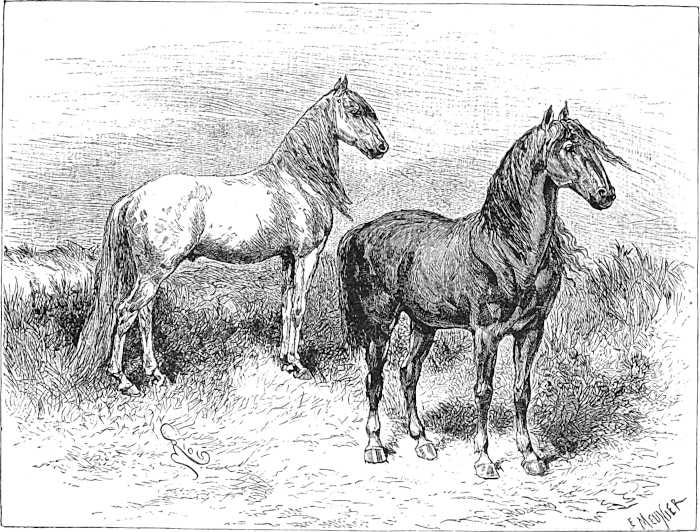
Horse breeds in Wagadugu. Image by L. Binger, ca. 1888.
Binger also visited the southern kingdom of Mamprugu, whose two most important centers were Oual-Oualé/Walwale and Gambakha/Gambaga, each with 2,500 to 3,000 inhabitants. The kingdom had greatly diminished in size; its ruler was apparently a Traouré (of Mandé origin), but he didn’t reside in the two main centers, which were imamates (societies led by an imam) headed by Imam Seydou Touré at Walwale, and Imam Baraga at Gambaga.38
The historian Nehemiah Levtzion suggests that the Traouré patronymic was simply adopted by the traditional rulers of Mamprugu as a praise-name, but it didn’t reflect a change in ethnicity. It was Na Atabia who moved the capital from Gambaca to the walled town of Nalerigu, partly to be safe from attacks by the neighbouring kingdom of Gurma, but also because rulers preferred to live apart from Muslims while also retaining the ability to control them.39
The existence of an imamate at Gambaga is also confirmed by the Copenhagen manuscripts from Asante, which contain manuscripts and letters written by the imams of Gambaca, dated to 1820.40
The transfer of the court to Nalerigu left Gambaga as the most important town in Mamprugu. Outsiders regarded it as the capital because that’s where they were received. Early British reports from 1898 mention that the proud Mamprugu king Nayiri Na Berega (d. 1902) refused to deal with the white men, leaving that job to Imam Baba of Gambaga. This arrangement caused some confusion in the minds of the Europeans as to the realities of political authority in Mamprugu.41
In any case, Maprungu was even less unified and more heterogeneous than other Mossi kingdoms, as reported by Binger, who observed that there were many nearly-independent Naba between Mamprugu and Dagbon, such as the Naba of Karaga. “Although his territory falls under the jurisdiction of Dagomba of Yendi, he maintains a somewhat independent position, wages war on his own behalf, and appears to care very little for the Naba of Yendi.”42
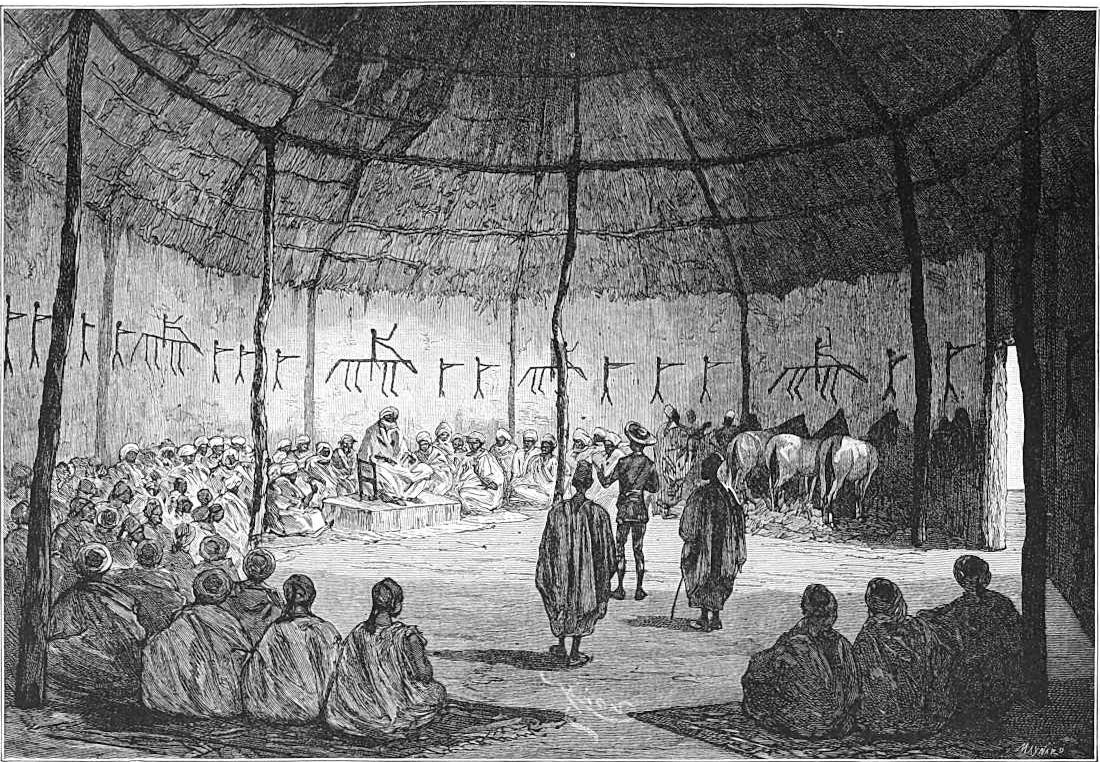
Visit to the Naba of Karaga. Binger, 1888.
Epilogue
Binger’s account suggests that the Mossi states were already in decline during the 19th century, while his expedition itself foreshadowed the colonial partition of Mossi territories in its final decade.
Around the same time, British and German reconnaissance missions from the south converged on the Dagbon and Mamprugu kingdoms in 1896-8, began to intersect with French incursions from the west. The French had already intervened in Yatenga between 1894 and 1895, and subsequently launched a campaign against the kingdom of Wagadugu from 1895 to 1897.
The last ruler of Wagadugu, Naba Wobogo, reportedly told the French officer, Captain Destenave:
“I know that the whites wish to kill me in order to take my country, and yet you claim that they will help me to organize my country. But I find my country good just as it is. I have no need of them. I know what is necessary for me and what I want.”43
The kingdom was occupied in January 1897 and incorporated into what would become modern Burkina Faso. The capital of the modern country remains the old city of Wagadugu (Ouagadougou), where horse races are still held in honour of Princess Yenenga, founder of the northern Mossi Kingdoms.
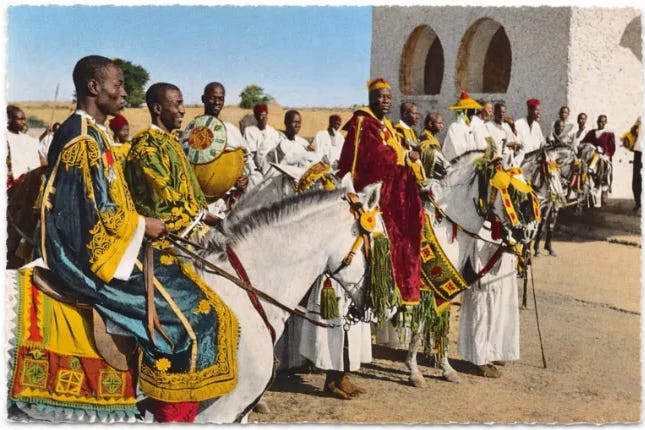
‘L’Empereur des Mossis le Morgho Naba et ses chefs de province’ Ouagadougou, Burkina Faso.
The first Africanists (specialists who study African languages, societies, and history) were not colonial researchers, as is often assumed, but African intellectuals who were actively engaged in the production of knowledge about their own societies.
My Patreon article examines the works of al-Hajj Musa of Zinder (ca. 1870-1930), a pioneering Africanist and ethnographer.
Please subscribe to read about it here and support this newsletter:
For a comparison of Mossi king lists and contemporary written accounts such as the Gonja chronicle, see; Muslims and Chiefs in West Africa: a Study of Islam in the Middle Volta Basin in the Pre-colonial Period. By Nehemia Levtzion, pg 197-201
History of West Africa: Volume One,” edited by J.F.A. Ajayi and Michael Crowder, 1985, pg pg 469
History of West Africa: Volume One,” edited by J.F.A. Ajayi and Michael Crowder, 1985, pg 466
Moogo - L’émergence d’un espace étatique ouest-africain au XVIe siècle by Michel Izard pg 135-145
Timbuktu and the Songhay Empire: Al-Sa’dī’s Ta’rīkh Al-Sūdān Down to 1613 and Other Contemporary Documents, translated by John Hunwick. pg 11-12
Timbuktu and the Songhay Empire: Al-Sa’dī’s Ta’rīkh Al-Sūdān Down to 1613 and Other Contemporary Documents, translated by John Hunwick. pg 38-39
Timbuktu and the Songhay Empire: Al-Sa’dī’s Ta’rīkh Al-Sūdān Down to 1613 and Other Contemporary Documents, translated by John Hunwick. pg 97-98
UNESCO General History of Africa Vol. IV, pg 215
History of West Africa: Volume One,” edited by J.F.A. Ajayi and Michael Crowder, 1985, pg 466
Timbuktu and the Songhay Empire: Al-Sa’dī’s Ta’rīkh Al-Sūdān Down to 1613 and Other Contemporary Documents, translated by John Hunwick. pg 99
The Chronicles of Two West African Kingdoms: The Tārīkh Ibn Al-Mukhtār of the Songhay Empire and the Tārīkh Al-Fattāsh of the Caliphate of Ḥamdallāhi By Mauro Nobili pg 127, 129
Timbuktu and the Songhay Empire: Al-Sa’dī’s Ta’rīkh Al-Sūdān Down to 1613 and Other Contemporary Documents, translated by John Hunwick. pg 106-107, 147
Timbuktu and the Songhay Empire: Al-Sa’dī’s Ta’rīkh Al-Sūdān Down to 1613 and Other Contemporary Documents, translated by John Hunwick. pg 146, 150, 239
UNESCO General History of Africa, Vol. IV, pg 214-220
History of West Africa: Volume One, edited by J.F.A. Ajayi and Michael Crowder, 1985, pg 469-470. Muslims and Chiefs in West Africa: a Study of Islam in the Middle Volta Basin in the Pre-colonial Period. By Nehemia Levtzion, pg 85-86
Moogo - L’émergence d’un espace étatique ouest-africain au XVIe siècle by Michel Izard pg 42-46
Moogo - L’émergence d’un espace étatique ouest-africain au XVIe siècle by Michel Izard pg 34-46
UNESCO General History of Africa, Vol. IV, pg 221-225
History of West Africa: Volume One, edited by J.F.A. Ajayi and Michael Crowder, 1985, pg 470
History of West Africa: Volume One, edited by J.F.A. Ajayi and Michael Crowder, 1985, pg 471
History of West Africa: Volume One, edited by J.F.A. Ajayi and Michael Crowder, 1985, pg 472
History of West Africa: Volume One, edited by J.F.A. Ajayi and Michael Crowder, 1985, pg 473
Muslims and Chiefs in West Africa: a Study of Islam in the Middle Volta Basin in the Pre-colonial Period. By Nehemia Levtzion, pg 124
Muslims and Chiefs in West Africa: a Study of Islam in the Middle Volta Basin in the Pre-colonial Period. By Nehemia Levtzion, pg 197
History of West Africa: Volume One, edited by J.F.A. Ajayi and Michael Crowder, 1985, pg 473. La formation de Ouahigouya. By Michel Izard, pg 151-152
La politique extérieure d’un royaume africain: le Yatênga au XIXe siècle by Michel Izard pg 363-365
History of West Africa: Volume One, edited by J.F.A. Ajayi and Michael Crowder, 1985, pg 474-475
History of West Africa: Volume One, edited by J.F.A. Ajayi and Michael Crowder, 1985, pg 475-476
Les Yarse du royaume de Ouagadougou: l’écrit et l’oral (The Yarse of Wagadugu Kingdom: Written and Oral Sources) by Anne-Marie Duperray pg 180-186. Muslims and Chiefs in West Africa: a Study of Islam in the Middle Volta Basin in the Pre-colonial Period. By Nehemia Levtzion, pg 89-90
The Growth of Islamic Learning in Ghana by Ivor Wilks pg 416
Muslims and Chiefs in West Africa: a Study of Islam in the Middle Volta Basin in the Pre-colonial Period. By Nehemia Levtzion, pg 104-105
Muslims and Chiefs in West Africa: a Study of Islam in the Middle Volta Basin in the Pre-colonial Period. By Nehemia Levtzion, pg 106-109
La politique extérieure d’un royaume africain: le Yatênga au XIXe siècle by Michel Izard pg 370-372. Late Nineteenth-Century Military Technology in Upper Volta by Myron J. Echenberg
UNESCO General History of Africa, VI pg 672-676. La politique extérieure d’un royaume africain: le Yatênga au XIXe siècle by Michel Izard pg 373
Du Niger au golfe de Guinée par le pays de Kong et le Mossi, tome 1 (de 2)” by Capitaine Binger, 1892, Project Gutenberg, pg 459, 502
Du Niger au golfe de Guinée par le pays de Kong et le Mossi, tome 1 (de 2)” by Capitaine Binger, 1892, Project Gutenberg, pg 462
Du Niger au golfe de Guinée par le pays de Kong et le Mossi, tome 1 (de 2)” by Capitaine Binger, 1892, Project Gutenberg, pg 486-489, 499
Du Niger au golfe de Guinée par le pays de Kong et le Mossi, tome 2 (de 2)” by Capitaine Binger, 1892, Project Gutenberg, pg 38-39.
Muslims and Chiefs in West Africa: a Study of Islam in the Middle Volta Basin in the Pre-colonial Period. By Nehemia Levtzion, pg 125, 9
Muslims and Chiefs in West Africa: a Study of Islam in the Middle Volta Basin in the Pre-colonial Period. By Nehemia Levtzion, pg 127-128
An early British report of 1898:
“The king of Gambaga is a fetish king and must remain in his town which is called Nalerigu. The inhabitants are partly fetish and partly Mahommedans. As is always the case, the Mahommedans are the leading party. Their headman is the imam of Gambaga, Baba. He is virtually the ruling power though he always makes a great point of referring matters to the king.”
Muslims and Chiefs in West Africa: a Study of Islam in the Middle Volta Basin in the Pre-colonial Period. By Nehemia Levtzion, pg 131
Du Niger au golfe de Guinée par le pays de Kong et le Mossi, tome 2 (de 2)” by Capitaine Binger, 1892, Project Gutenberg, pg 66
UNESCO General History of Africa, Volume VII pg 3-4
Thanks you for this article. I like that you focused on these indigenous Kingdoms that tend to get overlooked and where organized and existed 1000 years before Islam came in to replace a somewhat similar but more Ancient religion in the Sudan that went as far west and South. It was eventually called "Amun-Ra" or "Amen -Ra." and the people were called Sa-Ra. People of the one God a Religion that eventually went to the upper Nile and into West Africa past Lake Chad. I think the Dogon may have been an off shoot of it and the Kushites took on the religion. Also another reason why the Trans Saharan Slave Trade was over exaggerated before 1400 AD as these Southern people below the Sudan were well organized and could defeat raiders coming from above the Senegal River and Sahel and they would be servants for them Lol