

The ancients did not conduct trade through ‘dumb barter’.
One of the oldest accounts of cross-cultural trade in history comes from Herodotus’ description of “silent trade” between the Carthaginians and aithiopians somewhere on the northwestern coast of Africa “beyond the Pillars of Hercules” (Strait of Gibraltar) in the 5th century BC.
According to Herodotus, the Carthaginians brought their goods to a beach, away from towns and villages, deposited them, and withdrew. The Aithiopians then appeared, placed their gold alongside the goods, and left. The Carthaginians returned and took the gold if they considered its value sufficient; if not, they adjusted their offering and withdrew again, awaiting the response of their trading partners.1
About a thousand years later, on the other side of the continent, the Greek sailor Cosmas Indicopleustes (c. 550 CE) describes a similar trade custom, only this time conducted between two groups of “aithiopians” somewhere in the Ethiopia-Sudan borderlands.
In his account, a caravan organised by the aithiopians of Aksum travels to the enigmatic land of Sasu for gold. The Aksumite merchants would lay out their iron, salt, and beef, afterwhich, the people of Sasu would bring their gold and retreat, both sides adding to the quantity of the products until a satisfactory trade was reached.
According to Cosmas, “Such is the mode in which business is transacted with the people of that country, because their language is different and interpreters are hardly to be found. The facts which I have just recorded fell partly under my own observation and partly were told me by traders who had been to those parts.”2
Modern scholarship has cast doubt on similar descriptions of ‘silent trade’ throughout history, all of which are based on second-hand information.
Variations of the story have been repeated in accounts of trade from different parts of the world and across different historical periods, perhaps a clearer indication of the story’s inherent fascination than of its accuracy.3
It now appears unlikely that this extreme level of impersonality in trade actually ever occurred.
In his comprehensive account of cross-cultural trade in world history, Philip Curtin argues that:
“The empirical evidence for any of these accounts is extremely weak.
In a loose sense a present-day auction is “silent” when the bidder accepts a price with a nonverbal indication. Many nonverbal signals are used in face to-face bargaining in many cultures, but this is not the same as the no contact, cross-cultural trade found in Herodotus’s account.
And Herodotus’s model, taken full strength, is improbable on the face of it. To bargain with such elaborate avoidance, yet to assume that total strangers will act with honesty and good faith, calls for an unusual degree of cross-cultural understanding from both parties - and to believe it requires unusual credulity from the reader.”4
Herodotus never visited the region of northwest Africa where he claimed such exchanges occurred.
The Carthaginians, from whom he obtained the information, record that regular markets and towns were established in the region. One such market was called Kerne/Cerne, which first appears in the Periplus of Hanno the Navigator, an account of his voyage down the Atlantic coast of Africa in c. 500 BC.
Before sailing south to establish a market at Kerne, the Carthaginians befriended a local nomadic group near the coast known as the Lixitai/Lixitae who served as their interpreters. In the interior of the Lixitae lived a group of “inhospitable” aithiopians who were also herders.5
Kerne reappears in the Periplus of Pseudo-Scylax (c. 4th century BC) as a market town where the Carthaginians brought “Unguents, Egyptian stone, and Attic pottery” in exchange for ivory, leopard skins and cattle from the “long-haired” aithiopians in the interior. These aithiopians also made wine, which the Phoenicians exported, and possessed a large city, to which the Phoenician traders sailed.6
Leaving aside debates over the veracity of these accounts and the location of Kerne,7 they suggest that trade between the Carthaginians and the Aithiopians of northwest Africa was much less impersonal and more sophisticated than Herodotus claimed it to be.
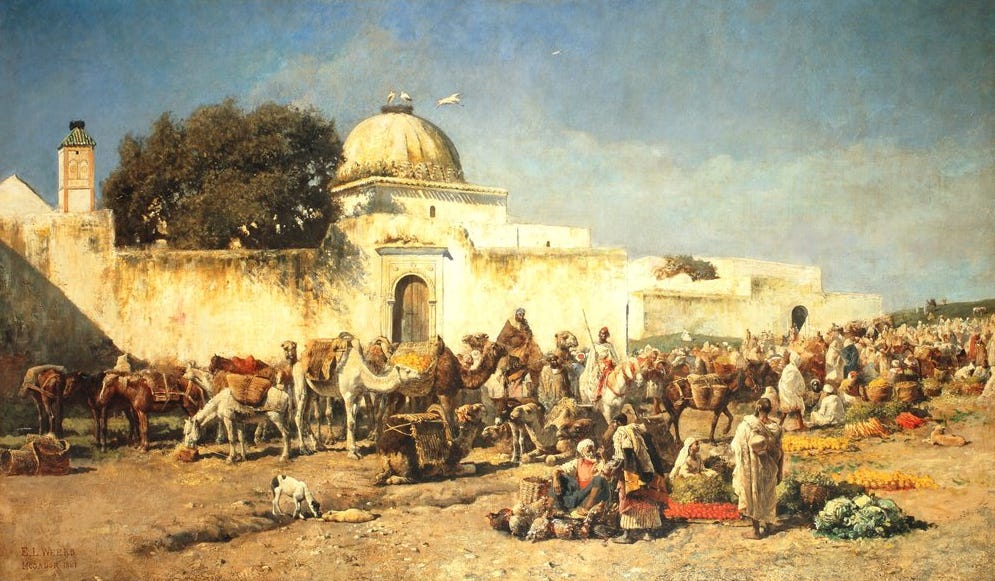
Market Scene at Mogador, Morocco, 1881, by Edwin Lord Weeks. The coastal port town of Mogador was the southernmost market known to the Carthaginians and was home to a factory for producing purple dye set up by King Juba II of Mauretania in the 1st century BC.8
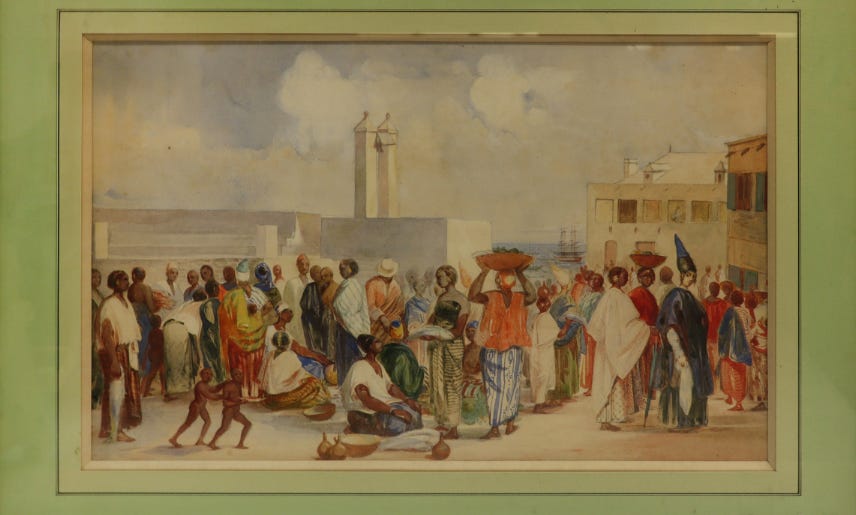
Market scene in Gorée, Senegal. ca. 1842-1867. Quai Branly. Goree is the first deep-water natural harbour encountered when sailing down the West African coast.
As Curtin explains, cultural differences between trading communities create acute problems of trust, which can only be overcome through the establishment of personal ties between the two groups.
Rather than encouraging impersonal exchanges, these conditions favour the emergence of “trade diasporas”, in which commercial specialists from one cultural group settle in the important markets and towns of another, serving as intermediaries and brokers.9
In this way, all continuing exchanges, however great the cultural distance, were mediated by personal ties.
Some well-documented examples of trade diasporas in pre-colonial Africa include the Wangara, Hausa and Swahili, whose languages became the lingua franca used along major long-distance networks.
In the Roman period, inscriptions obtained from the fort of Bu Njem (about 200km south of the coast in N.W. Libya) indicate that it was a major terminus for desert caravans from across the Fezzan (S.W. Libya) to the Nile Valley during the 3rd century CE.10
Several ostraca document how Roman soldiers were dispatched to a customs house (statio camellariorum) to collect taxes from Garamantian camel drivers who brought a variety of trade goods including barley, mules, and donkeys from the Fezzan.
Particularly interesting is the fact that measures of the imported goods are often cited in native languages. The Roman garrison also made use of the transport services offered by the Garamantians and travelled to their territory in Garama/Jarma, likely to serve as interpreters and merchants.11
Thus, the many opportunities for personal contact and continuous interaction created an environment of trust and familiarity that stimulated economic exchanges between the Romans and the Garamantians.
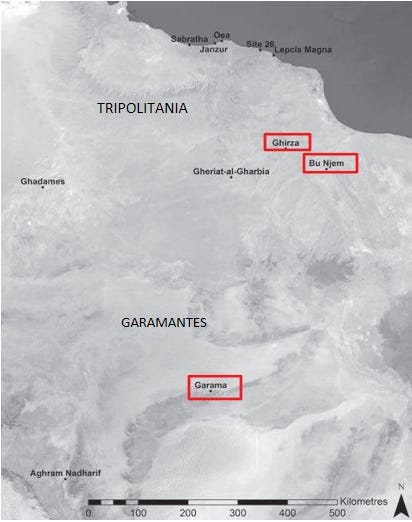
Some of the sites mentioned. Map by Martin Sterry
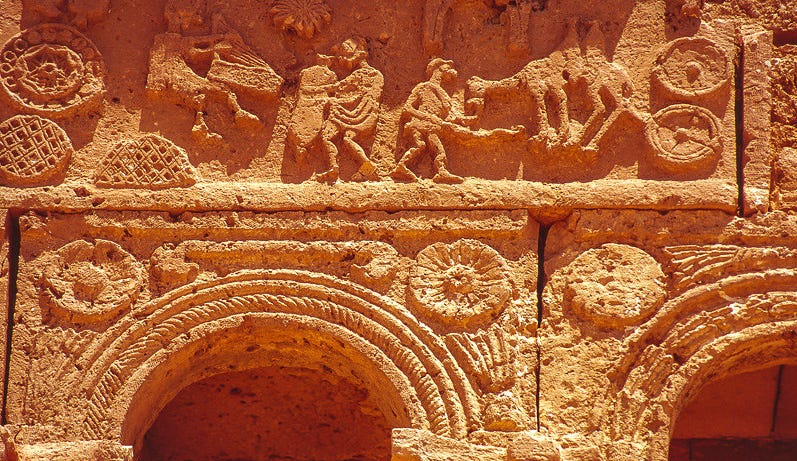
‘Ghirza - Nécropole nord, tombe B’. Flickr Image by Jacqueline Poggi. It depicts a camel loaded with four amphorae and a man unloading a large amphora. Ghirza was a 2nd- 5th-century Roman settlement in Libya north of Bu Njem.
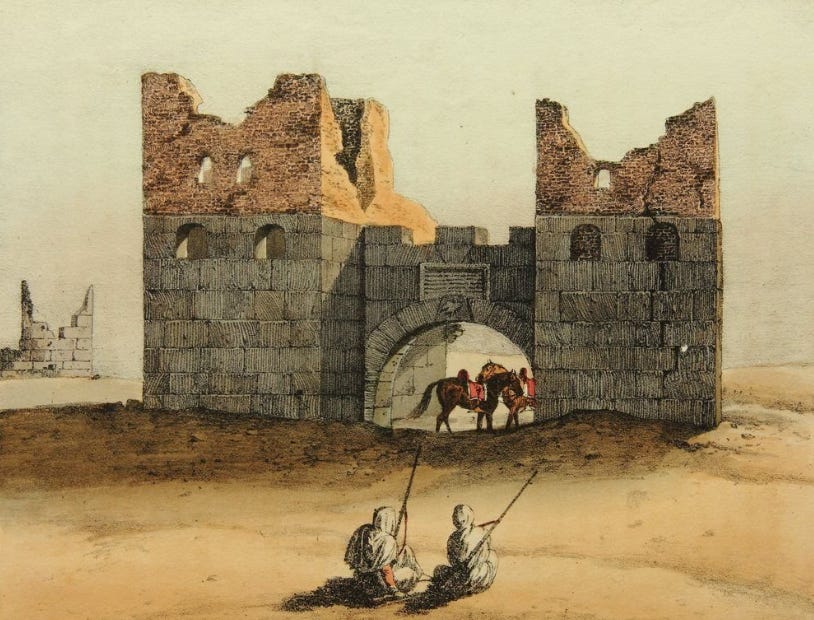
Ruins of Bu Njem by George Francis Lyon, 1819.
Yet even the absence of a shared trading language did not result in impersonal exchange.
For example, the port town of Berbera in present-day Somaliland was described by a visitor in 1849 as a modern version of the Biblical tower of Babel: “…as in languages; no chief is acknowledged, and the customs of bygone years are the laws of the place.”
At the height of the trading season, the market at Berbera had a floating population of over 20,000. Sailors from Yemen, merchants from the Persian Gulf, and wealthy Banias from India gathered to trade with Somali caravans from the interior, and transformed this ancient market into “a perfect Babel in confusion.”12
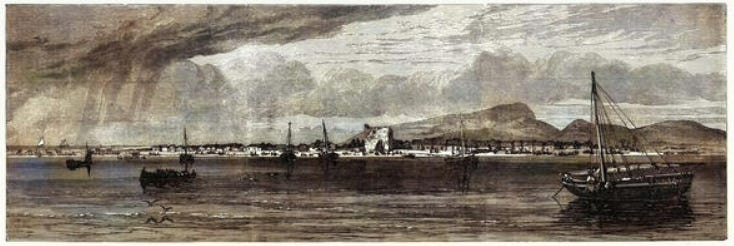
‘Berbereh, on the coast of Africa, opposite Aden’. Illustrated London News, 1868.
The commercial diversity and complexity of trade in Berbera was by no means a new feature of this coastline.
Centuries earlier, the Romans had traded extensively with this part of Africa, which they called Arômatophora; the “Spice-bearing Country”.
The northern Horn of Africa was located in a key strategic position connecting the Indian Ocean and the Mediterranean world, and it had extremely valuable resources, including frankincense, myrrh, cassia, and cinnamon.
Classical sources indicate that at least six emporia sprang up along the coast of northern Somalia where caravans from the interior brought large quantities of aromatic resins and spices to be loaded onto ships bound for Egypt.
Small communities of resident foreign merchants brokered exchanges of these African commodities for Roman imports, including glass, amphorae, and wine.
Local “Barbaroi” traders also transported the same spices in their own vessels to markets in South Arabia. In later centuries, this “spice-coast” came under the commercial and political orbit of the Aksumite Empire.
Archaeological evidence for this ancient spice trade has been known since the late 19th century, and has since been expanded with recent discoveries of Roman material remains, ruined structures of camp sites, and monumental stone tombs belonging to elite individuals in the ancient society of the Somali coast.
My latest Patreon article examines the historical and archaeological evidence for the ancient spice trade of the Northern Horn of Africa.
Please subscribe to read about it here:
Herodotus, Histories, 4.196
Christian topography of Cosmas, an Egyptian monk. By John Watson McCrindle, pg 54
Silent Trade: Myth and Historical Evidence, by P. F. de Moraes Farias
Cross-cultural trade in world history by Philip D. Curtin, pg 13
Line 6-8 in ‘Three Ancient Geographical Treatises in Translation’ by Duane W. Roller pg 18-20)
Itineraria Phoenicia by Edward Lipiński, pg 463-464. Pseudo-Skylax and the Natural Philosophers by D Graham J Shipley
According to Lipiński, these “Ethiopians” of Pseudo-Scylax are the inhabitants of western Morocco, either Phoenicians settled at the time of the first Phoenician expansion in the 8th-7th centuries B.C., or native Libyco-Berbers. The “big city up to which the Phoenicians sail” is most likely Lixus, and the wine producers are probably the Lixitae and the inhabitants of Arambys. Wine certainly plays a role in the exports of ancient Morocco and Strabo alludes to the vintages of this region, where the ancient names of the Cape Spartel are quite suggestive. A bunch of grapes is even a typical motive represented on coins from Lixus.”
That aithiopians (i.e; “black Africans”) were found in South-Western Morocco is indicated by various sources describing the native mauri of North-West Africa from Late Antiquity and in the early Islamic period around the city of Sijilmasa that are briefly outlined in my previous essay.
The World of Juba II and Kleopatra Selene by Duane W. Roller pg 116-117
Cross-cultural trade in world history by Philip D. Curtin
New perspectives on the Roman military base at Bu Njem by Anna H. Walas
Rome and the Worlds Beyond Its Frontiers, by Daniëlle Slootjes, M. Peachin, pg 105-108. Trade in the Ancient Sahara and Beyond, edited by D. J. Mattingly, pg 272-273
Memoir on the Western or Edoor Tribes, by C. J. Cruttenden, The Journal of the Royal Geographical Society of London, 1849, 19 (1849), p. 49-76