

Textile production was typically the most important element in the preindustrial manufacturing sector throughout the world.
In the region of southern Nigeria, sophisticated textile industries showing signs of proto-industry emerged during the early modern period, creating an “artisan class” of specialists in spinning, weaving, dyeing, and embroidery.
The textile trade among the kingdoms of southern Nigeria was exceptionally complex, as the region was one of several in Africa that exported its own cloth to European traders while also importing European textiles, at times within the same transactions.
People, ideas, and items of regalia all circulated among the kingdoms in the region, as did craftsworkers and their skills. Cloth dyeing, embroidery, and fashion styles were highly developed and varied, producing some of Africa’s best-known textile traditions.
Since the 16th century, visitors frequently remarked on the scale of local textile industries, the complexity of the cloth trade, and the quality of West African cotton cloths, which ‘far excel the prints and homespuns of Manchester’ and survived the onslaught of cheap industrial imports.
This article examines the history of the textile industry in pre-colonial southern Nigeria from the end of the Middle Ages to the early colonial period.
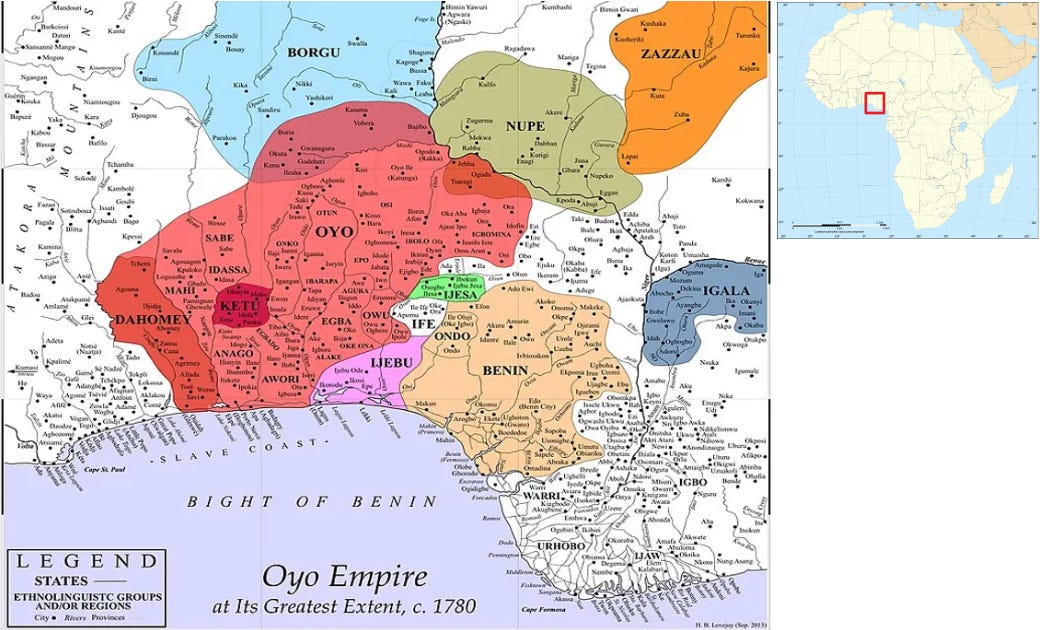
Southern Nigeria in the 18th century. Map by Paul E. Lovejoy
Support AfricanHistoryExtra by becoming a member of our Patreon community; subscribe here to read more about African history, download free books, and keep this newsletter free for all:
The cloth Trade in pre-colonial Southern Nigeria.
Trade in cotton textiles appears in the earliest historical accounts of the kingdoms of southern Nigeria.
The Portuguese captain Pacheco Pereira, who made four visits to the Edo city of Benin in the 1490s, noted a market center on the Forcados River, where goods included cotton cloths.1 These were exchanged for copper manillas, which were used to make the famous brass plaques.
By 1505, the factor at the newly established Portuguese trading post at Ughoton, north of the Forcados and about thirty miles inland, was purchasing local textiles regularly, some of which were exchanged for gold at Elmina on the Gold Coast (Ghana) and re-exported inland. In that year alone, he bought 1,816 locally woven cotton cloths.2
The Yoruba kingdom of Ijebu-Ode was another of the earliest textile-producing and hulking (distribution) centers noted specifically by European traders along the Bight of Benin.
A Portuguese document of 1519 records the dispatch of cloth to the Gold Coast, which was levied as tax on traders operating between São Tomé and Benin on the mainland, some of which are described as being “of Jabu.”3
Along the coast of southern Nigeria up to the Gold Coast (Ghana), there was a regional system of exchange that was handled by African mariners who plied the river systems, lagoons, and sea routes between Lagos and Accra.
[See my previous essay on ‘Seafaring, trade and travel in the African Atlantic.’]
What was new was the intercontinental scale of these commercial operations. Portuguese caravels built for ocean winds and currents expanded this pre-existing trade and were able to connect regional West African markets with the Indian Ocean and Atlantic systems.
“Cloth made of cotton wooll very curiously woven” from Benin was included in the goods bought in the city by the English trader James Welsh in 1591, as well as pepper, ivory and palm oil. Another trader remarked on the attractive, multicolored and patterned cloths sold in Lagos in 1603, probably the product of inland Yoruba looms.4
In 1659, a German merchant was gifted two dyed cotton robes by the king of Allada, one of them belonging to his own collection, and the other one customarily presented by the king to a nobleman or knight.
However, the visual and technical features of these robes make it very difficult to link them firmly to any specific well-known textile traditions. Some scholars suggest they were made in Allada itself, with influences from the interior, while others argue that they were made further inland before being traded at the coast.5
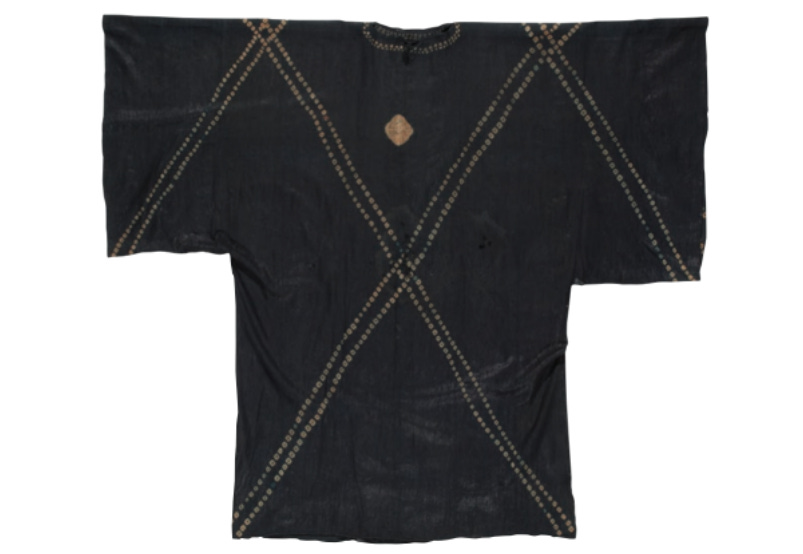
Indigo resist tunic from the Togo and Republic of Benin border zone, before 1659, cotton, Height: c. 142 cm, back upper part: c. 162 cm, bottom width: c. 87 cm, Ulmer Museum—Weickmann Collection. Ulmer Museum, Ulm, Germany6
In the early 17th century, cotton textile exports from Benin and surrounding areas were regularly being bulked and shipped to other ports on the West African coast. Wrappers were classified according to the number of individual woven breadths that were included per entire cloth.
Dapper’s report mentions two major products of Benin looms, each a wrapper of different size: one made up of three breadths of cloth, the other made up of four breadths of cotton dyed indigo blue or patterned with blue-and-white stripes. The latter, called mouponoqua (ukpon nokhua, or big cloth), was approximately 5 to 6 feet long by 4 1/2 feet wide.7
Textile exports from Benin and Yorubaland competed very well against foreign cloth in the coastal trade in both cost and quality, and were more profitable for many European traders than their own textile trade.
Whereas European textiles sold on the Guinea Coast for just under twice their cost, merchants sold native cloths from Benin and the Cape Verde Islands for up to three or four times what they had paid for them.8
A few of the written sources describe the specific regional market preferences that structured this trade: striped cloths were exchanged for gold dust on the Gold Coast, while indigo-blue cloths were most desired in Gabon and Angola.9
Barbot’s account mentions that the Portuguese brought blue cotton from Benin to Luanda (Angola), which were known to the Edo as Mouponoqua, and to the Portuguese as Panos de regatto de Berre “they are five cloths together, and a yard and a half, or two yards broad.”10
Textiles from Benin and Yorubaland were hulked and sorted to be shipped to ready markets along the West African coast and as far away as the West Indies and Brazil. Some Ijebu cloth was carried by Portuguese vessels to Brazil.
Benin cotton cloth was of such high quality that the Dutch tried (ca. 1717) to sell it in Europe, but it was not broad or long enough for European tastes. Later in the 18th century, merchants from the French port city of La Rochelle successfully marketed Benin cloth in France and the New World, where it was used for summer petticoats.11
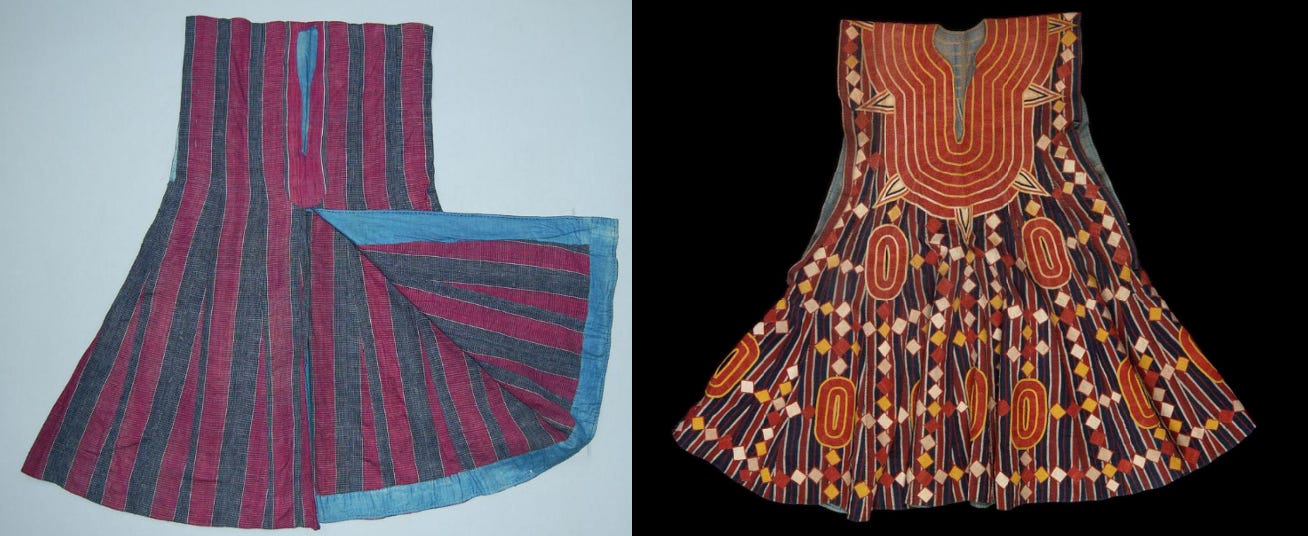
(left) Sleeveless tunic, formed from about 26 strips of handwoven cloth, using handspun white and indigo-dyed cotton, and imported magenta alaari silk. 1874-8, Yoruba, Lagos, Nigeria. British Museum No. Af,+.2070. (right). Cotton Tunic Made of sewn panels of blue, red, and white stripes. Late 19th century, Yoruba or Fon artist. Abomey, Dahomey, Benin. Quai Branly 71.1936.21.103
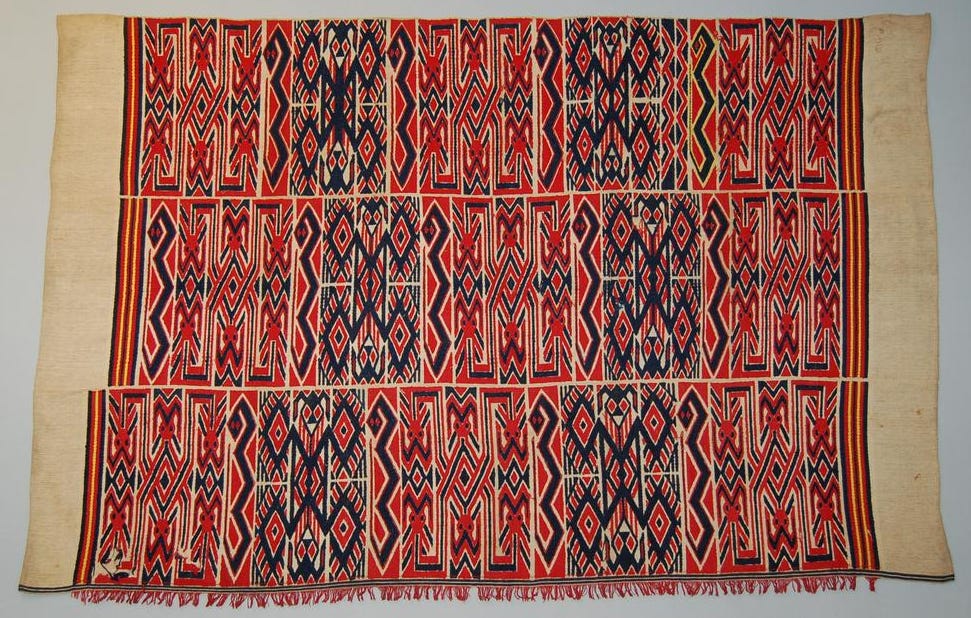
Wrapper; title cloth (aso olona); composed of three panels hand-sewn together. Natural handspun cotton warp and weft with grey cotton warp stripe. Supplementary weft float patterns in imported red-, yellow- and dark indigo-dyed cotton with densely worked patterns of snakes, frogs and crocodiles. Each panel ends with band of weft stripes in red-, indigo- and yellow-dyed cotton. Fringed red cotton border woven in along one side. Worn as title cloths for members of the Oshogbo society. c. 1820-1880, Yoruba, Ijebu Ode, Nigeria. British Museum 2018,2036.106.
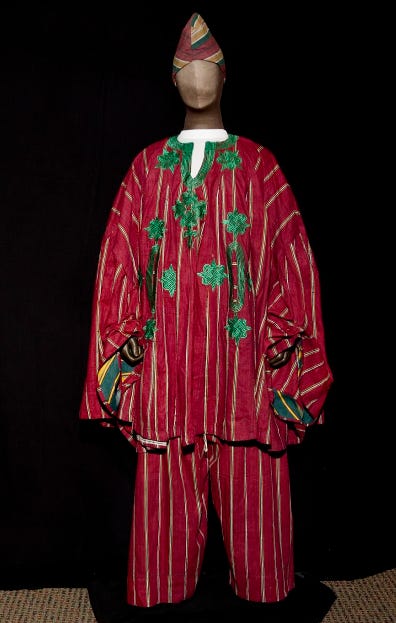
Chief’s Garment. Yoruba, Nigeria. Anacostia Community Museum, Smithsonian Institution.
One set of market prices from the Gold Coast illustrates how several types of Benin cloth fared in competition with exports from Allada and the Ivory Coast:
Both Allada cloth and Quaqua cloth from Ivory Coast were worth 5 brass manillas, while three varieties of Benin cloth were available at different price ranges: 3-bread cloth was worth 3 brass manillas; blue-dyed 5-breadth cloth was worth 7 brass manillas; and Benin calde cloth was worth 12 brass manillas.12
Available figures for the volume of textile exports during the 17th and 18th centuries give only fleeting glimpses, but they are impressive.
In 1633–34 the Dutch alone imported about 12,641 pieces of Benin cloth into the Gold Coast; another 16,000 pieces in 1644–46. According to Ryder, the English traders exported from Benin to the Gold Coast “at least as many” cotton cloths as the Dutch did during the same period.13
Like their Indian and European counterparts, demand for Benin cloth in the Gold Coast markets fluctuated greatly, according to data from Dutch exports. It fell to a few hundred cloths in the late 17th century, before briefly recovering in the early 18th century, although to relatively modest levels compared to the mid-17th century.14
Cloth became a form of currency in Benin’s international trade since the 16th century. The Oba (King) insisted on valuing imported goods and taxes paid by visiting European merchants in terms of Benin cloth, long after demand on the Gold Coast had fallen due to competition from local cloths and civil war in Benin.15
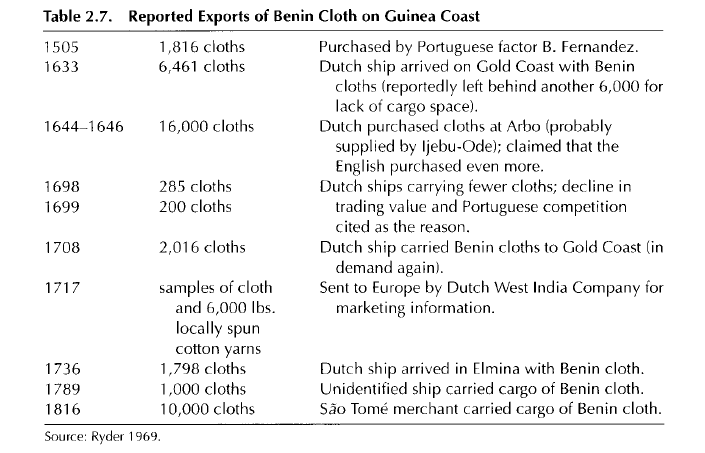
The Dutch factory at Arbo was able to attract cloth from areas outside the Benin kingdom: Ijebu in particular supplied large quantities. According to Dapper, some cloths came from a place named Koffo (possibly the Nupe market of Kulfo) which he understood to lie one day’s journey east of Benin City.
This would accord with Father Monteleone’s information around 1689 that some of the cloths sold by Benin traders came from “other kingdoms three hundred or more miles inland.” Such market expansion may have had a significant impact on the textile workshops in Benin, Ijebu-Ode, and their environs.16
Kulfo (or Koolfu) was later mentioned by Hugh Clapperton in 1826 as “the principal town for trade in Nyfe [Nupe]” with a large market into which cloth from the west, ie Yorubaland, was imported. The most expensive cloth, called Azane was worth 3,000 cowries and measured 6x2 yards, while the slightly less expensive “Jabbo cloth” from Ijebu was about the breadth of European sailcloths.17
In 1603, the German trader Josua Ulsheimer mentions that the Dutch visited the town of “Lago” (i.e. Lagos) in 1603, and noted the availability there of “beautiful cotton cloths” brought from inland.
In ca. 1618, a Portuguese naval officer complaining of Dutch activities on the West African coast mentions Benin and Jabu (Ijebu) as one of the places from where cloth and cotton were bought.18
In 1620, a separate Portuguese account mentions the kingdom of ‘Xabu’ from which they bought “many cotton cloths of very curious patterns, which are worn by the people of the island of Sao Thome, and go from there to other places.”
Olfert Dapper’s report, published in 1668 but based on information from the 1640s or 1650s, stated that the Dutch purchased cloth at the village of “Kuramo” (i.e. Lagos) on the “Rio Lagos,” for resale on the Gold Coast.19
In 1682, an English factor visiting Apa, a coastal town in the east of the Allada kingdom, noted that cloth was brought there along the lagoon from “Boneen” (i.e. Benin), and in 1723 English traders at Whydah reported that the cloth sold there came from “Lucamee” (i.e., Olukumi, or Yorubaland).
“Jaboe cloths” from Ijebu are included among the wealth left by governor Richard Brew of Anamabu, who died in 1776, indicating that the textile trade from the region to the Gold Coast continued well into the late 18th century.20
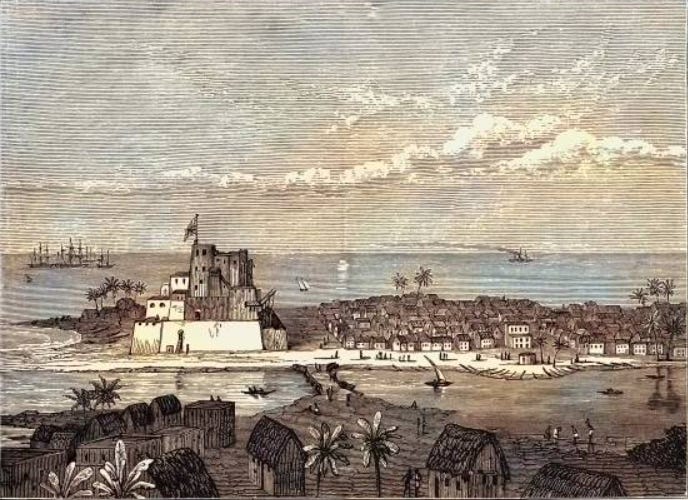
Fort of Elmina on the Gold Coast, c. 1850.
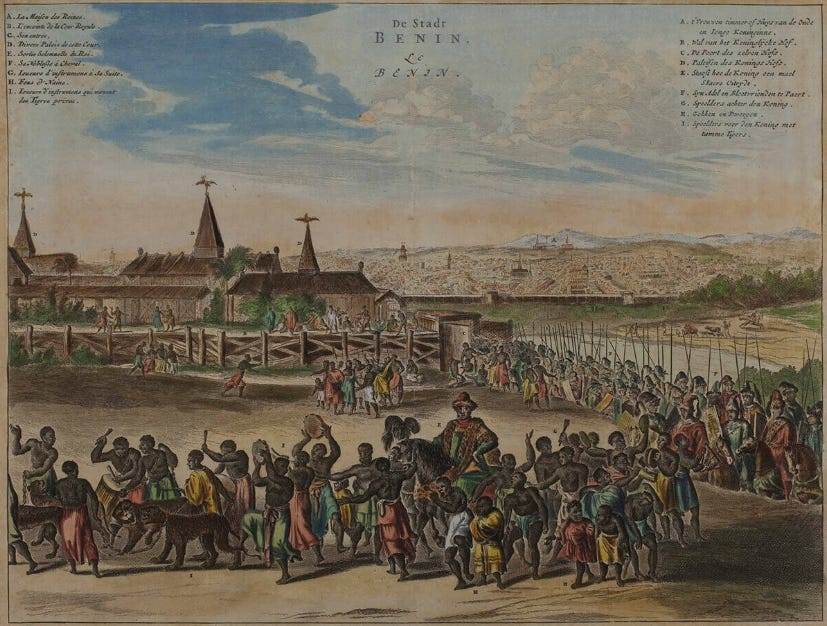
View of the city of Benin. Published in Olfert Dapper, “Description of Africa”, 1686.
The volume and complexity of the trade induced innovations in its organization.
Besides intensifying long-distance trade within the Benin region, the great demand for cloth also helped to develop the system of “trust”, or credit-trading, as a characteristic feature of European commerce in Benin.
Initially, the Oba of Benin extended credit to Portuguese traders who did not have the necessary goods to exchange for the cotton cloths. With the expansion of trade in the 17th century and the takeover by Dutch and English traders, the extension of credit moved in the opposite direction.
Father Monteleone (c. 1689) explained that “the cloths are not found ready made, but they (i.e. the traders) take goods on credit, and with these goods they have the cloth made in five or, at the most, six months.”21
At the Gold Coast, 17th-century reports observed that high officials wore “King’s garments” which were elaborately brocaded and cut-pile ceremonial shoulder cloths of the ljebuOde or their Benin counterparts.
Van Nyendael praised the textiles woven in Benin, singling out especially the ones worn by elite women. He described their locally made wrappers as “very fine” and “very beautifully chequered with several colours.” Included in his comments on dress was a reference to “a great painted cloath woven here, which they wear like a cloak.”22
The market for textiles was thus already well developed when international commerce opened up on the Bight of Benin during the 16th century, and European merchants had to adapt to this existing market.23
The reason that the very areas that produced large quantities of cloth were the same as the regions that imported it is that the market for cloth in those areas was well developed by the extensive local production.
Consumers here were already familiar with an impressive array of cloth types-plain and patterned, small and large-made of different kinds of threads, structures, and fibers. They had specific tastes and were careful to inspect merchandise thoroughly before striking a deal.24
Merchants’ records are replete with complaints and admonitions about changes in supply and demand for this or that item. Requests made by European factors for specified textile products known to sell well at a certain time reflected trends and tastes in consumer demand that differed from one port to another and among different classes of people.
As one 17th-century account noted about the consumer on the Gold Coast: “at one moment they like this new fashion, at another moment that; and whatever appeals to them at a particular time they must have .... This is why so many goods remain unsold and are sent back to Europe at great loss.”25
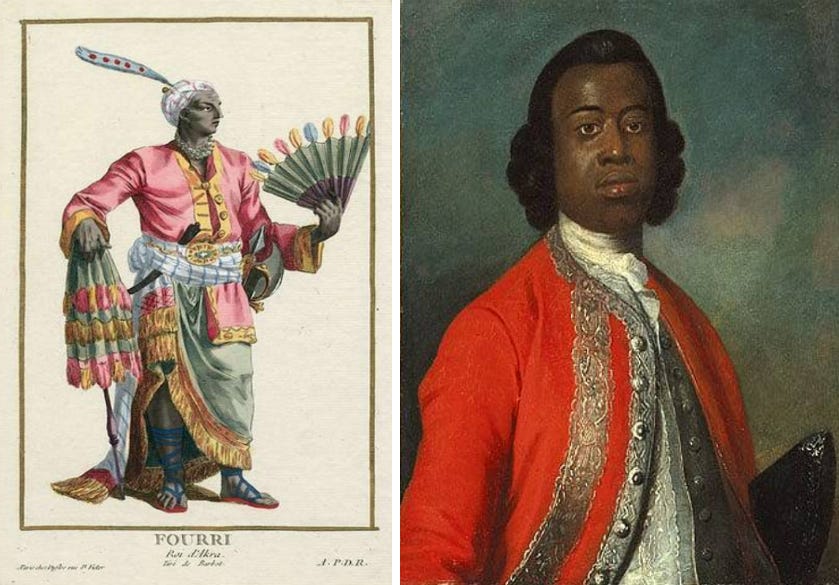
(left) Fourri, Roi d’Akra, (Fourri, King of Accra), Ghana, ca. 1780. (right) Portrait of William Ansah Sessarakoo, son of Eno Baisie Kurentsi (John Currantee) of Anomabu, Ghana (fl. 1736-1749).
Some of the imports closely resembled local cloth in color and pattern.
Imported linens were often the natural beige color of the fiber, while cottons from overseas were usually plain (muslins, undyed calicos, or salempors), dyed (haft or kannekins), or loom-patterned stripes and checks (such as ginghams and nicanees), as were the standard varieties of locally woven country cloth.26
Guinea cloth became a generic term for the cotton cloths woven in India and preferred by many consumers on the Guinea Coast. Painted and printed cottons (chintz) made in northwestern and south-eastern India and exported from Surat were highly prized, as were batiks (cloths patterned by wax resist), and handhani/bandanna tie-dyed silk fabrics from across South East Asia.27
Imported textiles were for the most part preselected to conform to established tastes and cultural values. European merchants quickly learned that adherence to such matters of taste was crucial if there was to be any successful trading.
For example, attempts by England’s Royal African Company to have English weavers copy certain types of these Indian-made Guinea cloths met with failure, since consumers in West Africa could easily spot the difference and consistently refused to buy the European imitations.28
Scarlet wool cloth imported from Europe was unraveled by Yoruba cloth makers; the bright red thread was then rewoven into ceremonial cloths-some for display at funerals, others to be worn as masquerade costumes representing ancestors.
In Benin, imported red wool was quickly absorbed into Edo culture, where the court closely monitored its use. A report from 1668 described the uniforms of the kingdom’s military officers as made of imported scarlet cloth.
Members of Benin’s royal weavers’ guild recounted that in the past it was their prerogative to weave a cloth reserved exclusively for the king-a complex fabric woven with bast threads, spun from the processed bark of the ighwian tree, and embellished with brocaded imagery in multicolored wool.29
John Adams's account from 1823 noted that cloth from the kingdom of Ijebu (Jaboo), whose subjects are described as an “agricultural and manufacturing people”, was purchased by traders from Lagos and for sale along the coast, and by the Portuguese for export to Brazil.
He also mentions that “The cloth manufactured in Hio [Oyo] is superior, both for variety of pattern, colour, and dimensions, to any made in the neighbouring states..” And noted that the coastal polity of Ardrah (Porto-Novo), which paid tribute to Oyo in cloth, also manufactured its own cotton cloth “into which they frequently weave threads taken from the red India silk taffity.”30
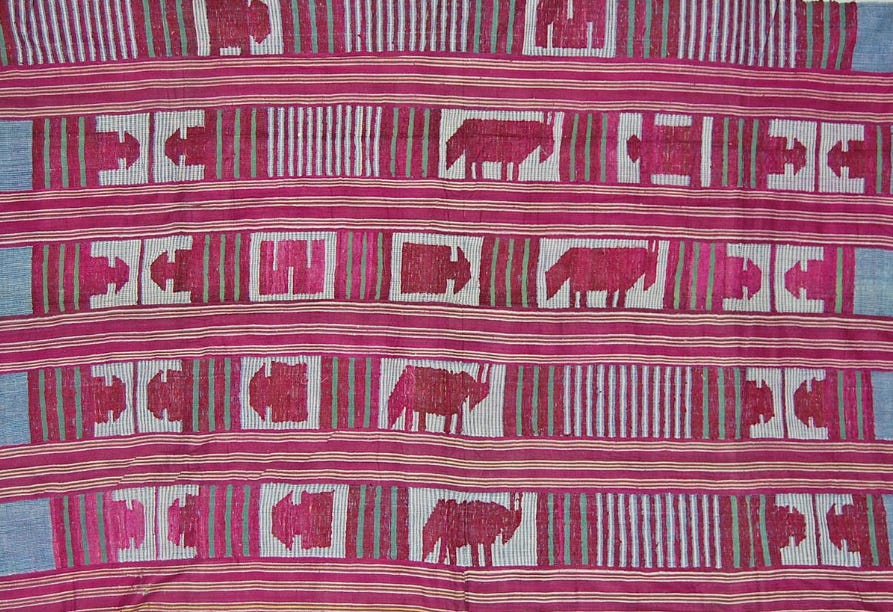
Cloth composed of 10 hand plain woven cotton and silk narrow strips hand sewn together. Decorated with blocks of supplementary weft decoration forming stripes and geometric shapes and animal figures. c. 1880-1913. Yoruba, Nigeria. British Museum, no. Af1934,0307.140
Changes in regional political landscape and international trade in the 19th century resulted in the emergence of new centers of cloth production such as the town of Akwete in Igboland.
The weavers of Akwete capitalized on their geographical location and longstanding trading relations with wealthy oil traders in the Niger Delta towns of Old Calabar and Bonny, who acquired a taste for certain kinds of both local and imported luxury cloth.31
Oral traditions in Akwete attribute its 19th-century textile industry to a woman trader named Dada Nwakata, who invented new weaving designs using both local and imported threads.
Examples of the much wider, more heavily patterned Akwete cloths began appearing in European museum collections in the late 19th century, having been acquired by British merchants during the 1880s and 1890s, indicating that the new textile form was established around midcentury or perhaps earlier.32
The innovation of these new products was aided by the incorporation of imported, machine-made yarn, and represented the final stage of development for this ancient industry.
By the late 19th/early 20th century, Akwete cloths were made entirely of yarn imported from Europe, which substantially increased industrial productivity while offering a broader range of colors.
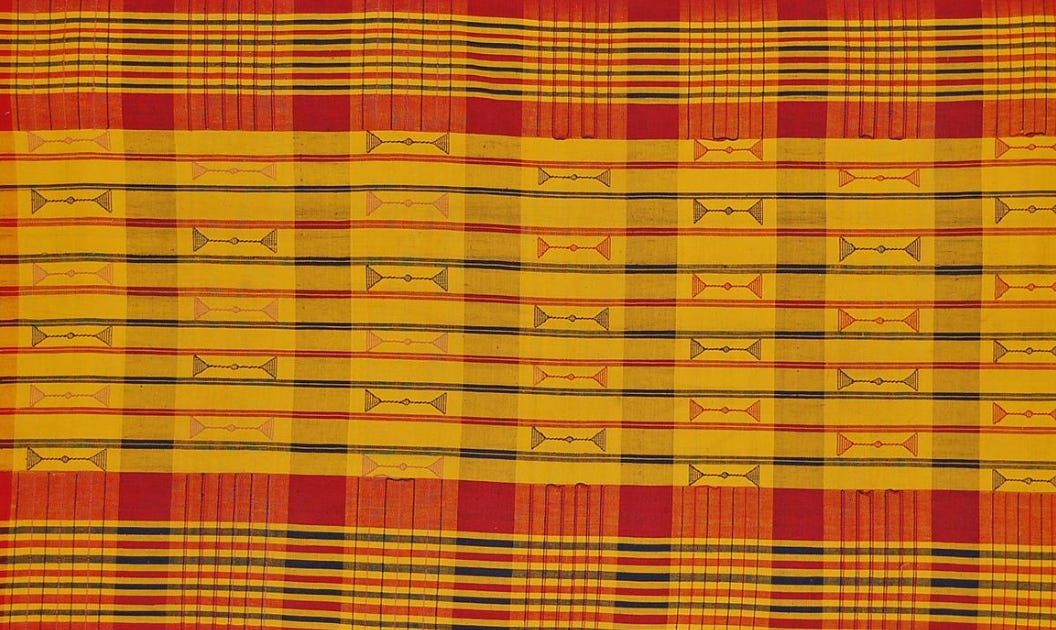
Cloth (woman’s weave), a single width, hand-woven from European machine-spun cotton in yellow, red and black. c. 1880-1913. Igbo. Akwete, Nigeria. British Museum No. Af1934,0307.113.
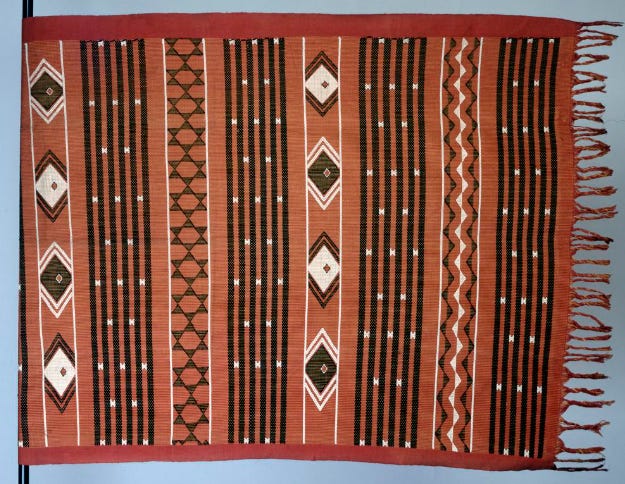
Cloth (woman’s weave), a single width hand-woven from European machine-spun cotton. The warp is of terracotta colour, interspersed with yellow threads. 1880-1913. Igbo, Akwete, Nigeria. British Museum No. Af1934,0307.109
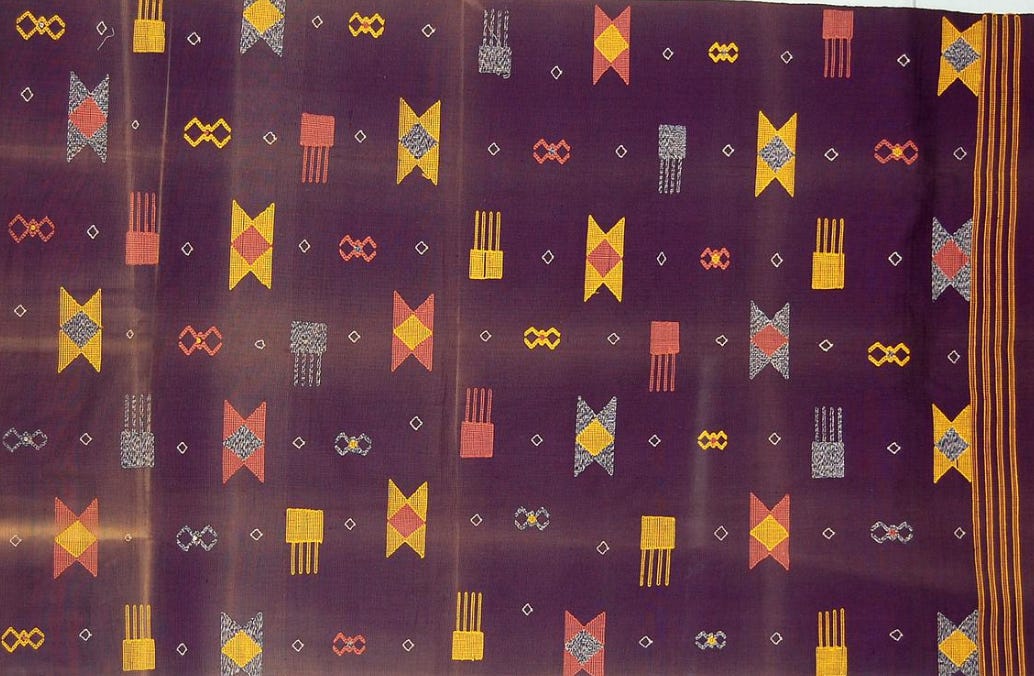
Cloth: single width. The cloth is composed of dyed indigo warps and wefts. The cloth is decorated with a series of geometric shapes, predominantly zig-zags and triangles forming warp bands, in dyed pink, yellow, blue and bleached white cotton. c. 1880-1913, Igbo, Akwete, Nigeria. British Museum Af1934,0307.114
Manufacturing and Dyeing of Cotton Fabrics.
The beginning of cloth making in southern Nigeria is mostly known from archaeological studies, despite the limited evidence. Buried textiles tend to decompose rather quickly in tropical soils unless some sort of special condition ensures their survival.
At the 9th-century site of Igbo Ukwu, contact with copper alloys preserved some very early textiles made of bast fiber.
The types of fibers used indicate indigenous manufacture, and the heaviness of some of the yarns, along with the openwork structures of some of the cloths, point to the vertical loom as the probable tool that was used to weave them.33
A medieval mass grave in Benin City, which is now attributed to the second plague pandemic of the mid-14th century, preserved the remains of cloth fragments which survived due to the damp anaerobic condition of the deposit.34
The threads were made of both cotton and raffia, and were used singly or plied together, with heavier threads consisting of as many as seven elements plied together. The woven structures of the fabrics included plain weave, network and openwork, and supplementary wefts that were applied to show patterning on one side of the cloth.
All were probably early products of the vertical loom; and the intricacies of design and pattern-making techniques are convincing evidence that their makers had achieved a high degree of skilled craftsmanship.35
While cotton was the most common plant fibre used to make country cloths, it did not completely displace raffia cloth, which consumers continued to use for special ceremonial occasions.
Raffia cloths were among the textiles exported from the Benin kingdom and resold by Europeans elsewhere on the Guinea Coast by 1591. Around 1778, raffia wrappers made in Benin were described by a French trader at that time as woven almost as finely as silk, and 8 or 9ft in length.36
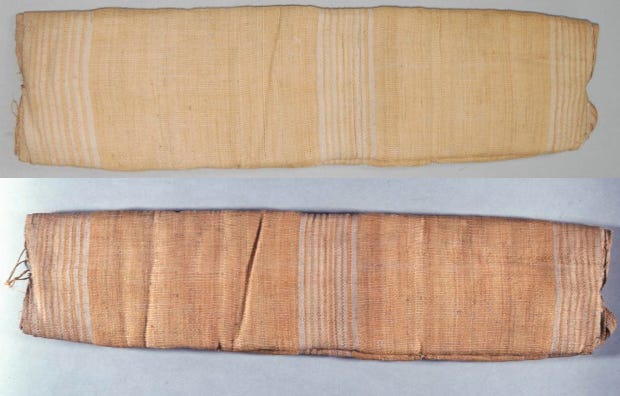
Woman’s cloth (waist) made of raffia and cotton thread. 1841. Made by the Kakanda at Egga, Nigeria. British Museum No. Af1843,0710.21
Domestic cotton production in the interior seems to have been of significant antiquity, as indicated by the making of cotton cloths since the late 15th century.
Dapper’s 17th-century account indicates that the cotton tree was extensively grown in Benin and was “of the finest sort; the wool whereof they dress, spin and weave into several sorts of cloths.”37
In his 1858 description of the kingdom of Igbomina, a Yoruba-speaking group, William Clarke reported that local cotton cultivation and trade supplied much of Yorubaland:
“The cultivation of this staple production is so extensive or so exclusive and the manufacturing department on such a large scale—comparatively speaking—the traders from Ijesa, Ilorin, Yoruba and Abeokuta flock to Ila for the purchasing of cheap cloths.
While passing through the market this morning, my attention was attracted to fifteen or twenty loads of cotton, the aggregate of which could have been scarcely less than one thousand pounds. The market for this article is said to be here every third day when, according to native testimony, two thousand loads from the farms of surrounding country are brought into town.
A native told me that the result of a single man’s farm was eighty of these loads; so that, allowing much for exaggeration, there can be no doubt that cotton is grown here very extensively and so much more so than I expected to find and that cloths purchased from lla may be sold in surrounding towns at an advance of seventy-five and a hundred per cent.”38
Clarke’s account mentions at least two types of looms were in Yorubaland: a vertical/upright loom that produced a narrow strip, and a horizontal one that produced a wider piece.
“The looms are of two varieties with all fixtures of an ordinary loom harness, sleight, treadle, shuttle, etc.” There was an apparent gendered division in use of the two looms, and a preference for unique designs. He noted that “for durability, [Yoruba textiles] far excel the prints and homespuns of Manchester. Hence the native cloths are by far the more costly.”39
The vertical loom, or the continuous warp loom, was used early on in settlements of the tropical rainforest belt along the Bights of Benin and Biafra and their hinterlands.
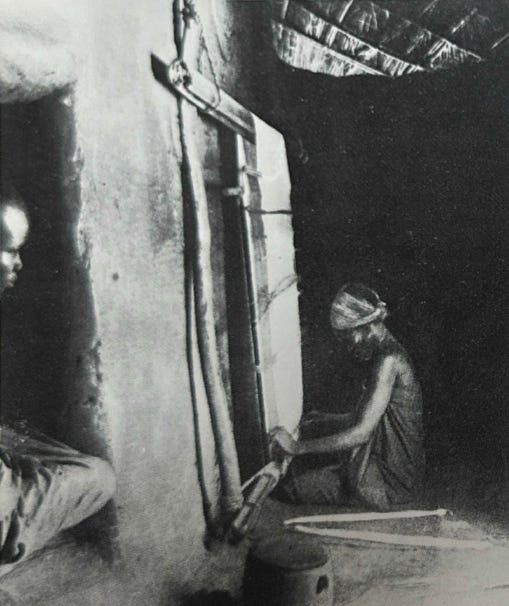
Weaver in Ilorin (Yorubaland). One of the earliest photographs of the woman’s vertical loom. Frobenius, 1912
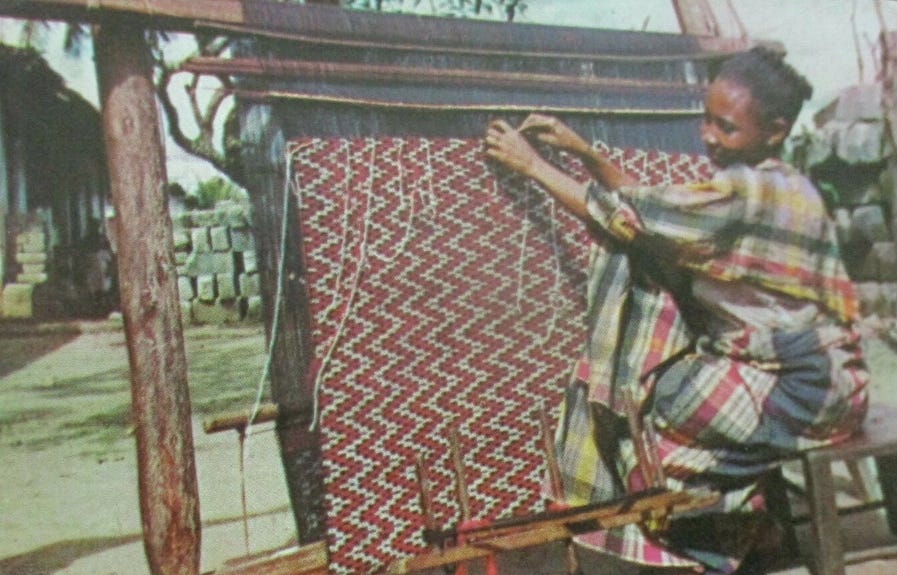
Akwete Weaver, Nigeria, 1960’s
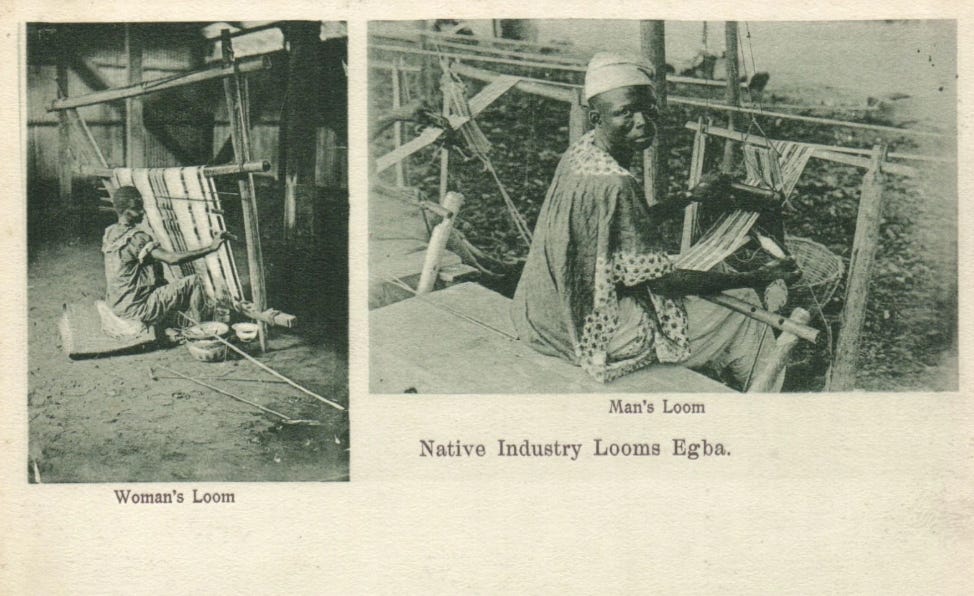
‘Native Industry, Looms, Egba.’ Yoruba, Nigeria, early 20th century.
A French merchant who made several extended visits to Benin between 1769 and 1783 observed weaving and indigo dyeing firsthand. He stated that women did both, and that the loom used was a vertical one.
Cloths were of either cotton or raffia, the former made with three breadths, the latter four breadths. Both types of wrapper were described as being 8ft long, though that figure may well have been an exaggeration. He also remarked on the volume of textile manufacture and that looms could be found in most houses.40
Cultivation of cotton for the purpose of producing textiles, noted in an 18th-century account, suggests that workshops of women weavers were well established also in the northern Yoruba kingdom of Oyo.
In 1826, while passing through Oyo, Clapperton “observed several looms going here: in one house we saw eight or ten —in fact a regular manufactory. Their cloth is in good texture, and some very fine”41
Where there were exceptions to this gendered labor pattern, it was in workshops producing special types of ceremonial cloth for political leaders and titleholders. Both men and women were observed at different times weaving in Benin’s royal palace, and cloths for titleholders in Ijebu-Ode, as well as Bunu funeral cloths, were reportedly woven by men and women.42
In 1841, Allan and Thompson visited the town of Egga, which is described as a considerable trading town. It contained “not less than two hundred looms” weaving cloth that was “white and blue, striped with grey and red.”
They were impressed with the textile industry of Egga, noting that “The manufacturing of country cloths deserves the first notice: with nothing, of African industry I ever saw, was I more pleased”43
Giving evidence before the 1842 committee on the West Coast of Africa, Macgregor Laird said that “the natives of the interior would not look at our cottons, preferring their own stronger goods”
At Egga, he noted that “The cloths made in the Nufie [sic] country, as well as the tobes, are of superior manufacture to any I have met with on the river. A good cloth may be purchased at 600 to 2,000 cowries, and a fine one may be had, dyed or plain, for about five to six thousand”
According to Lander’s journal, Egga had an immense number of bulky canoes filled with trading commodities. “Benin” and “Portuguese” cloths were worn by many. In the late 1850s, Crowther wrote about the Nupe cloth manufacturing and trading that were undertaken by both men and women.44
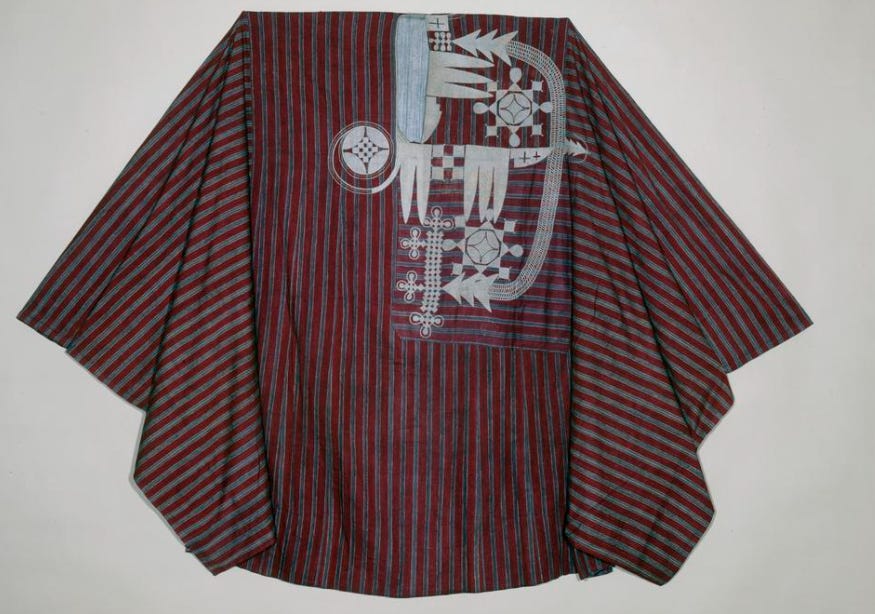
Gown (tobe, boubou, riga) composed of narrow strips of a uniform warp-faced pattern using trans-Saharan alaari handspun magenta silk, interspersed with narrow stripes of white and indigo handspun cotton. c. 1863-1866, Nupe or Hausa artisan. Nigeria. British Museum. Af1920,0211.1. ‘The acquisition register records that these were the ‘Robe and cap of the King of Dahomey given to Vice-Admiral Eardley Wilmot by the King of Dahomey between 1863 and 1866’. The cloth is likely to be Nupe, and the embroidery Hausa.’
Pre-colonial south-western Nigeria independently developed one of the most important indigo dyeing traditions in West Africa, using potash baked in a special kiln to prepare indigo dye vats or pots.
Threads or whole cloths were dipped into the dye vats, allowed to air, and dipped again and again, depending on the desired depth of color. The patterns were made by resist dyeing (adire), in which selected areas of the cloth are tied (tie-dyeing) or painted with a dye-resistant substance (batik) to produce different motifs and patterns.45
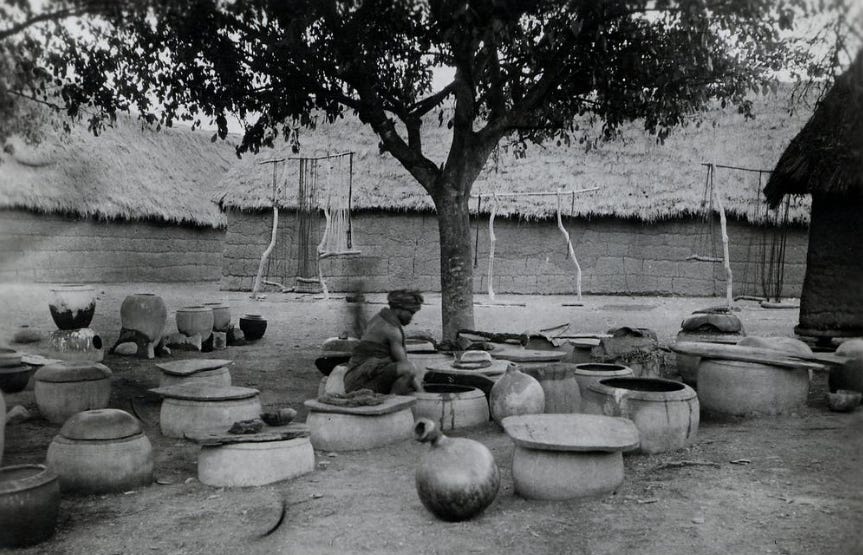
Backstreet section in Ilorin, showing a Yoruba man dyeing cotton in indigo surrounded by a large number of large pottery containers, and single-storey thatched-roof buildings in the background. ca. 1946. British Museum
Dapper’s report in the 17th century noted that Benin cloth was dyed with multiple colours, besides indigo blue:
“Indigo grows there abundantly, and they have the art of making very good blue from it, with which they dye their cloth. They also know very well how to make ſeveral sorts of green, black, red and yellow dyes, extracted by friction and decoction, from certain trees best known to themselves: and being better skill’d in making ſoap, than any other people of Guinea, their cloths are generally very clean. Most people in Benin are clothed with it, besides what is yearly exported by themselves and foreigners, to many other parts of Guinea.”46
In 1702. van Nyendael itemized a range of dyes used on cotton cloths produced in Benin, which were patterned with checkerboards. He seemed particularly impressed by the mastery of the dyers, who were able to produce green, black, red, and yellow colors.47
In the 18th century, Landolphe commented that he saw Benin dyers pounding indigo with their feet rather than with a mortar and pestle, which might indicate volume production of dyestuff for the textile export trade.
Adams praised the industrious peoples of Allada, who manufactured cotton cloths with patterns, using dyed threads. He gave his general opinion that indigo dyeing was done exceptionally well in Allada, Oyo, and Ijebu.48
In 1826, Clapperton passed through the Yoruba town of Ijanna, staying on long enough to visit several weaving and dyeing workshops to observe how the various manufacturing processes were carried out.
Boys wove cotton strips, about four inches wide, while women were the dyers. For each dye workshop, he counted at least 20 vats. He considered the indigo dyestuff produced in these workshops to be highly durable and of excellent quality.49
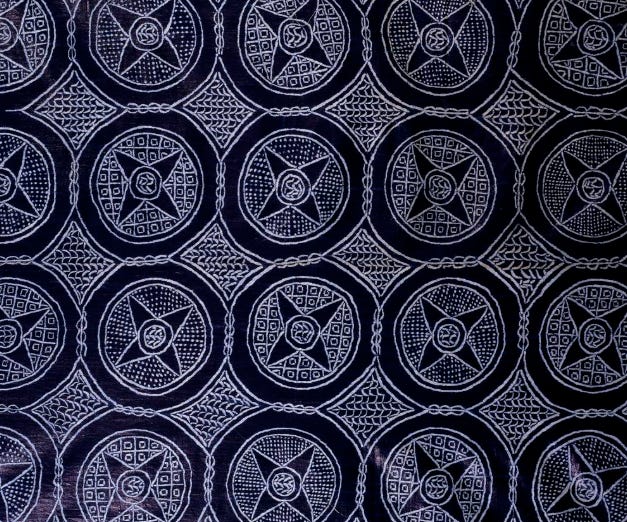
cloth (ndop), made of narrow strips of handspun and hand-woven cotton, hand sewn together along the selvedges. Resist-dyed using raffia stitching to produce a regular geometric pattern in dark indigo with the design in white/light indigo lines. 1822-1824. Wukari, Northern Nigeria, British Museum, No. Af,WA.11
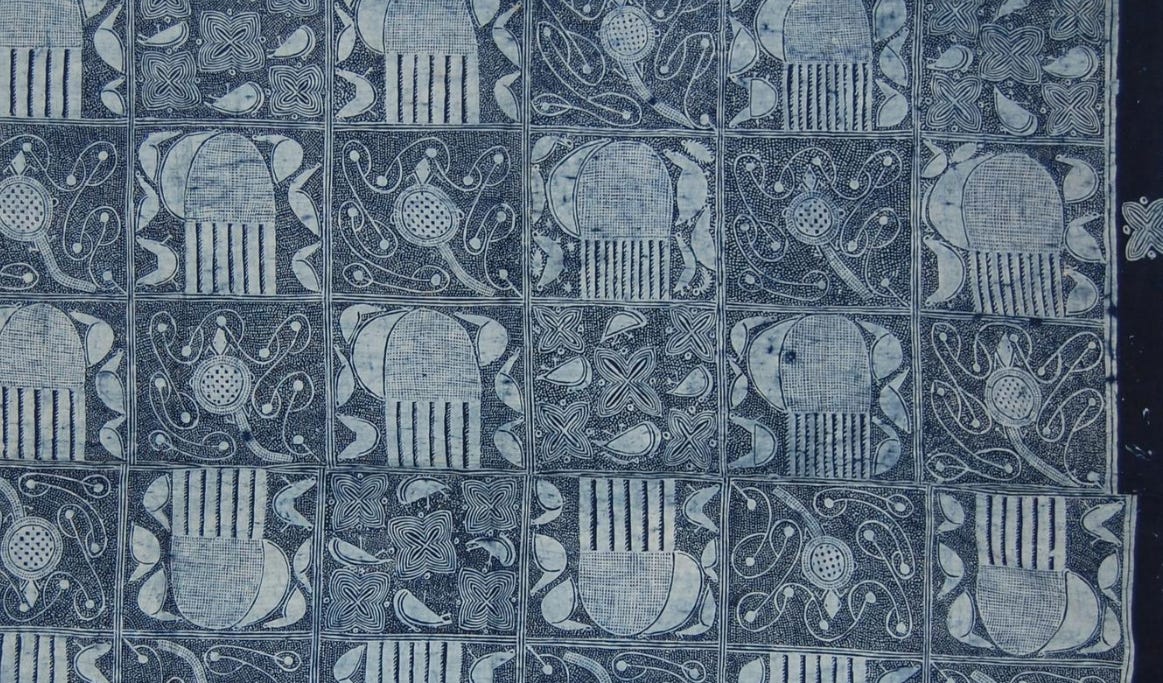
Indigo resist-dyed adire woman’s wrapper (adire eleko), on two panels of factory-made cotton machine-sewn together. Each square is filled by a hand-drawn pattern in starch resist which was then indigo dyed. There are three patterns, birds, tortoises and a comb. c. 1930-1940, Yoruba, Abeokuta, Nigeria. British Museum No. Af1980,38.12
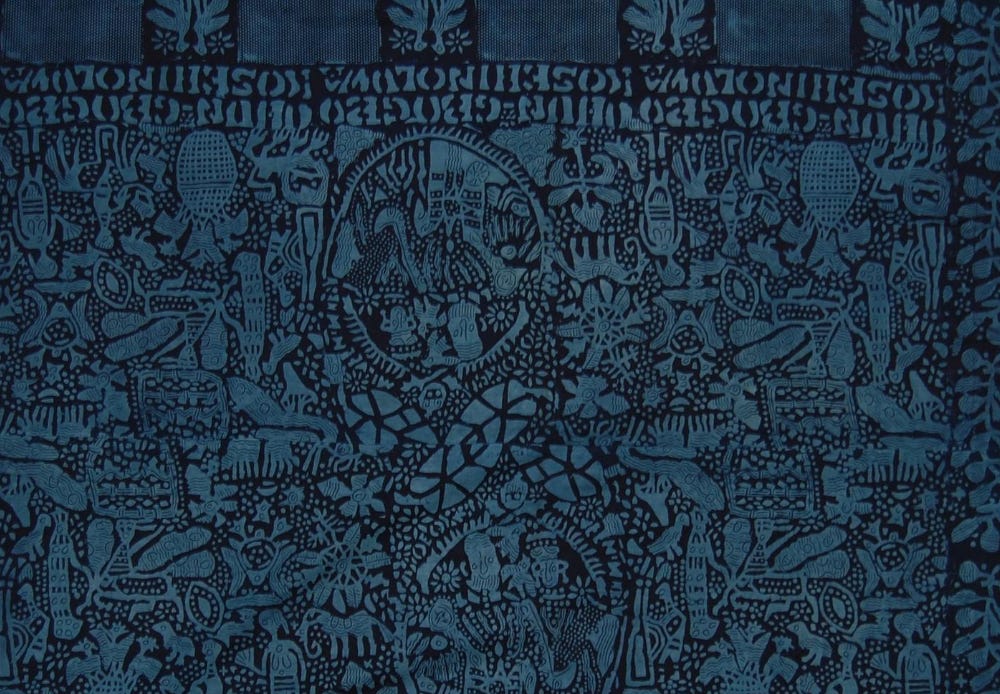
Adire, women’s cloth: composed of two even lengths of machine plain woven European cotton, machine-sewn together. The textile is decorated using the starch resist method with a combination of freehand painted and stencilled designs. c. 1970, Yoruba, Nigeria. British Museum No. Af1971,35.24
Consumption and Fashion.
A mainstay of dress for men and women throughout the history of pre-colonial S.W. Nigeria has been the rectangular cloth called the wrapper, several lengths of which are worn draped around the body and secured under the arm, over the shoulder, or at the waist.
Figural sculpture portraying rulers and elites from the kingdom of Ife, dated to the 13th-15th centuries, and the kingdom of Benin, dated to the 16th-19th centuries, indicates that royal and ceremonial dress included certain types of prestige textiles that were locally woven.
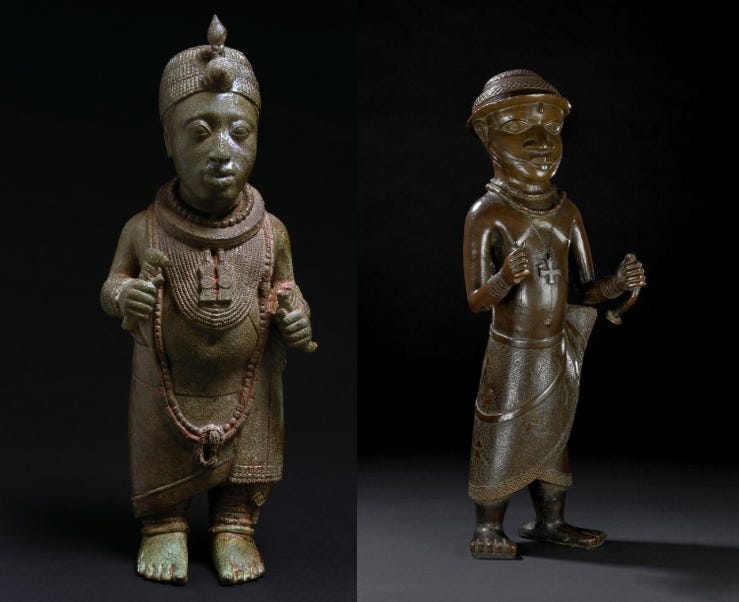
(left) Copper alloy figure from the Ita Yemoo site, 14th century, Ile-Ife, Nigeria. National Museum, Lagos. (right) Copper alloy figure of a court official, 18th century, Benin City, Nigeria. British Museum.
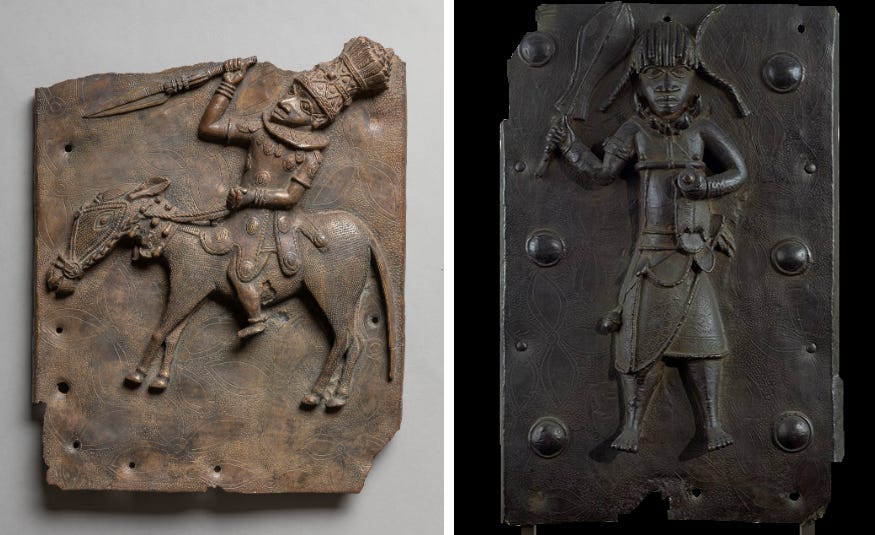
A Benin horseman in full battle gear. 16th-17th century, Benin City, Nigeria. Welt Museum. Court official in typical garb. 16th-17th century, Benin City, Nigeria. Museum of Fine Arts, Boston.
According to Dapper’s 17th-century account of Benin:
“Their habit is neat and ornamental, almost to magnificence, especially among the richest sort of people, who wear first a white calico or cotton cloth, about a yard long, and half as broad, which is in the form of drawers; and over it a finer white cotton, commonly about eighteen or twenty yards long, plaited very ingeniously in the middle; and upon that again a scarf, about a yard long, and two spans broad, the end of it adorn’d with fringe or lace.
Women of the highest rank, wear fine cloths of their country make, ingeniously chequer’d of several colours. The upper part of the body is covered with a beautiful cloth, a yard long or more. The meaner sort of women differ from the richer, only in the goodness of their clothes: some wear a sort of blue calico-frock or jacket, which hangs down almost to their knees, with a small narrow cloth over their breasts.”50
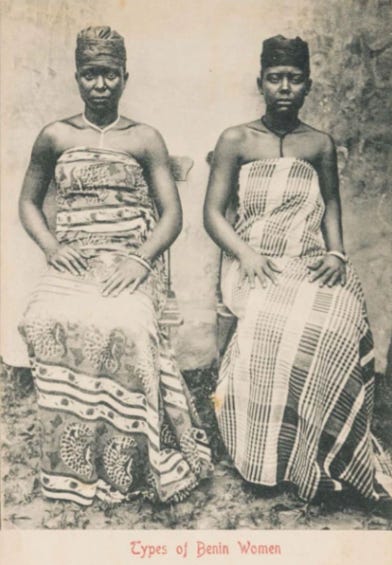
In his 1858 description of Yorubaland, William Clarke observed the following about local fashion:
“The dress of the natives certainly bespeaks for them a higher position than that generally assigned to people of this benighted continent. All classes, rich and poor, male and female, are generally well clad and have a sufficiency for a warm tropical climate. There is a variety of dress that is found in other countries and about with as much pride in the selection of style, colours, etc., even among the boasted civilized.
A full-made dress consists of a large shawl or wrapper or toga flowing robe, pants and cap. The shawl is a large oblong piece of cloth six by four feet and is thrown gracefully over the shoulders so as to fall to the knees and below and leave one arm exposed.
The toga or gown is a very large garment covering nearly the entire body with folds to be thrown over the shoulders so as to allow free circulation of air around the body, and the pants are either short, reaching to the knee, or half length, or full and lengthy, resembling precisely the Turkish trousers. The latter garment is guided by a string around the loins. The cap is round or peaked at the top with long ears and is made of native cloth or velvet and silk.”51
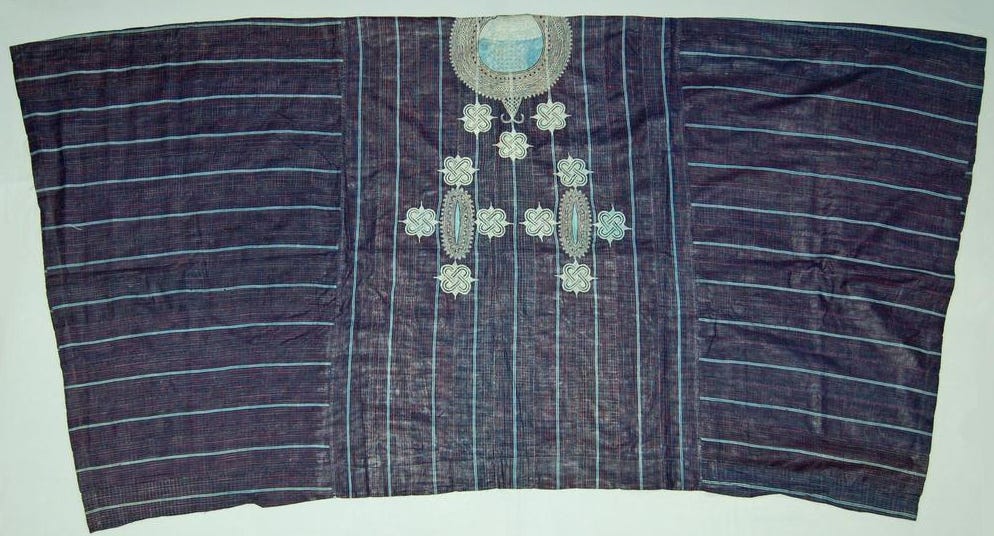
Tunic composed of repeating narrow strips (aso oke) sewn together. Warp stripes in dark indigo-dyed and white cotton and alaari (magenta silk), with alaari weft stripe. Embroidered with repeating knot designs in white cotton on front and back. c.1890-1910. Yoruba, Nigeria. British Museum, No. 2018,2036.162
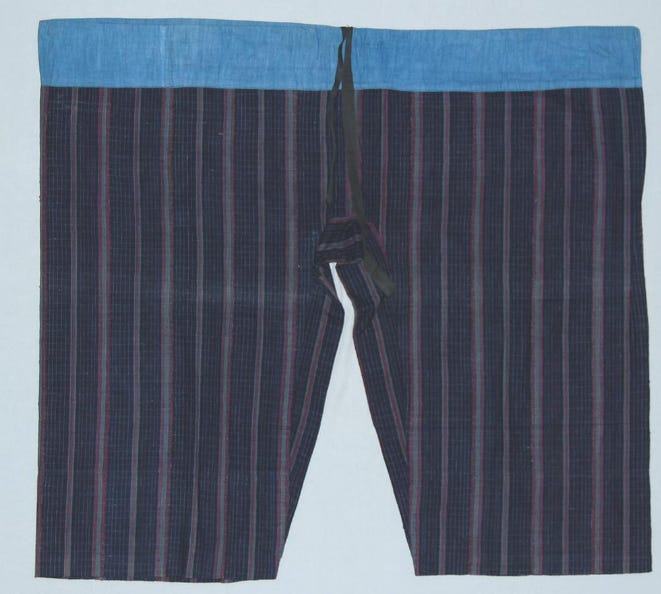
Trousers, formed from 22 hand-woven strips about 4 inches wide of handspun cotton, hand-sewn together along the selvedges. c. 1900-1930, Yoruba, Nigeria. British Museum Af1966,01.10.b
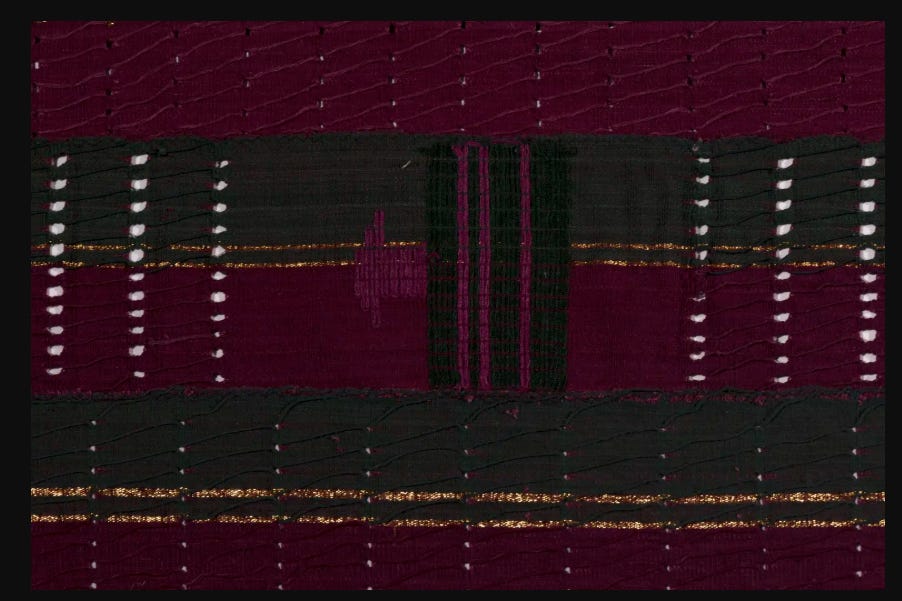
Woman’s wrapper (aṣọ-òkè), 20th century. Cotton, rayon, dye. Yorùbá, Ilorin, Kwara State, Nigeria. Brooklyn Museum No. 1990.132.2.
For the majority of the population, conventions of dress were revised, not revolutionized, by the international trade in textiles, as evidenced by the continued production of distinctive styles of embellishment.
One distinctive type of ceremonial cloth from Ijebu-Ode, known as aso olona, or “cloth with patterns,” was heavily embellished with brocaded patterns and worn either draped on the shoulder of chiefs and titleholders in the Oshugbo society, or as a large wrapper of several breadths sewn together and again as a prerogative of chiefs, titleholders, priests, and other members of the ruling elite.
The most important motifs woven into these cloths were schematic representations of water-dwelling creatures-crocodiles, frogs, fish, snakes-that symbolized deities and forces of the spiritual domain.52
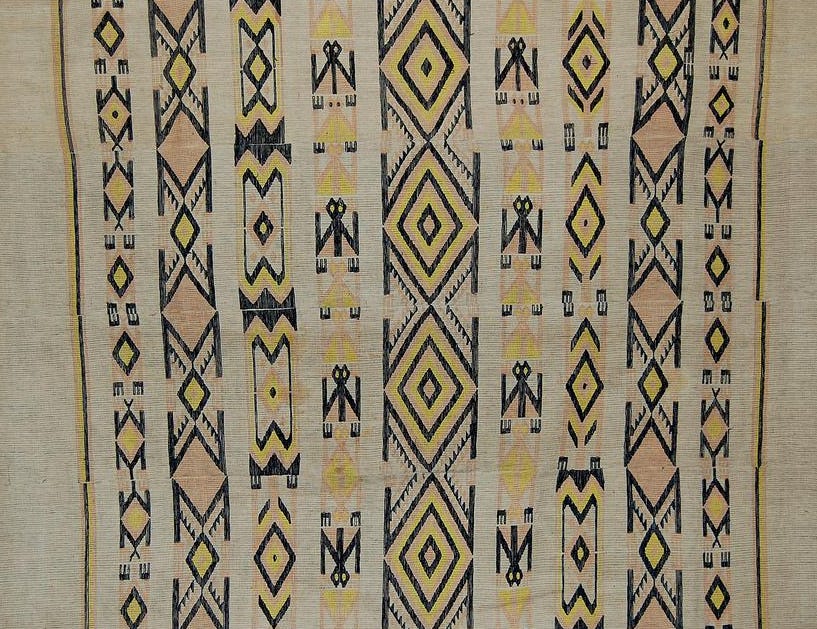
Cloth (Oshogbo society aso olona title wrapper) formed of four panels, hand-woven (woman’s weave) and then hand-sewn together. The white thread is locally hand-spun, while the green, pink, yellow and blue threads are of imported European manufacture. c. 1890-1910, Yoruba, Ijebu Ode, Nigeria. British Museum Af1966,01.26
Local competition and European imports
In markets affected by increased competition from both local and imported cloth during the 19th century, one strategy was to aim at the higher-priced sector of the market by producing cloth with complex patterning as either openwork or brocaded stripes and motifs.
Some women also ensured higher prices for their textile products by working with finer-quality yarns and weaving denser fabric, features that could easily be recognized by discerning consumers.
Examples collected by the 1841 expedition to the market town of Egga indicate that Nupe weavers produced the most expensive ones: narrow striped headdcloths made of fine silk and cotton that would have been exported northward to Kano.53
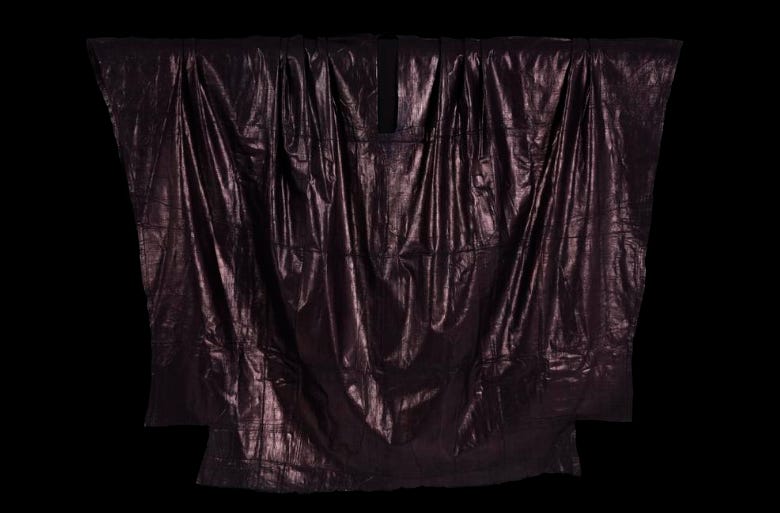
Dyed gown or tobe: a tunic with wide flared sleeves made up of 110 hand-woven narrow strips of hand-hand cotton, sewn together along the selvedges. c. 1841, Eggan, Nigeria. British Museum, No. Af1843,0311.53
Curator’s comments: “Here we have the famous “elephant shirt”, the kore nyffe, which was, with the “guinea- fowl” shirt, the most famous of the Nupe exports to the north, where these shirts were valued sometimes as highly as the “guinea-fowl” shirts. … This tobe, made in Egga, cost 7,000 cowries; it was probably of better quality than the 23 Kore Nyffi that Barth bought in Katsina in 1853 for an average of 6,5000 cowries.”
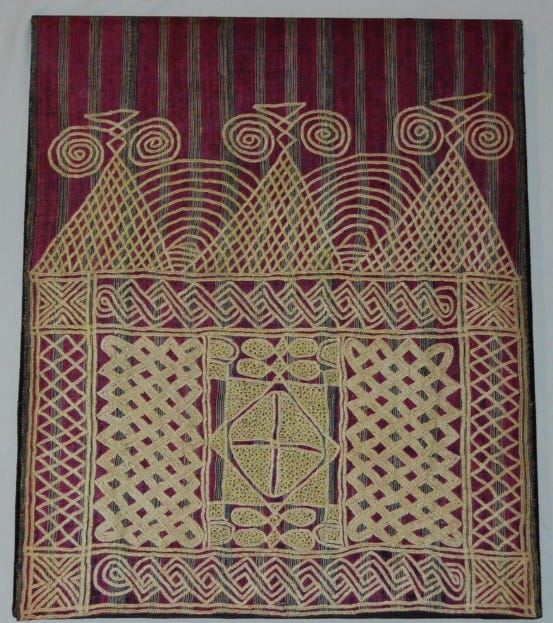
Man’s trousers, composed of narrow strips (aso oke) sewn together. Woven in indigo-dyed and white cotton with alaari (magenta silk) warp stripes. Hand-embroidered in white and green cotton thread. c. 1880-1900. Nupe, Nigeria. British Museum, No. 2018,2036.154
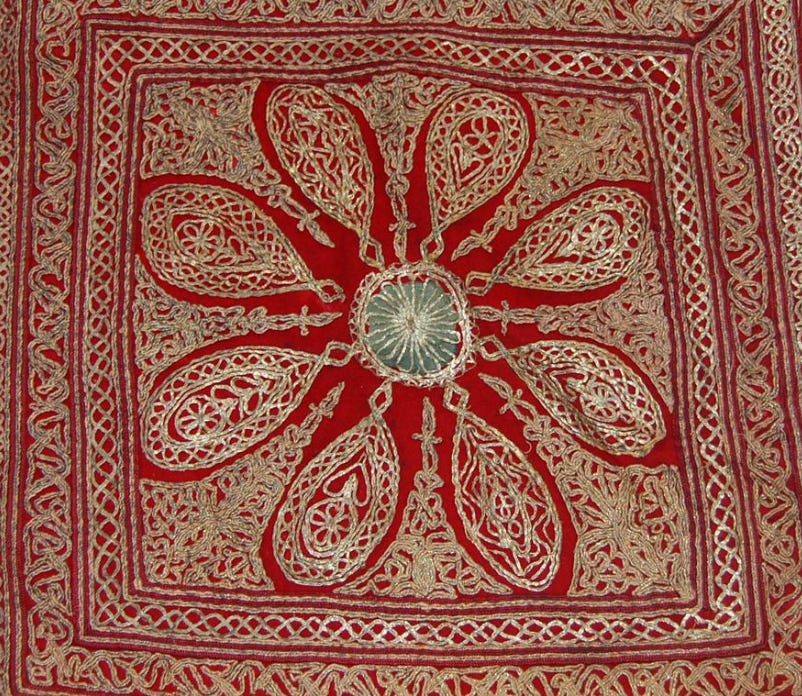
Hooded red cloak (burnous) made of silk, cotton and wool. ‘Although the red cloth is European, the tailoring and embroidery is Nigerian, and it was probably sewn by Nupe craftsmen in Bida.’ c. 1900. Nigeria. British Museum. No. Af1902,1116.5
Increasing imports of plain, lightweight cotton during the colonial period facilitated the rapid popularisation of starch resist-dyeing (adire eleko), which required very fine, thin fabric with an even, smooth surface.
Major centers of adire eleko manufacture developed in the southern cities of Lagos, Abeokuta, Ibadan, and Oshogbo. Imports grew substantially, numbering 40 million square yards yearly between 1896 and 1906, and increasing to 100 million square yards per year by 1912.54
Among the best-known types of resist-dyed cloths from this region are the so-called Olokun cloths. Although the names for this cloth and its designs serve to localize and naturalize the imagery in Yoruba textile traditions, visual evidence suggests the cloth belongs to a much larger family of West African textile traditions, such as the adinkra cloths of the Gold Coast, both of which feature elaborate geometric patterns, grids, and animal motifs.55
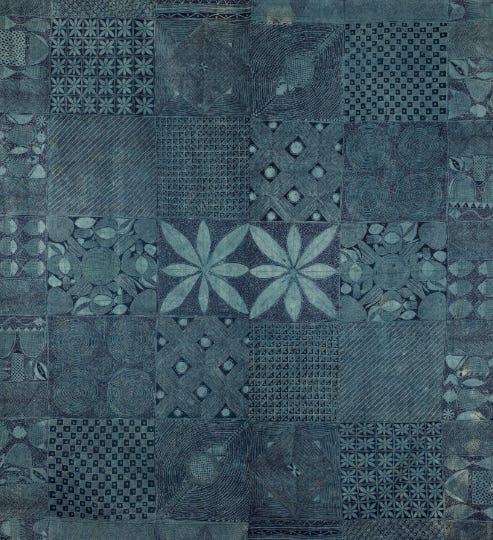
Cloth with Olokun, Goddess of the Sea Motif (adire eleko). Imported cotton cloth, indigo dye with starch resist. c. 1973, Yoruba, Nigeria. Harn Museum No. 2007.30.1
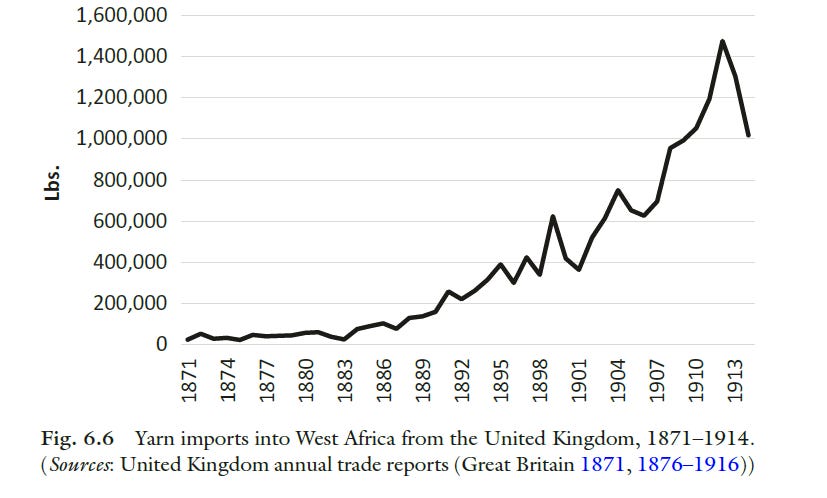
Yarn imports into West Africa. Map by Katharine Frederick
The impact of cheaper imports (both raw cotton and cotton cloths) was complex and varied considerably across the different markets, as demonstrated by the following example:
One of the leading African merchants in Lagos, Chief D. C. Taiwo, was still exporting “country cloths” from Egga in the interior to Lagos at the coast in 1881. In return, he was importing European cloth for interior markets, which consisted of silk alayan, dyed Manchester cloth, Madras headcloths, embossed velvet and spotted prints.56
Cloth from Lagos, ultimately obtained in the interior, was still exported in the thousands right up to the end of the 19th century, mainly for the Gold Coast market, but some was sent to Brazil as it had been nearly three centuries earlier.57
In 1891 the colonial agents Joseph Thomson and Alvan Millson made calculations of the quantities used in Yoruba clothing, looking wistfully at the possibilities of replacing this by exports from England.
Millson calculated that the Yorubas consumed ‘not less than 31,000,000 yards of cotton, silk, grass and mixture cloth’; over 95% was of local manufacture, made of home-grown cotton, dyed with native dyes, woven of yarn spun by hand. Nearly 25% of the population was engaged in producing cloth or dyes for the local market.
At 3d. a yard, the value of the annual output was some £375,000. Weavers earned 2d. a day on average (more accurate estimates put this figure much higher at 1s. 4d.) . In the previous year, Lagos imports of cotton piece goods had been some £200,000, and English cottons were selling at about 3d. a yard.58
The expansion of imported cloth, as well as colonial labor exploitation and coercive taxation policies, resulted in the decline of the local textile industry during the 20th century.
However, the decline of Nigeria’s ancient textile industry was a much more gradual process than the “deindustrialization of the periphery” thesis would suggest.59
According to the historian Marion Johnson, even though rising imports naturally led to a declining overall market share for domestic textiles, this by no means implied that local manufacturing was fading. Rather, in the context of increasing demand, the “absolute output” of local industries in West Africa may have “even been expanding” well into the second half of the 20th century.60
Moreover, rather than signaling deindustrialization, foreign competition often stimulated local innovation.
For example, besides the distinctive Akwete cloth, Igbo weavers sometimes reproduced popular imported patterns that had fallen out of production in European factories, flipping on its head a European strategy of mimicking African cloth.61
Textile production continued in much of Nigeria well into the post-colonial era. Imports from Asia would ultimately claim a large relative share of the expanding Nigerian textile market, but locally made cloth retained a strong foothold.
When the Federation of British Industry surveyed the Nigerian textile industry in the mid-1960s, it was estimated that 50,000,000 square yards of cloth, comprising 13% of all cloth consumed in the country, were annually woven on the traditional hand-looms.62
The ancient textile industry of Nigeria was thus one of the few clothmaking centers in Africa to thrive long after textile production declined across much of the continent during the colonial period, persisting into the post-colonial era.
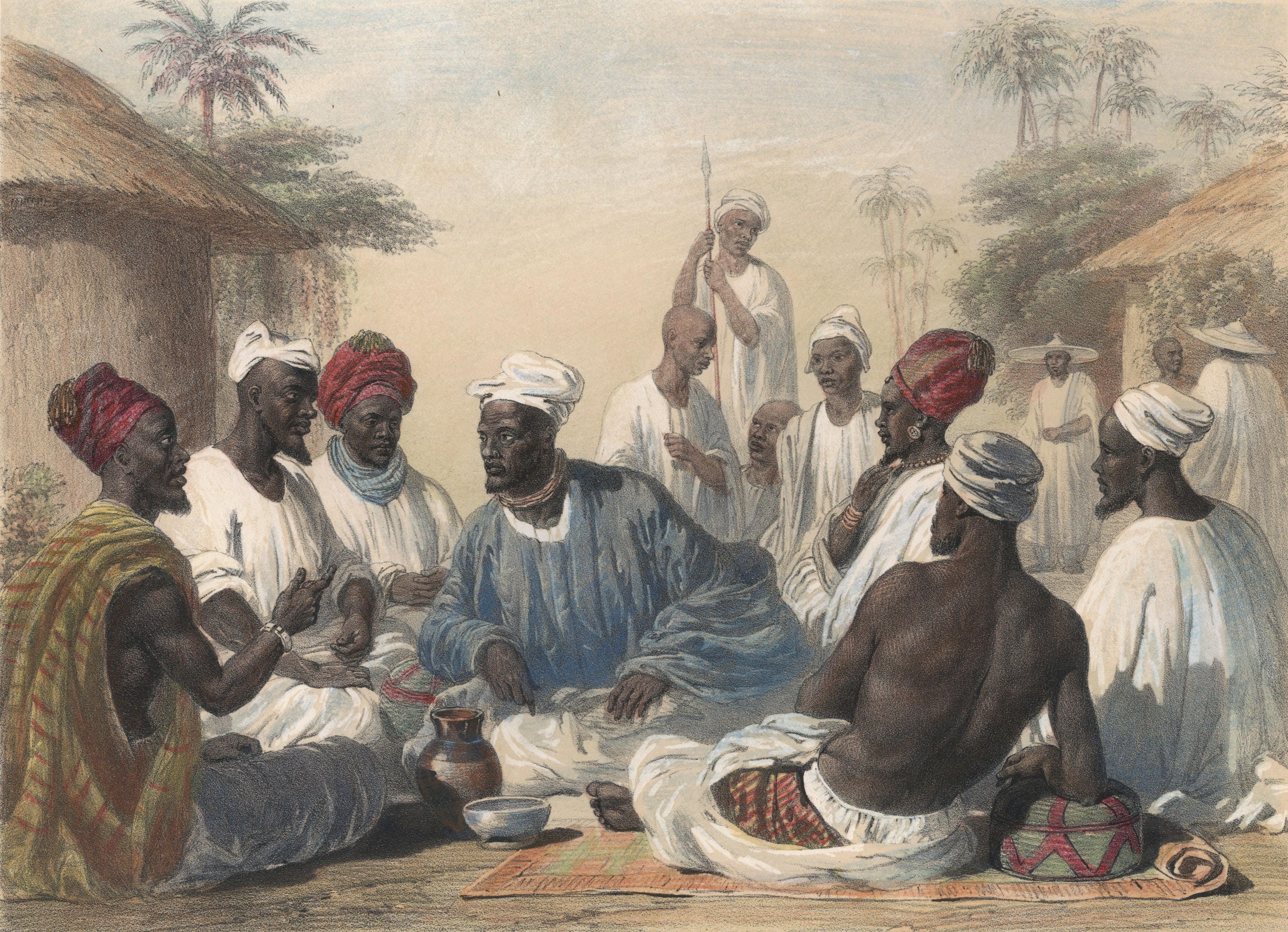
Illustration of a ‘Palaver’ (public meeting) not far from Badagry (Nigeria), by William Allen, ca. 1841
The naturalistic Rock paintings of Tassili n’Ajjer in southeastern Algeria were once described as “the greatest museum of prehistoric art in the whole world,” containing “the most ancient data that we have concerning Negro art.”
My latest Patreon article examines the debates regarding the identity of the ancient painters of Tassili.
Please subscribe to read about it here:
A Commentary on Duarte Pacheco Pereira’s Account of the Lower Guinea Coastlands in his Esmeraldo De Situ Orbis, and on Some Other Early Accounts, by J.D. Fage, Esmeraldo de situ orbis by Pacheco Pereira, edited by George H.T. Kimble, pg 128
Cloth in West African History by Colleen E. Kriger 29. Benin and the Europeans, 1485-1897 by Alan Frederick Charles Ryder pg 37
Early European Sources Relating to the Kingdom of Ijebu (1500-1700): A Critical Survey by Robin Law pg 247
Benin and the Europeans, 1485-1897 by Alan Frederick Charles Ryder pg 84. Cloth in West African History by Colleen E. Kriger pg 40
Cloth in West African History by Colleen E. Kriger pg 135-137
Indigo Quilts:30 Quilts from the Poos Collection, by Kay Triplett, Lori Lee Triplett, pg 11
Cloth in West African History by Colleen E. Kriger pg 40. Benin and the Europeans, 1485-1897 by Alan Frederick Charles Ryder pg 94
Cloth in West African History by Colleen E. Kriger pg 41
Dutch Trade on the Nigerian Coast during the Seventeenth Century by AFC Ryder pg 203
A description of the coasts of north and south-Guinea by Jean Barbot, 1732 pg 518
Precolonial African Industry and the Atlantic Slave Trade, 1500-1800 by J. K. Thornton. pg 11, 18. What Africans Got for Their Slaves: A Master List of European Trade Goods by Stanley B. Alpern, pg. 10
Cloth in West African History by Colleen E. Kriger pg 41. Benin and the Europeans, 1485-1897 by Alan Frederick Charles Ryder pg 96-97
Benin and the Europeans, 1485-1897 by Alan Frederick Charles Ryder pg 93
Benin and the Europeans, 1485-1897 by Alan Frederick Charles Ryder pg 134, 137
Benin and the Europeans, 1485-1897 by Alan Frederick Charles Ryder pg 57, 140-141, 151, 159, 173, 189-190, 206-207
Dutch Trade on the Nigerian Coast during the Seventeenth Century by AFC Ryder pg 203. A description of the coasts of north and south-Guinea by Jean Barbot, 1732, pg 361
Journal of a second expedition into the interior of Africa, by Hugh Clapperton, J. Murray, 1829, pg 136
Early European Sources Relating to the Kingdom of Ijebu (1500-1700): A Critical Survey by Robin Law pg 248
Early European Sources Relating to the Kingdom of Ijebu (1500-1700): A Critical Survey by Robin Law pg 248-249
Early European Sources Relating to the Kingdom of Ijebu (1500-1700): A Critical Survey by Robin Law pg 249, n.34
Dutch Trade on the Nigerian Coast during the Seventeenth Century by AFC Ryder, pg 204
Cloth in West African History by Colleen E. Kriger pg 49, 143
Portuguese Adaptation to Trade Patterns Guinea to Angola (1443-1640) by Eugenia W. Herbert
Africa and Africans in the Making of the Atlantic World, 1400-1800 by John Thornton pg 51. Cloth in West African History by Colleen E. Kriger pg 34
Africa and Africans in the Making of the Atlantic World, 1400-1800 by John Thornton, pg 53
Cloth in West African History by Colleen E. Kriger pg 38
Cloth in West African History by Colleen E. Kriger pg 142-144
Cloth in West African History by Colleen E. Kriger, pg 39
Cloth in West African History by Colleen E. Kriger, pg. 36
Remarks on the country extending from Cape Palmas to the river Congo by John Adams, published by G. & W.B. Whittaker, 1823, pg 79-80, 94, 96-98
Cloth in West African History by Colleen E. Kriger, pg 45. Weaving Tradition in Igbo-Land: History and Mechanism of Igbo Textile Industry By Adiele Eberechukwu Afigbo, C. S. Okeke
Cloth in West African History by Colleen E. Kriger, pg 46-47
Cloth in West African History by Colleen E. Kriger, pg 28
Retour sur l’archéologie mortuaire d’époque médiévale dans le sud-ouest du Nigéria Approches forensiques d’une mortalité discrète, by Cécile Chapelain de Seréville-Niel, Gérard Chouin and Adisa Ogunfolakan p. 37-62. Reflections on plague in African history (14th–19th c.) by Gérard Chouin
Cloth in West African History by Colleen E. Kriger, pg 28-29, 31
Cloth in West African History by Colleen E. Kriger, pg 24-25
A description of the coasts of north and south-Guinea by Jean Barbot, 1732, pg 357
Travels and Explorations in Yorubaland, 1854-1858 by, William H. Clarke, pg 152
Travels and Explorations in Yorubaland, 1854-1858 by William H. Clarke, pg 272-273
Cloth in West African History by Colleen E. Kriger, pg. 43
Journal of a second expedition into the interior of Africa by Hugh Clapperton, published by J. Murray, 1829, pg 14
Cloth in West African History by Colleen E. Kriger, pg. 43
Journals of the Expedition Up the Niger in 1841, By James Frederick and Samuel Crowther Schön, Samuel Adjai Crowther · 1842 pg 173
Cloth in West African History by Colleen E. Kriger, pg 354-355
Cloth in West African History by Colleen E. Kriger, pg 117-118, 127-130
A description of the coasts of north and south-Guinea by Jean Barbot, 1732 pg 357
Cloth in West African History by Colleen E. Kriger, pg. 132
Cloth in West African History by Colleen E. Kriger, pg 133
Journal of a second expedition into the interior of Africa by Hugh Clapperton, published by J. Murray, 1829, pg 15-16
A description of the coasts of north and south-Guinea by Jean Barbot, 1732 pg 362
Travels and Explorations in Yorubaland, 1854-1858 by William H. Clarke, pg 243
Cloth in West African History by Colleen E. Kriger, pg 47
Cloth in West African History by Colleen E. Kriger, pg 53
Cloth in West African History by Colleen E. Kriger, pg 148
Cloth in West African History by Colleen E. Kriger, pg 155-161
Cloth on the Banks of the Niger by Marion Johnson, pg 363
The Imperial Impact: Studies in the Economic History of Africa and India, edited by Clive Dewey, Antony G. Hopkins, pg 265
Cotton Imperialism in West Africa, by Marion Johnson, pg 182, 186
Cloth in West African History by Colleen E. Kriger, pg 162-164. What happened to the workshop of West Africa? Resilience and decline of handicraft textiles in colonial northern Nigeria, 1911–52 by Emiliano Travieso, Tom Westland. Cotton imperialism in Africa: Rethinking the gap between metropolitan rhetoric and colonial practice by Michiel de Haas)
The Imperial impact: studies in the economic history of Africa and India, edited by Clive Dewey, Antony G. Hopkins, pg. 268
Twilight of an Industry in East Africa: Textile Manufacturing, 1830-1940, by Katharine Frederick, pg 224-225
Cotton Imperialism in West Africa, by Marion Johnson, pg 186
For Igboland, here are some references that could have enriched the section dedicated to their historical textile industry/industries
Olaudah Equiano, when talking about his Igbo town that was probably part of the Igbo Kingdom of Aboh, he tells us about how
"The dress of both sexes is nearly the same. It generally consists of a long piece of callico, or muslin, wrapped loosely round the body, somewhat in the form of a highland plaid. This is usually dyed blue, which is our favourite colour. It is extracted from a berry, and is brighter and richer than any I have seen in Europe."
(Can't cite the exact page number since it is the EPUB version I read)
Most of the accounts on the historical textile industry comes from the 1800s & from one from the 1850s that I have read, they even used to export their textiles to the Niger-Benue confluence markets that was visited by many ethnic groups in contemporary southern Nigeria/the middle belt of Nigeria
I quote from the account
"The scene showed the disposition of the people to trade, and that a trading establishment at the Confluence would prove beneficial to the country in general. The languages spoken here are Igara (Igala), Igbira (Egbira), Nupe, Kakanda, Haussa, and Yoruba. The Yorubas find their way to the Confluence by way of Lade or Rabba, from Ilorin. People speaking Doma (Idoma and Djuku (Jukun), the language of Kororofa (Kwararafa), also visit the market at Igbebe at the Confluence, and the Ibo (Igbo) traders come up as far as this from the Delta. Among the things purchased as curiosities, was a kind of fancy cloth, said to be manufactured by the people of Igbo, south of Idda, near the Ibo country"
- pages 167-168 "Journal of an Expedition up the Niger and Tshadda Rivers Undertaken by Macgregor Laird, Esq. in Connection with the British Government, in 1854" by Samuel Crowther
The above account & some other ones (that I am yet to read) also helped inform a particular passage in the article "The Growth of Trade among the Igbo before 1800" by David Northrup
I quote (from page pages 226-227)
"Another group of regional trading networks grew up around the centres of the textile industry, which had already attained considerable sophistication in the days of the Igbo-Ukwu culture. In the sixteenth century, the inhabitants of Benin used types of cloth similar in description to that found at Igbo-Ukwu, and in the next century they were wearing and exporting large quantities of cloth.46 It is possible that some of this was of Igbo origin. Direct observations of Igbo-made cloth come only much later, but a nineteenth-century Niger explorer noted that the Northern Igbo made an intricately woven cloth which was sold in quantity in markets as far away as the Benue-Niger confluence.47 Missionaries also noted the extensive cloth industry using cotton (which grew in a semi-cultivated state throughout much of the Igbo territory) and other fibres which were woven and dyed. Most of the cloth was a luxury item intended for ritual, political, and ceremonial occasions, though plain cloth was also made.48 The southern Igbo town of Akwete has long been famous for its fancy cotton cloth, which may once have been made from locally grown cotton.49 These textile industries thus seem to have played an important role in regional exchange."
Lastly, I quote from an 1857 description of the Igbo town of Onitsha that I have come across second-hand (in a secondary source) which also tells us about the historical textile industries
“I took a short walk in the extensive corn and yam plantations, when I had a good opportunity of observing that cotton was extensively cultivated. The people of Onitsha...manufacture their own clothes, generally plain or fanciful white. European manufactured goods are not so commonly used here as in the lower parts of the river"
- from page 11 of "Origins of the Niger Mission 1841-1891" by K. Onwuka Dike