

The Sahara is one of the most dynamic zones of interaction in human history.
Its stone monuments and rock paintings provide important repositories of prehistoric evidence for ancient migrations and the spread of technologies across Africa.
Around 1600 BC, the Hyksos introduced the horse-drawn chariot to Egypt, from where it spread southward to the kingdom of Kerma (Kush in Sudan) and westward among the nomadic pastoralists of the Sahara, reaching as far as modern Mauritania.1
In Saharan rock paintings, many of the depictions of vehicles show two-wheeled chariots pulled by two galloping horses and carrying a single charioteer. Instead of an enclosed chariot box, the charioteer stands on a flat floor, while in some depictions he stands directly on the axle, precariously balanced as the vehicle moves.
The depictions nevertheless display considerable variation, and much of the artwork is highly schematic. A smaller number of examples show chariots at rest, being harnessed, or even drawn by bovines. Some are depicted without horses, while a few vehicles have four wheels and were presumably carts rather than chariots.2
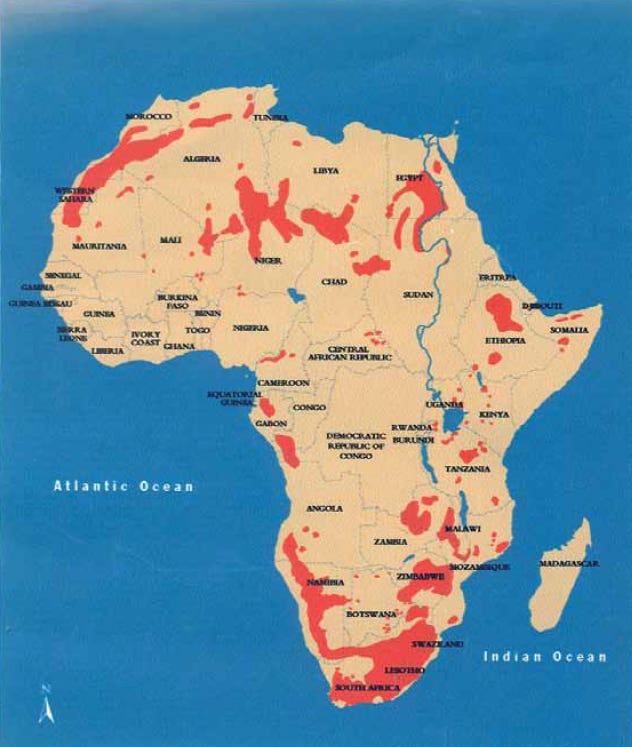
Distribution map for African rock art.
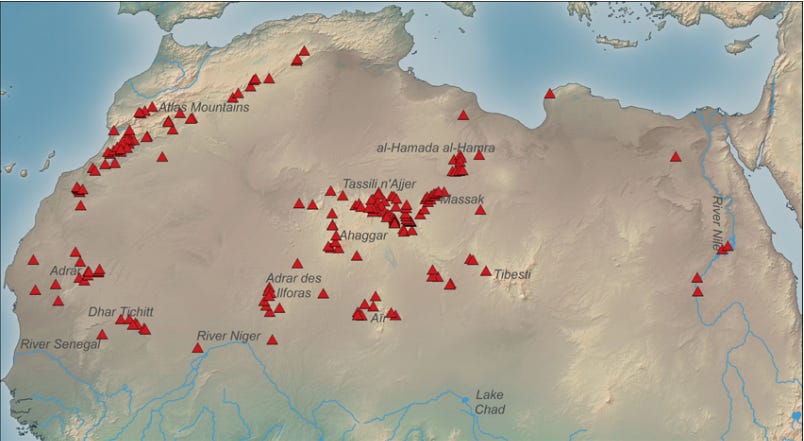
Distribution of chariot and horse rock art from the Sahara. Map by D.J. Mattingly et. al
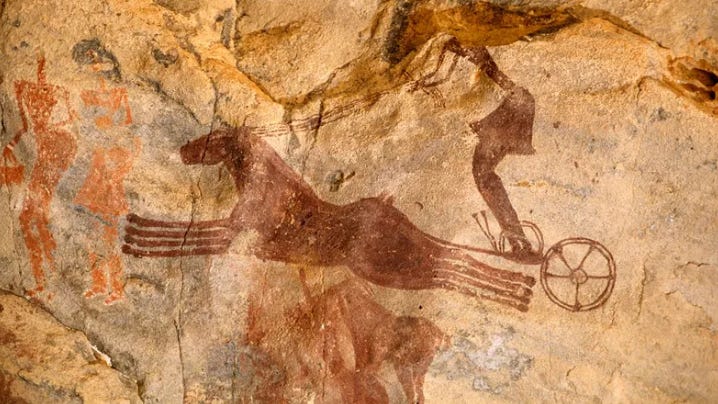
Chariot painting from Tassili n’ Ajjer, Algeria. Image by TARA.3
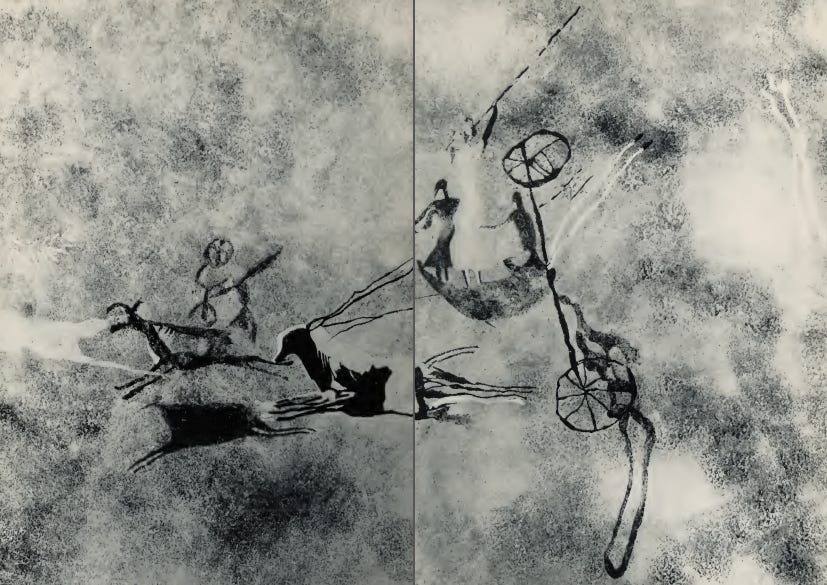
Ala-n-Edoument: War Chariot: Period of the ‘Flying Gallop’ Chariots. Image by Henri Lhote.
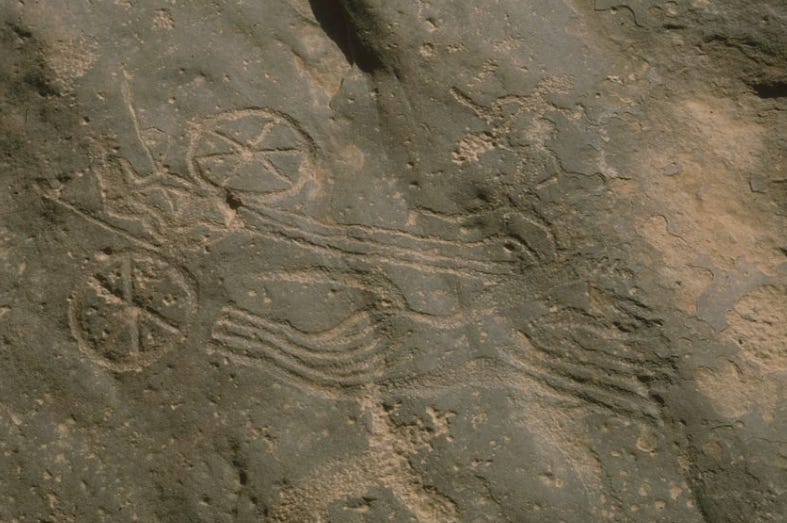
Chariots with horses in a “flying gallop”. Rock engraving from Oued Djerat, Tassili n’Ajjer, Algeria. Wikimedia Commons.
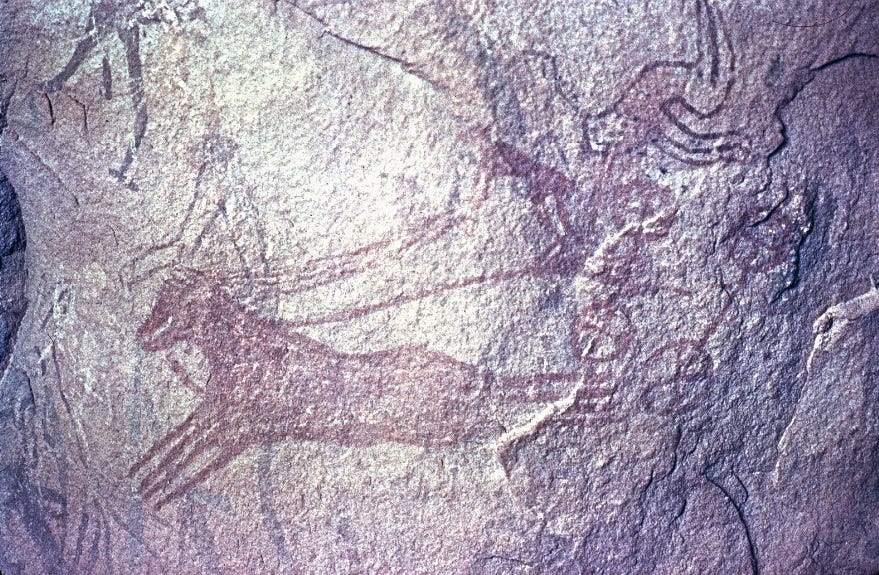
“Titeras n Elias. Four-wheeled chariot. Horse Period.” Tassili n’Ajjer, Algeria. Quai Branly
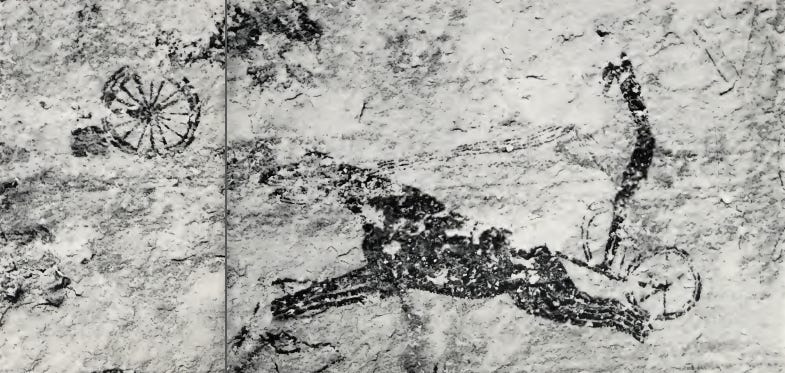
“TADJELAMINE . The detail of the chariot reproduced on the left [bottom] has been shown by itself to indicate the position of the driver, standing on the pole and apparently balancing precariously. As we have already pointed out, it is difficult to imagine a chariot of this sort on a long journey. The vehicle reproduced at the top is unusual in that it is mounted on four wheels.” Images and caption by Jean-Dominique Lajoux.
There has been much discussion of the distribution of the various representations of wheeled vehicles. They have been found along two corridors extending southward across the desert to the bend of the Niger River, originating respectively in Libya and Morocco.
These so-called ‘chariot tracks’ have been interpreted as evidence for trans-Saharan trade some 2,500 years ago. However, this interpretation has been strongly criticized, and there is no other archaeological evidence to substantiate the existence of such long-distance trade networks during this period.4
The archaeologists Sonja and Carlos Magnavita, whose survey of Neolithic sites along the southern margins of the Sahara found no evidence of northern imports dating to the 1st millennium BC, have characterized repeated references to ancient trans-Saharan trade as a ‘factoid,’ i.e., “a speculation or guess that has been repeated so often it is eventually taken for hard fact.”5
Herodotus (4.183), writing in the 5th century BC, provides the earliest and apparently sole ancient reference to the use of “four-horse chariots” by the Garamantes of southwestern Libya against the Troglodyte aithiopians during this period.
A much later reference by Strabo (17.3.7), dating to around 22 CE during the Roman period, mentions the use of “scythe-bearing chariots” by Libyan peoples known as the ‘Pharusians’ and ‘Nigritae.’
Subsequently, a substantial body of literature has been built upon these fragmentary references to argue for a role for the chariot in the expansion of the Afro-Asiatic language family across the ancient Sahara, especially the Imazighen (Berber) languages.6
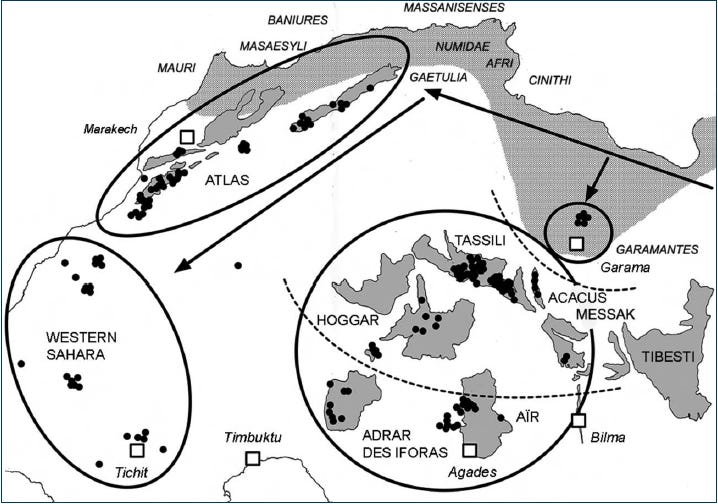
Distribution of chariot engravings. Map by Alain Gallay. In grey: the area in which chariots are mentioned in historical sources. Dashed lines: possible gradient of the distribution of chariots from the shores of the Mediterranean Sea
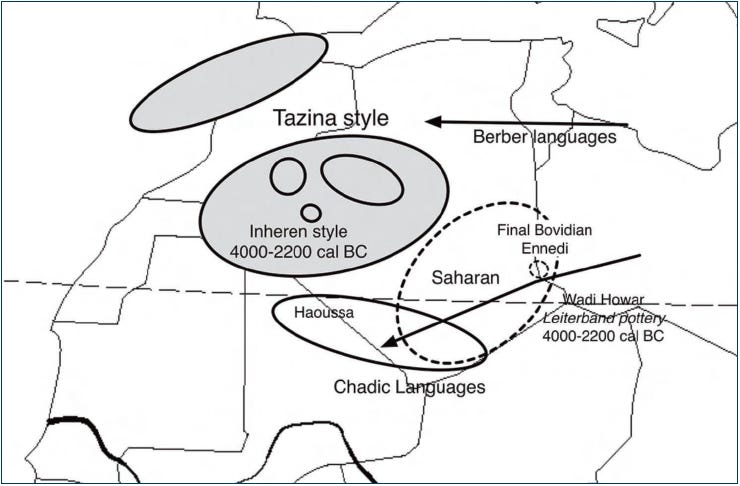
Spread of the Tazina style of rock art and the early spread of the Berber languages. Map by Alain Gallay.7
Such ancient interactions and migrations were often simplified, particularly in colonial literature and early scholarship on the spread of domesticates and technologies, which frequently attributed them to distinct contemporary ethnicities and/or “races.”
The historian Richard Smith, drawing on a range of classical sources concerning the ancient ‘Libyan’ peoples of the Sahara, cautions against assigning fixed ethnic or racial identities to groups described in historical texts.
He points to the existence of enigmatic groups such as the Leukaethiopes (“white Aithiopians”), the Melanogaetulians (“black Gaetulians”), and the Nigritae (“blacks”), who were found alongside other Aithiopians in the northern Sahara..8
The geographers Pomponius Mela (c.43 CE) and Pliny (c.77 CE), who were Strabo’s near-contemporaries, considered the Pharusii and Nigritae, who used “scythe-bearing chariots,” to be aithiopians.9
Interestingly, many images of chariots come from areas of the Central Sahara (such as Tassili n’Ajjer and Akakus) whose rugged terrain was unsuitable for chariots, while comparatively few representations have come from the Garamantian heartlands.10
As the archaeologist David Mattingly observes;
“The idea that the Garamantes travelled long distances across the Sahara in their chariots is clearly nonsensical, as anyone who knows the terrain will attest. But, between the sand and hard rock areas, there are stretches of gravel plain which would have been an ideal surface for chariots and the great advantage of the chariot was that it could easily be disassembled for onward transport and then reassembled for use.”11
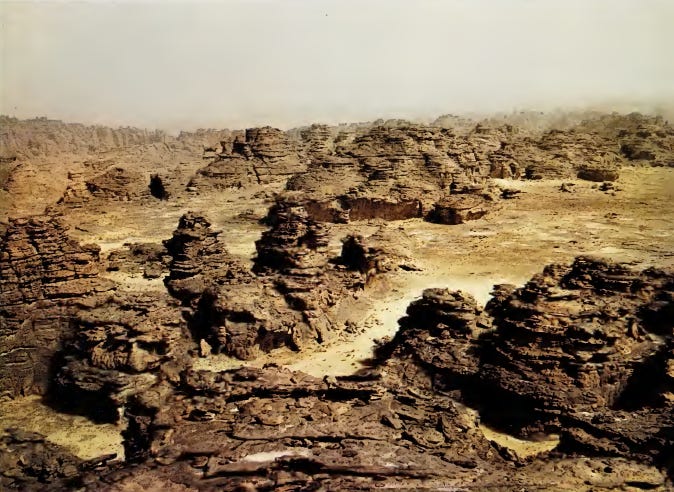
“A typical Tassilian landscape.” S.E. Algeria. Image and caption by Jean-Dominique Lajoux.
According to Léone Allard-Huard, the majority of ancient Saharan chariots were used for ‘individual sport’ and hunting rather than in warfare.12
Among the images of chariots from Tassili n’Ajjer in South-Eastern Algeria reproduced by Léone Allard-Huard, only one depicts a charioteer with a shield; the majority of the riders simply hold whips or reins of the horses.13
Weapons of war such as bows, arrows, and clubs are almost exclusively carried by figures on foot, while the few charioteers shown with javelins likely used them for hunting rather than combat. This pattern contrasts with depictions of chariots from the Nile Valley, which often carry bowmen who are shown engaged in combat.14
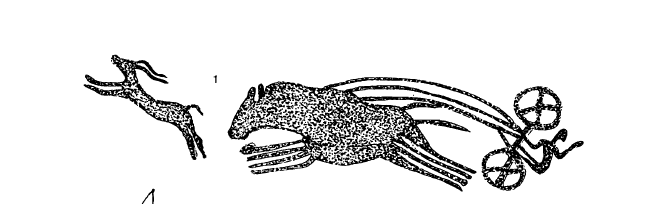
Antelope hunt using a chariot.
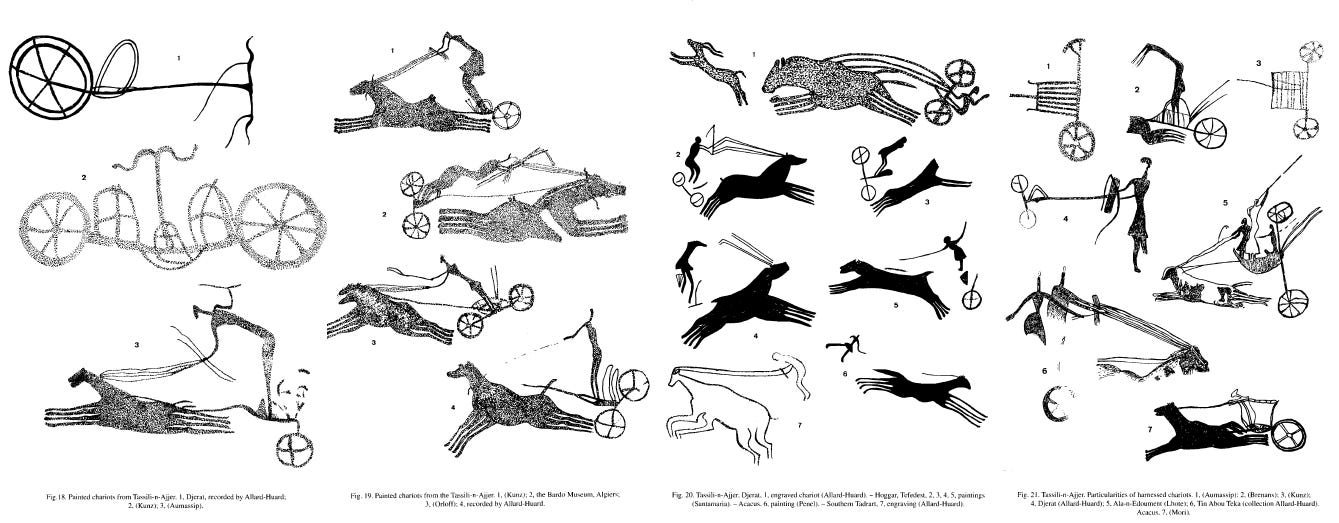
Images of chariots from Tassili n’Ajjer by Léone Allard-Huard
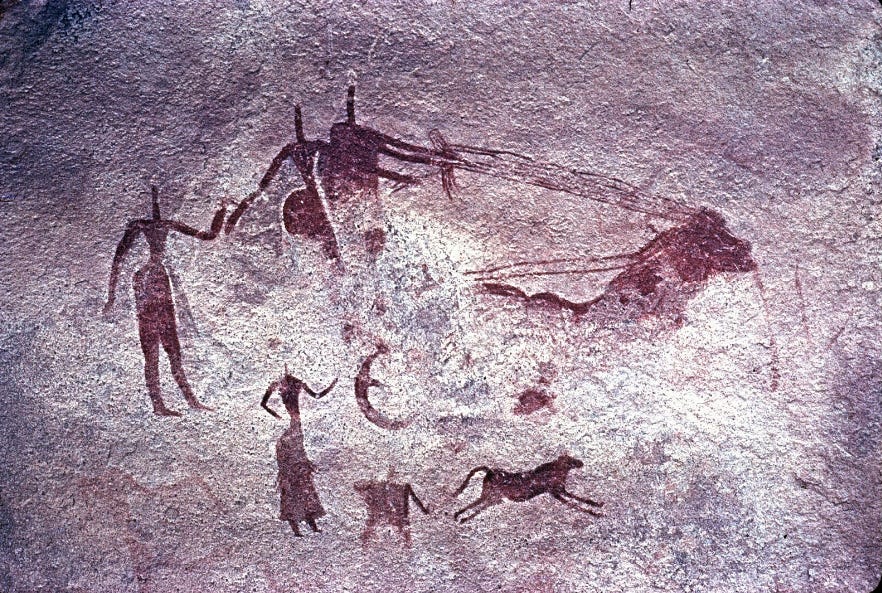
Chariot drawn by galloping horses, with human figures and dogs. Tin Aboteka, Tassili n’Ajjer, Algeria. Quai Branly Museum.
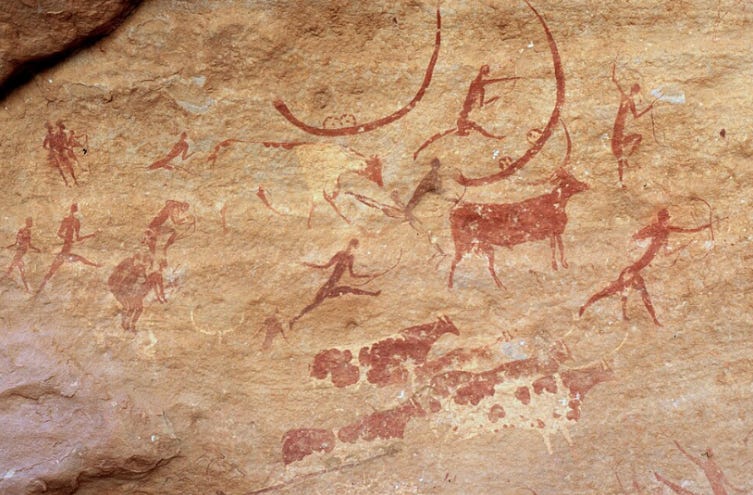
Rock painting depicting archers. Jabbaren, Tassili n’Ajjer, Algeria.
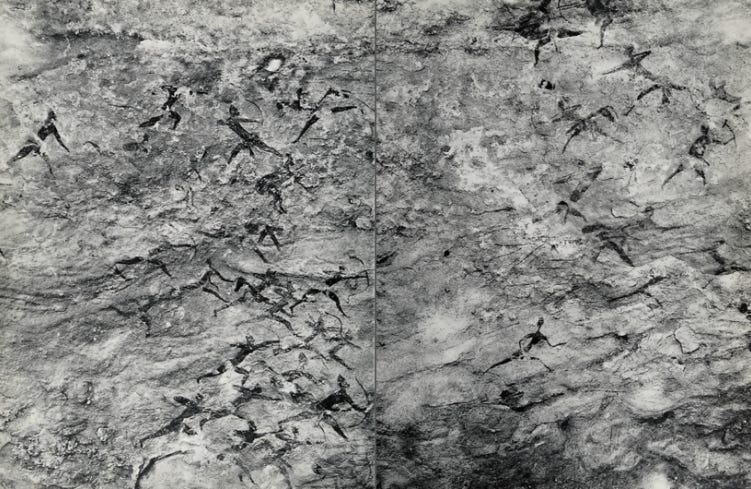
Painting showing a battle scene. Sefar, Tassili n’Ajjer, Algeria.
Despite the wide distribution of chariot depictions in ancient Saharan rock paintings, the introduction of the wheel appears to have had little impact on Saharan societies compared to those of the Nile Valley.
This is especially evident in the kingdom of Kush, where there was extensive use of the wheel in both military and civilian transportation, pottery making, and irrigation.
Moreover, no chariot teams have so far been uncovered in Garamantian graves, in contrast to the four-horse burials associated with the 25th Dynasty kings of Kush, which were found beneath the pyramids of Nuri in Sudan.15
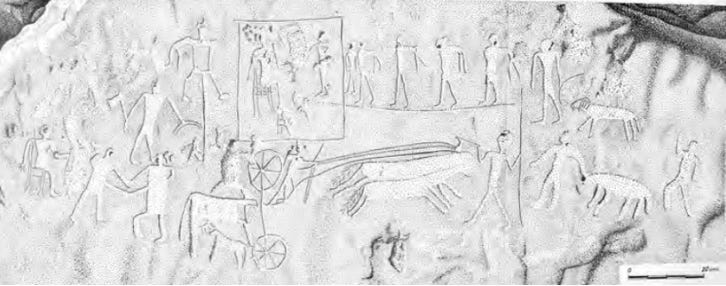
Rock engraving depicting a chariot figure and groups of captives. Found at Nag Kolorodna in lower Nubia. Interpreted as a victory scene for the ruler of Kerma in the 17th century BC based on stylistic similarities with both Kushite and Egyptian art.16
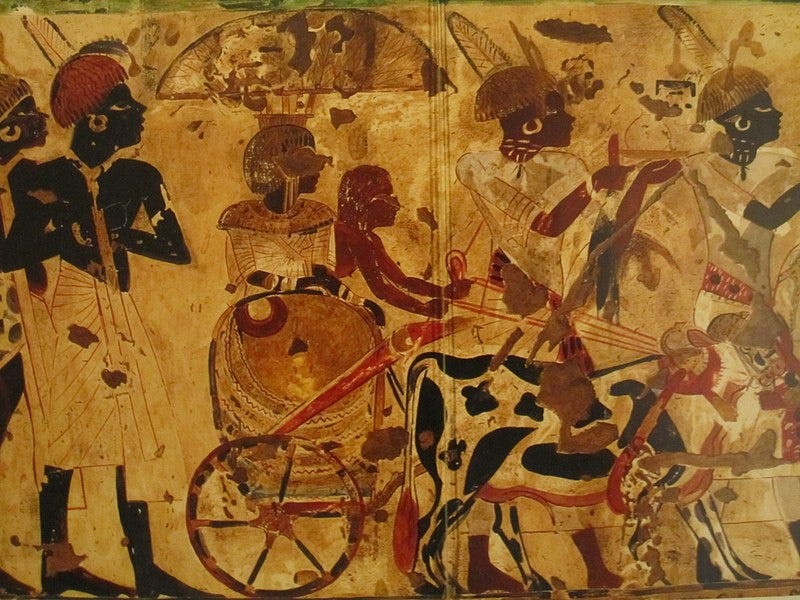
Nubians bringing tribute, Tomb of Huy, Viceroy of Kush under Tutankhamen (ca 1341- 1323 BC)

Colorised image from Temple M250, Meroe, Sudan, depicting a battle scene showing marching figures and a chariot (or wagon?) pulled by a horse. University of Liverpool, ca. 1911.
The intended meanings of the majority of these ancient paintings of Saharan chariots remain elusive, and aren’t immediately decipherable by a present-day observer.
Modern studies of rock paintings often evoke extremely far-fetched speculations: ethnographic art is notorious for revealing as much about its observers as about its makers.17
According to the archaeologist Gabriel Camps, there are no scenes that unequivocally depict the chariots being used in warfare.18
This observation is supported by the fact that the majority of the rock-art images depict bigae (chariots pulled by two horses), rather than quadrigae (drawn by four horses), the latter of which were more commonly used in combat:
“The light Saharan bigae could not have been war chariots, to which, as we have said, no painted or engraved scene actually refers. The presence of a single person on the platform also does not correspond to a warlike use of these machines. Near Eastern war chariots have at least two passengers, the driver and the archer or spearman.
The Ramesside bas-reliefs of Abu Simbel, representing the Battle of Kadesh, show heavy Hittite and Egyptian chariots occupied by three people: the driver, the spearman, and the shield-bearer. It is a royal license that allows the Egyptian artist to so often represent the pharaoh alone on his chariot”
He suggests that the chariots were ‘prestige’ symbols used in ceremonial contexts by the aristocracy of the ancient Saharan communities.19
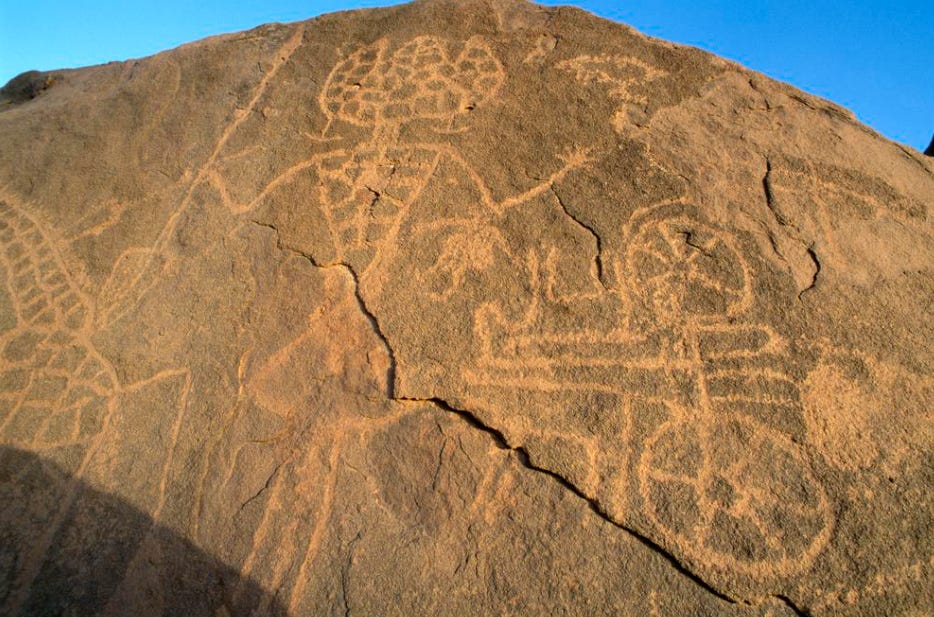
Warrior figure standing next to a flattened-out chariot with two horses, turned to the side, lying back to back. Iwellene, Niger. British Museum.
Scholars have suggested that these images of chariots were created not by the owners of such vehicles themselves, but by groups who came into contact with oasis-based agricultural communities that had adopted horses and chariots.
The images may therefore have served a practical purpose, transmitting knowledge of a potential threat, or simply recording something unfamiliar that had captured the imagination of pastoral communities.20
Whatever their precise purpose, the age of the wheel in the Sahara was abruptly ended by the introduction of the more efficient Camel about 2,000 years ago as increasing aridity transformed the region and the desert expanded.
Yet nearly 5,000 years earlier, the Sahara had been a lush, tropical environment that supported a much greater diversity of domesticated animals and the human societies that kept them.
The highland regions, or massifs, of the Sahara are dotted with thousands of paintings and engravings depicting scenes from a much wetter climate.
The most famous of these sites is Tassili n’Ajjer in southeastern Algeria, once described as “the greatest museum of prehistoric art in the whole world” and now designated a UNESCO World Heritage Site.
Many of the paintings at Tassili are remarkably informative about the lives of the ancient communities that produced them.
They include scenes of hunting, herding, and warfare, alongside more enigmatic depictions of masked dancers and anthropomorphic figures with “Round Heads,” which were rather confusingly nicknamed “Martians.”
Some of these paintings are very detailed and well preserved, displaying a variety of physical profiles that colonial explorers and anthropologists attempted to associate with specific “races” thought to have inhabited the Sahara before its transformation into a barren desert.
Such attributions of particular rock-art styles to different “racial” types have persisted among some professional scholars who study Tassilian art, long after the decline of “race science” in mainstream academia.
More recent approaches have instead drawn on anthropological data from modern nomadic groups, proposing cultural affinities between ancient Saharan imagery and the pastoral ceremonies of the Fulani, the mythological traditions of the Tuareg, and the masked dances of the Dogon.
The rock paintings of Tassili, and the identity of their ancient artists, are the subject of my latest Patreon article.
Please subscribe to read about it here:
Of Kings and Horses: Two New Horse Skeletons from the Royal Cemetery at el-Kurru, Sudan by Claudia Näser and Giulia Mazzetti pg 124.
‘Cheval.’ by G. Camps and S. Chaker p. 1907–1911 In ‘Encyclopédie Berbère 12’, 1993.
Léone Allard-Huard, Nile-Sahara: Dialogue of the Rocks. III. Innovative Peoples: The Horse, Iron and the Camel (Divajeu: chez l’auteur, 2011), pg 35-41. Les chars sahariens. Images d’une société aristocratique by Gabriel Camps pg 13-17
fig 19, n.1 in Nile-Sahara: Dialogue of the Rocks. III. Innovative Peoples: The Horse, Iron and the Camel, by Léone Allard-Huard, pg 37
Forgotten Africa: An Introduction to Its Archaeology by Graham Connah, pg 38
All that Glitters is Not Gold: Facing the Myths of Ancient Trade between North and Sub-Saharan Africa by Sonja Magnavita and Carlos Magnavita
Beyond Barbarians: The Garamantes of the Libyan Sahara by David J. Mattingly, pg 76, in ‘A Companion to North Africa in Antiquity,’ edited by Bruce Hitchner
In some of his more recent work, Mattingly seems to have revised his earlier position regarding the nature of Garamatians’ southern contacts:
“Older ideas of “Berber migrations” need to be re-evaluated with a greater awareness of the potential complexities of this sort of process. To start with, there seems no good reason to postulate mass population movements of horse-owning “Berbers” into the Sahara. Rather, small groups equipped with horses and key technological knowledge that supported oasis development could have implanted themselves within existing Saharan communities.
Our ancient sources hint at the ethnic diversity of the Sahara, when the neat binary categories of “white” Gaetuli and “black” Aethiopes populations quickly collapse into the acknowledgement of Melanogaetuli (”dark-skinned Gaetuli”), Leucoaethiopes (”white Aethiopians”), and the sources vacillated between describing the Garamantes as black or light-skinned.
The osteological evidence from the Sahara has long been recognised to relate to mixed populations from an early date. Much more analysis is needed from different Saharan, Sub-Saharan and Maghrebian regions, with extensive sampling for isotopic markers and aDNA. The key point is that we need to move away from the colonialist assumptions of “white” incomers conquering “black” inhabitants and imposing a pre-defined “Berber” culture on them.”
Echoes of Africa’s Past. Archaeological explorations in the Anthropocene by Savino Di Lernia, pg. 251
Megaliths of the World, edited by Luc Laporte
What Happened to the Ancient Libyans? Chasing Sources across the Sahara from Herodotus to Ibn Khaldun by Richard L. Smith pg 475-477
‘Pharousii / Pharusii / Perusii’ by Jehan Desanges, pp. 6217-6219. In ‘Encyclopédie Berbère’ 2015. Pomponius Mela: Geography of the World: Translation and Commentary by Georgia Irby, pg 108
‘A Companion to North Africa in Antiquity,’ edited by Bruce Hitchner pg 77. Nile-Sahara: Dialogue of the Rocks. III. Innovative Peoples: The Horse, Iron and the Camel, by Léone Allard-Huard, pg 39
The Archaeology of Fazzan, Volume 1: Synthesis, edited by David J. Mattingly, pg 88, 345
Nile-Sahara: Dialogue of the Rocks. III. Innovative Peoples: The Horse, Iron and the Camel, by Léone Allard-Huard, pg 41, 45-46
Camps suggests that the exceptional figure from Oued Djeratwasn’t a warrior either:
“We think that there is simply a partial superposition and that the chariot, drawn on a much smaller scale than the combatants, does not belong to the scene. In fact, the driver alone on his chariot is never shown in a menacing attitude. Even when he holds one or more javelins, he is never depicted in a throwing position. The weapon is never pointed horizontally toward an absent enemy. On the other hand, he often brandishes his whip or a two-corded cat-o’-nine-tails to activate the race of his horses.”
Les chars sahariens. Images d’une société aristocratique by Gabriel Camps, pg 36
Les chars sahariens. Images d’une société aristocratique by Gabriel Camps, pg 36-39
Symbolic equids and Kushite state formation: a horse burial at Tombos by Sarah A. Schrader pg 387
The Oxford Handbook of Ancient Nubia edited by Geoff Emberling, Bruce Williams pg 191, 196 n.41
Rock Art Studies - News of the World Volume 3 by Natalie R. Franklin, Matthias Strecker, pg 80-81
Les chars sahariens. Images d’une société aristocratique by Gabriel Camps, pg 36-39
Les chars sahariens. Images d’une société aristocratique by Gabriel Camps
The Archaeology of Fazzan, Volume 1: Synthesis, edited by David J. Mattingly, pg 345-346