

The Camel has an almost mythical place in the lore of the desert. Our modern image of the Sahara conjures up caravans of hundreds or thousands of camels, moving in long procession along the major trans-Saharan highways.
These resilient pack animals played a decisive role in revolutionizing trade and travel across the desert. Beyond their use as pack animals, camels also served as draught animals that powered a wide range of technologies, including water-wheels, irrigation systems, and oil mills.
The advent of camels in the Sahara marked a watershed in the demographic and political history of the desert.
What had once been perceived as a forbidding, empty expanse was gradually transformed into a habitable and more controllable environment capable of sustaining extensive networks of trade, communication, and human settlement.
The ‘camel revolution’ can be paralleled in its social and economic consequences with the introduction of motor vehicles during the first half of the 20th century, which similarly reshaped mobility and patterns of interaction across vast distances.
This article examines the history of the camel in Africa and explores its diverse uses among the nomadic and semi-nomadic societies of the continent.
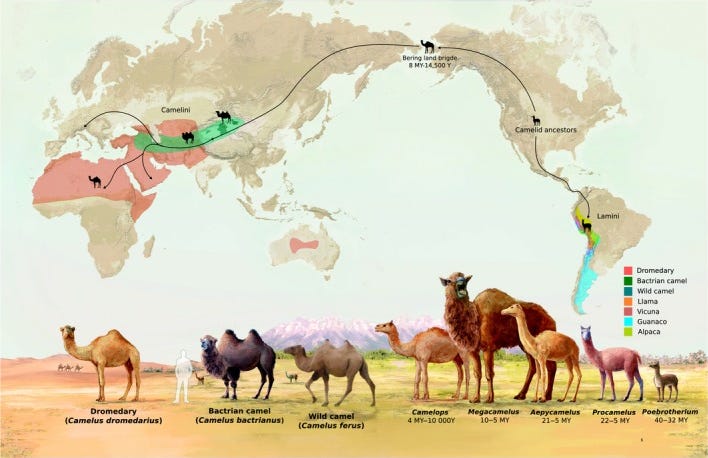
Migration map of the historical camelid family and the current distribution of Dromedaries (red) and Bactrian camels (green).1
Support AfricanHistoryExtra by becoming a member of our Patreon community, subscribe here to read more about African history, download free books, and keep this newsletter free for all:
The Dromedary in Africa: From the classical era to the late Roman period.
The interaction between Humans and Camels stretched back millennia before domestication.
Wild varieties of the Camel were present across northern Africa and the Arabian Peninsula since the Paleolithic period. Camels appear in ancient rock art across the Near East, North Africa, and the Sahara during the prehistoric era, but these representations likely depicted wild species that were hunted.2
The domestication of dromedaries likely occurred in the late 2nd millennium BC.3 Depictions of saddled camels from various regions in Mesopotamia and Arabia dating to the early 1st millennium BC indicate that the single-humped dromedary camel (Camelus dromedarius) was domesticated shortly before this period. It was later introduced to Egypt by the mid-1st millennium BC during the Assyrian conquest.4
The earliest identified camel skeletal material in the Maghreb has been excavated from Carthage in Tunisia and is dated to the 5th to 3rd centuries BC. Camel remains have also been identified at the Garamantian capital of Jarma, Libya, in the 2nd century CE.5
The earliest renderings of camels in Egypt, and those found on Assyrian wall reliefs of military camps depicting their invasions of Egypt, do not distinguish between riding mounts and pack animals. By the 3rd century BC, under Ptolemaic rule, camels had come into general use for transport on the desert route between Coptos and the Red Sea that would remain in use during the Roman period.6
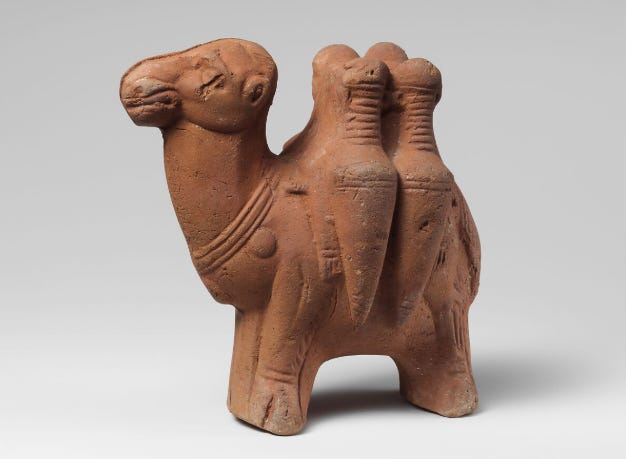
Terracotta figurine of a camel carrying transport amphorae. Roman, Egyptian. late 2nd–early 3rd century CE. Met Museum.
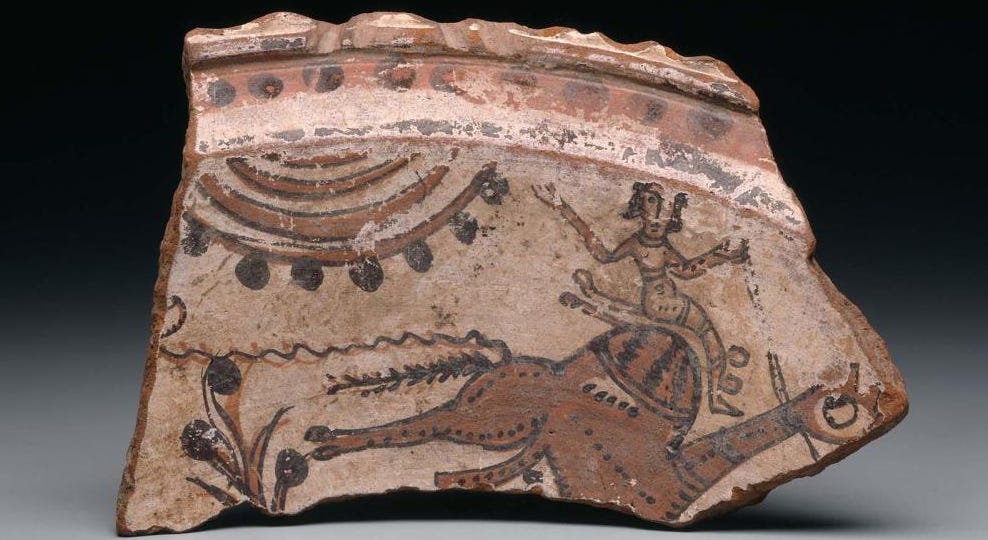
Painted vessel fragment depicting a woman atop a camel. Egyptian-Byzantine (Coptic) Period, 7th century A.D. Boston Museum of Fine Arts.
Romans encountered dromedaries in North Africa as early as 46 BC when Caesar defeated King Juba of Numidia and captured twenty-two camels as booty. Classical sources indicate that both Dromedary and Bactrian camels were used in civilian transport and later in military contexts, with distinctions between the camelus, which was a slow animal used for freight services, and the dromas, which was relatively fast.7
The use of Camels spread across much of the Roman world, not just in the semi-arid regions of the south and East, but also across Western Europe, where camel remains have been found in a variety of archaeological sites from the 3rd to 5th century.8
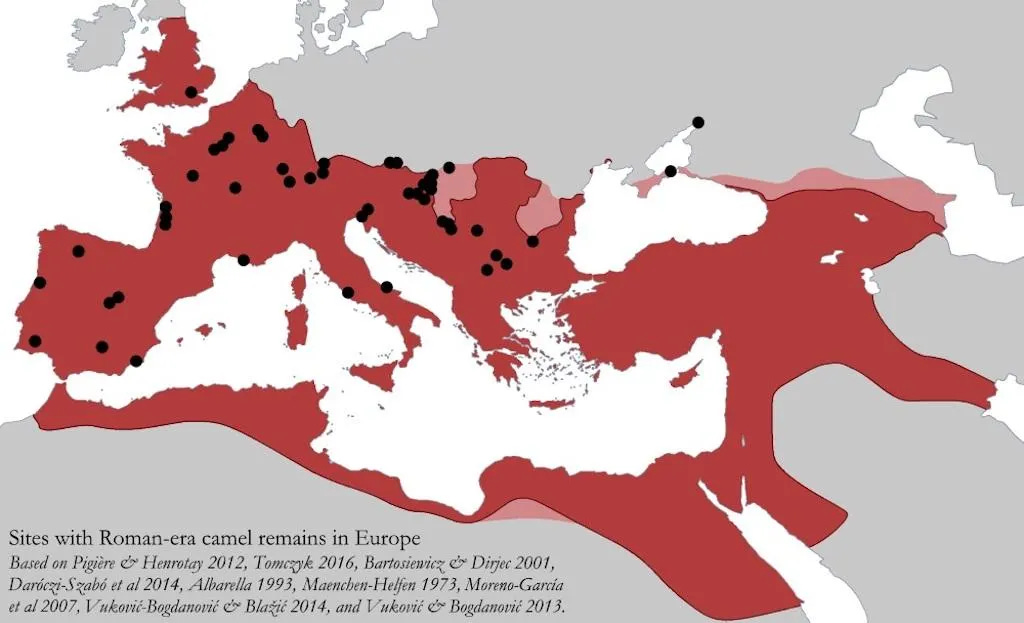
Distribution of finds of camel remains in Europe. Map by C. R. Green
In Roman Africa, sculptured scenes of agricultural life in the Tripolitanian hinterland that include depictions of Camels as plough animals point to the animals’ expanded use by the 3rd century CE. Short-distance routes between settlements previously dictated by horse and chariot could be extended into long-distance routes into the desert undertaken on camelback.9
A variety of autochthonous African groups within and along the frontier of Roman North Africa extensively bred camels, initially using them in trade and later for raids into the weakening empire. Key among these were the tribal confederations of the Numidians, the Austuriani, and the Garamantes.10
A text referring to the Austuriani raid of the city of Lepcis (Libya) in 364 indicates the latter’s inhabitants possessed a significant number of camels, with the Romans intending to requisition as many as 4,000 camels from the urbanites to defend the city.11
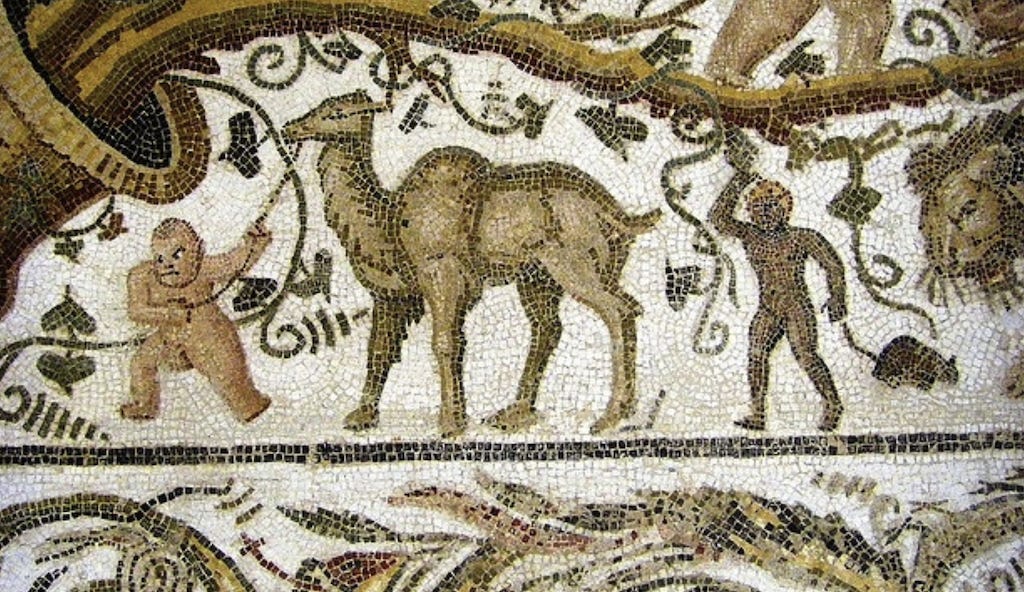
A camel from the ‘Mosaic of Silenus’ of Thysdrus. El Djem, Tunisia, 3rd c. CE, Wikimedia Commons
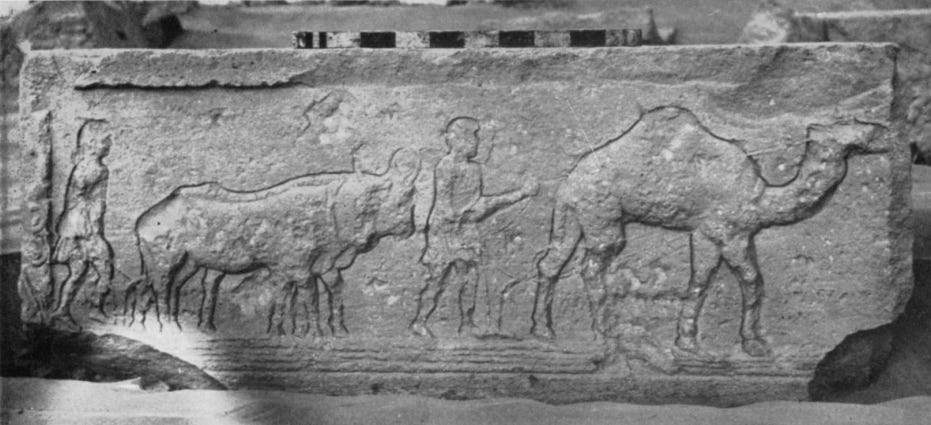
Henscir el-Ausaf, Tigi, Western Gefara: Ploughing Scene. ca. 3rd century CE.12
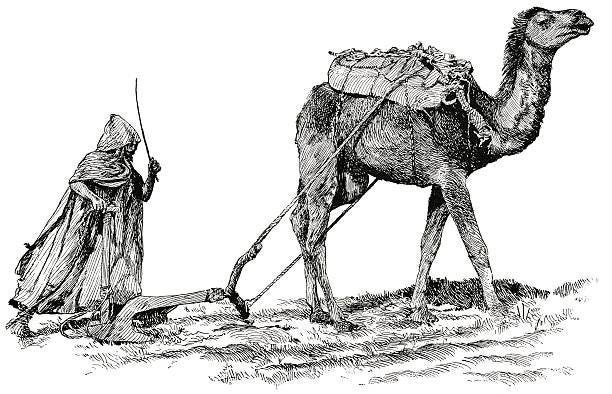
Farmer and Camel Plowing Field, Algeria, Africa, by Marshall M. Kirman, 1895.
According to the historian Richard W. Bulliet, during the late Roman period, the Camel and the mounted horseman largely replaced wheeled carriages across the Roman world, in both long-distance trade and warfare across much of North Africa, Western Asia, and Europe.13
Estimates on transport costs according to the Edict of the Maximum Diocletian (c. 301 CE) suggest that transport by Camels and donkeys was about 20% less expensive than overland transport by wheeled carts, although both means were more expensive than maritime transport. These estimates demonstrate the relative efficiency and low cost of pack animals over purchasing and maintaining wheeled carts.14
According to Stéphanie Guédon and Roger Bagnall, in the late Roman period, camel transport for long distances complemented preexisting forms of short-distance transport such as donkeys, horses, and wheeled carts on roads, the last of which remained in use at least until the Arab conquest in the 8th century.15
However, in the more southerly regions, the fact that rock-art depicting horse-drawn chariots from the Central and Western Sahara is almost never associated with images of Camels and Camel-riders is strongly suggestive of Bulliet’s hypothesis.16
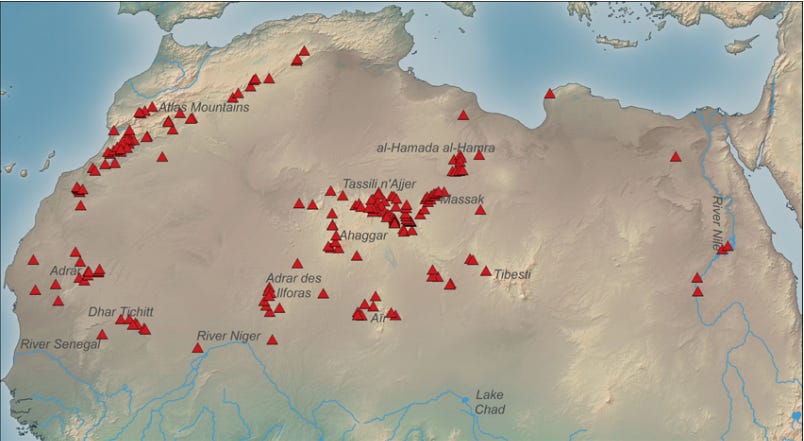
Map showing the distribution of chariot and horse rock art from the Sahara.17
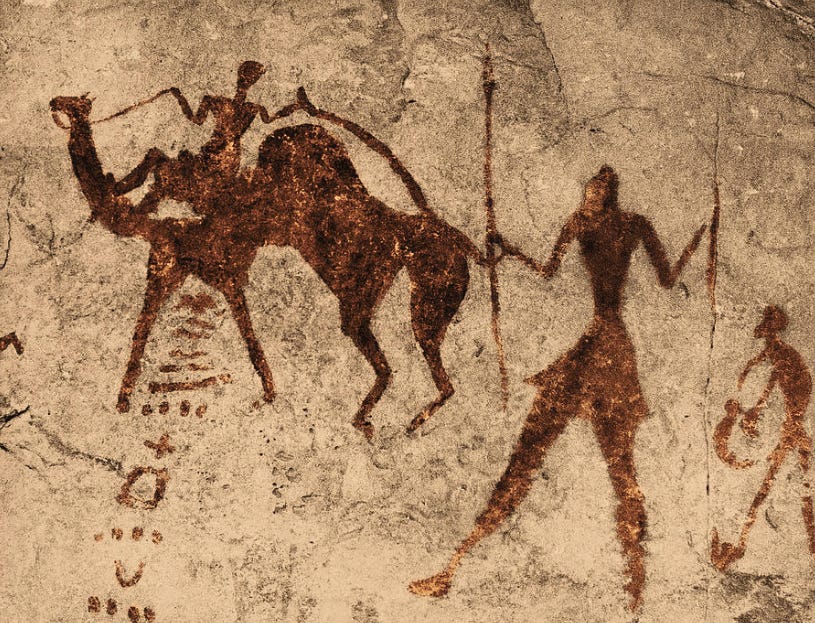
Rock Painting of Camel and Hunter, In Itinen, Tassili N’ajjer, S.E Algeria.
The Camel in Nubia, the Horn and West Africa.
Beyond North Africa and the Sahara, Camels appear in Upper Nubia (Sudan) during the Meroitic period after the 3rd century BC, where they have been found in a number of archeological sites, and extensively depicted in Nubian Art.18
They were also adopted by the nomadic groups of the eastern desert region by the start of the Roman period, and appear in some of the early medieval Nubian records from the 5th century, associated with the Noubadian king Silko.19
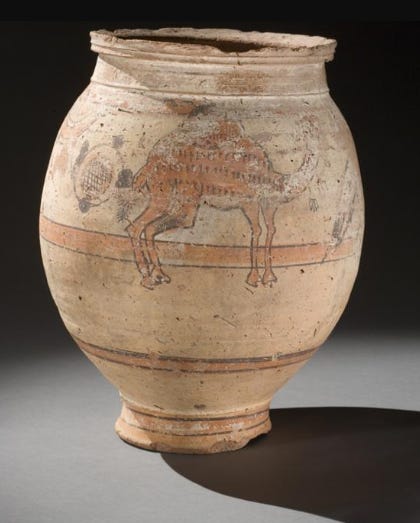
Painted vessel decorated with an image of a camel. Meroitic period (270BC-360CE), Sudan. Smithsonian museum
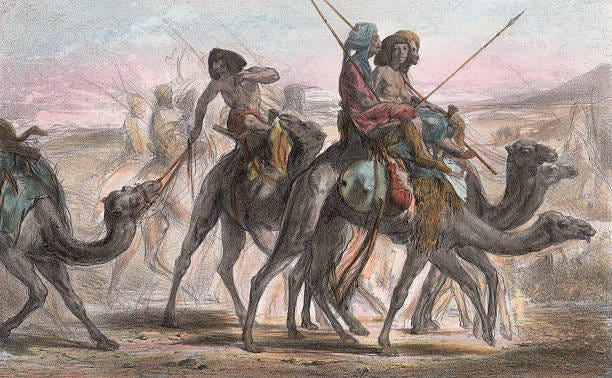
Colour lithograph depicting Nubians on camelback as they travel through Egypt, circa 1850. Getty Images.
In the northern Horn of Africa, camels appear in the ancient rock art, alongside the relatively more numerous depictions of other domesticates such as long-horned, humpless cattle, human figures, sheep, goats, and dogs.20
The dromedary appears in Aksumite inscriptions from the 6th century CE, relating to the low-lying regions of Ethiopia and Eritrea. It is also found in faunal assemblages from the site of Ceel Gerdi in Somaliland, dated to the 1st millennium CE.21
In the central Sahara, the dromedary appears at the end of the 1st millennium BC, during the era aptly named the “Camel Period”.
The earliest depictions show dromedaries mounted or used as pack animals. In later engravings which date from the early 1st millennium CE, era camels carry armed men, with some battle scenes mixing horse-riders and camel-riders together in both parties.22 In some regions, the images of camels are associated with the spread of the Libyco-Berber inscriptions (see rock painting above)
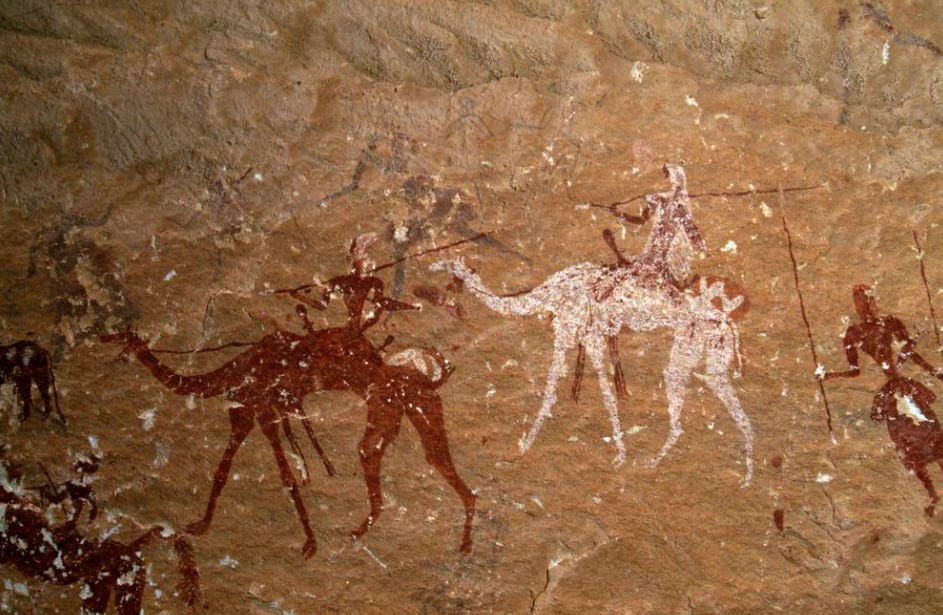
Engraved rock art depicting two riders on camels. Kozen Pass, Tibesti, Chad. British Museum.
The Camel appears in West African archeological sites between 250-400 CE at the site of Siouré along the Middle Senegal Valley, and at Tegdaoust (Mauritania) from the 8th to 13th century during the Islamic period.23
Dromedaries cannot thrive south of the Sahel zone because of their vulnerability to diseases spread by the tse-tse fly, but certain regional varieties used in trade were marginally more successful. Sculptural depictions of Camels in the Lake Chad region from the site of Houlouf (c.AD 1400–1600), corroborate written accounts on the presence of Camels in Bornu and parts of the Hausaland.24
Al-Yaˁqubi, writing in (c. 890), mentions camel nomads, the Anbiya, living south of Sijilmāsa in Morocco. After this date, there are numerous references to Saharan and West African camels by Arab writers, mentioning both its use as a pack animal in medieval Ghana by al Muhallabi (d. 990) and Al-Bakri (c. 1068), for carrying goods, as well as for meat and milk among the Zaghawa of Kanem (Chad) and the polity of Malal (Mali), according to Al-Idrīsī (c. 1154).25
During his journey through medieval Mali in 1353, the globe-trotter Ibn Battuta found camels across the region that were used as pack animals by traders, sold in markets, and at times consumed. His account suggests that they were bred locally, noting that they were cheaper than horses; with one horse costing 100 mithqals, compared to a camel at just 37.5 mithqals.26

Camel caravan approaching Timbuktu, Mali. ca. 1853. Image by Johann Martin Bernatz, based on explorer H. Barth’s sketches.
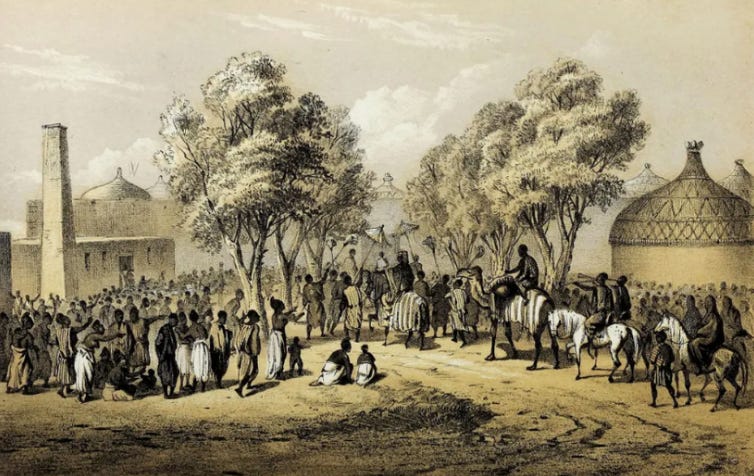
Más-eñá, (kingdom of Bagirmi, Chad) Return of the Sultan from the Expedition, 4th July 1852. By H. Barth.
Along the east African coast, camel bones were found at the medieval Swahili city of Shanga in the Lamu Archipelago of Kenya, around 1050 CE, even though the archipelago now lies beyond their range. The historian Mark Horton suggests that these camels were introduced by inland groups such as the Segeju, who were in contact with coastal and inland societies in northern Kenya and southern Somalia.27
By the 14th century, camels were extensively herded across Somalia's coastal and inland regions.
When Ibn Battuta visited the city of Zeila along the northern coast in 1331, he noted that “Their cattle are camels,” and many of these were slaughtered in the market, giving the city a disagreeable smell. Sailing down to Mogadishu, he mentions that “Its inhabitants are merchants possessed of vast resources; they own large numbers of camels, of which they slaughter hundreds every day [for food].”28
While Ibn Battuta doesn’t mention the presence of Camels along the southern (Swahili) coast, an eyewitness of the 1505 Portuguese attack on Mombasa mentions that the invaders captured “countless camels and a large number of cattle.” Unfortunately, this isolated account doesn’t indicate whether these were used in economic or military contexts.29
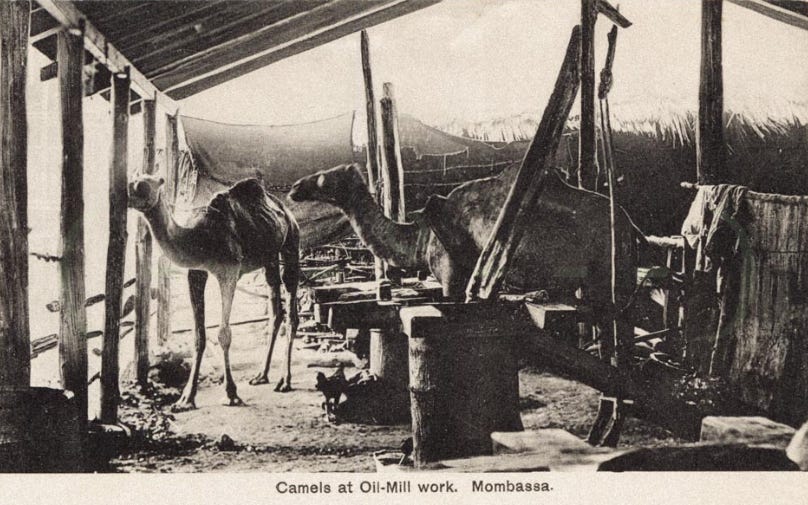
Camel at oil-mill work. Mombasa, Kenya. ca. 1910
The military Camel in African history.
The Camel was employed in military contexts since late antiquity. When the Vandals invaded Africa at the end of the 5th century CE, the nomadic Berber groups of the Atlas mountains were already in possession of numerous camel herds.
They became undisputed masters of the Magreb, using camels to transport supplies and families, for both defensive and offensive military operations, but not as a military mount. According to Procopius, who described their 5th-century battles with the Vandals, the Berbers arranged their camels in concentric rings, protectively surrounding women and children in the center.
In battle, these pack animals were used to form a defensive wall. At the time of the subsequent Byzantine invasion of North Africa, the camel was described as carrying the fortune of the nomad on its back, the household furniture, and the women with supplies perched on its summit.30
The Almoravids, who built a vast empire extending from Mauritania to Spain in the 11th century, came from a section of Sanhaja Berbers who were camel drivers. They invaded Morocco with an army of 30,000 warriors mounted on camels. On the outskirts of Sijilmasa, they captured a herd of 50,000 camels belonging to the Bani Maghrawa, which were later used for trade with West Africa.31
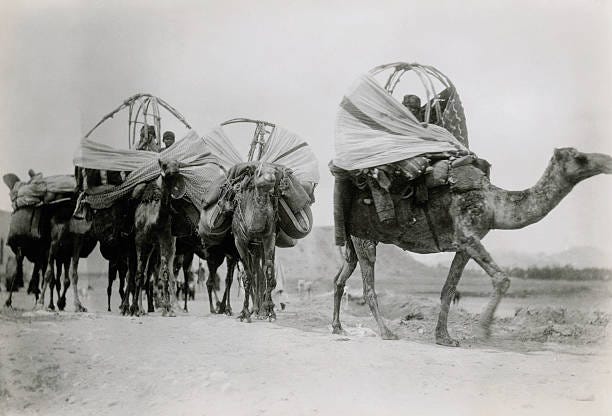
A nomadic people of Algeria, the Bassari (les Bassours), traveling through the Sahara Desert on camels, enroute to a new home. c. 1900. Getty Images.
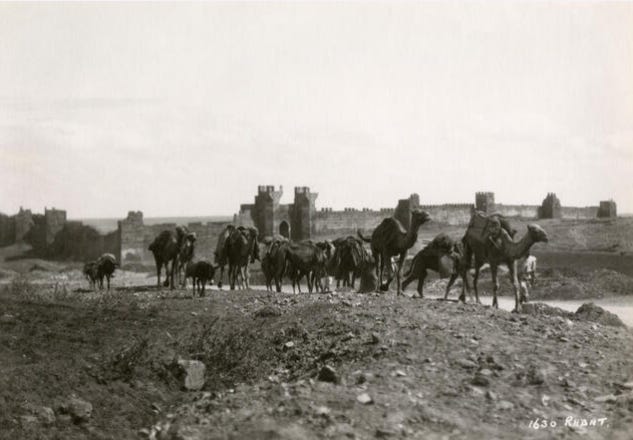
View toward the ancient city walls of Rabat, past a camel caravan. Morocco. ca. 1950s
In his description of West Africa, Al-Bakri (c. 1068) reported, with some exaggeration, that “The ruler of Awdaghust could put 100,000 camelry in the field.” Al-Idrīsī (c. 1154) mentions that the army of the ruler of the city of Gao (in Mali) included a unit that rode on camels and horses.32
The Egyptian chronicler Al-Umari suggests that the army of medieval Mali consisted of mounted horsemen and infantry, mentioning that “they have camels but do not know how to ride them with saddles.”33
This appears to be corroborated by the West African chronicler al-Sa’di (c. 1655), who mentions that when Sunni Ali of Songhai invaded Timbuktu in 1468, the city’s governor assembled 1,000 camels for its scholars. The latter, however, struggled to climb onto the beasts because their fathers never allowed them outside as children to learn how to ride them. They later vowed to teach their children how to ride camels.34
The Songhai empire, which succeeded Mali, employed camels more extensively. According to Leo Africanus’ description from 1520:
“The royal court is very well organized and magnificent. When the king goes from one town to another with his courtiers, he rides a camel, and the horses are led by grooms. If it is necessary to fight, the grooms hobble the camels, and the soldiers all mount the horses.”35
The armies of Songhai included camel units of about 2,000 mounted men, which were, in one instance, sent as far as Morocco in 1540 to conduct a raid in response to threats from the Moroccan sultan to seize the salt mine of Taghaza. When Songhai fell to the Moroccans in 1591, the latter’s army included a unit of 1,000 camel drivers for carrying military equipment and provisions. Many camels were also used to transport the estimated 4 tonnes of gold dust seized from the royal treasury.36
The Bornu chronicler Ahmad Ibn Furtu (c. 1576) suggests that camels were rarely used in Bornu’s military systems before the reign of his patron, Mai Idris Alooma, who “ordered his amirs and captains and chiefs and all, who were able, to buy camels, to make easy travelling in his reign.” However, most of the fighting was done on horseback or on foot, with the camels serving to transport troops.37
In the East, around 748 CE, the Nubian king of Makuria Cyriacus (Kyriakos) invaded Egypt with an army of ‘a hundred thousand horses and a hundred thousand camels.’ While these numbers are exaggerated, camel troops in the army of Makuria are mentioned by the 13th century writer el-Andalusi.38
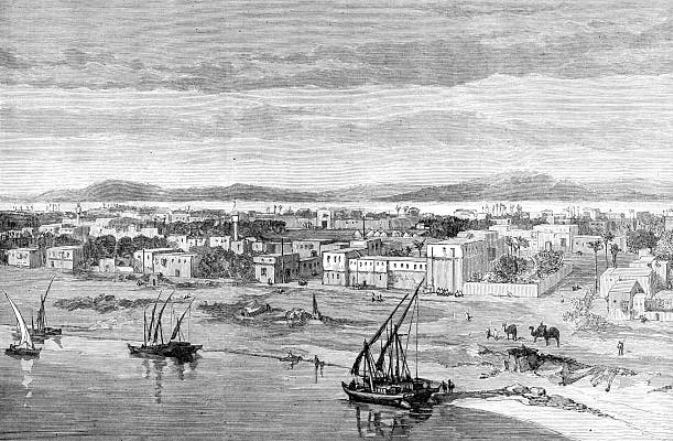
Camels approaching Dongola, Sudan. sketch by Mr. Bakewell, 1883
During the 16th century Adal conquest of Ethiopia, Camels were used to transport troops and military equipment (cannons), but couldn’t travel through the narrow highland passes. The furthest inland settlement visited by camel caravans in the late Middle Ages appears to have been the town of Gendebelu or Gendabelo, in eastern Shewa, where the cannon of Adal were kept.39
Camels continued to be used in warfare in the post-medieval period, and were central to the tribute systems of kingdoms such as Sinnar and Darfur (Sudan), where they were used alongside horses in both military and commercial contexts.40
Horses remained the prerogative of military leaders and royalty, but the success of their campaigns depended on the pack camel. In the sphere of trade, however, the camel’s importance was virtually unrivalled, both in the Sahara and across the semi-arid regions of the Horn of Africa.
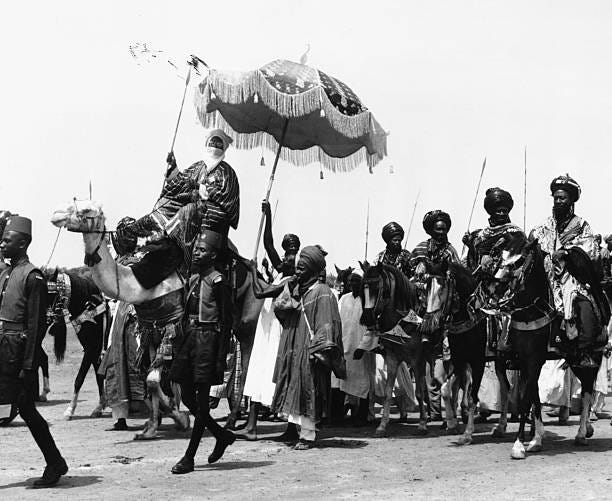
Northern Nigerian Emirs pictured riding camels to a meeting, circa 1960. Getty Images.
The Historical Role of the Camel in African Trade and Industry.
The introduction of the Camel is associated with the rise of trade across the Sahara, especially between North Africa and West Africa, during the late 1st millennium CE.
Although claims for the existence of significant pre-Islamic trade across the Sahara have frequently been advanced, archaeological evidence from West African sites dating to before the Common Era has thus far yielded little indication of imported goods or sustained external commercial exchange. While a few items have been recovered from a handful of sites dating to the mid-1st millennium CE, the bulk of imported trade goods only appear in sufficient quantities after the 8th century CE.41
The archaeologists Sonja and Carlos Magnavita have dismissed such claims of ancient Trans-Saharan trade as ‘factoids,’ i.e., “a speculation or guess that has been repeated so often it is eventually taken for hard fact.”42
[This debate is examined in greater detail in my previous essay on ‘The Garamantian kingdom of the Central Sahara (300BC-500CE)’ ]
Material and textual evidence for trade across the Sahara only appears in the Middle Ages, when Camel carravans formed the basis for exchanges between Saharan communities. It was onto this regional trade system within the Sahara that long-distance trade across the Sahara was grafted, but the former remained more important than the latter.
Summarizing research by several historians, Judith Scheele observes that43:
“No camel ever crossed the Sahara in a straight line, as the distance travelled by one set of pack animals was in most cases limited to around 500 km. Camels are well adapted to the Saharan climate, but they are fragile and need specialist care, and much rest after each continuous effort.
Figures for historic Trans-Saharan and Saharan trade are sporadic and unreliable, but there seems to be no doubt that trade in locally produced and consumed goods regularly exceeded that of Trans-Saharan goods.
Salt is a case in point. Paul Lovejoy estimates that the regional salt trade on the southern edge of the Central Sahara by far exceeded Trans-Saharan trade in value – being worth up to four times as much – and even more so in bulk: in the nineteenth century, while the number of camels involved in Trans-Saharan trade through Tripoli fluctuated between 2,000 and 3,000, salt caravans focused on the mines of Bilma alone drained 20,000 to 30,000 camels a year.
Studying the registers of the Bayruk, a leading commercial family in southern Morocco, Ann McDougall describes the close integration of local, regional and Trans-Saharan affairs, again largely but not exclusively centred on salt. A similar conclusion can be drawn from Ghislaine Lydon’s research on southern Morocco, and from Ulrich Haarmann’s collection and translation of commercial letters produced by traders in Ghadamis in what is now south-western Libya.
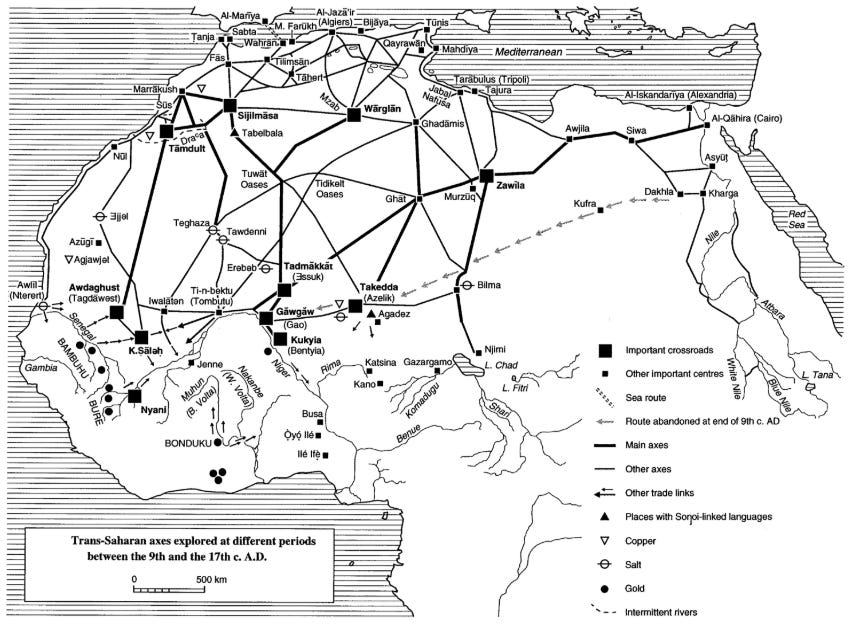
Trans-Saharan axes explored at different periods between the 9th and the 17th century. A.D. Map by Paulo Fernando de Moraes Farias.
The itineraries followed by caravan networks changed over time in response to shifting ecological conditions and the rise or decline of major economic centres.
In the central Sahara, regional trade between the Tuaregs of Air, the Teda/Tubu of Tibesti, the Kanuri of the Kawar oases (at Bilma and Djado), and the Hausa of Damergu and Zinder was heavily dependent on camels. Estimates for the caravan sizes in the 19th century vary dramatically, from 1,500 camels to over 70,000. A caravan of 3,000 camels had about 30 guides (madugu), and could extend over 25 kilometers.
Besides the trade goods, the caravan also carried camel feeds (bales of grass), some of which were at times left in the desert for the return journey. The main product exchanged was salt from Kawar, of which one basin could produce 4-5 tonnes a year, equivalent to 40-50 camel loads, which were exchanged for grain from the south. Elaborate systems of investment and risk-sharing were fundamental to this economy, and part of the surpluses were reinvested in purchasing camels.44
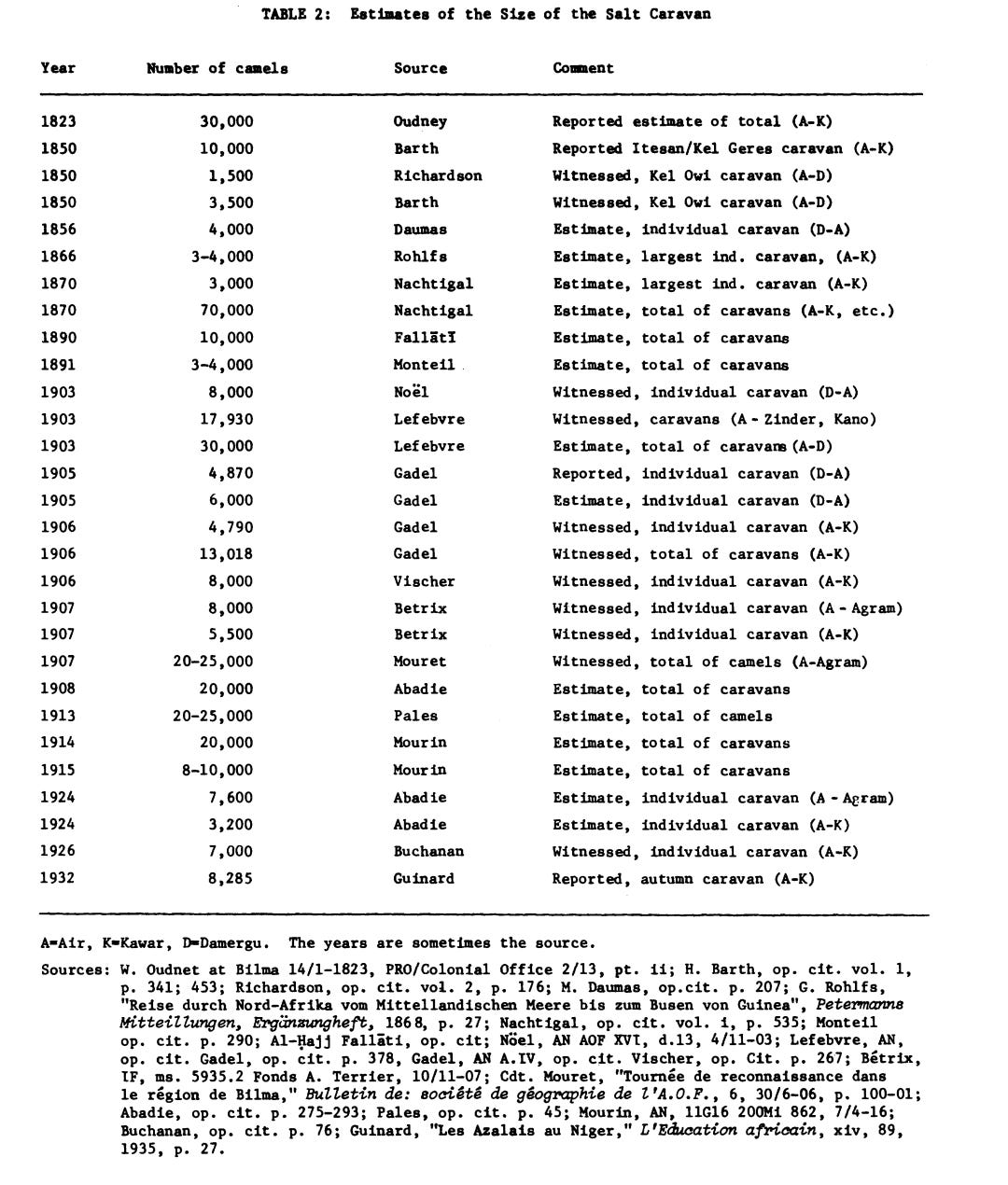
Estimated size of Salt caravans in the central Sahara, by Knut S. Vikør
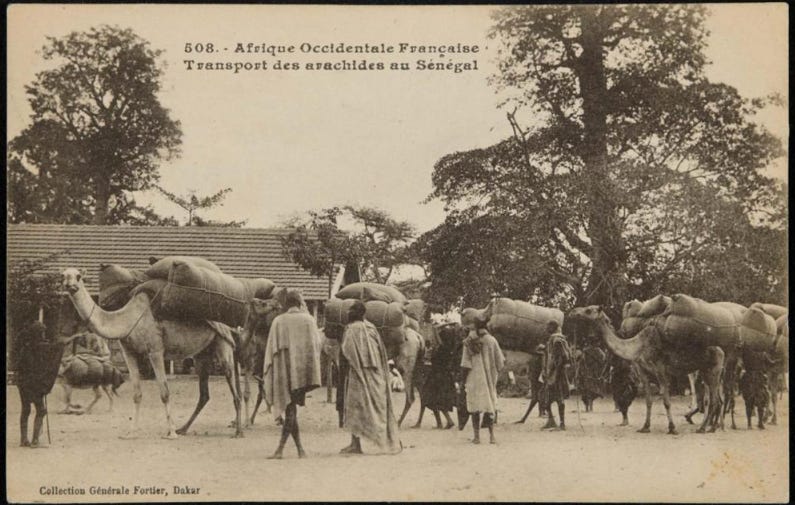
Transport of peanuts in Senegal. ca. 1906. Edmond Fortier.
From North-West Africa to the Horn of Africa, Camels were central to the organization of long-distance trade and the interactions between nomadic and sedentary societies. Across many regions, different nomadic communities specialised in herding camels and hiring them out to traders along known caravan routes.
In Sudan, the Bishariyyin, Ja’ali, and Ababda hired out their camels to the Jallaba (traders), who dominated the routes linking the kingdoms of Sennar, Darfur, Ethiopia, and Egypt. The cost of hiring out the camels and equipping the caravan made heavy demands upon the capital and profit of the jallaba. Camels were bought with imported silver dollars in the Shendi region, while the commodities were obtained on credit and through loans and various forms of partnership arrangements.45
In a number of these societies, Camels were also used to drive water-wheels, an ancient water-lifting device with a compartmented body or rim. These devices first appeared in rural Egypt during the 3rd century BC, from which they spread across the Mediterranean world during the Roman Period.46
Water-wheels (sāqiya) spread to Nubia during the Meroitic period and remain in use to the present day. Like in Egypt, the Nubian sāqiya are mostly powered by oxen.47 It’s only those found across the Maghreb, especially in Morocco, that are powered by Camels.48 In the central Sahara, the 11th-century account of al-Bakri refers to agricultural irrigation by Camels in the town of Zawila in Libya.49
The Dromedary was also harnessed for agricultural labour across parts of Sudan, Ethiopia, Eritrea, and most of North Africa, especially Morocco and Tunisia, since the early 1st millennium CE. Modern studies on draught camels in Ethiopia and Sudan suggest that they are more efficient than oxen, but their labour requirement is generally higher.50
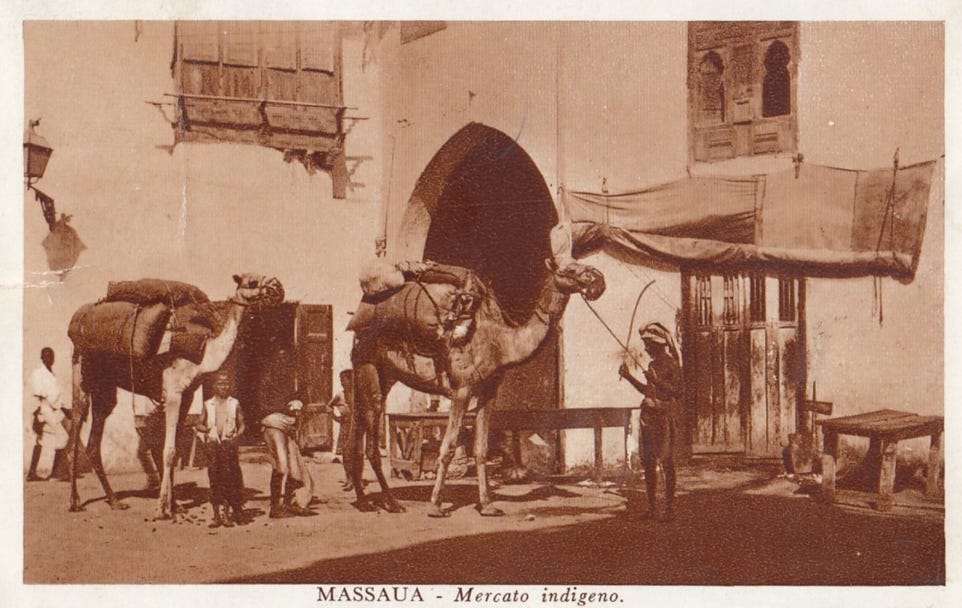
Camels at the local market in Massawa, Eritrea. ca. 1930
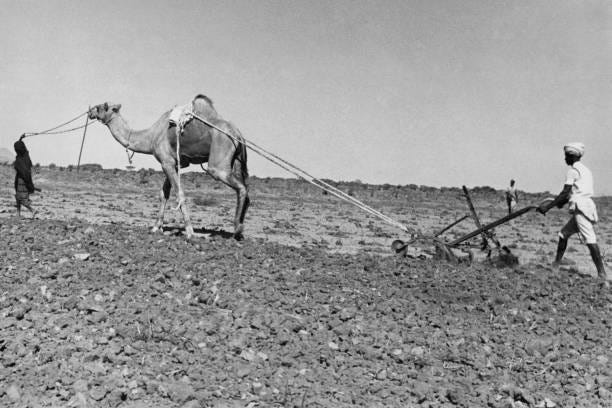
Plowing, Tesseney, Eritrea, ca. 1930. Getty Images.
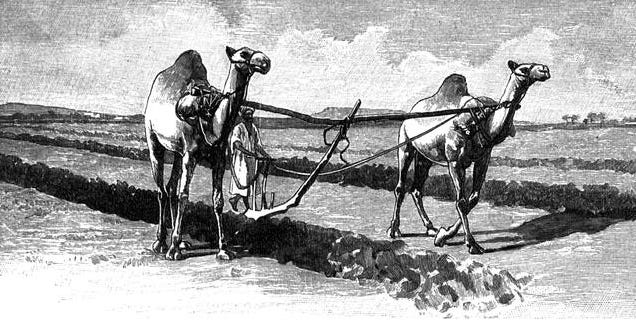
Plough with camel team in Algeria, wood engraving, late 19th century
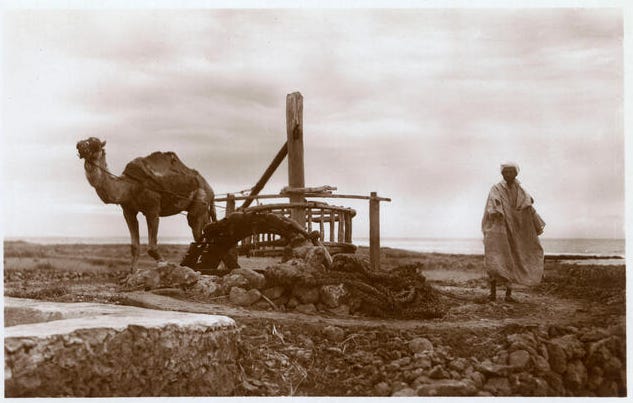
Camel-powered water wheel in Morocco. ca. 1930.
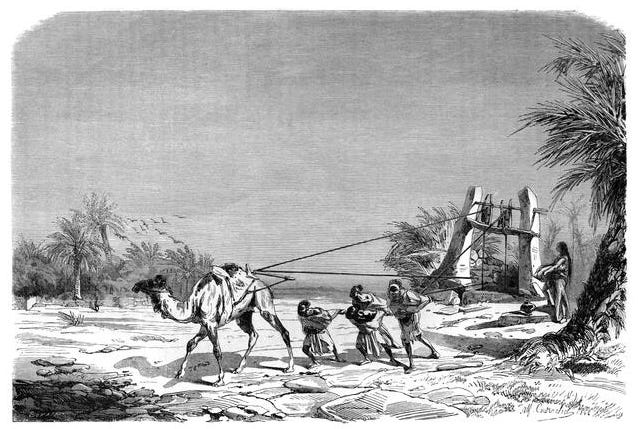
Illustration depicting water lifting from a well in Metlili, Algeria. By Couverchel, ca., 1863
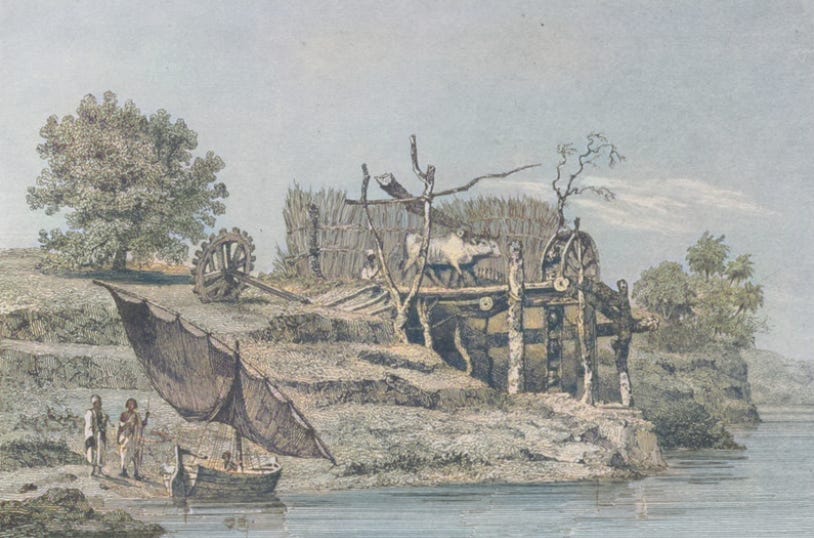
A Nubian sakia wheel powered by bullocks. ca. 1847. Wikimedia Commons.
In East Africa, camels from Somalia were the basis of caravan trade to the interior region of the Horn, and were exported along the coast, where they were used to power sesame-oil mills in the cities of Mogadishu, Zanzibar, Mombasa, and Lamu.51
Historically, for the nomadic societies of Somalia’s mainland, there are considerable advantages to keeping large camel herds in the arid areas of East Africa. Camels give more milk than cattle, for a longer period, do not need frequent watering, travel quickly, and can take advantage of the saline browse of desert regions.52
According to the historian Lee Cassanelli53:
Historically, certain clans were regarded as outstanding breeders of camels, others of cattle, though one could find all types of livestock in virtually all parts of the country. The Garre, who were renowned as breeders of burden camels, supplied the Somali and Oromo caravaneers of the Jubba Basin in the eighteenth century. Coastal townsmen also possessed camels that were grazed in distant pastures by agnates or affines.
Estimates from the early 20th century suggest that an average nomadic family required 10-20 camels, 50-60 sheep and goats, or 15-20 head of cattle to subsist in the normally harsh environment of the Horn. Many family herds, however, were three or four times this size.
Given the low level of commercialization, the accumulation of livestock recorded by many observers of the Somali scene can best be explained as a form of social capital used in bride wealth payments, in collective diya compensation, and in attracting allies or clients, or as a hedge against hard times.”
According to the account of Charles Guillian, who visited the region between 1847-8, trade and transport between the coastal towns of the Benadir (Mogadishu, Merca, and Barawe) and the interior regions of Luqq, was almost entirely conducted on camelback.54
The coastal towns purchased their camels from the “indigenes of the neighboring Soumal tribes, the Abgal, the Odjourane, the Guel-Djaal, the Gogoun’dobé, and by those of the territories of Ganarié and Lébine.” He notes that the best camels came from the territory of Geledi, where they cost 4 to 6 piastres (silver dollars), the cheapest sold for 2 piastres, while the most expensive sold for 10 to 12 piastres.55
In Zanzibar, camels (mostly imported from Somalia) cost 8 piastres for a young animal and 25 or 50 piastres for a good working animal. The latter are employed to run the sesame oil mills all along the coast. The sesame oil obtained from camel-powered mills in Mogadishu and Barawe alone, which was estimated at 23 to 39 tonnes annually, was exported to Zanzibar, Yemen, Oman, and India, while the rest was bought by visiting English and American ships.56
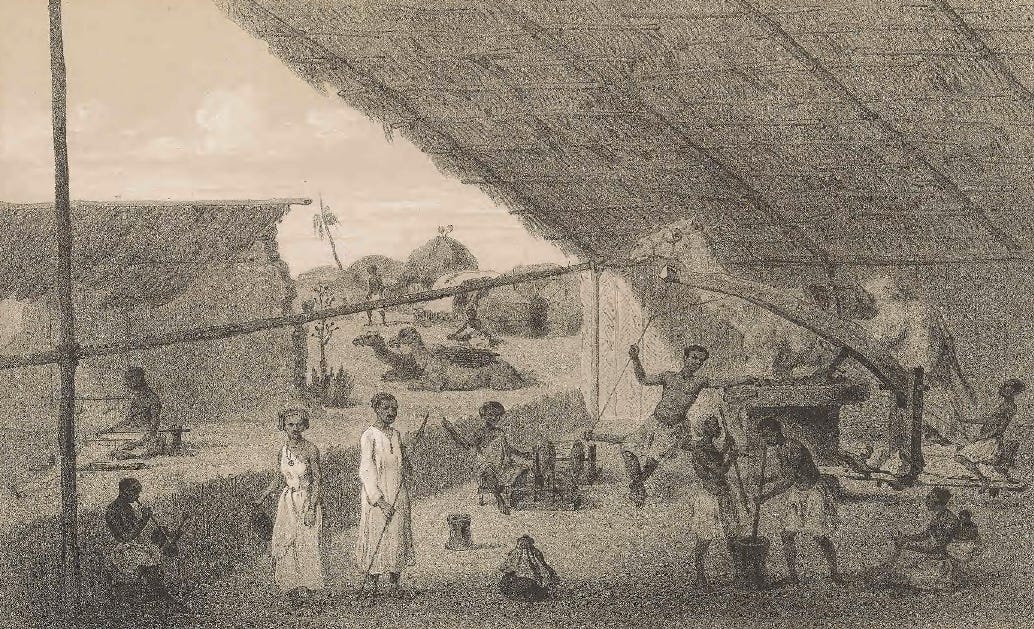
Illustration in Guillain’s Atlas depicting a camel operating a sesame seed press in Mogadishu. ca. 1847-8. Somalia.57
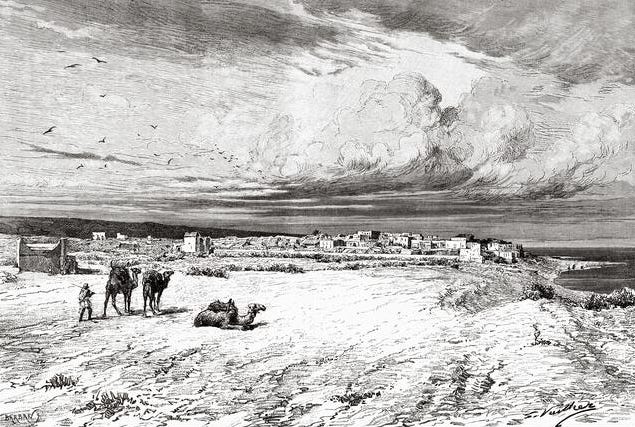
Camels outside Barawa, Somalia. Illustration by G. Revoil, ca. 1888.
Transport and Building technologies of Africa’s Camel keepers.
Many Saharan communities used camels to transport their temporary shelters, such as tents, palanquins, and house frames, which are disassembled, transported, and reassembled with each move. These structures were also modified during social events such as weddings, coronations, and religious ceremonies.
According to Labelle Prussin, the system of building is inseparable from the system of transportation. The components that make up the transport system, i.e., the “saddles,” the litters, and the palanquins, are the same as those that comprise the building system
Among sections of the Somali communities, marriage rituals include repeated processions of the groom and his party to the bride’s community (guro), accompanied by a pack camel loaded with house parts to house the groom’s wedding party at the bride’s community.58
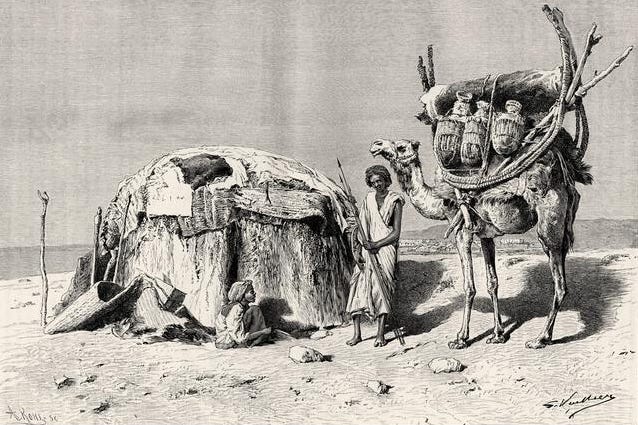
A medjourtine gurgi at Kismayo, Somalia. Image by G. Revoil, 1888.
When camels are used as draft animals, their hump presents no problem, but when used as pack or riding animals, then saddle design becomes a challenge because a heavy load can be carried only if it is distributed so that the skeletal structure bears the brunt of the burden.
The simplest pack saddle is one composed of two forked poles, which in more complex formations, are crossed with other poles and joined with bentwood arches depending on the weight of the load and the type of structure. All subsequent litters and palanquins that carry women, as well as goods, consist of a superstructure of one kind or another fastened above this basic design.59
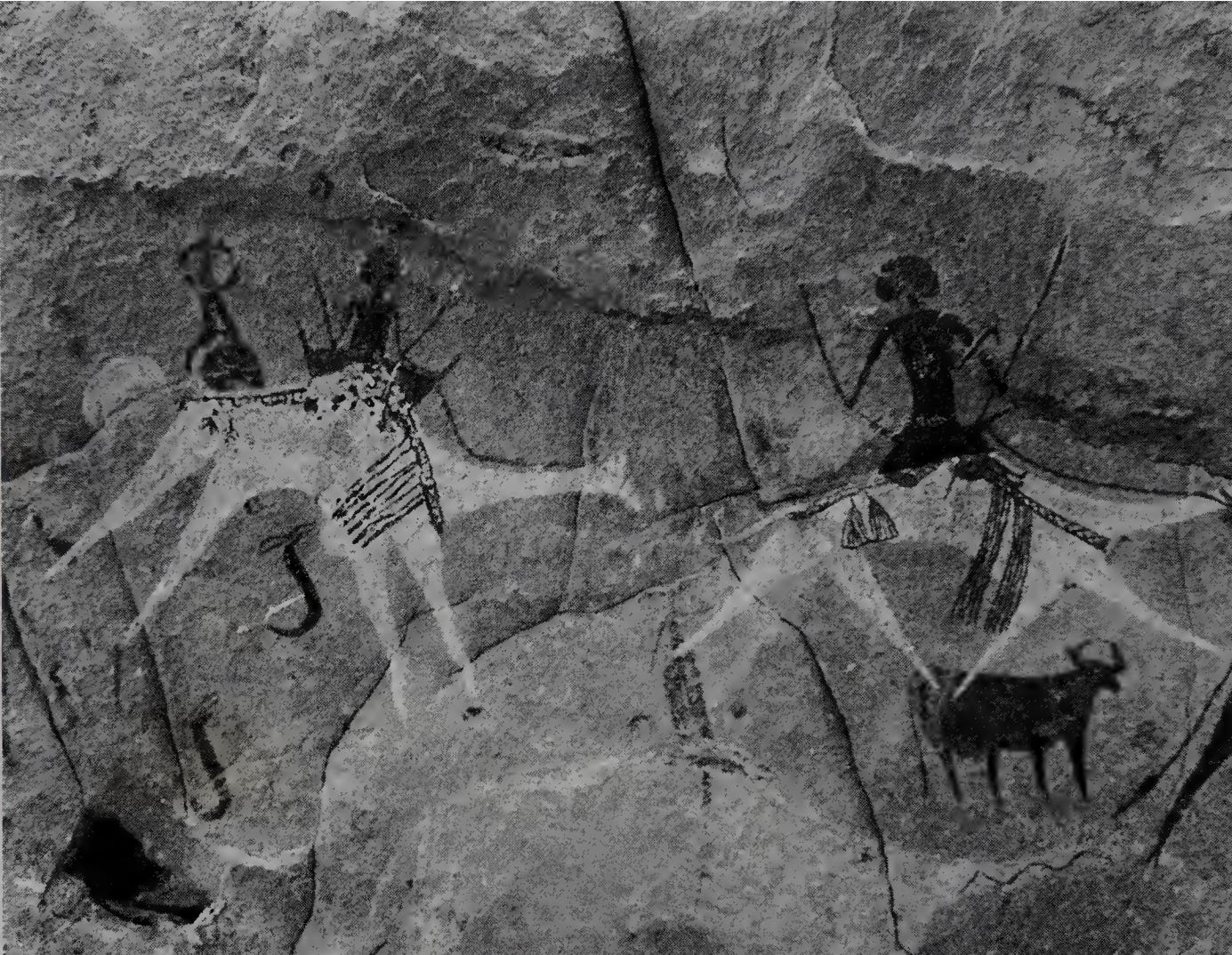
‘Rock painting. Ayou, Tibesti, Chad. The woman on the left is clearly riding in a litter.’ image and caption by L. Prussin
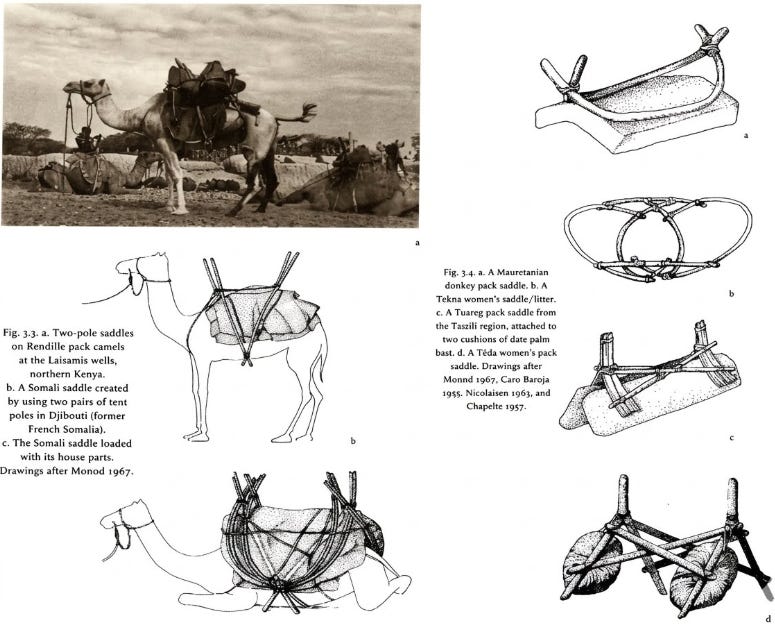
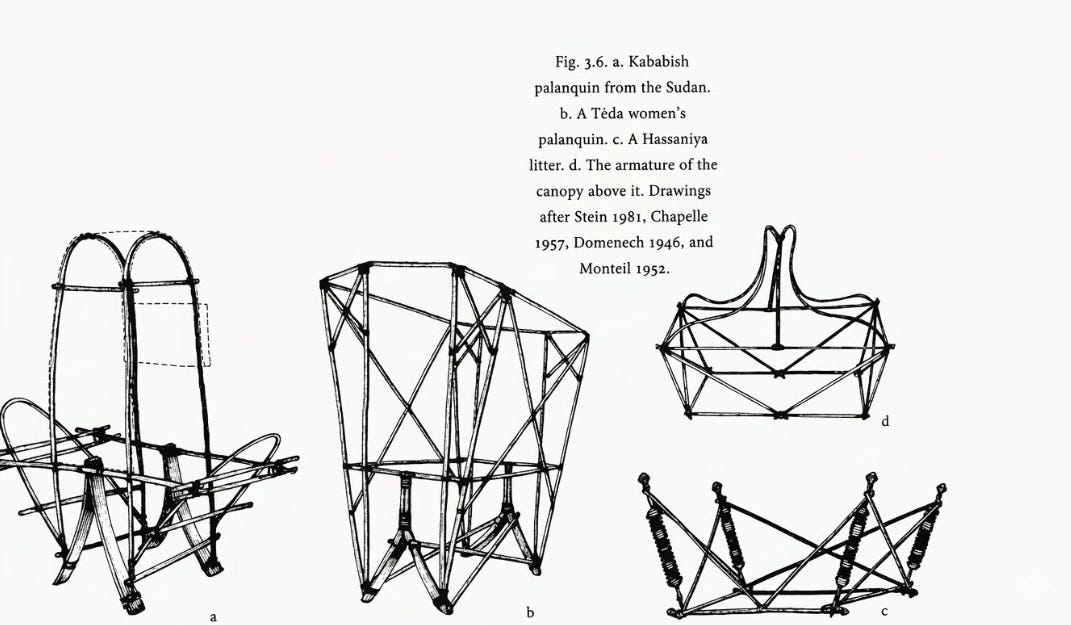
Saddles and Palanquins used by various nomadic groups. Images by L. Prussin
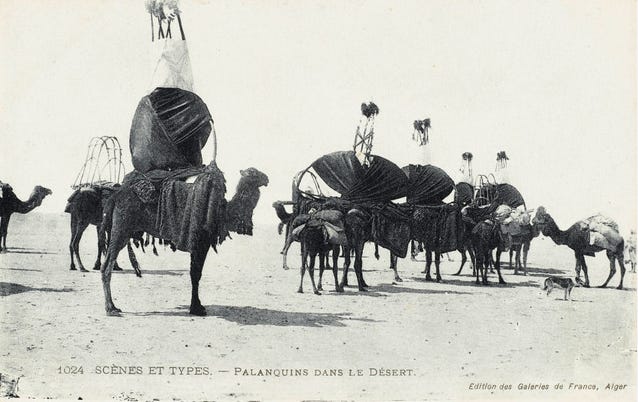
A camel palanquin (covered litter), used to transport wives and children across the arid desert of southern Algeria, each with a central ventilation shaft. ca. 1917
In Somalia, cameleers typically walked beside their dromedaries and only occasionally rode them using simple saddles. Women usually rode them only in the context of a marriage ceremony, when the bentwood members of the armature tent became the framework for a litter. In other nomadic communities such as the Teda, the Tuareg, and the Hassaniya of the Sahara, the palanquin structure is never dismantled.60
The use of palaquin structures on camels was most commonly observed among the Berber-speaking groups of the Maghreb and Western Sahara, as well as a variety of nomadic groups in Egypt and Sudan, such as the Beja and Kababish.
In most of their cultural traditions, each tribe had its palanquin, which served as a banner around which warriors rallied to battle.
In some traditions, the palanquin was occupied by a princess (daughter of the ruler of the tribe) who was adorned as a bride. Capture of the palanquin by the enemy symbolized defeat. But because the palanquin housed a daughter, embedded in the symbolism was a matrilineal heritage and the material accoutrements of the marriage ritual.61
According to Prussin62:
“In defeat, her palanquin, a singular political symbol of Berber unity, would have been confiscated or exchanged as part of the spoils of war. But her palanquin was also a metaphor for marriage, a symbol of matriliny, since she had gone out in it as a bride.
The exodus that followed her defeat may have looked very much like the early sixteenth-century exodus from the Tuareg city of Agades following its Songhay conquest by Askia Muhammed in 1515 which Barth recorded (1857, 5:461-62):
“It is explicitly stated that he drove out five tribes . . . and that a considerable number of Berbers, with five hundred jakhfa (cages mounted on camels, such as only wealthy people can afford to keep for carrying their wives), left the town.”
Some of the less elaborate jakhfa, which had been built as marriage palanquins, would have looked like those he subsequently recorded. In my mind’s eye, the more elegant ones could very well have looked like the noble Tuareg bride’s palanquin recorded in the early nineteenth century at a wedding south of Murzuq, Libya.”
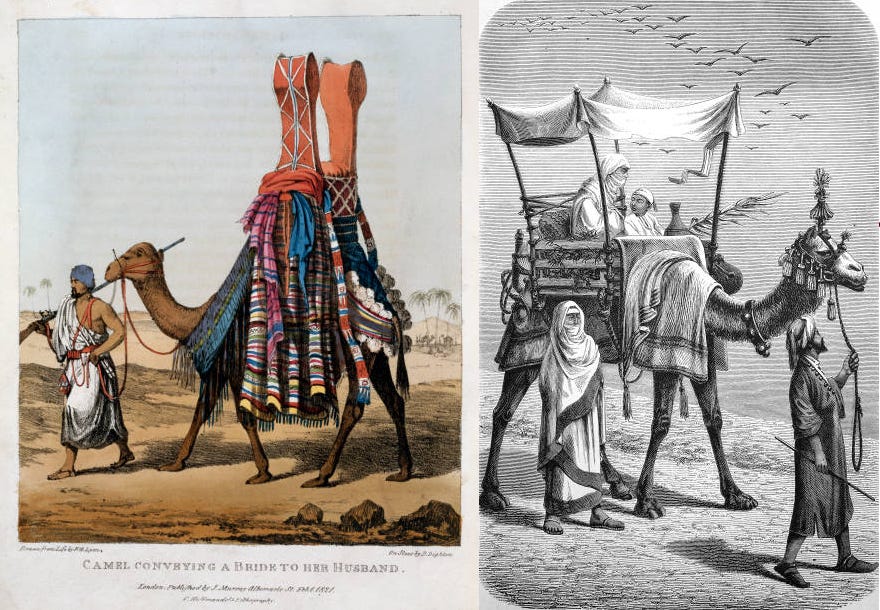
(left) ‘Camel Conveying a Bride to her Husband’, 1821. Plate 16 from A Narrative of Travels in Northern Africa by Captain George Francis Lyon, 1821. (right) Egypt, women on the trip on a camel through the desert, veil, camel drivers, litter, ca 1850. Getty Images.
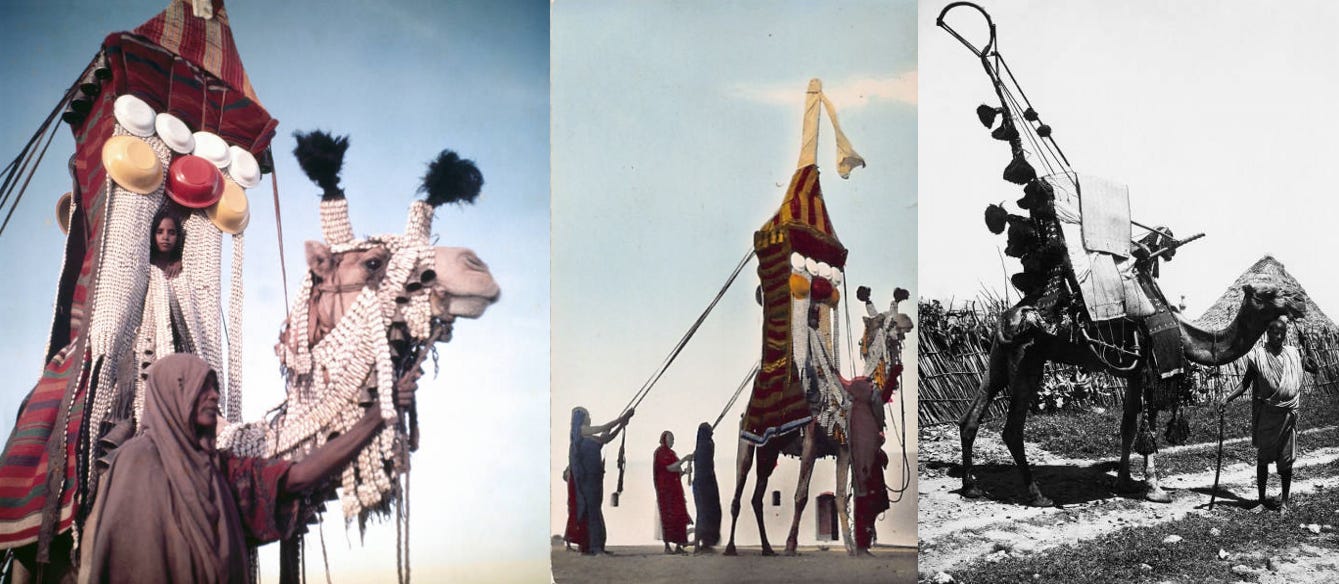
(left to right) Transport d’une jeune mariée sur un dromadaire au Tchad. Moorish wedding procession in Mauritania. Africa, Eritrea, decorated camel carries the bride hidden in the canopy, 1920.
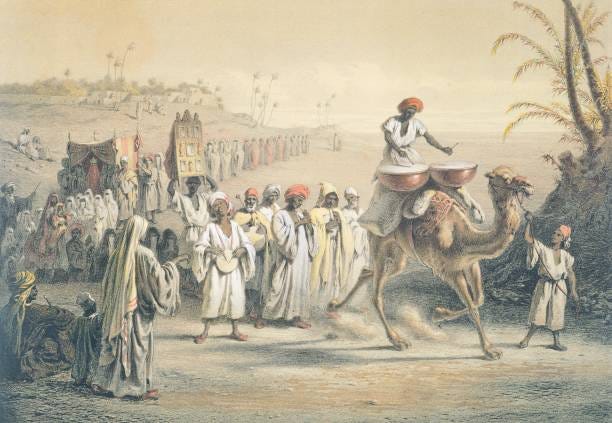
Wedding procession near Siut, by A. Schonn, engraving from a drawing by Louis Libay, ca. 1857, Egypt.
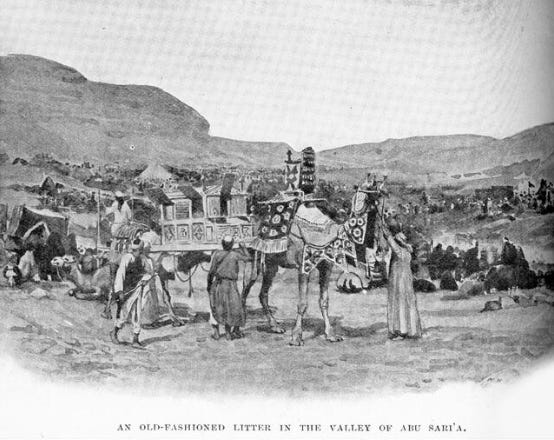
An old-fashioned litter in the valley of Abu Sari’a, Sudan, ca. 1914
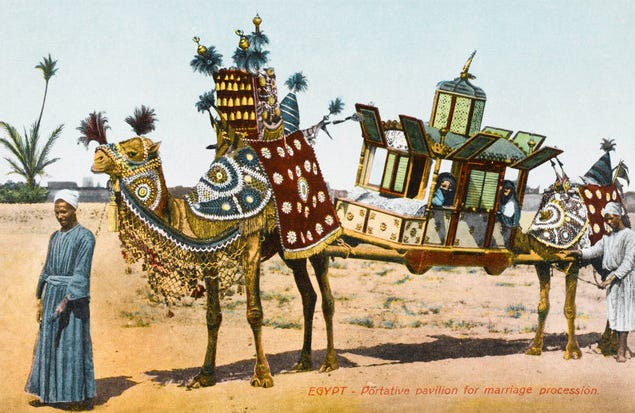
Marriage Pavilion carried by camels. Egypt. ca. 1910
During the colonial conquest of the Sahara, these palanquins were commandeered by the French in their skirmishes with the Tuareg. The use of camels declined in the colonial period, which was marked by repeated rebellions among the Tuareg, as well as the re-orientation of trade to the south, where roads and railways displaced the dromedary in bulk transport.63
Yet despite these transformations, the camel has never been fully displaced. While modern technologies have taken over much of its former role in long-distance trade, it remains one of the most important domesticated animals across Africa.
Even in the contemporary era of motorised transport, camels continue to occupy a central place in the economies, value systems, and cultural practices of numerous nomadic and pastoral societies. Africa today hosts over 80% of the world’s dromedary population, with roughly two-thirds found in Somalia, Sudan, Ethiopia, Kenya, and Djibouti.64
In more recent times, camels have also been introduced into regions well south of their historical range, including the arid landscapes of Namibia, where they now roam across the deserts of southern Africa.
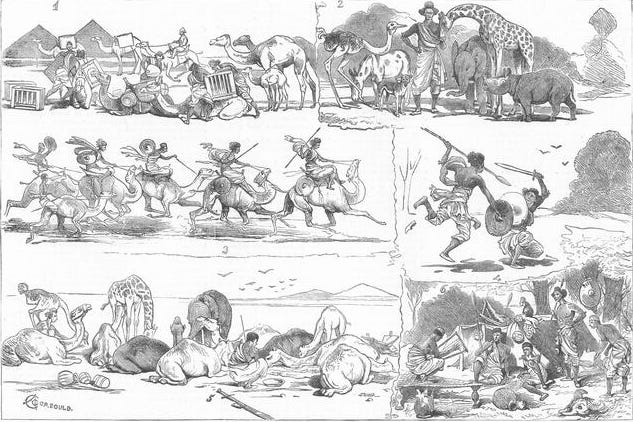
Nubian sports at the Alexandra Palace: 1. Loading and starting a caravan; 2. Some of the animals: 3. Camel racing; 4. Nubian assault of arms: Sword v. Spear; 5. Feeding a caravan in the desert; 6. Nubians at home. Images from The Graphic, 1877.
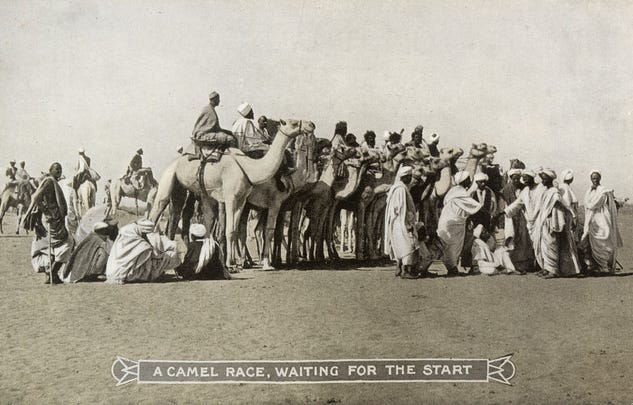
A Camel Race - waiting for the start. ca. 1910. Sudan.
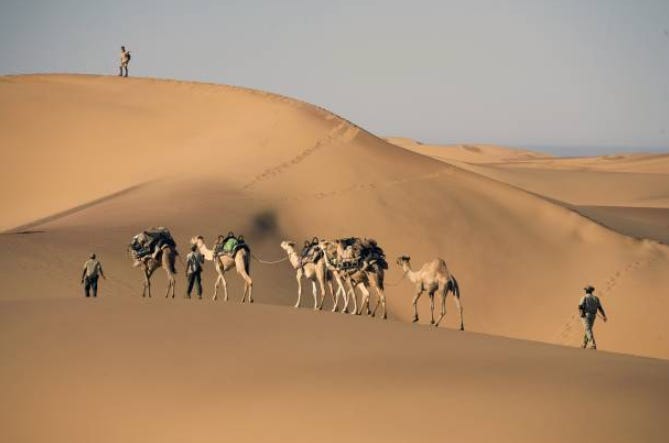
A camel caravan walks in the Namib Desert close to the Sand Dunes at Skeleton Coast, Namibia. Getty Images.
In 1894, two explorers set out on the first transcontinental journey from the Indian Ocean coast through Rwanda to the Atlantic.
The two travelers : Abdallah bin Rashid from Mombasa and the German Count Gustav Adolf, wrote separate accounts of the journey, which can be read as a microcosm of the broader shifts in African and European co-production of knowledge about the continent during the 19th century.
My latest Patreon article reproduces the English translation of Abdallah’s journey from the Indian Ocean to the Atlantic Ocean, showing how it contradicts von Götzen’s published narrative about the societies of Central Africa on the eve of colonialism.
Please subscribe to read about it here:
Old World camels in a modern world – a balancing act between conservation and genetic improvement, by P A Burger, E Ciani, B Faye.
The Camel in Roman North Africa and the Sahara: history, biology, and human economy by Brent D. Shaw, pg 676-688. When Was the Dromedary Domesticated in the Ancient Near East? By Peter Magee, pg 254-255
Old World camels in a modern world – a balancing act between conservation and genetic improvement, by P A Burger, E Ciani, B Faye.
When Was the Dromedary Domesticated in the Ancient Near East? By Peter Magee, pg 256-273. The Origins and Development of African Livestock, edited by Roger Blench, pg 107, 315-316.
Mobile Technologies in the Ancient Sahara and Beyond, edited by David Mattingly, A. Cuénod, Chloë Duckworth, pg 158-159
African Nomadic Architecture: Space, Place, and gender, by Labelle Prussin, pg. 14
African Nomadic Architecture: Space, Place, and gender, by Labelle Prussin, pg 14, Le voyage dans l’Afrique romaine by Stéphanie Guédon pg 83-87
Camels on the Northeastern Frontier of the Roman Empire by Weronika Tomczyk. Were there camels in Roman Britain? A brief note on the nature and context of the London camel remains by C. R. Green.
African Nomadic Architecture: Space, Place, and gender, by Labelle Prussin, pg. 15
Le voyage dans l’Afrique romaine by Stéphanie Guédon pg 86-87, 146, 157, 240
The Camel in Roman North Africa and the Sahara: history, biology, and human economy by Brent D. Shaw, pg. 695-696
The Camel in Roman Tripolitania by Olwen Brogan
The Camel and the Wheel by Richard W. Bulliet. The Wheel: Inventions and Reinventions by Richard W. Bulliet
Le voyage dans l’Afrique romaine by Stéphanie Guédon pg 83
Le voyage dans l’Afrique romaine by Stéphanie Guédon pg 88, The Camel, the Wagon, and the Donkey in Later Roman Egypt by Roger S. Bagnall
The Origins and Development of African Livestock, edited by Roger Blench, pg 107, 139
Trade in the Ancient Sahara and Beyond, edited by David Mattingly, M. Sterry, A. Cuénod, C. N. Duckworth, V. Leitch, F. Cole, pg 23
The Oxford Handbook of Ancient Nubia, edited by Bruce Williams, pg. 528, 693, 1002, 1094-1114
Fontes historiae Nubiorum: textual sources for the history of the middle Nile region between the eighth century BC and the sixth century AD Vol. 3 pg 1162
The Oxford Handbook of African Archaeology, edited by Paul J. Lane, Peter Mitchell, pg 154, 576.
Foundations of an African civilisation: Aksum & the Northern Horn, 1000 BC-AD, by David W. Phillipson, pg 15. Nomads Trading with Empires: Intercultural Trade in Ancient Somaliland in the First to Seventh Centuries CE, by A González-Ruibal et al., pg 123
The Origins and Development of African Livestock, edited by Roger Blench, pg 106
The Origins and Development of African Livestock, edited by Roger Blench, pg 142
Mobile Technologies in the Ancient Sahara and Beyond, edited by David Mattingly, A. Cuénod, Chloë Duckworth, pg 160, 171
Medieval West Africa: Views from Arab Scholars and Merchants, edited by Nehemia Levtzion, Jay Spaulding, pg. 7, 17, 31, 36.
The Travels of Ibn Battuta, AD 1325–1354, Volume IV, by H.A.R. Gibb, C.F. Beckingham, pg. 967, 975
Swahili Origins: Swahili Culture and the Shungwaya Phenomenon by James de Vere Allen, pg 25. The Swahili: The Social Landscape of a Mercantine Society By Mark Horton, John Middleton, n. 36, pg 226.
The Travels of Ibn Battuta, A.D. 1325-1354, Volume II, edited by H. A. R. Gibb, pg. 373, 374.
The East African Coast Select Documents from the First to the Earlier 19th Century, by G. S. P. Freeman-Grenville, pg 110
African Nomadic Architecture: Space, place, and gender, by Labelle Prussin pg 15
The Almoravids and the meanings of jihad. by Ronald A. Messier pg 1-25
Medieval West Africa Views from Arab Scholars and Merchants, edited by Nehemia Levtzion, Jay Spaulding, pg 12, 35
Medieval West Africa Views from Arab Scholars and Merchants, edited by Nehemia Levtzion, Jay Spaulding, pg 56)
Timbuktu and the Songhay Empire: Al-Sa’di’s Ta’rikh al-Sudan down to 1613, and other contemporary documents by John O. Hunwick, pg 93
Timbuktu and the Songhay Empire: Al-Sa’di’s Ta’rikh al-Sudan down to 1613, and other contemporary documents by John O. Hunwick, pg 281
Timbuktu and the Songhay Empire: Al-Sa’di’s Ta’rikh al-Sudan down to 1613, and other contemporary documents by John O. Hunwick, pg 142, 188 n.13, 221 n.30, 320, 330
History of the First Twelve Years of the Reign of Mai Idris Alooma of Bornu (1571-1533) By Aḥmad Ibn Furṭū, pg 33
The Medieval Kingdoms of Nubia: pagans, Christians and Muslims Along the Middle Nile, By Derek A. Welsby 73, 81-82, 244
The Conquest of Abyssinia By Shihāb al-Dīn Aḥmad ibn ʻAbd al-Qādir ʻArabfaqīh, Richard Pankhurst, pg 181, 344. A Social History of Ethiopia: The Northern and Central Highlands from Early Medieval Times to the Rise of Emperor Téwodros II, By Richard Pankhurst, pg 57
Kingdoms of the Sudan, By R. S. O’Fahey, J. L. Spaulding pg 48, 55-56, 175-176
Initial Encounters: Seeking traces of ancient trade connections between West Africa and the wider world, by Sonja Magnavita
All that Glitters is Not Gold: Facing the Myths of Ancient Trade between North and Sub-Saharan Africa, by Sonja Magnavita and Carlos Magnavita. In: Landscapes, Sources and Intellectual Projects of the West African Past
Trade in the Ancient Sahara and Beyond, edited by David Mattingly, M. Sterry, A. Cuénod, C. N. Duckworth, V. Leitch, F. Cole, pg 57-58
The Desert-Side Salt Trade of Kawar, By Knut S. Vikør, Pg 116-140
Prelude to the Mahdiyya: Peasants and Traders in the Shendi Region, 1821–1885. By Anders Bjørkelo pg 19, 22-28
Handbook of Ancient Water Technology, edited by Örjan Wikander, Vol. 2 pg 233-241
Oxford Handbook of Ancient Nubia, edited by Geoff Emberling, Bruce Williams pg 815, 940, 943. Prelude to the Mahdiyya: Peasants and Traders in the Shendi Region, 1821-1885, by Anders Bjørkelo, pg. 64-68.
Travels in the Atlas and Southern Morocco: A Narrative of Exploration by Joseph Thomson, published by George Philip & Son, 1889, pg 45-46
Mobile Technologies in the Ancient Sahara and Beyond, edited by David Mattingly, A. Cuénod, Chloë Duckworth, pg 78
The Camel (Camelus Dromedarius): A Bibliographical Review, by E. Mukasa-Mugerwa, pg 78-79. The Camel and the Wheel by Richard W. Bulliet, pg 192-197
Zanzibar: City, Island, and Coast · Volume 1, By Sir Richard Francis Burton · 1872, pg 220-221. Swahili tales as told by natives of Zanzibar By Edward Steere, pg 496. Lamu in the Nineteenth Century: Land, Trade, and Politics, By Marguerite Ylvisaker, pg 129
The Origins and Development of African Livestock, edited by Roger Blench, pg 214
The Shaping of Somali Society: Reconstructing the History of a Pastoral People, 1600-1900 By Lee V. Cassanelli, pg 14, 46-50
Documents sur l’histoire, la géographie et le commerce de l’Afrique Orientale by Charles Guillain, 1856, pg 384
Documents sur l’histoire, la géographie et le commerce de l’Afrique Orientale by Charles Guillain, 1856, pg 32
Documents sur l’histoire, la géographie et le commerce de l’Afrique Orientale, by Charles Guillain, 1856, pg 306, 337. East Africa and the Indian Ocean By Edward A. Alpers, pg 66-67
Voyage à la còte orientale d’Afrique : exécuté pendant les années 1846, 1847 et 1848 par le brick le Ducouëdic, sous le commandement de M. Guillain, Plate 24.
African Material Culture, edited by Kris L. Hardin, Mary Jo Arnoldi, pg 78-90
African nomadic architecture: space, place, and gender by Labelle Prussin, Pg 47-50
African nomadic architecture: space, place, and gender by Labelle Prussin, Pg 50-53
African Nomadic Architecture: space, place, and gender by Labelle Prussin, pg 17-19
African Nomadic Architecture: space, place, and gender by Labelle Prussin, pg 19)
African Nomadic Architecture: space, place, and gender by Labelle Prussin, pg 19. The Desert-Side Salt Trade of Kawar by Knut S. Vikør pg 135
The One Humped Camel in Eastern Africa. A Pictorial Guide to Disease, Health Care and Management By Horst Juergen Schwartz
Very interesting.
A historian once characterised the lowland/highland dynamic in Abyssinia as hinging on an uneasy alliance between the 'people of the camel' (ferrying in and out goods from places such as Gendebelo, from the low arid country and the coastal ports), and the 'people of the mule' (and donkeys), beasts of burden that were required for goods being transported over the Ethiopian plateaus.
The Gedeon Force that liberated Ethiopia from the Italians had many thousands of camels, that apparently all died in short order from the cold and wet of the highlands.
It makes one wonder how the Romans managed to used these animals, quite extensively from the maps presented here, in Europe.
Amazing post!
I travelled The Ghan from Adelaide to Darwin.
It looks like a railway story. But it is really a camel story.
Before steel tracks, camels made the interior repeatable.
They turned distance into routes, wells into nodes, and uncertainty into trust.
The railway did not replace anything. It formalised what the cameleers had already made possible.
That is the lesson for financial inclusion.
Agents, merchants, airtime dealers, cash handlers, and informal liquidity brokers are not “legacy infrastructure.”
They are the camel layer.
The first system that makes trust, liquidity, and movement repeatable.
Digital rails do not scale by deleting the camel layer. They scale by repricing its coordination work.