

The ways in which Africans accumulated and expressed wealth have occupied a central place in Africanist scholarship for more than half a century, with particular attention given to the relationship between labour and land in African value systems.
Many scholars advanced the argument that was abundant in Africa, which meant that wealth was accumulated through the control of labour. Within this interpretive framework, the accumulation of dependents, known as “wealth-in-people,” was identified as a key organizing principle in the lives of pre-colonial Africans.1
According to this interpretation, the main goal of rulers was to accumulate followers through patronage, clientage, marriage, apprenticeship, servitude, etc. The wealthy increased productivity by controlling labor or by converting goods into followers/dependents, rather than amassing land, which was imagined to be free and abundant.2
However, such theories positing a surplus of land or “unoccupied land” were not derived from an empirical examination of the historical data on pre-colonial land tenure systems. Rather, they drew heavily on assumptions formulated by colonial administrators, who were seeking to justify the expropriation of African land.
Scholars repeated the idea that Africans lacked property rights or notions of individual ownership produced by colonial bureaucrats, without critically examining how this colonial knowledge was created and for what purpose. Yet, the evidence available in the same colonial archives reveals that African rulers claimed jurisdiction and occupation rights over their lands.3
As argued by the anthropologist Steven Pierce, colonial administrators and anthropologists created the myth of static African societies with atavistic systems of land tenure. They invented new forms of land tenure, which became codified as “traditional land tenure” but were anything but traditional. “Tradition” became something other than legacies from the past.4
This dynamic reflects a broader pattern identified by Valentin-Yves Mudimbe, whereby Western knowledge systems constructed Africa through a series of oppositions.5
In this case, the reimagined notion of “traditional” African land tenure was contrasted with an equally misleading depiction of Europe as having long possessed the modern concept of land as a tradable, privately owned commodity, which was in fact only developed in the 18th and 19th centuries.6
Some scholars, particularly those ignorant of more recent African historiographic research, have cited the lack of written records on land tenure as evidence for the absence of land ownership.
This perspective is also derived from outdated colonial tropes that perpetuated images of African societies as isolated and excluded from global processes, overlooking the substantial body of written evidence on land tenure from Christian and Muslim African societies since the Middle Ages.
In a previous essay, I outlined the land tenure systems of medieval Nubia, Ethiopia, the Sudanic kingdoms of Darfur and Funj, and the West African empires of Bornu, Sokoto, and Masina. These societies produced written records that document landholding practices, including charters, grants, judicial proceedings over land disputes, and contracts of sale.
An example of these is a land document from the pre-colonial kingdom of Darfur, which contains a comprehensive listing of a grantees’ rights in his estate as such: “...as an allodial estate, with full rights of possession and his confirmed property... namely rights of cultivation, causing to be cultivated, sale, donation, purchase, demolition and clearance.”7
On the East African coast during the 19th century, a range of historical evidence from Comoros, Mombasa, Malindi, Zanzibar, and Brava demonstrates that land, estates, houses, and other forms of property were subject to well-established systems of ownership, exchange, and inheritance. These records also indicate that property rights were not confined to a narrow segment of society, but included women as well as free and enslaved persons among the property owners.8

land charter of Nur al-Din, a nobleman from the Zaghawa group originally issued by the Darfur king Abd al-Rahman in 1801 and renewed in 1803.9
It is important to emphasize that written documentation represents only one category of historical evidence for land tenure systems. Its privileging by colonial administrations and later scholarship has often obscured the significance of oral legal traditions, which structured and transmitted norms of landholding across many parts of the continent.
Multiple oral sources suggest that control over land provided a means to control people, and that the two cannot be separated.
Rulers, officials, and wealthy commoners accumulated wealth through land grants that conferred rights over territory as well as claims to the labor, tribute, and rents of those residing upon it.
The Lozi kingdom (Barotseland) of Zambia maintained a highly structured territorial system of administration, in which offices or title-holders (indunas) were tied to specific tracts of land (silalo) and the settlements on them, which were given to the indunas upon their appointment.10
This system underwent a significant transformation in the 19th century when the kingdom was invaded by the Kololo from the south, who were later deposed by the native dynasty. The latter rulers, specifically Lubosi Lewanika (r.1878-84, 1885-1916), instituted a land settlement policy known as the Muliu or redemption law, in which all landholders were required to resettle their ancestral lands occupied before the Kololo invasion.11
This policy displaced some of the indunas who had taken possession of land not formerly attached to them and naturally resented the proposal to allow such property to be reclaimed by its original owners. Despite this opposition, it revived the old territorial division of the kingdom into administrative units (Lilalo) and was later adopted by the Colonial administration.12
The Lozi concepts of land tenure and ownership have been known to Africanists since Max Gluckman’s publications in the 1940s-60s, but were surprisingly overlooked by the wealth-in-people theorists.
A strikingly similar form of territorial administration was also found in the kingdom of Asante (modern Ghana), but with added complexity. Titleholders could transfer/sale their tracts of land, along with the rents/tribute derived from the settlements on the land, to other titleholders in exchange for substantial payments in gold, or used as collateral for high-interest loans, also denominated in gold.13
This active, albeit restricted, real estate market was fairly well documented in the 19th century, but the historians Ivor Wilks and T. McCaskie have shown that it dates back to the 18th century. It was a system of land control that was closely tied to the central government at Kumasi and was often manipulated by the court for political ends.14
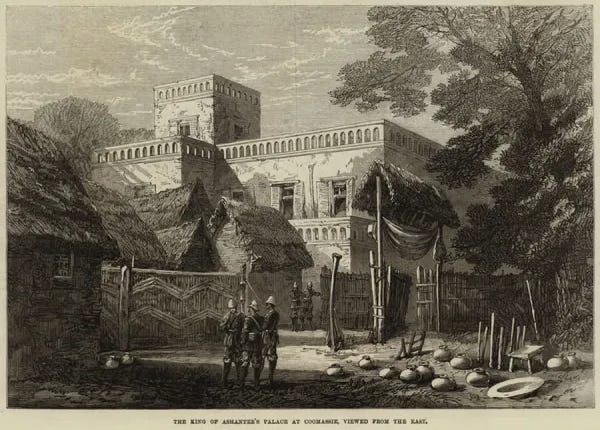
The king of Ashantee’s palace at Coomassie. ca. 1874
Even among African societies where land was not transferred through market mechanisms, the historian Assan Sarr argues that the inability to sell land isn’t evidence for the absence of ownership, but is instead evidence for its lack of commodification.15
He offers a more nuanced analysis of the changing values of land and labor in the pre-colonial Gambia from the 18th century, where rulers and members of prominent lineages acted as landholders (bankuttiyolu: “owners of the land”). They augmented their wealth by renting land to their followers, junior relatives, subordinates, and strangers, who cultivated it and paid taxes to the landholders.16
Some of the proponents of the wealth-in-people theory extend it to African political history, presenting illogical arguments about African warfare in which states supposedly invested insurmountable resources in raising armies whose objective wasn’t to occupy more land or expand borders, but to control and accumulate dependents.17
However, military historians and other specialists on warfare in pre-colonial Africa have long argued against such reductive interpretations. They emphasize that the fundamental cause of most wars in Africa, like in any part of the world, was territorial expansion.18
The overwhelming internal and external documentary evidence demonstrates that large-scale wars were frequently aimed at establishing control over neighbouring polities, strategic cities, lucrative trade routes, and economically productive lands.19
In many examples, most notably the Oyo empire, medieval Mali, and the Lunda empire, conquest was followed by the establishment of administrative structures designed to secure and regularize control over newly incorporated territories.
As in any part of the world, state expansion inevitably led to border conflicts, some of which were negotiated in writing or resolved by the establishment of boundary settlements/forts, and in some cases, such as between the kingdoms of Wadai and Darfur, physical borders made of stone cairns, large iron spikes, and walls were erected that resembled modern borders.20
All of this indicates that control over land mattered as much as control over people.

Ruins of the walled complex at the 17th-century capital of Wara/Ouara in Chad
Besides landholdings, Africans also accumulated “wealth-in-things” that could be traded, transferred, and bequeathed to heirs.
Even defenders of the “wealth-in-people” framework, such as Jane Guyer, emphasize that Africans produced and acquired wealth-in-things of value, such as gold objects, metallic currencies, luxury cloth, ivory, and artworks, which “moved easily into Western categories of wealth.”
She argues for a nuanced relationship between African concepts of wealth, observing that not all wealth-in-things was converted into wealth-in-people, because we know of vast storehouses of gold, cowries, and grave-goods that were taken out of circulation, rather than being used for accumulating dependents.21
Guyer also notes that many scholars tend to borrow concepts developed in equatorial Africa and generalize them for the rest of the continent.
In a line of reasoning that echoes Valentin-Yves Mudimbe, she observes that this process, whereby attributes of Central Africa become metonymic of Africa-in-general, is largely a product of Western metaphorical constructions of Africa, in which “the forest remains Europe’s image of Africa.”22

funeral of Andris Poucouta, a Mafouk of Cabinda on the Loango coast. 18th-century engraving by Louis de Grandpre. His coffin, made entirely of bundles of textiles, was 20 feet long by 14 feet high and 8 feet thick; the whole was transported by a wheeled wagon pulled by at least 500 people over a road built for the purpose.
Recent scholarship on land tenure systems in pre-colonial central Africa has uncovered internal documentary evidence from the 17th century showing that, even in this region, where theories of “wealth-in-people” were first formulated, land was neither abundant nor socially insignificant.
According to the historian Mariana Candino, evidence from the pre-colonial archives of various kingdoms and societies in what is today Angola demonstrates that societies in West-Central Africa placed value on land and other material forms of wealth, yet only their ownership of dependents was recognized by scholars.
She criticises the singular focus on the accumulation of dependents in scholarship of the region, which perpetuates colonial claims that the lands were devoid of legitimate occupants, and created historical narratives that rationalized dispossession in the name of “effective occupation.”
As in medieval Nubia, Ethiopia, West Africa, Sudan, the East African coast, and Barotseland, the empirical evidence demonstrating that political elites and commoners in Central Africa competed for land and territorial rights clashes with the colonial and scholarly trope of abundant land.
By emphasizing the absence of landed property as a central feature of African societies, scholars have overlooked how vital land was in securing social belonging, obligation, and protection.
The history of land and wealth in West-Central Africa is the subject of my latest Patreon article. Please subscribe to read about it here and support this newsletter.
Slavery in Africa: Historical and Anthropological Perspective, edited by S. Miers and I. Kopytoff, pg 55-56. Paths in the Rainforests: Toward a History of Political Tradition in Equatorial Africa by Jan Vansina, pg 251 Way of Death : Merchant Capitalism and the Angolan Slave Trade 1730-18 by Jospeh Miller, pg 42-53.
An Economic History of West Africa By Antony G. Hopkins, pg 9-11. Jack Goody, Technology, Tradition, and the State in Africa pg 21–37. Gareth Austin, Labour, Land, and Capital in Ghana: From Slavery to Free Labour in Asante, 1807-1956
Wealth, Land, and Property in Angola by Mariana P. Candido
“Farmers and the state in colonial Kano” Land Tenure and the Legal Imagination by Steven Pierce, pg 79-107
The Invention of Africa. Gnosis, Philosophy, and the Order of Knowledge by V. Y. Mudimbe
Property Relations: Renewing the Anthropological Tradition edited by C. M. Hann, pg 12-16
Land in Dar Fur: Charters and Related Documents from the Dar Fur Sultanate edited by R. S. O’Fahey, M. I. Abu Salim, pg. 19.
On the Kenyan and Tanzanian coast: Muslim Women in Mombasa, 1890-1975 by Margaret Strobel, pp. 58-73, La maison urbaine, cadre de production du statut et du genre à Anjouan (Comores), XVIIe-XIXe siècles by Sophie Blanchy, pp. 35-36. The Swahili-Speaking Peoples of Zanzibar and the East African Coast (Arabs, Shirazi and Swahili) East Central Africa Part XII by A. H. J. PRINS.
In Comoros: La maison urbaine, cadre de production du statut et du genre à Anjouan (Comores), XVIIe-XIXe siècles by Sophie Blanchy pg 6. Cités, citoyenneté et territorialité dans l’île de Ngazidja (Comores) by Sophie Blanchy Prg 41.
In Brava: Translocal Connections Across the Indian Ocean: Swahili Speaking Networks on the Move by Francesca Declich, pg 59-66. Servants of the Sharia : the civil register of the Qadis’ court of Brava, 1893-1900 by Alessandra Vianello and Mohamed M. Kassim, eds
Land in Dar Fur: Charters and Related Documents from the Dar Fur Sultanate edited by R. S. O'Fahey, M. I. Abu Salim pg 83.
Bulozi under the Luyana Kings: Political Evolution and State Formation in Pre-colonial Zambia by Mutumba Mainga pg 45-50
Bulozi under the Luyana Kings: Political Evolution and State Formation in Pre-colonial Zambia by Mutumba Mainga pg 129-130
The Elites of Barotseland 1878-1969: A Political History of Zambia’s Western Province by Gerald L. Caplan pg 21-30.
State and society in pre-colonial Asante by T. McCaskie, pg 40-41
Asante in the nineteenth century by Ivor Wilks pg 106-109
Islam, Power, and Dependency in the Gambia River Basin; The Politics of Land Control, 1790-1940 By Assan Sarr , pg 6
Land, Power, And Dependency along the Gambia River, Late Eighteenth to Early Nineteenth Centuries by Assan Sarr
States and Power in Africa: Comparative Lessons in Authority and Control by Jeffrey Herbst.
Warfare & Diplomacy in Pre-colonial West Africa By Robert Sydney Smith pg 44-45. Warfare in Atlantic Africa, 1500-1800 By John Kelly Thornton
Warfare in African History By Richard J. Reid
The most famous of these fixed borders was established between Darfur and Wadai , when Sultan Muḥammad Tayrāb (r. 1752-1785) concluded a peace treaty with Wadai and delineated a border between the two kingdoms marked by stone cairns and walls, known as the tirja (barrier) , see: Kingdoms of the Sudan by R. S. O'Fahey, J. L. Spaulding pg 116-120, Sahara and Sudan. Volume Four: Wadai and Darfur Volume: 4 by Gustav Nachtigal; Allan G. B. Fisher, Humphrey J. Fisher, Rex S. O'Fahey pg 283-289
The more common solution was the construction of boundary settlements, e.g., the ribats of Sokoto and Bornu. see: A Geography of Jihad: Sokoto Jihadism and the Islamic Frontier in West Africa by Stephanie Zehnle. The Revenue System of Government of Borno in the Nineteenth Century by A Benisheikh. Studies in the History of Pre-colonial Borno, pg 147-149
Wealth in People, Wealth in Things – Introduction, by Jane Guyer
Wealth in People as Wealth in Knowledge: Accumulation and Composition in Equatorial Africa by Jane I. Guyer and Samuel M. Eno Belinga
Great piece. I’ve found the wealth in people (or in economic terms, high land to labour ratio) an interesting idea - seems quite a powerful lens for explaining certain institutional outcomes in (parts of) Africa - but I very much take your point that there is lots of examples that point against a simple binary (and many parts of Europe and Asia were also fairly land abundant until recently). Do you think there is any power in the relative price idea, that agricultural land in much of Africa was comparatively ‘cheap’ relative to labour, when compared to Eurasia?
love this page.you are an awesome writter and I've learned a lot because of your work.For some reason african history appears to me to suffer more than anyother world region from distortions by specious claims and popular but ultimately very stupid tropes.
take ''States and Power in Africa: Comparative Lessons in Authority and Control ''by Jeffrey Herbst ,the argument has so many flaws(like j diamonds book) that i struggle to believe why even today it is quoted(even in books by african authors) as a serious work in the analysis of premodern african states.would be a dream to read a sharp analysis of yours about it btw.
However,do you share my appreciation of african history beign particularly distorted or misreppresented? If so, would you agree with me that the quantity as well as the quality of knowledge production and versatility its communication by africans and afro-descendents must increase?or do you have other reasons in mind?
I'm very grateful for your contribution.Thanks