

In 1596, the Ethiopian monk Takla ’Alfā left his home near Lake Tana, at the source of the Blue Nile, and embarked on a pilgrimage that took him through the kingdom of Sennar (present-day Sudan) and Egypt to Jerusalem.1
While passing through the territory of Sennar, one of his companions died near the city of Old Dongola, compelling the monk to remain in the city to arrange his burial. Takla ’Alfā stayed there for more than two months, during which he composed several theological works.
“‘This malkǝ’ to our Lord Jesus Christ and the malkǝ’ to our Lady Mary, I, Takla ’Alfā, the sinful and poor, composed while being in the land (mǝdr) of Dongola (dǝngwǝlā), amongst Muslims (maslǝmān), on my way to Jerusalem, without a camel to ride on, in order to come back to my region (hagar), the land (mǝdr) of Ethiopia (’ityop. yā), and also in order that I might go to Jerusalem. I resided in Dongola, amongst the Nubians (nobā) and Muslims (tanbalāt), on my own. And my son (i.e. disciple) kwǝllu ’andāʿāl(l)aňň, that is to say, Christ chose him, he died in Dongola.”
The text also refers to the presence of Muslim Nubians and Arab gelaba (traders) in Old Dongola, communities that formed important cultural and commercial elements within the Funj kingdom of Sennar and the riverine populations of modern Sudan.
This exceptional text provides direct internal evidence for the long-established intra-African networks that facilitated the travel of pilgrims, scholars, and merchants throughout this region.
These pre-existing networks would later be utilised by European travelers/explorers such as James Bruce, who is often thought to have “discovered” the source of the Nile in 1733.
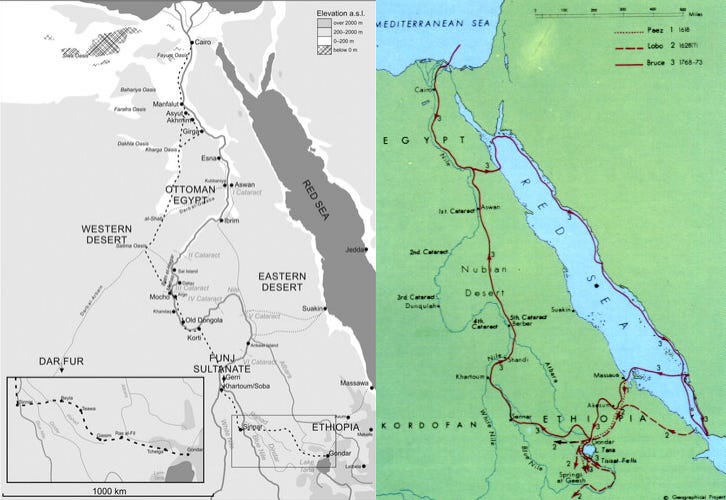
Map of the journey by Takla ’Alfā (1596) and James Bruce (1773) across North-East Africa (left) Map by D. Dzierzbicka (right) Map by Tompaterson.
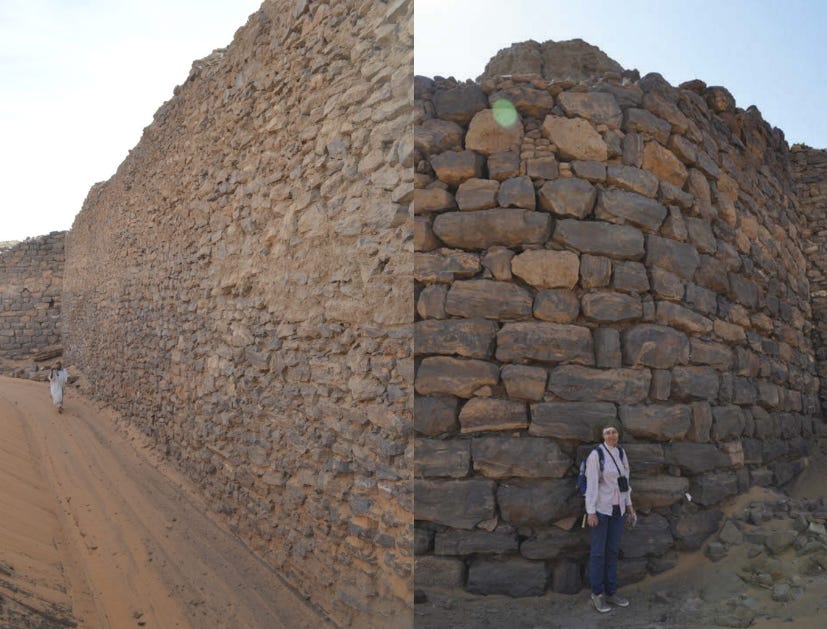
The medieval citadel of Old Dongola, Sudan.2
Support AfricanHistoryExtra by becoming a member of our Patreon community, subscribe here to read more about African history, download free books, and keep this newsletter free for all:
Until the 1960s, much of African history was reconstructed primarily through the writings of external writers, whose accounts often reflected the interests and biases of their authors.
The bulk of these accounts emerged during the second “Age of exploration” or “discovery, in the 18th and 19th centuries, when Africa was widely imagined in European thought as an unknown continent whose peoples existed only at the margins of history.
Since then, historical scholarship centred on Africa has fundamentally transformed this older historiography. Historians, archaeologists, and linguists have uncovered a vast body of textual, oral, and archaeological evidence that has made it possible to reconstruct the continent’s past on its own terms.3
This new scholarship has shown that since antiquity and through the modern era, African societies were never isolated from global processes. African explorers, envoys, merchants, and pilgrims travelled to and maintained contacts with peoples in Asia, Europe, and the Americas, as well as within the vast continent itself.
Africa has been at the center of various transnational and global processes of historical formation. Its traditions of travel, exchange, and exploration are foundational to how we understand global history today.
Many African societies were intimately familiar with both the outside world and their own continent. And it was their established intra-African networks that would be utilized by later European travelers to “discover” what was already known to their hosts.
In a few cases, some of the more famous explorers acknowledged the prior accomplishments of their African predecessors.
For example, David Livingstone, who is often described as the first explorer to traverse central Africa in 1855, noted that at least two African explorers known to him had completed the journey nearly half a century earlier and had left a written record of their expedition.4
These men belonged to the Ovimbundu trading communities from the kingdom of Kasanje, whose merchants had long dominated commerce across the inland empire of Lunda, and its extensive network of copper and ivory trade that linked the Indian Ocean coast to the Atlantic coast.
Livingstone emphasizes that “no European” had ever accomplished the journey before these two African explorers. He adds that while those who acknowledged this fact misidentified the traders as Portuguese, since they bore the Lusitanized names of Pedro Joao Baptista and Antonio Jose, they were in fact known as (os feirantes pretos) “the trading blacks”.
However, the aforementioned expedition was only the first journey across Central Africa, which was internally recorded. Earlier accounts indicate that interconnected networks of Yao, Swahili, and Nyamwezi traders moved goods across long-distance networks that, in some cases, directly linked the Atlantic and Indian Ocean coasts.5
In West Africa, such intra-African networks of trade, travel, and pilgrimage were of considerable antiquity, appearing in both the external and internal documentary record from at least the 9th century CE.
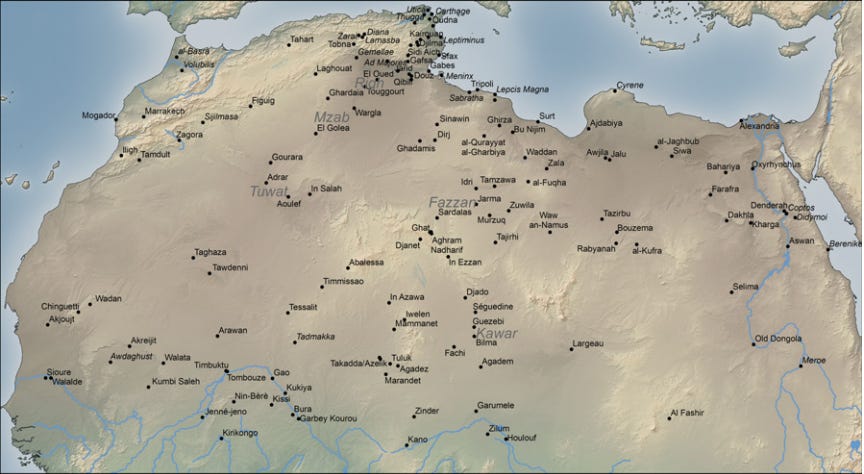
The medieval cities of the Sahara. Map by D. Mattingly
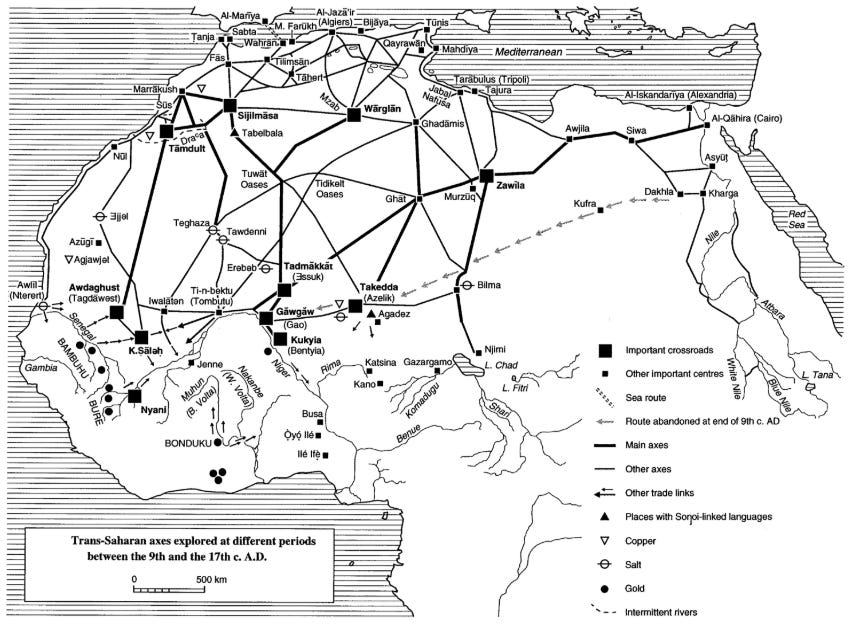
Trans-Saharan axes explored at different periods between the 9th and the 17th c. A.D. Map by Paulo Fernando de Moraes Farias.
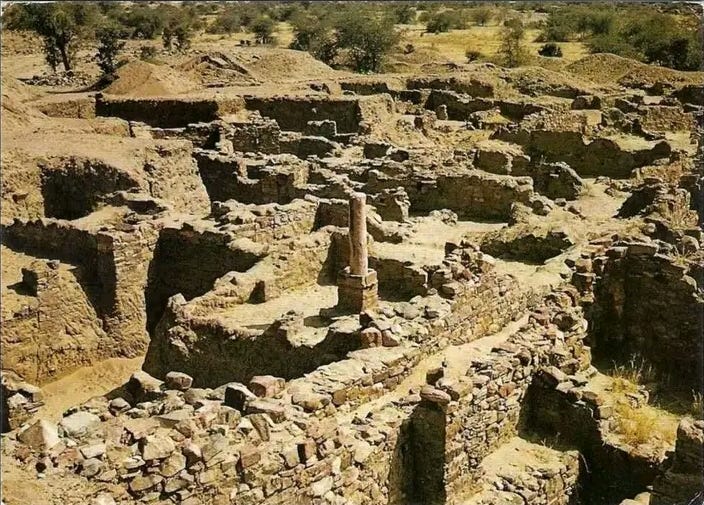
10th-13th century ruins at Awdaghust, Mauritania. Wikimedia Commons.
These networks, which were dominated by commercial diasporas such as the Wangara. The latter became known to Portuguese traders at both ends of the West African coast in the late 15th century, engaging in the lucrative Gold trade in both Ghana (at Elmina) and Gambia (Sutuko).
The Portuguese utilized the Wangara routes to dispatch the first European embassies to the inland empires of Songhai and Mali,6 shortly after African embassies from the kingdoms of Benin (1487), Kongo (1487), and Jolof (1488) had visited Lisbon and exchanged knowledge about the kingdoms of the interior.7
For this reason, many of the “external” European accounts of pre-colonial Africa were in fact derived from information obtained from Africans.
As explained by the historians Beatrix Heintze and Adam Jones, “A great deal of the material we have about pre-colonial African societies probably originated from information given by Europeanized Africans or Africanized Europeans; and this grey zone makes it almost impossible to distinguish neatly between external and internal sources.”8

Map of West Africa showing the dispersion routes taken by the Jakhanke (yellow), Juula (green), and Wangarawa (red)
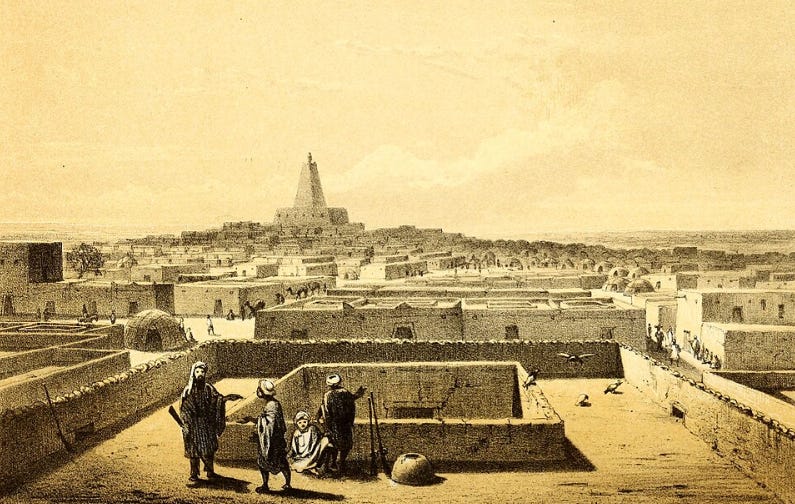
Timbuktu from the terrace of the traveller’s house. Image by H Barth, 1853
Pre-existing African networks were also utilized by Mungo Park, the “first explorer” to “discover” the course of the Niger River.
Park himself acknowledged that much of his progress along the river, as well as his descriptions of regions beyond it, depended on information provided by African travelers and traders he identified as “Serawoolies” (Sarakhole/Wangara) and Mandingoes (Mandinka). Among these were his guides: Isaaco and Amadi Fatouma, who wrote down the last half of Mungo Park’s second journey, after he died in the interior in 1805.9
West African scholars also produced written accounts of their own journeys across the continent, particularly in the context of pilgrimage and advanced education.
Among the most notable include the rihla (travelogue) of the mathematician Muhammad al-Kashnāwi (d.1741)̄, who travelled from Katsina to Cairo and Mecca, Another important example is the more detailed account by the Tukulor leader El-Hajj Umar Tal, who travelled extensively through West Africa, Egypt, the Hijaz, and Jerusalem in 1827.10
Some European explorers who never travelled to West Africa, nevertheless relied heavily on information gathered from African sources.
The French explorer Stanislas d’Escayrac (d. 1868), for example, wholly appropriated the travel accounts of West African pilgrims he encountered in Cairo to compose his own travelogue, while omitting most of the intellectual contributions of his African ‘informants.’11
The British Captain George Francis Lyon (d.1832), who was meant to succeed Mungo Park in exploring the Niger River, failed to reach West Africa from North Africa in 1818-1819, but obtained information from West African pilgrims and traders of Bornu who routinely travelled through Murzuk (Libya).12
This information was utilized by Hugh Clapperton as a roadmap on his journey to the Lake Chad region in 1827.
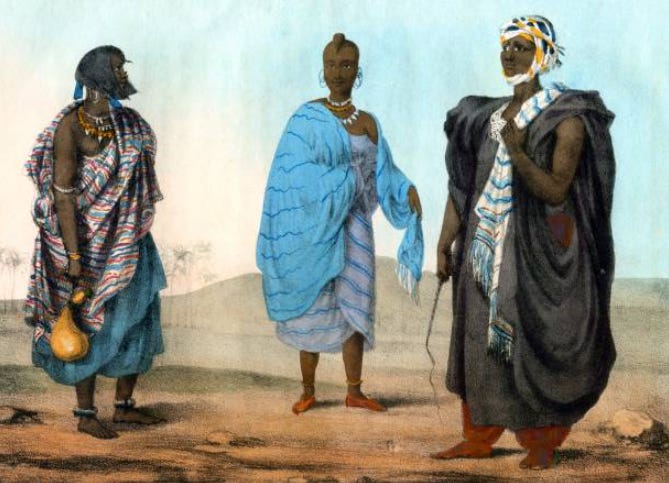
Libya: Tubu people of Qatrun, by George Francis Lyon, ca. 1819
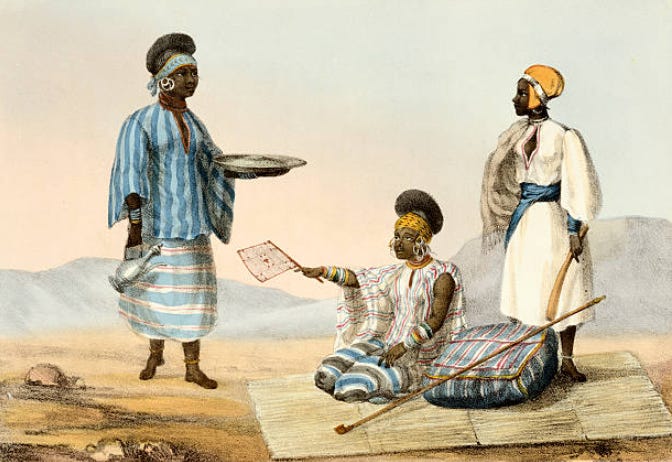
Color Lithograph Showing Native Women of Sudan (West Africa) by Denis Dighton and Charles Joseph Hullmandel after George Francis Lyon, ca. 1819
Unlike earlier explorers such as James Bruce and Mungo Park, whose expeditions to the African interior were largely dependent on pre-existing networks and systems of knowledge, the armchair explorers d’Escayrac and Lyon developed more asymmetrical relationships with the African travellers they encountered.
In these contexts, African interlocutors were often treated not as fellow explorers or co-producers of knowledge, but rather as informants whose testimony was selectively recorded and reframed.
By the late 19th century, the expansion of European imperial rule further intensified these asymmetries, extending them into the African interior itself. The production of geographical and ethnographic knowledge increasingly privileged European epistemologies, while marginalising local African sources.
African travelers whose expertise about their own societies had been disregarded employed various strategies of resistance and negotiation in these decreasing spaces of agency. One such strategy involved producing their own written accounts alongside the European explorers, who were essentially tourists using local infrastructure.
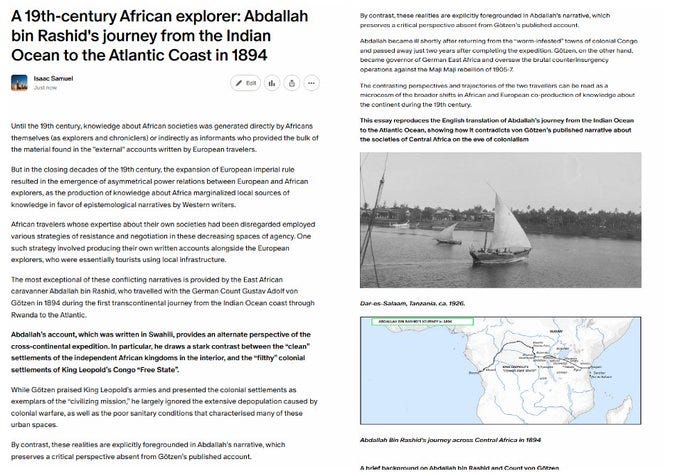
The most exceptional of these conflicting narratives is provided by the East African caravanner Abdallah bin Rashid, who travelled with the German Count Gustav Adolf von Götzen in 1894 during the first transcontinental journey from the Indian Ocean coast through Rwanda to the Atlantic.
Abdallah’s account, which was written in Swahili, provides an alternate perspective of the cross-continental expedition. In particular, he draws a stark contrast between the “clean” settlements of the independent African kingdoms in the interior, and the “filthy” colonial settlements of the Belgian King Leopold’s Congo “Free State”.
While Götzen praised King Leopold’s armies and presented the colonial settlements as exemplars of the “civilizing mission,” he largely ignored the extensive depopulation caused by colonial warfare, as well as the poor sanitary conditions that characterised many of these urban spaces.
By contrast, these realities are explicitly foregrounded in Abdallah’s narrative, which preserves a critical perspective absent from Götzen’s published account.
Abdallah became ill shortly after returning from the “worm-infested” towns of colonial Congo and passed away just two years after completing the expedition. Götzen, on the other hand, became governor of German East Africa and oversaw the brutal counterinsurgency operations against the Maji Maji rebellion of 1905-7.
The contrasting perspectives and trajectories of the two travellers can be read as a microcosm of the broader shifts in African and European co-production of knowledge about the continent during the 19th century.
My latest Patreon article reproduces the English translation of Abdallah’s journey from the Indian Ocean to the Atlantic Ocean, showing how it contradicts von Götzen’s published narrative about the societies of Central Africa on the eve of colonialism.
Please subscribe to read about it here:
‘I resided in Dongola, amongst the Nubians and Muslims, on my own.’ The sixteenth-century account of Ethiopian monk Takla ’Alfā in context, by Dorota Dzierzbicka and Daria Elagina
Old Dongola: Continuity and change from the Medieval period to the 21st century, by Tomomi Fushiya
History in Sub-Saharan Africa. by Toyin Falola. In The Oxford History of Historical Writing: Volume 4: 1800-1945, edited by Stuart Macintyre et al. Writing African History Volume 20, edited by John Edward Philips
“A considerable trade is carried on by the Cassange merchants with all the surrounding territory by means of native traders, whom they term “Pombeiros”. Two of these, called in the history of Angola “the trading blacks” (os feirantes pretos), Pedro Joao Baptista and Antonio Jose, having been sent by the first Portuguese trader that lived at Cassange, actually returned from some of the Portuguese possessions in the East with letters from the governor of Mozambique in the year 1815, proving, as is remarked, “the possibility of so important a communication between Mozambique and Loanda.” This is the only instance of native Portuguese subjects crossing the continent. No European ever accomplished it, though this fact has lately been quoted as if the men had been “PORTUGUESE”.
Taken from: ‘Missionary Travels and Researches in South Africa’ by David Livingstone.
For the full text of their travel account, see “The Lands of Cazembe: Lacerda’s Journey to Cazembe in 1798,” pg 203-240.
Ivory and Slaves in East Central Africa by Edward A. Alpers pg 180
Wangara, Akan and Portuguese in the Fifteenth and Sixteenth Centuries. 1. The Matter of Bitu, by Ivor Wilks. Wangara, Akan and Portuguese in the Fifteenth and Sixteenth Centuries. II. The Struggle for Trade, by Ivor Wilks. Silent Trade: Myth and Historical Evidence, by PF de Moraes Farias, pg 16-17.
Africa’s Discovery of Europe: 1450-1850 by David Northrup pg 25-40
European Sources for Sub-Saharan Africa before 1900: Use and Abuse, edited by Beatrix Heintze and Adam Jones, pg 9
Travels in the interior of Africa by Park, Mungo, 1771-1806, published 1858 by A. and C. Black, Pg 176-180. Mungo Park, journey on the Niger in 1796 to 1805 by A. H. S. Fletcher. A. H. S. Fletcher.
West Africa and the Muslim pilgrimage: An historical study with special reference to the nineteenth century. by El-Nagar, Omer, pg 198-223.
Nineteenth-Century Co-Production of Knowledge about West Africa by Siga Maguiraga
Hugh Clapperton, Into the Interior of Africa: Records of the Second Expedition, 1825-1827 edited by James Bruce Lockhart, pg 15-20
This is awesome. Thank you so much for your perspective and for getting this information to the surface!
Great historical culture commentary!