

Christianity reached Africa soon after the rise of the religion, spreading first to Egypt and later across the Maghreb and southward into Aksum/Ethiopia and Nubia/Sudan.
The religion was subsequently adopted by wider sections of the population, in large part through the institution of monasticism, which first emerged among the desert monks of Egypt.
The Egyptian monastic movement exerted a decisive influence throughout the Roman Empire, with figures such as the 4th-century monks Anthony and Pachomius being venerated across the early Christian world, from Western Europe to Ethiopia.
In North-East Africa, the rise of monasticism in Aksum and Nubia established Christianity as a popular religion beyond the royal capitals, while contributing to the production of some of the oldest written records from the continent.
These developments were sustained by networks of African monks and pilgrims living in monasteries across Egypt, Nubia, and Ethiopia, creating a dynamic and interconnected Christian world that continued to thrive for centuries after the Arab conquest and the widespread adoption of Islam.
The ancient monks of north-east Africa reveal an overlooked chapter in the history of religion in Africa, challenging the enduring misconception that Africa was isolated from the wider currents of global history.
This essay provides a brief overview of the history of African monasticism during the early Christian period, focusing in particular on the relationship between Egyptian monks and their southern neighbours in Aksum and Nubia during antiquity
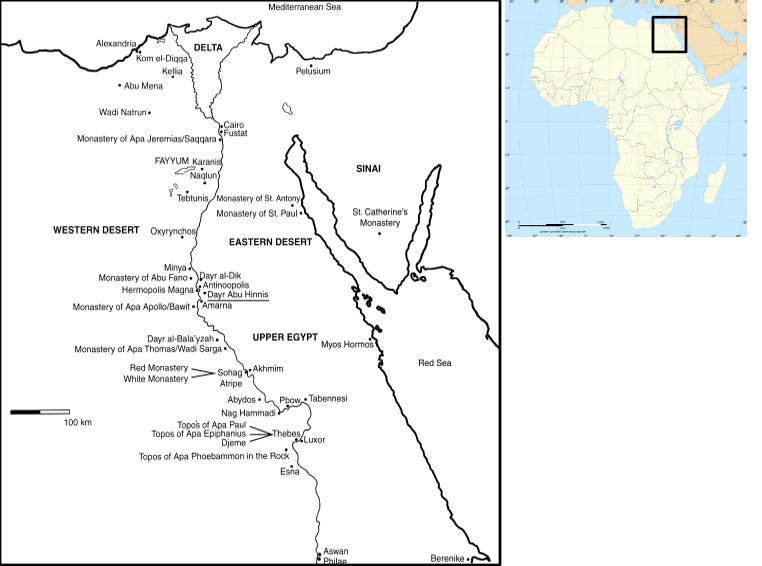
Map of Egypt showing some of the monasteries.1
Support AfricanHistoryExtra by becoming a member of our Patreon community; subscribe here to read more about African history, download free books, and keep this newsletter free for all:
A brief background on early Christianity in Egypt before the 5th century.
Christianity is attested in Egypt from the late 1st century CE. The country occupies a privileged position in biblical tradition as the place of refuge for the Holy Family during the reign of King Herod, the Roman client king of Judea.2
Roman Egypt (30 BC-642 CE) had inherited the Pharaonic religion, onto which a classical gloss had been superimposed, mostly during the preceding Ptolemaic period (332–30 BCE).
The main deities included the ancient gods: Ra, Ptah, Horus, Isis, Bes, and others to whom were dedicated numerous temples and cultic centers. In the Ptolemaic period, Horus was equated with Apollo, Thoth with Hermes, Amun with Zeus, Hathor with Aphrodite, etc., while a few new deities were added to the pantheon, such as Serapis.3
Christianity first appeared in Alexandria, then spread to urban centers along the Nile, and, by the middle of the 3rd century, to the rural towns and villages of the Delta and Nile Valley.
Coptic traditions, first recorded in the 4th century by Eusebius, suggest that St. Mark the evangelist founded the see of Alexandria in 68 CE and ordained Anianus as the city’s first bishop.4
The prominence of early Christian theologians such as Clement of Alexandria (147-215 CE) and his teacher Pantaenus (d. 200) indicates that the religion was well established in the city by the 2nd century.5
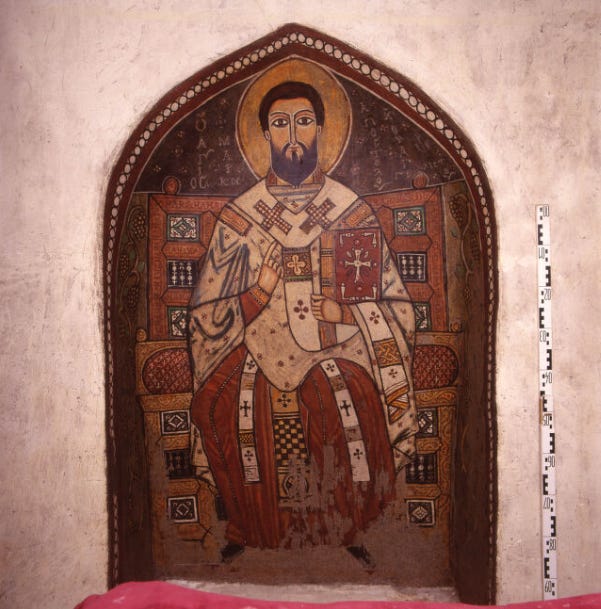
St. Mark the Evangelist, left side of East wall in the monastery of St. Anthony, Egypt. 13th century. Image and Caption from UCLA Library Digital Collections.
It was during this period that Coptic, which is the late stage of the Egyptian language written in Greek and Demotic characters, was increasingly employed by Christians for both documentary and literary purposes.
Christians in late antique Egypt wrote extensively in Greek and Coptic, and both languages are heavily attested in manuscripts and documentary papyri as well as ostraca. Translations of the Septuagint and New Testament appear by 300 CE, along with one of the world’s first codices (a forerunner to the modern book).6
Christianity remained diverse through Late Antiquity, in ritual practice, theology, and institutional structure. A variety of groups/sects flourished and competed for adherents and imperial support.
In Egypt, as elsewhere in the Mediterranean region, “orthodox” groups (not to be confused with modern Orthodoxy) appear only in the 3rd and 4th centuries, while groups eventually labeled as “heretical” are attested already in the 2nd century.7
It’s important to note that members of all dogmatic groups labelled themselves as “orthodox” in contrast to all other Christians who, in their mind, were the “heretics.”
Onomastic material provided by documentary sources suggests that Egypt was 9% Christian in 276–285; 48% in 336–345; and 76.3% in 436–445. Claimants to orthodoxy vied for imperial support, as manifested in buildings, endowments, and various institutional and political privileges and responsibilities. Melitians, Arians, Nicenes, and other groups also sought and sometimes received this support.8
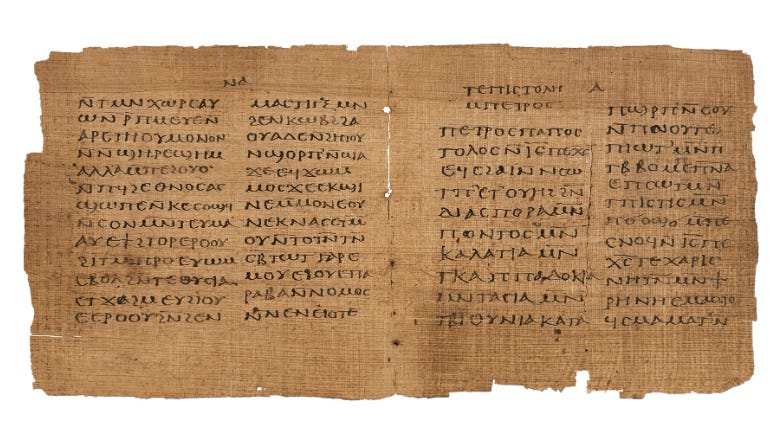
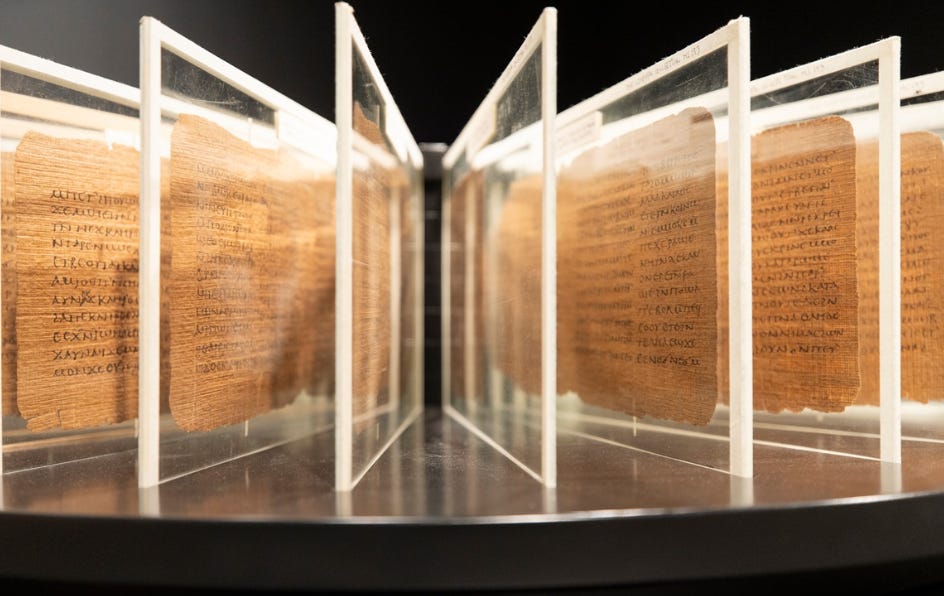
The Crosby–Schøyen Codex MS 193 from Alexandria, Egypt. 3rd century CE. Image from Christie’s, London. It’s considered one of the earliest extant MSS in codex form; the earliest Christian liturgical book in existence; and the oldest book in private ownership.
Christian and non-Christian sources suggest that the 3rd century was a period of religious conflict between the different sects and persecution by the state, beginning in the reign of Decius (249-251) and accelerating during the reign of Valerian (253-260) and the “Great Persecution” of Diocletian in 303-313.9
In Egypt, evidence for these persecutions during the time of Decius and Valerian seems to have been most concerned with the Church leaders and wasn’t targeted against Christians specifically, but affected “pagans” as well.10
Under Diocletian, a series of edicts made it illegal for Christians to gather, ordered the destruction of churches, confiscated Christian texts, arrested the clergy, and apparently ordered universal sacrifice.11
During Diocletian’s Great Persecution, Egypt was particularly hard hit and suffered the death of its bishop, Peter I of Alexandria, in 311. The Church in Egypt became the “Church of the Martyrs,” beginning its calendar with the year of Diocletian’s accession: AM 1, anno martyrorum, “the year of the martyrs.”12
The Great Persecution ended when Emperor Constantine ushered in the “Peace of the Church” in 313. In the succeeding period, both the Christian clergy and Imperial forces now turned against the “Pagans.”
Many Christian literary works refer to the ‘destruction’ of temples in Late Antiquity. However, the historians David Brakke and Jitse Dijkstra have shown that many of these writings conflate the re-occupation of abandoned and disused temples with descriptions of real but relatively few cases of temple destruction in later periods.13
A variety of evidence, including temple inscriptions, papyri, and archaeological remains, indicates that the economic foundation of the temples had been severely weakened by the early 4th century due to internal causes that began in the early Roman period when Imperial administration undermined their financial independence.14
The priestly staff, regular sacrifices, and festal calendar of temples gradually disappeared, to be replaced by more individualized strategies of communication through oracles and diviners outside the temples, as well as domestic cults in private houses where wall niches contained images and icons of gods, just as later niches in monastic cells feature Christian iconography.15
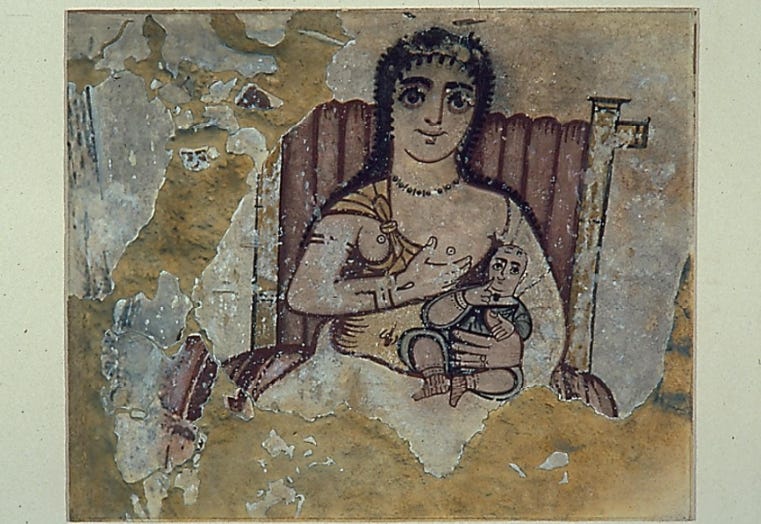
Isis and Harpocrates, wall painting from southern wall of House B50E at Karanis. The Kelsey Museum, University of Michigan.
For example, cultic activity at the Temple of Hatshepsut at Deir el-Bahari at Thebes ended by the mid-2nd century CE, and by the 4th century at the temples at Kellis in the Dakhla Oasis the 4th century. In 301 CE, the abandoned Temple of Amun at Thebes (Luxor) was reused as a military camp during the reign of Diocletian.16
Active temple cults seem to have been mostly maintained in the south, especially in Lower Nubia at the Isis temple in Philae.17
Two 7th-century Coptic texts mention a certain Macedonius belonging to the orthodox claimants, who is thought to have been the first Christian bishop of Philae (330-50 CE), and reportedly ended the ‘pagan’ practice of falcon worship on the island by killing the sacred bird. However, the historicity of this account is doubtful.18
A bit more certain is the career of the monk Shenoute, who became the abbot of the ‘White Monastery’ in 385. Shenoute, the most significant Coptic writer, led the struggle against adherents of the old religions and destroyed their temples, especially at Akhmim. When the Blemmye raiders attacked Upper Egypt, his monastery reportedly took in thousands of refugees.19
The last “pagan” inscription at Philae by the priest of the Isis temple is dated to 456.
While the 7th-century Coptic text mentions three Bishops that succeeded Macedonius during the 4th century, the oldest Christian inscriptions from the island are dated to 449 or 460 and mention a Bishop Daniel. It wasn’t until the 6th century that the abandoned Isis temple was transformed into a Church by Bishop Theodore (525-577).20
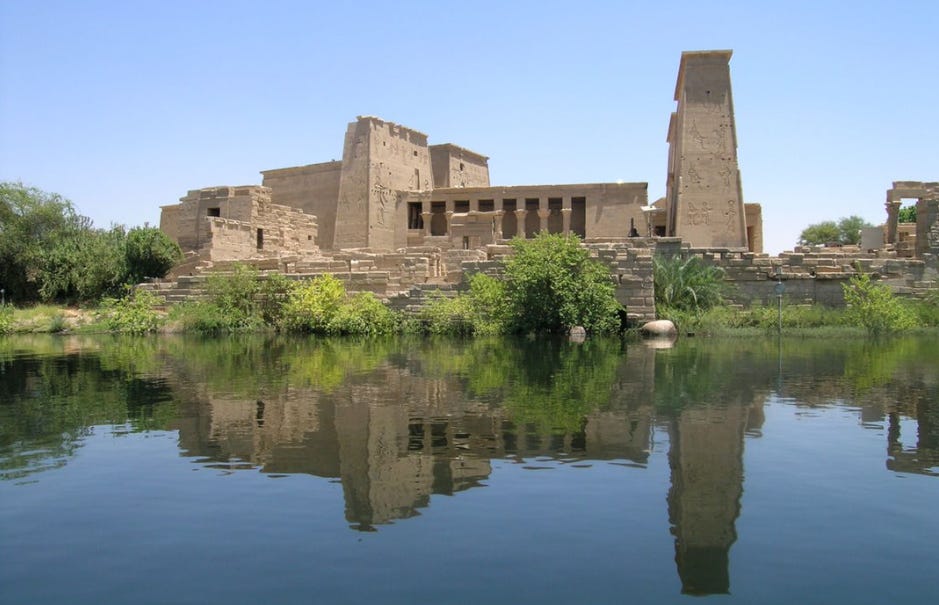
Temple of Isis at Philae
The Invention of Monasticism in Egypt.
Christians had experimented with ascetic practices since the 1st century, but the full flowering of dramatic renunciations and spiritual exercises was particularly marked in late antique Egypt.
The first ascetic known as a monachos (monk) appears in a papyrus dated to 324 CE, which mentions a monk named Isaac, who, along with a deacon named Antoninus, settled a village dispute.
Isaac likely represented the early apotactic (renunciant) movement that was centered not in the desert but in the cities and villages, involving those who lived lives of personal renunciation in service to the Church.
This movement preceded both the anchoritic (solitary) and cenobitic (communal) forms of monasticism, such as those represented by the famous monastic founders Anthony, the “Father of Monasticism,” and Pachomius.21
Anthony (251-356 CE), a rich man who rejected his inheritance and departed for the desert around 270. First learning from older ascetics/hermits, later battling demonic temptation in the solitude of a tomb, and at the foot of Mt. Colzim (Qulzum) near the Red Sea, the site of the present-day Monastery of St. Anthony, where he attracted his own disciples by 305.
Anthony’s career is recounted in the Greek Life of Anthony, a pioneering work of Christian hagiography attributed to bishop Athanasius of Alexandria (328-373), who portrays Anthony as a “holy man” with broad influence, teaching disciples, debating philosophers, and exchanging letters with Emperor Constantine.22
Anthony, and the monastery that still bears his name, are part of 4th-century Egyptian monasticism. Around 320, Pachomius founded the first community of his koinonia at Tabennisi in Upper Egypt. Around 330, when Anthony was living on the inner mountain, St. Macarius of Egypt founded a monastic community in Scetis (Wadi al-Natrun).23
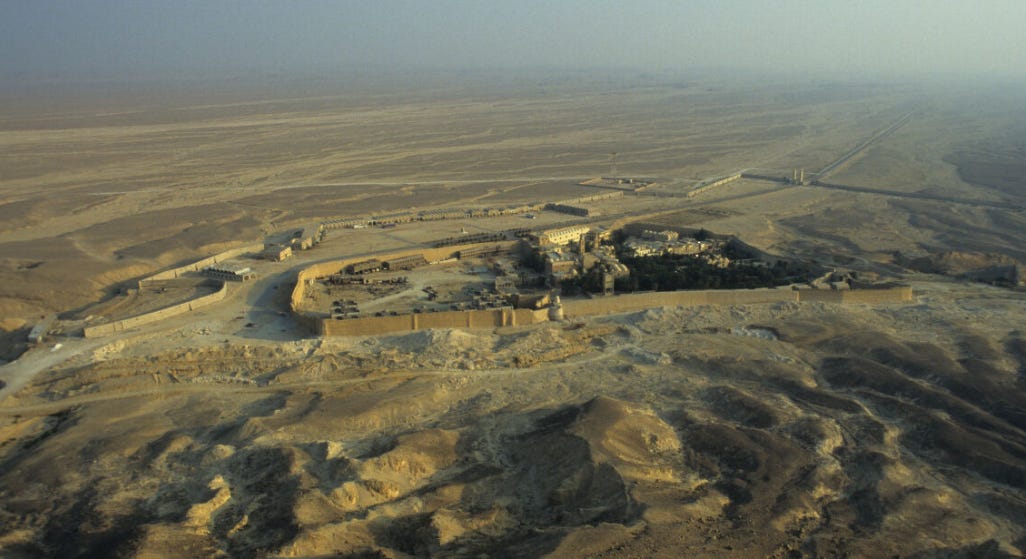
Aerial shot of the Monastery of St. Anthony the Great. UCLA
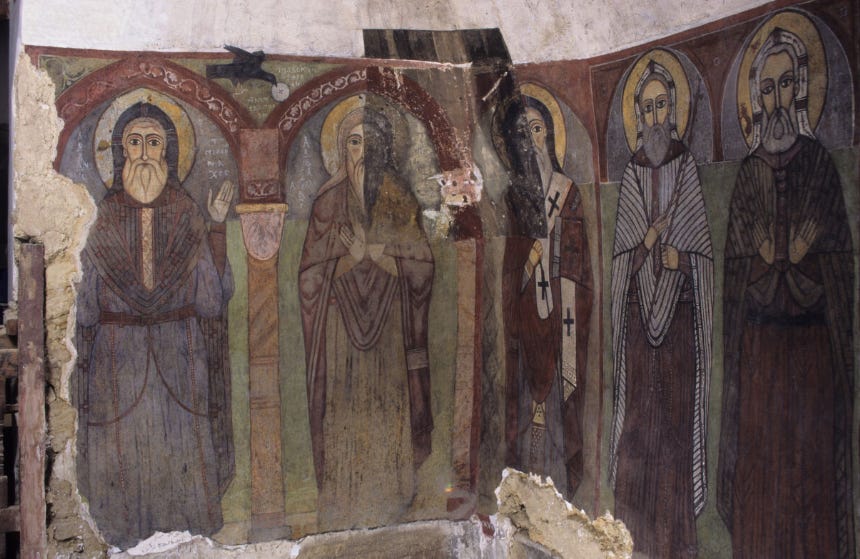
St. Antony and St. Paul (left); an anonymous bishop, and St. Isaac the priest (right). East wall of Eastern Nave Monastery of St. Anthony. 13th century. UCLA
According to biographies written in the 4th or 5th century, Pachomius (ca. 292–348 CE) first apprenticed to a local hermit, gaining enough experience to live on his own near Tabennisi, a village in Upper Egypt north of Thebes. Pachomius gathered followers and organized them into several “houses.”
He founded a number of monasteries, delegating authority across an extensive hierarchy, and establishing a set of rules to govern his developing federation, the Koinonia. Pachomius’s Koinonia attracted a broad array of professions and status levels, and included female communities, the first of which was governed by his sister, Mary.
Pachomius and other cenobitic leaders claimed to provide both physical and spiritual necessities to monks: on the one hand, room, board, health care, and burial; on the other, offering them the path to salvation. In turn, they demanded complete obedience from their disciples through following the extensive institutional schedule of work and prayer.24
Over the course of the 4th and 5th centuries, Egyptian cenobitic practices founded by Pachomius spread across the Mediterranean world up to Western Europe, and southwards to Ethiopia and Nubia (see sections below).
Many early monks, who are not included in this essay for the sake of brevity, also contributed significantly to the development of monasticism in the Christian world.
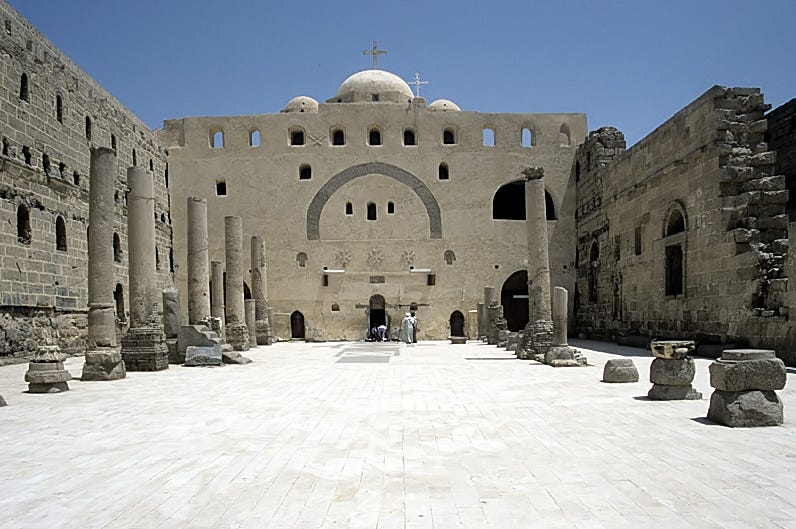
The ‘White monastery’ of Shenoute in Upper Egypt. Named after the limestone used to construct its massive exterior walls
While the monastic institution appeared separate from the clergy, the two were often complementary, since the clergy regarded the authority of the great monks as considerably important. For example, monasteries such as St. Macarius in Scetis supplied some of the monks who ascended to the patriarchal throne in Alexandria.25
Between the 4th and 5th centuries, monasteries rapidly became numerous throughout Egypt. Thousands flocked to the Egyptian deserts to serve an apprenticeship in the art of monasticism.
Palladius of Galatia (d.430 CE) reported 5,000 monks in Nitria and 600 in Kellia around 390. At the beginning of the 5th century, St. Jerome stated that 50,000 Pachomian monks attended the annual meeting. Sources speak of 2,200 monks and 1,800 nuns under Shenute (d. 464 CE) at Atripe, and of 3,500 monks in Scetis ca. 570.26
While some of these figures were exaggerated and were used as a measure of a monastery’s importance rather than an actual headcount of the number of monks at each monastery, they suggest a significant expansion of monastic communities in late antique Egypt.27
Women constituted a significant population of ascetics. At the time when monasticism first appeared in Egypt in the late 3rd to early 4th century, the position of female ascetics had been firmly rooted in the long-established and respected tradition of the Church. Like their male peers, a number of them were involved in the theological debates of the time, especially the Arian controversy.28
Pachomius founded two monasteries for women, and a third was established by his successor Theodorus. Palladius affirms that there were twelve monasteries for women in the single town of Antinoopolis in the Fayyum. Later, 1,800 lived under the authority of Shenute.29
A significant proportion of Egypt’s monastic population came from neighbouring Christian societies, most notably the Syrian monks who had their own ‘Monastery of the Syrians’ (Dayr al-Surian), as well as Armenian monks, Ethiopian monks and Nubian monks who held various monasteries, especially in Scetis/Wadi el-Natrun.30
The Nubian and Ethiopian monks are examined in later sections below.
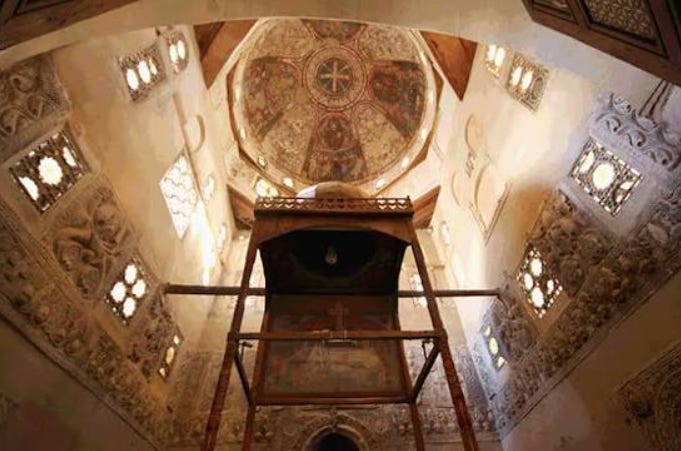
Interior view of the sanctuary. The Church of the Virgin in Dayr al-Suryān. Wadi al-Natrun, Egypt.
Crisis and Expansion: The spread of Monasticism to Aksum and Nubia.
In the 5th century, two major developments reshaped Egyptian monasticism, strengthening the institution’s resilience while also facilitating its subsequent expansion southward into Nubia and Aksum.
The first of these was the collapse of the Western Roman Empire and the insecurities along its borders as raiders such as the Mazices-Berbers devastated prominent monasteries in Scetis (Wadi al Natrun) in 407-8, 410, 444, and 507 CE. They sacked the monasteries of St. Macarius, St. John the Little, and St. Bishoi. 31
The most devastating of these raids occurred in 570 CE and left Scetis virtually abandoned for the next several decades. In all of these sacks, many, if not all, of the monastic buildings were wrecked, the churches plundered, and the monks either slain or carried off as captives.32
Hagiographical records typically identify these types of brigands within tribal categories including those of the Mazices to the north-west, Blemmeyes in the south, and Saracens in the east.
These upheavals are reflected in the career of one of Scetis’ most famous monks: St. Moses the Ethiopian (also called Moses the black).
According to Palladius, Moses was originally a bandit who decided to become a monk. He met St. Isidore and St. Macarius and lived a highly ascetic life, and was later ordained to the priesthood. Knowing beforehand of a possible raid by the Mazices, he warned his disciples and advised those who could escape. He remained with seven other monks at al-Baramus to be martyred by the raiders.33
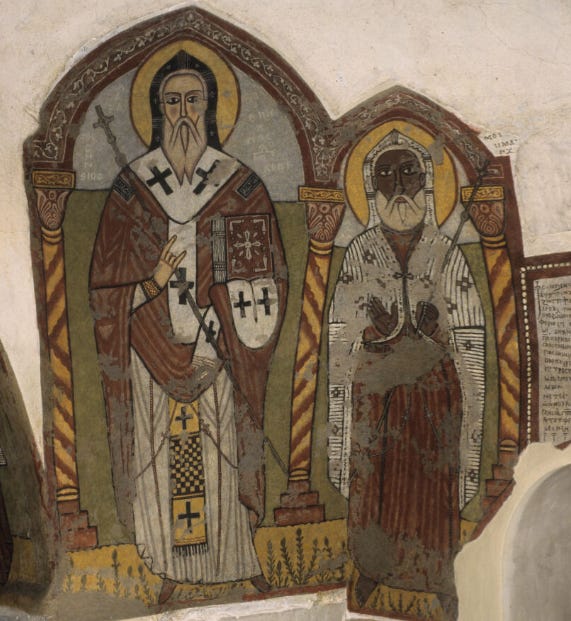
St. Pisentius and St. Moses the Black, West wall of Eastern Nave, Monastery of St. Anthony, Egypt. 13th century. UCLA.
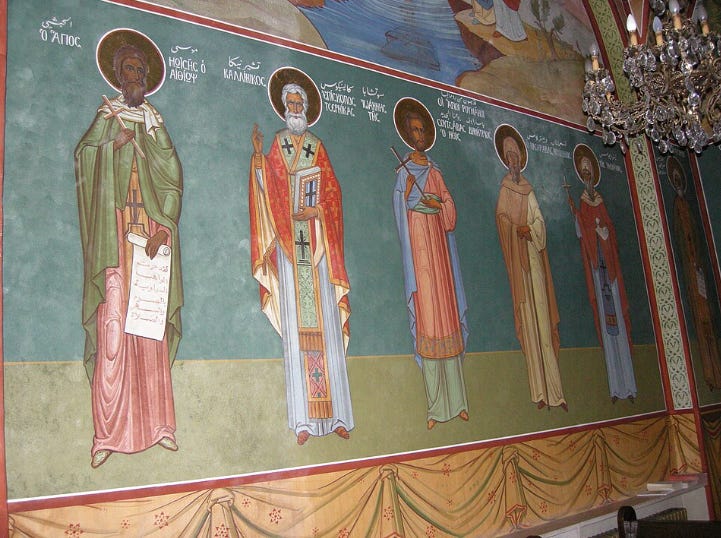
St. Moses the Ethiopian and St. Kallinikos painting in the Cathedral of Our Lady of the Annunciation, Jerusalem.
Moses and seven companions were slain; St. John the Little and St. Bishoi, the founders of two monasteries in Scetis, fled and died soon in exile. Destruction and rebuilding became a motif of the monasteries through their later history.
The second and arguably more consequential development was the controversy over the Council of Chalcedon, which deepened the division between the Egyptian Church and the Byzantine imperial church and contributed to the wider schism between Chalcedonian and non-Chalcedonian Christianity.
In 451, the Council of Chalcedon accepted the Tome of Leo, Bishop of Rome, which affirmed that Christ existed in two natures, divine and human. In its aftermath, competing Chalcedonian and non-Chalcedonian (Miaphysite) hierarchies claimed authority over the Egyptian Church. The non-Chalcedonian Church ultimately became dominant in Egypt, although the process unfolded over several decades and was facilitated by the Arab conquest of Egypt in 641–642.34
The divided nature of the Church in Egypt was reflected also in the monasteries.
The Pachomian monastery of Metanoia at Canopus in Lower Egypt had Melkite leanings, while the Pachomian monasteries in Upper Egypt remained anti-Chalcedonian until the time of Justinian (d.565). The monastery of Kellia, west of the Nile Delta, which was originally one church, became two, each with its own baptistry, possibly for baptizing converts from the other side.35
In Alexandria, the fierce competition meant the throne of the Patriachate often changed hands, but there were also instances when the city had two sitting patriarchs, including some pretenders.36
The Aksumite empire and the Nubian kingdoms were drawn into the orbit of the Alexandrian Patriarch.
Frumentius, the first bishop of Aksum, was appointed by the Patriarch Athanasius (328–373) during the reign of King Ezana. The greater antiquity of Christianity in Aksum (c. 340 CE) meant that its church was pre-Chalcedonian and only chose to retain its non-Chalcedonian status after the Council of 451.37
In Nubia, both confessions initially existed side by side, the kingdom of Makuria being Chalcedonian and Noubadia non-Chalcedonian. After their unification following the Arab invasion of Nubia c. 651 CE, the combined church in Makuria came under the authority of Alexandria as a non-Chalcedonian Church.38
In spite of its ecclesiastical allegiance to the Patriarchate of Alexandria, Christian Nubia was politically independent of Egypt, which was, until the Arab conquest, a province of the Byzantine Empire.
Early evidence for the presence of monks in Nubia appears in the 5th-century Coptic letters found in Qasr Ibrim. One of the letters was sent from a monk named Moses to Tantani, an official. On the one hand, the letter documents contacts of monks with Nubia; on the other hand, it seems clear that Tantani was a Christian in the administration.39
Monasticism in the kingdoms of Noubadia and Makuria appeared in an already developed institutional form by the 6th-7th century.
Monasteries built during this period include Qasr al-Wizz (Apa Dios) near Faras in lower Nubia, Kom H at Old Dongola, Ghazali in the Bayuda Desert, the former temple of Taharqa at Qasr Ibrim, and the monastery at al-Rahmal. All were expanded in later centuries; the largest at Ghazali could house about 70 monks.40
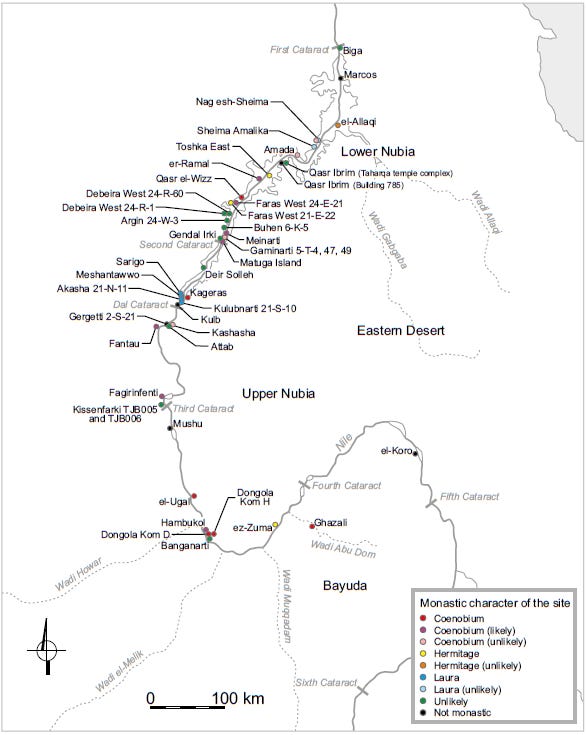
Monastic sites of Nubia. Map by S. Maślak, reproduced by A. Obluski.
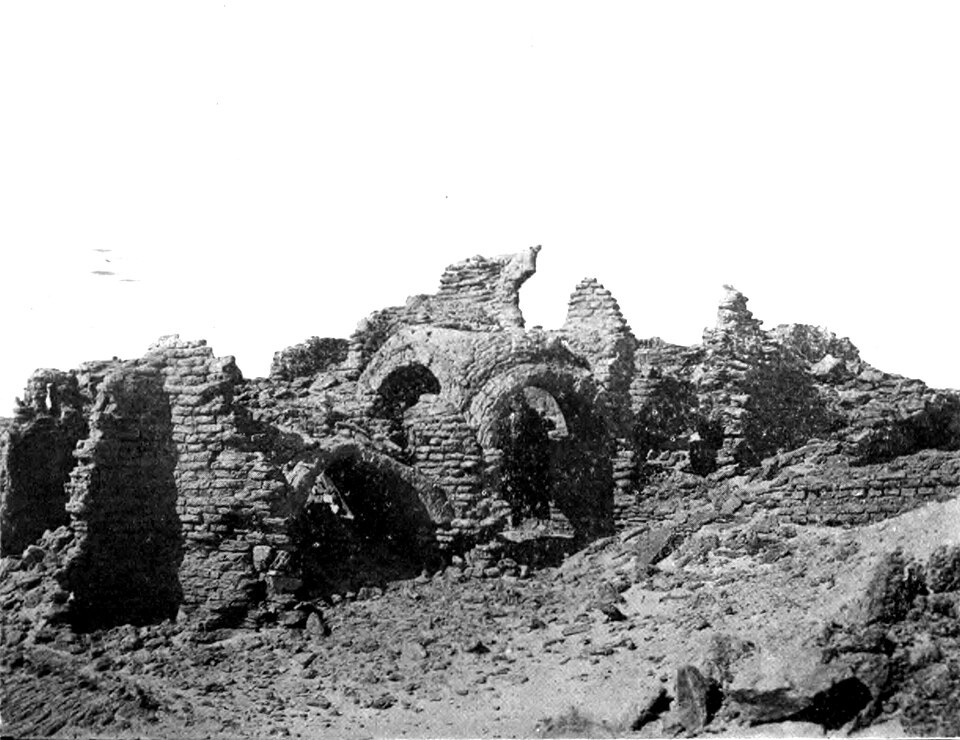
Ruins of Qasr el Wizz, c. 1910. Geoffrey S. Mileham.
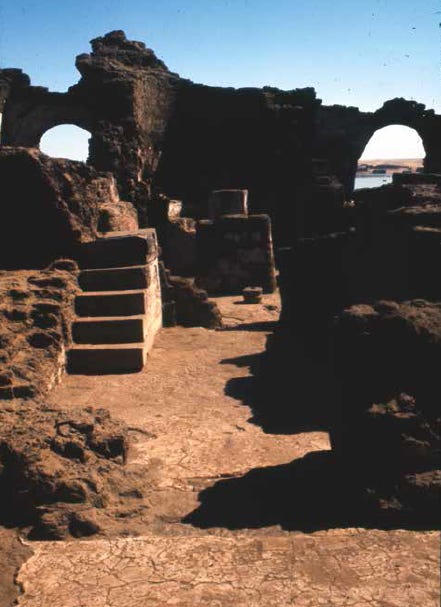
Apa Dios (Qasr el-Wizz), church. Oriental Institute, University of Chicago.
Monasticism in Nubia is largely known from archaeological evidence. It was mostly coenobitic, with monks living in institutionally organised monasteries enclosed by a physical barrier in the form of a wall.
According to the archaeologist Artur Obluski, the El-Ghazali monastery “can be called a textbook example of a coenobitic monastery, as its spatial organisation was conceived and planned with proper know-how, or good knowledge of what coenobitism really represents.”41
Its spatial organization was made up of three zones: one dedicated to spiritual and religious activity represented by the church (es); a second zone devoted to economic and household activity, and included bakeries, storerooms, kitchens and mills; and a third zone for catering to basic human needs, with dormitories, refectories and toilets.42


The monastery of el-Gahazali.
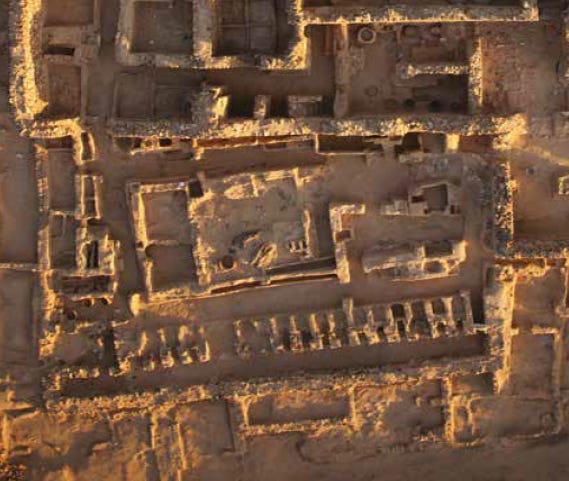
The lavatory complex (toilets) at el-Ghazali, Sudan. Image by Miron Bogacki.
Besides the widespread use of Coptic writing (alongside the Greek and Old Nubian scripts), a connection to Egyptian monasticism in Nubia is found in the monastery of Kom H at Dongola, which was probably dedicated to St. Anthony, as suggested by the funerary stela of the Abba Georgios (d. 1113), who was an archimandrite of this monastery.43
Additionally, the sayings of St. Pachomius (apa Pachom) in an anchorite grotto in the Faras cathedral dated c. 780 CE, along with the sayings of Apa Evagrius, Apa Ezaias, Apa Arsenios, and Apa Makarios. The 5th-century collection known as the ‘Sayings of the Desert Fathers’ was thus known in Nubia.44
However, while Egypt was the cradle of monasticism from which the institution spread to Nubia, it soon developed into a distinctively Nubian form.
Obluski observes;
“In sixth-century Nubia, coenobitic monasticism may have appeared already in a form that was spatially well planned, well suited to the needs of the community…
It would be difficult to find direct parallels between early Egyptian, for example Pachomian monasticism, and the Nubian one due to the considerable variety in architectural forms of the former, resulting from its polycentric and highly individualized development.”45
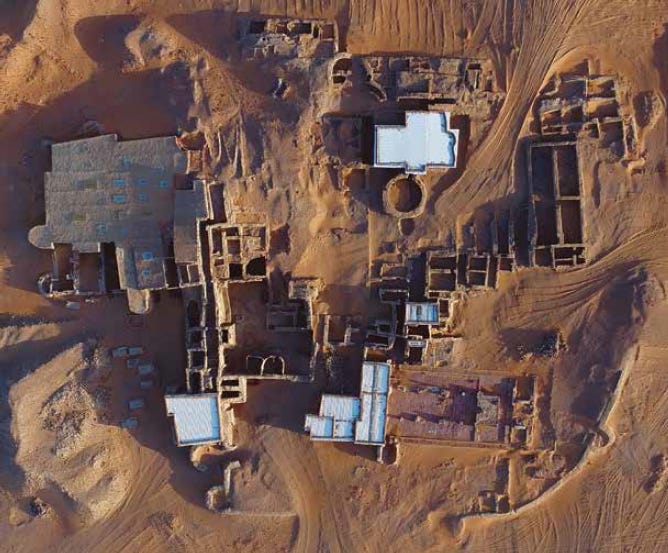
Dongola, Kom H, drone photo of the monastery. Image by Roman Łopaciuk
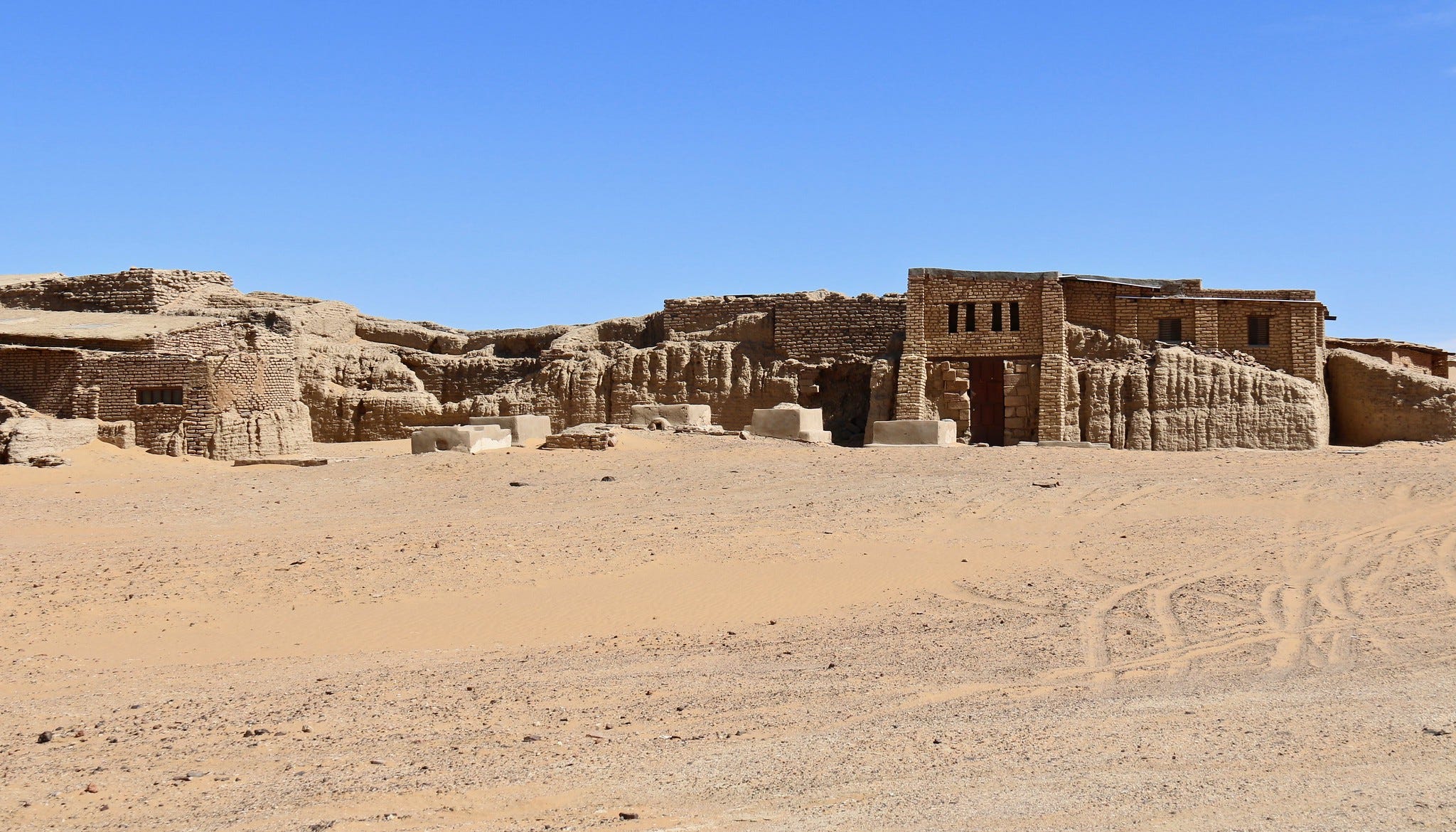
Kom H monastery at Old Dongola, Sudan.
In the Aksumite kingdom, monasticism is linked to the arrival of the non-Chalcedonian “nine saints” from Byzantine Syria, rather than Egypt.
Traditions from a number of extant churches and monasteries in present-day Ethiopia and Eritrea attribute their foundation to the 5th-7th century period, often linked with the ‘nine saints’ and the Sadqan from Anatolia and Syria.46
As essentially individuals rather than a formal collective, the form of monasticism introduced by these first monks would have been anchoritic rather than the coenobitic, communal version found in Egypt.47
However, Pachomian coenobitic monastic rules are among the earliest translated literary works in the Christian Kingdom of Aksum. Pachomian tradition is considered to be the basis for Ethiopian monasticism, and the rules were adopted by the monastic orders in later days.
Pachomius (ጳኩሚስ Pakumis) is one of the highly venerated monastic figures mentioned next to Anthony and Macarius in the listing of Ethiopian monastic genealogy. The Ge’ez translation of Pachomian Rules; “The Rules of the [Monastic] Community” ( Śər atä mahbär), depends on a Greek Vorlage (ie; during the Aksumite period). Ethiopian tradition attributes its translation to the “Nine Saints.”48
Additionally, some of the works of Saint Anthony were likely translated during the Aksumite period, such as the Vita Antonii (Zenāhu la-ʾabuna qəddus ʾƎnṭonyos, ‘The story of our holy father Anthony’). The famous monk is usually placed at the top of genealogical lists of monks, followed by Macarius, Pachomius, etc., and ends with the names of Ethiopian monks to show the pedigree of the latter and his monastic house.49
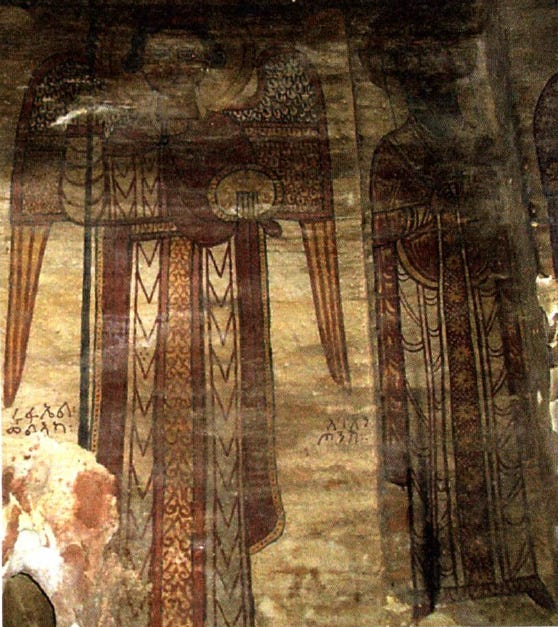
Antony and archangel Raphael; wall painting, Church of Maryam QorQor, 14th/15th century. Ethiopia. Image by Ewa Balicka-Witakowska
Among the early monasteries, evidence for Aksumite monasticism independent of later historical tradition can be found for at least two monasteries founded by the ‘nine saints.’
The first is the Monastery of St. Abba Garima (named after one of the ‘nine saints’), in which two illuminated gospel manuscripts were recently discovered, dated to between 330–650 and 530–660 CE.50
The second is the mountain-top monastery of Debra Damo, where the larger of the two churches is dedicated to St. Za-Mika’el Aregawi, who was active in the reign of the 6th-century Aksumite king Gabra Masqal. This date is supported by the similarities between its basic plan and architecture and the churches forming the superstructure of the 6th century Tombs of Kaleb and Gabra Masqal at Aksum.51
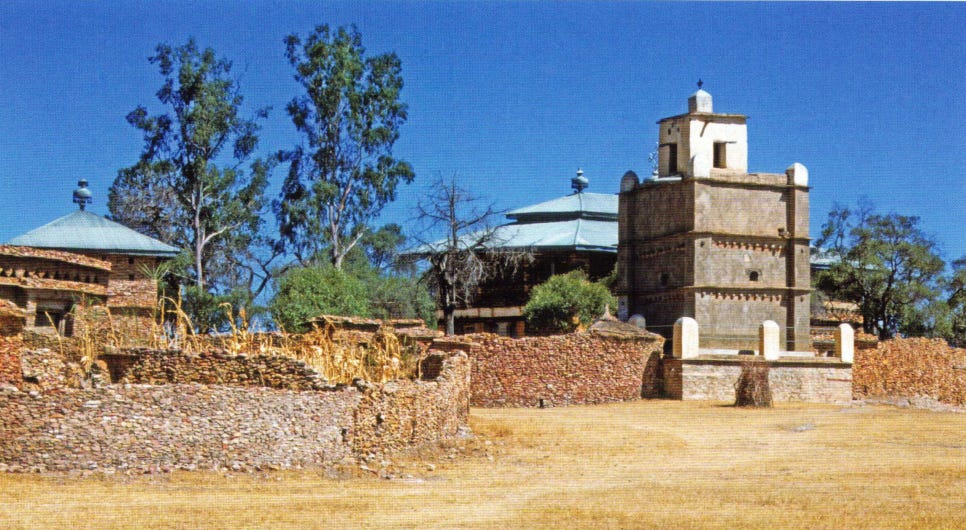
Debre Damo, main church and tower. Image by David W. Phillipson.
Besides the Life of Anthony, other texts translated into Gəʿəz from Greek at an early stage of Ethiopian literary history during the Aksumite period include: the 4th century Life of Paul the first hermit and the 5th century Life of St. Alexis. However, the more popular 5th-century collection, ‘Sayings of the Desert Fathers,’ may have been translated after the 13th century.52
Despite its institutional roots in both Egypt and Syria, monasticism in medieval Ethiopia, like that of Nubia, soon developed into a distinctively Ethiopian tradition.
The expansion of the Christian kingdom in Ethiopia after the 14th century coincided with the decline of Christian institutions in Egypt and Nubia under Mamluk rule. By the end of the Middle Ages, Ethiopia had emerged as the principal centre of a thriving and expanding monastic tradition in Africa, while the older monastic landscapes of Egypt and Nubia entered a prolonged period of decline.53
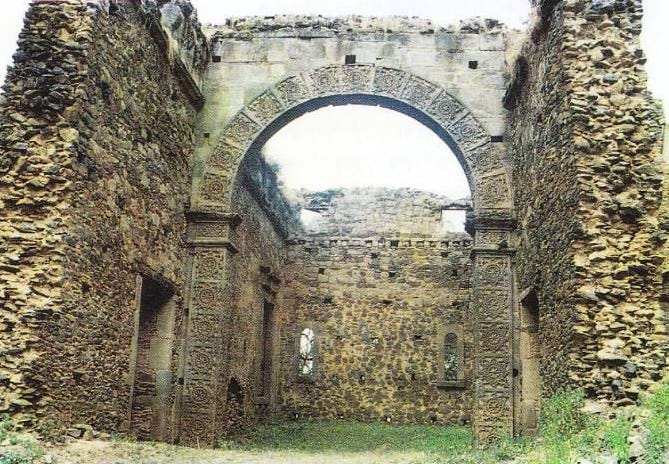
Queen Eleni’s monastery of Marṭula Māryām, Ethiopia.
Decline of monasticism
In Egypt, the real decline of Coptic monasticism began in 705 when the poll tax was imposed for the first time on the monks.
Between the 9th and the 12th centuries, a large number of monasteries were abandoned, partly due to continued attacks by nomadic raiders as well as the decline of the Christian population in Egypt, which no longer made up the majority.54
The Coptic historian Mauhub ibn Mansur ibn Mufarrig states that there were only 712 monks at Wadi Habib (ie Scetis/Wadi el-Natrun) in 1088. They were divided among seven monasteries, the largest three of which were 400 monks in the Monastery of St. Macarius, 156 in the Monastery of John the Little, and 60 in the Monastery of the Syrians.55
The Fatimids (969-1171) expressed a more sympathetic attitude towards the Copts, except al-Hakim (996-1021), who persecuted them and destroyed churches, except the monasteries of Scetis.56 It was during this period that the Coptic patriarchate was moved from Alexandria to Cairo.
In the Ayyubid period (1171-1250), a brief Christian Arabic renaissance flared in the fields of theology, apologetics, ecclesiastical history, and canon law. Yet its impact on the church was hardly noticeable, and Christianity in Egypt rapidly declined under the new rulers, the Mamluks, who took power in 1250.57
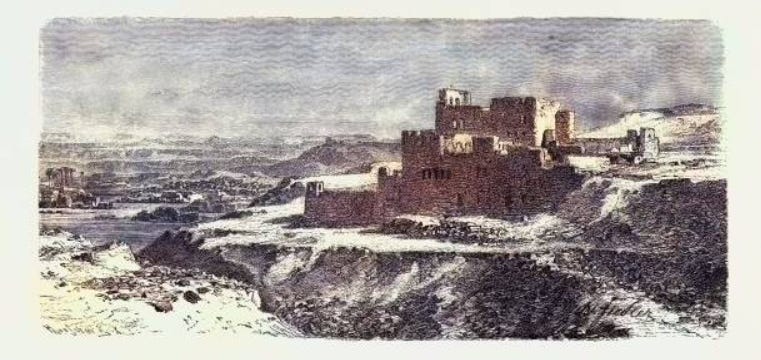
Deserted Coptic Monastery at Aswan, Egypt. Engraving by Bernhard Fiedler, 1885
Nevertheless, the decline of monasticism in Egypt was temporarily stemmed by continued contacts with the independent Christian kingdoms of Nubia and Aksum/Ethiopia, whose rulers presented themselves as protectors of the Coptic Christian community in Egypt.
The Makurian army under King Kyriakos invaded Egypt twice, ostensibly to force the Arab governor of Egypt to restore the persecuted Alexandrian patriarch Michael (r. 743–67).58 Later Makurian incursions into Upper Egypt and subsequent occupation of Edfu in the 9th century suggest a political motive behind these northern campaigns.59
After the fall of Makuria to the Mamluks in the 14th century, Ethiopian monarchs assumed a similar protective role toward the Coptic community in Egypt, at times leveraging their influence over Muslim vassals and repeated threats to block the Nile.
Both Al-Maqrizi and Ethiopian sources indicate that in 1381, the armies of the emperor Dawit I (r. 1382-1413) raided the region of Aswan, ostensibly because of the persecutions of the Alexandrian Patriarch and the Copts due to Mamluk fears of an alliance with the Crusaders. Some Copts fled to Ethiopia during this period.60
The existence of powerful Christian states allied with the Copts, together with the continued influx of monks and pilgrims from Ethiopia and Nubia61 into late medieval Egypt, arguably helped sustain monasticism and Christianity itself during this tumultuous period.
The apparent strength of the Copts’ southern Christian neighbours was noted by a number of contemporary European witnesses, some of whom viewed these powerful Christian states as potential allies against the Muslim rulers of Egypt.62
In 1335, while in Jerusalem, the Italian pilgrim Jacopo da Verona observed that “They are black Ethiopians from among the people of Prester John, who is one of the greatest princes in the world. They always carry, as I have said, a cross in their hand, even in the presence of the [Mamluk] Sultan and in the presence of the Saracens, and they pay no tribute through the entire land of the Sultan.
Also, however often the sepulcher of Christ is opened, they enter without [paying] money or tribute; and the reason for this is that Prester John, the Lord of Nubia and Ethiopia, has the potential within his own realm to divert the Nile river. If that land did not receive this river, it would be wholly uninhabitable, as evidently [is the case for] all of Egypt; and, similarly, Prester John is more powerful than the Sultan.” 63
A number of Makurian kings, such as King Solomon (1080) and King Giorgios IV (d. 1158), are known to have renounced their thrones in favor of their sons or nephews in order to become monks in Egypt. A marble tray was found at the Syrian monastery (Dayr al-Suryan) in Wadi al-Natrun, with Greek and Old Nubian inscriptions for King Giorgios IV.64
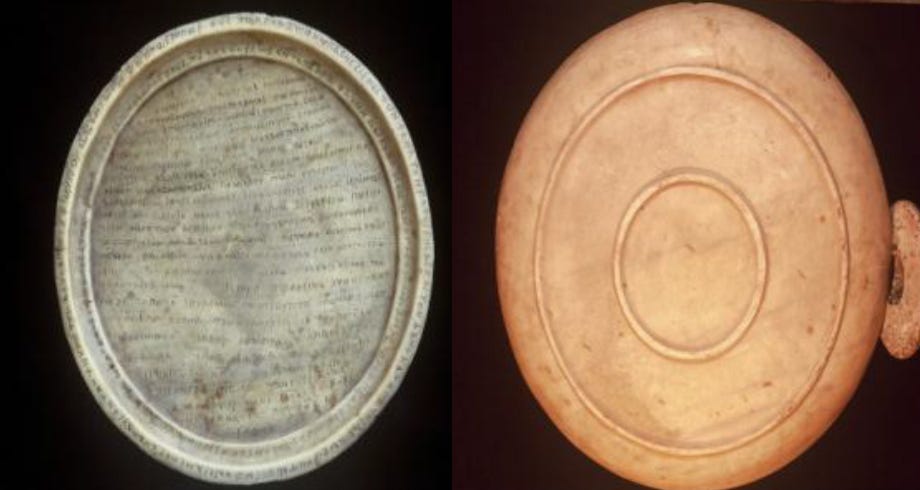
Marble tray with the inscription of King Giorgios IV from the monastery of the Syrians in Wadi al-Natrun. Image by Bishop Martyros.
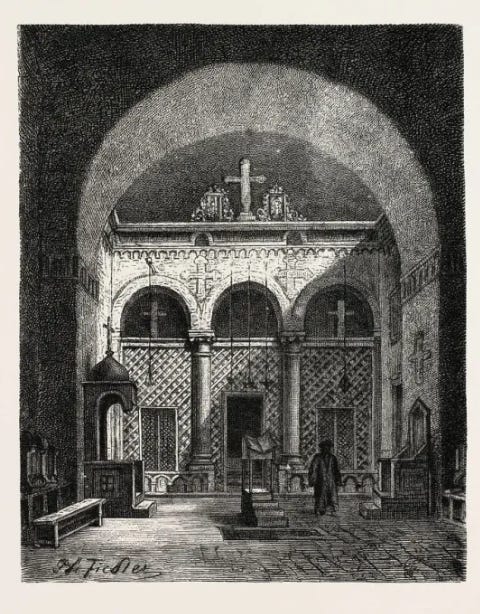
Interior of a Coptic Church, by Bernhard Fiedler, 1885
A certain Macarius the Nubian was an important figure in the monastic community of st John Kame in a text concerning the episcopate of Christodoulos of Alexandria (1046–1077).65 Abyssinian/Ethiopian monks were present at the monasteries of St. John Kame and Anba Bishoi in a text by Bishop Athanasius of Qus dated 1317.66
According to Abū al-Makārim, writing c. 1200, Nubians (Nūbah) even shared a sacred space with other groups – Greeks (Rūm), Franks (Faranj), and Ethiopians (Ḥabasha) – whose envoys would be received at the court in Cairo, where they would customarily worship alongside each other at the fountain at al-Maṭariyya.67
At the monastery of St. Anthony near the Red Sea, and the White Monastery in Upper Egypt, Coptic monks lived together with Syrians, Ethiopians, Franciscans, and Armenians. Apparently, there were large Ethiopian communities at both sites as late as the Ottoman period in the mid-16th century.68

Copy of a Psalter written in multiple scripts and languages, 12th-14th century, monastery of Saint Macarius, Wadi al-Natrun, Egypt.69 Beginning with Ethiopic/Ge’ez on the extreme left column, followed by Syriac, Coptic in the center, Arabic on the right, and ending with Armenian.
In the late Mamluk period, waves of persecution and the confiscation of monastic property led to the gradual abandonment of the majority of Coptic monasteries. Recorded Coptic history came to an end by the 14th century, leaving only external sources as our main sources for the succeeding period.70
In the 14th century, the amirs ordered that all churches built after the Arab conquest were to be destroyed. The Black Death wiped out a large number of monks, although some monasteries were soon repopulated. By the time of Maqrizi c. 1441, the Desert of Scetis had declined. He notes that previously one hundred monasteries stood in the Wadi Habib, of which only seven survived.71
By 1799 the total number of monks in the Wadi el-Natrun complex stood at just 59.72 Many of the monasteries had long been abandoned, their floors covered with sand and strewn with loose leaves of old manuscripts guarded by a few solitary monks.
From the 16th to early 20th centuries, European collectors acquired a large collection of books from these ancient monastic libraries, some of which contained precious historical information on North-East Africa and Christian theology in antiquity.
Monasticism left a profound mark on the ancient Christian world in its piety, ethics, and institutions.
Egyptian monasticism, through the immense influence it exerted across the Mediterranean world and North-East Africa, remains one of Egypt’s most significant legacies to Christianity and to the religious history of Africa.
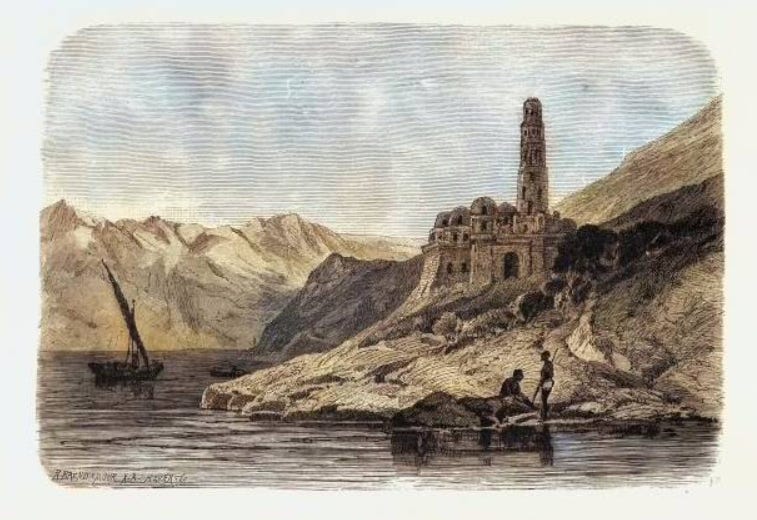
Ruins of a Coptic monastery near Philae, Egypt. Engraving by Bernhard Fiedler, 1855.
Ancient state structures in Africa included Empires, which carried with them all the complexity, inequalities, and political baggage inherent in such systems.
The best documented and oldest example of imperial administration in ancient Africa comes from Lower Nubia (present-day southern Egypt), which was subsumed into the empires of New Kingdom Egypt (c. 1570–1069 BC) and Meroitic Kush (c. 270 BC–360 CE)
The Imperial administration in Lower Nubia and the ancient biographies of its native rulers are the subject of my latest Patreon article
Please subscribe to read more about it here:
Taken from: New Life for an Old Church: Investigating the Village Church of Dayr Abū Ḥinnis in Middle Egypt, by Gertrud J.M. van Loon, Dina Ishak Bakhoum and Naglaa Hamdi Boutros
Two Thousand Years of Coptic Christianity By Otto F. A. Meinardus, pg 14-27
The Oxford History of Ancient Egypt, edited by Ian Shaw 428-430. The Oxford Handbook of Roman Egypt, edited by Christina Riggs pg 436-452
Two Thousand Years of Coptic Christianity, by Otto F. A. Meinardus, pg. 28-30
The Oxford Handbook of Roman Egypt, edited by Christina Riggs pg 474-477
The Oxford Handbook of Egyptology edited by Ian Shaw, Elizabeth Bloxam, pg 1096-1106 The Oxford Handbook of Roman Egypt, edited by Christina Riggs pg 582-590
Orthodoxy and Heresy in Earliest Christianity, by Walter Bauer
A Companion to Religion in Late Antiquity, edited by Josef Lössl, Nicholas J. Baker-Brian pg 188
The Wiley Blackwell Companion to Christian Martyrdom by Paul Middleton, pg 33-35
The Oxford Handbook of Roman Egypt, edited by Christina Riggs pg 481-483.
The Wiley Blackwell Companion to Christian Martyrdom, edited by Paul Middleton, pg 42-47
Coptic Monasteries: Egypt’s Monastic Art and Architecture, by Gawdat Gabra, Tim Vivian pg 3
“The Fate of Temples in Late Antique Egypt.” by Jitse Dijkstra, pg 394-400 In ‘The Archaeology of Late Antique ‘Paganism’, edited by L. Lavan and M. Mulryan. “From temple to cell, from gods to demons: pagan temples in the monastic topography of fourth-century Egypt” by David Brakke. In: ‘From Temple to Church: Destruction and Renewal of Local Cultic Topography in Late Antiquity ’, edited by Stephen Emmel
The Oxford Handbook of Roman Egypt, edited by Christina Riggs pg 136-138
A Companion to Religion in Late Antiquity, edited by Josef Lössl, Nicholas J. Baker-Brian pg 183-185. The Oxford Handbook of Roman Egypt, edited by Christina Riggs pg 406-412
The Archaeology of Late Antique ‘Paganism’, edited by L. Lavan and M. Mulryan pg 401-410
Calling Out to Isis: The Enduring Nubian Presence at Philae by Solange Ashby
Philae and the End of Ancient Egyptian Religion, by J. H. F. Dijkstra pg 55-56, 255-269)
Coptic Monasteries: Egypt’s Monastic Art and Architecture, by Gawdat Gabra, Tim Vivian pg 119-120. From Temple to Church: Destruction and Renewal of Local Cultic Topography in Late Antiquity, edited by Johannes Hahn, Stephen Emmel, Ulrich Gotter pg 161-181
Christianity in Philae by Samuel Moawad, in ‘Christianity and Monasticism in Aswan and Nubia,’ edited by Gawdat Gabra
Coptic Monasteries: Egypt’s Monastic Art and Architecture, by Gawdat Gabra and Tim Vivian pg 9-10
The Life of Antony and the Letter to Marcellinus by Saint Athanasius, translated by Robert C. Gregg. Coptic Monasteries: Egypt’s Monastic Art and Architecture, by Gawdat Gabra, Tim Vivian pg 11-12, 55-56
Coptic Monasteries: Egypt’s Monastic Art and Architecture, by Gawdat Gabra, Tim Vivian, pg 12
A Companion to Religion in Late Antiquity, edited by Josef Lössl, Nicholas J. Baker-Brian, pg 192, Monks and the Hierarchical Church in Egypt and the Levant During Late Antiquity by Ewa Wipszycka, pg 68-79.
Two Thousand Years of Coptic Christianity By Otto F. A. Meinardus, pg 157-159. Monks and the Hierarchical Church in Egypt and the Levant During Late Antiquity by Ewa Wipszycka, pg 80-107, 181-183
Coptic Monasteries: Egypt’s Monastic Art and Architecture, by Gawdat Gabra, Tim Vivian, pg xx
Monks and the Hierarchical Church in Egypt and the Levant During Late Antiquity by Ewa Wipszycka, pg 6, 157-158. The Monasteries and Monks of Nubia by Artur Obłuski pg 233-234
Monks and the Hierarchical Church in Egypt and the Levant During Late Antiquity by Ewa Wipszycka pg 102-106
The Coptic Encyclopedia Volume 5, edited by Aziz Suryal Atiya pg 1663
Coptic Monasteries: Egypt’s Monastic Art and Architecture, by Gawdat Gabra, Tim Vivian, pg 23, 31-45
Two Thousand Years of Coptic Christianity By Otto F. A. Meinardus, pg 157, 160, 164
Christian Monastic Life in Early Islam by Bradley Bowman, pg 75-76. Monks and Monasteries of the Egyptian Desert, Revised Edition, by Otto F.A. Meinardus, pg 54-55
The Lausiac History of Palladius II, by Dom Cuthbert Butler, Cambridge University Press, 1904, pg 58-62. Monks and Monasteries of the Egyptian Desert, Revised Edition, by Otto F.A. Meinardus, pg 54
The term ‘Monophysites’ was used exclusively by opponents of anti-Chalcedonians and is thus marked by negative overtones. It is for this reason that some among the contemporary representatives of Churches which reject the theological output of Chalcedon - the Copts in particular- demand to abandon the use of the term and replace it with ‘Miaphysites’
Monks and the Hierarchical Church in Egypt and the Levant During Late Antiquity by Ewa Wipszycka, pg. 13-14, 141-144)
Coptic Monasteries: Egypt’s Monastic Art and Architecture, by Gawdat Gabra, Tim Vivian, pg 5
Monks and the Hierarchical Church in Egypt and the Levant During Late Antiquity by Ewa Wipszycka, pg. 141-143
Foundations of an African Civilisation: Aksum & the Northern Horn, 1000 BC-1300 AD by D. W. Phillipson pg 104
Was King Merkourios (696 - 710), an African ‘New Constantine’, the unifier of the Kingdoms and Churches of Makouria and Nobadia? – A re-examination and alternative suggestions, by Benjamin Hendrickx
Christianity and Monasticism in Aswan and Nubia By Saint Mark Foundation, Saint Shenouda the Archimandrite Coptic Society, pg 51
The Monasteries and Monks of Nubia by Artur Obłuski pg 18-22, 40-46, 64-69, 98-99, 101-104
The Monasteries and Monks of Nubia by Artur Obłuski pg 64
The Monasteries and Monks of Nubia by Artur Obłuski pg 64, 130-136)
The Monasteries and Monks of Nubia by Artur Obłuski pg 148, 152, 278, 287-288
The Oxford Handbook of Ancient Nubia, edited by Bruce Williams, Geoff Emberling, pg 779
The Monasteries and Monks of Nubia by Artur Obłuski pg 200
The Archaeology of Ethiopia by Niall Finneran, pg 195. The monastic holy man and the Christianization of early Solomonic Ethiopia by Steven Kaplan, pg 16-17
The Archaeology of Ethiopia by Niall Finneran, pg 195-196
Encyclopaedia Aethiopica Vol. 4, edited by Siegbert Uhlig, pg 87. A Companion to Medieval Ethiopia and Eritrea edited by Samantha Kelly, pg 165
‘Antony, “the First Monk” in Ethiopian Tradition by Witold Witakowski pg 205-207, in ‘Veneration of Saints in Christian Ethiopia ’, edited by Denis Nosnistin.
The Archaeology of Ethiopia by Niall Finneran, pg 196, 198-199. The Garima Gospels: Early Illuminated Gospel Books from Ethiopia By Judith S. McKenzie, Francis Watson
Foundations of an African Civilisation: Aksum & the Northern Horn, 1000 BC-1300 AD by D. W. Phillipson, pg 104-105, 131-132
Encyclopaedia Aethiopica Vol. 3, edited by Siegbert Uhlig, pg 993-994
The monastic holy man and the Christianization of early Solomonic Ethiopia by Steven Kaplan.
Monks and Monasteries of the Egyptian Desert, Revised Edition, by Otto F.A. Meinardus, pg 55-56.
Coptic Monasteries: Egypt’s Monastic Art and Architecture, by Gawdat Gabra, Tim Vivian, pg 23
Monks and Monasteries of the Egyptian Desert, Revised Edition, by Otto F.A. Meinardus, pg 107-108
Two Thousand Years of Coptic Christianity By Otto F. A. Meinardus, pg 65
The Oxford Handbook of Ancient Nubia, edited by Bruce Williams, Geoff Emberling, pg 763.
Ancient Nubia by P. L Shinne, pg 125
Church and State in Ethiopia, 1270-1527 by Taddesse Tamrat pg 255. The Cross and the River: Ethiopia, Egypt, and the Nile by Haggai Erlich pg 44-45
A Note towards Quantifying the Medieval Nubian Diaspora by Adam Simmons, pg 25-26
Nubia, Ethiopia, and the Crusading World, 1095–1402, by Adam Simmons
The African Prester John and the Birth of Ethiopian-European Relations, 1402-1555 by Matteo Salvadore, pg 5
Christianity and Monasticism in Aswan and Nubia by Saint Mark Foundation, Saint Shenouda the Archimandrite Coptic Society, pg 213-217
The Monasteries and Monks of Nubia by Artur Obłuski pg 122
Christianity and Monasticism in Aswan and Nubia by Saint Mark Foundation, Saint Shenouda the Archimandrite Coptic Society, pg 262-3
A Note towards Quantifying the Medieval Nubian Diaspora by Adam Simmons, pg 26
Coptic Monasteries: Egypt’s Monastic Art and Architecture, by Gawdat Gabra, Tim Vivian, pg 56, 121
Africa and Byzantium By Andrea Myers Achi pg 157, 165
Two Thousand Years of Coptic Christianity By Otto F. A. Meinardus, pg 65-66)
Monks and Monasteries of the Egyptian Desert, Revised Edition, by Otto F.A. Meinardus, pg 58
Monks and Monasteries of the Egyptian Desert, Revised Edition, by Otto F.A. Meinardus, pg 61