

It is generally assumed that, historically, labour rather than land was scarce in Africa, making wages for free labourers prohibitively high compared with the costs of household labour and slave labour.1
As the historian Gareth Austin boldly asserted: free (ie; non-slave) labour was “vanishingly rare” in Africa, except in European enclaves at the coast, and “material rewards that might be given to groups of youths for casual help.”2
However, historical evidence suggests that wage labour was not uncommon in many African societies.
Markets and craft industries were found in many historical societies in Africa.
Specialist labourers included clothworkers (weavers, embroiderers, dyers), metalworkers (blacksmiths, goldsmiths, coppersmiths, gunsmiths), leatherworkers (tanners, curriers, saddlemakers, etc.), scribes and copyists, masons and carpenters, potters, carriers, miners, ferrymen, etc.3
Many earned a living by selling their wares or working for wealthy patrons. What remains debated, however, is whether they also offered their labour in exchange for wages.
THIS IS A TWO-PART ESSAY.
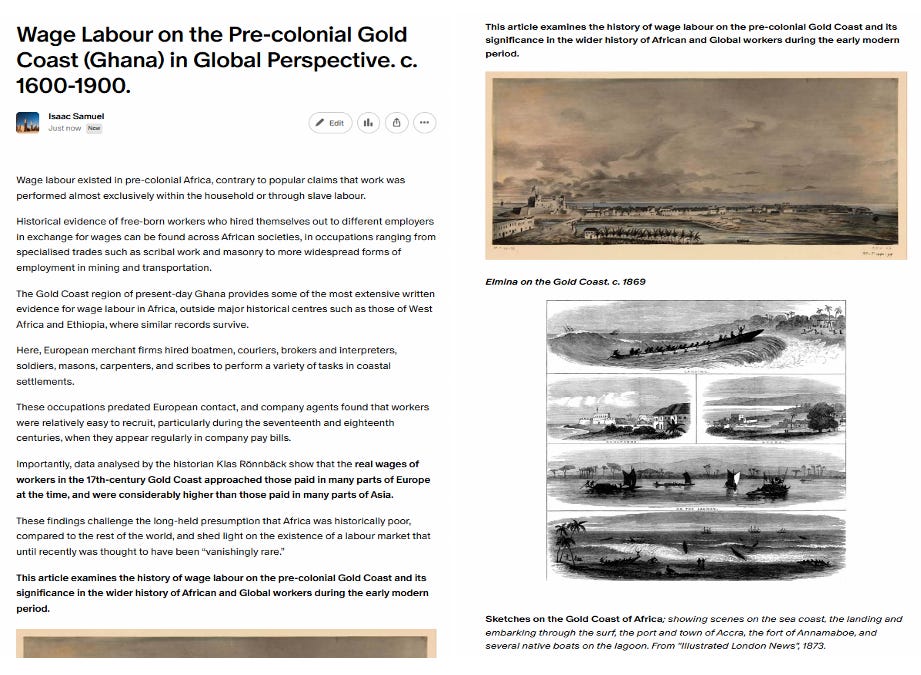
The first part is about how the real wages of workers in the 17th-century Gold Coast (Ghana) approached those paid in many parts of Europe at the time, and were considerably higher than those paid in many parts of Asia.
Subscribe to Patreon to read about it here and support this newsletter:
Direct historical evidence of hired labour exists for several occupations in pre-colonial Africa, including scribal work, clothmaking, construction, mining, and transport.
Naturally, the scribes, who provide our earliest internal written accounts of Africa’s past, also included brief details about their remuneration.
Manuscript-copying, in particular, was a professionalized business, and compensation was paid by legal contract, as evidenced by the colophons at the end of the manuscripts from Timbuktu (Mali) from the late 16th century.
On one of the manuscripts, dated April 1574, the copyist received 1 mithqal of gold per volume, for a total of 28 volumes, and the ‘proof-reader’ received half that amount.4
Manuscripts degraded quickly and needed to be re-copied meticulously by trained scribes. The copying industry was thus driven by the preservation of previously acquired and valued books and the duplication of popular works for study and possibly trade.
There were major manuscript-copying centers across West Africa, especially in Bornu (Northern Nigeria), Timbuktu (Mali) and Tichitt (Mauritania), where these well-paid scribes produced the hundreds of thousands of historical manuscripts that are today preserved in dozens of private libraries.5
The Songhay emperor Askiya Dāwūd (d. 990–1/1583), who purchased an illuminated dictionary of al-Firūzābādī for 80 pieces of gold, is known to have encouraged the manuscript copying business in Timbuktu by hiring numerous scribes to produce works to gift to local scholars.6

Copy of the dictionary of al-Firūzābādī (d. 1415), 18th century, Aboubacar Ben Said Library. Images from HMML Reading Room with the permission of SAVAMA-DCI, Num. SAV ABS 03132.
In addition to working for wealthy patrons, skilled calligraphers and professional copyists likely worked independently, selling their manuscripts and contributing to a dynamic ‘book market’.
According to Hugh Clapperton in 1824, Qurʾāns written by scribes from Bornu (Nigeria) were exported for $40–$50 to the Tripoli market in North Africa (about $1,000- $1,500 today).7
A similar pattern prevailed in eastern Africa.
In Ethiopia, internal evidence attests to the existence of scriptoria (dedicated spaces where scribes meticulously copied texts) from at least the 17th century.
Scribes, calligraphers, and painters commanded a fee for their services; court scribes were paid both in kind and with grants, and are credited for their work. Most scribes, however, sought out different churches and patrons for whom they worked for wages on a semi-permanent basis.8
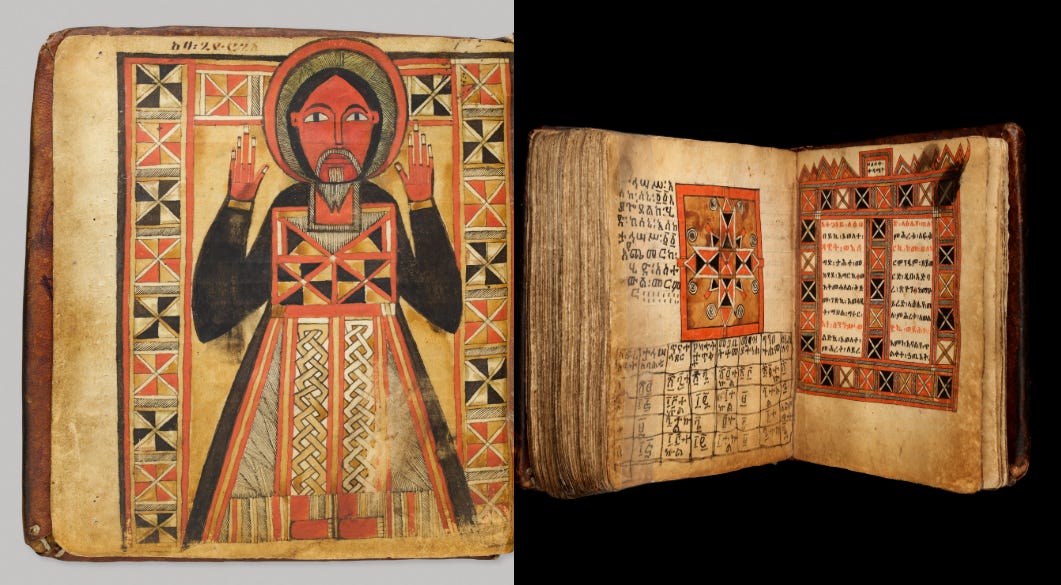
Arganonä Maryam (The Organ of Mary), 17th-century, Met Museum. Written by the scribe Baselyos, the text was illuminated by the ‘ground hornbill painter’ who included a portrait of its original author; Abba Giyorgis of Sägla.
This established market for manuscript copying helps explain why 19th-century explorers and book collectors could often readily hire scribes or teachers (malams) to work for wages.
In 1824, Hugh Clapperton commissioned a malam Mohamed of Massina to write an account of the Sokoto empire, for which he was paid 20,000 cowries (equivalent to 10 Spanish silver dollars, or £2 10s. ie; £350 today), over a few months.9
In 1894, Charles Robinson hired a Hausa malam named Abd el Kadr for 4,000 cowries a week, for about two months, for proofreading a dictionary he was compiling.10
At the close of the century, colonial manuscript collectors in both West and East Africa, as well as local elites who wanted to build private libraries, set up large workshops employing many copyists and editors, sending some of them on manuscript-searching and copying missions to different towns.11
These scribes also doubled as teachers, known as Malams in West Africa and Mwalimu in East Africa.
Ethnographic accounts from both sides of the continent during the 1890s, one by the Hausa Imam Imoru, and the other by the Swahili lecturer Mtoro Bakari, indicate that teachers received a fixed tuition from their students: about 30,000 cowries in West Africa and the equivalent of 10-15 rupees a month in East Africa.12
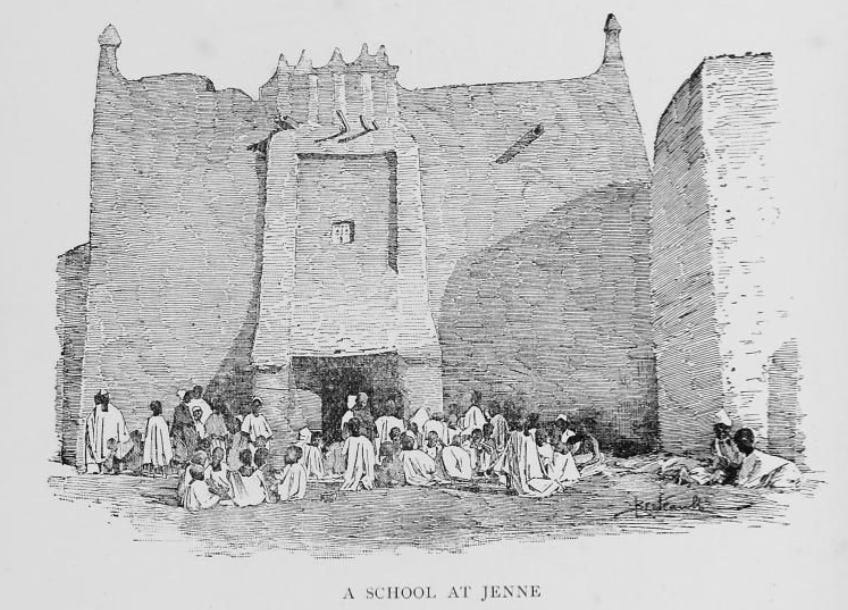
A school at Jenne, Mali. c. 1897, illustration by Félix Dubois
This income was well above subsistence level. In 1851, Heinrich Barth estimates that in the city of Kano, one could live “with ease, including every expense” on 50-60,000 cowries a year, equivalent to £4 to £5 (or between £700- £900 today).
Commenting on the textile industry of Kano, he observes that “this industry is not carried on here as in Europe, in immense establishments, degrading man to the meanest condition of life, but that it gives employment and support to families without compelling them to sacrifice their domestic habits.”13
In addition to this income, both the teacher and the students also hired out their labour for other kinds of work for various reasons.
For example, during the 19th century, Kano’s cloth merchants began to buy unfinished cloth from the weavers and put it out for processing by dyers in return for wages. As the market grew, cloth merchants established many new dye pits and hired cheap migrant labourers, often the students mentioned above, to perform routine tasks.14
There were I5,000-20,000 dye pits in Kano Emirate alone by the end of the 19th century. In one outlying town, known as Kora, an estimated 2,000 of the 8,000 population were cloth dyers who were hired to work for wages.15
The exact earnings of these dyers were, however, not well documented. This is the one occupation whose workers weren’t hired by colonial authorities, but were in fact considered direct competitors of the latter.16
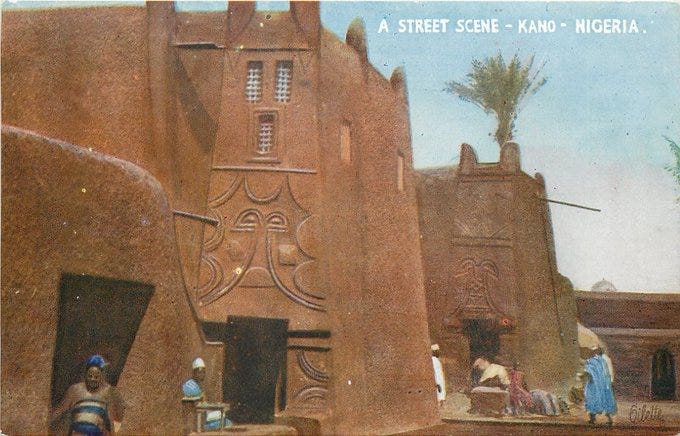
A street scene, Kano, Nigeria. c. 1925.
Besides scribes, teachers and cloth dyers, other forms of specialist labour included builders/masons, who erected the monumental structures found across the continent.
While most homes were built by the household, the construction of substantial monuments in large cities created a demand for more specialised groups of builders, plasterers and carpenters, many of whom were paid for their labour.
In Ethiopia, historical evidence highlights the role of Betä Ésraýel house-builders, who were considered “the best masons in the country.” From at least the 17th century, they provided much of the labour involved in constructing the Gondarine castles and other monuments.17
While their wages for constructing these elite structures aren’t specified in internal accounts, the Englishman William Coffin could easily find masons for hire to construct a simple house that he built for 80 Thalers in half a month, with about 30 thalers going to the labourers.
The builders worked for one thaler per six-day week, while a thatcher would complete a roof for a piece-rate of four thalers (about $110 today).18
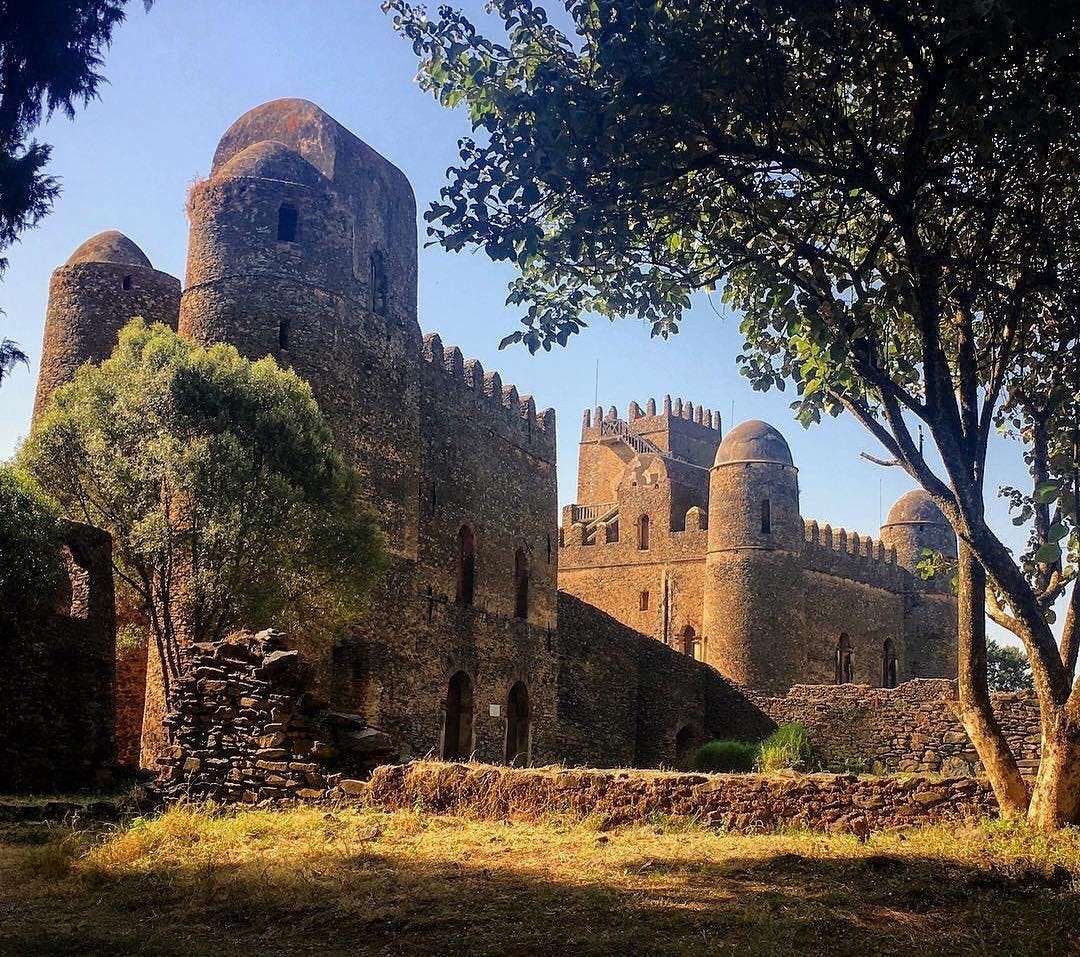
Iyasu’s castle in Gondar, Ethiopia.
James Bruce, who visited Gondar in 1770, spoke of a lavish decoration of an audience chamber in one of the palaces in Gondar, whose roof “in gaiety and taste, corresponded perfectly with the magnificent finishing of the room. It was the work of the falasha (Betä Ésraýel), and consisted of a painted cane, split and disposed in mosaic figures, which produces a gayer effect than it is possible to conceive.”19
In West Africa, specialist guilds of masons, such as the famous masons of Djenne, renowned for the construction of several palaces and mosques in Sudano-Sahelian style, were hired as labourers by wealthy patrons.
In 1822, at a construction site for a “highly ornamented” mosque in Sokoto, Clapperton found one such team of masons headed by a “master-builder” who was a native of Zaria and had studied architecture from the manuscripts left by his father, who had been to Egypt.20
The master-builder mentioned above was commissioned by the Sultan for the construction project. But patrons need not be wealthy to hire such masons. In 1851, Barth could readily find and hire masons to construct a modest house at Gúmmel, in Bornu.21
While neither of these accounts mentions the amount paid to the masons, the ethnographer Charles Monteil recorded that by 1932, in the city of Djenne “a proficient master mason received a daily wage of 400 cowry shells; the mason who prepared the mortar was paid 200 cowries and the laborers each received 100.”22
This work often lasted several weeks during the 4-month building season from January to April, not counting the off-season time spent on brickmaking, repairs, re-plastering, and carpentry.
Conversion rates for this period are more difficult to estimate, since cowries proved more stable than francs in the 1920s and 30s, even though they were phased out not long after. But 800 cowries were worth 5 francs in the town of Mopti in 1928.23
It was these builders who were hired for the reconstruction of the Djenne mosque and other iconic monuments built during the 19th century and the colonial period.
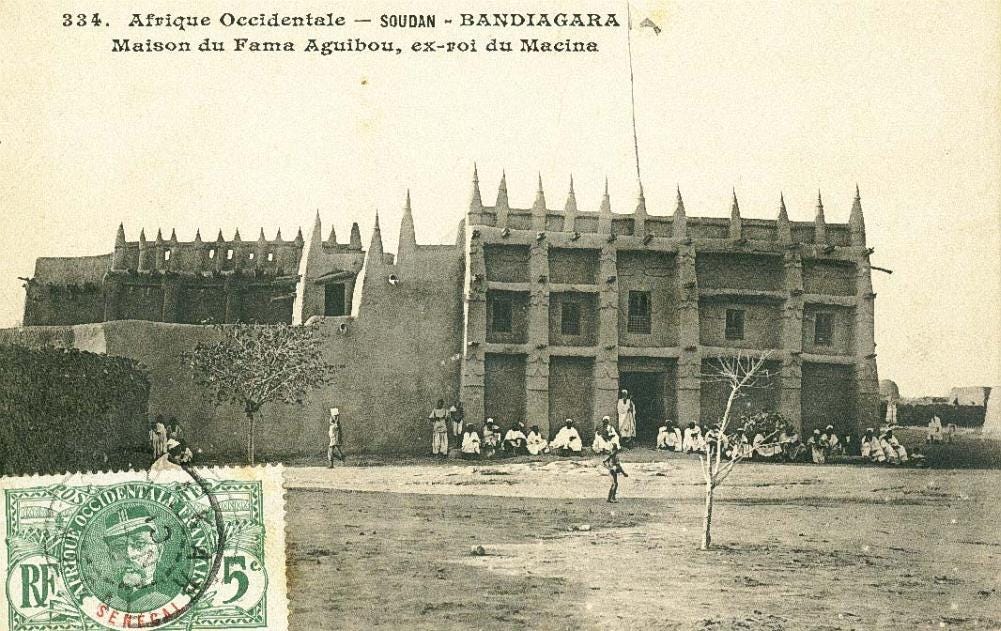
Agibu’s palace at Bandiagara, Mali. Image by Edmond Fortier, ca. 1906.
Besides these builders, agricultural labourers were also hired for wages.
While most peasants supported themselves through their own labour, a significant proportion also hired themselves out to wealthy landowners in exchange for wages.
In Ethiopia, 19th-century accounts describe agricultural labourers (diggers, grass-cutters and wood-cutters) as fewer than the peasantry, and differing from the latter in that they worked not for themselves, but for landlords who paid them a daily wage, usually in salt bars.24
In West Africa, in 1827, Rene Caillie noticed at Tieme, in N.W Côte d’Ivoire, a cultivator who ‘had several free Bambaras at work for him. .. When they had done work, I observed that [he] paid his labourers in kind.’25
The townsmen of Djenné employed small numbers of seasonal agricultural labourers during the late 19th century, paying them in cowrie shells, as did farm-owners in parts of Hausaland.26
Wage labour was also common in mining, particularly in the extraction of salt in West Africa and copper in Central Africa. These workers were paid, according to custom, in the product they made, which was itself a type of currency.
In the famous copper belt of Katanga (southern D.R.Congo and Zambia), oral accounts transcribed in the early 20th century indicate that miners, both free and enslaved, were paid 3 copper crosses weighing 20kg per trading season.
According to these accounts, enslaved miners needed only three trading seasons to accumulate enough copper to purchase their freedom.
By the 1850s, the exploitation of these deposits had reached a veritable boom, attracting migrant labour from across the region, which soon outnumbered the original inhabitants. Individual mines like Lubushia and Kiembe could have as many as 900 and 500 miners, nearly half of whom were migrant workers.27
Copper production by wage labourers in Katanga greatly expanded during the colonial period, but was certainly not a creation of the latter.
In West Africa, the bulk of the salt-mining labor, especially in the oases of Kawar was supplied on a household basis, but was supplemented by both wage-laborers (often migrant workers) and slaves, who were both paid in salt.28
Using records from the late 19th to early 20th century, historian Paul Lovejoy notes that:
“many thousands of workers, perhaps around twenty-five thousand, were involved in the production of salt and natron in the many sites in Kawar, Fachi, Muniyo, Mangari, Kadzell, Lake Chad and its eastern shores.
Over half, and possibly two-thirds, of these workers were freemen
This constituted a considerable market for foodstuffs, manufactured goods, and other commodities. Consequently, the scale of operation required the participation of thousands of merchants, brokers, and transporters. When the total number of workers, merchants, farmers, and craftsmen who depended upon this trade are considered, then it becomes apparent that a significant portion of the Borno population was involved in the salt industry or its subsidiary sectors.”29
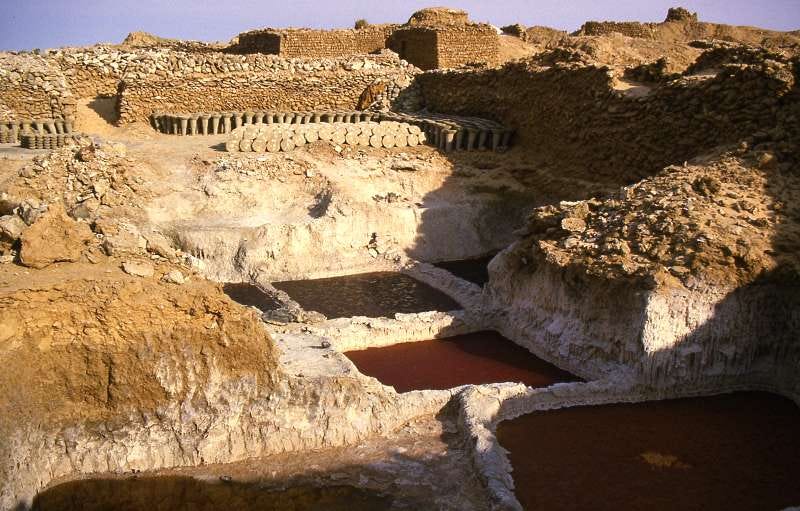
Saltpans of Bilma, Niger.
Lastly, the most common form of mass employment for wage labourers was in transportation, where professional carriers/porters (and boatmen such as the Somono) transported goods across the various ecological zones of Africa where draught animals couldn’t be used.
Across West, Central, Southern, and Eastern Africa, thousands of workers were hired by caravan merchants to carry trade goods in exchange for payment, often at a fixed rate. These workers were also known to organise ‘labour strikes’ when their rights were infringed upon.30
Some carriers, particularly in West Africa, worked seasonally.
In East Africa, however, they constituted a professional class of permanent workers, numbering between 20,000 and 100,000. They were paid an average of $5–$8 per month (equivalent to approximately $150–$250 today) or received 18–55 metres of cloth per month.31
Like the scribes, masons, and miners discussed above, carriers were also hired by colonial governments in exchange for wages. They remained indispensable to transportation in the early 20th century, before the expansion of railway and road networks.
Neither these historic occupations nor the labour markets that sustained them were creations of the colonial economy.
The historian Stephen Rockel, who wrote an excellent monograph on the Nyamwezi carriers of 19th-century Tanzania, argues that free, wage labour in pre-colonial Africa was not a creation of colonial capitalist economies, but a product of pre-existing economic and social institutions. 32

Coffee house in Bagamoyo, Tanzania, with African patrons. Early 1900s, German Federal Archives.
The idea that wage labour did not exist in Africa seems to have originated in the writings of a few early explorers such as Mungo Park33, as well as the twin discourses of Atlantic slavery and colonialism that greatly shaped our knowledge of Labour history in Africa.34
According to the historian Klas Rönnbäck, studies of African factor markets for labour were influenced by the analysis of economic development in Marxist literature on the presumed stages of production (from slavery to feudalism to capitalism).
In this literature, which was based on studies of European societies, free labourers were argued to exist only in a more “developed” capitalist stage, compared to a more “primitive” stage of a slave-based mode of production.35
For Marx and Engels, slavery was “the first form of exploitation, the form peculiar to the ancient world; it is succeeded by serfdom in the Middle Ages, and wage-labor in the more recent period. These are the three great forms of servitude, characteristic of the three great epochs of civilization”36
However, such theories were hardly applicable to the Western societies for which they were developed, and even less so to African societies onto which they were projected.37
Capitalism was not incompatible with slavery, nor was slavery and serfdom incompatible with free labour.
This deceptively simple progression from slavery to serfdom to wage-labour underpins Acemoglu’s flawed analysis of African economic history.
In his monograph on the labour market of the Gold Coast region (modern Ghana) from the 16th to the 18th century, Klas Rönnbäck demonstrates that free, hired labourers were relatively common in the region, despite the expansion of slavery.
Workers such as boatmen, brokers and interpreters, soldiers, masons, carpenters, and scribes were hired by European merchant firms to perform a variety of tasks in coastal settlements.
Written evidence from pay bills and correspondence between European company agents indicates that wage labour was readily available, including for permanent employment.
Importantly, as the overview above demonstrates, these occupations predated European contact and thus reflected pre-existing labour markets and employment practices.
More significantly, Rönnbäck found that the real wages of workers in the 17th-century Gold Coast approached those paid in many parts of Europe at the time, and were considerably higher than those paid in many parts of Asia.
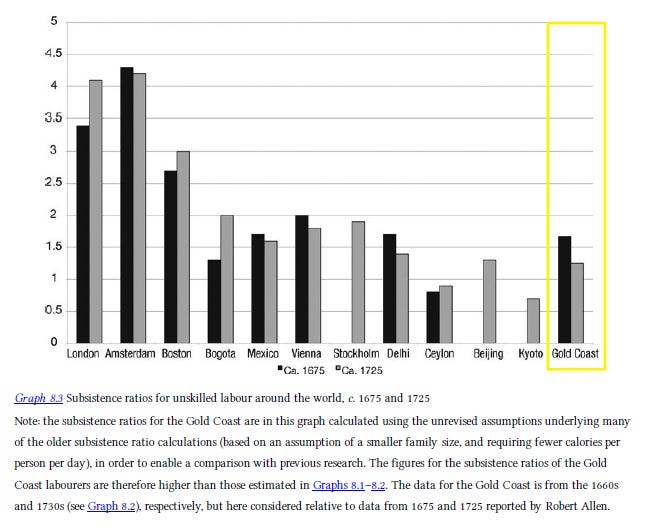
Subsistence ratios for unskilled labour around the world, c. 1675-1725. Graph by Klas Rönnbäck
These findings challenge the long-held presumption that Africa was historically poor compared to the rest of the world.
Even enslaved workers on the Gold Coast received wages, albeit at slightly lower rates than their free counterparts, while working longer hours.
The seemingly paradoxical phenomenon of wage-earning slaves, also documented in the salt and copper mining occupations discussed above, further illustrates the complexity of slavery in African history.38
That free-born African workers in the pre-colonial period could earn high wages shouldn’t be too shocking.
Nyamwezi porters in the 1870s, who were making a minimum of 5 Thalers a month (almost equal to $5), earned more than the best-paid railroad conductors and engineers in America ($4.79), and nearly twice the income of a blacksmith ($3.8), according to data by the U.S. Department of Labor.39
The History of Wage Labour on the Pre-colonial Gold Coast is the subject of my latest Patreon Article;
Please subscribe to read more about it here and support this newsletter:
An economic history of West Africa by A. G. Hopkins, pg 65-71
Factor markets in Nieboer conditions: precolonial West Africa, c.1500–c.1900 by Gareth Austin, pg 38
An economic history of West Africa by A. G. Hopkins. A Modern Economic History of Africa: The nineteenth century, by Paul Tiyambe Zeleza. Economy and Society in Pre-industrial South Africa by Anthony Atmore and Shula Marks. Economic History of Ethiopia 1800-1935, by Richard Pankhurst. Twilight of an Industry in East Africa: Textile Manufacturing, 1830-1940, by Katharine Frederick. An Economic History of Imperial Madagascar, 1750-1895: The Rise and Fall of an Island Empire, by Gwyn Campbell
West Africa, Islam, and the Arab World: Studies in Honor of Basil Davidson, by John O. Hunwick, pg. 42
The Trans-Saharan Book Trade: Manuscript Culture, Arabic Literacy and Intellectual History in Muslim Africa, edited by Ghislaine Lydon, Graziano Krätli pg 61, 259-260
The Trans-Saharan Book Trade: Manuscript Culture, Arabic Literacy and Intellectual History in Muslim Africa, edited by Ghislaine Lydon, Graziano Krätli pg 75-76
The Trans-Saharan Book Trade: Manuscript Culture, Arabic Literacy and Intellectual History in Muslim Africa, edited by Ghislaine Lydon, Graziano Krätli pg 187
A Kingly Craft: Art and Leadership in Ethiopia by Earnestine Jenkins, pg 48. A Companion to Medieval Ethiopia and Eritrea, edited by Samantha Kelly, pg 309-315. The Traditional Teaching of the Ethiopian Orthodox Täwahedo Church Faith and Spirituality, by Christine Chaillot, pg 123-124.
Journal of a second expedition into the interior of Africa by Hugh Clapperton, published by J. Murray, 1829, pg 229, 253. For conversions, see: The Shell Money of the Slave Trade, by Jan Hogendorn, Marion Johnson, pg 137-138
Hausaland, or Fifteen Hundred Miles through the Central Soudan. By Charles Henry Robinson pg 105
The Trans-Saharan Book Trade: Manuscript Culture, Arabic Literacy and Intellectual History in Muslim Africa, edited by Ghislaine Lydon, Graziano Krätli pg 67-68, 250-253. Localising Islamic Knowledge: Acquisition and Copying of the Riyadha Mosque Manuscript Collection in Lamu, Kenya, by Anne K. Bang, pg 153-161 in ‘From Dust to Digital: Ten Years of the Endangered Archives Programme’ )
Nineteenth Century Hausaland: Being a Description by Imam Imoru of the Land, Economy and Society of His People by Douglas Edwin Ferguson pg 260-265
Travels and Discoveries in North and Central Africa by Heinrich Barth Vol 1, Harper & Brothers 1857, pg 512
The emergence of African capitalism by John Iliffe, pg. 10- 11
Big Is Sometimes Best: The Sokoto Caliphate and Economic Advantages of Size in the Textile Industry by Philip J. Shea pg 9-12. Textile Production and Gender in the Sokoto Caliphate by Colleen Kriger pg 391
What happened to the workshop of West Africa? Resilience and decline of handicraft textiles in colonial northern Nigeria, 1911–52 by Emiliano Travieso, Tom Westland.
A Social History of Ethiopia: The Northern and Central Highlands from Early Medieval Times to the Rise of Emperor Téwodros II by Richard Pankhurst, pg 105-109
A Social History of Ethiopia: The Northern and Central Highlands from Early Medieval Times to the Rise of Emperor Téwodros II by Richard Pankhurst, pg 229-230, 233
The Falashas: A Short History of the Ethiopian Jews, by David F. Kessler, pg 89
Narrative of travels and discoveries in Northern and Central Africa, in the years 1822, 1823, and 1824, by Dixon Denham, Hugh Clapperton, Walter Oudney, published by Murray, 1826, pg 103
Travels and Discoveries in North and Central Africa by Heinrich Barth, Vol 1, Harper & Brothers, 1857, pg 537
The Masons of Djenné, by Trevor Hugh James Marchand, pg 16
The Masons of Djenné, by Trevor Hugh James Marchand, pg 151. The Cowrie Currencies of West Africa Part II by Marion Johnson, pg 352-353.
According to Monteil in 1932, 2 francs were enough to buy good quality shoes. See: The History of the Great Mosques of Djenné by Jean-Louis Bourgeois, pg. 58
A Social History of Ethiopia: The Northern and Central Highlands from Early Medieval Times to the Rise of Emperor Tewodros II, by Richard Pankhurst, pg 133
Travels through Africa to Timbuctoo, by Rene Caillie, Vol I, Henry Colburn & Richard Bentley, 1830, pg 340-341
The emergence of African capitalism by John Iliffe, pg. 6-7
Kingdoms and Associations: Copper’s Changing Political Economy during the Nineteenth Century, by David M. Gordon pg 162-165
The Desert-Side Salt Trade of Kawar, by Knut S. Vikør, pg 118-119
The Borno salt industry by P. Lovejoy, pg 657
Chapters 2-7, and 9-12 in The Workers of African Trade, edited by Catherine Coquery-Vidrovitch and Paul E. Lovejoy. The Emergence of African Capitalism, pg. 7, 15-16. The Making of Wage Laborers in Nineteenth Century Southern Africa: Magololo Porters and David Livingstone, 1853–1861 by Elias Mandala
Carriers of Culture by Stephen J. Rockel pg 212-214, Twilight of an Industry in East Africa by Katharine Frederick pg 148-151. Relocating Labor: Sources from the Nineteenth Century by Stephen Rockel, pg 449-450
Carriers of Culture: Labor on the Road in Nineteenth Century East Africa’ pg 5-6
Cited authoritatively by Austin, Park asserted that ‘Hired servants, by which I mean persons of free condition, voluntarily working for pay, are unknown in Africa…’
see; Factor markets in Nieboer conditions: precolonial West Africa, c.1500–c.1900 by Gareth Austin, pg 38
Labour and Living Standards in Pre-Colonial West Africa: The Case of the Gold Coast by Klas Rönnbäck, pg 10. Also see Chapter 4 in the same book
Labour and Living Standards in Pre-Colonial West Africa: The Case of the Gold Coast by Klas Rönnbäck, pg 5-12, see; African Population and Capitalism: Historical Perspectives (edited by Dennis D. Cordell and Joel W. Gregory, pg 20-28
Slavery in Africa: Historical and Anthropological Perspectives, edited by Suzanne Miers and Igor Kopytoff, pg 236
‘In Search of a Marxist Perspective on Pre-Colonial Tropical Africa’ Review by: Robin Law, in ‘The Journal of African History, Vol. 19, No. 3 (1978)’, pp. 441-452. ‘How not to be a Marxist historian: the Althusserian threat to African history’, by Robin Law, pg 313-319, in People’s History and Socialist Theory. edited by Raphael Samuel
The Murgu payment arrangements of Sokoto are sufficiently known in West African history, see; Murgu: the wages of slavery in the Sokoto Caliphate by Paul E. Lovejoy, pg 168-185.
Less known are similar arrangements along the East African coast. See: Twilight of an Industry in East Africa by Katharine Frederick, pg. 96-98.
Quote: “Already in 1856, slaves could earn wages of $2.50–3.00 per month for manual labor, while “higher order Servants” could earn $7.50–$10.00 per month for preparing and shipping cargoes”
Compare these earnings with the rest of the figures mentioned in the essay.