

Ancient state structures in Africa included Empires, which carried with them all the complexity, inequalities, and political baggage inherent in such systems.
On 19th January 1469, the Songhai ruler Sunni ʿAlī entered the city of Timbuktu (in present-day Mali) at the invitation of its ruler/governor, the ‘Timbuktu-koi’ ʿUmar.
The latter’s family had inherited the office, along with its “judicial, fiscal, and other powers,” after Timbuktu was conquered by Mansā Mūsā of Medieval Mâli in 1325.1
Following Mâli’s withdrawal in 1433, however, the city was taken over by the Tuareg sultan Akil, who reportedly “stopped allowing the Timbuktu-koi his customary dues, which amounted to one-third of all taxes”.
The Songhai chronicle known as the Taʾrīkh al-Sūdān (1655), which records these events, states that the wronged official wrote a letter to Sunni Ali and provided boats for his army to cross the River Niger. Songhai’s armies subsequently expelled Sultan Akil, while many of his allies were forced to flee; some were pursued by the brother and successor of the Timbuktu-koi named al-Mukhtār.2
In the aftermath, Sunni ʿAlī and his successors reconstituted the administration of Timbuktu and other provinces across the empire according to an imperial arrangement, with clear lines of authority extending directly to the capital at Gao.
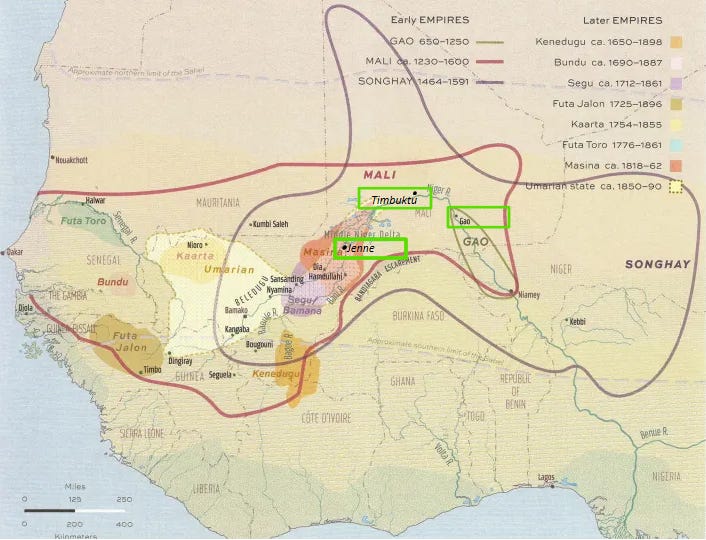
Empires of medieval West Africa. Map by A. LaGamma
The titles of pre-existing offices “changed with the change of overlord,”3 for example, offices ending with the Songhay word -koi, which first appears in an inscription from Gao dated 1146 CE4, were given to pre-conquest/“native” rulers and governors like the sultans of Jenne and Massina, who thus became the Jenne-koi and Massina-koi, respectively.5
Alongside these retained offices, the dual administrative approach resulted in the creation of appointed positions such as the Timbuktu-mondio, the head administrator/resident responsible for collecting city revenues6; the Balmaʿa, head of the garrison at Timbuktu’s river port of Kabara7; the Kabara-farma, harbour master and collector of customs dues at the port of Kabara, whose office is first mentioned by Leo Africanus in 1510.8
Other offices appear in the Tārīkh Ibn Al-Mukhtār (1667) and the Tārīkh Al-Fattāsh (c. 1842) chronicles, such as the Yubo-koi or “commissioner of the market”; the Koyra-banda-mondio, who had a supervisory capacity outside of the city’s perimeter; and the Ashar-mondio, an assistant to the qāḍī or the chief of police. In addition to these were the heads of the different quarters of the city and its hinterlands, e.g., Qāḍīs of the main mosques, and the Maghsharan-koi of the Kel Tamasheq living north of the city.9

'Timbuctoo' in 1852, by Johann Martin Bernatz, based on H. Barth
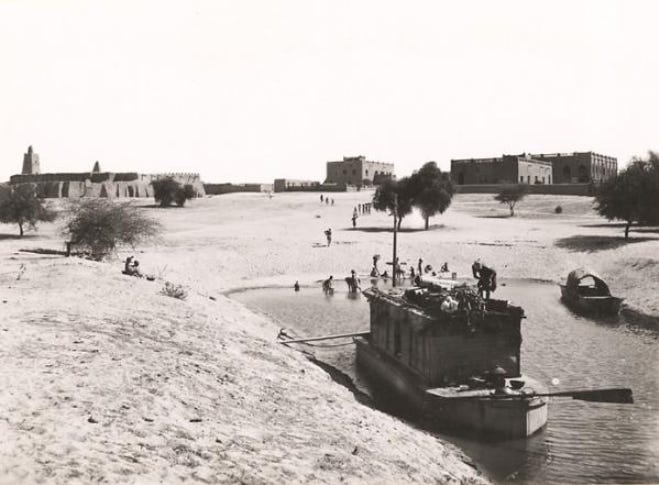
The port of Kabara, Timbuktu. ca. 1920-1939 ANOM
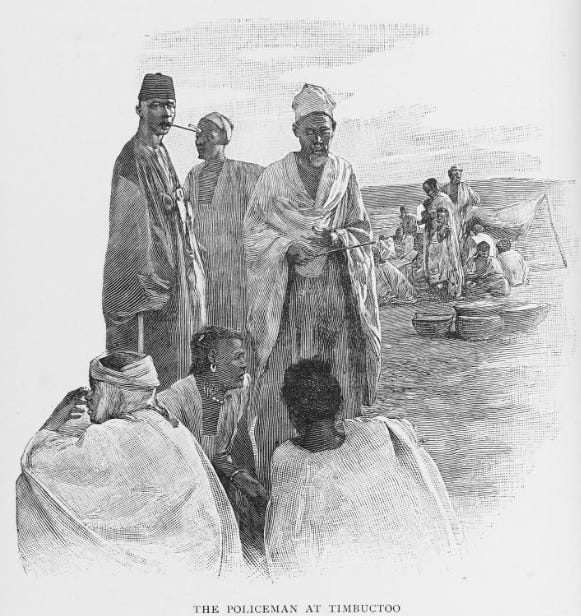
‘The policeman at Timbuctoo’ c. 1897. Illustration by Felix Dubois
These offices were not exclusive to the main cities of Timbuktu, Gao, and Jenne, but were found across many provinces. At least sixty-two different offices in the Songhai Empire were identified by the historian John Hunwick from the three chronicles.10
According to the historian Michael Gomez, this “impressive array of officials,” together with their control over the taxation, security, and internal politics of Timbuktu, indicates that the city was directly administered by the imperial government at Gao.11
The “native” rulers, such as the Timbuktu-koi and Jenne-koi, were incorporated into the imperial administration of Songhai. These subordinate elites assumed a mediatory position between their overlords in Gao and the local communities, allowing them to preserve much of their existing internal structure while remaining subordinate to the imperial government.
Although the Askiya (Songhai emperor) in Gao intervened in the succession to the offices of Jenne-koi and Timbuktu-koi, they were also allowed certain privileges at the imperial court and could maintain their own administrations and palaces.12
In the city of Jenne, this “native administration” would survive the collapse of Songhai, and it was preserved by the Moroccan pashalik of Timbuktu in the 17th century,13 and would continue in various forms until the 19th century.

Residence of the chief of Djenne. c. 1906. Quai Branly. This is the ‘Maiga House’ of the chief of the Songhay quarter of the city during the reign of Amadu Lobbo (r. 1818-1845)
Similar examples of Imperial administration can be found across the continent.
In Ethiopia, 14th-century Gǝʿǝz and Arabic accounts list several provinces and kingdoms which paid a fixed tribute to the Emperor ʿAmdä Ṣǝyon (r. 1314–1344)
Focusing on the Muslim kingdom or province of Ifāt (ኢፋት) and its Walasmaʿ rulers, al-Maqrīzī reports that the Christian monarch kept some of the Walasmaʿ princes at his court. He granted them “patronage,” appointed new sultans, and provided military aid, in exchange for which they were required to “obey his orders.”14
The Walasmaʿ royals nevertheless retained the governorship of Ifāt and could nominate subordinate officials to administer the province.15
Ultimately, however, this indirect style of administration came to an end when a split within the Walasmaʿ family resulted in the formal conquest and occupation of Ifāt by 1415 CE, the destruction of its mosques, and the replacement of the native elite with governors sent from the Christian capital.16
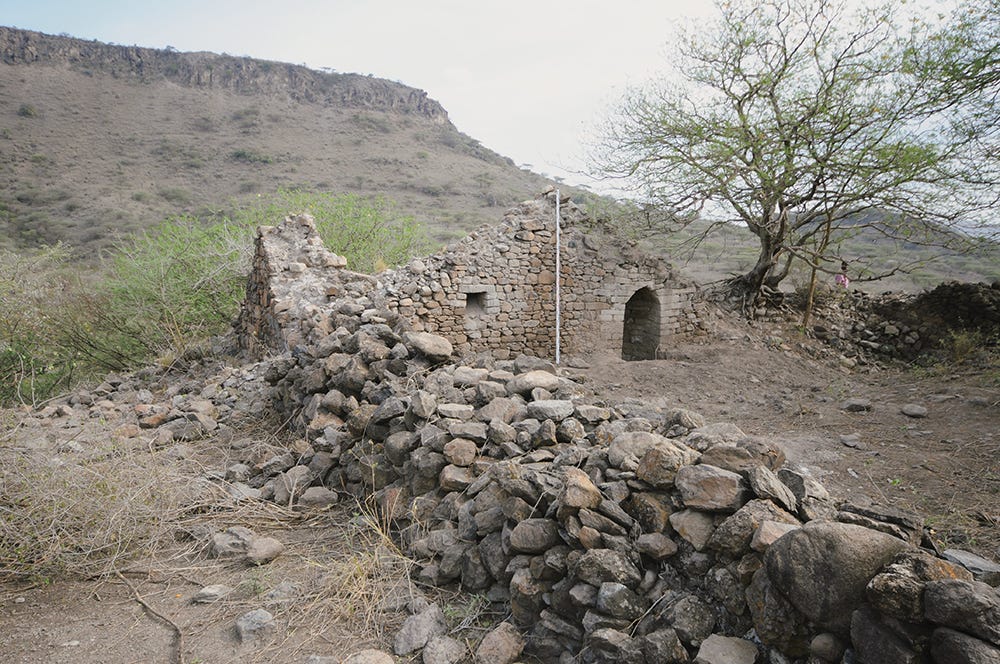
Ruined mosque at the capital of Ifat, Ethiopia.
In other imperial governments, however, “native” elites were completely sidelined after conquest.
An example of this is the Lunda province of Kazembe (present-day Zambia), whose governors were sent directly from the capital.
Direct administration in the provinces included a regular taxation system, such as in 1799, when the king sent his cilolos (a Lunda term for nobles) to the regional cilolos to “collect the annual revenue (pensões) of their lands.”17
A separate account from 1831 attributed this system of direct rule to a rebellion by native elites in 1760, which forced the Lunda Emperors to send reinforcements from the capital. After the province was pacified, “there was no more individual authority among them that was not a Campoculo [Lunda official].”18
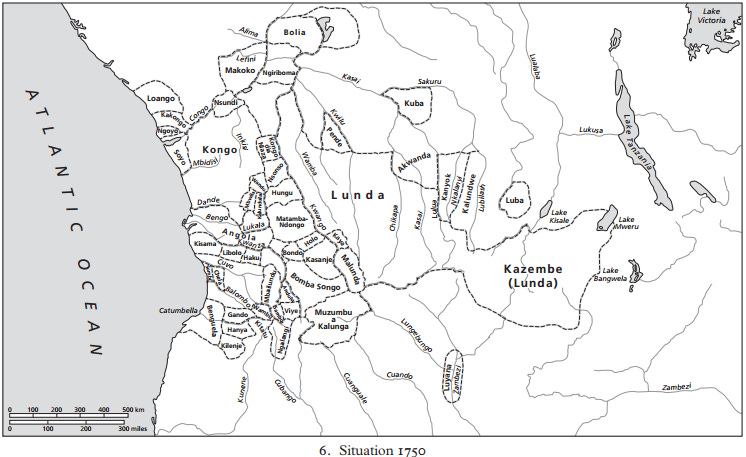
The Lunda Empire in 1750. Map by J. K. Thornton.

Grand audience of the Kazembe. Image from Gamito and Antonio Pedroso’s “O Muata Cazembe”
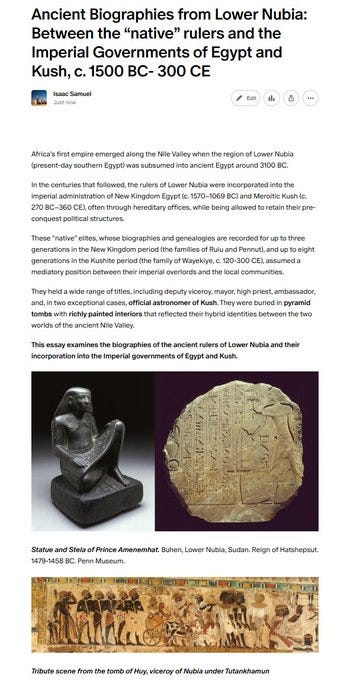
The best documented and oldest example of imperial administration in ancient Africa comes from Lower Nubia (present-day southern Egypt), which was subsumed into the empires of New Kingdom Egypt (c. 1570–1069 BC) and Meroitic Kush (c. 270 BC–360 CE)
The native rulers of Lower Nubia were incorporated into the Egyptian and later Kushite administrations, often through hereditary offices, while being allowed to retain their pre-conquest political structures.
These “native” elites, whose biographies and genealogies are recorded for up to three generations in the New Kingdom period (the families of Ruiu and Pennut), and up to eight generations in the Kushite period (the family of Wayekiye, c. 120-300 CE), assumed a mediatory position between their imperial overlords and the local communities.
They held a wide range of titles, including deputy viceroy, mayor, high priest, ambassador, and, in two exceptional cases, official astronomer of Kush. They were buried in pyramid tombs with richly painted interiors that reflected their hybrid identities between the two worlds of the ancient Nile Valley.
The Imperial administration in Lower Nubia and the ancient biographies of its native rulers are the subject of my latest Patreon article
Please subscribe to read more about it here:
Timbuktu and the Songhay Empire: Al-Saʻdi’s Taʼrīkh Al-Sūdān Down to 1613, and Other Contemporary Documents by ʻAbd al-Raḥmān ibn ʻAbd Allāh Saʻdī, translated by John Hunwick pg 92-93, 30-32,
For more on Umar’s Azer ethnic group and the town of Shinqit, from where they originated, see my previous essay on The south-western Saharan towns of Tichitt, Walata, Wadan and Chinguetti
Timbuktu and the Songhay Empire by ʻAbd al-Raḥmān ibn ʻAbd Allāh Saʻdī, translated by John Hunwick pg 33-34, 93-94, 103.
ʿUmar was the elder brother of al-Mukhtār (pg 93), the former reportedly fell out with Sunni ʿAlī during the invasion of Timbuktu (pg 34), despite sending him boats to invade the city. He left his brother in charge, but he too fell out with Sunni ʿAlī and was imprisoned in 1486, shortly after he killed some of the scholars who were allied with Akil and had fled from the city (pg 100). He reportedly died in prison shortly after Sunni ʿAlī’s death. Ultimately, ʿUmar was restored as Timbuktu-koi by the Askiya Muhammad in 1493 (pg 103)
Timbuktu and the Songhay Empire by ʻAbd al-Raḥmān ibn ʻAbd Allāh Saʻdī, translated by John Hunwick, pg 32
Arabic Medieval Inscriptions from the Republic of Mali: Epigraphy, Chronicles and Songhay-Tuareg History, by Paulo de Moraes Farias, pg ccxii, 24
Timbuktu and the Songhay Empire by ʻAbd al-Raḥmān ibn ʻAbd Allāh Saʻdī, translated by John Hunwick, pg xli
Timbuktu and the Songhay Empire by ʻAbd al-Raḥmān ibn ʻAbd Allāh Saʻdī, translated by John Hunwick, pg li. In Jenne, the jenne-mondio also headed the garrison in his role as the Songhai resident/governor. Timbuktu and the Songhay Empire by ʻAbd al-Raḥmān ibn ʻAbd Allāh Saʻdī, translated by John Hunwick, pg 149
Timbuktu and the Songhay Empire by ʻAbd al-Raḥmān ibn ʻAbd Allāh Saʻdī, translated by John Hunwick, pg 111, n. 52
Timbuktu and the Songhay Empire by ʻAbd al-Raḥmān ibn ʻAbd Allāh Saʻdī, translated by John Hunwick, pg 169, 285
African Dominion: A New History of Empire in Early and Medieval West Africa, by Michael A. Gomez pg 265-266
Timbuktu and the Songhay Empire by ʻAbd al-Raḥmān ibn ʻAbd Allāh Saʻdī, translated by John Hunwick, pg 338-344
African Dominion: A New History of Empire in Early and Medieval West Africa, by Michael A. Gomez pg 263-268
Timbuktu and the Songhay Empire by ʻAbd al-Raḥmān ibn ʻAbd Allāh Saʻdī, translated by John Hunwick, pg 21, 207-208.
The Tārīkh Ibn Al-Mukhtār (1667), and the Tārīkh Al-Fattāsh (c. 1842) claim that Sunni ʿAlī wanted to occupy the palace of the Jenne king “and would have done so were it not for the vipers, snakes and scorpions. So, he left, and took up residence in a house to the south of the king’s palace and to the east of the grand mosque. Askiya Muhammad would later take possession of this house.”
see: ‘TIM 82 /TF 115’ in ‘The Chronicles of Two West African Kingdoms: The Tārīkh Ibn Al-Mukhtār of the Songhay Empire and the Tārīkh Al-Fattāsh of the Caliphate of Ḥamdallāhi ‘, edited by H. Ali Diakité, Mauro Nobili, Zachary V. Wright
Timbuktu and the Songhay Empire by ʻAbd al-Raḥmān ibn ʻAbd Allāh Saʻdī, translated by John Hunwick, pg 213-215
A Companion to Medieval Ethiopia and Eritrea, edited by Samantha Kelly pg 100. Church and State in Ethiopia, 1270-1527 by Taddesse Tamrat pg 144
Church and State in Ethiopia, 1270-1527 by Taddesse Tamrat pg 147-149
A Companion to Medieval Ethiopia and Eritrea, edited by Samantha Kelly pg 100-101
A History of West Central Africa to 1850 by John K. Thornton, pg. 270, n. 11. Thornton interprets the ‘xireros’ to be ‘cilolos’, the Lunda term for nobles and officials, and that there are two levels of such officials, the first that gathers taxes on their lands, and the second to bring them to the capital.
also see; Lacerda’s Journey to Cazembe in 1798 Translated and Annotated by R. F. Burton, published by John Murray, london, 1873 pg 142
A History of West Central Africa to 1850 by John K. Thornton pg 269-270
Mr. Issac Samuel Nice article and I do love your sources using Hunwick and Michael Gomez who I know personally as an expert on these issues. However, Thornton I have found some inconsistency on his work on the Kongo empire and Angola and West Central Africa in general...as I went to Luanda museum and so some of the primary sources and materials seemed to me conflicts with John Thornton's work. Maybe because Angola had just opened up to the West in 2018 and just organized well it's museum and primary sources.