

Gold was one of the oldest metals worked by ancient African societies.
In Ethiopia, evidence for the first gold coins minted by African rulers south of Egypt and an abundance of documentary references to vast quantities of gold tribute demonstrate the importance of the precious metal to the ancient economies in the northern Horn of Africa.
For centuries, gold was the principal currency of international trade in Ethiopia, and was used in everything from land sales to pious donations and inheritances. Gold was a scarce commodity mined from the frontier regions, carried along long-distance caravan routes, and closely regulated by the state.
While popular literature on gold in African history is primarily concerned with its export, there’s sufficient evidence for internal demand for the precious metal, which greatly shaped African concepts of wealth and value systems long before the rise of capitalism.
This article examines the history of Gold in Ethiopia, focusing on its function as a currency and store of wealth from the Aksumite period to the 19th century.
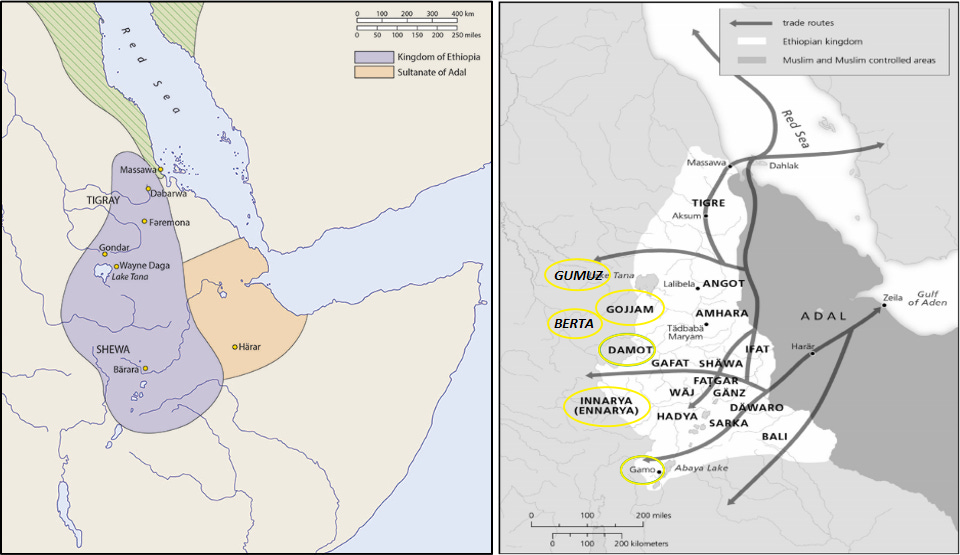
Ethiopia in the 16th century showing the sources of gold and major trade routes.1
Support AfricanHistoryExtra by becoming a member of our Patreon community; subscribe here to read more about African history, download free books, and keep this newsletter free for all:
The Gold statues and Gold tribute of Aksum and medieval Ethiopia
The oldest reference to gold in Ethiopia is found in the inscriptions of the Aksumite king Ezana in the 4th century CE, which mention a gold statue dedicated to the god of war.
In his trilingual inscriptions, the king refers to himself as the son of the unconquered war god Mährém (translated as Ares in the Greek versions) and refers to metal statues erected in honour of this deity:
“In sign of recognition to he who engendered us, the unconquered Ares, we have raised statues to him, one of gold, one of silver, and three others of brass, to his glory”.2
The bases of some of the stone thrones discovered at Aksum have central sockets and depressions in the shape of human feet that served as fixings for such statues.
These depressions being three-and-a-half times the size of the average foot, it may be calculated that the statue, if it represented a complete upright human figure as the positioning of the feet would suggest, was between 5.5 and 6.0 m tall.3
According to the archaeologist David Philipson, “No other metal statues of this age are known to have approached this size anywhere in the world, although some Greek bronze and chryselephantine figures probably did so.”4
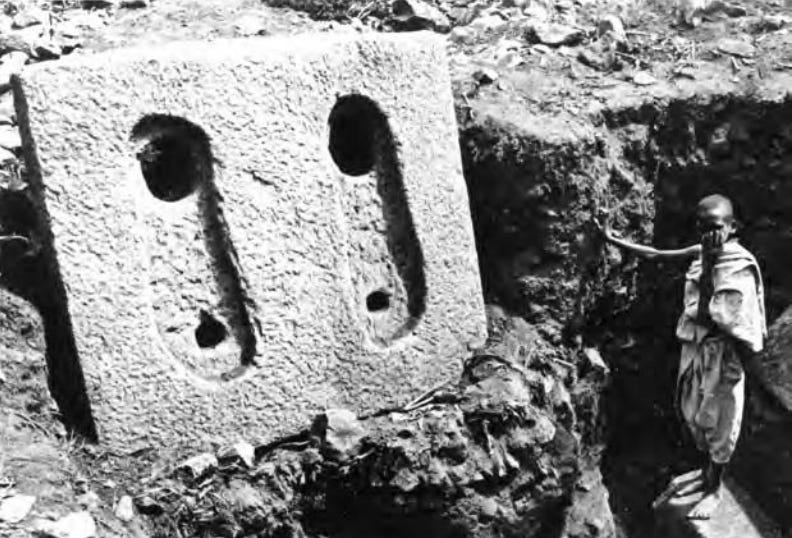
Base slab for a gigantic statue, discovered at Aksum by the DAE in 1906
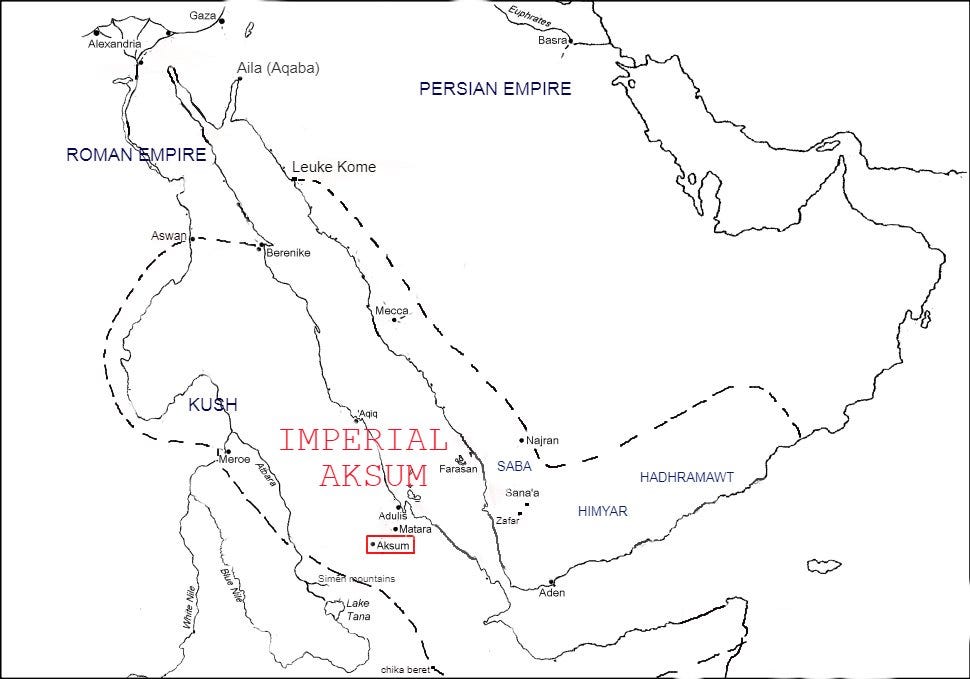
Sketch showing the maximum extent of the Aksumite empire.
An eyewitness description of the 6th century Aksumite king Kaleb Ella Atsbeha, recounted by one of the ambassadors of the Byzantine emperor Justinian I (r. 527-565), indicates that gold was the metal of choice for royal paraphernalia:
The emperor wore “gold-threaded linen clothing… around his head was wound a gold-threaded linen turban with four cords on either side and a gold collar around his neck. He stood on top of four elephants which had a yoke and four discs, and upon them something like a tall carriage covered with gold leaf, just as the chariots of the provincial governors are covered in silver.”5
The traveller Cosmas Indicopleustes, who visited the Aksumite port of Adulis in about 518–20, recorded expeditions into the interior to obtain gold from a place called Sasu, a gold-producing region thought to be near the modern Sudan border.6
Nonnonus, a later ambassador sent by Justinian to the Aksumites, reported in 530 or 540 that Aksum was fifteen days’ journey from Adulis, and that both places were ‘the chief centres of trade for gold dust, ivory, leather, hides and aromatics’.7
While the minting of gold coins at Aksum ended in the 7th century (see next section below on currencies), the multiple records of gold tribute sent to the court during and after the Middle Ages point to the metal’s continued importance in the medieval economy.
An Ethiopian embassy to Rome in 1482 carried gifts that included some unique blank gold ‘coins’, which are also mentioned in other European sources as particular to the realm of the nägäśt (Christian monarch) during this period.8
According to Francisco Alvares, who visited Ethiopia in 1520, the largest annual tribute or geber/gibre paid to the emperor came from Gojam, which, besides other items like horses and mules and textiles, included 30,000 ouquias of gold (ie; waqet, which was equal to 39 grammes9 or about 1,174 kg ):
“At the presentation of this gibre, I saw with my eyes all the gold which came covered up on ganetas (trays) and they said that it was a great quantity, and it all came in this way.”10
Alvares notes that the gold which wasn’t spent in pious donations, or in payment for obtaining the Abuna/patriach, or in trade was kept in “treasure baskets” in “pits in the earth which are designed for that purpose” that were closely guarded but often moved with the royal court. This treasury also appears in Ge’ez texts as early as the reign of Amda Siyon (r. 1314-1344) that refer to a place called Warq Wasa, ‘gold cave’, whose guards were called the ba’ala or ‘keepers of the caves’.11
The chronicler of the Ethiopia-Adal wars (1529-1543) mentions that the King’s treasure of gold and silk textiles near a mountaintop church in ‘Walaqa’ was guarded by eunuchs, but was handed over to the invaders. It mostly consisted of golden crowns, armlets, daggers, maces, bridles, and chalices belonging to deceased kings.12
João Bermudes’ account from the 1520s mentions that the ‘heathen’ people of Gurage, a region in the south, paid the King every year as much ‘fine and good’ gold as eight men could carry.13
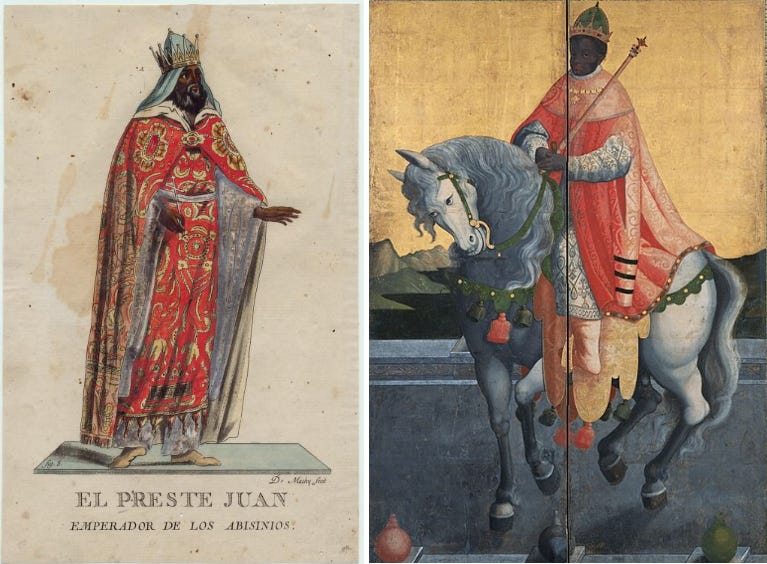
‘Preste John, Emperor of the Abyssinians’ c. 1800 Pierre-Antoine Demachy. (right) “King of Abyssinia” (Sarsa Dengel) based on Portuguese descriptions to a Japanese Momoyama Nanban painter. c. 1609
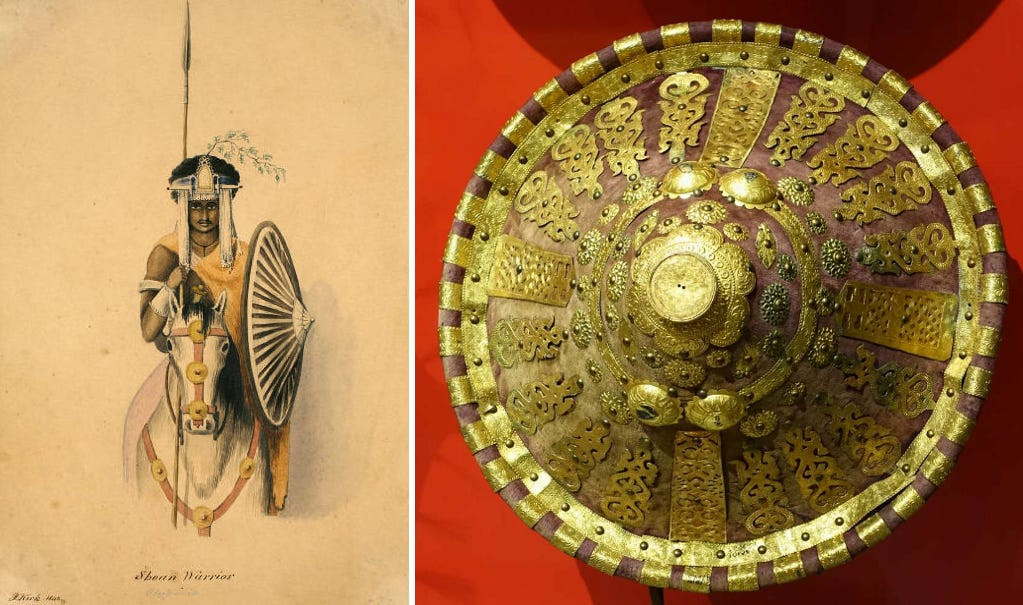
Shoan warrior, Abyssinia, Ethiopia. ca. 1842. (right) Ethiopian shield covered with gold leaf. Peabody Museum, Harvard University, USA.
According to Poncet, who was in Ethiopia from 1698-1700, the ‘richest gold mines’ were in Enarea and Gojjam, whence ‘standing armies’ carried the precious metal to the capital at Gondar. It was refined and worked into wedges. These gold bars reached the imperial treasury and were used for the payment of troops and for court expenses.14
Pero Pais’s report on Ethiopia, completed in 1620, notes that Gojjam contributed a significant amount of gold in tribute, though it was not of such a fine quality as that of Enarea. Manuel de Almeida’s account on the same period states that certain lands in Gojjam paid 1,100 ouquias of gold a year. But the emperor gave most of these lands to royals and other lords who thus retained much of the revenue.15
James Bruce’s report of 1770 notes that several provinces paid tribute in gold, such as Lasta, Damot, Shewa, Enarea and Kuara, but adds that most of these obtained their gold from further inland.16
Unlike some of the African societies where gold comprised a significant proportion of the Royal treasury (eg medieval Mali, Songhai, Segu, and the kingdom of Asante), much of the gold in Ethiopia seems to have been used to offset the costs of imports, at least for the period of the early 17th century.
According to Manuel de Almeida’s report of Susenyos’ reign (1607-1632), the imperial treasure was relatively modest, with 1,500 oqueas/waqet of gold (about 55.5 kg), valued at 15,000 patacas (silver dollars). He attributes this “loss of so much gold” to international trade, as most imports were paid in gold dust currency, since “there is no other money in this country except gold.”17
However, it’s unlikely that this gold shortage predated the Ethiopia-Adal wars (1529-1543), as Alvares’ 1520 report mentioned above indicates a much higher tribute collection than Almeida's, who, after all, noted that insecurity in the gold-producing regions had reduced tribute from 5,000 oqueas in the reign of Sarsa Dengel (r. 1563-1597) to just 1,000-1,500 in Susenyos’ time.18
Additionally, documentary and archaeological evidence, examined in later sections, suggests much of the gold tribute before the 16th century was retained at the court and significant sums were distributed in pious donations to churches and monasteries.
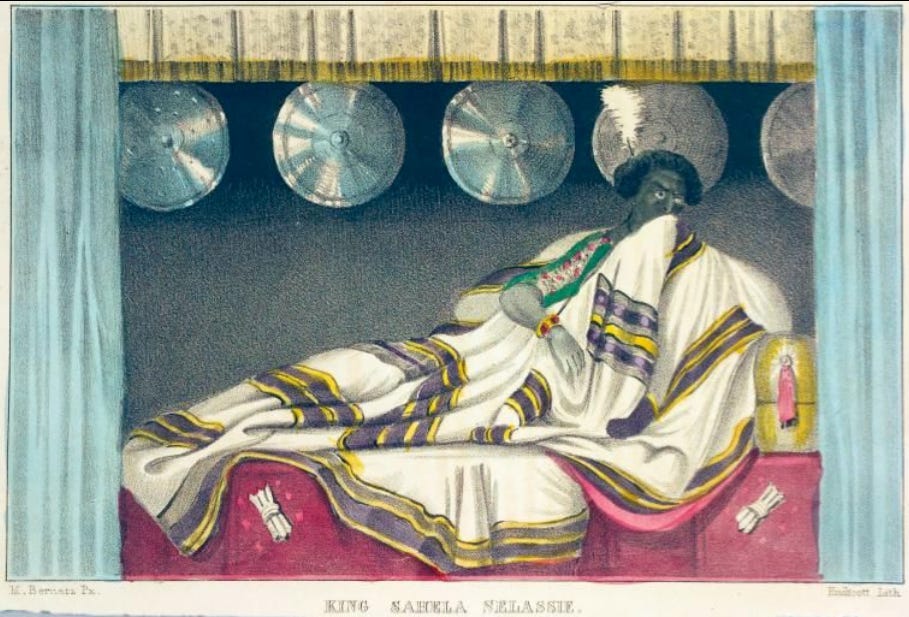
King Sahela Selassie of Shewa, Ethiopia. by Sir William Cornwallis Harris c. 1844.
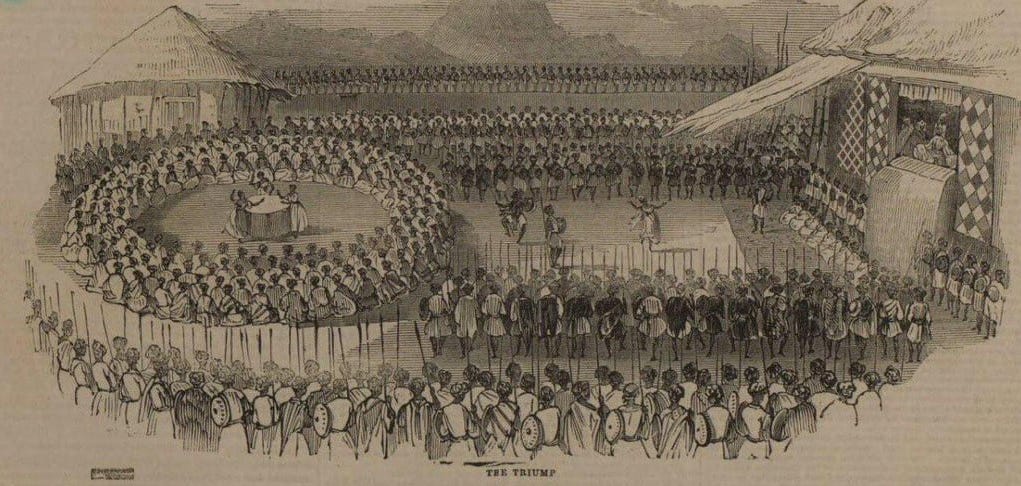
‘The Triumph’ at the court of Sahle Selassie. Shewa, Ethiopia, ca. 1844.
Gold currency
Between the 3rd and 7th centuries, the kingdom of Aksum was the first African polity south of Egypt to issue its own coinage, centuries before similar mints appeared along the Swahili coast and parts of West Africa.
The inscriptions on Aksumite coins preserve the names of approximately twenty kings, whose reigns provide a sequence and chronology for the series as a whole.
Gold coins of the pre-Christian period of Aksum, especially those belonging to King Endubis and Ousanas dated to the 3rd-4th century, have been recovered from the northern Horn itself, with smaller numbers recorded from southern Arabia and from India.
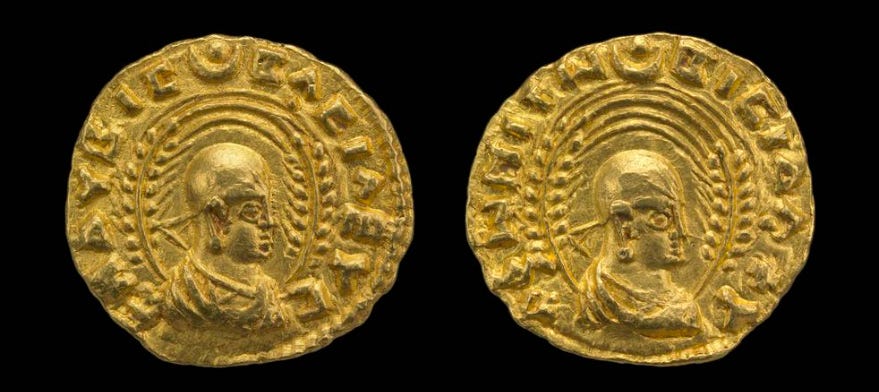
Gold coin of Endubis, ca. 270-300. British Museum. No. 1969,0624.1
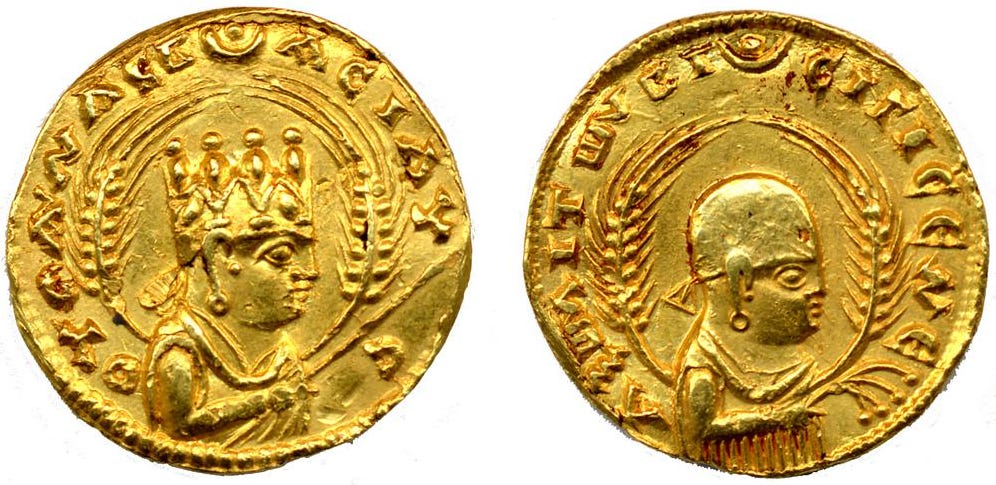
Gold coin of Ousanas, ca. 300-340. British Museum. No. G1925,1112.1
Those dating between the reigns of Ezana and Kaleb from the 4th to 6th centuries have rarely been found in the Horn, but are recorded in comparatively large numbers from southern Arabia. Many of these coins may have reached southern Arabia during the Aksumite conquests under Kaleb.19
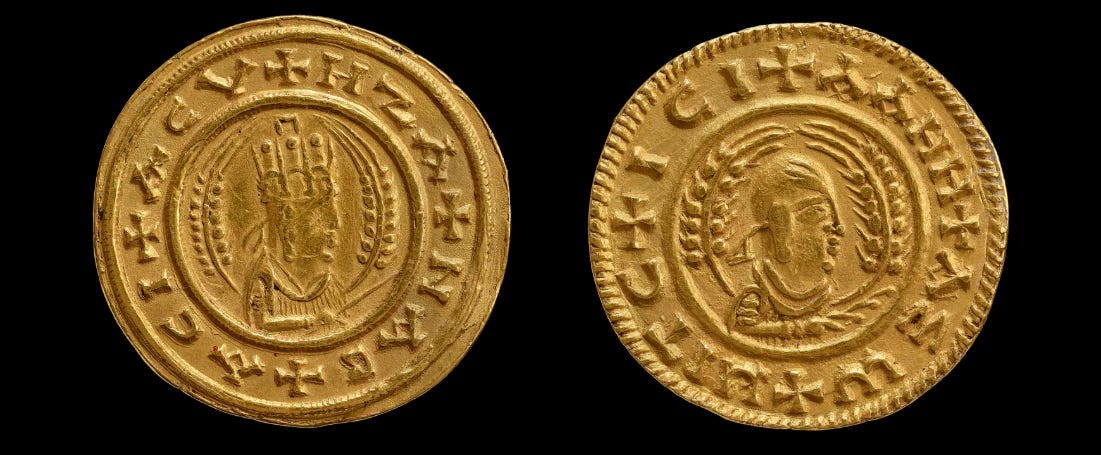
Gold coin of Ezana. ca. 340-400. British Museum. No. 1915,0108.81
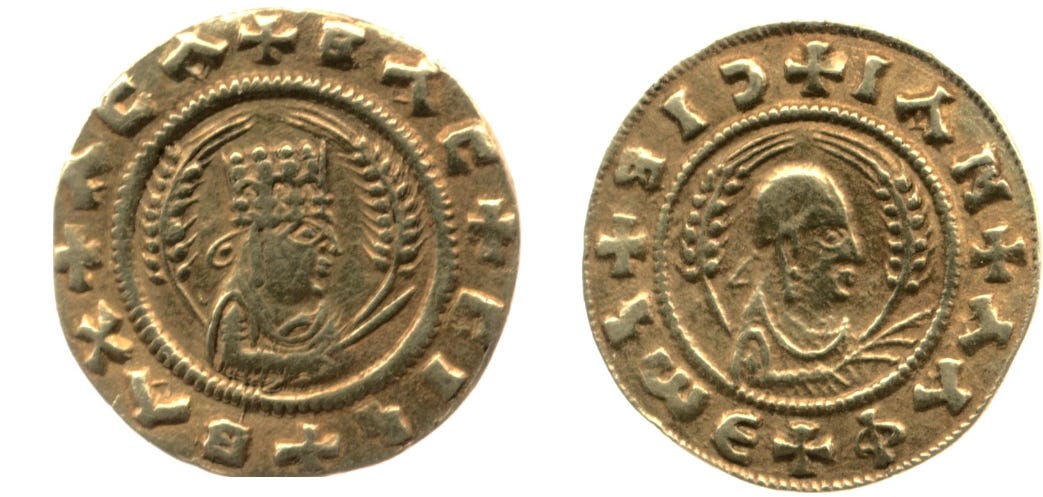
Gold coin of Eon. ca. 400-450. British Museum. 1915,0108.78
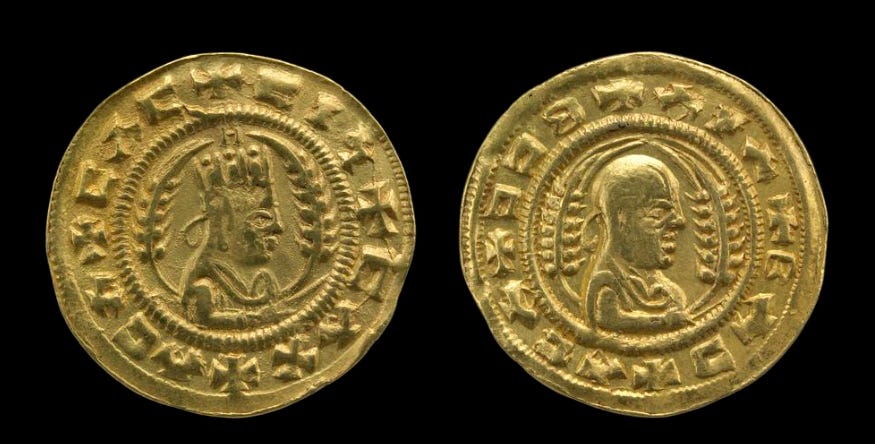
Gold coin of Ebana, ca. 450-500. British Museum. No. 1904,0404.1
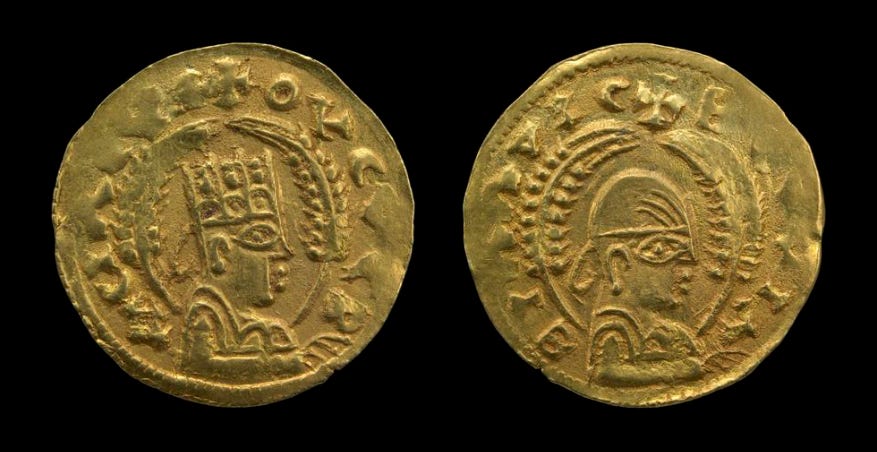
Gold coin of Ousas. ca. 500-520. British Museum. No. 1989,0518.336
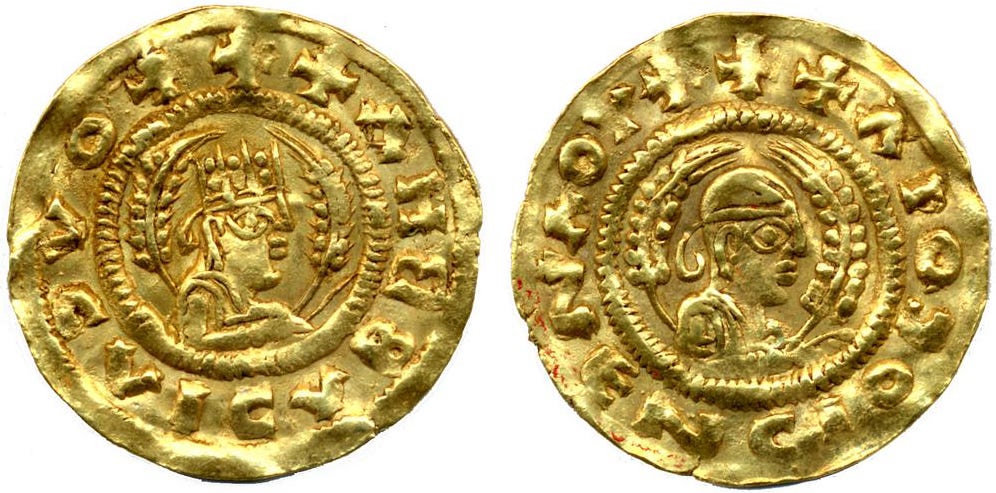
Gold coin of Kaleb, ca. 500-525. British Museum. No. 1910,1207.1
A hoard of gold objects from Matara included fourteen 2nd-century Roman gold coins with suspension loops indicating their eventual use as jewellery. The excavators considered that the hoard was deposited in the 6th century. A hoard of 105 gold Kushan coins was found in an ancient wooden box beneath the Debra Damo monastery in Tigray. They are dated to the 3rd century, but were likely deposited later.20
Archaeological finds of this sort are rare, and the amount of foreign money circulating in Aksum’s domains was probably relatively restricted. It is, however, thought to have influenced the minting of Aksumite currency.21
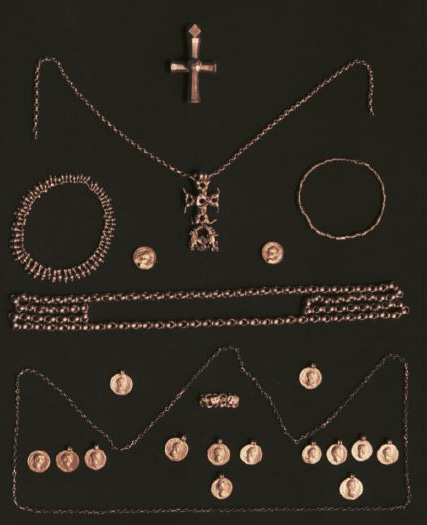
Collection of gold jewelry, including 14 coins of the Antonine era, crosses, and three chains. ca. 6th-7th century CE. (late Aksumite period) Matara, Eritrea.
The first gold coins were 93–97% pure and weighed 2.4–2.8 g, apparently based on the standard then prevailing in the Roman Empire, being half the weight of the Roman aureus. Changes in the weights of Aksumite gold coins during the late-3rd and early-4th centuries followed contemporaneous reforms of Roman gold coinage.
In the Eastern Roman Empire, the aureus of 5.45 g was replaced in 324 CE by a solidus weighing 4.54 g. There was undoubtedly a reduction in average weights of the Aksumite gold unit from that noted above under Endybis to 1.85– 2.09 g and 1.35–1.67 g for successive Christian issues of Ezana, nearly a century later.22
Rapid debasement of the coinage at Aksum could also imply that gold itself was in short supply, at least from the mid-4th century onwards, despite continuation of its use for embellishment of base-metal issues.23
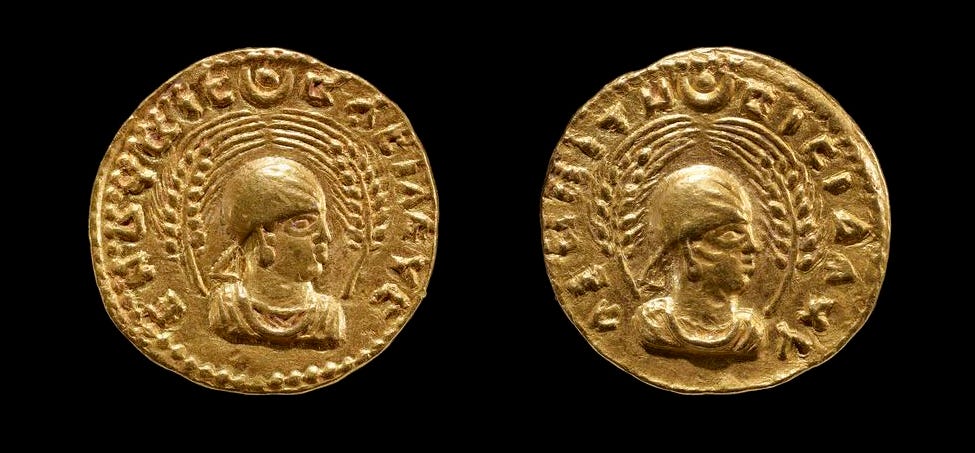
Gold coin of Endubis. c. 270-300. British Museum. No. 1989,0518.1
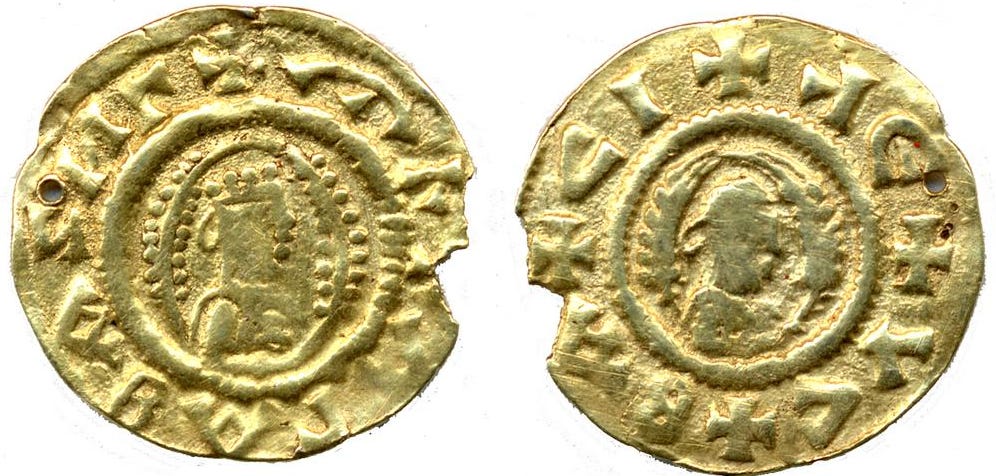
Gold coin of Ella Gabaz. ca. 520-550. British Museum. 1929,1107.10
Under Kaleb in the first half of the 6th century, exclusive use of Greek for coinage inscriptions was discontinued: denominations in silver and in copper were inscribed in Ge‘ez, while Greek remained in use on the gold coins, which continued to circulate internationally.24
The disappearance of gold coins in the 7th century is usually interpreted as a sign of the exclusion of the Aksumite kingdom from the Red Sea trade following the rise of the Arab empire.
It wasn’t until the 14th century that the gold of Ethiopia would reappear as a major currency used in international trade. The rulers of the Christian kingdom dispatched Muslim merchants with gold and silver in exchange for imported trade goods used at the court.
A Gǝʿǝz text recounting the war between King ʿAmdä Ṣǝyon and the Waläsmaʿ general Ṣabr al-Dīn in 1332 has King ʿAmdä Ṣǝyon complain, “You took away the commodities belonging to me obtained in exchange for the large quantity of gold and silver I had entrusted to the merchants. And you imprisoned the traders who did business for me.”25
This and later accounts indicate that multiple currencies were in circulation during the late Middle Ages in both the Christian and Muslim kingdoms of Ethiopia.
The Egyptian chronicler Al-ʿUmarī (d. 1349) mentions the use of Egyptian coins, i.e. silver dinars, in the kingdom of Ifat; iron currency (ḥakūna) in the sultanates of Dawāro, ʿArābabni and Šarḫā; and that elsewhere, in the kingdoms of Amḥara, Bāli and Dāra, barter dominated.26
In al-Maqrizi’s account, the sultanate of Awfat/Ifat was using coins (dirhams) in the 1430s. Damot and Sahem are also mentioned as two locations where Ifat is believed to have obtained its gold for mintage. al-Qalqashandi (d. 1418) suggests that Ifat was using dirhams and dinars minted in Egypt.27
An Ethiopian traveller, Brother Antonio, gives us an account of 16th century Gendebelu, which was a trading centre located near Ankober. Gendebelu, he reports, was using Hungarian and Venetian ducats, and silver coins of the Moors (Muslims).28 According to the chronicle of the Ethiopian-Adal wars, in the muslim trading city of Wis, all transactions were carried out in gold.29
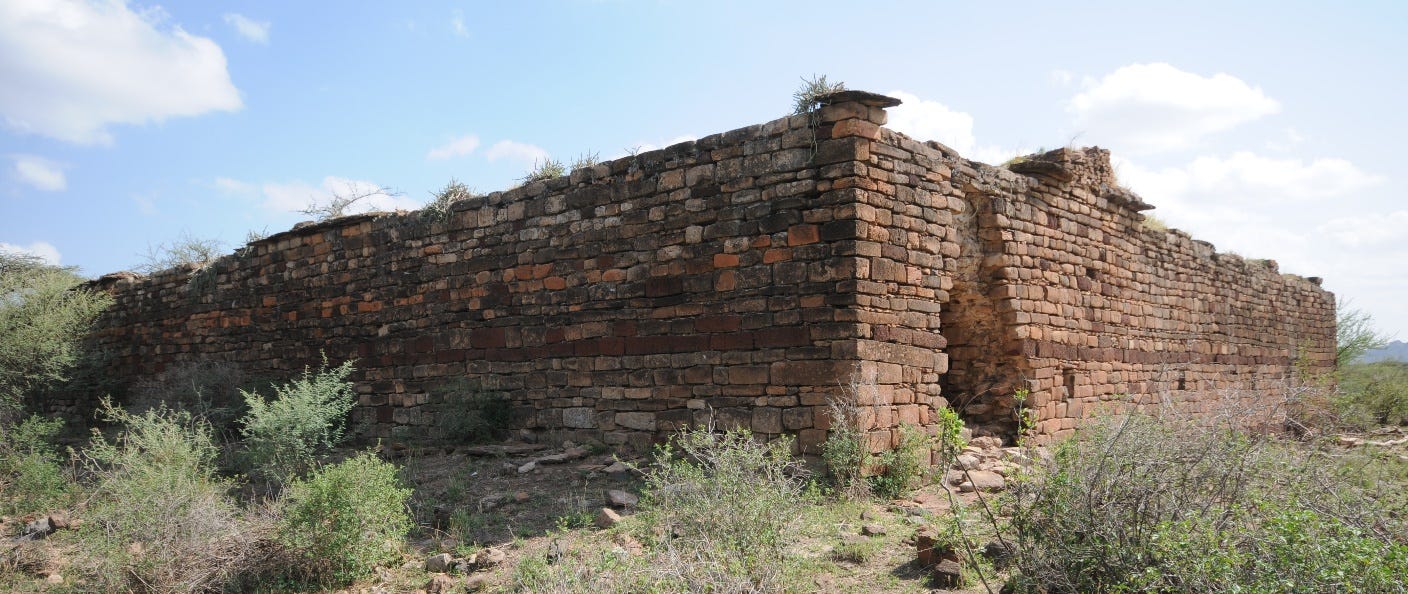
The main mosque of Asbari, an archeological site identified as medieval Gendevelu/Gendabelo
A document from the city of Harar recording events in the late 16th century, after the defeat and expulsion of Adal’s armies, provides the first internal evidence for the city’s use of coinage and its related units of measurement.
According to this account, a unit of measurement known as the sa’a, which amounts to four handfuls of durah (sorghum), was worth 12 ashrafi (Harari currency), a sa’a of salt was sold for 15 ashrafi, and a cow was over 300 ashrafi. As the economy recovered, food prices dropped so that durah cost four or five mahallak, the lower denomination of the ashrafi.
Apparently, one wealthy merchant, Muhammad ibn Said al-Shatiri, alone had more than 35,000 units of currency, and in each thousand, 50 were pure gold units. The document does not specify the name of the currency, but it’s estimated that a few hundred thousand coins were in circulation in the city.30
Virtually all the surviving Harari coins were made of silver and copper, and are documented in several 19th century accounts. Most of the coins are dated after 1197 A.H. (1783 A.D.), a few from the 16th century, the earliest of which is dated 910 AH. (1504 A.D.), and an exceptional piece dated 615 A.H. (1218 A.D.), about a century before al-Umari’s reference to coins used in the Muslim kingdoms of Ethiopia.31
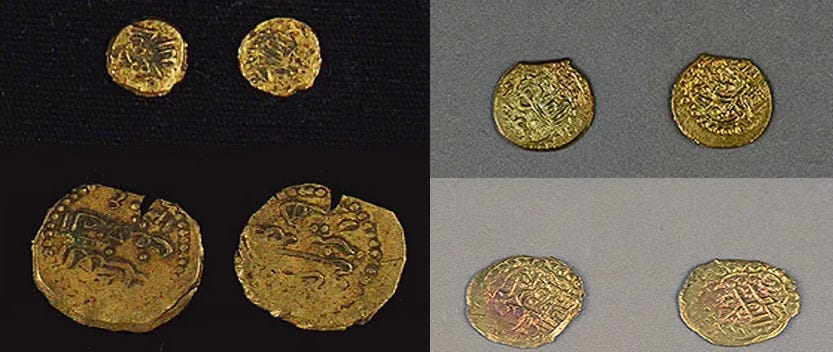
Copper coins from Harar, issued in 1222 AH, 1304 AH (1807, 1887 A.D). University of Illinois
According to C. J. Cruttenden in 1849, gold was used at the time of ‘Emir Abd el-Shukoor’, about “two hundred years ago” (ie; 1640s). The explorer Richard Burton in 1855, reported that gold coins were by then a nominal unit known as “ashrari” and that the only species in circulation were inscribed brass coins. He also observed that “The Amir pitilessly punishes all those who pass in the city any other coin.” 32
The silver and copper currency of Harar continued to be minted until the conquest of the city by Menelik in 1887. About five years later, Harar became the first centre of mintage for modern Ethiopia when Menelik’s first coins were minted in Harar bearing the date 1885 E.C. (1892 A.D), some of which were gold coins.
But for much of Ethiopia, unminted gold currency, along with other forms of commodity money, remained the primary medium of exchange.
Manuel de Almeida’s account in the 1620s observes that “There is no other money in this country except gold, by weight… gold alone is used for buying clothing from India, carpets, silks and Meca (Mecca) brocades, and all drugs, pepper, cloves and a thousand other things that they send for to Maçuâ , Moqhâ (Mocha), Iudâ (Jedda) and Egypt in caravans which used to go by land.”33
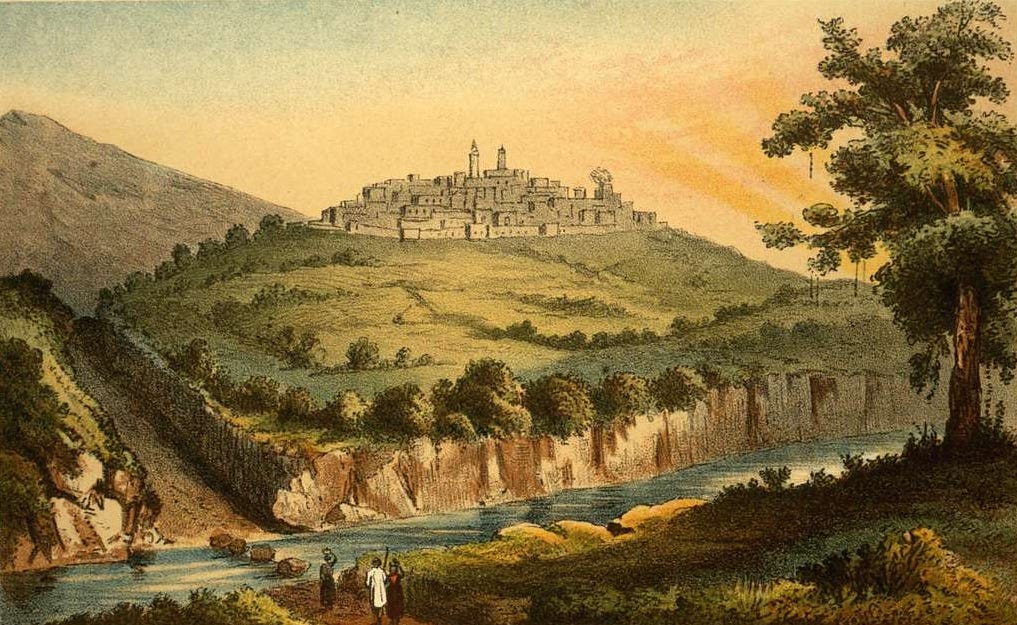
Harar from the Coffe Stream. Illustration by R. Burton.
Gold Mining and Trade
Recent archaeological finds around Aksum and across Tigray suggest that some of the gold used in the ancient kingdom was obtained from the hinterland of its capital.34
Several stone slabs in the vicinity of Aksum, which are stone basins measuring about 4.4 metres by 1.8 metres, bear the name mistah werki [= where gold is spread out to dry]. The form of these slabs is concordant with their use for washing auriferous earth in order to extract the gold, which would suggest that the material thus processed was obtained in fairly close proximity.35
According to Laurel Phillipson, areas of disturbed terrain immediately west of Aksum might have been caused by mining for alluvial gold. She also raised the question whether the deep rock-cut vats at Adi Tsehafi may have been used for gold-processing rather than for wine-making as has more usually been suggested.36
There are 16th-century records of gold being found after rain in the Aksum vicinity. In the early-17th century, Barradas recorded the wide distribution of auriferous deposits in Tigray, while a 19th century prospector was noted by Bent as having discovered gold in the vicinity of Adwa.
According to Poncet, “a great deal of gold’ was found in Tigray where the specimens he had seen he considered ‘very fine’. Such gold, he concludes, was often found in the river beds after the rains and was ‘much more pure’ than that obtained from the mines.37
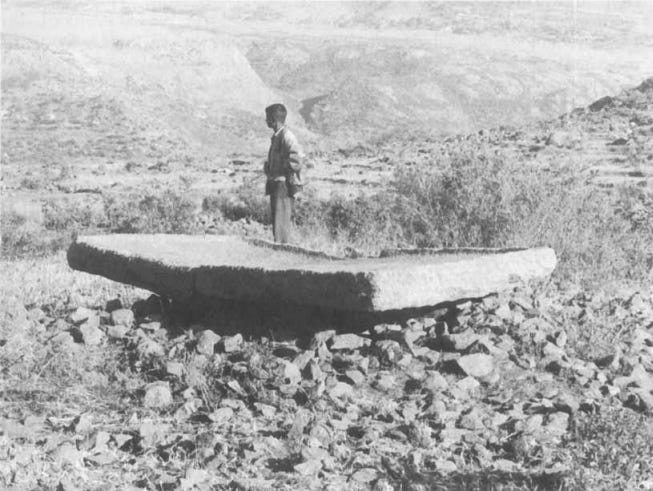
The Mistah Werki at Daro Maicbew. Image by L. Phillipson
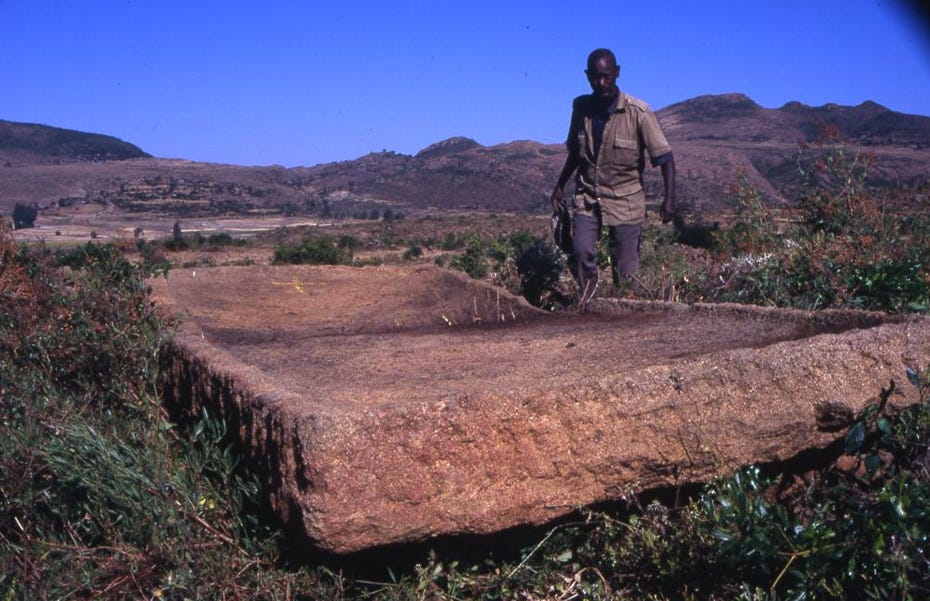
Stone basin at Aksum.
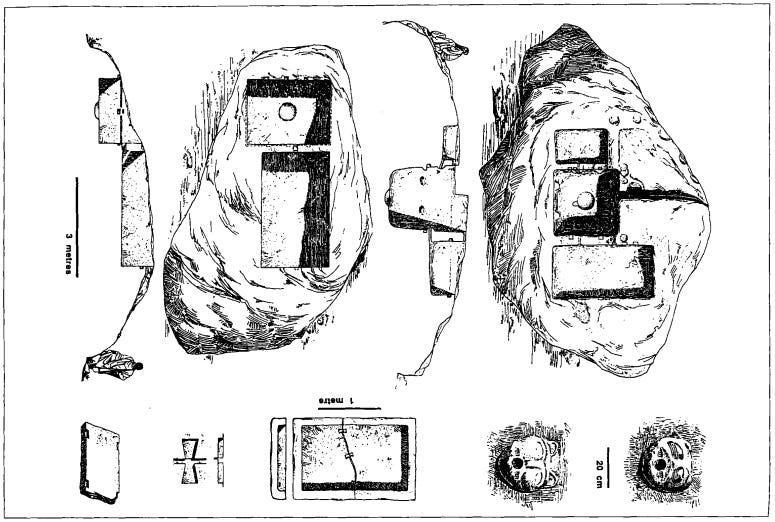
Plans and sections of the tanks and ‘rectangular stone bowl’ at Addi Tshafi, Aksum. by L. Phillipson

The rock-cut tanks at Addi Tshafi, Aksum.
Kosmas Indicopleustes recorded expeditions from Aksum to obtain gold from a place called Sasu, where a caravan was sent under the ‘governor of Agaw’.38 His account reproduces the silent trade fable, a well-known legend used by commercial monopolists to disguise the details of their exchange.39
Historians identify Sasu with the region of Fazogli, on the modern Sudanese-Ethiopian border, where gold deposits have been known since the 18th century.40 Others have suggested locations closer to Aksum, most notably, the southwestern regions of Damot, Ǧanǧäro and Gamo, where gold was exploited in the Middle Ages.41
The greater part of the gold in medieval Ethiopia was found by panning or by searching river beds, rather than mining.
Ibn Fadl Allah, writing in 1342-1349, reported that considerable quantities of gold were reaching the Muslim sultanate of Ifat from Damot (a province to the south of the Blue Nile) and that an ounce varied in value between eighty and one hundred drams/drachms.
Brother Thomas of Angot in the early 16th century also asserted that the province of Damot was ‘rich in very fine gold’, while Alvares in 1520 stated that in his day most of the gold came from Damot though an ‘inferior’ type was brought from Gojjam.
Gold, he added, could be obtained in Damot by merely digging immediately before or during the rainy season; the water then washed away the soil, leaving the precious metal on the surface. He also mentioned the practice of gold-washing near Aksum and said that he had himself attempted it, but without success.42
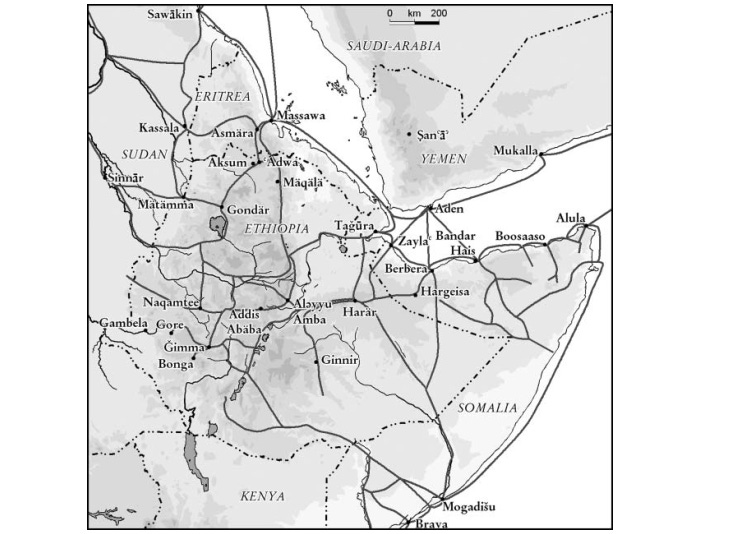
Trade routes in the Medieval and Early Modern period. Map by R. Pankhurst
Kosmas’ 6th-century story about the exchange of gold for iron, salt and cattle is supported by de Almeida’s 1620s account of gold obtained in his day from the western and southern provinces, where it was exchanged for textiles, cattle, salt and other goods.
Castanhoso in the 1540s tells how the Emperor stated that ‘there was much gold in his country’, and that it came from ‘far inland’ where the Cafres came to a market in the country of Damot ‘in gangs on foot with much gold in bags at their sides’.43
James Bruce in 1770 states that Sartsa Dengel, desirous of opening up communication with the gold-producing area of Enarea, crossed the Blue Nile, was ‘received with great joy’ by the Prince of Enarea and was given ‘many rich presents, more particularly a large quantity of gold’.
Susneyos, he adds, on one occasion received one thousand oqueas brought by a caravan which travelled once a year through the country of the Oromo and thence by way of the lands of the Gafats and Gongas. A 17th-century source noted that the ruler of Enarea came to Fasilidas’s capital at Gondar ‘laden with gold’.44
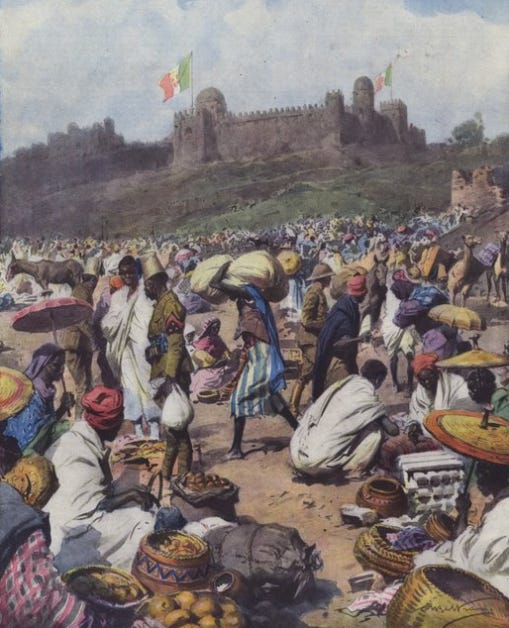
Market in Gondar, Ethiopia ca. 1936-41
James Bruce in 1770 indicates that most Ethiopian gold came from what he calls the country of the Gummuz south of the Blue Nile, that it was bought from them at Burye market in Damot by the Agaos who gave them copper, iron, beads and hides and skins in exchange, and that it was taken to Gondar both by Agaos and Muslim traders.
This gold was obtained by washing auriferous earth in wooden dishes, the grains which remained being stored by the Gummuz in quills. The pure metal was subsequently melted down and adulterated by the admixture of one tenth part of silver; it was then fashioned into small rods or ingots of a ‘very pale colour’.45
In 1835 an Austrian named J. Russegger wrote that the frontier region between western Ethiopia and the kingdom of Sennar (Sudan) was called dar al-Berta. Among the natives were many Dongolawi jallaba (traders) who carried on the gold trade, some of it, to Ethiopia.46
Reports from the early 19th century indicate that most gold exported through the coastal town of Massawa came from Limmu-Enarea and the neighbouring kingdoms of the Gibe region, and that much of it passed through the entrepot of Baso in Gojjam.47
The German missionaries Isenberg and Krapf, who were in Ethiopia in the 1830s, Oromo and Gurage traders from Enarea and the southern regions carried a significant traffic in coffee and gold to Gondar and Shewa, where some was retained by the royal treasury.
“The gold which comes to Shoa, is brought from Gurague and beyond, where it is found in the bed of rivers after the rain. But no Shoan subject is allowed to possess gold, which is only in the hands of the king, who would severely punish any of his subjects who had any, except the king himself had given it.”48
Returning from Shewa, Krapf was at times accosted by his guests in the northern regions of Lasta and Wag who thought he was carrying gold, despite his destitute appearance, which only convinced his guests that he was disguising his wealth, as most gold merchants did.49
The Gold trade and market towns were subjected to special taxation, much of which was collected in gold dust. Alvares in 1520 states that the important trading centre of Manadeley in Tigray paid the Emperor no less than 1,000 ouquias of gold a year in taxes from trade.50
According to Nathaniel Pearce, who visited Gondar in 1810, there was a market official known as the “Negiule Ras” who “pays yearly to government five hundred wakeahs of gold, which is called negus gibba [King’s duties] and twenty wakeahs worth of goods as a tax to government for his office called mershamyer.”
The large sum was because every horse, mule, and captive passing through the city had to pay two drams/drachms of gold (about 2 silver dollars); every ivory tusk was charged one dram, and every mule-load of imports was charged one wakeah, while one porter’s load paid six drams. At Adwa, a mule-load of imports paid half a wakeah of gold, and a large tusk two drams, while the rest of the taxes were paid in textiles.51
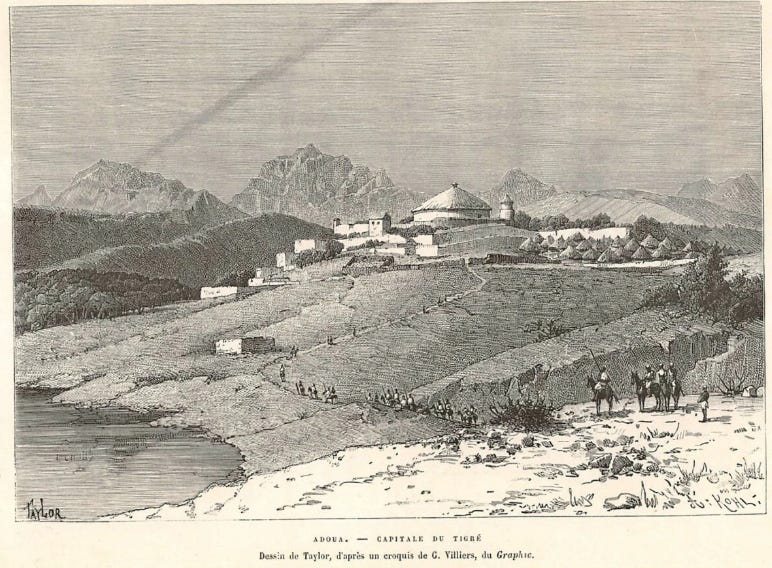
Adoua (Adwa) ‘capital of Tigre’ early 19th-century engraving.
The weight of the gold was standardised by an official called the buggerunde, who was also the King’s silversmith. He received two bars of salt for every wakeah of gold he weighed. In Antido he received four bars, at Socotta in Lasta he received two bars, at Adwa in Tigray, he received a gribbaub, which is a quarter measure of textiles.52
Gold came in a variety of forms. According to Mansfield Parkyns at Massawa in 1848, there were three types of gold exported to the coast;
Gold from Sennar was the best quality, and found its way to market in rings or links. The second and third quality, which are distinguished as being Abyssinian gold, were available in grains or beads, and in ingots respectively. Parkyns recorded that Sennar gold cost between 17 and 20 “German crowns (Maria Theresa)” per ounce, second quality 13 to 15 dollars per ounce, and third quality 9 to 11 dollars per ounce.53
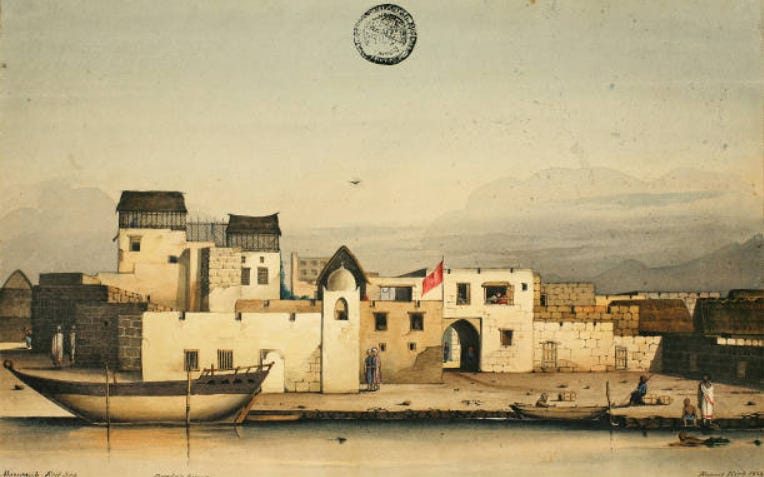
Dowla's house, Massowah (Eritrea), ca. 1833
Measurements
From the 16th century onward, the main unit was the waqet. This term comes from the Arabic wiqīyya, reflecting the influence of the language on long-distance trade, such that the same term, wiqīyya, gave birth to the European “ounce.”
A short Chronicle of Lǝbnä Dǝngǝl (r. 1508-1540) states that a waqet of gold was exchanged for 30 bars of salt and was the price of an ox. Alternative units existed, eg the 10,000 mädalw of gold spent by King Galäwdewos to create a manuscript library.54
Brother Thomas of Angot says small pieces of refined gold were employed in large transactions and were measured by weight, the unit principally used being the ouquia, roughly an ounce, the weight of ten cruzados or the equivalent of ten to twelve drams/drachms.
According to Alvares’ report in 1520:
“In all the kingdoms of the Prester John [Ethiopia] money is not current, but only gold by weight, and the principal weight is called onquia, and this, which is an ounce, makes in weight ten cruzados, and for change there is a half onquia, and then they use the drachms; ten drachms make an onquia. The value of the drachm is according to its value in the Kingdom of Portugal, or in India. It is worth three quarters of a gold ducat in gold,3 so an ounce is worth seven and a half gold ducats in gold.”55
Poncet, writing of the end of the 17th century, confirmed that gold was widely used, though it was “not stamp’d with the prince’s image as in Europe,” but circulated in wedges, cut as required in units from an ounce to half a dram/drachms. As a safeguard against adulteration, there were many goldsmiths who made “trial of its goodness.”56
During the reign of the Emperor Iyoas I (1755-1769) an oquea, or ounce, of gold was said to be worth only about eight patacas, but in Bruce’s day it was valued at ten, and sold at Mocha for 15 or 16 patacas, though Sennar gold fetched 22 patacas, being less adulterated.
The Gummuz of western Ethiopia are said to have long weighed their gold with the aid of the seeds of a tree called kuara, which is known among them as ambilish and in Amharic as korch. James Bruce, in 1770, considered these seeds as the best available choice, as repeated experiments had shown him that from the time of their being gathered they varied little in weight.57
The use of specific plant seeds for measuring smaller units of gold across Europe and the Muslim world is discussed in my previous essay on the Gold Trade of Medieval West Africa.
Given the use of multiple currencies, a commodities/currency exchange market existed in many of the major cities and towns, especially for salt bars.
According to Alvares in 1520, salt, which mostly originated in the northern regions, was “very cheap where it was obtained and very dear at court,” while in the far-off region of Damot it was said to be almost “worth its weight in gold.”
He notes that a drachm of gold would buy 120 or 130 bars where they were collected, 5 or 6 less at Corcoro market in Angot, “and so it goes on diminishing from market to market. When it arrives at Court, six or seven blocks are worth a drachm”.58
James Bruce states that at Gondar 72 to 76 bars were normally exchanged for an oquea of gold; in 1768, however, the exchange rate rose to eighty, and in 1771 it fell to 34.59
The exact weight of the waqet seems to have varied slightly in the Red Sea region, but according to Alessandro Triulzi’s study of the gold trade in Ethiopia-Sudan borderlands during the 19th century. one waqiya was 37.44 grammes.60
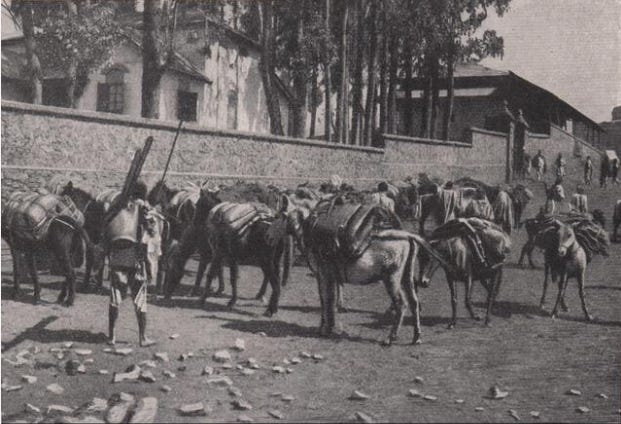
Native Merchandise conveyed by donkey Caravan. Ethiopia. Abyssinia (1923)
Gold smithing
The Aksumites possessed highly accomplished metalwork with items in gold, silver, iron, and copper together with their various alloys, including bronze, speculum, and brass
The corpus of excavated Aksumite metalwork reveals that a number of metalworking technologies were known, including hammering, gilding, casting, wire-pulling, riveting, and soldering/welding.61
Based on his excavations at Adulis, Roberto Paribeni suggested that furnaces from Adulis were employed in liquefying tar and in gold-working.
He uncovered what was apparently a gold workshop, with amphorae and ashes in association with a collection of gold rods, earrings, and two elaborate bejewelled crosses with chains; in a different place a stone mould for making jewellery was found.62
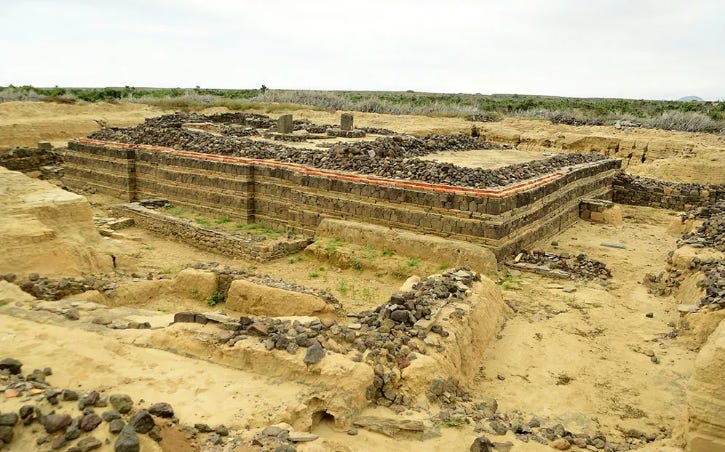
Ruins of the Cathedral of Adulis, Eritrea.
Paribeni also found evidence for several bronze scales called trutina, which were also uncovered in several ancient Meroitic sites in Sudan, and were usually employed for weighing precious gems, pearls and gold.
Paribeni reports that an almost complete scales was found in the church to the east of the city; two other fragments were found along the south and the east side of the altar. A pair of scales and weights was also found in later excavations. The presence of so many scales seems to testify to the involvement of the town in the trade of gold and other commodities.63
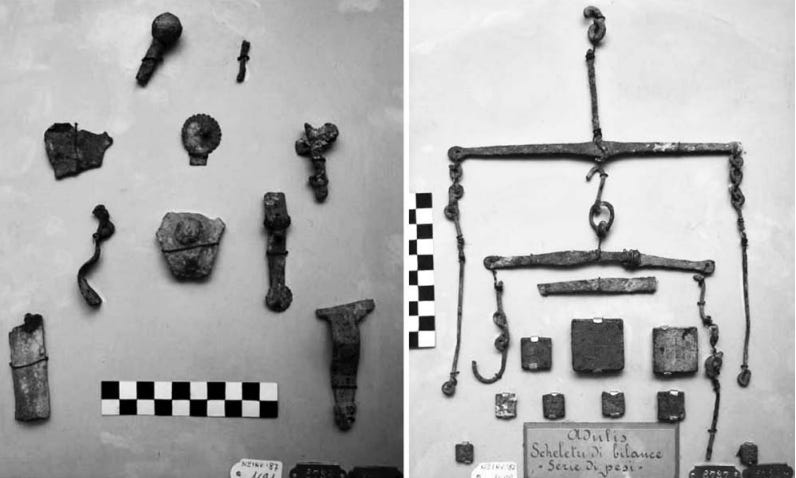
‘Metal artefacts in the African Museum in Rome’ from Adulis.
Archaeological evidence for goldsmithing has also been found in the late medieval sites of Harlaa, near the Muslim merchant-town of Harar, where small bucket-shaped goldsmith crucibles were found, likely used for making jewellery. The city of Harar is also known to have minted its own coins since the Middle Ages, although there have been few excavations within the old town.64
Besides the local goldsmiths, Medieval Ethiopian monarchs also patronized foreign craftsmen from the Mediterranean world.
Diplomatic correspondence by Ethiopian monarchs in the 15th and 16th centuries includes requests for goldsmiths from the kingdoms of Aragon and Portugal, among other craftsmen such as carpenters, bookmakers, and jewellers.65 Greek and Armenian metalworkers were employed at the court since the 17th century.
In the early 19th century, many craftsmen, mostly Ethiopian, were attached to King Sahla Sellase’s palaces at the twin Shewan capitals, Ankobar and Angolala. Carpenters, masons and craftsmen were engaged in making gunpowder, repairing rifles and producing intricate jewellery and other articles of gold, silver and ivory.66
In most of Ethiopia and Eritrea, metalworkers, both blacksmiths and goldsmiths, belonged to endogamous groups of ostracized specialists who were perceived as possessing special spiritual powers. However, because of the nature of the materials each wields, the economic status of the goldsmith was considerably better than that of silversmiths and blacksmiths.67
The English adventurer Mansfield Parkyns, who was employed as a goldsmith in Adwa for “a considerable time,” observed that the life of a goldsmith was a good one, although it did involve “appropriating a large portion of both the gold and the silver entrusted to them for work.”68
The goldsmiths of Adwa skillfully fabricated objects using a range of techniques, including filigree, gilding and stamping. Many of these artefacts, dating from the 17th to the early 20th century, can be found in Western collections, especially those captured at Magdala after the British invasion of Ethiopia in 1868.
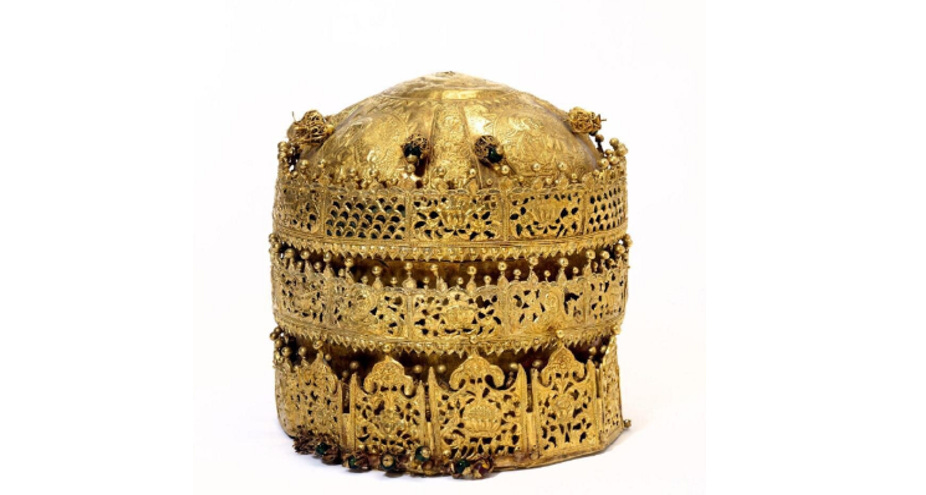
Crown, made in Gondar, Ethiopia, around 1740. Museum no. M.27-2005. Victoria and Albert Museum, London
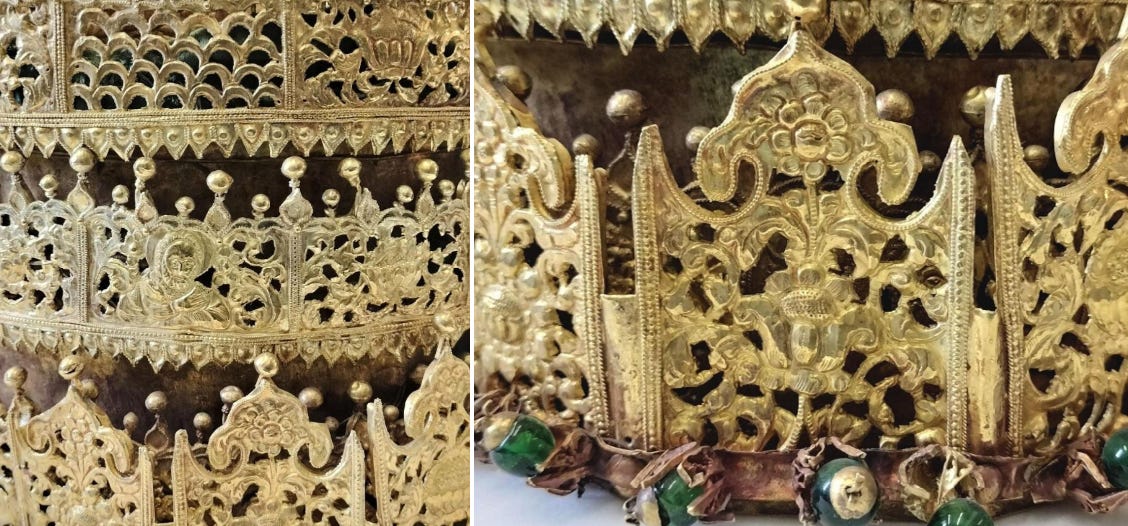
Detail of the crown.
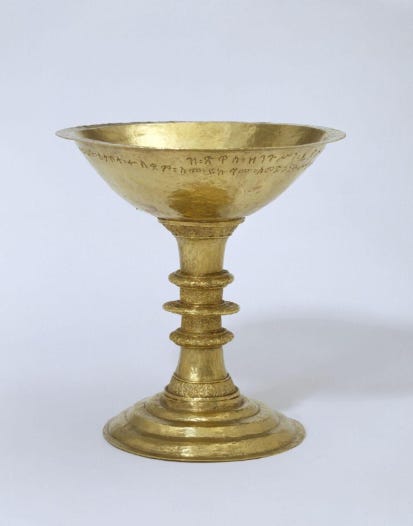
Gold Chalice, ca. 1735-1740. Magdala, Ethiopia. Victoria & Albert Museum.
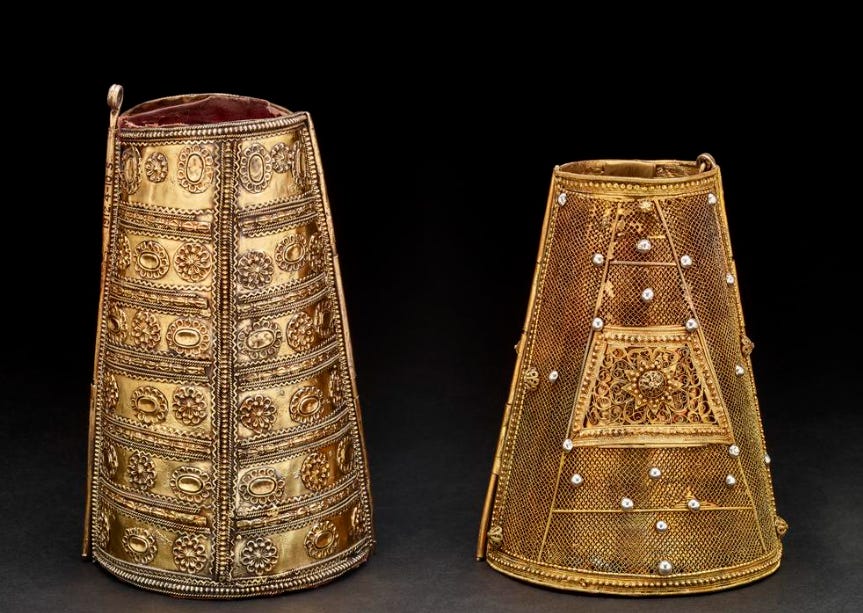
Armlet; made of silver-gilt. Two curved plates, fastened together in a pyramidal shape with hinges. 19th century, Ethiopia. British Museum
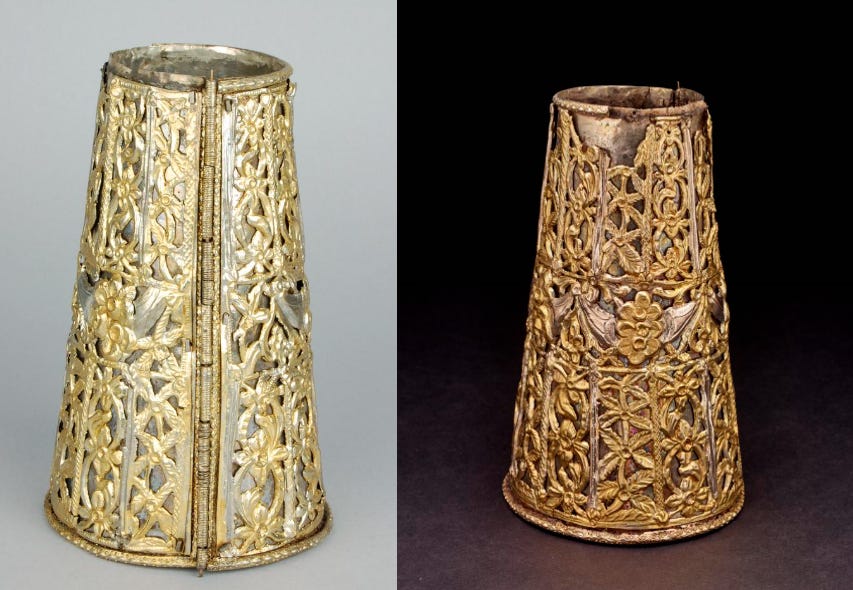
Armlet, Bitäwa, made of sheet silver, overlaid with gilded open-worked repoussé and joined with a pin hinge. ca. 1841-3, Ethiopia. British Museum
Gold use
Until the 20th century, gold, the metal of choice for the paraphernalia and symbols of church and state, was the exclusive privilege of royalty and priests. In contrast, silver objects, while certainly used and worn by priests and royalty, were more commonly available to, and used in the production of jewelry for the non-elite.
Gold was used for coins and jewellery, as foil or inlay on items made of other metals, and for thread in weaving and/or embroidery.
Jewellery, including gold cross-pendants of clear Christian type, has been found in a hoard at Adulis. A collection of gold jewellery and Roman coins was found in the bronze vase dated to the 6th-7th century CE. Traces of gold-threaded textile were recovered from primary contexts in the 4th-century Mausoleum at Aksum, as well as items decorated with gold leaf and engraved mother-of-pearl.69
Multiple accounts from the 15th and 17th centuries refer to elite clothing with gold and silver embroidery, as well as jewelry consisting of gold chains, processional crosses, bangles, necklaces, and swords with gold hilts.70
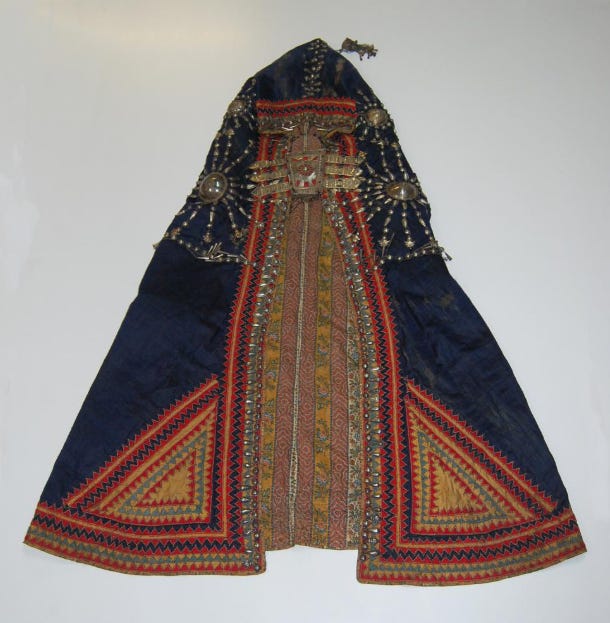
Silk robe embroidered with silver and gold. Maqdala, Ethiopia. 19th century. British Museum.
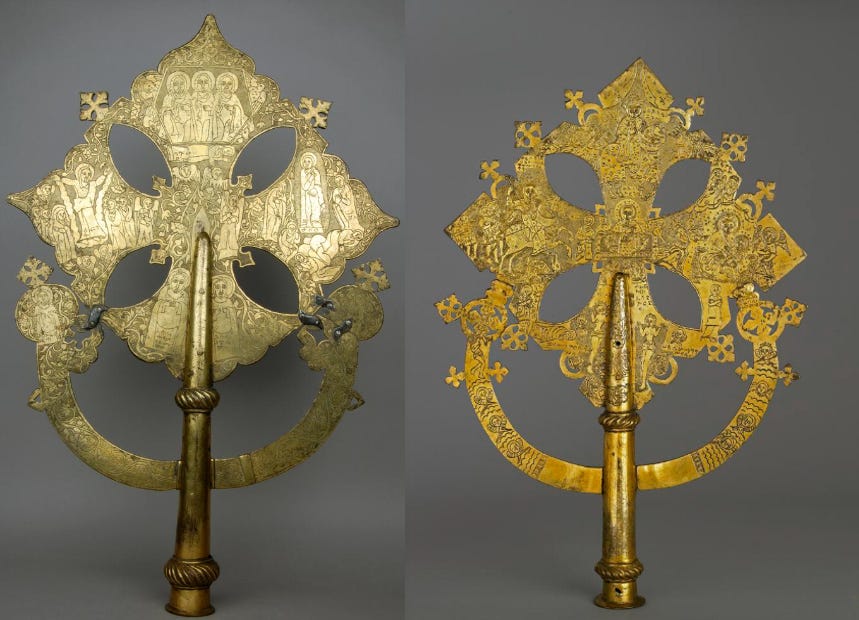
Processional crosses cast from a copper alloy; engraved and gilded. Maqdala, Ethiopia. 19th century. British Museum.
Ethiopian monarchs, their consorts and other royals wore luxurious and costly clothes. Lebna Dengel, when receiving the Portuguese mission of the 1520s, wore “a high crown of gold and silver”, and was dressed in a “rich mantle of gold brocade”, while his feet were covered with a “rich cloth of silk and gold.”71
In the southern Oromo kingdoms of the Kaffa and Gibe regions, the insignia of the kingship consisted of a crown in the form of a helmet made of gold and silver, as well as a gold staff, chain, parasol, ear-rings, armlets, and finger-rings; and a golden sword and shield.72
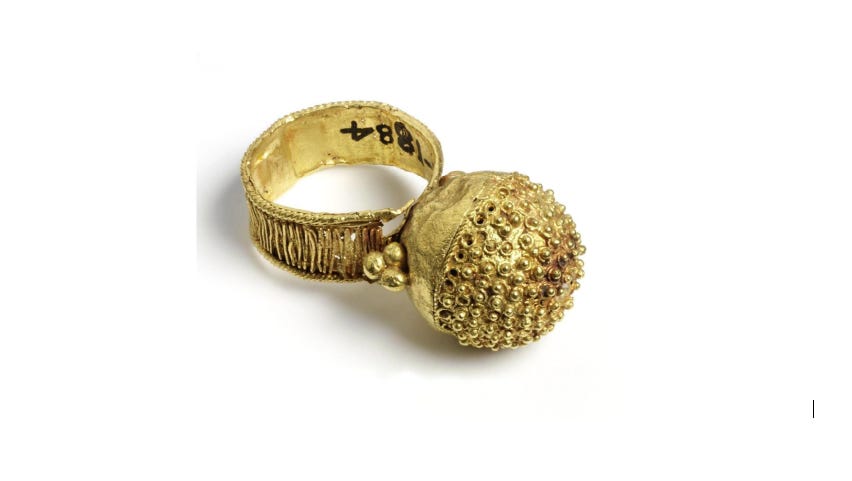
Gold band ring with a large hollow spherical bezel. 19th century, Ethiopia. Victoria & Albert Museum
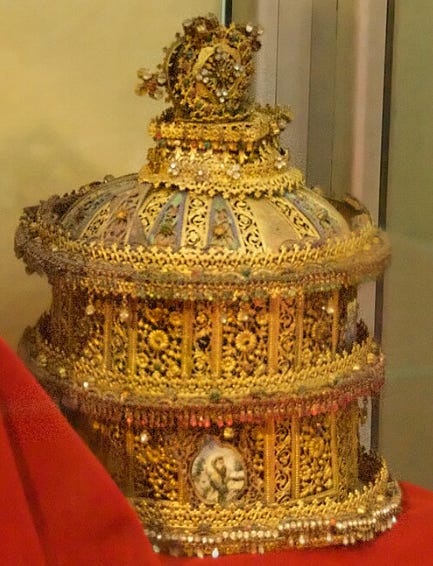
Ethiopian Crown at the National Museum, Addis Ababa. Wikimedia Commons
In the north, 17th century accounts describe the coronation ceremony at Aksum, during which the king would distribute largesse by flinging gold amongst the crowd as he processed over rich carpets laid out on the streets from the entrance of the town to the cathedral area.73
Almeida in the 1620s observed that “... nobles put on their necks their gold chains which are like what we call skeins with many turns of yarn wound round them. On their arms they put bracelets of the same and their swords which are very large, have scabbards covered with silver. They wear girdles or sashes of very big pieces of gold and so the court, when it is in festival, is brilliant and sumptuous enough.”74
In 1810, Nathaniel Pearce, while attending the reception of the Abuna (patriarch of the Church) by King Tekle Giyorgis I, observed that: “the priests were dressed in ornaments of gold and silver, velvets and silks, with crowns of silver and gold on their heads”75
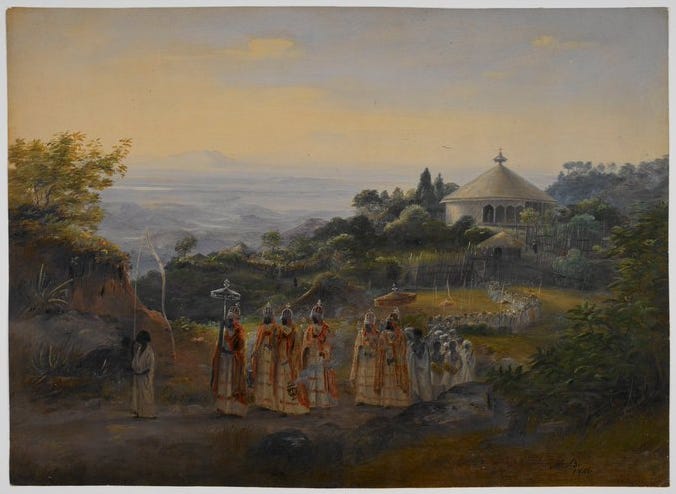
Religious procession from the court of St. Michael at Ankobar. Shewa, Ethiopia ca. 1841-1843
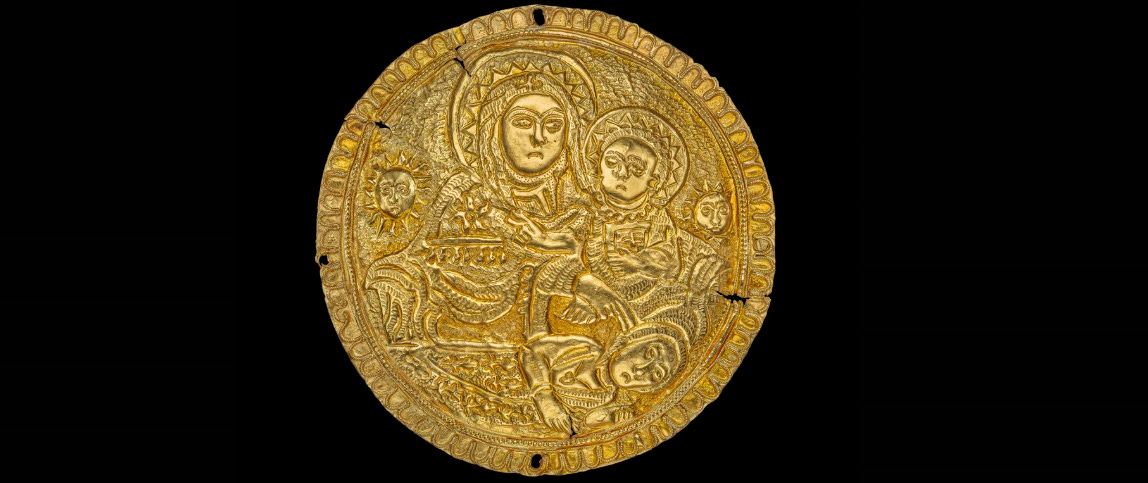
Ornament; made of gold, in form of convex disc. Central repoussé design depicting the Virgin Mary with the infant Christ on her lap. Maqdala, Ethiopia. 19th century. British Museum.
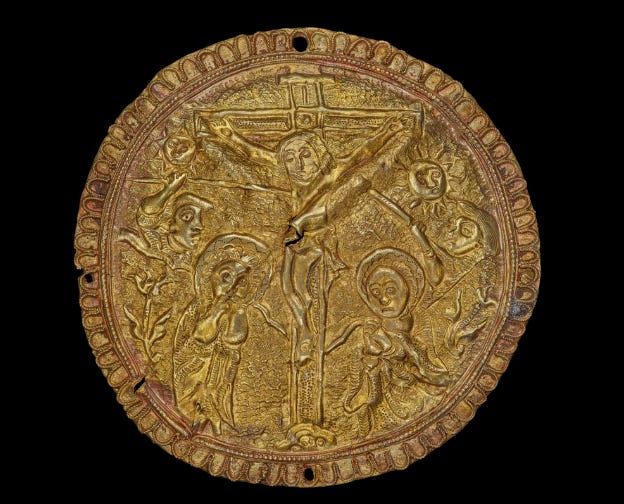
Ornament; made of gold in form of disc, depicting the Crucifixion in repoussé. Maqdala, Ethiopia. 19th century. British Museum.
Gold was used in architectural ornamentation and in embellishing manuscripts.
The 16th century chronicle of the Ethiopia-Adal wars describes the interior of the church of Makana Sellassie, which was “ornamented with sheets of gold and silver on which had been placed incrustations of pearls. The wooden doorway was ten cubits long and four wide; it was covered with sheets of gold and silver, and over the gold had been placed incrustations in various colours”
The chronicle also recounts how the church of Atronsa Mariam was pillaged after the battle. The invaders tore out rich brocaded velvets and silks, gold and silver in heaps, gold and silver cups, dishes and censers, a gold tabot on four feet weighing over 1,000 ounces, an illuminated Bible bound in sheets of gold, and innumerable other riches.76
The chronicle of the Ethiopia-Adal wars contains numerous references to gold that was stripped from the walls of churches and monasteries, and gold objects that were melted down before the buildings were burned down.
It states that the invading armies carried away much of the loot, “some of them carried two-thousand ounces of gold; some of them one-thousand-five-hundred; others of them one-thousand; and others again five-hundred”
“They had so vast a quantity of gold that at this time they made any deals with gold. When someone wanted to buy some necessity, he would take a fistful of gold, go to the market and use it for the purchase. They ignored the scales. The price of a mule went up to forty ounces of gold because gold was so plentiful.”77
Archaeological surveys of ruined churches corroborated this textual record. Among the ruins of the churches of Ǝnsǝlale and Gǝnbi in Shewa, whose walls burned at a heat high enough to melt glass, were fragments of gold plates and clearly cut gold cubes.78
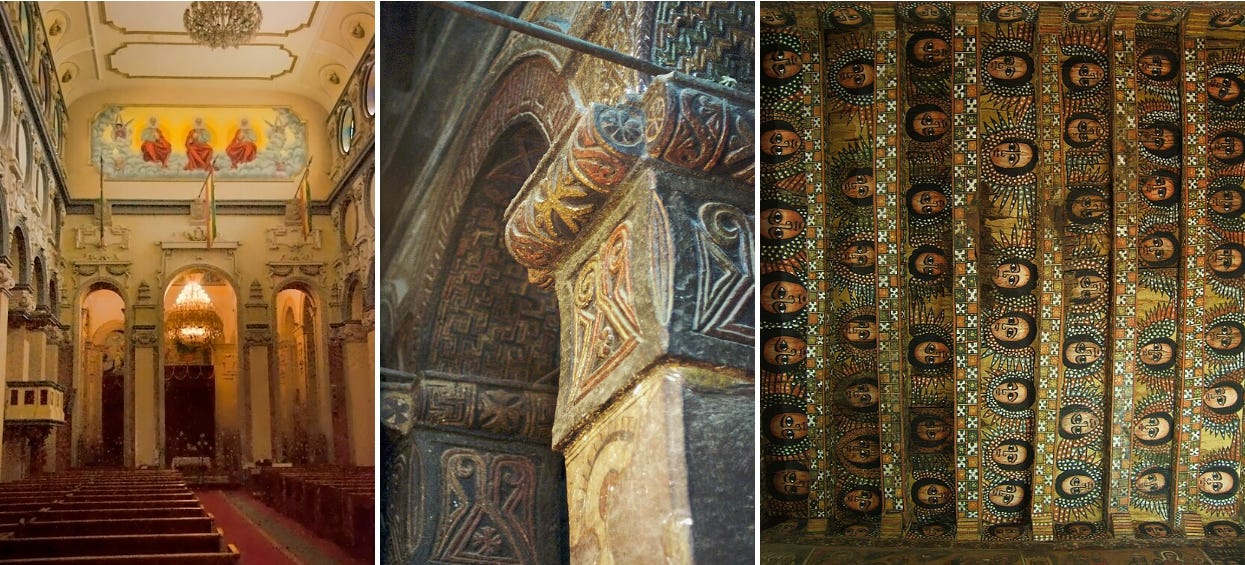
Interior of Ethiopian churches; (left) Holy Trinity Cathedral, Addis Ababa. (center) Arch and Capitals, Church of Bet Maryam, Lalibela. (right) Debre Berhan Selassie Church Roof, Gondar.
Poncet in Gondar wrote with admiration of the new palace with ‘more than twenty rooms’, the throne with feet of ‘massy gold’ placed in an alcove surmounted by a dome all shining with gold and azure. The sovereign reclined on great cushions embroidered in gold; the ‘great lords’, richly dressed, were ranged on either side.79
The castle of Fasiladas was repaired in the reign of Iyasu I (1682-1706). His chronicle states that the building was decorated with ivory, gold, and precious stones and was finished in 1685 by the Ethiopian architect Walda Giyorgis.80
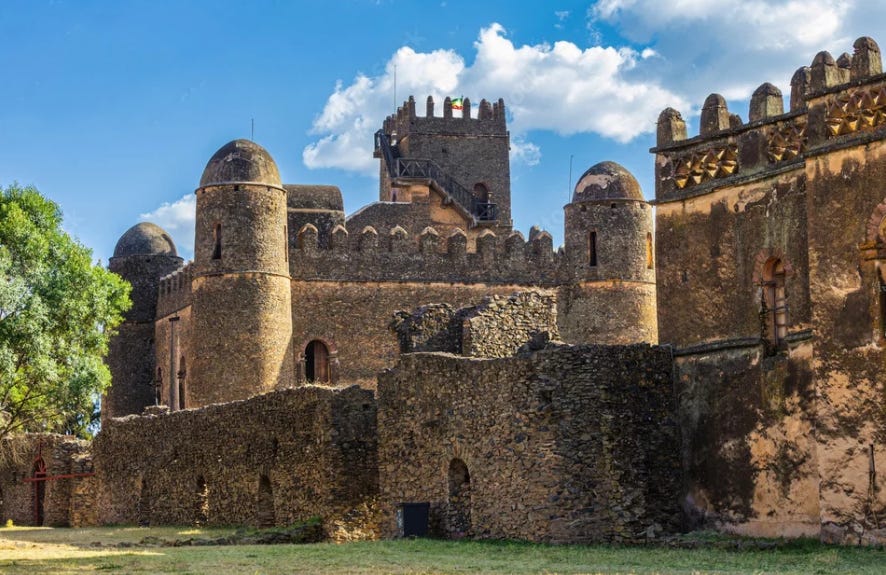
Fasiladas’ castle at Gondar, Ethiopia.
The term wängel zä-wärq (“Golden Gospel”) is widely used today to refer to the main Four-Gospel book of a church or monastery, and is thought to be linked to the practice of embellishing books in this way.
Such decorations were only used in a few manuscripts of exceptional importance, including those destroyed in the 16th century Adal invasion.81
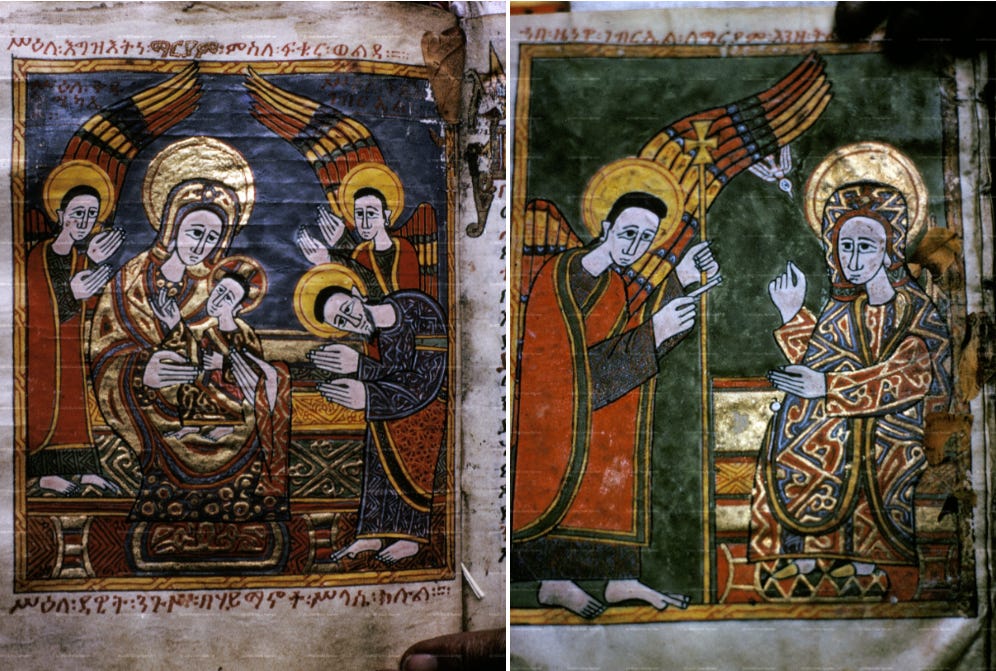
‘This famous manuscript, also called the Codex Aureus or Golden Codex due to its unusual use of gold leaf, was commissioned by King Dawit (r. 1379/80-1413) and was started on August 29 and completed on December 8, 1400.’ Images and Caption from PEMM.
Endowments and donations to churches, as well as fines, were made in gold dust.
An Ethiopian text referring to the reign of Zärʾa Yaʿǝqob (r. 1434-1468) mentions that the pious ruler built a church dedicated to the Virgin, and gave it so many precious liturgical utensils that access to it had to be monitored. He also bestowed 30 ecclesiastical vestments woven with gold, 7 ecclesiastical garments made of silk, 7 gold fans, and other valuable objects alongside 150 ounces of gold, 2000 oxen, and vast land to the monks of Däbrä Libanos.82
In the early 16th century, both Alvares and the Chronicler of the Ethiopia-Adal wars describe a church constructed by Na’od (r. 498-1508) and finished by Dawit II (r. 1508-1540), whose walls and doors were covered with gold and silver plating.83
In November 1730, Empress Mentewwab (d. 1773) granted land and thirty pieces of gold to the monastery of Qwärät’a Wälättä P’ét’ros. Among the principal landholdings of Mentewwab’s QwesQwam church was a land in Tegray called Dambila, which paid an annual tribute of twenty gold dinars.84

Empress Mentewab’s Banqueting Hall of the Dabra Sahay Qwesqwam complex, outside Gondar
Gold wealth and property.
Land sales, landholdings and other forms of property were valued in gold, among other currencies.
One of our earliest references to the sale and purchase of land dates to the 13th century. His hagiographer informs us that Emperor Lalibala “bought with his own gold” land on which he built the now famous rock churches of Lalibela.85
In a document concerning land sales dated to the reign of Emperor Takla Giyorgis I (1786-1800), it is reported that one Wayzaro Trengo, a woman of high birth, sold a third of her property for the then considerable sum of over 70 ounces of gold.86
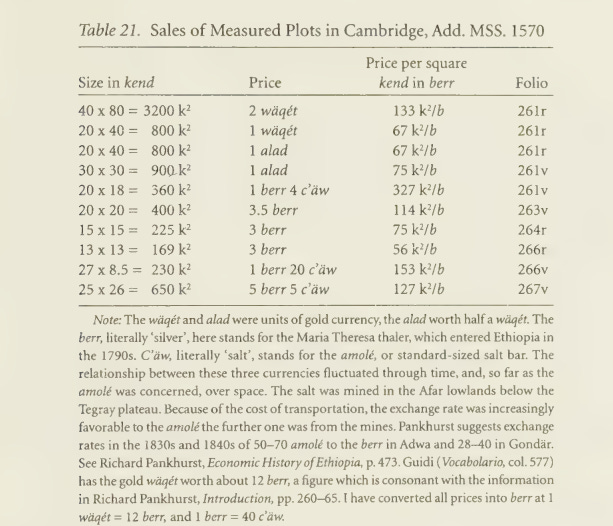
Sales of measured plots of Land in 18th century Ethiopia. Image by Donald Crummey
Documentation of such transactions wasn’t restricted to large estates of wealthy royals, but also includes smaller units of land held by non-elites, e.g., a sale of 11.5 fields for 5 ounces of gold in 1738, by a woman called Walatta Kessos, and in September 1740, the purchase of one-half of Selondis’s field [meder] in Qobla by Yashalaqa Takla Haymanot for 6 ounces of gold.87
Some of the private wealth in gold was at times deliberately concealed from both the public and the authorities.
According to Nathaniel Piece in 1810, an elderly woman whom he’d known as a travelling beggar “with scarcely a rag to cover her” gave her priest 82 wakeahs of gold (about $470,000 in current value) for her tezkar (memorial feast), a few hours before she passed away.
He adds that “when the inhabitants heard of her leaving so much money for the benefit of her soul, there were as many assembled at her cry in the market-place, as if she had been the daughter or wife of a king.”88
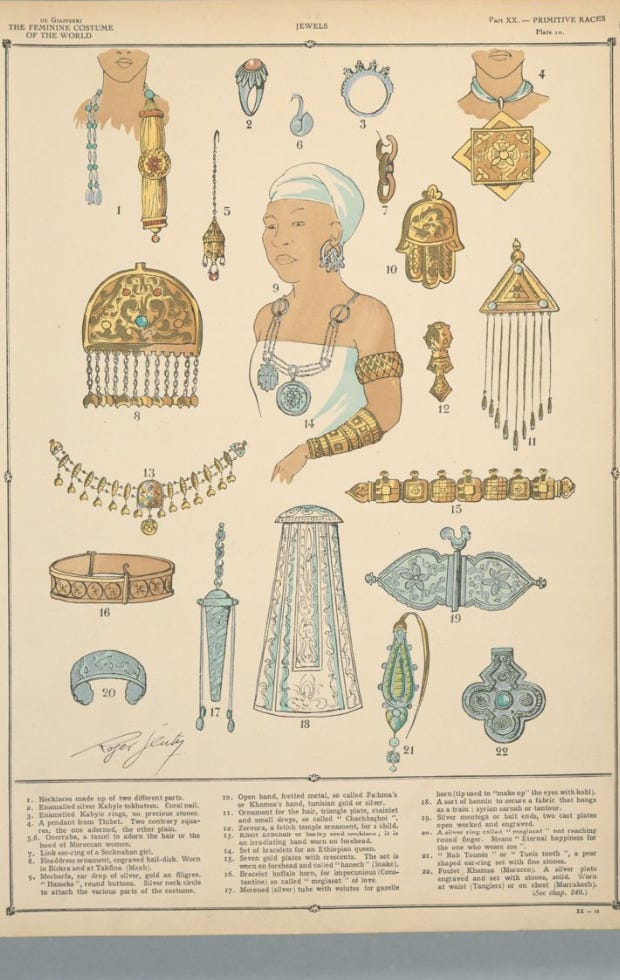
Jewellery of Ethiopia. from ‘The history of the feminine costume of the world’ by Paul Louis de Giafferri, 1926.
By the end of the 18th century, gold dust was largely replaced by imported silver coins known as the Maria Theresa Thalers (berr).
A record of land sales by a woman named Sanayt in the province of Bagémder in the early 1780s indicates the prices of at least two of the sales, one of them expensive at 7 ounces of gold, the other more modest at 17 berr.89
The Thaler was first minted in Austria in 1751 and re-struck many times thereafter to satisfy the demand for silver currency, particularly in those countries involved in trade along the Red Sea. It was the 1780-thaler that became the principal coin of choice. 1780 was the year Maria Theresa died, and all subsequent thalers carried this date.
Subsequently, most of the private wealth in the 19th century sources was valued in silver thalers, land, and cattle, rather than gold.
An example is Walda Sellase, a ruler of Tigray in the early 19th century, who is known to have accumulated considerable personal fortune.
At his death in 1816, he is said to have possessed 75,000 Maria Theresa dollars, 50 waqet, or ounces, of gold, and “a number of gold and silver ornaments,” besides 15,500 cows, 4,100 plough oxen and 1,730 ploughshares.90
By the time of Yohannes’ coronation in 1872, land purchases and donations to churches were made exclusively using thalers.91 Taxes from the various provinces that had been previously paid in gold began to be valued and remitted in silver thalers.92
Gold remained an important medium of exchange and store of wealth in Ethiopia well into the 20th century. The precious metal constituted a significant share of the revenues collected during the reign of Menelik II (r. 1889-1913), some of which was used to mint the first currency of the modern state.
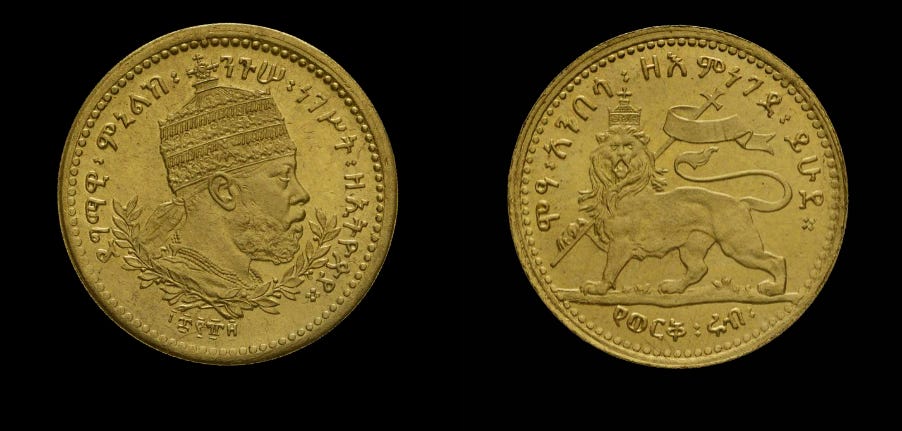
Gold coin of Menelik II, ca. 1889. British Museum. No. 1935,0401.9310
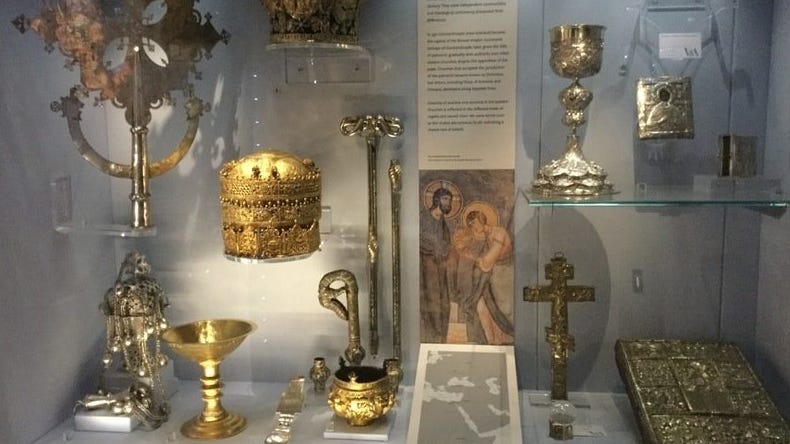
Ethiopian artefacts at the Victoria and Albert Museum, London.
Africa was a haven for religious minorities (“heretics”), political exiles, and other refugees from beyond the continent during Late Antiquity.
Recent discoveries of Zoroastrian constructions in Madagascar and Ibadi mosques along the East African coast provide archaeological evidence for the presence of religious minorities across the region, whose existence has until now been known primarily from written sources.
My latest Patreon article examines the history of these mixed communities of “pagans”, “heretics,” and foreign refugees in Africa from the 8th to the 13th centuries.
Please subscribe to read more about it here
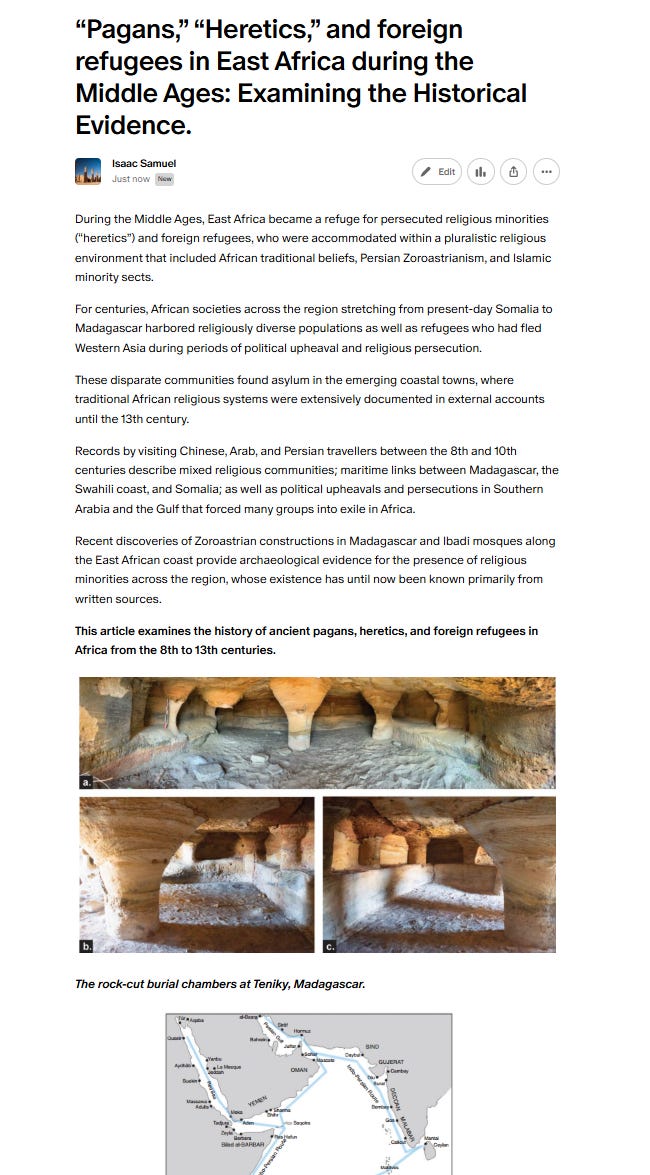
Maps by Matteo Salvadore and Habtamu Mengistie Tegegne, modified by author
Aksum: An African Civilisation of Late Antiquity, by Stuart C. Munro-Hay, pg 225, Foundations of an African Civilisation, by D. W. Phillipson, pg 134
Foundations of an African Civilisation: Aksum & the Northern Horn, 1000 BC-1300 AD, by D. W. Phillipson, pg 134-137
Foundations of an African Civilisation: Aksum & the Northern Horn, 1000 BC-1300 AD, by D. W. Phillipson, pg 137
Aksum: An African Civilisation of Late Antiquity, by Stuart C. Munro-Hay, pg 225, Foundations of an African Civilisation, by D. W. Phillipson, pg 154
Foundations of an African Civilisation: Aksum & the Northern Horn, 1000 BC-1300 AD, by D. W. Phillipson, pg 203
Economic History of Ethiopia: 1800-1935, by Richard Pankhurst, pg 47
Medieval Ethiopian Kingship, Craft, and Diplomacy with Latin Europe, by Verena Krebs, pg 130
In this particular segment of the account, 1 ouquia/waqet is worth eleven cruzados, a gold coin of 3.56 grammes (ie 1 waqet = 39 grammes), “it is already known that an ouquia weighs eleven cruzados.” see; ‘The Prester John of the Indies’ Volume I, pg 108, n.1. ‘The Prester John of the Indies’ Volume II, pg 426
However, later sources put the value at 37.44 grammes.
The Prester John of the Indies, edited by Beckingham and Huntingford, 1958, Vol II pg 426
The Prester John of the Indies, edited by Beckingham and Huntingford, 1958, Vol II, pg 448, n.1. Church and State in Ethiopia, 1270-1527 by Taddesse Tamrat, pg 104
The Conquest of Abyssinia By Shihāb al-Dīn Aḥmad ibn ʻAbd al-Qādir ʻArabfaqīh, Richard Pankhurst, pg 250-251
Economic History of Ethiopia: 1800-1935, by Richard Pankhurst, pg 184
Economic History of Ethiopia: 1800-1935, by Richard Pankhurst, pg 226-227
Economic History of Ethiopia: 1800-1935, by Richard Pankhurst, pg 185
Economic History of Ethiopia: 1800-1935, by Richard Pankhurst, pg 115-116, 118, 192-193
Some Records of Ethiopia (1593–1646). Being Extracts from The History of High Ethiopia or Abassia, published by the Hakluyt Society, 1954 pg 43, 85
Some Records of Ethiopia (1593–1646). Being Extracts from The History of High Ethiopia or Abassia, published by the Hakluyt Society, 1954 pg 86
Aksum: An African Civilisation of Late Antiquity, by Stuart C. Munro-Hay, pg 192, Foundations of an African Civilisation, by D. W. Phillipson, pg 182
Aksum: An African Civilisation of Late Antiquity, by Stuart C. Munro-Hay, pg 181
Aksum: An African Civilisation of Late Antiquity, by Stuart C. Munro-Hay pg 182
Foundations of an African Civilisation: Aksum & the Northern Horn, 1000 BC-1300 AD, by D. W. Phillipson, pg 183
Foundations of an African Civilisation: Aksum & the Northern Horn, 1000 BC-1300 AD, by D. W. Phillipson, pg 165
Foundations of an African Civilisation: Aksum & the Northern Horn, 1000 BC-1300 AD, by D. W. Phillipson, pg 55, 189, 192
A Companion to Medieval Ethiopia and Eritrea, edited by Samantha Kelly pg 415
A Companion to Medieval Ethiopia and Eritrea, edited by Samantha Kelly pg 419
Harari Coins: A Preliminary Survey by Ahmed Zekaria pg 23
Harari Coins: A Preliminary Survey by Ahmed Zekaria pg 24
The Conquest of Abyssinia: 16th Century, by Shihāb al-Dīn Aḥmad ibn ʻAbd al-Qādir ʻArabfaqīh, Richard Pankhurst, pg 177
Harari Coins: A Preliminary Survey by Ahmed Zekaria pg 24
Harari Coins: A Preliminary Survey by Ahmed Zekaria pg 26
First footsteps in East Africa, or, An exploration of Harar by Richard Burton, Vol II, published by Tylston and Edwards, 1904, pg 22-23
Some Records of Ethiopia (1593–1646). Being Extracts from The History of High Ethiopia or Abassia, published by the Hakluyt Society, 1954 pg 43
Did the gold of the Aksumites originate in Tigray? A report on ongoing research on local traditions of gold mining in Tigray by Wolbert Smidt.
Ancient Gold Working at Aksum by Laurel Phillipson
See response: Aksum: goldfield or vineyards? by J. E.G. Sutton
Economic History of Ethiopia: 1800-1935, by Richard Pankhurst, pg 227
Church and State in Ethiopia, 1270-1527 By Taddesse Tamrat, pg 26. Process of Ethnic Interaction and Integration in Ethiopian History: The Case of the Agaw by Taddesse Tamrat, pg 8-9
Silent Trade: Myth and Historical Evidence by P. F. de Moraes Farias
Aksum and Nubia. Warfare, Commerce, and Political Fictions in Ancient Northeast Africa, by George Hatke pg 54-57. Economic History of Ethiopia: 1800-1935, by Richard Pankhurst, pg 40-41
Gold, Slaves, and Trading Routes in Southern Blue Nile (Abbay) Societies, Ethiopia, 13th–16th Centuries, by Ayda Bouanga
Economic History of Ethiopia: 1800-1935, by Richard Pankhurst, pg 224
Economic History of Ethiopia: 1800-1935, by Richard Pankhurst, pg 224
Economic History of Ethiopia: 1800-1935, by Richard Pankhurst, pg 185
Economic History of Ethiopia: 1800-1935, by Richard Pankhurst, pg 227
Islam in Ethiopia: by J. Spencer Trimingham, pg 219
The Oromo of Ethiopia: A History, 1570-1860, by Mohammed Hassen, pg. 135-136
Journals of the Rev. Messrs. Isenberg and Krapf by Ludwig Krapf, Karl Wilhelm Isenberg, James MacQueen, published by Seeley, Burnside and Seeley, 1841 pg 150, 363
Journals of the Rev. Messrs. Isenberg and Krapf by Ludwig Krapf, Karl Wilhelm Isenberg, James MacQueen, published by Seeley, Burnside and Seeley, 1841 pg 363, 464, 484
The Prester John of the Indies edited by Beckingham and Huntingford, 1958, Vol 1, pg 187
The life and adventures of Nathaniel Pearce, Vol II, published by H. Colburn and R. Bentley, 1831, pg 11, 13
The life and adventures of Nathaniel Pearce, Vol II, published by H. Colburn and R. Bentley, 1831, pg 15
Life In Abyssinia Vol.1 by Mansfield Parkyns, published by John Murray, 1853, pg 405-406
A Companion to Medieval Ethiopia and Eritrea, edited by Samantha Kelly pg 420
The Prester John of the Indies Volume I, edited by Beckingham and Huntingford, pg 123-124
Economic History of Ethiopia: 1800-1935, by Richard Pankhurst, pg 261
Economic History of Ethiopia: 1800-1935, by Richard Pankhurst, pg 227
The Prester John of the Indies edited by Beckingham and Huntingford, 1958, Vol 1, pg 181
Economic History of Ethiopia: 1800-1935, by Richard Pankhurst, pg 264-265
Salt, Gold, and Legitimacy: Prelude to the History of a No-man’s Land, Belā Shangul, Wallaggā, Ethiopia (ca. 1800-1898) by Alessandro Triulzi, pg 194
Gold and Silver at the Crossroads in Highland Ethiopia by Raymond Silverman and Neal Sobania, pg 83
Aksum: An African Civilisation of Late Antiquity, by Stuart C. Munro-Hay, pg 235
The Ancient Red Sea Port of Adulis, Eritrea: Results of the Eritro-British Expedition, 2004-5, edited by D. P. S. Peacock, Darren Glazier, Lucy Katherine Blue pg 77
Les Harla : archéologie et mémoire des géants d’Éthiopie, by Amélie Chekroun et al, pg 83-84
Economic History of Ethiopia: 1800-1935, by Richard Pankhurst, pg 292. Medieval Ethiopian Kingship, Craft, and Diplomacy with Latin Europe, by Verena Krebs, pg 151, 206-211
A Social History of Ethiopia: The Northern and Central Highlands from Early Medieval Times to the Rise of Emperor Téwodros II, by Richard Pankhurst, pg 237
Gold and Silver at the Crossroads in Highland Ethiopia by Raymond Silverman and Neal Sobania, pg 92-95
Gold and Silver at the Crossroads in Highland Ethiopia by Raymond Silverman and Neal Sobania, pg 88
Foundations of an African Civilisation: Aksum & the Northern Horn, 1000 BC-1300 AD, by D. W. Phillipson pg 86, n. 35, 143. Matara: the Archaeological Investigation of a City of Ancient Eritrea by Francis Anfray
Economic History of Ethiopia: 1800-1935, by Richard Pankhurst, pg 254-6. A Social History of Ethiopia by Richard Pankhurst, pg 19
A Social History of Ethiopia: The Northern and Central Highlands from Early Medieval Times to the Rise of Emperor Téwodros II, by Richard Pankhurst, pg 25
Some Records of Ethiopia (1593–1646). Being Extracts from The History of High Ethiopia or Abassia, published by the Hakluyt Society, 1954 pg liv, The Oromo of Ethiopia: A History, 1570-1860, by Mohammed Hassen, pg 99
Aksum: An African Civilisation of Late Antiquity, by Stuart C. Munro-Hay pg 162. Some Records of Ethiopia (1593–1646). Being Extracts from The History of High Ethiopia or Abassia, published by the Hakluyt Society, 1954 pg 93, 96
Gold and Silver at the Crossroads in Highland Ethiopia by Raymond Silverman and Neal Sobania, pg 87
The life and adventures of Nathaniel Pearce, Vol II, published by H. Colburn and R. Bentley, 1831, pg 158
Economic History of Ethiopia: 1800-1935, by Richard Pankhurst, pg 308-309. Medieval Ethiopian Kingship, Craft, and Diplomacy with Latin Europe, by Verena Krebs, pg 194-196
The Conquest of Abyssinia by Shihāb al-Dīn Aḥmad ibn ʻAbd al-Qādir ʻArabfaqīh, Richard Pankhurst, pg 251, 290
Medieval Ethiopian Kingship, Craft, and Diplomacy with Latin Europe, by Verena Krebs, pg 201
Economic History of Ethiopia: 1800-1935, by Richard Pankhurst, pg 102
Economic History of Ethiopia: 1800-1935, by Richard Pankhurst, pg 151
A Companion to Medieval Ethiopia and Eritrea, edited by Samantha Kelly pg 302
Medieval Ethiopian Kingship, Craft, and Diplomacy with Latin Europe, by Verena Krebs, pg 202
The Conquest of Abyssinia By Shihāb al-Dīn Aḥmad ibn ʻAbd al-Qādir ʻArabfaqīh, Richard Pankhurst , pg 220. The Prester John of the Indies edited by Beckingham and Huntingford, 1958, Vol II, pg 332-333.
Land and Society in the Christian Kingdom of Ethiopia: From the Thirteenth to the Twentieth Century By Donald Crummey pg 105, 108
Land and Society in the Christian Kingdom of Ethiopia: From the Thirteenth to the Twentieth Century by Donald Crummey pg 183
A Social History of Ethiopia: The Northern and Central Highlands from Early Medieval Times to the Rise of Emperor Téwodros II, by Richard Pankhurst, pg 114
Land and Society in the Christian Kingdom of Ethiopia: From the Thirteenth to the Twentieth Century by Donald Crummey pg 185
The life and adventures of Nathaniel Pearce, Vol II, published by H. Colburn and R. Bentley, 1831, pg 270-271
Land and Society in the Christian Kingdom of Ethiopia: From the Thirteenth to the Twentieth Century, by Donald Crummey, pg 166, 195
A Social History of Ethiopia: The Northern and Central Highlands from Early Medieval Times to the Rise of Emperor Téwodros II, by Richard Pankhurst, pg 170
Land and Society in the Christian Kingdom of Ethiopia: From the Thirteenth to the Twentieth Century, by Donald Crummey, pg 212, 221
A Social History of Ethiopia: The Northern and Central Highlands from Early Medieval Times to the Rise of Emperor Téwodros II, by Richard Pankhurst, pg 297, 299, 301. Ethiopian Taxation Prior to the Time of Menilek : A Collation and Analysis of Estimates , Part II,, by Richard Pankhurst
👍🏿👍🏿👍🏿
The Lust_For_Gold -- is endemic .... replete with all the vagaries we still see today, and on the back of millions who suffered for it --- at home !