

Writing systems were independently invented multiple times across several ancient civilizations, with the earliest evidence coming from Mesopotamia, Egypt, China, and Meso-America between the 4th and 1st millennium BC.
In the western half of the Old World, historical inquiry on the development of writing systems primarily focuses on the Egyptian writing system, from which most of the world’s alphabetic scripts originated.
The oldest securely attested alphabetic inscriptions were discovered at the Wadi el-Hol site in Egypt ca. 1900-1800 BC; these were largely influenced by concepts and signs borrowed from Egyptian hieroglyphs.
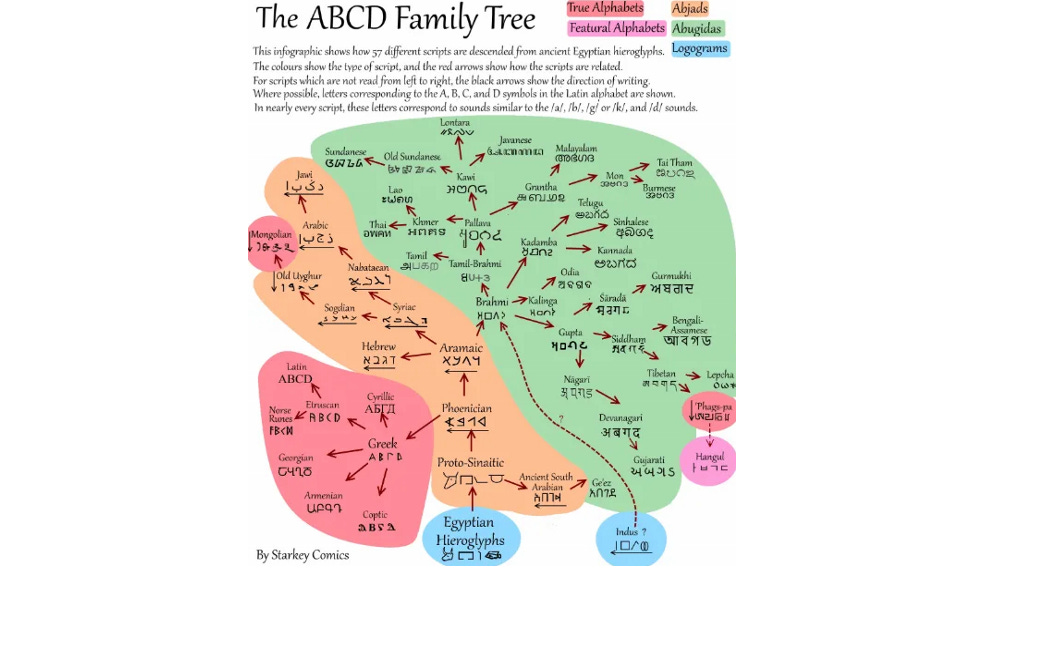
This early alphabetic script, called Proto-Sinaitic, branched into the South Arabian, Phoenician, Aramaic, Greek, Latin, Arabic, and numerous other scripts with varying degrees of modification between the late 2nd and mid 1st millennium BC.1
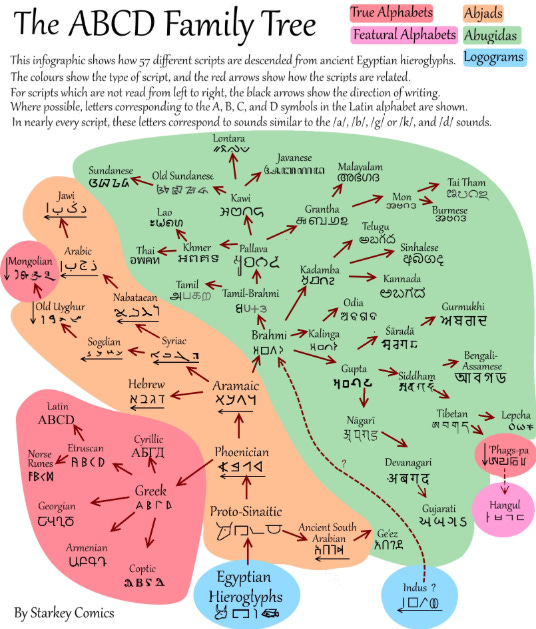
The ABCD Family Tree by Ryan Starkey
Support African History Extra by becoming a member of our Patreon community, subscribe here to read more about African history, download free books, and keep this newsletter free for all:
Despite the widespread adoption of the alphabetic scripts, several writing systems existed independently in the same region.
Some of these scripts, such as the Sumerian Cuneiform and its variants, as well as the Aegean Scripts, were developed before the adoption of the alphabetic scripts, and later abandoned after the adoption of the latter. Others, such as the Brahmic scripts, were developed after the spread of the alphabetical writing systems, and some remain in use today.
Focusing on the African examples, the alpha-syllabic scripts of Ge’ez and Meroitic, and the Libyco-Berber alphabet were developed in the late 1st millennium BC by local scribes who had been in contact with older writing systems, such as South Arabian (for Ge’ez), Demotic-Egyptian (for Meroitic), and Phoenician-Punic (for Libyco-Berber).
However, these writing systems were not directly derived from their presumed “parent” scripts, but were essentially endogenous creations inspired by foreign examples. These new scripts were used concurrently with the older scripts, and in some cases came to displace them entirely.
For example, the use of the Libyco-Berber script begun in the 6th century BC during the Carthaginian period, but it employed different signs from Punic and didn’t undergo an intermediate stage. The existence of bilingual Libyan–Latin inscriptions from the Roman period, suggests that the script functioned as a marker of identity for the native Berber-speaking populations.
Most surviving inscriptions are short texts, such as funerary or commemorative engravings, though a few appear in more formal contexts. It fell out of use shortly after the Arab conquest of North Africa in the 7th-8th century CE, but survived in the central Saharan area, where it is known as Tifinagh/Tifinaɣ.2
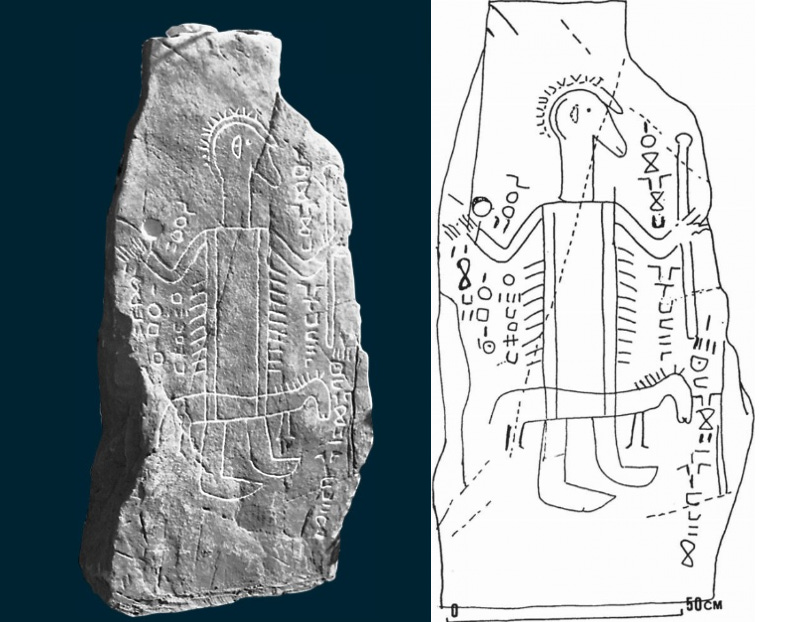
The Kerfala stele, Algeria. ca. 1st century BC-2nd century CE. Museum of Antiquities in Algiers. Figure holding a “chief’s staff”, horse near the base of the legs, engravings in the Libyco-Berber alphabet.3
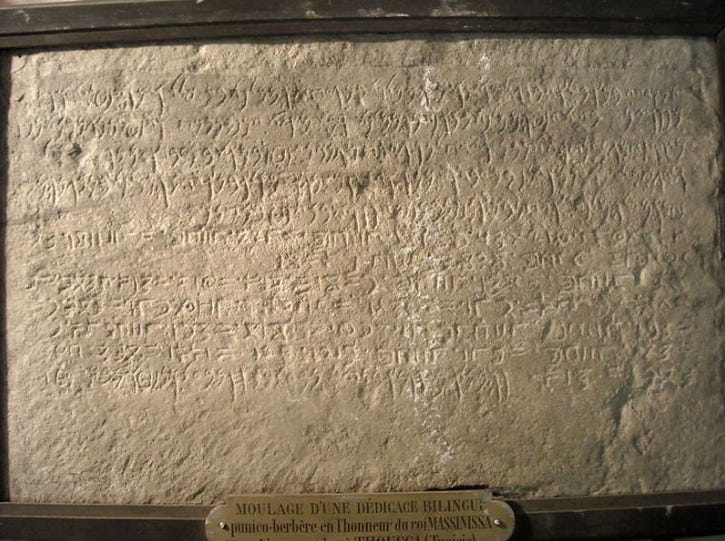
Cast of the bilingual Punic-Lybian inscription from Dougga,Tunisia. The first 5 lines in Punic, the remainder in Lybian. Louvre Museum. late 2nd century BC, dedicated to King Massinissa.
The Meroitic script of Kush (Sudan) was developed in the 3rd century BC as an alpha-syllabary, diverging from the mixed logographic-consonantal system of Demotic and Egyptian hieroglyphs. The Meroitic hieroglyphic signs in turn originated from the cursive script, rather than from their Egyptian counterparts.
Majority of the 2,000 extant Meroitic texts that include royal chronicles, funerary inscriptions, and engravings, were written in cursive. A few brief Egyptian hieroglyphs found in royal funeral contexts indicate that the older writings systems also remained in use.
The Meroitic script was discontinued in the 5th century CE, after the fall of ancient Kush and the rise of medieval Nubian kingdoms. These sucessor states developed their own writing system called Old Nubian, that was largely based on the alphabetical Greek and Coptic scripts, with a few Meroitic signs.

Stele of prince Tedeqene displaying both scripts; Merotic hieroglyphs of the invocation of Osiris and cursive writing for the invocation of Isis. ca. 200–100 B.C, Beg W, pyramid 19, Meroe, Sudan. Boston Museum of Fine Arts.

Royal stela of Queen Amanirenas and King Akinidad, ca. 1st century BC, Hamdab, Sudan. British Museum.
The Ge’ez script is named after the language of the Aksumite kingdom (in Ethiopia and Eritrea), of which two scripts were employed for writing around the 2nd-3rd century CE.
The first was the so-called ‘ASAM’ script [Ancient South Arabian Monumental], which closely replicated the South Arabian script used in the pre-Aksumite period (mid-1st millenium BC). The second is the ‘Ethiopic’ script which is more closely related to that used in extant Ge‘ez manuscripts found across Ethiopia and Eritrea.
Both scripts appear in royal inscriptions, but only ‘Ethiopic’/Ge’ez was used for other media such as manuscripts and engravings. In addition, a number of royal inscriptions and many early Aksumite coins include Greek inscriptions, indicating the coexistence of multiple writing systems within Aksumite society.4
The Ge’ez writing system was retained long after the fall of Aksum, and remains the main writing system of modern Ethiopia and Eritrea.

Ge’ez Manuscript: ‘Harp of Praise’, 16th century, Ethiopia. Berlin State Library.
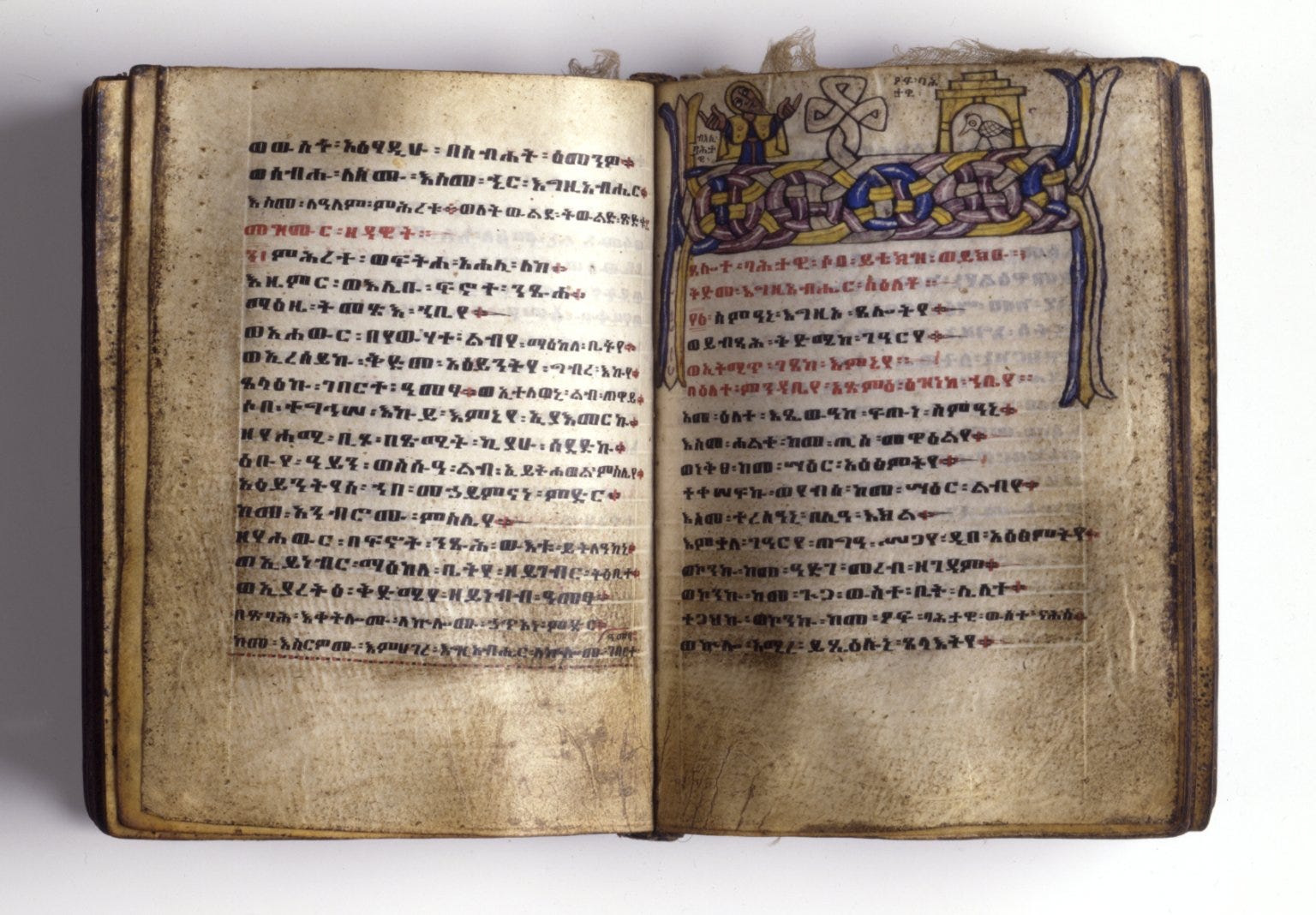
Ge’ez Psalter: Psalms of David and Miracles of Mary. 19th century, Brooklyn Museum.
In West Africa, archaeological evidence suggests that the Nsibidi script was developed independently following a long evolutionary sequence from the 6th century CE.
It’s a semasiographic script, whose symbols represent concepts or ideas directly, as opposed to the more common glottographic systems listed above, which represent linguistic units.
Nsibidi was mostly used in private/esoteric contexts, and ocassionally in more public settings like recording court proceedings, as well as in various forms of visual display, including engravings, body markings, and textiles. A handful of Nsibidi manuscripts were also written by formerly enslaved Africans in Cuba.

Nsibidi symbols on an Igbo or ibibo fan, ca. 1859. National Museums Scotland
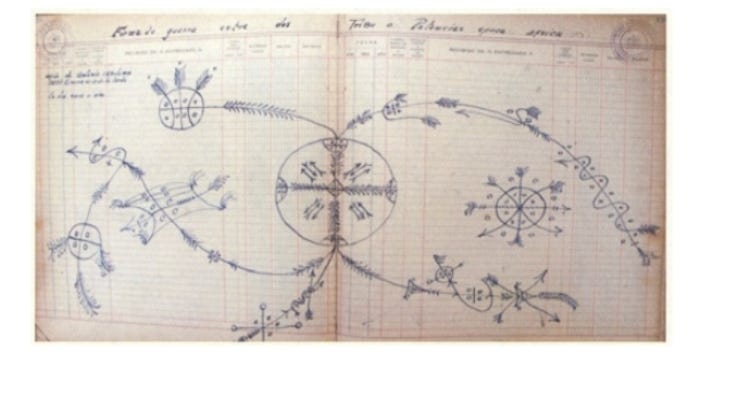
Nsibidi Manuscript written in 1877 by an Abakua society member in Cuba, private collection
The bulk of the surviving written material from West Africa, and across much of the continent since the Middle ages, utilized the Arabic script and its Ajami variants, to produce the vast manuscript collections found in Timbuktu to the East African coast.
In other parts of the continent, the Latin script was adopted by a variety of societies, from west-central Africa (Kongo and Cahenda in Angola), to the West African coast ( Warri in Nigeria).
The coexistence of multiple writing systems in West Africa (Tifinaɣ, Nsibidi, Arabic, and Latin), influenced the invention of new scripts, through the same endogenous processes that had resulted in the creation of the Ge’ez, Meroitic, and Libyco-Berber scripts.
The development of these later scripts often involved local innovation inspired by contact with existing literate traditions rather than simple borrowing or imitation.
Few regions of the world rival West Africa for the sheer scale, diversity, and dynamism of its indigenous writing traditions. Between the 19th and 20th centuries, at least 27 scripts were invented in the region extending from Senegal to Cameroon, the oldest of which are the Vai script of Liberia (ca. 1833-present) and Njoya’s script (1897-1931) of the Bamum kingdom in Cameroon.5
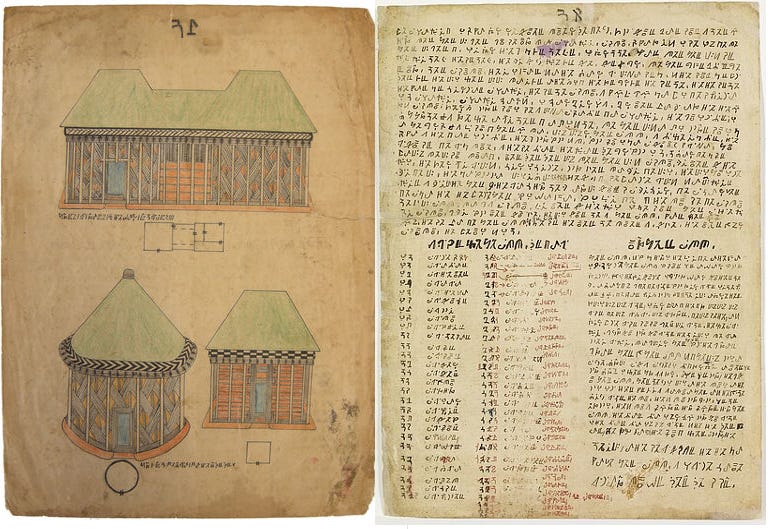
Drawings of Houses and House plans with description of their construction written in the Bamum script, attributed to Ibrahim Tita Mbohou, early 20th century, Quai Branly.
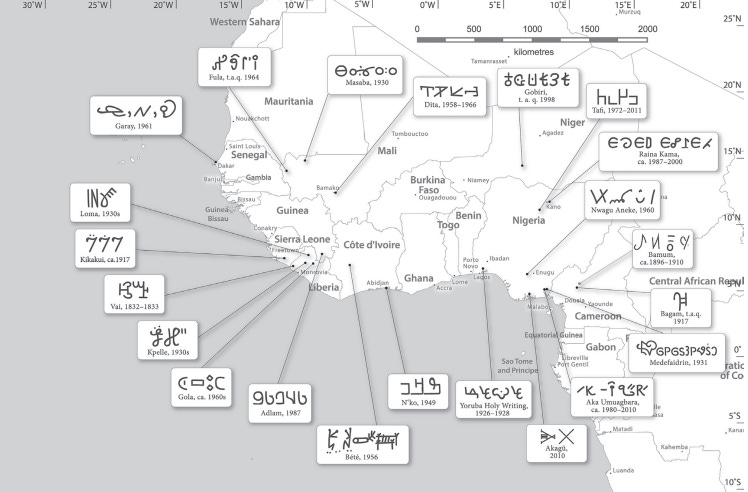
West African script invention, ca. 1832-2011. Map by Piers Kelly
While these were mostly syllabic scripts rather than the consonantal/alphabetical scripts of Arabic and Latin, historical traditions indicate their creators were prompted to develop their own writing systems to enhance their prestige and assert their identity in a competitive political landscape.
This “creative tension” is made explicit in the historical traditions regarding the inventors of the Vai script, who challenged themselves to write letters as good as the intelligent “poro” (foreigners). The Vai emphatically maintain that “There are three books in this world—the European book, the Arabic book, and the Vai book.”6
Nearly 1,000 years before this, the adoption of the Arabic script in west Africa was prompted by similar internal processes, but in reverse.
The presence of Tifinaɣ engravings in what is today North-Eastern Mali during the late 1st millennium CE, prompted local Muslim converts to inscribe the landscape with the Arabic script, as a way to display their identity and mark their ascendancy.
Historians and Archaeologists have long observed that West Africa’s earliest texts in the Arabic script come from precisely the same areas where older Tifinaɣ engravings were found. In some cases, both scripts were written side by side, suggesting that the adoption of Arabic writing did not entirely displace earlier writing traditions.
From 1103 to 1489 CE, hundreds of funerary inscriptions and engravings were produced in the medieval sites of Essouk, Junhan, Gao, and Kukyia, in what is today eastern Mali.
This epigraphic corpus consists of inscribed royal tombstones, engravings and stelae made of marble and chloritic schist, some of which are impressively carved in ornamental Kufic.
These inscriptions are a unique register of internal historical evidence, and the only extant body of dateable medieval texts written in medieval West Africa.
They document the emergence of kingship in the region, the presence of Queen regnants who ruled with full authority, the complex ethnic landscape of medieval West Africa, and the origin of aristocratic titles which were adopted by the imperial administration of Songhai.
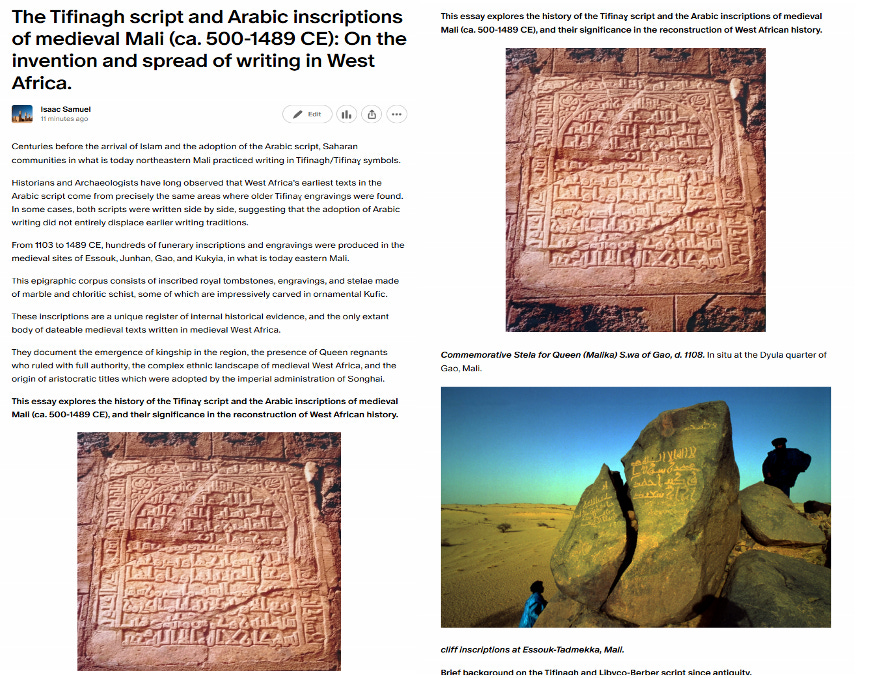
My Latest Patreon article explores the history of the Tifinaɣ script and Arabic inscriptions of medieval Mali (ca. 500-1489 CE), and their significance in the reconstruction of west African history.
Please subscribe to read about it here and support this newsletter:
There are many historical works that examine the origin of the ancient alphabet. A useful introduction for its relationship to the ancient Egyptian writing systems, is : Hieroglyphs, Pseudo-Scripts and Alphabets: Their Use and Reception in Ancient Egypt and Neighbouring Regions By Ben Haring, 2023.
Libyque : écriture et langue by S. Chaker, pg 4395-4409, In ‘Encyclopédie berbère, 28-29’. 2008.
Kerfala (stèle libyque) by P. Salama pg 4148-4157
Foundations of an African Civilization: Aksum & the Northern Horn By D. W. Phillipson pg 51-65
The invention, transmission and evolution of writing: Insights from the new scripts of West Africa, by Piers Kelly, In ‘Paths into Script Formation in the Ancient Mediterranean’ edited by S. Ferrara and M. Valério
The psychology of literacy by Sylvia Scribner pg 31
Thank you for including Nsibidi in this matrix! I have heard estimates that Nsibidi was over 10,000 years old by some accounts so I was fascinated to learn how it fits into the timeline!
I don't know where or how you gather this amount of information from for us but I'm very grateful that you do 🙏🏾