

In 1845, the abolitionist Frederick Douglass observed that American slaveholders appealed to the biblical claim that ‘God cursed Ham’ as a theological justification for slavery, an argument he rejected as fundamentally unscriptural.
At the time of his writing, the so-called “curse of Ham,” which had for centuries provided religious sanction for the exploitation of African labour, was being supplanted by the pseudo-scientific ‘Hamitic hypothesis’ in which a civilizing “caucasiod” race migrated to Africa and founded its ancient civilizations.
Both versions are now recognized and dismissed as myths by most professional scholars. However, their ideological remnants are still found in popular literature concerning ancient Egypt and West Africa, and they directly influenced the racial ideologies that led to the Rwandan Genocide.
While existing scholarship on the Hamitic myth emphasizes its external intellectual origins, from Jewish and Muslim writers to European colonialists, written sources produced by African scholars indicate that the story of Ham had already been adopted in different forms across the continent since the medieval period.
This essay examines the Hamitic myth from the African perspective, outlining the use (and misuse) of the story of Ham in both its religious and pseudo-scientific versions by African scholars since the late Middle Ages.
Support AfricanHistoryExtra by becoming a member of our Patreon community, subscribe here to read more about African history, download free books, and keep this newsletter free for all:
A brief background on the Hamitic myth from ancient Israel to late medieval Europe.
The original version of the idea of the “Hamites” derives from the Old Testament, in the story of the dispersal of the sons of Noah after the Flood in Genesis 9-10. In this account, Noah had three sons called Shem, Japhet, and Ham, who were held to be the ancestors of the various peoples known to the ancient Israelites.
In the story, Noah’s curse is directed (not very logically) specifically against Canaan, the son of Ham, because his father had found Noah lying drunken and naked. Shem and Japheth receive their father’s blessing, while Canaan is to be the slave of each of them. Genesis proceeds with the Table of Nations (10:1–32), according to which Ham’s first three sons, Cush, Egypt, and Put, live on the African continent (10:6–20), while his fourth son, Canaan, has two sons in western Asia; Heth (Hittites from Asia Minor) and Sidon (the Phoenician coastal cities)1
The biblical account of Noah’s curse is very clear about who was cursed. Although it was Ham who behaved improperly, it was not Ham whom Noah cursed, but rather his son Canaan. Why Canaan was cursed if it was Ham who sinned is a question that has been debated for well over the past two thousand years.
Scholars who study the Hebrew myths of Genesis argue that the curse was intended to justify the Israelite occupation of eastern Palestine and the dispossession and subjection of the indigenous Canaanites.2
Despite the Bible’s explicit statement, we find writers who claim that although the curse was pronounced against Canaan, it affected Ham and all of his children, hence “the curse of Ham.”
The Roman-Jewish author Philo (d. 50 AD) was the first to make a false etymological claim connecting the name Ham with ‘heat’, ‘darkness’, and “sin”. He allegorizes the “blackness” of the Ethiopians as evil, suggests that Nimrod’s bad character was because he was one of the grandsons of Ham through Kush, and claims that Canaan was punished because he acted upon the evil thoughts of his father. His interpretation was followed in Rabbinic and early Christian literature by scholars such as Origen (d. 253), who elaborated on the allegory of Noah’s curse, “blackness”, sin, and slavery.3
This early literature, in turn, greatly influenced several Western-Christian and Muslim scholars as early as the 7th century, as explored in greater detail by the historian David Goldenberg.4
While the writings associating the biblical Ham or his descendants with “blackness” may have initially been figurative, they soon came to be linked with all dark-skinned people, including both Africans and non-Africans.
The genealogies were often confused, at times having Canaan as father of Kush (instead of his brother), and drawing from older, non-biblical sources, such as the 2nd century BCE scholar Eupolemus, who recounts a Babylonian myth about “Canaan, the father of the Phoenicians. To him was born a son, Chum, whom the Greeks called Asbolus [literally, ‘soot’], the father of the Ethiopians and the brother of Mestraeim, the father of the Egyptians.”5
It’s from such sources that both Rabbinical (Jewish) and Muslim authors extend Canaan’s descendants to include other dark-skinned African peoples, in a way that contradicts modern/Eurocentric racial categories.6
To cite a few examples, Ibn Qutayba (d. 889) groups the Nuba, the Zanj [East Africans], the Zaghawa [Chad], and the Habasha, together with the Qibt [Egyptian-Copts], the Barbar [Berbers], and the people of “the land of Hind and Sind.”7 Eutychius, the Alexandrian Melkite patriarch (d. 940), specifies that the “blacks” who received the curse of Ham included “the Egyptians, the Sudan, the Abyssinians [Habash], the Nubians, and the Barbari.”8 Muḥammad al-Kisāʾī (ca. 1100 CE) includes the “Berbers and Sind and Hind” among the other African groups in the list of the children of Ham.9 As late as 1526, the Maghrebian scholar Leo Africanus argued for a common origin of all Africans.
Medieval Islamic scholars inherited two principal ideas about the differences in human populations from classical sources. The first came from the ancient environmental theory that explained the differences between societies in each “clime” (latitudes), and the second were the Old Testament stories about Noah’s sons Shem, Japheth, and Ham.
As with all theories, both could be used to justify the political hierarchies between different groups and societies.
For example, the Arab sociologist Ibn Khaldun (d.1406) argued against the notion that blackness is related to descent from Ham:
“Some genealogists who had no knowledge of the true nature of beings imagined that the **blacks are the descendants of Ham, the son of Noah, and that they were characterized by black color as a result of a curse put upon him by his father, which manifested itself in Ham’s color and the slavery that God inflicted upon his descendants....
The curse of Noah upon his son is there in the Torah. No reference is made there to blackness. His curse was simply that Ham’s descendants should be the slaves of his brothers’ descendants. To attribute the blackness of the sūdān to Ham, shows disregard for the nature of heat and cold and the influence they exert upon the air and upon the creatures that come into being in it.”
For Ibn Khaldun, the explanation of physical difference lay in the Mediterranean-centered theory of climes. However, his explanations were no less disparaging for most of the people of the sūdān and ‘Slavs’ in the northernmost latitudes, with exceptions granted to Muslim kingdoms like Mali or Christians like Abyssinia/Ethiopia.10
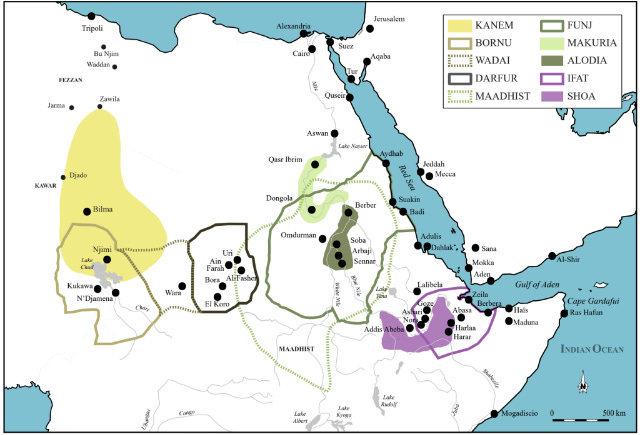
Some of the kingdoms of North-East Africa. Map by S. Pradines, modified by author
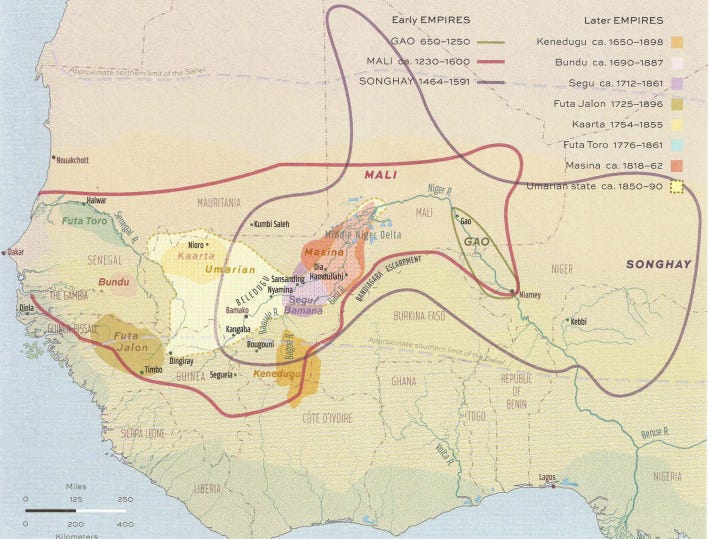
Some of the empires of medieval West Africa (sūdān). Map by Alisa LaGamma
[**It should be noted here that most medieval Islamic writers didn’t have our modern/Eurocentric concept of “black” nor ‘Sub-Saharan Africa’, but instead used specific ethnonyms for different African groups based on their places of origin. As Ibn Khaldun explains, “The inhabitants of the first and second zones in the south are called Abyssinians, the Zanj and the Sudan. The name Abyssinia however is restricted to those who live opposite Mecca and Yemen, and the name Zanj is restricted to those who live along the Indian Ocean.”11 ]
As mentioned earlier, most Arab writers attributed Hamitic origins to both the Imazighen (Berbers) of North Africa and the sūdān of West Africa, both of whom suffered equally from the curse of servitude to the descendants of Noah’s other sons because of Noah’s curse on Ham’s son Canaan.
Among the consequences of Arabization in the Maghreb and later in West Africa was a repudiation of this idea among the Imazighen. Several alternatives were proposed, including the idea that the Imazighen were the descendants of purported pre-Islamic Yemeni (Himyarite) colonists.
When ideas about race emerged in these regions, local intellectuals insisted that patrilineal relationships to Arab ancestors, regardless of their current skin color, rendered them Muslim bidān (**white) in opposition to the ‘non-Muslim’ sūdān (black).12
[**It’s important to note that these “white” vs “black” categories don’t exactly match our modern/Eurocentric notions of race, since “white” people from Europe are in these regions called Faranj/Nasara (ie, Frankish/Christian), while many “bidān” would in fact be considered “black” in the West.]
According to Ibn Khaldun, the Himyarite claims made by the Imazighen, which were accepted by historians like al Tabarī, al-Jurjanī, and al-Masʿudī, were all false:
“All this information is remote from the truth. It is rooted in baseless and erroneous assumptions. It is more like the fiction of storytellers.” The important issue at stake in these Himyarite stories is precisely the ability of certain Berber intellectuals to claim Semitic origins back to Noah’s son Shem, rather than accept that they are sons of Ham.13
Interestingly, the Maghrebian scholar Leo Africanus, in 1526, stressed to his European readers that both “white and black Africans have almost the same origin. Even if they descended from the Philistines, the Philistines also originated from Mizraim, son of Cush. If they come from Sheba, Sheba was the son of Raamah, and Raamah was the son of Cush. The Egyptians, according to the scripture of Moses, descend from Mizraim, son of Cush, son of Ham, son of Noah.”14
Muslim theories about Africa’s genealogical unity did little to sway European writers at the time of the “discovery” of the New World, who were seeking to justify the mass enslavement of ‘black’ Africans.
According to the version of the Hamitic myth by the Portuguese scholar Gomes Eannes de Azurara (d. 1474), in service to Prince Henri the Navigator:
“[B]lacks were Moors like the others, though their slaves, in accordance with ancient custom, which I believe to have been because of the curse which, after the Deluge, Noah laid upon his son Cain.”15
There was clearly little regard for the accuracy of the Biblical account on whether the recipient of the curse was Canaan, Ham, or Cain; what mattered more was the rationale for enslaving others based on race.
The myth of Ham, according to medieval African scholars
African scholars from societies that had adopted Christianity and Islam during the Middle Ages, such as Aksum/Ethiopia and the empires of West Africa, also adopted the historical framework of the peopling of the world by the dispersal of the descendants of Noah after the Flood.
In medieval Ethiopia, the kəbrä nägäst (‘Glory of the Kings’), which was composed in the 13th/14th century but includes older material from the 6th century16, Noah blesses Shem and instructs both Ham and Japhet to be servants and subjects of Shem:
“And to Ham he said, “Be servant to thy brother.” And he said unto Japhet, “Be thou servant to Shem my heir, and be thou subject unto him.”
Canaan is only described as a tyrant who “seized seven cities that belonged to SHEM’S children, but eventually had to relinquish them.”17
The kəbrä nägäst is mostly an account of the visit by Makeda, Queen of Sheba, to King Solomon of Israel, the birth of their son Menelik I, and of the latter’s subsequent appropriation of the Ark of the Covenant, which he brought to Ethiopia. It therefore includes sections indicating how Noah’s blessings and curses were later interpreted.
In one section about the daughter of the Pharaoh attempting to seduce King Solomon, the former admonishes Solomon for marrying the ‘black’ Ethiopian queen Makeda, and for letting Menelik carry away the Tabernacle (Lady Zion) containing the Ark of the Covenant, to which Solomon responds that the Egyptians also belong to the “race of Ham”18
And she answered and said unto him, “Thy son hath carried away thy Lady ZION, thy son whom thou hast begotten, who springeth from an alien people into which God hath not commanded you to marry, that is to say, from an ETHIOPIAN woman, who is not of thy colour, and is not akin to thy country, and who is, moreover, black.”
And SOLOMON answered and said unto her, “Though thou speakest thus art thou not thyself of [that race] concerning which God hath not commanded us that we should take wives from it? And thy kin is her kin, for ye are all the children of HAM. And God, having destroyed of the seed of HAM seven kings, hath made us to inherit this city, that we and our seed after us may dwell therein for ever. And as concerning ZION, the will of God hath been performed, and He hath given her unto them so that they may worship her.”
The phrase “thy kin is her kin” indicates that both the rulers of Egypt and Ethiopia were considered children of Ham at the time of Solomon, and the text’s composition.
According to the Kebra Nagast, while the kingdom of Rome “was the portion and dominion of Japhet, the son of Noah,” the Roman ruler arranged for his daughter to marry Solomon. Their son, Adrami, became king of Rome, while his older brother, Menelik I, reigned in Ethiopia. Solomon then declared that “The people of Israel have taken the kingdom of Ethiopia and the kingdom of Rome.”19
This was written long after the Roman conquest of Judea and the Aksumite destruction of the Jewish kingdom of Himyar by Kaleb, who, in the text, met with the Byzantine Emperor Justin I (518–27) in Jerusalem to divide the world. The political rationale of the text is self-evident.20
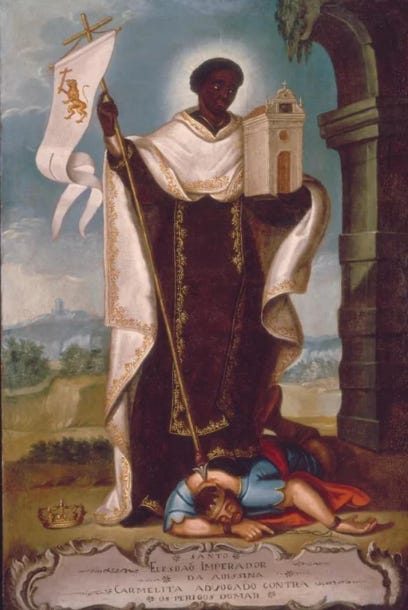
“Saint Elesbaan having slaughtered Evil.” Oil on Canvas, 110 x 75 cm. Arouca, Museu de Arte Sacra. 18th-century anonymous Portuguese painting depicting King Kaleb (also known as Saint Elesbaan) defeating the Himyarite king Dhu Nuwas
The Kebra Nagast describes every kingdom as belonging to Shem, including Babylon, Persia, Moab, and Amelek. Isaac, the legitimate son of Abraham and predecessor of Solomon, is said to have ruled over many kingdoms, including Judah, Babylon, and Ethiopia. Even the kingdoms ruled by the children of Ishmael (Abraham’s illegitimate son) were counted among “the seed of Shem”, including Noba and Soba (Nubia), as well as Maka (Mecca in Arabia).21
This was reportedly according to God’s will: “For as God sware He gave all kingdoms to the seed of Shem … and slavery to the seed of Ham, and the handicrafts to the seed of Japhet.”22 However, Kebra Nagast says nothing about the descendants of Ham or Japhet, and none of the kingdoms are said to belong to them, since they were all ruled by the descendants of Shem.
In the Kebra Nagast, the three continents of Europe, Africa, and Asia are exclusively ruled by the descendants of Shem, contrary to the more popular medieval theory that Europe was ruled by the children of Japhet, Africa by the children of Ham, and Asia by the children of Shem.
‘Internal’ slavery in Ethiopia and the Hamitic myth
Medieval Ethiopian legal texts such as the Fetha Nägäst (Law of Kings), which was composed in the 13th/15th century, do not use the curse of Noah as the basis for enslavement, attributing it instead to war.
According to the Fetha Nagast: “[The state of Liberty is in accord with the law of reason, for all men share liberty on the basis of natural law. But war and the strength of horses bring some to the service of others, because the law of war and of victory rendered the vanquished slaves of the victors.”23
Texts concerning slavery, such as the edict of King Gälawdéwos, which was issued in 1548, make it clear that protections against enslvaement were granted to his Christian subjects, and that enslavement could only be justified if the captive was non-Christian.24 There’s no mention of the Hamitic myth to rationalise enslavement, despite the influx of Ethiopian slaves during this time and the influences of the Portuguese and Ottomans across the region.
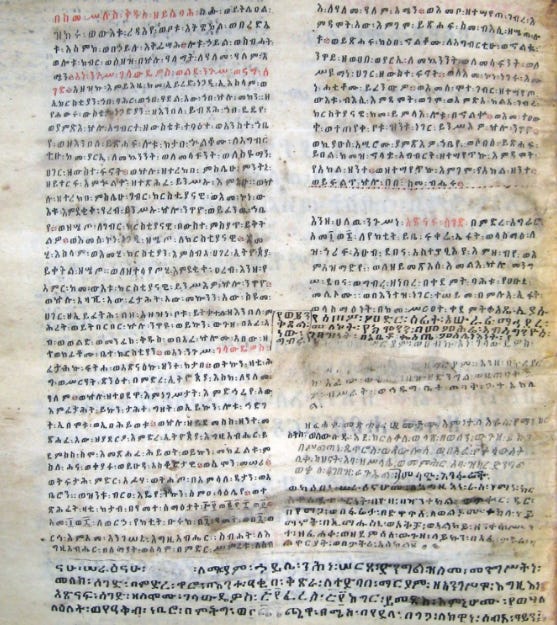
The Edict of Gälawdéwos in situ at the Tädbabä Maryam church, Ethiopia. “If the seller who [knowingly] sold a Christian is a merchant, whether he be Muslim or a Christian Ethiopian compatriot, let them kill him.” (see: Anti-slavery laws and Abolitionist thought in Ethiopia during the 16th and 17th centuries. )
By the late 19th century, Ethiopian traditional histories concerning Noah’s sons shifted away from the monarchical unity of Shem, towards the more popular theory that Abyssinians are descended from Ham.
According to a manuscript obtained by Enno Littmann from a priest in Tigray in 1906: “Ham begot Kush, Kush begot Aethiopis, after whom the country is called Aethiopia to this day. Aethiopis was buried in Aksum and his grave is known there to this day. Aethiopis begot ‘Aksumawi, ‘Aksumawi begot Malakya ‘Aksum, and begot also Sum, Nafas, Bagi’o, KudukI, ‘Akhoro, Fasheba. These six sons of ‘Aksumawi became the fathers of Aksum.”25
The theory of natural liberty and the absence of the ideological link between “Ham” and slavery may explain why the Hamitic theory retained its more classical version in Ethiopia.
Ideas about the enslaved ‘Hamite’ appear to have been introduced much more recently in the 20th century. Interviews of Ethiopian immigrants living in Israel, who included formerly enslaved groups from Gummuz (western Ethiopia), indicate that Ethiopian jews had become acquainted with the Western, racialised version of Ham, as ‘black’ African, supposedly distinct from themselves. Yet Ethiopian jews also face discrimination, ostensibly, because they are the children of Ham.26
The myth of Ham in West Africa
In West African chronicles of the 16th and 17th centuries, the story of Noah and his descendants isn’t mentioned, nor is the curse of Ham used to justify enslavement when captives are acquired through war.
However, in kingdoms which had long been in contact with the Imazighen (Berbers), such as Kanem-Bornu, rulers adopted the Himyarite myths, claiming to be descendants of Sayf b. Di Yazan, as early as the 13th century. This origin myth was found among the Kanuri, the Kanembu, and the Tubu, populations, historically connected with the Sayfuwa Empire.27
The Himyarite hero acquired an original “sūdān-ese” identity, and his genealogy was linked to the Qurays tribe of the Prophet; this claim was rejected as early as the 14th century by the Mamluk-Egyptian secretary al-Qalqasandí (d. 1418). At a later date, the Hausa, who at times recognized Bornu’s suzerainty, adopted a version of the myth in which the founder king Bayajidda, who is thought to have come from Arabia through Bornu, travelled to Hausaland and married a pagan Queen.28
Curiously, in the 12th century, the rulers of the Ghana empire were apparently claiming descent from a man called Salih, who was represented to be a great-great-grandson of the Caliph ‘Ali, the Rashidun Caliph. Like the Himyarite myth of the Berbers, Ibn Khaldun dismissed this connection, commenting that “this Salih is not known among the descendants of ‘Abd Allah b. al-Hasan”29
According to the Tarikh al-Sudan, a chronicle written in Timbuktu in 1655, the Tuareg, Massufa, and the Sanhaja trace their ancestry to Himyar. The author notes that “The Sanhaja trace their descent from Himyar and are not related to the Berbers except through marriage.” He says nothing about the ‘Hamitic’ origins of the people of the bilad al-sūdān, which he called home, and to whom many of the respected Muslim scholars and rulers he mentioned belonged.30
According to the Tarikh Ibn Mukhtar (1664), which presents an official version of the history of the Songhai empire, “the ancestor of the Songhay, the ancestor of the Waakaare, and the ancestor of the Wangara were full brothers. Their father was one of the kings of Yemen, whose name was Tarāsa b . Hārūn.” The three brothers migrated to west Africa, where the eldest, Waakaare/Wa’koroy “was their authority, whom they called Kaya-Magha.” 31
The three brothers are said to be the ancestors of the Wa’koroy, the Songhay (rulers of Songhai), and the Wangara (merchant-scholars from Medieval Mali). Kaya-Magha was a royal title for the rulers of medieval Ghana, which was later conquered by the rulers of Mali and thereafter by Songhai. In another section of the text, the chronicler mentions that the Za/Zuwa rulers of Gao were also descended from a legendary giant from Yemen.

12th century Funerary stelae from Gao, Mali.
Ibn Mukhtar (1664) says nothing about the biblical Ham and his relationship to the peoples and kingdoms of West Africa, despite acknowledging the west Africa was part of the bilad al-Sudan. The four early West African kingdoms are thus ruled by the sons of Shem.
According to the historian Mauro Nobili, the biblical genealogical claims about Noah’s sons were mapped onto pre-existing West African cultural norms of landlord stranger reciprocities that celebrated the foreign “hunter” who intermarried with an established community and fostered stronger political legacies.
Importantly, the 17th-century chronicle doesn’t contain any claims to justifiable enslavement along ethnic lines, all of which were added during the 19th century, in the forgery known as the Tarikh al-Fattash, written by Nuh al-Tahir of the Massina Caliphate.32
The Hamitic myth was therefore of little use to medieval West African laws concerning slavery. West African scholars and genealogists only adopted the Genesis myths of Noah to establish claims of legitimacy by linking their ruling dynasties to the descendants of Shem.
On the Hamitic myth and slavery in West Africa.
The above chronicles of Timbuktu were composed after the Moroccan invasion of Songhai, by which time the ideological link between “blackness” and servility had gained currency in Morocco. In one of his letters, the Moroccan sultan al-Mansur, whose Saadian dynasty claimed descent from the sharifs, declares that “God brought (peace) between Shem and Ham with its Sharīfian call.”33
When the Timbuktu scholar Ahmad Baba (d. 1627) was captured and taken to Morocco after the invasion of Songhai in 1591, he found himself confronted with a much more racialized discourse than he was evidently accustomed to in Timbuktu. This prompted him to write an extended rebuttal of what he considered to be the false ideas held by North Africans about “black” West Africans, such as claims that none were Muslims and could thus be enslaved regardless of their later conversion.34
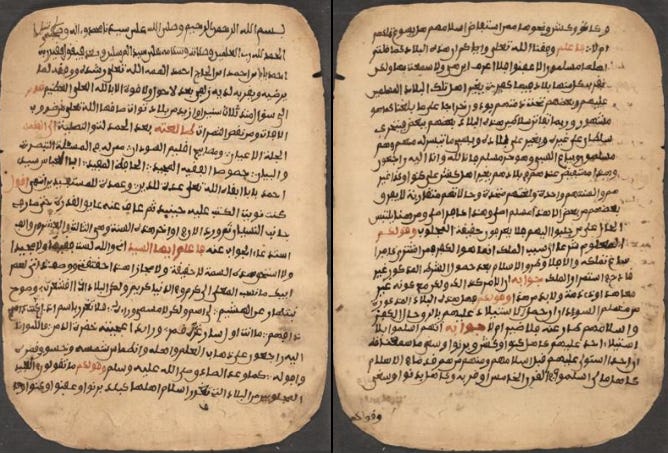
Copy of Ahmad Baba’s treatise on slavery, Library of Congress
According to the historian Bruce Hall:
“nowhere in any legal sources before the eighteenth century do we find the invocation of racial labels used to mark collective groups of slaves.
The use of racial labels in the nineteenth-century forgery of the “Taʿrikh al-fattash” suggests that some thing had indeed changed since the original composition of this chronicle.”35
In West Africa, attempts at defining whole groups of people as permanently servile based on genealogical arguments only appear in the 19th century.
Several of the passages in the Tarikh al-Fattash forgery suggest that the chronicle was also intended to justify the imposition of slave status on different endogamous (and hostile) groups of the periphery of the Massina empire, such as the Sorko boatmen and the Dogon of the mountains. Sections of these groups were labeled as ‘Zanj’ or ‘Arbi’ in order to avoid confusion with the term sūdān, which was already used by West African Muslims. All three terms were later translated as ‘black’ in the French and English versions of the texts.36
A Massina-born scholar (from Mali) who met the explorer Hugh Clapperton in 1827 while in Sokoto (Nigeria), counts several tribes among the “Benoo-Hami” (the children of Ham). These included the mountain dwellers who had long resisted the authority of the Fulbe-led states of Sokoto in Adamawa, as well as the Jerma [Zarma, Songhai speakers] who, despite their supposed unbelief, “are great warriors, possessing swift and well-trained horses.”37
This marks the first connection of the Hamitic myth with slavery in West Africa, centuries after it had been established in the Atlantic world and the central Islamic lands. Like the Berbers of medieval North Africa, the West African scholars who invoked the Hamitic myth to justify slavery also tried to distance themselves from any connection with the “Hamites”/”children of Ham.”
Sokoto scholars such as Abdullahi Dan Fodio and Muhammad Al-Bukhari in the early 19th century created even more superficial genealogies for themselves, claiming descent from a union between the Arab conqueror Uqba and a Byzantine princess. These scholars, who belonged to a clerical lineage known as the Torodbe, defined themselves in opposition to the descendants of Ham, such as the non-Muslim mountain dwellers of Adamawa, who resisted their authority.38
Torodbe genealogies were, however, far from coherent and were contested even amongst themselves. (as explored in my previous essay)
This intellectual debate is hinted at by Abdullahi, who writes, “Oh critics, abstain from blaming me for I am eager to clarify my lineage and preserve my honorable rank.” His biggest critic and rival was his nephew, the Sokoto Caliph Muhammad Bello, who, in direct response to his uncle’s claims, wrote that “the origin of the Torobbe is the Bambara, a people of the sūdān” and that the original language of the Fulbe was “Wākuru, a language of the Bambara.” 39
Unlike the medieval Imazighen and the kings of Ghana, the Torodbe of Sokoto didn’t need Ibn Khaldun to dismiss their fictitious genealogies, since they had their own critics. Thus, the dichotomy between the ‘Shemite’ rulers and ‘Hamitic’ slaves wasn’t fully developed before the colonial occupation of West Africa.

Entrance to the Palace at Rey, Cameroon. ca 1930-1940. Quai Branly.
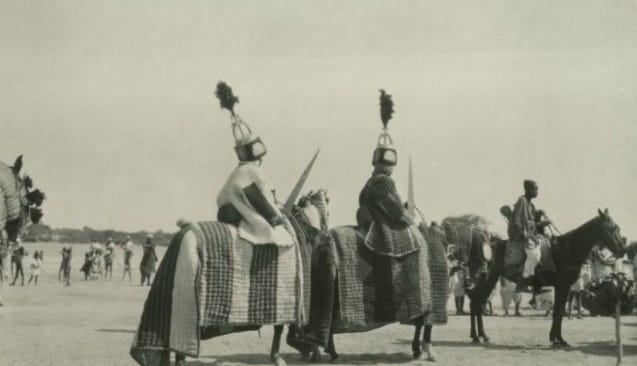
Djerma horsemen ca. 1924. Zerma-Songhai, Niger. L’archivio fotografico della Società Geografica Italiana
Ancient Egypt and the rebirth of the Hamitic myth
Western European Enlightenment and the rise of empirical science in the 18th century challenged the religious account of the origins of race, only to give rise, unfortunately, to even more abhorrently racist, pseudoscientific concepts like polygenism.
As the conservative theologians clung to the biblical theories of enslaved Hamites, “enlightened” writers like Voltaire (d. 1778) advanced the theory that **Africans, Europeans, Chinese, Indians, etc belonged to different “species.”40
[**Importantly for this section of the essay, Voltaire grouped all ‘black Africans’, including Ethiopians, under the racial category of “Negroes”. His theory of polygenism was directly based on the findings of the Italian atomist Marcello Malpighi, who examined the skin of a deceased Ethiopian in 1666, and found a permanent layer of dark pigmentation (known today as melanin) in the innermost layer of the epidermis, which is still called the “Malpighian layer”. Despite the presence of melanin in many populations outside Africa, Voltaire took it as evidence that such superficial differences were innate.41]
A few decades later, however, almost overnight, the medieval myth of the enslaved “Negro-Hamite” suddenly gave way to the modern myth of the “Hamitic hypothesis,” in which the “Hamites” became Caucasoid civilizers from the north.
This radical reconceptualization of the Hamites as racially “white” was prompted by the discovery of ancient Egypt during the country’s brief occupation by the French general Napoleon in 1798.
The genesis of the new Hamitic myth was excellently summarized by Edith Sanders (1969)42, which I will quote here in full:
Napoleon’s scientists made the revolutionary discovery that the beginnings of Western civilization were earlier than the civilizations of the Romans and the Greeks. Mysterious monuments, evidences of the beginnings of science, art, and well-preserved mummies were uncovered.
Attention was drawn to the population that lived among these ancient splendours and was presumably descended from the people who had created them. It was a well-mixed population, such as it is at the present time, with physical types running from light to black and with many physiognomical variations.
The French scholars came to the conclusion that the Egyptians were “Negroids.” Denon, one of Napoleon’s original expedition, describes them as such: ‘...a broad and flat nose, very short, a large flattened mouth... thick lips, etc.’.
The Egyptian expedition made it impossible to hide that seeming paradox of a population of Negroids who were, once upon a time, originators of the oldest civilization of the west. Such a notion upset the main existing tenets; it could not be internalized by those individuals on both sides of the Atlantic who were convinced of the innate inferiority of the Negro, nor by those who adhered to the biblical explanation of the origin of races. To the latter such an idea was blasphemous, as Noah’s curse condemned the Hamites to misery and precluded high original achievement.
A few short years after the Egyptian expedition, there appeared a large
number of publications dealing with Egypt and Egyptians. Many of these works seemed to have had as their main purpose an attempt to prove in some way that the Egyptians were not Negroes.
The polygenist theories of race postulated that as each race was created separately, so it was endowed with its own language. Because the Coptic language was clearly related to Arabic, it was convenient to draw the conclusion that the nations who spoke related languages must have proceeded from one parental stock. Since the Ethiopians, Nubians and other allied peoples were declared not to be Negro by European travellers, the Egyptians could not be said to be of African (Negro) race, as all of these peoples were colonists from Syria or Arabia Felix.
New interpretations of the meaning of Scriptures were offered. Egyptians, it was now remembered, were descendants of Mizraim, a son of Ham. Noah had only cursed Canaan-son-of-Ham, so that it was Canaan and his progeny alone who suffered the malediction. Ham, his other sons, and their children were not included in the curse.
So it came to pass that the Egyptians emerged as Hamites, Caucasoid, uncursed and capable of high civilization. This view became widely accepted and it is reflected in the theological literature of that era.”
These problematic and explicitly racist foundations of modern Egyptology continue to exercise profound influence on the discipline today.43 It’s for this reason that casual conversations about ancient Egyptian history at times devolve into debates about “race”, skin colour, skull sizes, and nose shapes.
Questions on the “race” of ancient Egyptians and their interaction with other African kingdoms were not derived from professional historiographical inquiry into Egyptian society, but are intended to defend Eurocentric racial hierarchies.44
The modern Hamitic theory cast a wide net to include a great variety of populations, from pale Scandinavians to black Ethiopians and the Maasai, conveniently counting every ancient civilization as the product of “the white race”. An example of this is the hype-diffusionist theory promoted by the American Egyptologist James Henry Breasted, in which an ancient “great white race” spread civilization from Egypt to the rest of the Mediterranean world.45
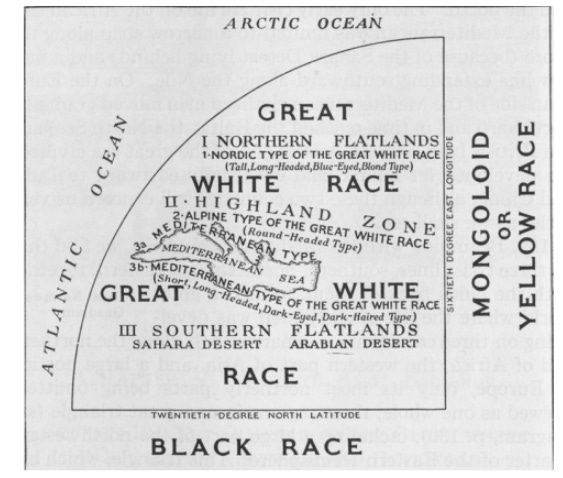
James Breasted’s map of racial categories.
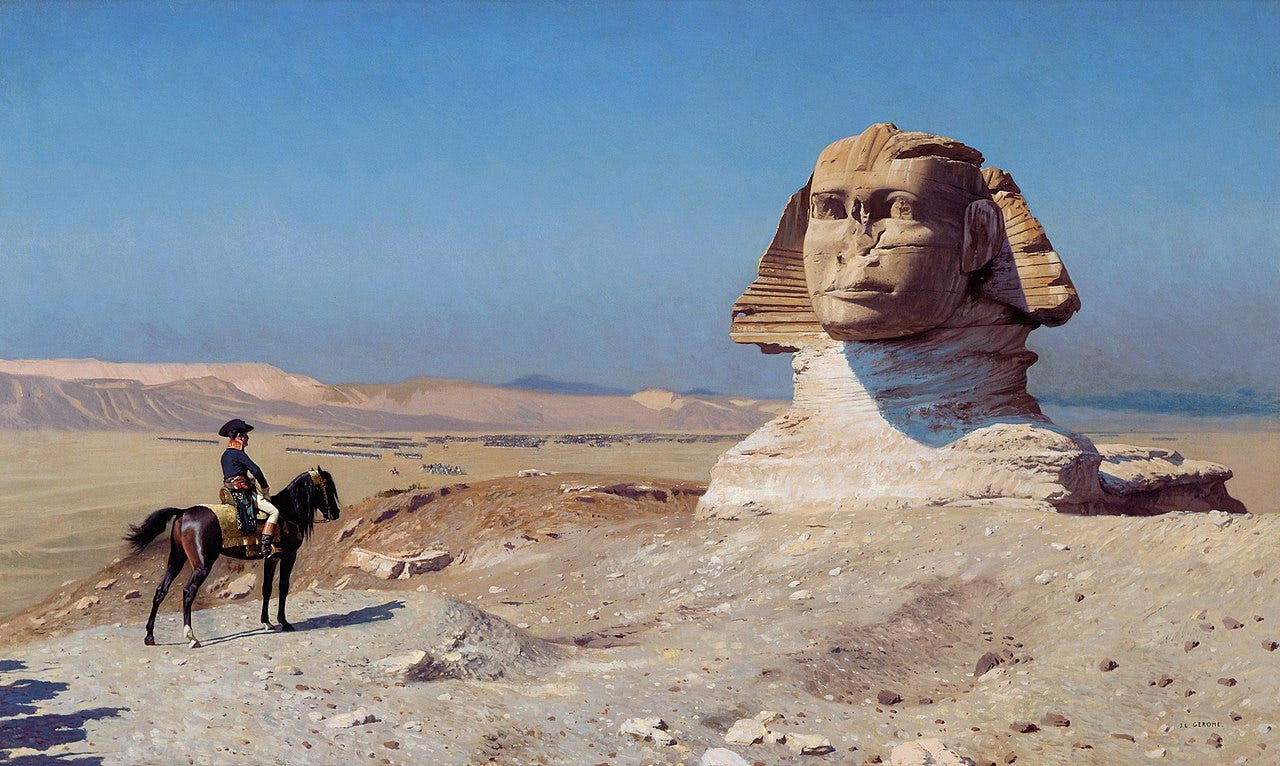
Bonaparte Before the Sphinx. 1888 Painting by Jean-Léon Gérôme
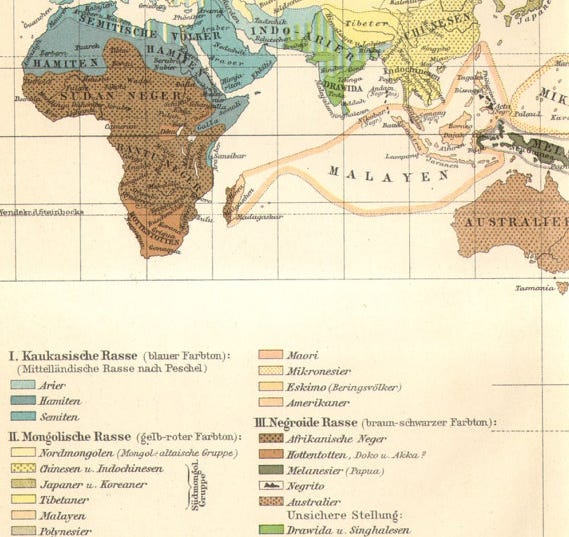
German 1932 ethnographic map portraying Hamites (in German: “Hamiten”) as a subdivision of the Caucasian race (”Kaukasische Rasse”).
The Hamitic myth and the European invention of “Race” in the Great Lakes region of Central Africa.
In the late 19th century, the ideologies of colonialism and “scientific” racism utilized and expanded the concept of the ‘Caucasoid Hamite’, completely erasing their earlier myths of the “Negro-Hamite”, who now simply became “Negro.”
Such theories were especially prevalent in accounts written by ‘explorers’ of central Africa, who found a variety of physical types in the region, and their ethnocentrism made them value those who looked more like themselves. They declared these groups to be “Hamitic” and endowed with the myth of superior achievements and considerable beneficial influence on their “Negro” brothers.
The Englishman John Hanning Speke was seminal to the Hamitic hypothesis, which we know today. When he arrived in the kingdom of Buganda (Uganda) in 1862, and found a centralised state with a complex political organization, he attributed its ‘barbaric civilization’ to a nomadic pastoralist race related to the Hamitic “Galla” (Oromo-speakers of Ethiopia), thus setting the tone for the interpreters to come.
Unlike the kingdoms of West Africa and Ethiopia, whose adoption of Islam and Christianity had given them a long familiarity with the Hamitic myth, the kingdoms of the Great Lakes had little direct contact with these Abrahamic traditions, and their origin myths contained nothing about the Middle East or any part of the continent beyond central Africa.
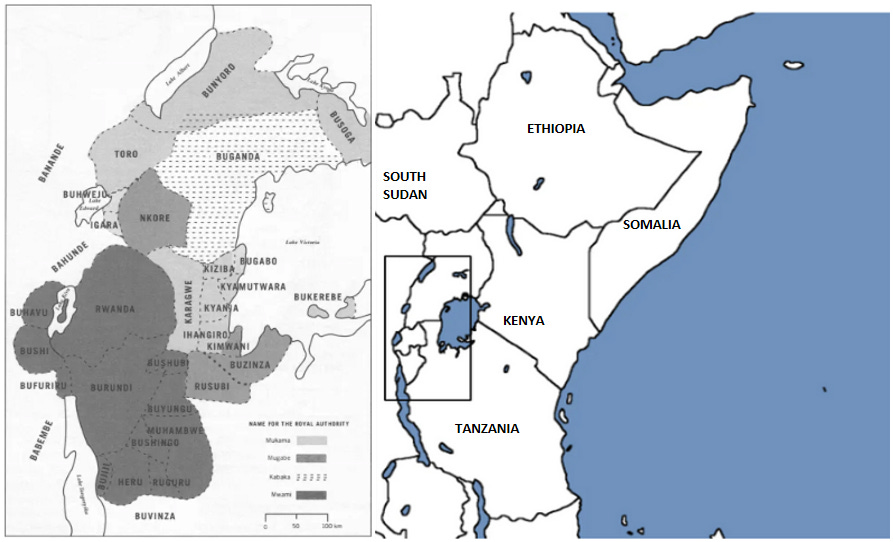
The Central African Great Lakes and neighbouring countries.
Explorers, therefore, had to invent Hamitic myths and extrapolate the pre-existing stories about foreign founder figures to give them an origin from Ethiopia. This would have disastrous consequences in Rwanda a century later, when genocidal militias threw their Tutsi victims in the river Kagera to send them up the Nile to their supposed “homeland”.
This mythmaking began with John Speke’s attempts to reconstruct the history of the Bunyoro kingdom, Buganda’s neighbour to the west. King Kamurasi (r. 1852-1869) of Bunyoro reportedly told Speke that he and King Mutesa of Buganda (r. 1856-1884) were ‘wawitu’, who came from the east in Kidi (ie; the east of Bunyoro)
Speke deliberately misinterpreted the name of King Kamurasi’s dynasty; wawitu (ie; baBito) with Omwita (ie, Mvita), the native name for the coastal city of Mombasa (Kenya), in order to extrapolate the eastern origins of these rulers to the coast, and then further north to Ethiopia. He confidently told the king that:
“I know all about your race for two thousand years or more. Omwita, you mean, was the last country you resided in before you came here, but originally you came from Abyssinia, the sultan of which, our great friend, is Sahela Selassie.”46
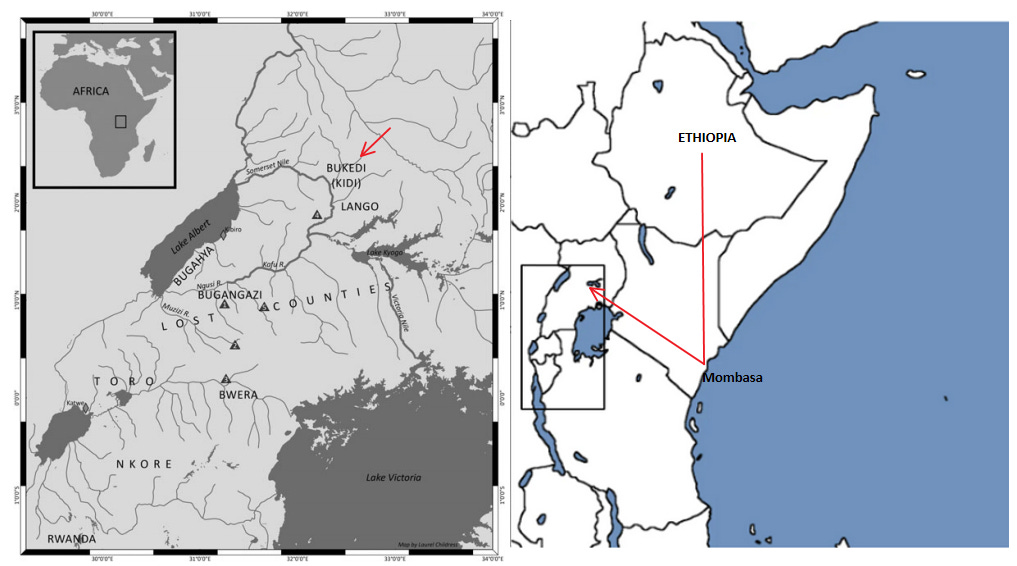
The “east” that the Bunyoro king was referring to versus the “east” that John Speke extrapolated for his Hamitic myth.
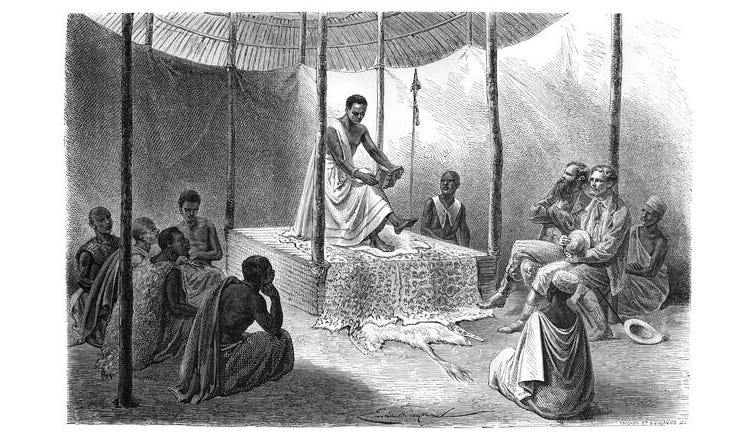
King Kamurasi reading the Bible of Speke and Grant, ca. 1862.
Contrary to Kamrasi’s insistence that he belonged to the baBito, Speke categorizes the ruling class of Bunyoro as ‘Wahuma’ (baHima/bahema, a collective ethnonym for a variety of herders in the region), about whom he writes:
“It appears impossible to believe, judging from the physical appearance of the Wahuma, that they can be of any other race than the semi-Shem-Hamitic of Ethiopia.”
He then invents an elaborate story about their migration from Ethiopia, mixing facts and fiction about the Oromo migrations of the 16th/17th century, placing them at the coast in Mombasa, before they apparently crossed 1,000km west to found Bunyoro and Buganda. To explain why these central Africans knew nothing about Ethiopia, Speke claims that the Abyssinians “lost their religion, forgot their language, extracted their lower incisors like the natives, changed their national name to Wahuma, and no longer remembered the names of Hubshi or Galla.”47
Considering the Speke was writing barely 250 years after the end of the Oromo migrations, the explanation for how they supposedly lost their language and history so fast was dubious even for the time, not to mention the fact that such centralized kingdoms were hardly known in the Oromo heartland during the 16th/17th century48.
We don’t know what the Bunyoro king thought of Speke’s bold invention of his people’s history, but it’s clear that he had already rejected it by the time Samuel Baker visited his court in 1864. The English explorer admitted to having failed to convince the king of Bunyoro that his ancestors were Oromo:
“It was in vain that I attempted to trace his descent from the Gallas; both upon this and other occasions he and his people denied all knowledge of their ancient history.”49
Apparently, Baker expected the African ruler to blindly accept the fiction that had been invented just two years earlier, over his own historical traditions!
The Bunyoro king probably had a low opinion of his European guests; he had received rumours that John Speke was a cannibal:
“At the time the white men were living in [B]Uganda, many of the people who had seen them there came and described them as such monsters, they were not satisfied until they got a dish of the ‘ tender parts’ of human beings three times a day. Now I [Kamurasi] was extremely anxious to see men of such wonderful natures. I could have stood their mountain-eating and N’yanza-drinking capacities, but on no consideration would I submit to sacrifice my subjects to their appetites.”50
It’s not difficult to imagine why his response to Speke’s Hamitic myth was to give an equally ludicrous story about how his people were formerly ‘black on one half of the face and white on the other half, with frizzly hair on one side and straight hair on the other.’
John Speke’s mythmaking had a profound influence on the accounts of later explorers, who maintained the basic outline of the story about the baHima’s supposed migration from Ethiopia, as explained by Samuel Baker’s account described above.
15 years after Speke, Emin Pasha, the Anglo-Egyptian governor of Equatoria (South-Sudan), visited Bunyoro in 1879, in his account of the kingdom’s history, he included a claim that “people with a white skin came from the far north-east and crossed the river. The intruders called themselves “wawitu,” people of witu, a name still given to the ruling families; but the people called them “wahuma.”
On the same page, he explains the source of these claims: “I give the foregoing narrative exactly as i have heard it in conversation here, and at the same time I am constrained to do full justice to the account given by my predecessor, Speke, whose work is beyond all praise.”51
Evidently, the ethnocentrism of European explorers was not shared by their African guests, who placed little value on the supposed “Caucasoid” features of the ‘Hamites’.
According to H.M. Stanley’s description of the wives of King Mutesa of Buganda in 187552:
“Mtesa apparently differs widely from Europeans in his tastes. There were not more than twenty out of all the five hundred [wives] worthy of a glance of admiration from a white man with any eye for style and beauty, and certainly not more than three deserving of many glances. These three, the most comely among the twenty beauties of Mtesa’s court, were of the Wahuma race, no doubt from Ankori (Ankole, S.W Uganda).
They had the complexion of quadroons, were straightnosed and thin-lipped, with large lustrous eyes. The only drawback was their hair—the short crisp hair of the negro race—but in all other points they might be exhibited as the perfection of beauty which Central Africa can produce.
Mtesa, however, does not believe them to be superior, or even equal, to his well-fleshed, unctuous-bodied, flat-nosed wives: indeed, when I pointed them out to him one day at a private audience, he even regarded them with a sneer.
At the time of Speke’s visit in 1864, the kingdoms of the Great Lakes knew nothing about Mombasa or Ethiopia. The earliest caravan from the east African coast had arrived in Buganda in 1844, but it came from Zanzibar, not Mombasa, and it was led by Arabs and Swahili, not Ethiopians.
Despite the adoption of Islam and Christianity in Buganda in the succeeding decades, the Biblical myths didn’t displace local traditions transcribed by both European and Ganda Historians like Sir Apolo Kaggwa (1901). These maintained that their putative founder was Kintu, who is thought to have descended from the sky.53
Curiously, there had been attempts to link Kintu with the biblical Ham during Mutesa’s reign; the king’s conversations with H.M.Stanely in 1875 and G.S. Smith in 1877, suggest that he thought Kintu and Ham were the same. By the 1890s, missionaries were reporting claims that Kintu was a “white” man, and children’s books in 1893 were claiming that Kintu was a personification of Oromo immigrants.
However, the biggest challenge this mythmaking faced was that it didn’t correspond to the “racial” image of the people of Buganda, nor even to King Mutesa. Missionaries tried to resolve this contradiction by explaining that Mutesa had lost his “pure Mhuma features” “through the admixture of Negro blood”. For these and several other reasons, by the time Ganda historians were putting their oral traditions in writing, the Hamitic myth didn’t become as popular as it would be in other regions.54
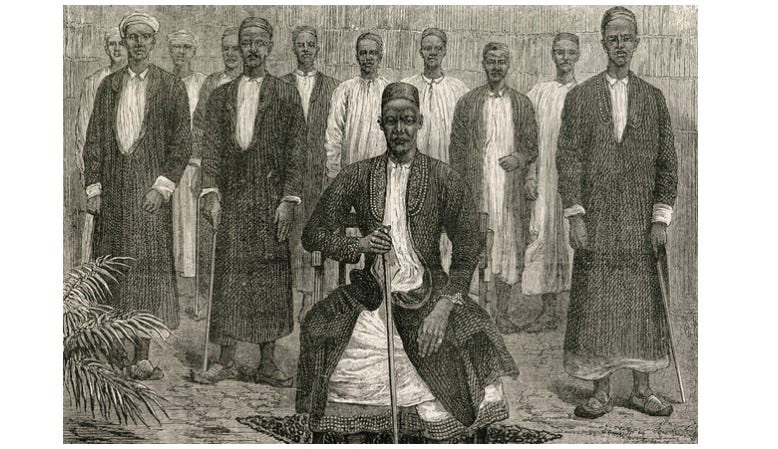
King Mutesa and his chiefs. ca. 1875.
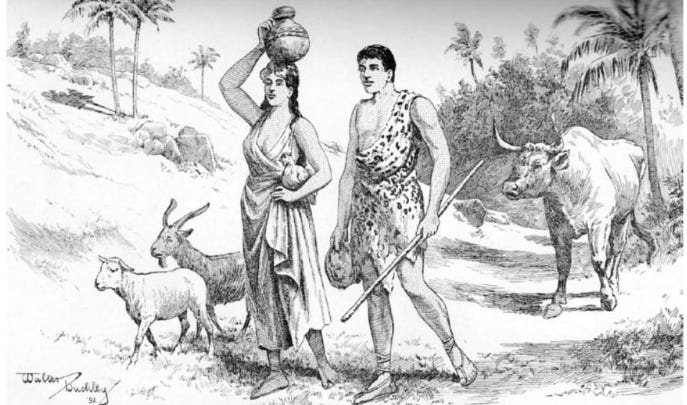
The caucasiod Kintu and his wife Nambi as they appear in A.J. Mounteney Jephson, Stories Told in an African Forest, 1893
Similarly, in Bunyoro, traditions collected by both European and Nyoro historians like Petero Bikunya (1927) identify the kingdom’s founder as Rukidi, who came from east of Bunyoro in Bukedi (North of Lake Kyoga in Uganda). This founder is thought to have established the semi-legendary Kitara ‘empire’ whose ruling dynasty, the baChwezi, were succeeded by the baBito.55
A few decades later, accounts by Bunyoro’s historians like John Nyakatura (1947) had done away with both the Hamitic myth and the ‘Wahuma’ from the kingdom’s dynastic history.
While acknowledging their presence as herders who “may have come from Egypt or Ethiopia [ Abyssinia ]”, Nyakatura argues that the baHima were a different “race” from the baChwezi and baBito, identifying both ruling dynasties as belonging to the baIru, the agriculturalist group that forms the Hima/Iru dichotomy, similar to the Tutsi/Hutu dichotomy of Rwanda.56
In contrast to this, in the southern kingdom of Rwanda/Nyiginya, which was visited relatively late by European explorers, the Hamitic myth arrived fully developed and gained widespread acceptance at the court and by Rwandan historians.
In his 1868 account, the explorer John Speke, who never visited Rwanda, briefly mentioned the supposed “racial” similarities between ‘Wahuma’ herders he encountered in Uganda, with the ‘Wahinda’ princes of Karagwe (N.W Tanzania), and the ‘Watusi’ client herders in Unyamwezi (Central Tanzania).
He deliberately overlooked many of the contradictions he had observed in these three different groups, including the fact that they spoke different languages, in order to emphasize their “racial” unity.57
Speke’s ideas directly influenced the writings of Gustav Adolf von Götzen, the first European to visit Rwanda in 189458.
“Rwanda’s history is obscure and shrouded in legend. We learn of great migrations of Hamitic peoples from Abyssinia and the Galla lands, who moved southwest with countless herds of large-horned cattle and subjugated the lands between the Great Lakes.
A powerful empire, Kitara, which Speke has already described, certainly existed. Its center was roughly in present-day Unyoro. The ruling dynasty there called itself the Wakintu, from whom the kings of Uganda also trace their lineage. And when we hear from the ancient legends of the Waganda that the first Kintu came from the north, that he was a superhuman figure in all his mass.
Furthermore, we hear of three rulers from the Ruhinda dynasty, the first of whom possessed the lands of Karagwe and Mpororo, the second Ihangiro, and the third Ussuwi. Urundi, which borders Ussuwi to the west, fell to the Mwesi dynasty.
All these states, however, more or less disintegrated over time, whether through the extinction of the ruling families, violent internal upheavals, or external attacks. Only Rwanda, under the rule of the Wahinginia dynasty, not only retained its power but continues to increase it year by year.
Whether it once formed part of the Kitara Empire, or existed independently alongside it, and whether the ancestors of Kigeri were related to the Ruhinda and Wakintu, must remain an open question.”
Gustav’s account simply grafted John Speke’s Hamitic myth onto the local traditions that the German had heard during his brief stay at the court of Kigeli IV Rwabugiri (d. 1895).
In the years following his arrival, the Germans would establish a colonial presence in Rwanda, subsuming the kingdom of **Nyinginya while expanding its territorial claims over neighbouring polities mentioned in Gustav’s account.
[**The central kingdom in Rwanda was ruled by the Nyiginya (abaNyinginya) dynasty, and is thus accurately known as the Nyiginya kingdom, but there were other kingdoms in the modern country, and the name ‘Rwanda’, whose semantic derivation is “a large space” isnt derived from the kingdom59]
German and Belgian missionaries and colonial officers greatly expanded and elaborated upon the Hamitic myth in Rwanda, and embedded it in colonial institutions that favored “Tutsi” over the “Hutu” and “Twa”. These three groups, which speak the same language, share the same culture and live side by side, were imagined to have separate origins and histories.
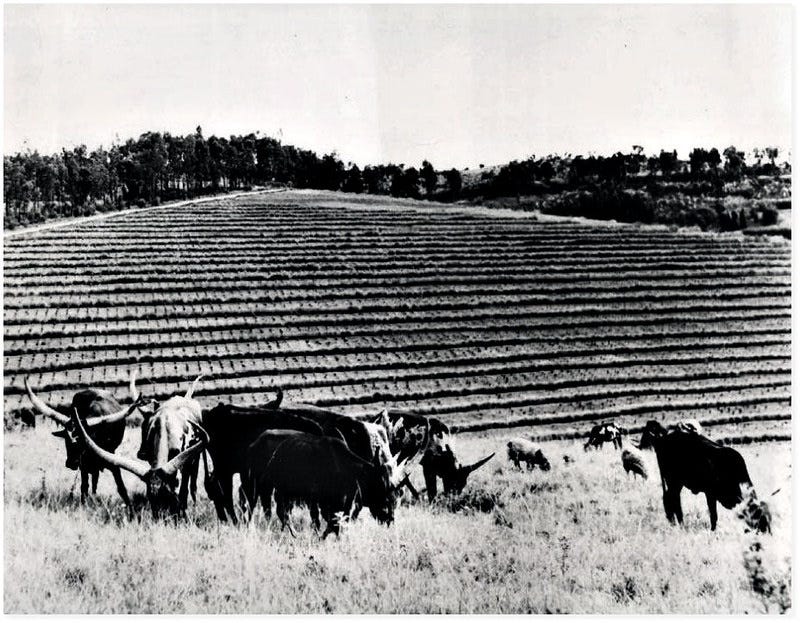
mixed agro-pastoral land use on the hills of Rwanda. ca. 1950, Collection Pierre Gallez. Contrary to modern simplifications of the Tutsi/Hutu dichotomy as pastoralists vs agriculturalists, many of those considered Hutu in the 20th century had cattle, and many of those considered Tutsi farmed the land. In 1955, 45% of the bovines in Rwanda were kept by the Hutu, while 50% were held by the Tutsi.60
The “racialization” of Rwanda through its colonial education system has been sufficiently explored in greater detail in numerous anthropological works that analyze this most absurd iteration of the Hamitic myth.61
To quote some of the more absurd claims, the missionary Etienne Brosse suggested that the Tutsi came from the Garden of Eden, the Belgian administrator speculated that they were the last survivors of Atlantis, and as late as 1970, a former French ambassador to Rwanda rambled about the Tutsi ‘Magi’ who had come from Tibet, with a minor branch making it to Iceland!62
While Rwanda had a rich collection of oral traditions and founding myths63, their transcription by professional historians was, from the onset, tainted by the Hamitic myth.
Such can be found in the title of the first book on Rwanda’s history, ‘Un royaume hamite au centre de l’Afrique’ (A Hamitic kingdom in the Center of Africa) by Albert Pagès (1933), and the contents of the first book written by a Rwandan Historian, “Inganji Kalinga” (Kalinga’s Reign) by Alexis Kagame (1943).
The latter account was written in Kinyarwanda, and unlike most books, which were written in French, it was widely read by many Rwandans at the time, and reflected elite beliefs about their own history, which had been manipulated by decades of colonial propaganda.
Alexis Kagame was a favorite of both the Catholic missionaries and the king. He became an ideologue and court historian (*omwiiru64) for the Tutsi monarchy in the 1950s, a professor at the University of Rwanda (even, paradoxically, under the Hutu republic), and a member of UNESCO’s International Committee on African History. He imposed a long-lasting Hamitic interpretation on Rwanda’s ancient history.65
According to Alexis Kagame:
“The origin of the abaNyiginya is Abyssinia, like other Tutsi. If we were people who could travel anywhere … and went to Abyssinia, we would undoubtedly find many things there that are similar to ours, which would truly convince us that the Tutsi came from there … We know that they came from Abyssinia, perhaps they also passed through Nubia, or they first settled in Nubia, because that is also possible.”66
In his later writings, such as ‘La notion de génération’ (1959), which was unfortunately completed in the same year as the first Rwandan genocide, Kagame revised his position on the Hamitic myth, writing that:
While the Oromo and the Tutsi “share the criteria of Hamitic race and pastoral civilization,” the “written history itself and cultural evidence sufficiently demonstrate that there is no trace of a Galla presence in interlacustrine Africa.”67
This work, which was written in French, was more grounded in modern historiographical methods, but it’s unlikely to have been as popular as the first publication.
By the time of its publication, it was already too late. The political reforms of the 1950s that aimed to increase the share of the Hutu in government in preparation for independence were considered ineffective. Hutu intellectuals were opposed to the transfer of power to what would be a Tutsi-led government. The “foreignness” of the Tutsi was at the heart of the debate.
As Mahmood Mamdani explains: “The more assertive the Hutu counter elite grew, the more it provoked a shrill reaction from those Tutsi who had swallowed wholesale the venom that was the Hamitic hypothesis and who were bent on defending colonial privilege as a time-tested tradition.”68
The political polarization of the 1950s in Rwanda culminated in the first genocide of Tutsis in 1959-62, and the violent abolition of the monarchy. The contrasts between the historic trajectory of such social/”racial” divisions in Rwanda and Uganda between the Tutsi/Hima and the Hutu/Iru are explored in greater detail in my previous essay: state and ethnicity in Rwanda and Nkore.
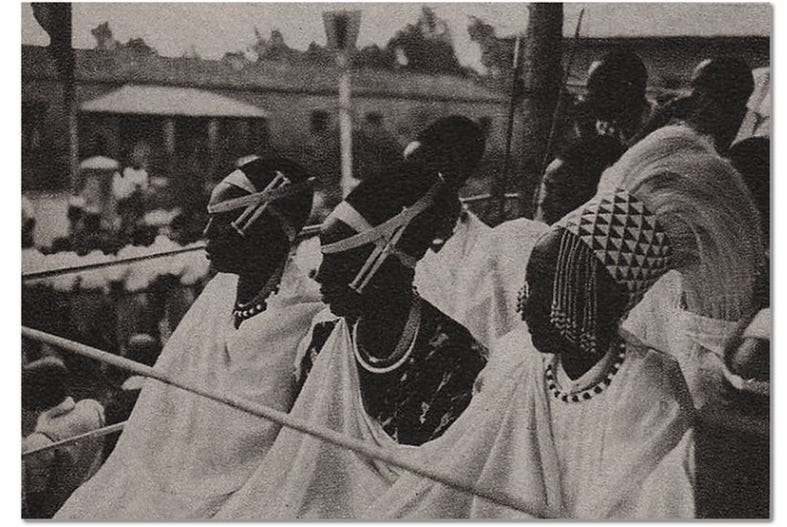
King and Queen of Rwanda at a ceremony in 1950.
The Hamitic myth as a product of transcribing oral traditions
The divergent response to the Hamitic myth in Rwanda and Uganda demonstrates the complexities of transcribing African oral traditions, as explained by the historian Jean-Pierre Chrétien69:
In the debate over how much history and how much myth is in African traditional narratives, it is often forgotten that mythologies are frequently forged when the oral encounters the written.
Marcel Detienne has convincingly shown that in ancient Greece “mythology” was forged through “the logographer’s pen [conveying tradition) with subtle tattoos of verisimilitude ... intertwining the mythos and the logos, the writing and the telling.”
This is a matter more of graphics than orality. “Before being thought over, before being discussed, the Greek myth is written down.” This conclusion can be applied to the oral traditions in the Great Lakes kingdoms with one significant caveat: that the logographer’s pen emerged under the shadow of foreign colonization.
A similar problem was encountered by early Yoruba scholars of S.W Nigeria, whose traditional histories were first transcribed in the late 19th century, by which time they were already interwoven with the Hamitic myth.
In Samuel Johnson’s ‘History of the Yorubas’ (1899), the legendary Yoruba founder Ododuwa is presented as the son of one “Lamurudu,” a king of Mecca who renounced Islam, clashed with a pious Muslim called “Braima,” and was killed in a Muslim uprising.
“Lamurudu” and “Braima” in this story evidently represent Nimrud and Ibrahim (i.e., Abraham), and the story is based on an Islamic saga of the confrontation between these two figures. Johnson derived this tradition from the writings of Muhammad Bello’s Infaq al-Maisur (1812), claiming that the Yoruba (more specifically, Oyo) were descendants of Nimrud.70
While Bello was writing in the context of Sokoto’s rivalry with Oyo before the latter was invaded in 1835-6, Johnson evidently glossed over this association of the kingdom with the Hamitic enemies of the Torodbe rulers of Sokoto. Bello didn’t refer to the Yoruba of Oyo as the “Benoo-Hami” (“children of Ham”) like his peers had done for the non-Muslims of Adamawa, but he did refer to them as ‘Banu Kanan’ (sons of Canaan).
The Infaq al-Maisur was written about a decade before Bello reversed his opinion on the origins of the Torodbe-Fulani, when he claimed that they were from the sūdān (‘blacks’ west Africans), as mentioned earlier.
Samuel Johnson rejects the theory that the Yoruba were Arabs, but maintains that “the Yorubas came originally from the East,” linking them instead with “Upper Egypt or Nubia” based on the apparent similarity between Egyptian artwork and the naturalistic sculptures of Ife and the Obelisks found in Yorubaland.71 He also posits an ancient connection with the Egyptian Coptic Church, in part to situate his own Christian identity within the broader trajectory of Yoruba history.72
It’s clear that despite the apparent negative connotations of the Hamitic myth, Johnson and other African intellectuals of his time were utilizing the more positive aspects of the myth, most notably, the belief in the common origins of humanity from a single family and a shared universal history.73
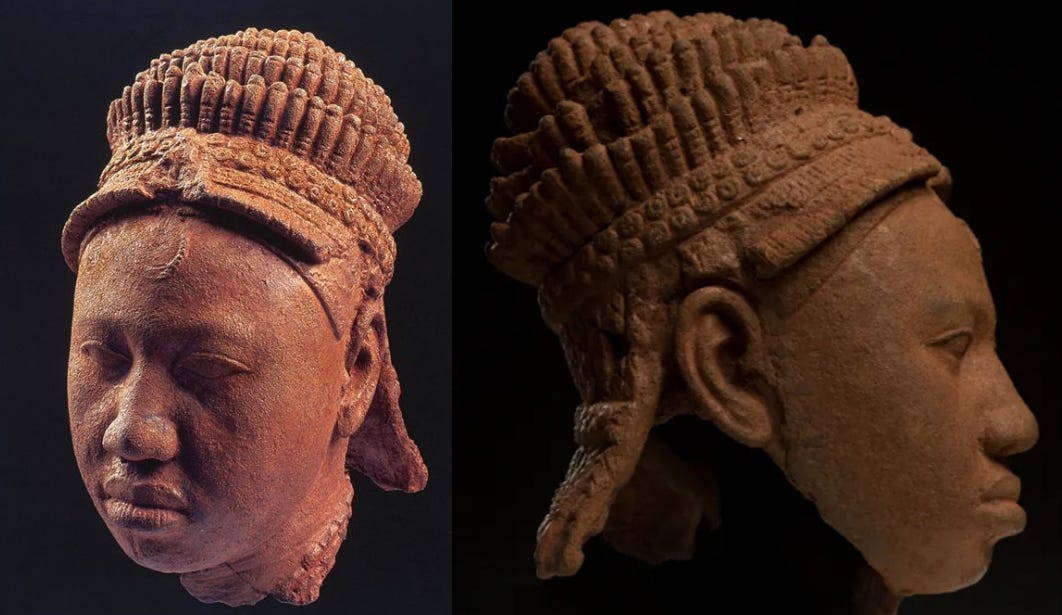
Crowned head. Ife, Nigeria. 12th–15th century. National Commission for Museums and Monuments, Nigeria
The death of the Hamitic myth
In the early years of academic study of African history, pre-existing Hamitic traditions claiming origin from the Middle East were often interpreted literally by colonial scholars, as recording real historical migrations.
This was partly because interpretations of some aspects of African traditions seemed to align with the pseudo-scientific versions of the Hamitic myth, which attributed every trace of civilization in Africa to foreign immigrants.
As the historian Robin Law writes:
“It seems clear, at least, that one of the major reasons why Europeans attributed Middle Eastern origins to West African peoples/cultures was, straightforwardly, because this is what they were told by their African informants.”74
The popularization of the Hamitic myth was made easier when it was accompanied by photographs of allegedly typical persons from the “Hamites,” which were contrasted against the other African groups that were deemed “natives.” Colonial photography, as with all facets of colonialism, is imbued with deeply problematic visual narratives meant to furnish “proofs” for pseudo-scientific racial theories.
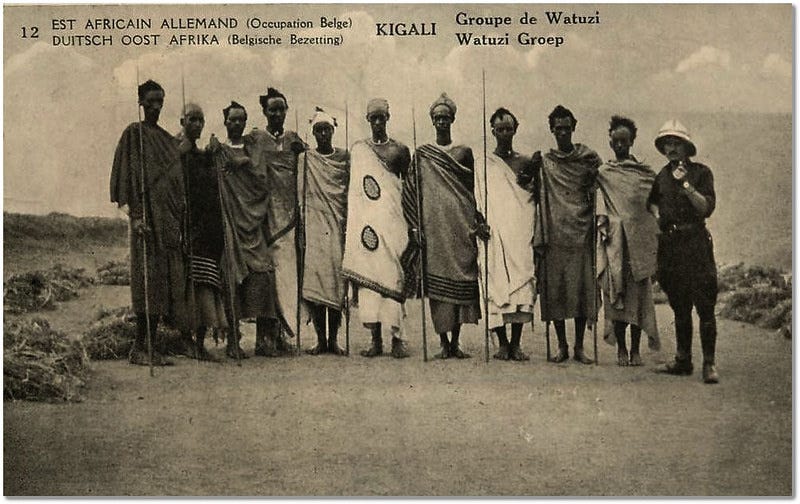
Colonial postcard titled “Group of Watuzi” taken in Rwanda. ca. 1914-1918.
For the colonialists, the denial of historical achievement to Black Africans functioned to legitimate European colonial rule as the last of the “Hamitic” civilizers of Africa.
This argument is implicit, for example, in a work of the British imperialist proconsul Sir Harry Johnston, published in 1899, in which the catalog of foreign invaders/immigrants in sub-Saharan Africa, beginning with the Phoenicians and culminating in the contemporary European partition of Africa, is prefaced by supposed prehistoric immigrations of “Hamitic civilisers,” mainly from the Nile valley.75
The decline of scientific racism after World War II and the decolonization of Africa brought an end to the Hamitic hypothesis, which, in any case, was never free of contradictions, even when adopted by African intellectuals.76
Although the overt racism of the “Hamitic hypothesis” was repudiated by the academic historiography of Africa, which developed from the 1950s, the model of state formation through invasion or diffusionism continued to influence the work of pioneering Africanists.
It’s only fairly recently that archaeological discoveries about ancient African metallurgy, architecture, and state formation have discredited the last vestiges of the Hamitic myth in academic literature.
Unfortunately, popular literature and online discussions continue to espouse aspects of the Hamitic ideology that they find politically and culturally expedient, keeping the myth alive and transforming it into a pseudo-legitimate historical tradition.
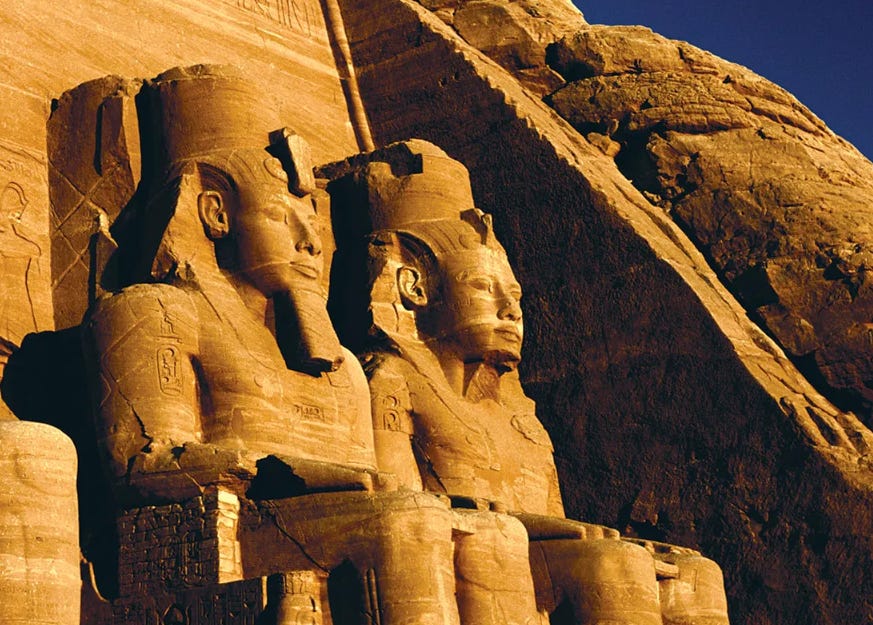
Statues of Ramses II at the main entrance to the Great Temple at Abu Simbel near Aswān, Egypt
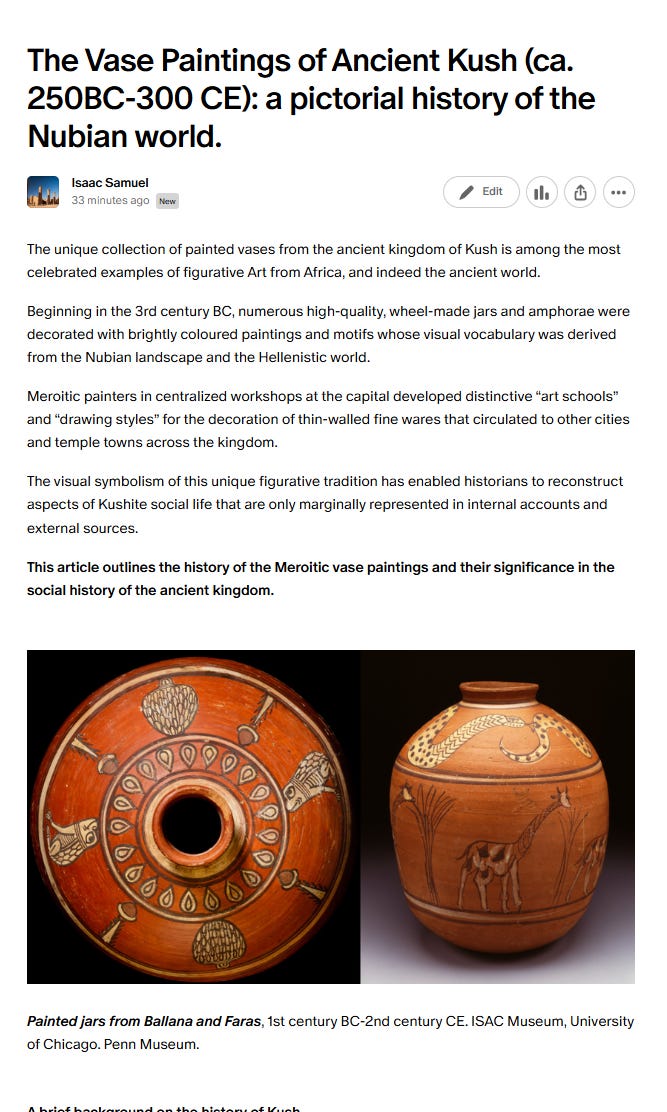
Beginning in the 3rd century BC, vase painters in the Kingdom of Kush produced a richly decorated collection of numerous wheel-made jars and amphorae, using motifs derived from the Nubian landscape and the Hellenistic world
The vase paintings of ancient Kush are the subject of my Latest Patreon article. Please subscribe to read more about it here:
Classics and Race: A Historical Reader, by Sarah Derbew, Phiroze Vasunia, Daniel Orrells pg 136
The Hamitic Hypothesis; Its Origin and Functions in Time Perspective by Edith R. Sanders, pg 534
The Curse of Ham: Race and Slavery in Early Judaism, Christianity, and Islam by David Goldenberg, pg. 47-51, 150-175.
Black and Slave: the Origins and History of the Curse of Ham by David Goldenberg
Black and Slave: the Origins and History of the Curse of Ham by David Goldenberg pg 80-81
The Curse of Ham: Race and Slavery in Early Judaism, Christianity, and Islam by David Goldenberg pg 106-109.
A History of Race in Muslim West Africa, 1600-1960 by Bruce S. Hall, pg 47
The Curse of Ham: Race and Slavery in Early Judaism, Christianity, and Islam by David Goldenberg pg 173
Black Knights: Arabic Epic and the Making of Medieval Race By Rachel Schine pg 251
A History of Race in Muslim West Africa, 1600-1960 by Bruce S. Hall, pg. 49
Ibn Khaldun, the maqadimma: an introduction to history, by Franz Rosenthal, pg 60-61
A History of Race in Muslim West Africa, 1600-1960 by Bruce S. Hall, pg. 40-41, 47-48
“The history of the Tubbaʿs, the kings of the Yemen and the Arabian Peninsula, as it is generally transmitted, is another example of silly statements by historians. It is said that from their home in the Yemen, (the Tubbaʿs) used to raid Ifrīqiyah and the Berbers of the Maghrib. Afrīqus b. Qays b. Sayfī, one of their great early kings who lived in the time of Moses or somewhat earlier, is said to have raided Ifrīqiyah. He caused a great slaughter among the Berbers ... When he left the Maghrib, he is said to have concentrated some Himyar tribes there. They remained there and mixed with the native population. Their (descendents) are the Sinhajah and the Kutamah. This led al Tabarī, al-Jurjanī, al-Masʿudī, Ibn al-Kalbī, and al-Bayhaqī to make the statement that the Sinhajah and the Kutamah belong to the Himyar.”
A History of Race in Muslim West Africa, 1600-1960 by Bruce S. Hall, pg 43.
Classics and Race: A Historical Reader, by Sarah Derbew, Phiroze Vasunia, Daniel Orrells, pg. 50
Black Morocco: A History of Slavery, Race, and Islam By Chouki El Hamel pg 77
Foundations of an African Civilisation Aksum and the Northern Horn, 1000 BC - AD 1300 By D. W. Phillipson, pg 66.
The Kebra Nagast: The Queen of Sheba and Her Only Son Menyelek By E. A. Wallis Budge, 1932, republished by Forgotten Books, 2007. pg 59,93.
The Kebra Nagast: The Queen of Sheba and Her Only Son Menyelek By E. A. Wallis Budge, 1932, republished by Forgotten Books, 2007. pg 215
The Kebra Nagast: The Queen of Sheba and Her Only Son Menyelek By E. A. Wallis Budge, 1932, republished by Forgotten Books, 2007, pg 239-240
Foundations of an African Civilisation: Aksum and the Northern Horn, 1000 BC - AD 1300 By D. W. Phillipson, pg 67
The Kebra Nagast: The Queen of Sheba and Her Only Son Menyelek By E. A. Wallis Budge, 1932, republished by Forgotten Books, 2007, pg 246, 253, 255, 257, 267. Noba and possibly Soba were already known in the Aksumite times, see: Aksum and Nubia Warfare, Commerce, and Political Fictions in Ancient Northeast Africa by George Hatke. Mecca/Makka may have only been included after the rise of Islam. These sections aren’t included by Phillipson among the Aksumite sections, so they may be from the 13th century.
The Kebra Nagast: The Queen of Sheba and Her Only Son Menyelek By E. A. Wallis Budge, 1932, republished by Forgotten Books, 2007, pg 267, 243
An Introduction to the Economic History of Ethiopia, from Early Times to 1800 by Richard Pankhurst, pg 372-373, A Social History of Ethiopia: The Northern and Central Highlands from Early Medieval Times to the Rise of Emperor Téwodros II by Richard Pankhurst, pg 64-66
Legal Encounters on the Medieval Globe edited by Elizabeth Lambourn 105-108
A History of Ethiopia: Volume I (Routledge Revivals): Nubia and Abyssinia By E. A. Wallis Budge, pg 143
Blackness in Transition: Decoding Racial Constructs through Stories of Ethiopian Jews by Hagar Salamon, pg. 9-15. Blackness and Jewishness – Ethiopian Jewry’s Durability: Diasporic, Zionist, and Israeli Discourses on Identity By Danny B. Admasu
Studies in the History of Pre-colonial Borno, edited by Yusufu Bala Usman pg 20-43
The Sudanese Elements in the Sirat Sayf b. Di Yazan By Andrea Crudu
The “Hamitic Hypothesis” in Indigenous West African Historical Thought by Robin Law, pg 301
Timbuktu and the Songhay Empire Al-Sa’dī’s Ta’rīkh Al-Sūdān Down to 1613 and Other Contemporary Documents by John Hunwick pg 35
The Chronicles of Two West African Kingdoms: The Tārīkh Ibn Al-Mukhtār of the Songhay Empire and the Tārīkh Al-Fattāsh of the Caliphate of Ḥamdallāhi, by Mauro Nobili, Zachary V. Wright, H. Ali Diakité, pg 104-105.
The Chronicles of Two West African Kingdoms: The Tārīkh Ibn Al-Mukhtār of the Songhay Empire and the Tārīkh Al-Fattāsh of the Caliphate of Ḥamdallāhi by Mauro Nobili, Zachary V. Wright, H. Ali pg 35-38
Reviving the Islamic caliphate in early modern Morocco by Stephen Cory pg. 130
A History of Race in Muslim West Africa, 1600-1960 by Bruce S. Hall pg 52-53
A History of Race in Muslim West Africa, 1600-1960 by Bruce S. Hall pg 73
Sultan, Caliph, and the Renewer of the Faith: Aḥmad Lobbo, the Tārīkh Al-fattāsh and the Making of an Islamic State in West Africa By Mauro Nobili pg 215-216, 232. A History of Race in Muslim West Africa, 1600-1960 by Bruce S. Hall pg 74
A Geography of Jihad Sokoto Jihadism and the Islamic Frontier in West Africa By Stephanie Zehnle, pg. 96-97
A Geography of Jihad Sokoto Jihadism and the Islamic Frontier in West Africa By Stephanie Zehnle, pg. 155, 164-165
Abdullahi dan Fodio and Muhammad Bello’s Debate over the Torobbe-Fulani: Case Study for a New Methodology for Arabic Primary Source Material from West Africa pg 50-54
The Hamitic Hypothesis; Its Origin and Functions in Time Perspective by Edith R. Sanders, pg 524. Slavery and Race: Philosophical Debates in the Eighteenth Century By Julia Jorati, Pg 234-240
The Race Makers: A History of the Enlightenment’s Most Dangerous Legacy, By Andrew S. Curran
The Hamitic Hypothesis; Its Origin and Functions in Time Perspective by Edith R. Sanders 525-527
Concepts of Race in the Historiography of Northeast Africa by Wyatt MacGaffey. Ethnic Identities in the Land of the Pharaohs by Uroš Matić
On the “race” and ethnicity of ancient Egyptians, see the above book by Uroš Matić, and my previous essay: Were ancient Egyptians “black”?
Egyptology from the First World War to the Third Reich: Ideology, Scholarship, and Individual Biographies by Thomas Schneider, P. Raulwing
Journal of the Discovery of the Source of the Nile byJohn Hanning Speke, New York, Harper & brothers, 1868, pg 486
Journal of the Discovery of the Source of the Nile byJohn Hanning Speke, New York, Harper & brothers, 1868, pg 241-243
As one apologist for the Cushitic origin of the Tutsi pointed out; “Coming from elsewhere does not imply any form of ‘superiority’. Anyway, what kind of superiority? The Oromo were simple acephalous pastoral people who developed monarchical institutions only in the nineteenth century, as they became culturally part of the Abyssinian world.”
The Rwanda Crisis, 1959-1994: History of a Genocide By Gérard Prunier · pg 17
The Albert N’yanza: Great Basin of the Nile, and Explorations of the Nile Sources · Volume 2 By Sir Samuel White Baker , 1868 pg 177
Journal of the Discovery of the Source of the Nile byJohn Hanning Speke, New York, Harper & brothers, 1868, pg 460
Emin Pasha in Central Africa by Eduard Carl Oskar Theodor Schnitzer, 1888 pg 92
Through the Dark Continent; Or, The Sources of the Nile by Henry Morton Stanley. Sampson Low, 1878 pg 308
Kingship and State: The Buganda Dynasty By Christopher Wrigley pg 79-121
The Lost White Tribe: Explorers, Scientists, and the Theory that Changed a Continent By Michael Frederick Robinson, pg 100-104
A Mask of Calm: Emotion and Founding the Kingdom of Bunyoro in the Sixteenth Century by David Schoenbrun pg 647-655
“there was a certain ethnic group known as Bahuma who lived in Kitara. They were not Bachwezi but were rather the descendants of Kahuma, the son of Mutembuzi kintu...It is generally believed that the Bachwezi and the Bahuma are different peoples… since the Babiito were the ruling clan they could marry also among the Bahuma. This, however, did not prevent the Bahuma from looking down on Babiito. In fact they despised them and dismissed them as belonging to the Bairu group”
Anatomy of an African Kingdom: A History of Bunyoro-Kitara By John W. Nyakatura pg 47-48
Journal of the Discovery of the Source of the Nile byJohn Hanning Speke, New York, Harper & brothers, 1868, pg 244-245
Durch Afrika von Est nach West. Resultate und Begebenheiten einer Reise von der Deutschostafrikanischen Küste bis zur Kongomündung in den Jahren 1893/94, by Gustav Adolf von Götzen Pg 187
Antecedents to Modern Rwanda: The Nyiginya Kingdom By Jan Vansina, pg 35.
When Victims Become Killers: Colonialism, Nativism, and the Genocide in Rwanda By Mahmood Mamdani pg 51, Antecedents to Modern Rwanda: The Nyiginya Kingdom By Jan Vansina, pg 299, n. 59
When Victims Become Killers: Colonialism, Nativism, and the Genocide in Rwanda By Mahmood Mamdani
The Rwanda Crisis, 1959-1994 History of a Genocide By Gérard Prunier · pg 5-8
Antecedents to Modern Rwanda: The Nyiginya Kingdom By Jan Vansina
Colonial scholars and amateur linguists downplayed shared aspects of the region’s cultures that would have undermined the Hamitic myths, eg; Tutsi court historians in Rwanda were called abiiru, while the same term was used to designate agriculturalists in Uganda. Similarly, the title for King in Rwanda in Mwami, while the same word simply means husband in Buganda. Whatever meaning these terms originally carried evidently had little to do with “race”.
The Great Lakes of Africa: Two Thousand Years of History By Jean-Pierre Chrétien pg 34
“Abanyiginya aho baturutse ha mbere ni mu bya Abisiniya, nk’abandi Batutsi. Iyaba twari abantu bashobora kugenda hose, Ngo tujye muri Abisiniya, nta Kabuza twahasanga ibintu byinshi bimeze nk’ibyacu, byatwemeza koko ko Abatutsi ari yo baturutse. Tuziko bavuye muri Abisiniya,wenda bagaca no muri Nubiya, cyangwa se bakaba barabanje no gutura muri Nubiya, kuko nabyobishoboka” taken from: Inganji karinga: igitabo cy’ amateka y’u Rwanda by Alexis Kagame, Israel Ntaganzwa
La notion de génération appliquée à la généalogie dynastique et à l’histoire du Rwanda des Xe — XIe siècles à nos jours by Alexis Kagame, pg 102-103
When Victims Become Killers: Colonialism, Nativism, and the Genocide in Rwanda By Mahmood Mamdani, pg 115-120
The Great Lakes of Africa: Two Thousand Years of History By Jean-Pierre Chrétien pg 34-35
The “Hamitic Hypothesis” in Indigenous West African Historical Thought by Robin Law 303
The History of the Yorubas : From the Earliest Times to the Beginning of the British Protectorate By Samuel Johnson · 1966, pg 5-6
The Cultural Work of Yoruba Ethnogenesis by J. D. Y. Peel, pg 206-9, History of the Yorubas, by Samuel Johnson, CMS, Lagos, Nigeria, pg 7
Of Origins and Colonial Order: Southern Nigerian Historians and the ‘Hamitic Hypothesis’ C.1870-1970 by Philip S. Zachernuk
The “Hamitic Hypothesis” in Indigenous West African Historical Thought by Robin Law pg 305
The “Hamitic Hypothesis” in Indigenous West African Historical Thought by Robin Law pg 298
Of Origins and Colonial Order: Southern Nigerian Historians and the ‘Hamitic Hypothesis’ C.1870-1970 by Philip S. Zachernuk
A Bronze Age myth kept alive and embellished to justify slavery and other forms of exploitation. Capitalists and imperialists have been using the Bible to justify their own positions and actions for centuries.
As you know, they still are.
Africa has its own stories, language and everything. it's a shame that over time we have lost this.