

The first Africanists (specialists who study African languages, societies, and history) were not colonial researchers, as is often assumed, but African intellectuals who were actively engaged in the production of knowledge about their own societies.
These pioneering scholars and cultural translators provided much of the ethnographic, linguistic, and historical information that later appeared in works of colonial writers.
Their contributions shaped a substantial portion of the documentary record on Africa, challenging the conventional distinction between “external” and “internal” sources.
This intellectual collaboration produced new epistemological frameworks for organizing and interpreting knowledge about African societies, laying the foundations for the academic disciplines that today constitute African studies.
IN June 1905, the Ethiopian scholar Aläqa Tayyä arrived at Seminar für orientalische Sprachen (School of Oriental Languages, SOL) in Berlin, Germany, to assume a position as a Lektor (Lecturer) of the Geʿez and Amharic languages.1
The 45-year-old däbtära (scholar) had received his early education in the monastic schools of the Lake Tana region before travelling to the coastal town of Imkulu in Eritrea, where he worked as a teacher for the Swedish Evangelical Mission.
He later returned to Ethiopia to complete his advanced studies, during which time he gained the acquaintance of the emperor, who subsequently recommended him to the German government for a teaching position at the SOL.2
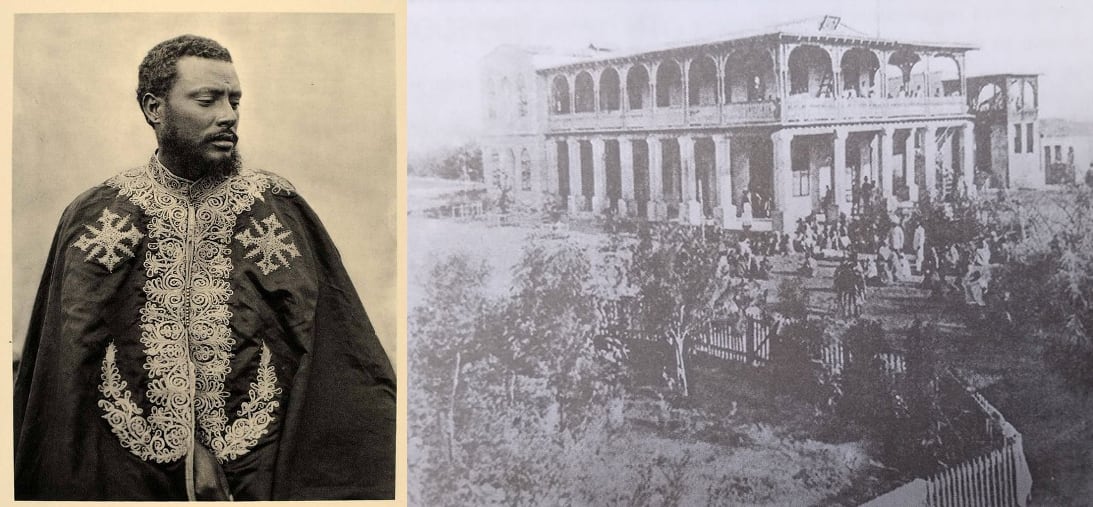
(left) Dajazmach Gabra Sellase Barya Gabr (1872-1930), who collaborated with the German scholar Enno Littmann during the German Aksum Expedition of 1906. (right) The Swedish mission station at Imkulu, Eritrea, where Aläqa Tayyä was a teacher and translator for about 6 years, and used its printing press (the first in the Horn), to publish his first book Maṣḥafa Sawāsew (1889)
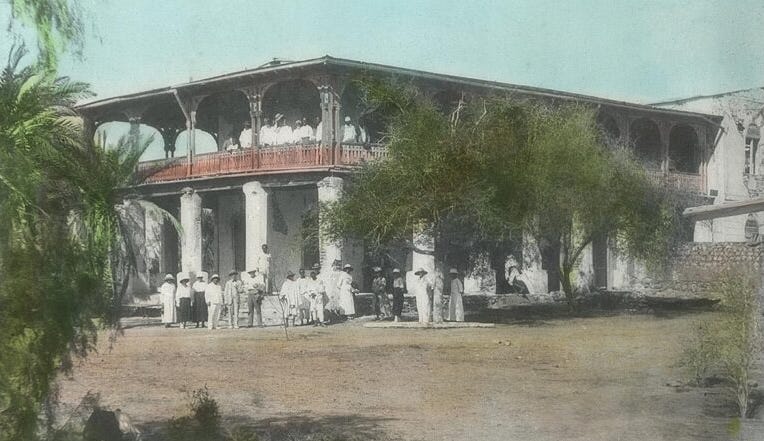
The mission station in Monkullo/Imkulu.
African lecturers and translators played a central role in the founding of the SOL and in establishing its reputation as one of the first Western institutions to lay the scholarly foundations of modern African studies.
This birthplace of academic African studies was built upon the often-unacknowledged intellectual labor and collaborative effort of African scholars, which were later subsumed by European imperial interests.
Among these was the collaboration between the Swahili ethnographer Mtoro bin Mwinyi Bakari (at SOL from 1900-1905) and the German linguist Carl Velten, as well as the Duala prince Njo Dibone, who, from 1885, worked with Carl Gotthilf Büttner.
The contributions of these and several African lecturers at the SOL are summarised in my previous essay on ‘The Hidden Founders of African Studies in Europe.’

Swahili lecturer at the SOL in Berlin, ca. 1911, collection of Carl Velten & Alice Carnwath. Rooftop view of Zanzibar, Tanzania, ca. 1936, Deutsche Digitale Bibliothek.
The Ethiopian scholar Aläqa Tayyä's lectures attracted both ordinary students and learned orientalists.
The most notable among the latter was Eugen Mittwoch (1876-1942), who is described as ‘one of the most prominent representatives of German Orientalism during the first decades of the twentieth century.’3
After his encounter with Tayyä, he also became a leading specialist in Ethiopian languages at the SOL and transmitted his work to his students, some of whom became prominent ‘Ethiopists’ as well.4
The collaborative efforts of Eugen Mittwoch and Aläqa Tayyä between 1905 and 1907 resulted in the publication of at least three foundational texts on Ahmaric literature, for which Mittwoch properly acknowledged the contribution of Tayyä.5
Through his collaboration with Mittwoch, Tayyä gained access to Western collections of Ge’ez manuscripts that had been taken from Ethiopia, whose historical information would influence his composition of the first general history of Ethiopia published by an Ethiopian author.6
In his correspondence with Menelik, the Ethiopian scholar wrote:
“I was burning [with envy] when Europeans displayed their manuscripts in their libraries for visitors. Your majesty, I am sending you a list of Ethiopian manuscripts stolen and taken to Germany so that you can get them returned. So that the coming generation would be proud of you not only as a hero of Adwa, but also as a hero of collecting and preserving heritage and history.”7
Just like the Xhosa writer Tiyo Soga (1829-1871, South Africa), Owusu-Ansa (1851-1910) of Asante (Ghana), and many African proto-nationalists of the 19th century, Tayyä was a reformist who recognized the need to modernize Ethiopian institutions if the country was to retain its autonomy.
He urged Menilek to send young Ethiopians to Europe to study science and technology, as the Japanese and Moroccan governments had done. He advocated for the introduction of compulsory education, the establishment of a printing press, the replacement of the Maria Theresa thaler with a national currency, and the elevation of the status of craftsmen.8
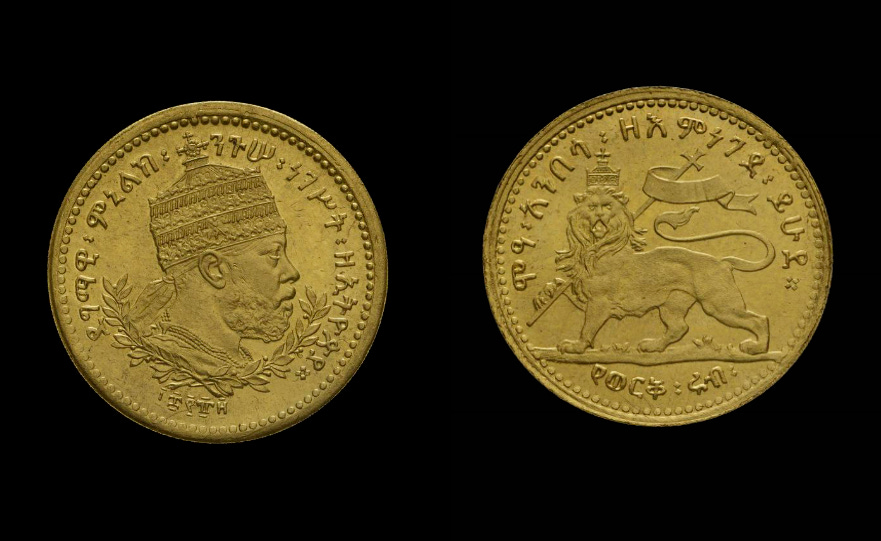
Gold coin of Menelik II, ca. 1897. British Museum.
Upon returning to Ethiopia in 1907, he brought with him a collection of more than 130 books and soon began composing an extensive and ambitious account of Ethiopian history. Part of this work was eventually published in 1922 under the title YäʾItyoppʾya Hizb Tarik (“History of the People of Ethiopia”).9
As its title indicates, the book wasn’t based on the model of the ancient royal chronicles, but was a history of the people of Ethiopia as a ‘nation.’
Like Samuel Johnson’s history of the Yoruba (1899, Nigeria), which combined the historical traditions of diverse sub-groups into one ‘nation’, Tayyä describes the diversity of languages and cultural traditions of Ethiopia, and outlines the history of its different components.
He doesn’t exclude the information provided in traditional historical accounts, but instead expands and reframes this pre-existing narrative framework with additional perspectives and materials acquired during his travels in Europe.10
This ‘History’ long constituted the sole reference for Ethiopian students who lacked access to the manuscripts of royal chronicles or to the publications of Western scholars. Its wide circulation is reflected in the numerous reprints it received, appearing in 1927, 1953, 1955, 1962, 1965, and 1971.
Although Tayyä succeeded in publishing only two of his works, the Maṣḥafa Sawāsew (1889) and the ‘History’ (1922), he was a prolific writer with wide-ranging interests. He left behind a substantial corpus of unpublished manuscripts, including original compositions on ethnography, theology, and other subjects.11
In this respect, he may be compared to his near contemporary, the Bornu scholar al-Hajj Musa of Zinder (in present-day Niger), who, after travelling to the Hejaz and Jerusalem between 1900 and 1904, eventually settled in Cairo at al-Azhar University.
Between 1904 and 1914, the intellectual collaboration between al-Hajj Musa and the German Orientalist Rudolf Prietze resulted in the creation of a veritable corpus of Hausa and Kanuri publications that would influence modern studies of both languages.
Over several years spent between Cairo and Jerusalem, Prietze and al-Hajj Musa met daily and worked together, with the latter composing hundreds of pages in Ajami Kanuri and Hausa on a variety of topics. These include traditional tales, fables, songs, and historical narratives that have been translated and published by the historians Ari Awagana and Camille Lefebvre.12
These unique works of literature originally belonged to the oral rather than scribal world since the bulk of West Africa’s intellectual heritage mostly consists of theological works, grammar, law, royal chronicles, and scientific writings.13
They represent some of the earliest transcribed works of West African popular literature. According to the historian Louis Brenner, the Kanuri folklore transcribed by al-Hajj Musa was a ‘repository of insights and comments on social and political life in the nineteenth century.’
In this interpretive framework, folklore and other forms of popular literature could serve to legitimize, negotiate, or subvert political authority and social hierarchies.
The ethnographic data provided by al-Hajj Musa offer an alternate perspective of the relationship between different social groups in pre-colonial West Africa, especially the non-elites, whose presence in royal chronicles often appears only at the margins of narratives celebrating the exploits of rulers and other prominent figures.
Building on this insight, my latest Patreon article examines the ethnographic meanings of the Kanuri folklore and historical narratives of al-Hajj Musa, drawing on comparative analysis of related traditions collected by European and African scholars in Bornu during the 19th and 20th centuries.
Please subscribe to read about it here and support this newsletter:
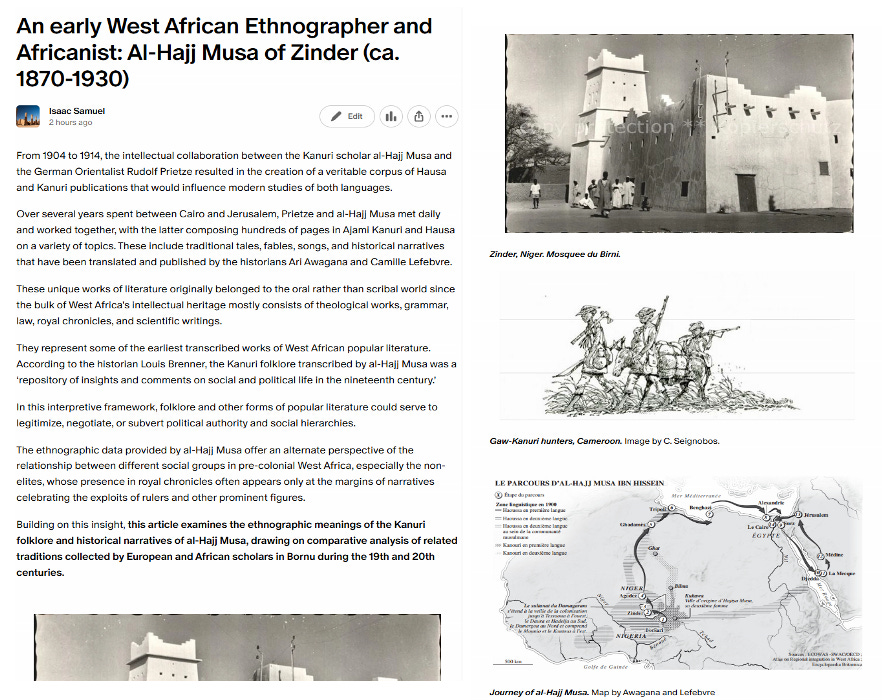
Studies in Honour of Clifford Edmund Bosworth, Volume I Hunter of the East: Arabic and Semitic Studies, edited by Ian Richard Netton pg 149-152.
for a direct account of his time in Berlin, see: Some Amharic and other documents from the Eugen Mittwoch Nachlass by E Ullendorff pg 441-447, and Alaqa Taye Gabra Mariam (1861–1924) by Aleme Eshete, pg 16-17.
Alaqa Taye Gabra Mariam (1861–1924) by Aleme Eshete, pg 14-15
The Library of Eugen Mittwoch (1876–1942) by Sabine Schmidtke
Most notably; Hermine (Herma) Brauner-Plazikowski, who relies on Aleka Taje’s Maṣḥafa Sawāsew (Moncullo 1889) and his other writings for her 1913 work, Ein äthiopisch-amharisches Glossar (An Ethiopic-Amharic Glossary
‘Proben aus dem Amharischen Volksmunde’ (‘Samples of Amharic Sayings’) in 1907, ‘Abessinische Kinderspiele’ (’Abyssinian Children’s Games’) in 1910 and ‘Abessinische Erzählungen und Fabeln’ (’Abyssinian Stories and Fables’) in 1911.
Tayyä initially thought such seemingly ‘mundane’ cultural data wasn’t worth studying, compared to the rich and complex theological and historiographic intellectual heritage in which he was trained. But Mittwoch convinced him of the significance of studying such folklore, especially for its linguistic value, since it was primarily transmitted through oral traditions and was thus thought to preserve more “accurate” linguistic forms than those found in written accounts.
According to Hammerschmidt, the collection not only provides a deep insight into the intellectual and emotional world of the Amharic-speakers but is also important from the point of view of grammar and lexicography, as it contains words not found in Ge’ez literature.
see; Ethiopian Studies at German Universities By Ernst Hammerschmidt, pg 26.
Studia Aethiopica: In Honor of Siegbert Uhlig on the Occasion of His 65th Birthday, edited by Verena Böll, pg 408.
Envoys of the Gospel in Ethiopia: In the Steps of the Evangelical Pioneers 1898-1936 By Gustav Arén pg 36
Aleqa Tayye G. Maryam: Trials and Tribulations by Fantahun Ayele pg 4
Aleqa Tayye G. Maryam: Trials and Tribulations by Fantahun Ayele pg 6. Alaqa Taye Gabra Mariam (1861–1924) by Aleme Eshete, pg 29-30
Alaqa Taye Gabra Mariam (1861–1924) by Aleme Eshete, pg 22
Tayyä (Alaqa Gâbrâ Maryam): History of the People of Ethiopia. Texte en facsimilé, traduction de Grover Hudson et Tekeste Negash, review by Jacques Bureau, 1988
The Archives of Historical Research as Sources for the History of Ethiopian Historiography in the Twentieth Century by Emmie Le Galès pg 124-126
[Open Access] L’œuvre en kanouri d’al-Hajj Musa ibn Hissein, un savant du Borno (Niger-Nigéria) Edited by Ari Awagana and Camille Lefebvre
Germany seems to have a rather interestingly long history in intellectual collaboration in the study of Ethiopia. Hiob Ludolf and Abba Gorgoryos's joint work, for instance, is in many ways the start of serious European scholarship on the country.
Learned a lot on this one. Thank you