

An estimated two-thirds of the world’s gold in the late Middle Ages may have come from West Africa.
Gold mined in the region supplied the mints of North Africa and southwestern Europe, and the lure of this precious metal helped stimulate early European exploration along the Atlantic coastline of Africa.1
While the external demand for West African gold is well documented, far less is known about its internal demand within the continent. As a result, it is often erroneously assumed that the metal held little value for the communities that produced it.
External observers frequently imagined that the medieval empires of West Africa controlled vast mines worked by their subjects. The historical reality was quite different.
Although many of these states built their wealth on the gold trade, control over the gold fields remained in the hands of small-scale communities on the periphery. The political relationship between the mining communities and the large states was one of economic alliance rather than vassalage.
This arrangement created an internal market for gold. The metal circulated widely enough to support the use of gold currency, the creation of state treasuries that regulated its distribution, and, in some cases, the minting of gold coinage.
Beyond its economic utility, gold served as a definitive marker of royalty and social status, fueling urban growth and the development of specialized artisanal production, including goldsmithing, many examples of which were later removed to museums in Europe and North America.
This article examines the historical significance of gold within West African monetary and cultural systems from the medieval period
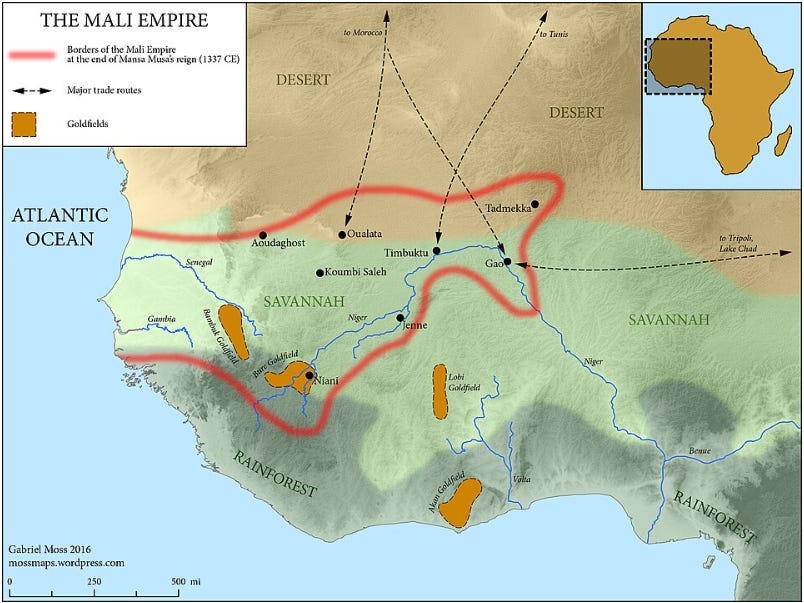
The goldfields of West Africa and the empire of Mali.
Support AfricanHistoryExtra by becoming a member of our Patreon community, subscribe here to read more about African history, download free books, and keep this newsletter free for all:
The State treasuries of medieval West Africa.
The region of the West African Sahel and savannah, known in medieval Arabic sources as Bilād al-Sūdān, first appears in written accounts from the 8th-9th century.
These early references describe the kingdom of Ghana (today in southern Mauritania) and its fabled gold mines,2 but most accounts remain fragmentary until the 11th century, when the Andalusi historian al-Bakrī (d. 1094) provides a more detailed description of the region.
He reports that the king of Ghana maintained a royal treasury in order to regulate the circulation of gold arriving from the mines located south of his domains.
According to al-Bakrī’s account, the kings of Ghana retain large gold nuggets while allowing only gold dust to circulate in trade, a practice intended to prevent an oversupply of gold and the consequent depreciation of its value:
“The nuggets found in all the mines of his country are reserved for the king, only this gold dust being left for the people. But for this the people would accumulate gold until it lost its value. The nuggets may weigh from an ounce to a pound. It is related that the king owns a nugget as large as a big stone.”3
This practice is well-documented in the 19th century kingdom of Asante on the Gold-Coast (modern Ghana), which maintained a monetary system based on gold as well as a state treasury, but it’s clearly of significant antiquity, as shall be examined below.
Al-Idrisi, in 1154, also reports, based on information received from Moroccan merchants, that the king of Ghana possessed a “brick of gold weighing thirty pounds made of one piece.” Ghana was later subsumed by the Mali empire in the 13th century, which also controlled the gold routes but not the mines themselves, reportedly because production would decline every time the Mansa (ruler) of Mali extended his authority southwards.4
The above account came from Mansa Musa (r. 1312-1337) while on his famous pilgrimage through Cairo to Mecca in 1324, during which he carried about 100 tonnes of gold, according to several contemporary accounts.5
These accounts don’t explain whether the gold came from the treasury or Mansa’s own wealth (or if there was any distinction between either). As I examined in my previous essay, West African pilgrims visiting Egypt and Mecca often carried significant quantities of gold for their journey, and it’s possible that their assets could have been included in the total estimate.
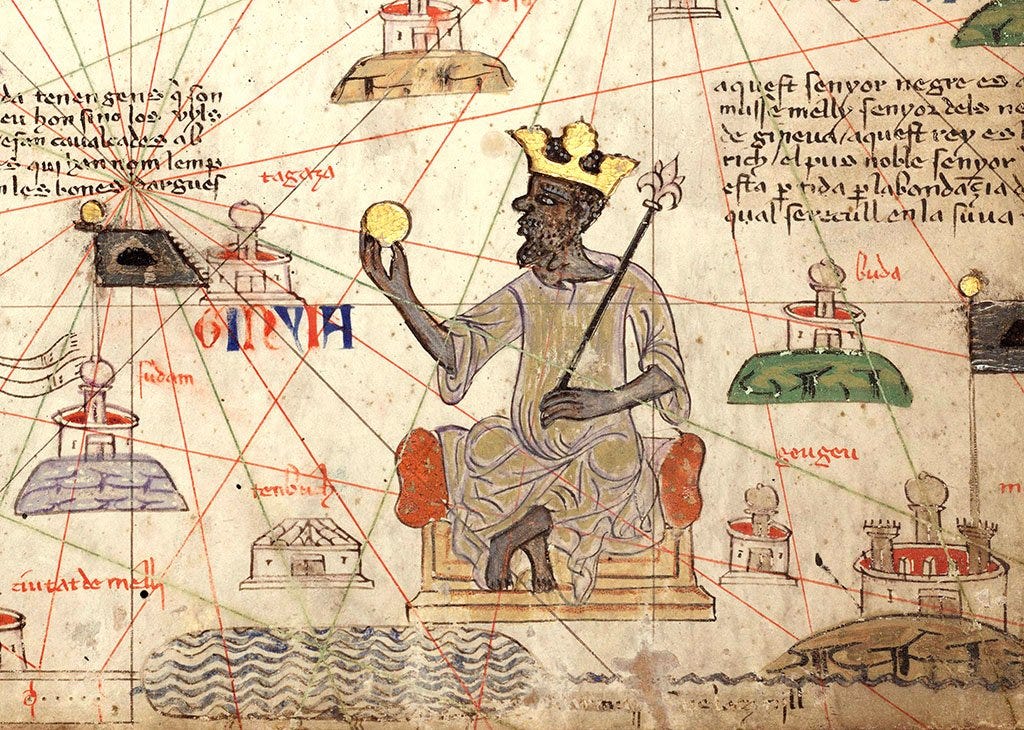
Detail from the 14th-century Catalan Atlas showing Mansa Musa holding a gold nugget.
The globe-trotter Ibn Battuta, who visited Mali in 1353, doesn’t mention a treasury but describes the gold ornaments found at the court of Mali, and the use of gold dust for paying court officials. He adds that near the end of the Ramathan fast, Mansa Sulayman (r. 1340-1359) “distributed money to the qadi, the preacher and the jurists” and gave 133 1/3rd mithqals of gold to the traveller.6
According to information obtained by Ibn Khaldun from a qadi of Gao, it was Mari Jata (r. 1360-1374) who reportedly “squandered the treasure” and ruined the empire.
“His extravagance and profligacy, reached such a point that he sold the boulder of gold which was the prized possession of their treasury. It was a boulder weighing twenty qintars … They regarded it as the rarest and most precious of treasures because its like is so scarce in the mines.” He adds that “In his loose living he squandered other royal treasures.”7
The Songhai empire under Sonni Ali (r. 1464-1492) ultimately conquered most of Mali’s territories and assumed control of the gold routes.
The correspondence between Askiya Muhammad (r. 1493-1528) and the Maghrebian scholar Al-maghili (d. 1505) refers to a public treasury which had been left by Sonni ‘Ali, consisting mostly of gold dust. The 17th century Timbuktu chronicle Tarikh al-Sudan reports that 300,000 mithqals of gold (approx. 1275 kg) were recovered after Sunni ‘Al’s death, some of which was spent by Askiya Muhammad on pious works during his pilgrimage.8
Leo Africanus reports that the Askiya of Songhai “possesses great treasure in coin and gold ingots. One of these ingots weighs 1,300 pounds.” He adds that the Askiya collected tribute of 150,000 ducats/mithqals from the city of Agadez (W. Niger). According to Hunwick, much of this gold likely came from the Akan gold fields via Hausaland.
He also mentions that while the king possessed a lot of gold, some of which he used to gild his furnishings. However, the King refused to pay merchants with this gold, and for this reason, Leo Africanus refers to him as ‘mean’.9
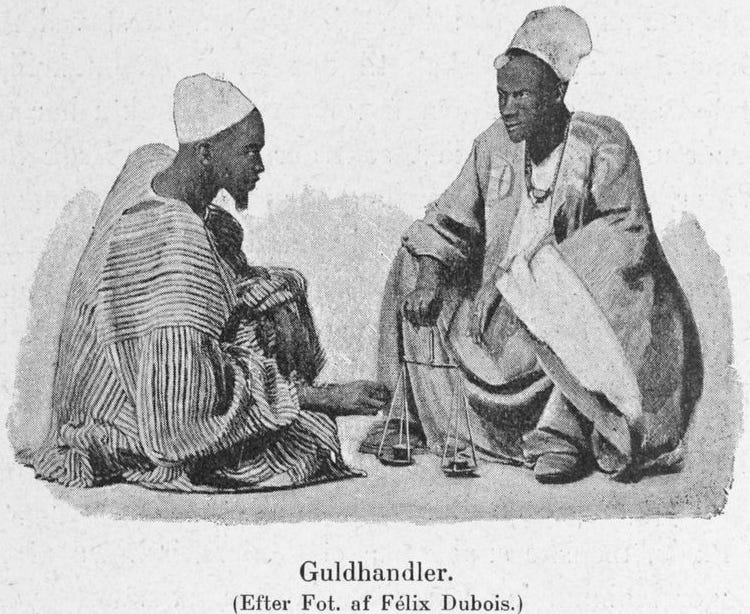
‘gold merchants’ in Timbuktu, Mali, ca. 1896
Internal and external accounts suggest that this royal treasury was spent on redistributive exchange between rulers and subordinate officials, on pious donations, and on maintaining the army.
This system of redistribution, which has been explored in greater detail in anthropological and historiographic literature on Africa (especially in Asante and Dahomey), is explicitly described in al-Umari’s account of Mali:
“The emirs and soldiers of this king have fiefs and benefices. Among their chiefs are some whose wealth derived from the king reaches 50,000 mithqals of gold every year, besides which he keeps them in horses and clothes. His [the king’s] own ambition is to give them fine clothes and to make his towns into cities.”10
The Tarikh al-Sudan reports that the invasion of Timbuktu by Songhai’s Sonni Ali in 1468 was instigated by the Timbuktu-koi (governor of Timbuktu, an official from the era of imperial Mali) because he had not been given his share of the taxes collected by the city’s Tuareg ruler Akil, which amounted to a third of the 3,000 mithqals in one day.
The chronicle explains that, traditionally, the Timbuktu-koi used this sum to buy textiles for the nomadic Tuareg (likely for redistribution rather than just apparel) and for entertaining them when they came from their camps to Timbuktu. Akil, who had seized the town after the withdrawal of medieval Mali, initially left the Timbuktu-koi in charge before he decided to assume direct control.11
With regards to pious donations, the same chronicle provides an account of the pilgrimage of Askiya Muhammad, who donated about 100,000 mithqals in the Hejaz, apparently more than Mansa Musa’s 20,000 mithqals. Neither of these figures is accurate, but they were, in all likelihood, intended to glorify the Songhai ruler, especially considering that Mansa Musa’s wealth and generosity are much better documented in external sources.12
In external accounts, the Askiya’s pilgrimage is confirmed by a letter from 1511, based on information from Jewish merchants in the Maghreb. It mentions a ‘Negro king of Guinea’ named ‘azquya’ (ie, Askiya) at the head of a bi-annual caravan from ‘Takrur’ (Muslim West Africa) that arrived in Cairo carrying a lot of gold.13
Although there is some evidence that the Askiya had funds of his own that were different from the state treasury, in practice, there was probably not a very fine distinction. Leo Africanus claims that the officials of Timbuktu, the qadi, and the major scholars were supported by the Askiya Muhammad, probably similar to the tradition described by al-Umari. 14
According to the Tarikh al-Sudan, Askiya Ishaq (r. 1539-1549) reportedly collected 70,000 mithqals of gold from the merchants of Timbuktu by ‘extortion’ (ie, more than the Zakat he was entitled to). The chronicler adds that “No one mentioned this during the askiya’s lifetime for fear of harsh punishment.” According to Hunwick, this figure is equivalent to about 315 and 350 kg of gold.15
During the reign of Askiya Dawud (r. 1549-1582), the Songhai ruler sent 10,000 mithqals of gold to the Moroccan/Saadian sultan al-Mansur (r. 1549-1603). The text indicates that this was a goodwill gift, but the latter may have interpreted it as a remission of taxes accruing from the salt mine of Taghaza, which was controlled by Songhai but claimed by Morocco.16
Dawud also donated money for the reconstruction of the Great Mosque of Timbuktu that was undertaken by the qadi al-Aqib.17 The Tarikh Ibn Mukhtar, another 17th-century chronicle, mentions that the qadi spent about 66.67 mithqals (283 grammes) on the construction.18
After his death, disputes between the Saadian ruler al-Mansur and the Songhai rulers over the ownership of Taghaza ended with the invasion of 1591.
The invading army seized large amounts of gold from Songhai, estimated to be about 100,000 mithqals, or 500kg, with other amounts arriving over the course of about a decade. Much of it was from the Askiya’s treasury, and the rest was taken from the homes of the scholars of Timbuktu and even from the soldiers, mostly in the form of gold dust and jewelry.19
There are numerous accounts (West African, Moroccan, and European) which describe the capture of this gold, virtually all of which was seized from the royals of Gao and scholars of Timbuktu, rather than obtained through trade.
To give just two examples; an English merchant, Lawrence Madoc, writes of the arrival in July 1594 of princes from Gao along with “thirty mules laden with gold.” Another English merchant in Morocco, Jasper Thomson, reported the arrival of Jawdar Pasha on 28 June 1599 with 30 camel loads of gold dust, as well as pepper, horses, captives, and some of the royals of Gao.20
For context, Mansa Musa took about 100 camel-loads (about 12 tonnes) of gold on pilgrimage, so the quantities of gold taken from Songhay must have been equally significant.
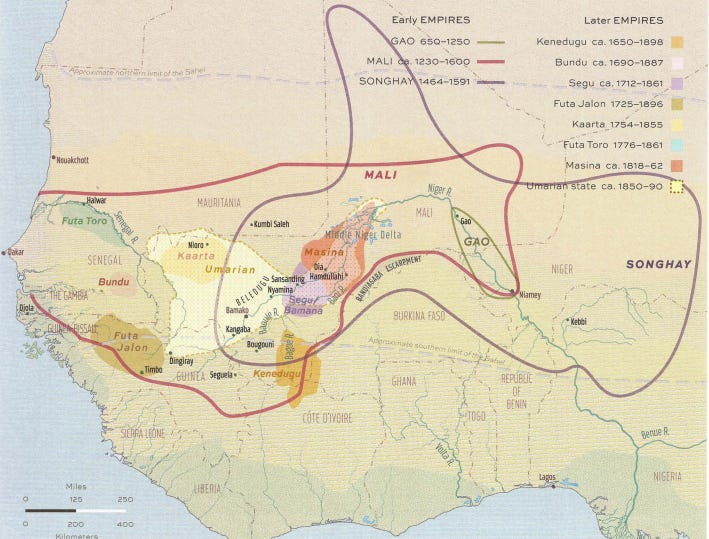
Map showing some of the empires mentioned in this essay.
After the collapse of Songhai, imperial administration was reconstituted in the 18th century following the rise of the Bambara empire at Segu, and the Tukulor empire of Umar Tal, which conquered Segu in 1861.
Like their medieval predecessors, the rulers of Segu reportedly kept a state treasury, part of which consisted of gold. Most accounts describing this gold come from after Umar Tal’s conquest of Segu.
At Segu, Umar found storehouses full of treasure, which he distributed among his army. The value of the gold alone was reportedly worth 20 million francs, according to an account by the French traveler Eugene Mage, who visited Segu in 1864, although he later suggests that the figure may have been exaggerated.21
In his travel account, Mage notes that a gold gros from the Bouré gold fields south of Tukulor is worth 12.50 to 18 francs, and that 12 grams of gold in Segu was worth 36 francs. This suggests that the treasure was worth between 110,000 and 160,000 gros, or 666.7 kg of gold.22
He provides other figures he consideres more reliable, including a gift of 800 gros of gold from Umar Tal (r. 1854-1864) to the Kunta shaykh of Timbuktu; a trader who had received 340 gros of gold from the king and gave it to Mage for safekeeping; and a departing gift from Umar’s successor Ahmadou Tall (r. 1864-1893) of two gold bracelets, each worth 100 gros.23
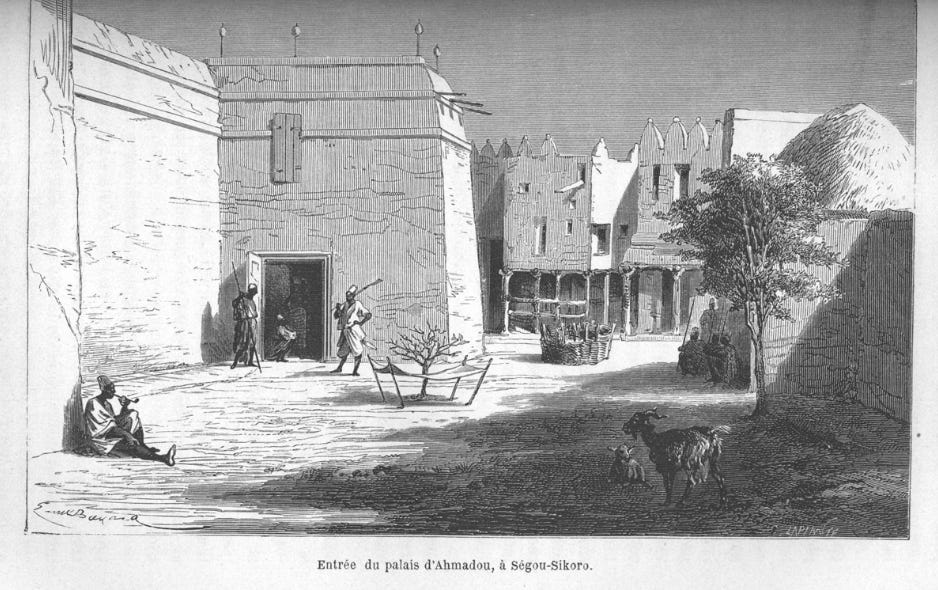
Palace of Amadou at Segou, Mali. ca. 1863-8, Engraving by Eugene Mage.
Chronicles of Umar Tal’s conquest, which were written in the late 19th century, describe this treasure in more detail:
“When the Shaikh came to his [Ali’s] private chambers, he found his [uneaten] food. The bowl was made of gold, the soap dish was gold, the wash basin was gold, the carpet was of woven gold, his walking stick was gold, ... even his bed was made from gold. The Shaikh entered the storehouse and found it partitioned into various apartments. He found stores of gold of such an amount that no one had ever counted its value.”24
It’s suggested that the Tukulor rulers also kept a treasury, containing gold obtained through tribute. According to the French traveler Paul Soleillet in 1878, the Bure gold-producing region initially paid al-Hajj ‘Umar a tribute of 10,000 gros of gold, but later stopped after he had shifted his campaigns northward. (c.1855).25
Another chronicle recounts that Umar distributed a large number of gold and silver coins (possibly imported Thalers) and great quantities of cowries, salt, and cloth to the talibés (his followers/soldiers).26
Umar also kept the gold and wooden ‘fetishes’ from the palace of the defeated Bambara rulers to serve as a proof text, in the religiously couched ideological dispute he had with their ‘protectors’; the Muslim state of Massina/Hamdallaye and the Kunta of Timbuktu. Ironically, Umar spent a large sum of gold recruiting the non-Muslim Dogon of Bandiagara shortly before he was defeated by the Massina and Kunta.27
The gold and wooden objects kept by Umar Tal at Segu had been used in annual rituals that recalled the founding of the Segu state in the 18th century, and it was this treasure that would later be seized by the French and carried off to Western museums after the colonial conquest.
At the time of its capture, the treasure contained just 75kg of gold, as well as over 160 tons of silver.28 ( $10m worth of gold, $351 m of silver based on current prices)
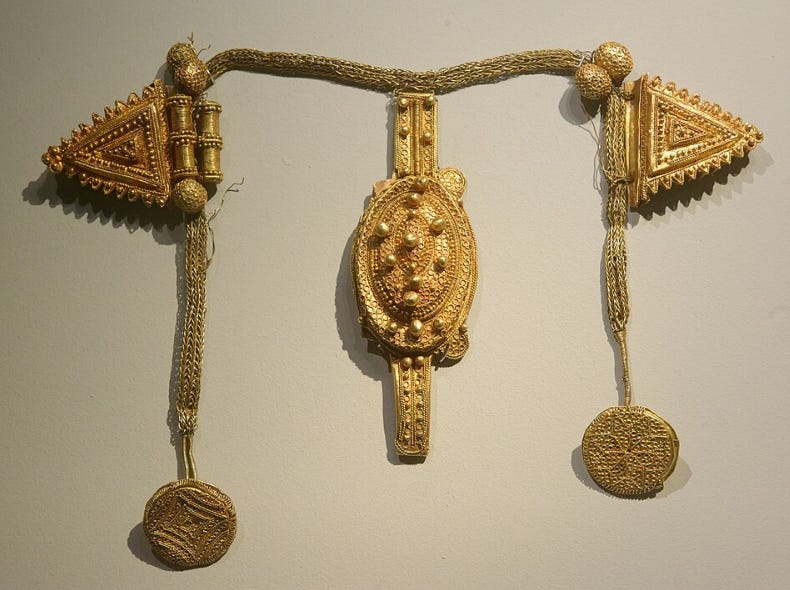
Gold necklace from Ségou, Mali. Taken as spoils of war by Colonel Archinard, 19th century. Quai Branly.
Gold as currency in medieval West Africa: gold coins, gold dust, and measurements
There are also several references to the use of gold coins in West Africa from the Middle Ages to the late 19th century, whose corroborating archaeological evidence has only recently come to light.
The first of these comes from al-Bakri in the 11th century, who mentions that in the medieval town of Tadmekka (Mali) “Their dinars are called “bald” because they are of pure gold without any stamp.”29
Leo Africanus’ description of Djenne in the early 16th century also mentions that “the coinage used by these blacks is unstamped gold,” while iron was used for smaller purchases. He adds that Timbuktu, “instead of coined money they use pieces of pure gold,” while cowries were used for smaller purchases.30
Excavations at Essouk-Tadmekka in Mali have uncovered evidence of gold-coin moulds and crucibles from occupation levels from the 10th to 12th centuries CE. Similar coin moulds had also been found during excavations at the site of Tegdaoust in Mauritania.
The gold from Essouk’s crucibles has a high level of purity (atleast 98%), and given the absence of refining waste, was likely obtained in its natural form, which fits with analyses of modern West African nuggets. The Archaeologist Sam Nixon suggests that the Almoravids brought an end to Tadmekka’s coinage as they tried to reduce the importance of competitor coinages to their own.31
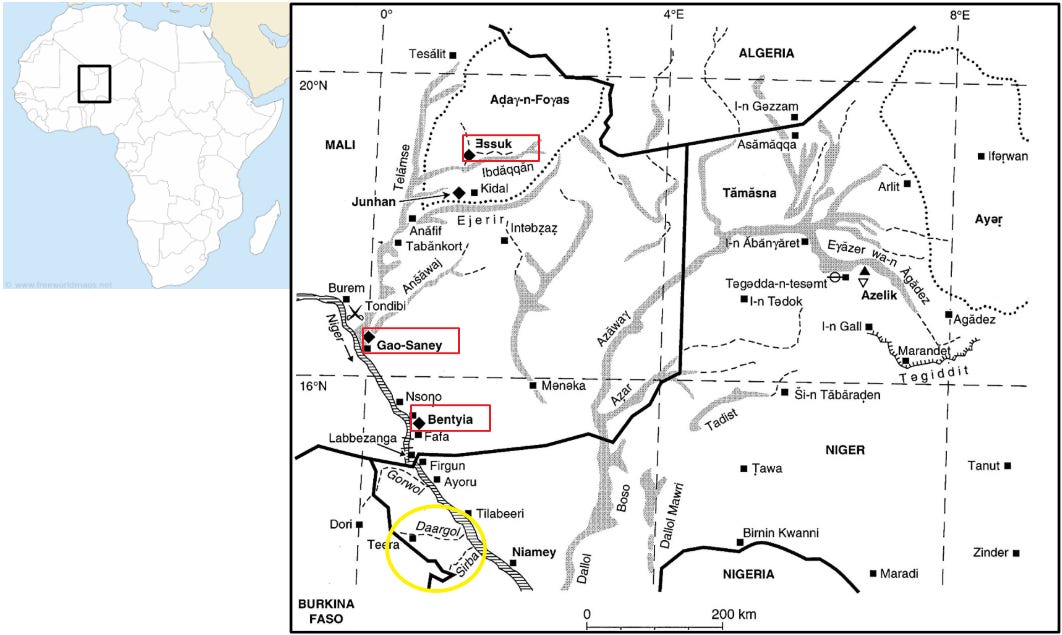
Map showing Essouk, Gao, Bentyia, and the goldfields of S.W Niger. Map by Paulo de Moraes Farias
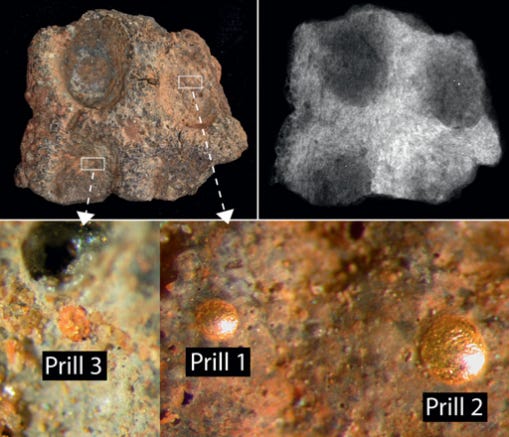
Fragment of ceramic mould for producing gold coin blanks, excavated at Tadmakka, shown together with radiograph (top right) and close-up of individual prills trapped in surface. Images by S. Nixon.
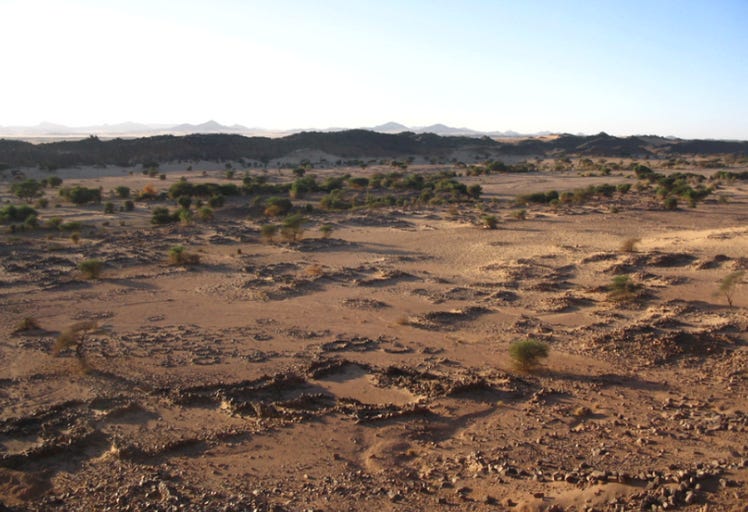
East-west view across the central area of the Tadmekka ruins. Image by S. Nixon.
It’s been suggested by Paulo de Moraes Farias that the mint at Essouk was supplied with gold from the mines south of Bentyia, rather than the better-known mines of Bambuk and Bure. Bentyia was a medieval town south of the Songhai city of Gao, which was later also associated with the Wangara gold trade. Archaeological surveys have recovered small clay crucibles at some of these sites, suggesting that the metal was smelted in the area.32
In addition to these finds, a 10th-century gold dinar was found at Gao (Mali), six Almoravid gold coins were found near Tegdaoust, and at least five silver coins and a copper-alloy coin were recovered from excavations at Essouk. The origin of these silver coins is unclear, but they may have also been of local manufacture.
It’s relevant to note here that silver coins are also mentioned as currency in al-Umari’s 14th century description of the Kanem empire, which was east of Essouk and was apparently its suzerain in the previous century. A 15th-century account also describes the presence in Egypt of silver coinage from ‘Bilad al-Takrur’, a generic name for West Africa. These imported coins were considered illegal in Mamluk Egypt and were brought to be melted down.33
These archaeological discoveries, which are fairly recent, suggest that historical references to indigenous West African coinage should now be more seriously considered.
According to Sam Nixon, given the historical evidence from Djenne and Timbuktu, it shouldn’t be surprising that the presence of abundant gold and exchange with coin-based economies led to the production of coinage.34

Copper-alloy and silver coins from medieval Essouk-Tadmekka, images by Sam Nixon.

The empire of Kanem during the late Middle Ages.
In the post-medieval period, the most suggestive of this historical evidence of local coinage comes from the 19th century, describing the ‘Nikky dinar’ of the Wangara traders in Borgu (Benin) and the gold dinars of Araouane (Mali).
According to the British consul Joseph Dupuis, who visited the kingdom of Asante (Ghana) in 1820, from where he obtained two of the gold coins minted at Nikky. He explains that in the eastern neighbours of Asante, the mithqal was simply a “nominal coin” for they are not manufactured there, “they are only partially current from the influx of specie brought by the northern traders.”
He then adds that “Nikky, the capital of Bargho or Killinga, is the great mint of Soudan, south of the Niger, as Bornou is that of the north; such was the similitude used by my informers, who shewed me two pieces of money of the description, which were stamped, as clearly as I could discern, with characters similar to the mitskal of Morocco, although the impression, from the purity of the metal, was too much defaced to enable me to trace the year or the whole of the writing. I was told they were the coin of Kilinga [Borgu] and that they were current not only in Wangara, but also in Bambarra, Maroa, Fillany, Haussa, some parts of the desert, and even in Egypt.”35
Dupuis suggests that the gold from which the Nikky mithqal was minted came from Bonduku; from there it was sent to Salaga, Yendi, and other towns to the north-east of Asante, from which it reached Nikky by way of Zogho [Djougou] and other intermediate towns. At Nikky, which Dupuis calls ‘the great metropolis of the great kingdom of Bargo’, he states ‘it is transformed into trinkets and ducats (mitskal)’.36
Dupuis notes that its value was reckoned at thirteen to the Ashanti benda, about 11s. 2d. Sterling. and that it never varied ‘from the standard that passed for currency in all parts of the continent.’
The coin was used along the routes used by the Wangara traders, but the social upheaval of the era was beginning to disrupt the trade at the time Dupuis was writing. Nikky eventually came under the control of the emirate of Katsina (a province of the empire of Sokoto), and by mid-century had evidently ceased to mint gold coins.37
Archaeological research in this region, which remains limited, has yet to recover the Nikky coins, which may have been melted or converted to jewelry. Recent excavations at the site of Bogo-Bogo in northern Benin yielded a number of metal objects from occupation levels dated to the 19th/early 20th century, including a coin made from an unidentified metal, with one surface decorated, that was seemingly used as a pendant.38
These dinars could have been a relic of an older monetary system of the medieval period (described in Tadmekka, Kanem, and Songhai) that was quickly becoming displaced by the mass importation of cowries, which only reached the interior in significant sums during the 18th and 19th centuries.
When Hugh Clapperton visited Kano in 1822-4, which he described, with some exaggeration, as the best-regulated market in Africa, he mentioned that the governor of the market fixes the exchange prices between the two main currencies: cowries and silver.
He notes the “great convenience of the cowrie, which no forgery can imitate; and which, by the dexterity of the natives in reckoning the largest sums, forms a ready medium of exchange in all transactions, from the lowest to the highest.”39
Further east in Bornu, the Sheikh al-Kanemi reportedly requested that Dixon Denham, Clapperton’s companion, send equipment for minting gold, silver, and iron coins to replace the cloth-currency that was in use at his capital, Kukawa.40
Further east in the town of Logone-Birni, where both gold and silver were unavailable, and cowries hadn’t been adopted, Clapperton reported that the traditional currency was thin, horse-shoe-shaped plates of iron, for which there was a lively currency market.
“The money market of Loggun, has its fluctuations: the value of this “circulating medium” is settled by proclamation, at the commencement of the weekly market, every Wednesday; and speculations are made, by the bulls and bears, according to their belief of its rise or fall.”41
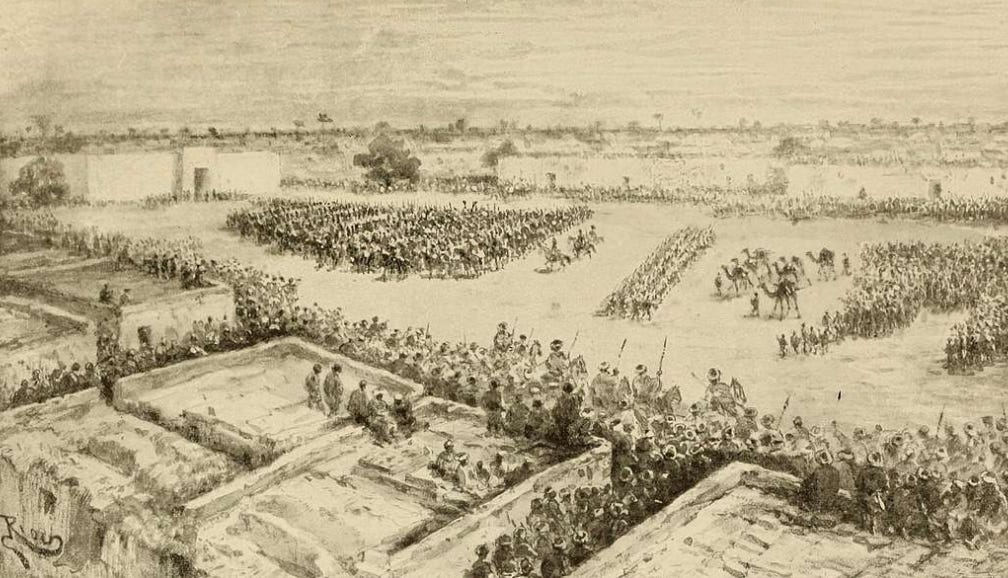
Reception of Monteil by Bornu’s courtiers, army, and spectators at Kukawa, Nigeria. ca. 1891
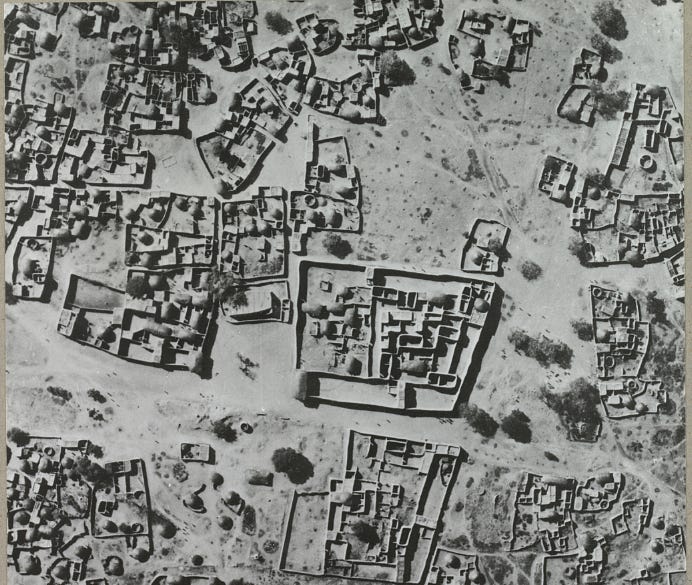
Aerial view of Logone-Birni, Cameroon. ca. 1932 Quai Branly
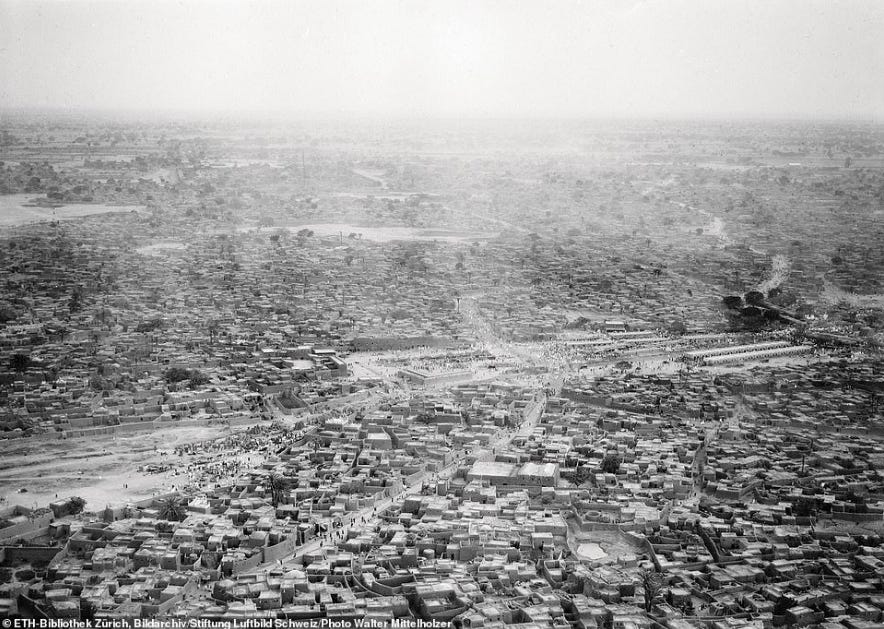
Aerial photo of the city of Kano, Nigeria in the early 1930s
At the time of René Caillié’s visit in 1828, the only market in which solid gold currency prevailed was the town of Araouane, north of Timbuktu:
“Cowries, which are the current money of Soudan (West Africa), do not pass at El-Arawan. There, nothing circulates but gold and silver —neat pieces of the value of a mitkhal, in imitation of the money of Morocco. The gold mitkhal increases in value as you approach the coasts.”
He adds that the value of the gold ‘mitkhal’ is about twelve francs, and the silver mitkhal about four.42
The Austrian explorer Dr. Oskar Lenz, who traveled from Morocco to Timbuktu between 1879 and 1880, found that gold coins had disappeared from both Morocco and Araouane.
He explains that the mithqal in use at El Arouan and at Timbuktu was a unit of weight, not a coin, weighing ‘about 4 grams’. By his time, the gold-dust currency had ceased to circulate, such gold as was in circulation being in the form of rings, small gold plaques, and small grains.43
Lenz observed that because the Moroccan gold coins were made of very high-purity gold, they were hoarded or exported to Europe for profit, leaving only debased or common metal coins in circulation. A similar fate had likely befallen the Nikky dinar and the unstamped coins of Tadmekka and Djenne before them.
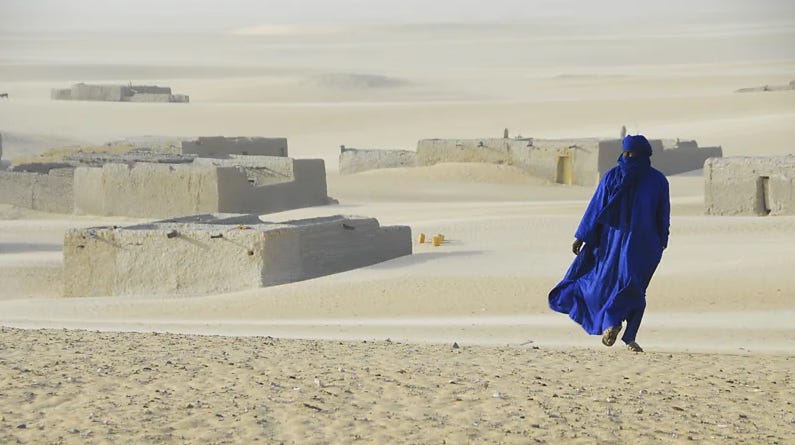
Remains of the old town of Araouane, now largely abandoned and partially submerged by the surrounding dunes. Image by Anthony Ham
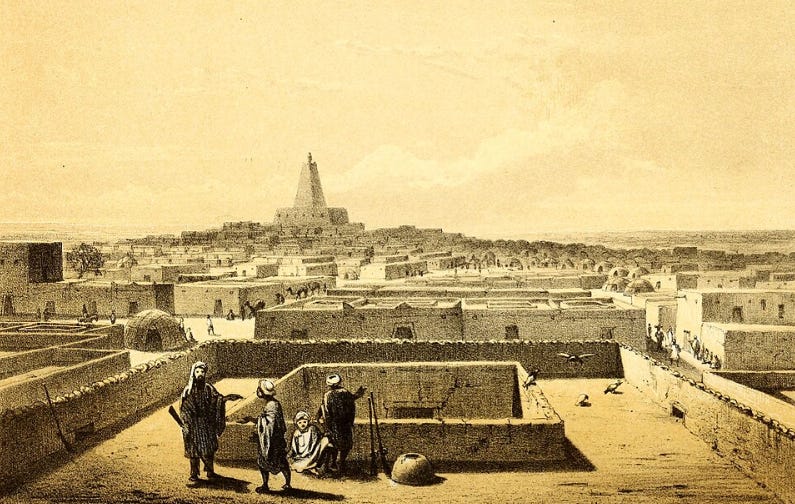
Timbuktu from the terrace of the traveller’s house. H Barth, 1853
The measures of Gold currency in West Africa
The mithqal, which is derived from the Arabic word for weight, was the standard measure for weighing gold dust, averaging 4.25 grams; any variations were due to custom and weighing techniques. It was the only pre-colonial Western African measure corresponding to an actual weight as opposed to a quantity, and was also used as a standard unit of account.44
One of the earliest references to the use of scales/weights in the conduct of West African gold trade comes from the Portuguese trader Andre Alvares de Almada, who described trade in Sutuko (Gambia) in the 1560s:
“At the village of Sutuco there are transactions in gold, which is brought there by Mandinga traders who are also men of religion. The gold is of good quality, most of it golddust but some of it in pieces. These traders are very knowledgeable regarding weights and everything else. They have very sensitive balances ... and silk-thread strings. They [also] have little writing desks made of leather, without fasteners, in the drawers of which they keep the weights. These are in brass and look like dice; [but] the marco [eight ounce weight] looks like a sword pommel.
The gold is brought in quills of big feathers and bones of cats, hidden and strapped in their clothing. These traders spend much more than six months on the trip;... they travel in obedience to the orders to the Black Emperor, whom all the Blacks of this Guinea we are talking about obey. He is called Mandimanca [king of Mali] ..The inhabitants of the Mina (El-mina in Ghana) refer to this king as ‘Big Elephant’.”45
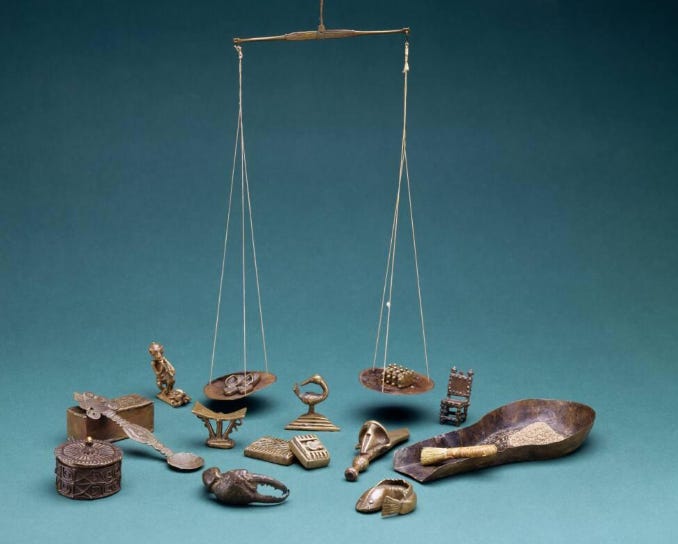
Gold scales with weights 18th-19th century, Akan, Ghana & Cote D’ivoire. Houston Museum of Fine Arts
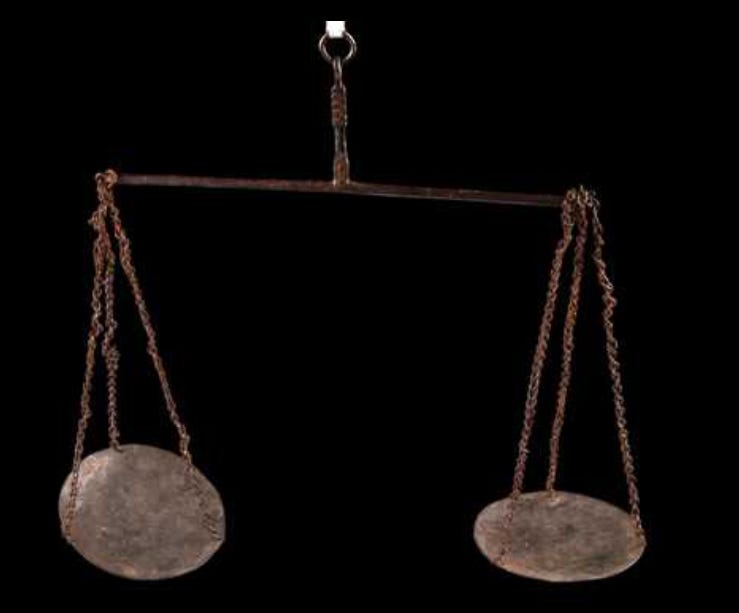
Jeweler’s scale. Trarza, Mauritania. ca. 1938. Quai Branly
While variations in certain measures rendered comparisons difficult, the gold weight or mithqal was apparently a stable 4.25 grams across most African markets, and it served as a common unit of account from Kumasi to Cairo, which formed the basis of currency exchanges between silver, crowries, and salt bars.
The price of the cowrie shell money remained stable in the region from the late 17th until the early 19th century, with an exchange rate of around 3,000 cowries to the gold mithqal. In the mid-19th century, the price of cowries varied greatly even within West African markets. But in the course of the century, the shell money progressively lost value due to import-led inflation.46
At the time of Leo Africanus, a camel-load of salt (about 250 lbs) was worth eighty ducats/mithqals of gold.47 When Mungo Park visited the region in 1795, he reported that most of the gold was exchanged for salt and other merchandise. He provides an exchange rate of one slab (2.5ft long) for 2 pounds 10 shillings sterling (ie, £2 10s. 0d sterling), and one mithqal at I2s. 6d. sterling. Meaning 4 mithqals of gold bought one slab of salt.48

Changing value ratios of gold, silver, and cowries in the ‘western Soudan’. image by Philip Curtin.49
He mentions that each trader carried his own small balances for weighing gold, and that both gold dust and wrought gold had the same value. The unit of measurement was the minkalli/mithqal, valued at I2s. 6d. sterling. It could be subdivided further for small purchases measured using a teelee-kissi (black bean), of which six were equivalent to a mithqal.50
René Caillié found that merchants at Kankan (Guinea) used gold dust as both currency and a trade item, and carried “small scales made in the country.. Which are as accurate as ours.” The weight of the gold was measured against the black seeds of a particular tree, two of which were equivalent to six francs. The gold at Kankan came from Bure, often shaped into earrings valued at between 6 and 25 gourdes (Spanish silver), or as gold dust kept in quills.51
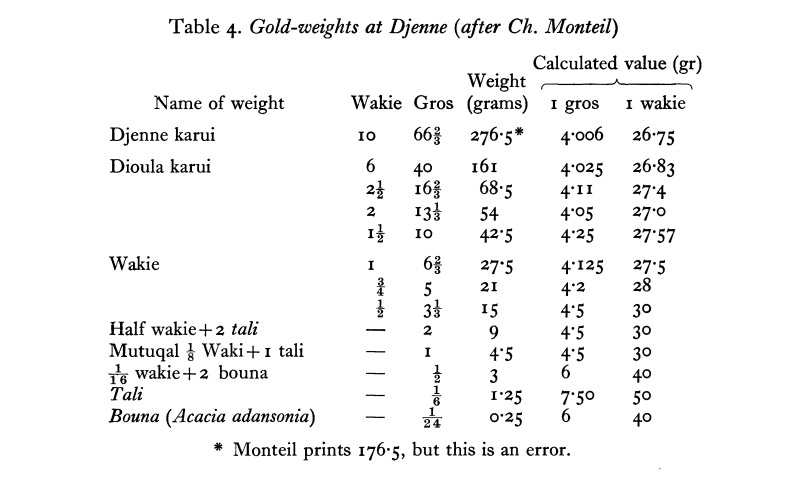
Gold weights at Djenne, Table by Marion Johnson.
It’s relevant here to note that in Europe and Asia, the mithqal, like the ounce, was usually subdivided into grains, and often also into larger divisions, also based on common fruits or seeds. Most of the European grains resolve themselves into three groups, based on the troy grain, which is the barley grain (0.0648 grams); the wheat grain/ Roman grain, about 0.75 times the weight of the barley grain; and an intermediate grain, about five-sixths of the barley grain.52
The English troy weight system, and some of the Arab systems, are based on the barley grain; the Dutch use the ass, a wheat grain three-quarters of the weight of a barley grain. The Spanish grao used in gold weighing was about the same size as the Dutch; but in gold weighing, there were only 600 to the ounce. The French used the intermediate size of grain, about 0-82 of the troy grain, counting 576 grains to the ounce.
In West Africa, the seed of Arbrus precatorius formed the basis of a grain-mithqal system. It has a conventional weight of about I.25 troy grains, and is the basis of the Akan gold-weights system, being usually 1/24 ackie. In the Fezzan (Libya), this was known as ‘ain el Dik and had the conventional weight of half a Kharub (carob) bean, 2 wheat grains, or I.5 barley grains. Interestingly, the Fezzan seed was reported to have been brought from West Africa, and is associated with a dynasty claiming West African origins.53
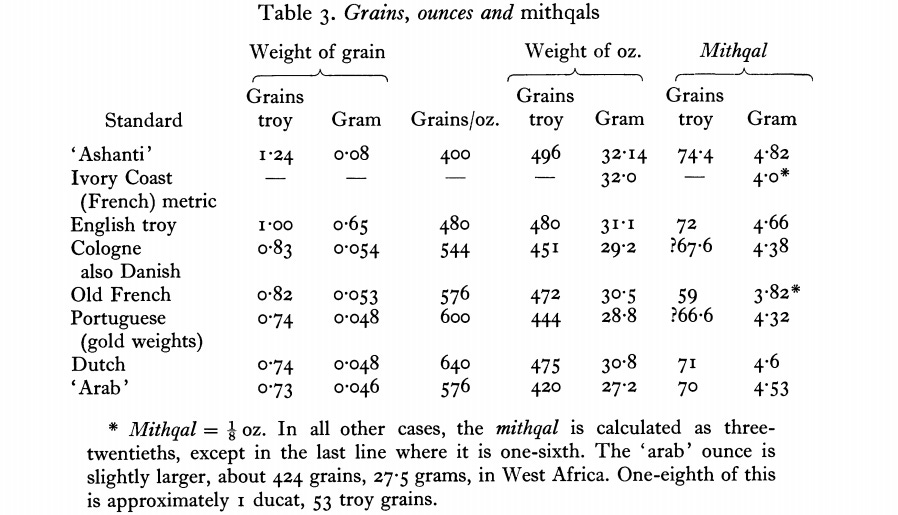
Grains, ounces, and mithqals across Africa, Europe, and Asia. Table by Marion Johnson.
Internal textural evidence indicates that scribes were also paid in gold, and books were purchased directly with gold; their prices could vary considerably.
The colophons of the Mukham of Ibn Sidah, which was copied in Timbuktu in 1573, indicate that the copyist was paid 1 mithqal of gold, while the proofreader was paid 0.5 mithqals.54 In the same city, the 16th century historian Mahmud Kati found for sale the dictionary, al-Qamus of al-Firuzabadi (ca. 1410), costing 80 mithqals, and he sought the gold to buy it from Askiya Dawid.55
Various manuscripts from private collections in Timbuktu, some of which date back to the 15th and 16th centuries, indicate the prices of the manuscripts in mithqals and the amounts paid to copyists and proof-readers, which points to the importance of gold currency in the local book market.56
In Mungo Park’s account from 1795, two mithqals could purchase a dyed cotton garment of local manufacture, one could purchase a bullock, three could purchase a musket, and 10-17 mithqals could purchase a horse.57 In René Caillié’s account from 1824-8, the merchants of Kankan “attached great value” to their gold, “and exchanged it for none but the choicest articles.”58
By the time of Eugene Mage in 1864, gold was rarely used in most market transactions, but was instead almost exclusively used in the import-export trade, especially for firearms.

copy of the al-Qamus of al-Firuzabadi (ca. 1410), 18th century, Aboubacar Ben Said Library. Timbuktu, Mali. images from HMML Reading Room with the permission of SAVAMA-DCI, Num. SAV ABS 03132.
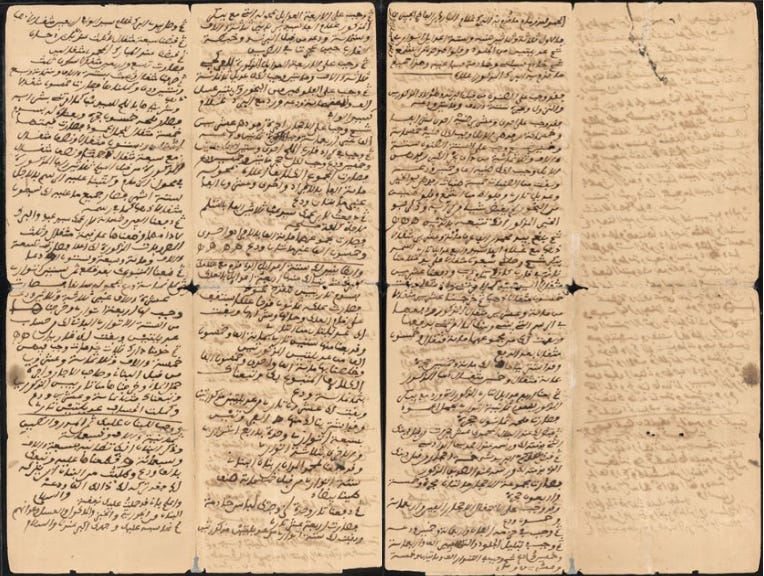
19th cent. manuscript from Hamdullahi, Mali. commercial agreement on trade in several West African cities, including the costs of constructing a house in Massina (Hamdullahi). All prices in gold. Mamma Haidara Library, Mali.
Gold mining in pre-colonial West Africa.
There are several brief references to the mining of West African gold in external accounts, most of dont provide useful historical descriptions of the activity. The exception is found in Al-Umari’s 14th century description of the mining in medieval Mali.
He notes that gold was obtained from ‘pagan’ nations, in exchange for copper at the price of 100 mithqals of copper to 66 2/3rds of gold. “The gold is extracted by digging pits about a man’s height in depth and the gold is found embedded in the sides of the pits or sometimes collected at the bottom of them.”59
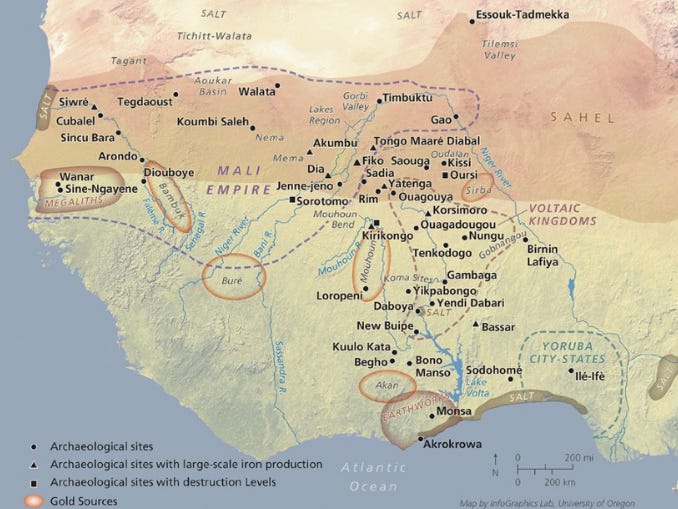
Gold fields of West Africa
Four centuries later, Mungo Park observed a similar process of gold mining in Kamalia (eastern Senegambia, part of the Bambuk goldfields), where gold was extracted by both reef and alluvial mining. Mining activity was organized by the town’s Mansa (ruler), and usually occurred at the end of the harvest season.
The miners were residents of the town (ie, free labourers, not captives), with the men digging the pits and women washing the gold. The earth removed from the pits was drawn up in large calabashes until the miners encountered a gold vein. This ore was then sent up for washing to obtain the gold grains and nuggets. The gold is then kept in quills, and part of it is converted into jewelry for the women.60
His journal describes a similar process at Shrondo and Dindikoo (In the eastern Seneg-Gambia region), where gold was mined from relatively shallow pits (about 10-12 ft deep) next to which were wash pits, on the top of each were different coloured stones that marked each person’s mine. He also describes the process of converting the gold into ornaments using the lost-wax method to make “massy and precious” rings.61
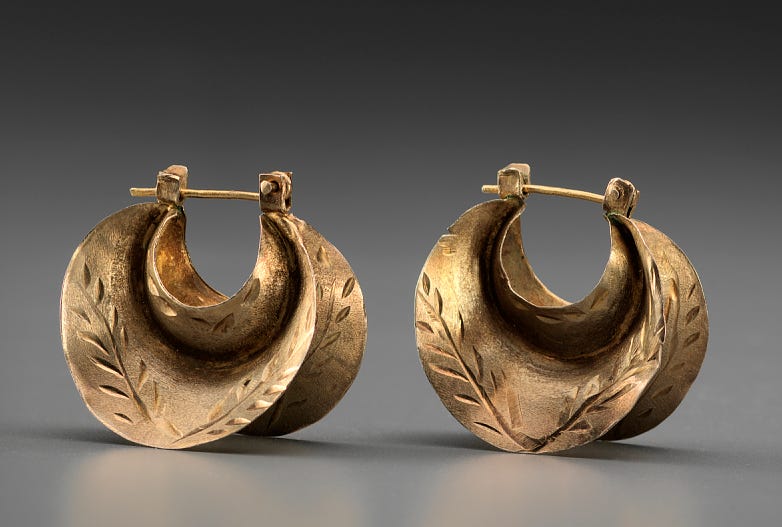
Gold hoop earrings of flattened, flanged design with floral or wheat stalk design incised on both sides and inside of each earring. Senegal. mid-20th century. Smithsonian Institute.
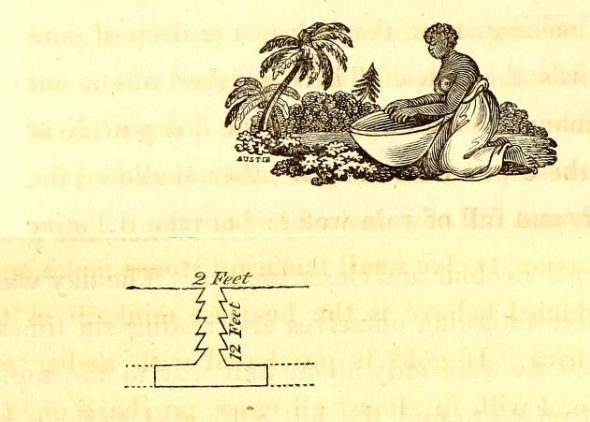
(Top) gold washing (bottom) cross-section of a mine. Shrondo, Senegal. sketch by Mungo Park.
Another traveller, Gaspard Mollien, visited the gold-producing region of Bambuk in 1818, which he describes as a ‘kingdom’ situated to the east of Bundou (Futa Bundu). He reported that when the “king of Bondou goes to war, the proprietors of the mines are obliged to deliver to him the gold which they have amassed, and for which they are paid in flocks and slaves at the end of the campaign.”62
He describes the various mythical traditions associated with the goldfields that were meant to discourage foreign traders from seizing them, and the gold-mining and washing process, similar to that observed by Mungo Park, and mentioned by medieval Arab authors. He estimates that there were thousands of pit mines, the largest of which was 20-25ft deep, and 20ft wide, with steps for descending, but the sides were not reinforced.
“The continual invasions to which the Bamboukians are liable have rendered them so suspicious that they seldom permit strangers to enter their rich country, especially Europeans, whose cupidity is known to them and against whom they have had to defend themselves.”63
Mollien also reported on the goldfields of Bure/Bourré, much further south, “which possesses more gold than all Bondou and Bambouk together. The negroes dig deep to find the metal, and make very long subterraneous galleries.”64
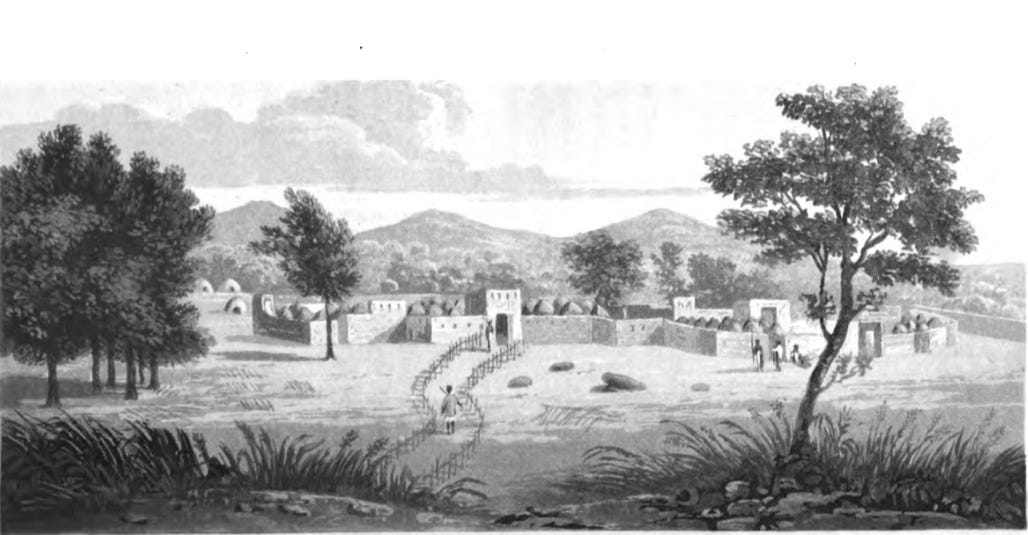
Boolibani, the capital of Futa Bundu, in 1820
The Bure goldfields were later visited by Lieutenant Vallière, when he travelled across the Upper Niger in 1879–1881. Bure did indeed have signifıcant resources of high-quality gold, but it was a very small region. Vallière argued that people talked up the quality of gold mined elsewhere by naming it “gold from Bure.”
After the breakdown of Medieval Mali, the goldfields of Bure were controlled by various polities and confederations, among which Kangaba was the most important. In the 1860s, the region fell under the orbit of, but not the direct control of El Hadji Umar‘s Tukulor empire, which, like medieval Mali, only controlled the trade routes, but not the mines.65
The Bambuk gold fields enjoyed nearly a millennium of notoriety in the Muslim world and in Europe. The earliest among the latter were the Portuguese in the 15th-17th century, who made several unsuccessful forays into the region. They were later followed by the French in 1858-60, whose attempts at extracting the gold using modern techniques failed.
During the colonial period, the French, who despised the extraction methods used by the Africans and replaced them with modern mining technology, found that the gold content of the ores was not uniformly distributed, and thus produced a low average gold content per ton of ore.
According to the historian Philip Curtin, gold could only be mined using less intensive methods during the pre-colonial era because the opportunity cost of labour was low in the dry season, but this had since risen with the increased labour mobility in the colonial period, thus making gold mining largely unprofitable.66
.
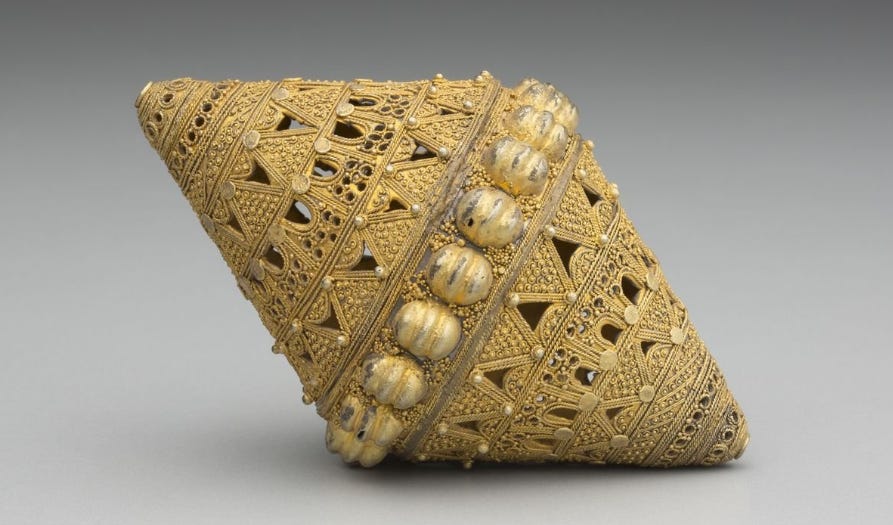
Biconical gold and silver bead. Fulani, Senegal, 19th-20th century. Detroit Institute of Arts
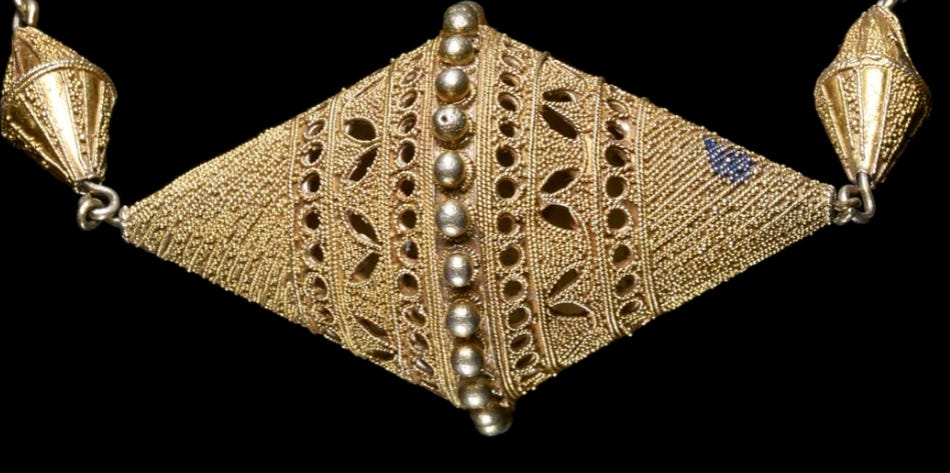
Biconical pendant on a gold-plated silver-alloy necklace. Tukulor artist, Senegal or Mali. Smithsonian Institution.
Goldsmithing and consumption in West Africa.
Al-Bakri, in the 11th century, provides one of the earliest references to the internal demand for gold in West Africa. He reports that the king, his attendants, his horses, and even his dogs are adorned with gold jewelry, while soldiers carried shields and swords decorated with gold.67
Various medieval Arab accounts mentioned above refer to the presence of gold ornaments in the various royal courts of medieval Ghana, Mali, and Songhai, including the firsthand account of Ibn Battuta, the pilgrim caravan of Mansa Musa described by al-Umari and later sources, and the Portuguese descriptions of Mande traders at Elmina (Ghana).
Archaeological evidence suggests that although populations in the Sahel and savannah wore gold, they rarely chose gold to accompany them in death. Excavations of tumuli dating from the Middle Ages in contemporary Senegal and Mali have unearthed only a handful of objects, mostly from the pre-Islamic period, such as the famous Rao Pectoral from the 8th century, as well as gold chains and gold beads from the Wanar and Kael Tumulus, dated to the 6th century CE.68
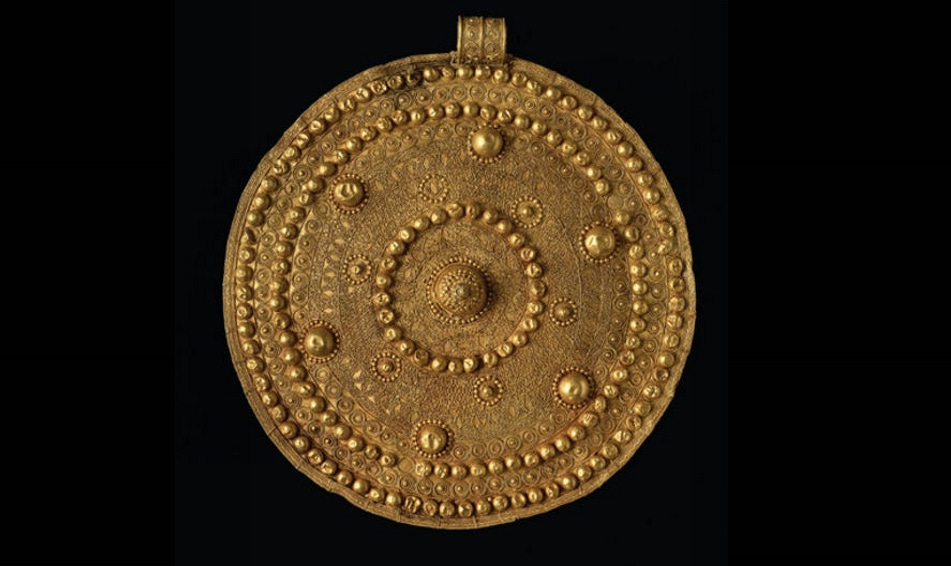
Rao pectoral, 8th century CE, Senegal, Institut Fondamental d’Afrique Noire Cheikh Anta Diop.
Several internal accounts also describe the political, monetary, and cultural value of gold in the kingdoms of the West African Sahel and Savannah.
The wealth of rulers such as Mansa Musa and Aksiya Muhammad was tied to their control of gold ‘mines’ like Bitu/Begho. The foundation of kingdoms and cities in the interior, such as Gonja (N.W Ghana) and Bonduku (N.E Côte d’Ivoire), is attributed to the southern expansion of the Wangara/Juula, and the beginnings of the exploitation of the Akan goldfields of Ghana.69
The Wangara were a commercial diaspora whose name was synonymous with the gold trade networks from the Portuguese coastal fort of Elmina (Ghana) to the trading towns of Libya and beyond.70

Map of west Africa showing the dispersion routes taken by the Jakhanke (yellow), Juula (green) and Wangarawa (red)
Ethno-archaeological research in the town of Djenne during the 20th century indicates that goldsmithing was an old and established profession, undertaken by a diverse community of artisans (Songhai, Somono, Fulbe, Arma). They used the same technology as blacksmiths, to make a variety of gold jewellery and ornaments. They were the wealthiest group of artisans.71
In a broad summary of the ‘arts and manufactures’ of the interior regions of West Africa (principally in the Mandinka regions), Mungo Park observed that
“Most of the African blacksmiths are acquainted also with the method of smelting gold, in which process they use an alkaline salt, obtained from a ley of burnt corn-stalks evaporated to dryness. They likewise draw the gold into wire, and form it into a variety of ornaments, some of which are executed with a great deal of taste and ingenuity.”72
Describing the marriage between Aksiya Dawud and princess Nara, the daughter of the Mali ruler Magha Kanta in 1558, the Tarikh al-sudan mentions that she was sent to Gao along with “a magnificent train” containing jewellery, furnishings, and household goods and utensils “covered in gold leaf.”73
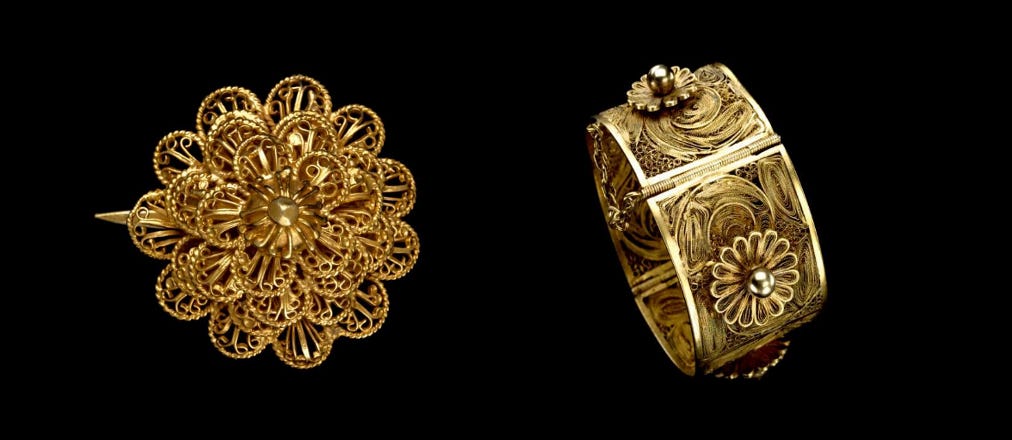
Gold jewellery, Wolof artist, Senegal. early 20th century. Houston Museum of Fine Arts
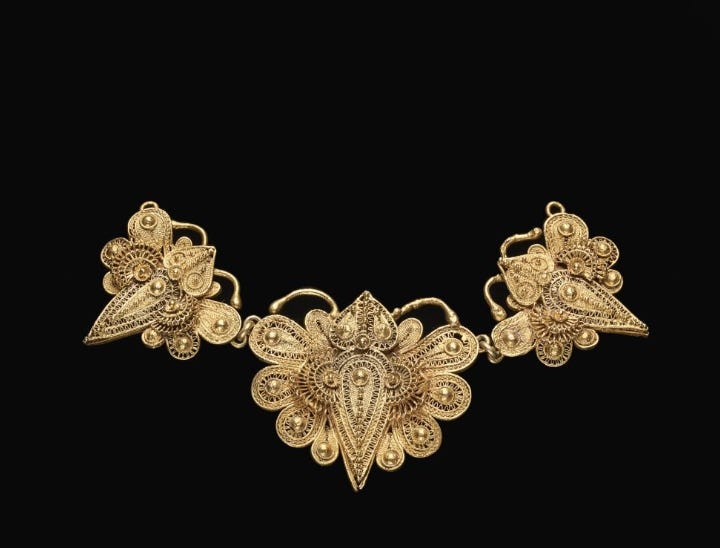
Gold necklace pendant in the form of a butterfly. Wolof or Tukulor artist, Senegal. early 20th century. Smithsonian museum
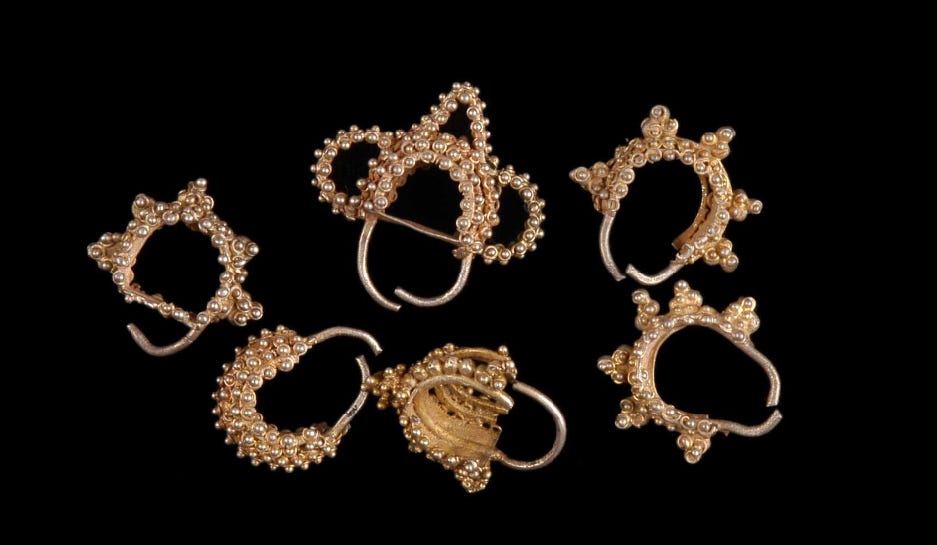
Earrings. gold and silver. West Africa. 19th-20th century. Quai Branly
In the later periods, the internal demand for gold can be inferred from the account of Mungo Park, who described some of the gold jewelry made by local smiths in Kamalia, in Mandinka country, that included “massy” earrings “which are commonly so heavy as to pull down and lacerate the lobe of the ear”, and necklaces of gold beads and plates that display “great criterion of taste and elegance.” He notes that “When a lady of consequence is in full dress, her gold ornaments may be worth altogether from fifty to eighty pounds sterling.”74
These large gold earrings are also mentioned by Gaspard Mollien at Timbo (Guinea) in 1818-975 and by René Caillié at Brakna (S.W Mauritania), as well as in the cities of Jenne and Timbuktu.76 Mage (1864) makes several references to prestige textiles and velvet skullcaps embroidered with gold that were worn by the men of Segu, as well as a variety of jewelry worn by the women.77
Commercial and legal records from the old merchant towns of Mauritania, like Tichitt, reveal that gold circulated in quite large quantities for much of the 19th century, some of which was kept in the form of ornaments (often, large rings) and gold dust.78
Gold necklaces and rings from these regions of pre-colonial West Africa are today found in many African and Western museum collections, where they are displayed alongside other objects like gold bracelets, chains, anklets, hair-pins, and pendants made by local goldsmiths.
The tradition of goldsmithing, like most ancient West African artisanal activities, continues to this day in the modern countries of Mali, Guinea, Mauritania, and Senegal, which remain some of the major producers (and consumers) of Gold on the continent.
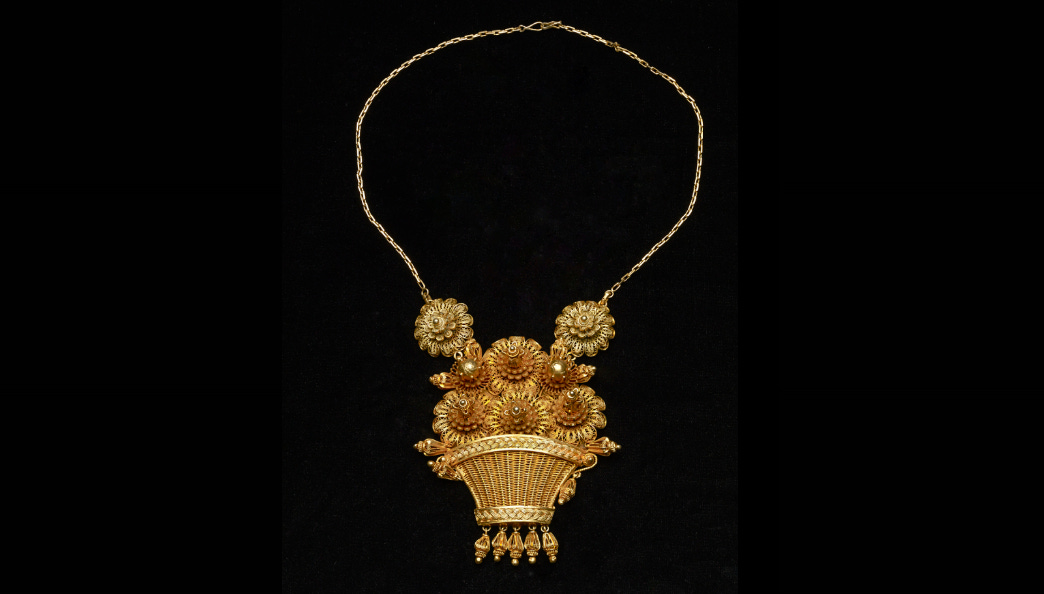
Tukulor gold necklace with a “basket-of-flowers” pendant on a gold chain. early 20th century. Smithsonian Institution.
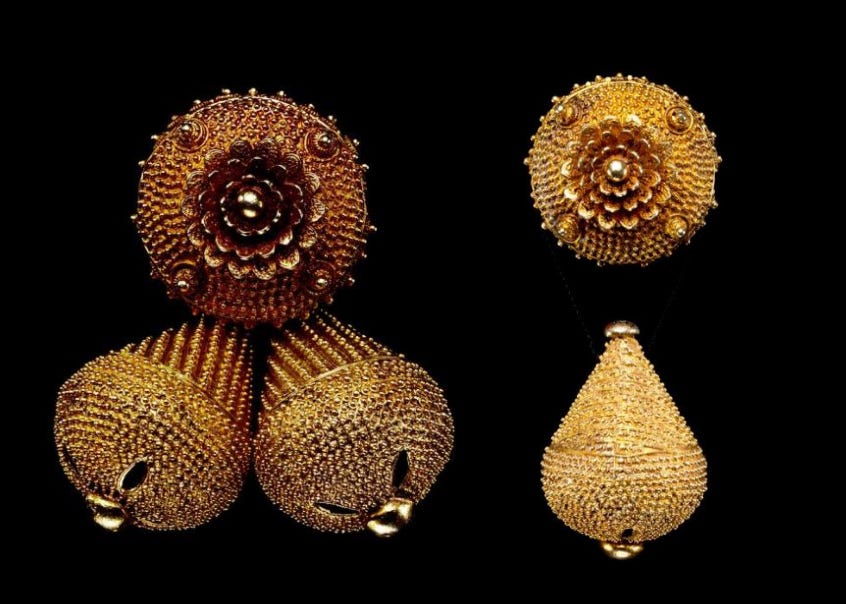
Hair ornaments made of Gold. Wolof artist, Senegal. Early 20th century. Houston museum of fine arts
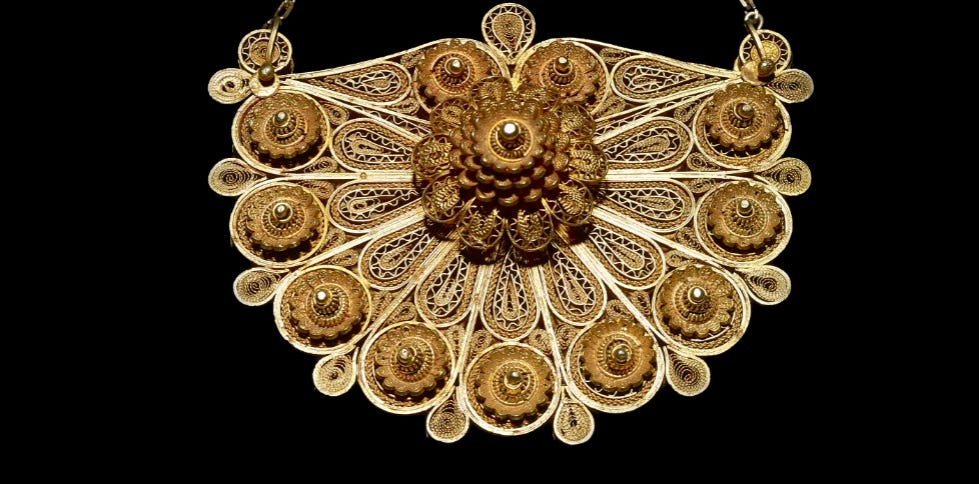
Large gold-plated silver alloy pendant in a variation on the basket of flowers design and heavily decorated with filigree and openwork, with a central, tiered flower. Senegal. mid-20th century. Smithsonian Institution.
Historians and Archaeologists have long observed that West Africa’s earliest texts in the Arabic script come from precisely the same areas where ancient engravings in the Tifinaɣ script were found.
From 1103 to 1489 CE, hundreds of funerary inscriptions and engravings were produced in the medieval sites of Essouk, Junhan, Gao, and Kukyia, in what is today eastern Mali.
These inscriptions are a unique register of internal historical evidence, and the only extant body of dateable medieval texts written in medieval West Africa.
My Latest Patreon article explores the history of the Tifinaɣ script and Arabic inscriptions of medieval Mali (ca. 500-1489 CE), and their significance in the reconstruction of West African history.
Please subscribe to read about it here and support this newsletter:
The Hidden Treasures of Timbuktu: Rediscovering Africa’s Literary Culture by John Owen Hunwick, Alida Jay Boye pg 44, The Last Civilized Place: Sijilmasa and Its Saharan Destiny By Ronald A. Messier, James A. Mille, pg 86-89
Ancient Ghana and Mali by Nehemia Levtzion pg 15
Medieval West Africa: Views from Arab Scholars and Merchants, edited by Nehemia Levtzion, Jay Spaulding pg 15
Medieval West Africa: Views from Arab Scholars and Merchants, edited by Nehemia Levtzion, Jay Spaulding pg 32, 54)
For the collection of sources on Mansa Musa’s pilgrimage, see; Le sultanat du Mali - Histoire régressive d’un empire médiéval XXIe-XIVe siècle by Hadrien Collet
The Travels of Ibn Battuta, AD 1325–1354, Volume IV By H.A.R. Gibb, C.F. Beckingham pg 958-962
Medieval West Africa: Views from Arab Scholars and Merchants, edited by Nehemia Levtzion, Jay Spaulding pg 96
Al-Maghili’s replies to the question Askia al-Hajj Muhammad, edited by John Hunwick pg 78
Timbuktu and the Songhay Empire Al-Sa’dī’s Ta’rīkh Al-Sūdān Down to 1613 and Other Contemporary Documents edited by John Hunwick, pg 280-281, 286, 291
Medieval West Africa: Views from Arab Scholars and Merchants, edited by Nehemia Levtzion, Jay Spaulding pg 56
Timbuktu and the Songhay Empire Al-Sa’dī’s Ta’rīkh Al-Sūdān Down to 1613 and Other Contemporary Documents edited by John Hunwick, pg 33
Timbuktu and the Songhay Empire Al-Sa’dī’s Ta’rīkh Al-Sūdān Down to 1613 and Other Contemporary Documents edited by John Hunwick, pg 10
Timbuktu and the Songhay Empire Al-Sa’dī’s Ta’rīkh Al-Sūdān Down to 1613 and Other Contemporary Documents edited by John Hunwick, pg 335, n.4)
Timbuktu and the Songhay Empire Al-Sa’dī’s Ta’rīkh Al-Sūdān Down to 1613 and Other Contemporary Documents edited by John Hunwick, pg Liii
Timbuktu and the Songhay Empire Al-Sa’dī’s Ta’rīkh Al-Sūdān Down to 1613 and Other Contemporary Documents edited by John Hunwick, pg 142-143
Timbuktu and the Songhay Empire Al-Sa’dī’s Ta’rīkh Al-Sūdān Down to 1613 and Other Contemporary Documents edited by John Hunwick, pg 155)
Timbuktu and the Songhay Empire Al-Sa’dī’s Ta’rīkh Al-Sūdān Down to 1613 and Other Contemporary Documents edited by John Hunwick pg 154
The Chronicles of Two West African Kingdoms: The Tārīkh Ibn Al-Mukhtār of the Songhay Empire and the Tārīkh Al-Fattāsh of the Caliphate of Ḥamdallāhi by Mauro Nobili, Zachary V. Wright, H. Ali Diakité, pg 187, 241, 243
Timbuktu and the Songhay Empire Al-Sa’dī’s Ta’rīkh Al-Sūdān Down to 1613 and Other Contemporary Documents edited by John Hunwick pg 190, 221, 225-226, 313, 315)
Timbuktu and the Songhay Empire Al-Sa’dī’s Ta’rīkh Al-Sūdān Down to 1613 and Other Contemporary Documents edited by John Hunwick pg 221, n. 30, pg 225, n. 46)
Voyage dans le Soudan occidental (Sénégambie-Niger)” by E. Mage, published by L. Hachette et cie pg 312
Voyage dans le Soudan occidental (Sénégambie-Niger)” by E. Mage, published by L. Hachette et cie pg 9, 84
Voyage dans le Soudan occidental (Sénégambie-Niger)” by E. Mage, published by L. Hachette et cie pg 9, 609, 612
The holy war of Umar Tal : the western Sudan in the mid-nineteenth century. by: Robinson, David, pg 266, Historical Writing in Nineteenth Century Segu: A Critical Analysis of an Anonymous Arabic Chronicle by John H. Hanson
In the Path of Allah: ‘Umar, An Essay into the Nature of Charisma in Islam’ by John Ralph Willis pg 21
The holy war of Umar Tal : the western Sudan in the mid-nineteenth century. by: Robinson, David pg 269
The Bandiagara Emirates: Warfare, Slavery and Colonisation in The Middle-Niger, 1863–1903 By Joseph M. Bradshaw pg 5, 53, 62.
Caravans of Gold, Fragments in Time: Art, Culture, and Exchange Across Medieval Saharan Africa by Kathleen Bickford Berzock pg 179-180.
Essouk-Tadmekka: An Early Islamic Trans-Saharan Market Town, edited by Sam Nixon, pg 283
Timbuktu and the Songhay Empire Al-Sa’dī’s Ta’rīkh Al-Sūdān Down to 1613 and Other Contemporary Documents edited by John Hunwick pg 278, 282
Essouk-Tadmekka: An Early Islamic Trans-Saharan Market Town, edited by Sam Nixon, pg 174-187, 275
Bentyia (Kukyia): a Songhay–Mande meeting point, and a “missing link” in the archaeology of the West African diasporas of traders, warriors, praise-singers, and clerics by Paulo Fernando de Moraes Farias, prg 19, 46-51
Essouk-Tadmekka: An Early Islamic Trans-Saharan Market Town, edited by Sam Nixon, pg pg 203-208
Essouk-Tadmekka: An Early Islamic Trans-Saharan Market Town, edited by Sam Nixon, pg pg 274
Journal of a Residence in Ashantee by Joseph Dupuis · 1824, pg cxiii
The Nineteenth-Century Gold ‘Mithqal’ in West and North Africa By Marion Johnson pg 552-553
The Nineteenth-Century Gold ‘Mithqal’ in West and North Africa By Marion Johnson pg 553-555
Two Thousand Years in Dendi, Northern Benin : Archaeology, History and Memory, edited by Anne Haour, pg 369, 699
Narrative of Travels and Discoveries in Northern and Central Africa, Vol II by Dixon Denham, Hugh Clapperton, Walter Oudney, Abraham V Salamé, published by John Murray, pg 253-254
Narratives of travels and discoveries in Northern and Central Africa, Vol 1, by Dixon Denham, Hugh Clapperton, Walter Oudney, published by John Murray, pg 334
Narrative of Travels and Discoveries in Northern and Central Africa, Vol II by Dixon Denham, Hugh Clapperton, Walter Oudney, Abraham V Salamé, published by John Murray, pg 17-18)
Travels through Central Africa to Timbuctoo : and across the Great Desert, to Morocco, performed in the years 1824-1828 by René Caillié pg 101, 94
The Nineteenth-Century Gold ‘Mithqal’ in West and North Africa By Marion Johnson pg 557-558
On Trans-Saharan Trails: Islamic Law, Trade Networks, and Cross-Cultural Exchange in Nineteenth-Century Western Africa By Ghislaine Lydon pg 250
Silent Trade: Myth and Historical Evidence by PF de Moraes Farias pg 16-17
On Trans-Saharan Trails: Islamic Law, Trade Networks, and Cross-Cultural Exchange in Nineteenth-Century Western Africa By Ghislaine Lydon pg 254
Timbuktu and the Songhay Empire Al-Sa’dī’s Ta’rīkh Al-Sūdān Down to 1613 and Other Contemporary Documents edited by John Hunwick pg 280, n. 50
Travels in the Interior of Africa by Mungo Park, published 1858 by A. and C. Black pg 254
see; Toward the Comparative Study of Money: A Reconsideration of West African Currencies and Neoclassical Monetary Concepts by James L. A. Webb, Jr
Travels in the Interior of Africa by Mungo Park, published 1858 by A. and C. Black pg 255
Travels through Central Africa to Timbuctoo : and across the Great Desert, to Morocco, performed in the years 1824-1828, by René Caillié, Vol 1, Published by Henry Colburn and Richard Bentley, pg 265
The Nineteenth-Century Gold ‘Mithqal’ in West and North Africa By Marion Johnson pg 449-450
The Nineteenth-Century Gold ‘Mithqal’ in West and North Africa By Marion Johnson pg 550
Timbuktu and the Songhay Empire Al-Sa’dī’s Ta’rīkh Al-Sūdān Down to 1613 and Other Contemporary Documents edited by John Hunwick pg 353-354. West Africa, Islam, and the Arab World: Studies in Honor of Basil Davidson by John O. Hunwick pg 42
The Chronicles of Two West African Kingdoms: The Tārīkh Ibn Al-Mukhtār of the Songhay Empire and the Tārīkh Al-Fattāsh of the Caliphate of Ḥamdallāhi by Mauro Nobili, Zachary V. Wright, H. Ali Diakité, pg 197
West Africa, Islam, and the Arab World Studies in Honor of Basil Davidson By John O. Hunwick, pg 34-44.
Travels in the Interior of Africa by Mungo Park, published 1858 by A. and C. Black pg 233, 253-254
Travels through Central Africa to Timbuctoo : and across the Great Desert, to Morocco, performed in the years 1824-1828, by René Caillié, Vol 1, Published by Henry Colburn and Richard Bentley, pg 265
Medieval West Africa: Views from Arab Scholars and Merchants, edited by Nehemia Levtzion, Jay Spaulding, pg. 64
Travels in the Interior of Africa by Mungo Park, published 1858 by A. and C. Black pg 249-252. It should be noted here that while René Caillié claims that slaves were used in the Bure goldfields, he never visited the mines, but relied on second-hand information
The journal of a mission to the interior of Africa, in the year 1805 by Mungo Park, published 1815 by W. Bulmer and Co, pg 55-59, 78
Travels in the interior of Africa, to the sources of the Senegal and Gambia; performed by command of the French Government, in the year 1818 by Gaspard Mollien, published by London, H. Colburn & Co, pg 188
Travels in the interior of Africa, to the sources of the Senegal and Gambia; performed by command of the French Government, in the year 1818 by Gaspard Mollien, published by London, H. Colburn & Co, pg 191-194
Travels in the interior of Africa, to the sources of the Senegal and Gambia; performed by command of the French Government, in the year 1818 by Gaspard Mollien, published by London, H. Colburn & Co, pg 300
In Defense of Mali’s Gold: The Political and Military Organization of the Northern Upper Niger, c. 1650–c. 1850 By Jan Jansen
The lure of Bambuk gold by Philip D. Curtin
Medieval West Africa: Views from Arab Scholars and Merchants, edited by Nehemia Levtzion, Jay Spaulding pg 16
Sahel: Art and Empires on the Shores of the Sahara By Alisa LaGamma pg 51-54, Caravans of Gold, Fragments in Time: Art, Culture, and Exchange Across Medieval Saharan Africa by Kathleen Bickford Berzock pg 181.
The Forest and the Twis by Ivor Wilks. Baghayogho: A Soninke Muslim Diaspora in the Mande World by Andreas W. Massing. The Wangara, an Old Soninke Diaspora in West Africa? by Andreas W. Massing
On the Wangara in Libya: Un document de la fin du XVIIe siècle sur le commerce transsaharien by Lange Dierk.
Ethno-archaeology in Jenné, Mali: Craft and Status Among Smiths, Potters and Masons by Adria LaViolette
Travels in the Interior of Africa by Mungo Park, published 1858 by A. and C. Black pg 236
Timbuktu and the Songhay Empire Al-Sa’dī’s Ta’rīkh Al-Sūdān Down to 1613 and Other Contemporary Documents edited by John Hunwick pg 148
Travels in the Interior of Africa by Mungo Park, published 1858 by A. and C. Black pg 254
Travels in the interior of Africa, to the sources of the Senegal and Gambia; performed by command of the French Government, in the year 1818 by Gaspard Mollien, published by London, H. Colburn & Co, pg 256)
Travels through Central Africa to Timbuctoo : and across the Great Desert, to Morocco, performed in the years 1824-1828 by René Caillié pg 63, 108, 464.
Voyage dans le Soudan occidental (Sénégambie-Niger)” by E. Mage, published by L. Hachette et cie pg 42, 143, 155, 199, 226, 292, 307
On Trans-Saharan Trails: Islamic Law, Trade Networks, and Cross-Cultural Exchange in Nineteenth-Century Western Africa By Ghislaine Lydon pg 144, 356-375
Before imperialism Africa wasn't poor like many believe today. In fact Africa thrived as is seen in the wealth, scholars, art and architecture it's many empires brought fourth. Thank you bringing Africa's history to the surface.
Fantastic! Thank you.