

Africans who were forcibly transported to the Americas during the Atlantic slave trade introduced cultural institutions and intellectual traditions that have been overlooked in hegemonic narratives of American history, which overwhelmingly emphasize external influences from Europe.
Although enslaved Africans were prevented from reconstituting their past social structures in the Americas, many carried with them the knowledge, learning, and cultural practices they had acquired in their homelands, adapting these skills to their new environment.
Recent historical inquiry on the cultural impact of Africans in the Atlantic world has focused on the transfer of specialized occupational skills such as rice-farming techniques1, metallurgy2, horsemanship, and cattle rearing3.
Much of this scholarship has emphasized the practical value of these skills to enslavers, some of whom deliberately sought out Africans from particular regions renowned for their expertise in these occupations.
Far less attention, however, has been devoted to the equally significant presence of African writers and religious specialists, whose intellectual and cultural contributions challenged the ideological foundations of American slave societies.
THIS IS A TWO-PART ARTICLE:
The first part is on the History of the Kongo Cosmogram and African Divination in the United States and Brazil during the 17th and 18th centuries.
Please subscribe to read about it here:
The oldest known texts written by non-native populations in the Americas using a non-Latin script are the Arabic manuscripts composed by enslaved African Muslims in the 18th century.
Just as rice-farming, metalworking, and horsemanship were of considerable antiquity in West Africa, writing in the Arabic and Ajami scripts was adopted across the region centuries before Columbus crossed the Atlantic.
The very first West African scholar whose work has survived was Ibrahim al-Kanemi (b. 1155, d. 1212), a grammarian from Bilma (Kanem, in present-day Chad). He studied in medieval Ghana (in present-day Mauritania and Mali) before moving to Morocco and al-Andalus (Islamic Spain), eventually settling in Seville, where he spent the remainder of his life.
(see my previous essay on The African diaspora in south-western Europe )
The political and social complexities of state building, social hierarchies, and slavery in Africa meant that Muslims could be both captors and captives of non-Muslim rivals at various times.
Much of the slave trade along the West African coast took place in territories controlled by non-Muslim kingdoms and polities. But an estimated ten percent of enslaved Africans taken across the Atlantic were muslim.4
The influx of Muslim captives in the 16th and 17th centuries sparked a series of political-religious movements across West Africa that were driven, among other reasons, by opposition to the enslavement of Muslims to Christian (European) merchants.5
Forcefully taken across the Atlantic, these enslaved African Muslims retained their cultural identity as a form of resistance against the violence and “social death” of chattel slavery.
For example, the disintegration of the Jolof kingdom in present-day Senegal during the mid-16th century produced large numbers of Muslim captives, who were sold to Portuguese traders and ended up in Spain, Portugal, and the Americas.
Between 1549 and 1554, these Muslim slaves drew the attention of the Portuguese Inquisition in Lisbon, which imprisoned them for practicing their religion.
Yet these Africans defiantly asserted the superiority of faith and homeland over those of their Catholic enslavers, pointing out, among other things, that Christians were unsanitary.6
Challenging ideologies that justified the enslavement of Africans on the pretext that slaves preferred their new homes in the West, many of these Africans repeatedly sought to escape by seizing boats along the coast of Portugal and risking perilous journeys across the high seas in the hope of returning to their homeland.7
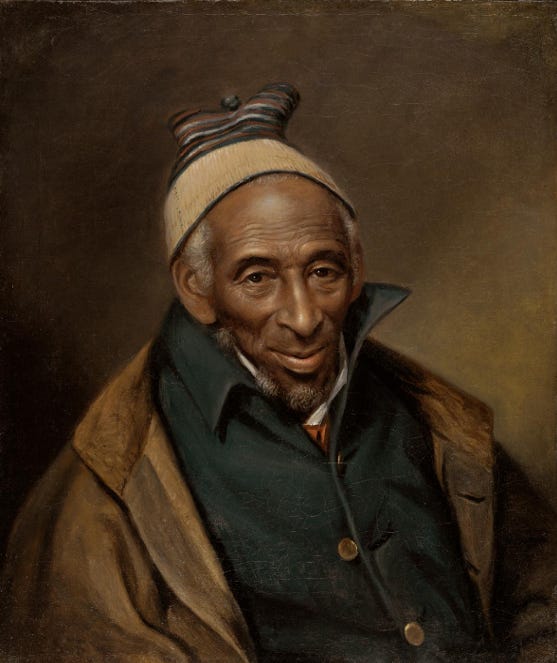
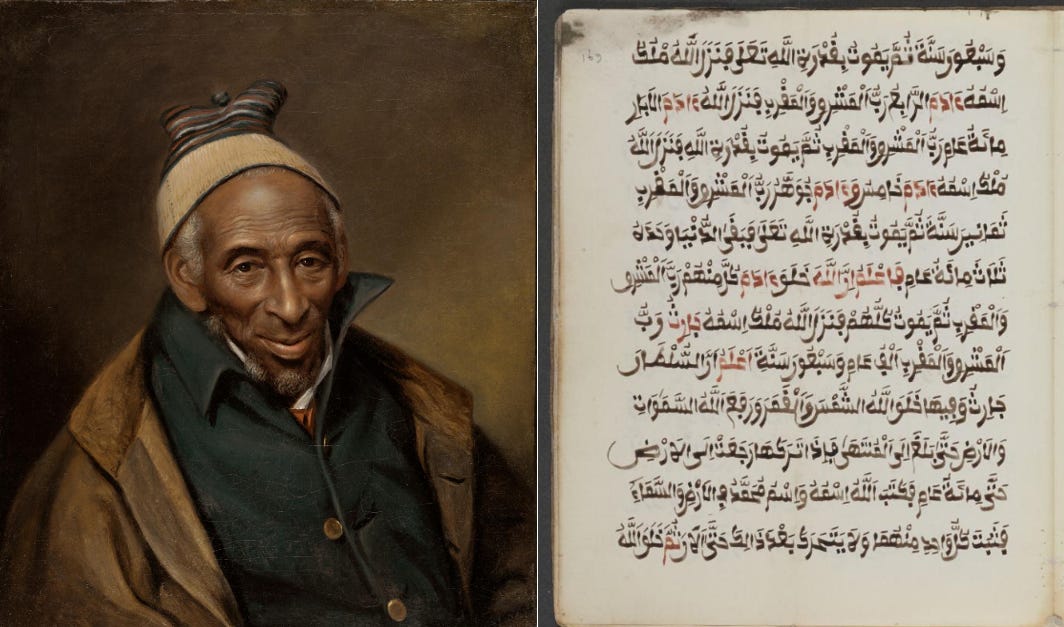
Portrait of Yarrow Mamout (c. 1736–1823), a formerly enslaved Muslim man of Georgetown, Maryland. Oil Painting by Charles Willson Peale, c. 1819. Philadelphia Museum of Art.8
These “Black” Muslims were often literate, and they composed some of the oldest accounts about African societies written by Africans. Their writings challenged the prevailing negative portrayals of Africa by their “White” contemporaries, which were often used to justify chattel slavery.
Although some of these writers may have attained elevated status because of their backgrounds, literacy could also be extremely dangerous for enslaved Africans, particularly in the United States, where teaching enslaved people to write was illegal in many jurisdictions.
Among the most notable works was the 1734 biography of Job Ben Solomon (Ayuba Suleiman Diallo), one of the earliest texts in African American literature.
It recounts the life of a runaway enslaved man in Maryland who was deeply knowledgeable about the history of his religion and homeland and who eventually secured his return to present-day Senegal.9
Ayuba’s biography and his description of centralized kingdoms and literacy in the interior, evidenced by the dozens of manuscripts he composed from memory, fundamentally challenged prevailing Western justifications for the enslavement of Africans articulated by philosophers like David Hume during the same period.10
Ayuba’s descriptions of his home country and his Fulbe people were corroborated by the English traveler Francis Moore, who lived and traveled with him for a year before leaving Africa for England in May 1735.
Moore noted that both the “Pholeys” (Fulbe) and “Mundigoes” (Mandinka) who were muslim could “read and write Arabick (Arabic) which they take care to teach their Children, there being Schoolmasters among them for that purpose.” He pointedly observed that the Fulbe “are more generally learned in the Arabic than the People of Europe are in Latin.”11
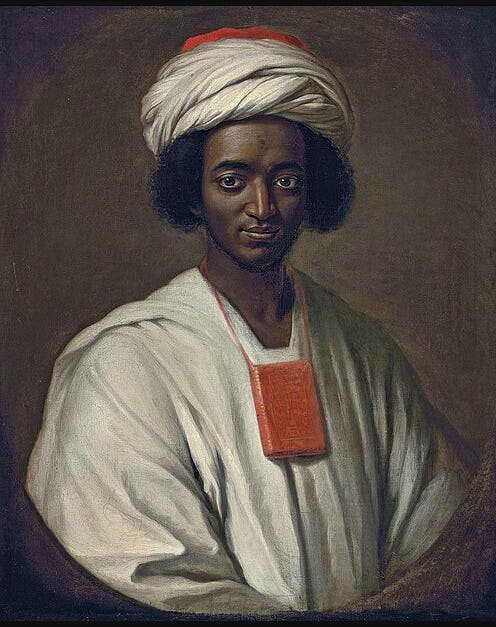
Portrait of Ayuba Suleiman Diallo by William Hoare, c. 1733. National Portrait Gallery.12
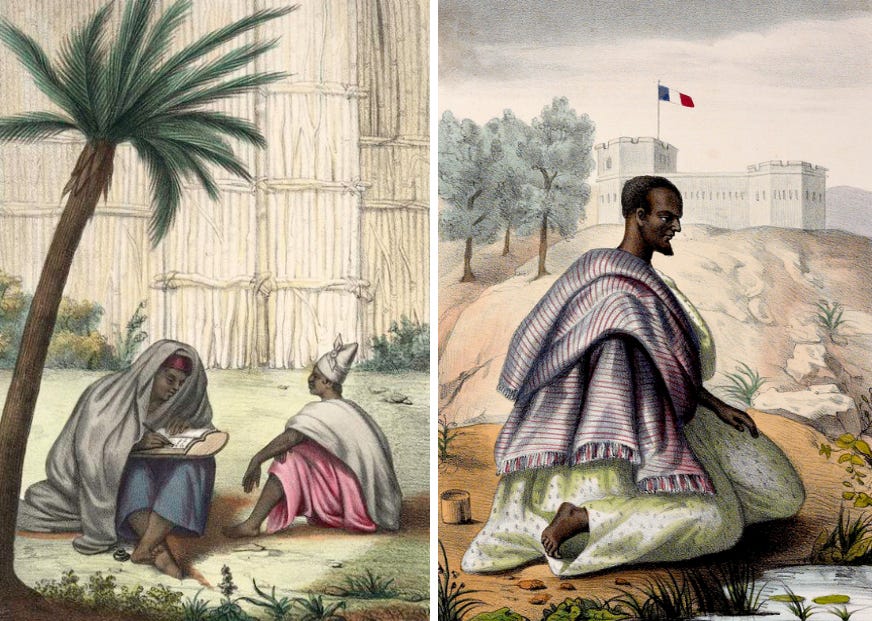
(left) “Grand Marabout Toucoulaure” (right) “Marabout Mandingue”. Images by David Boilat, c. 1853.
Another learned figure was the African-born Lamine Kebe in 1835, who, after forty years of slavery in three Southern states, came to the attention of the American Colonization Society that was transporting thousands of freed slaves to Liberia.
Kebe traced his ethnic origins to the “Serecule” (i.e., Soninke/Jakhankhe/Wangara of medieval Ghana) and the “Manenca” (i.e., Maninka/Mandinka of Medieval Mali). **See map below.
He is described as a
“Venerable old man ... a scholar, and could write in the Arabic. He had left behind him a wife and three children, and it was the earnest wish of the Society to send him home as soon as possible, in the hope that he might once more meet his family.
Kebe was born in the kingdom of Futa Jalloo. His education, which commenced at fourteen, and was finished at twenty-one, was obtained chiefly at Bunder, [Futa Bundu, homeland of Ayuba Suleiman Diallo]. He was a school-master five years in the city of Kaba, which he left to travel to the coast, to obtain paper for the use of his pupils, when he was taken and sold as a slave.”13
The Abolitionist Theodore Dwight, Jr., who was a founder of the American Ethnological Society, found Kebe to be an exemplary teacher and published his advice in The American Annals of Education and Instruction in 1836, making Kebe the only African quoted at length in a contemporary American professional journal.14
Some of Lamine Kebe’s remarks on Africa and his Guinean homeland were related to Theodore Dwight, before the former moved to Liberia in 1835. They included:
“Accounts of [other African nations Kebe had visited] … on the history, customs, arts, religions, learning, languages, books, schools, teachers, travelers, productions, trade, of the mixed people among whom he lived …”
Kebe related several details about the schools that were common in West Africa and the curriculum taught by the schoolmasters.
He also pointed out that “several native African languages were written in Arabic characters,” providing some of the earliest evidence for the widespread use of the Ajami script.15
“Our informant had from fifty-five to fifty-seven pupils in his native town, after he had completed his education.
His scholars were seated on the floor, each with small boards rubbed over with a whitish chalk or powder, on which they were made to write with pens made of reeds, and ink which they form with care, of various ingredients.
The mind of our informant shows some of the traits of a professional school-master, and his opinions on pedagogy, claim some attention, as they are founded on experience, and independent of those current in other countries.
It is interesting to the friends of education in America, to hear of improvements introduced in the schools of other countries. Lamen Kebe has a high opinion of a certain process practised in some of the institutions of his native land, which he calls doubling; while of those in which it is not practised, he speaks with comparative contempt.”16
Kebe’s descriptions of West African society and historical literacy were corroborated by Americo-Liberian explorers of West Africa who visited the interior of present-day Guinea, Liberia, and Sierra Leone during the mid-19th century.
For example, when the Americo-Liberian traveler Edward Blyden visited the town of Gbile in Sierra Leone in 1872, he found a “university” run by the Jakhanke scholar named Foday Tarawali, which Blyden called: “the Oxford of this region—where are collected over 500 young men studying Arabic and Koranic literature.”17

Map of West Africa showing the dispersion routes taken by the Jakhanke (yellow), Juula (green), and Wangarawa (red), and the medieval Empires of Ghana, Mali and Songhay.
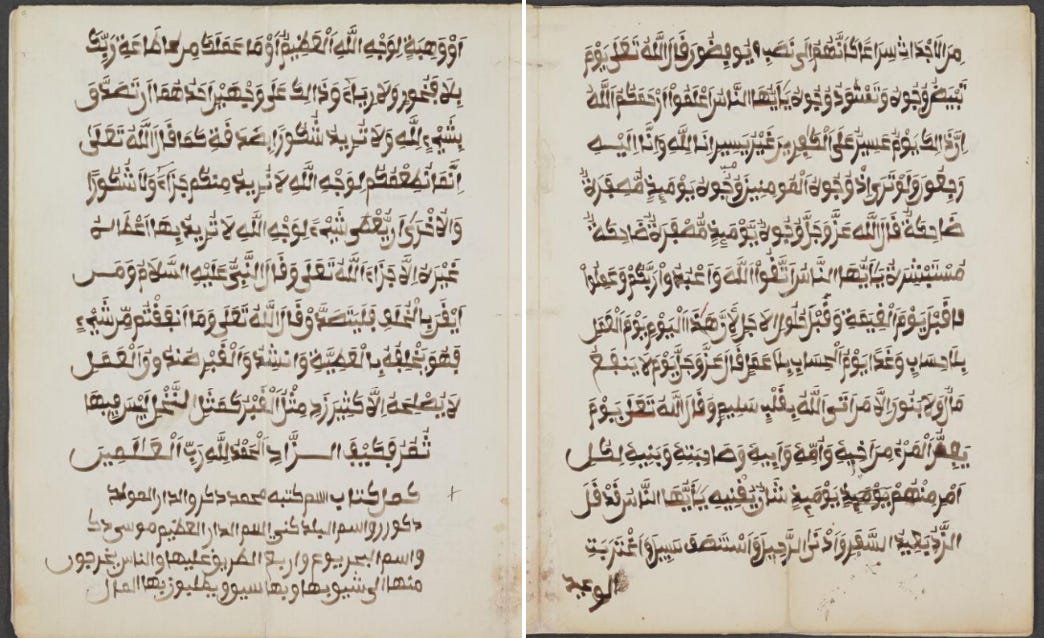
Manuscript containing a description of China. Written in 1860 by Muḥammad Dukur, an African scholar in Liberia. Omar ibn Said Collection, Library of Congress.
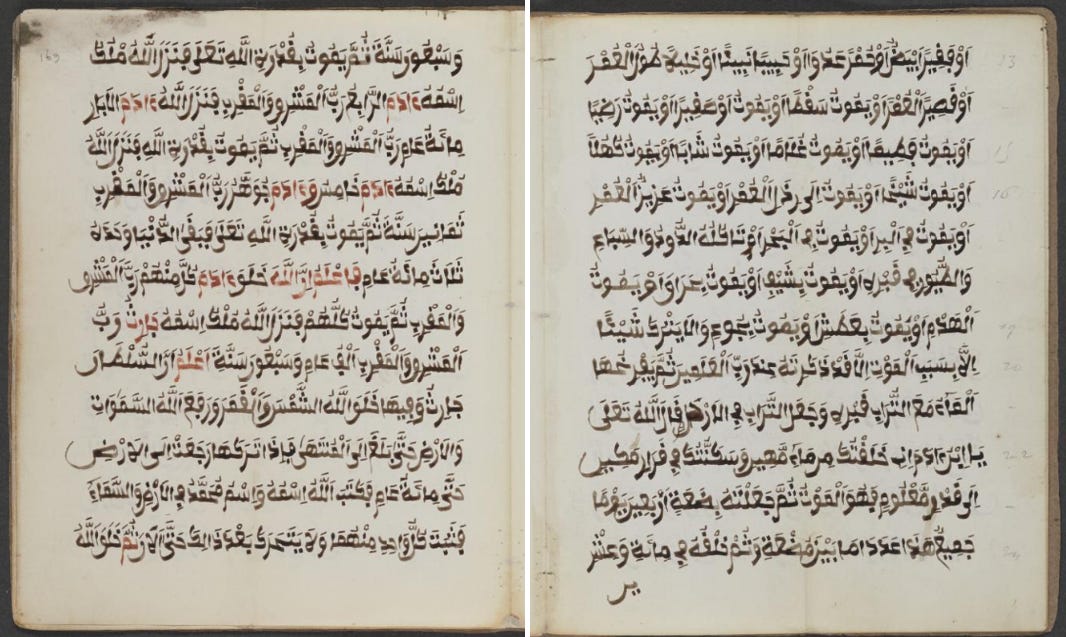
“Faṣl fī uṣūl khalq ibrāʼ Adam” (Brief treatise on the creation of man and the subsequent history of the world.) Written ca. 1855-1865 by Muḥammad Dukur, an African scholar in Liberia. Omar ibn Said Collection, Library of Congress.
Besides a handful of returnees, the vast majority of enslaved African Muslims stayed in America and created the oldest documents not written in the Latin script.
The most prolific among these writers was Umar ibn Said of North Carolina, who, from 1819 to 1864, composed many works in Arabic, including a Bible, a Quranic commentary, and 14 extant manuscripts in both Arabic and Fulfulde (the language of the Fulbe).
Umar also wrote an informative 16-page autobiography in Arabic preceded by sections from the Quran, three (Christian) Lord’s Prayers, two Twenty-third Psalms, and a commentary on Christian prayers.18
Many of Umar’s writings couldn’t be read by his white audience, who sought to convert him to Christianity, and were initially convinced of their success before learning that he hadn’t done so when they later obtained translations of his works.
On the other hand, Umar corresponded with his Muslim peers, mostly enslaved Africans, and in one exceptional case, wrote a letter to a Muslim from Canton, China, who’d heard about this exceptional African American writer.19
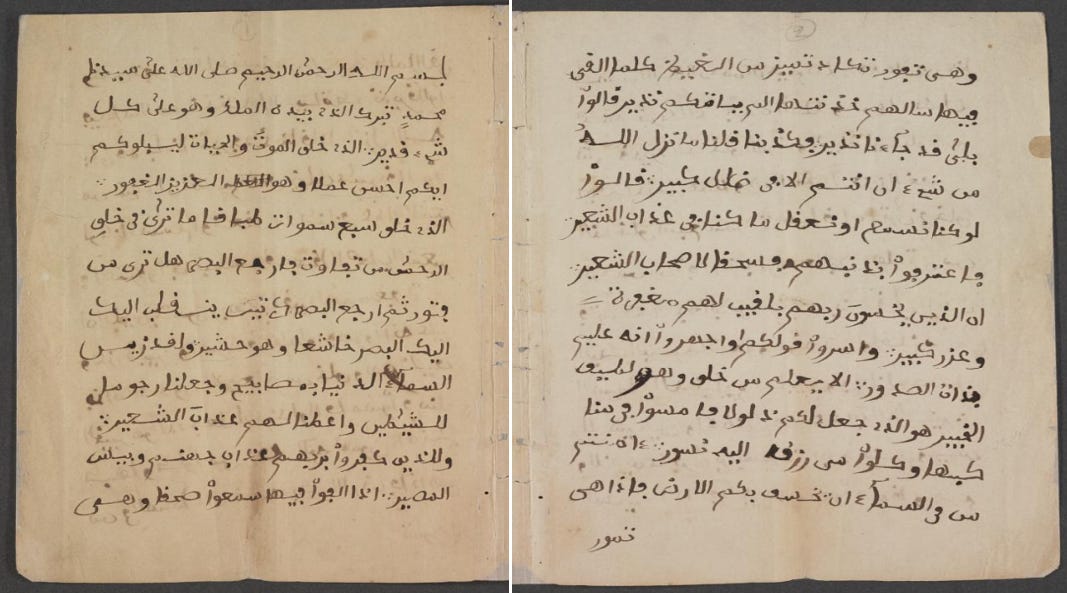
“The life of Omar ben Saeed”, by Omar ibn Said, 1770? -1863, ca. 1831. Omar ibn Said Collection, Library of Congress.
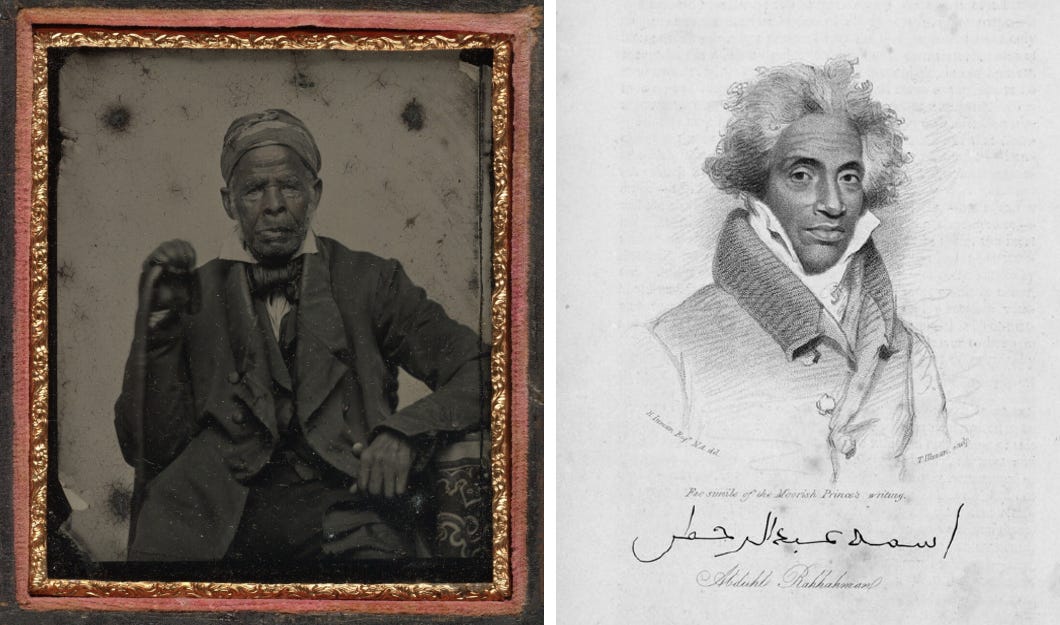
(left) portrait of Omar ibn Said, c. 1850. (right) engraving of Abdul Rahman Ibrahima ibn Sori by T. Illman, 1834.
Similar stories of African Muslims can also be found in the Caribbean, especially in Jamaica during the 18th and 19th centuries.
Such include Benjamin Larten, who wrote out the Quran from memory; Anna Mousa (also called Benjamin Cochrane), a medical doctor from Mali, who wrote two short autobiographies; and Abu Bakr as-Siddiq, who in 1834 composed a lengthy autobiography that includes a list of trade routes in West Africa, all in Arabic.
Abu Bakr reported that he had visited or was informed about towns from Sin near the mouth of the Gambia to Katsina in Nigeria, more than 1,600 miles to the east, and from Timbuktu to the Guinea coast, about 900 miles to the south.
He was laying out an area comparable in size to the United States east of the Mississippi. Not many Americans would have been able to lay out similar lists.20
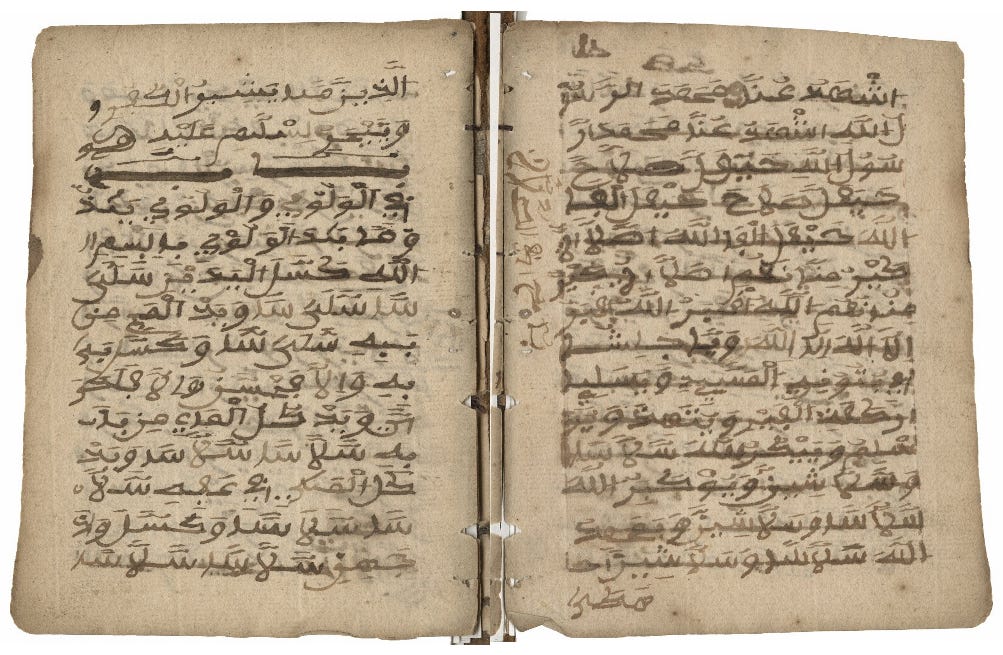
Manuscript of Bilali Mohammed, an enslaved African Muslim on Sapelo Island, Georgia, in the early 19th century. Hargrett Rare Book & Manuscript Library, University of Georgia. Considered the oldest and only extant work on Islamic Law written in the United States during the early 19th century, it was reportedly written on paper that Balali brought with him from West Africa.21
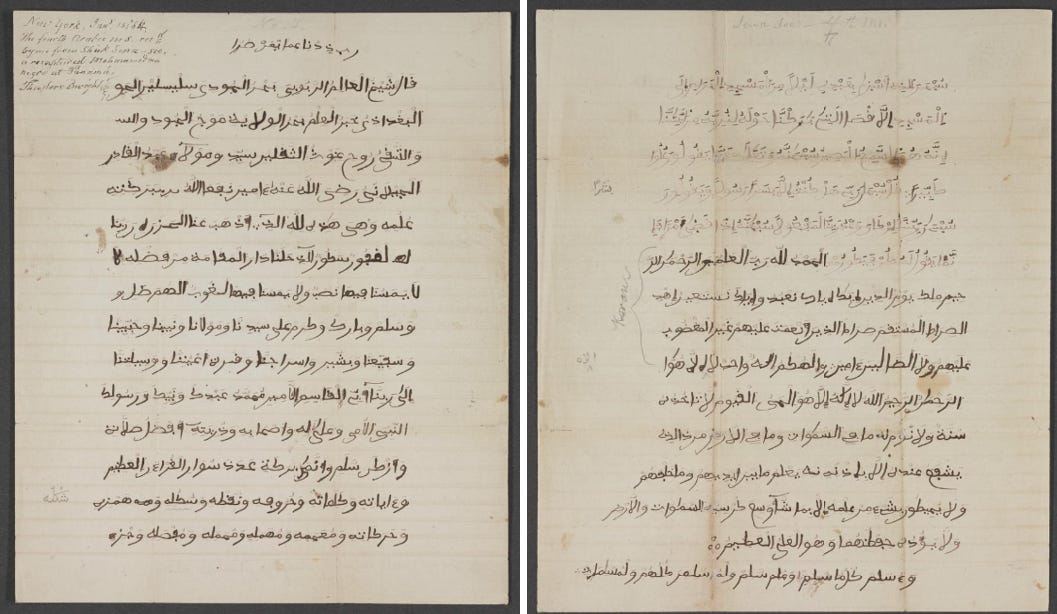
Manuscript by Sheikh Sana See, written in 1853. The author is described in Dwight’s archival notes as a “recaptured Mohammedan negro at Panama.” Omar ibn Said Collection, Library of Congress.
Many of these African American Muslims were unsurprisingly critical of chattel slavery and openly condemned their Christians captors for their cruelty and hypocrisy.
Abdul Rahman Ibrahima ibn Sori (1762-1829), who spent forty years enslaved in the southern United States, observed that although the New Testament was “good law”, the Christians (whites) did not follow it, didn’t pray enough, were greedy, and only wanted more land, more slaves, and more cotton.22
Other enslaved muslims shared the same opinion. The Senegalese emir Samba Makumba of Trinidad remarked that
“It was safe to judge people by their actions, and when he saw the Christians holding those of their own faith in slavery, engaging in wars with members of their own church, and addicted to habits of intemperance, all of which the Koran forbids, he thought it was sufficient evidence that the religion of Mahomet was superior to the religion of Anna Bissa (Jesus Christ).”
The four Jamaican Muslims mentioned above sent a letter of protest to Magistrate Richard Madden in Kingston, on October 2, 1834, condemning the enslavers for their cruelty, intolerance, and hypocrisy.23
In Brazil, enslaved Muslims in Salvador, Bahia, many of whom were learned scholars running clandestine schools to teach their enslaved peers, took on a more direct approach in 1835, organising one of the largest slave rebellions in the Atlantic world.24
Many of these exceptional African writers were known to their white contemporaries.
Yet, to reconcile their intellectual accomplishments with prevailing racist attitudes, they were often “de-Africanised” in semi-fictional accounts, transformed into legendary “Turkish” or “Arab” princes with supposedly “Greek profiles” and tragic backgrounds.25
“It was more acceptable to deny any Africanness to the distinguished Muslims than to recognize that a “true” African could be intelligent and cultured but enslaved nevertheless. So, gradually, the African Muslims were seen as owing their perceived superiority not to their own “genes,” not even to their culture or proximity to the Arab world, but to foreign “blood.”26
For their part, these African American muslims proudly asserted their “Black” African identity, which they traced to specific ethnic groups, and made no pretentions to Arab origins.
Rather than sounding defeated or ashamed of their homelands or culture and eager to please American saviors, their accounts offered a proud affirmation of African societies, cultures, and religion. Many of them retained their faith and formed the very first communities of Muslims in the Americas.27
“There are good men in America,” declared Lamine Kebe in 1835, “but all are very ignorant of Africa.”
The preceding examples broaden our understanding of resistance among enslaved Africans in the Americas, which did not always take the forms that scholars have traditionally associated with challenges to slavery.
Enslaved Africans resisted the institution with the most potent weapons at their disposal, which included not just muscle and might, but also religion and writing.
The historical significance of African religious traditions in the Americas is particularly evident in the spread of Central African cosmologies, which served as counter-hegemonic forces that continually undermined the ideological foundations of Atlantic slave societies.
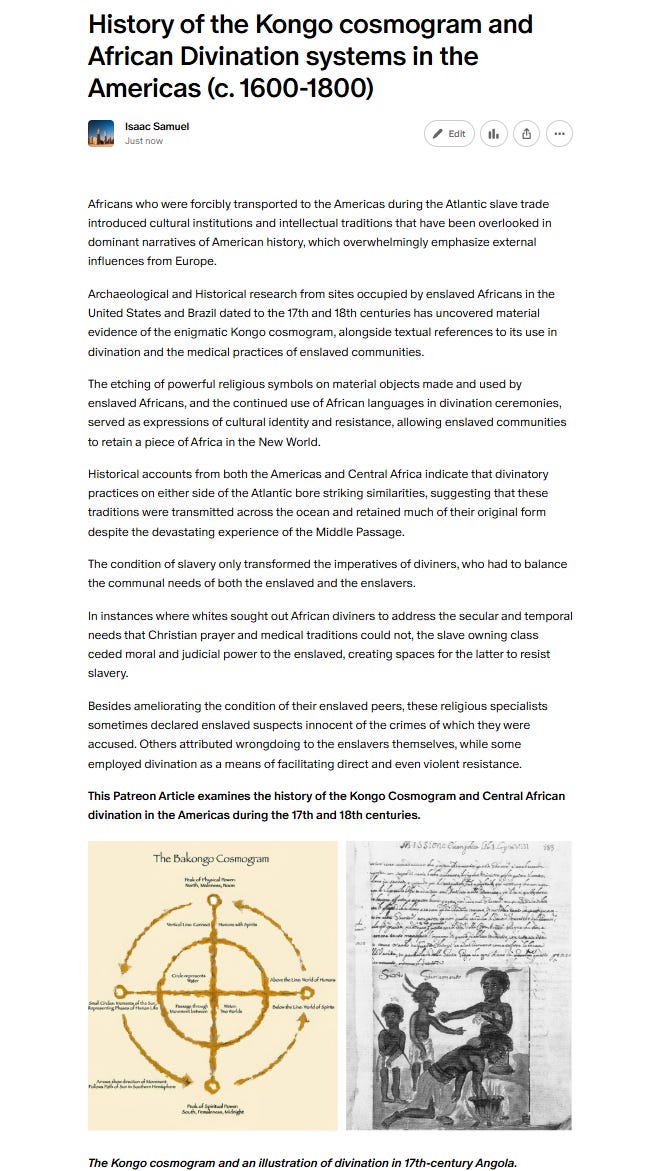
Archaeological and Historical research from sites occupied by enslaved Africans in the United States and Brazil dated to the 17th and 18th centuries has uncovered material evidence of the enigmatic Kongo cosmogram, alongside textual references to its use in divination and the medical practices of enslaved communities.
The etching of powerful religious symbols on material objects made and used by enslaved Africans, and the continued use of African languages in divination ceremonies, served as expressions of cultural identity and resistance, allowing enslaved communities to retain a piece of Africa in the New World.
Historical accounts from both the Americas and Central Africa indicate that divinatory practices on either side of the Atlantic bore striking similarities, suggesting that these traditions were transmitted across the ocean and retained much of their original form despite the devastating experience of the Middle Passage.
The condition of slavery only transformed the imperatives of diviners, who had to balance the communal needs of both the enslaved and the enslavers.
In instances where whites sought out African diviners to address the secular and temporal needs that Christian prayer and medical traditions could not, the slave owning class ceded moral and judicial power to the enslaved, creating spaces for the latter to resist slavery.
Besides ameliorating the condition of their enslaved peers, these religious specialists sometimes declared enslaved suspects innocent of the crimes of which they were accused. Others attributed wrongdoing to the enslavers themselves, while some employed divination as a means of facilitating direct and even violent resistance.
The history of the Kongo Cosmogram and Central African divination in the Americas is the subject of my latest Patreon Article
Please subscribe to read more about it here:
With Grains in Her Hair: Rice in Colonial Brazil by Judith A. Carney. Black Rice: The African Origins of Rice Cultivation in the Americas by Judith A. Carney. Deep Roots: Rice Farmers in West Africa and the African Diaspora, by Edda L. Fields-Black. For a more nuanced perspective, see Agency and Diaspora in Atlantic History: Reassessing the African Contribution to Rice Cultivation in the Americas by David Eltis et al. On the introduction of African rice in Portugal, see *African knowledge transfer in Early Modern Portugal: Enslaved people and rice cultivation in Tagus and Sado rivers by Miguel Carmo et al.
African metallurgy in the Atlantic world by Candice L. Goucher. Archaeology of Atlantic Africa and the African Diaspora, edited by Akinwumi Ogundiran, Toyin Falola pg 281-291.
Africa and Africans in the Making of the Atlantic World, 1400-1800 by John Thornton, pg 135. Servants of Allah by Sylviane Diouf, pg 148-149. Ancient DNA confirms diverse origins of early post-Columbian cattle in the Americas, by Nicolas Delsol et al.
“The area where Islam was a dominant feature of trade and society was Senegambia, which accounted for only about 4 percent of the total traffic. Fewer than 10 percent of Africans taken to the Americas came from Muslim areas, and even fewer were actually Muslims.”
Jihād in West Africa During the Age of Revolutions, by Paul E. Lovejoy.
Jihād in West Africa During the Age of Revolutions, by Paul E. Lovejoy
Recreating Africa: Culture, Kinship, and Religion in the African - Portuguese World, 1441–1770, by James H. Sweet, pg. 89.
The Atlantic World and Virginia, 1550-1624, edited by Peter C. Mancall pg 229-232
“Yarrow [Yoro] Mamout used to pray publicly. He had been deported to Maryland at the beginning of the eighteenth century and lived there for the rest of his long life. The painter Charles Willson Peale, who made his portrait, wrote in 1819, “he professes to be a Mahometan, and is oft en seen & heard in the streets singing Praises to God — and conversing with him.”
Peale described Mamout as an honest, courageous, serious man, well liked by everyone. His age, his Islamic dress, and his economic success had made him a celebrity. In Maryland — the very Catholic land of Mary — he had been able to retain his Muslim African name and to have others respect his faith and his right to express it publicly.”
Servants of Allah: African Muslims Enslaved in the Americas, 15th Anniversary Edition, by Sylviane Anna Diouf, pg 87
African Muslims in Antebellum America: Transatlantic Stories and Spiritual Struggles, by Allan D. Austin, pg 51-61
Some memoirs of the life of Job, the son of Solomon the high priest of Boonda in Africa, by Thomas Bluett, London, 1734, pg 14, 36, 52-53.
David Hume, in keeping with the hubris and ignorance of his less-educated, slave-owning peers, boldly asserted in his 1742 essay “Of National Characters,” that “I am apt to suspect the negroes, and in general all other species of men to be naturally inferior to the whites. There never was a civilized nation of any other complexion than white, nor even any individual eminent in action or speculation. No ingenious manufactures amongst them, no arts, no sciences. On the other hand, the most rude and barbarous of the whites, such as the ancient Germans, the present Tartars, have still something eminent about them, in their valour, form of government, or some other particular. Such a uniform and constant difference could not happen, in so many countries and ages, if nature had not made an original distinction between these breeds of men. Not to mention our colonies, there are Negroe slaves dispersed all over Europe, of whom none ever discovered any symptoms of ingenuity”
Travels into the inland parts of Africa, by Francis Moore, Edward Cave, 1738 pg 39, 50, 145
Ayuba Suleyman Diallo’s portrait, realized in London in 1733, shows a quintessential Pulo with long hair and wearing a white turban, a white boubou, and an Islamic talisman pouch. What he was really wearing when he sat down for the painter is not known, but he had insisted on being represented “in his own country dress.”
He had to describe it minutely, as the artist stated that he could not draw something he had not seen. Diallo displayed some Islamic humor by retorting, “If you can’t draw a dress you never saw, why do some of you painters presume to draw God, whom no one ever saw?”
Servants of Allah: African Muslims Enslaved in the Americas, 15th Anniversary Edition, by Sylviane Anna Diouf, pg 106
African Muslims in Antebellum America: Transatlantic Stories and Spiritual Struggles, by Allan D. Austin, pg. 116, 119
African Muslims in Antebellum America: Transatlantic Stories and Spiritual Struggles, by Allan D. Austin, pg. 116
African Muslims in Antebellum America: Transatlantic Stories and Spiritual Struggles, by Allan D. Austin, pg. 119-120, 124
African Muslims in Antebellum America: Transatlantic Stories and Spiritual Struggles, by Allan D. Austin, pg. 120-121
Beyond Jihad by Lamin Sanneh, pg. 164
African Muslims in Antebellum America: Transatlantic Stories and Spiritual Struggles, by Allan D. Austin, pg. 24, 129-130, 134-156
African Muslims in Antebellum America: Transatlantic Stories and Spiritual Struggles, by Allan D. Austin, pg. 152-153
African Muslims in Antebellum America: Transatlantic Stories and Spiritual Struggles, by Allan D. Austin, pg 41
African Muslims in Antebellum America: Transatlantic Stories and Spiritual Struggles, by Allan D. Austin, pg 90-92
African Muslims in Antebellum America: Transatlantic Stories and Spiritual Struggles, by Allan D. Austin, pg 76
Servants of Allah: African Muslims Enslaved in the Americas, 15th Anniversary Edition, by Sylviane Anna Diouf, pg 129
Slave Rebellion in Brazil: The Muslim Uprising of 1835 in Bahia, by João José Reis
African Muslims in Antebellum America: Transatlantic Stories and Spiritual Struggles, by Allan D. Austin, pg 131-133. Servants of Allah: African Muslims Enslaved in the Americas, 15th Anniversary Edition, by Sylviane Anna Diouf, pg 130-134
Servants of Allah: African Muslims Enslaved in the Americas, 15th Anniversary Edition, by Sylviane Anna Diouf, pg 133
Black Crescent: The Experience and Legacy of African Muslims in the Americas, by Michael A. Gomez