

The monumental tombs of the East African coast have been described as “the most striking” and “sole invention” of Swahili architecture.
The ancient mausoleums encompass a variety of architectural forms, including domes, pyramids, panels, pillars and stepped sides.
The pillar tombs of the medieval East African coast, some of which rose 15 meters above the ruins of coral-stone houses, were among the tallest freestanding structures in pre-colonial Africa and have no parallels elsewhere in the world.
The mortuary practices associated with these tombs drew on both Islamic and traditional belief systems concerning the veneration of saints. They transformed cemeteries into sacred landscapes that attracted pilgrims from across the region.
This essay explores the history of the medieval mausoleums of the Swahili coast, examining their architectural forms and religious significance to the development of sacred landscapes in pre-colonial Africa.
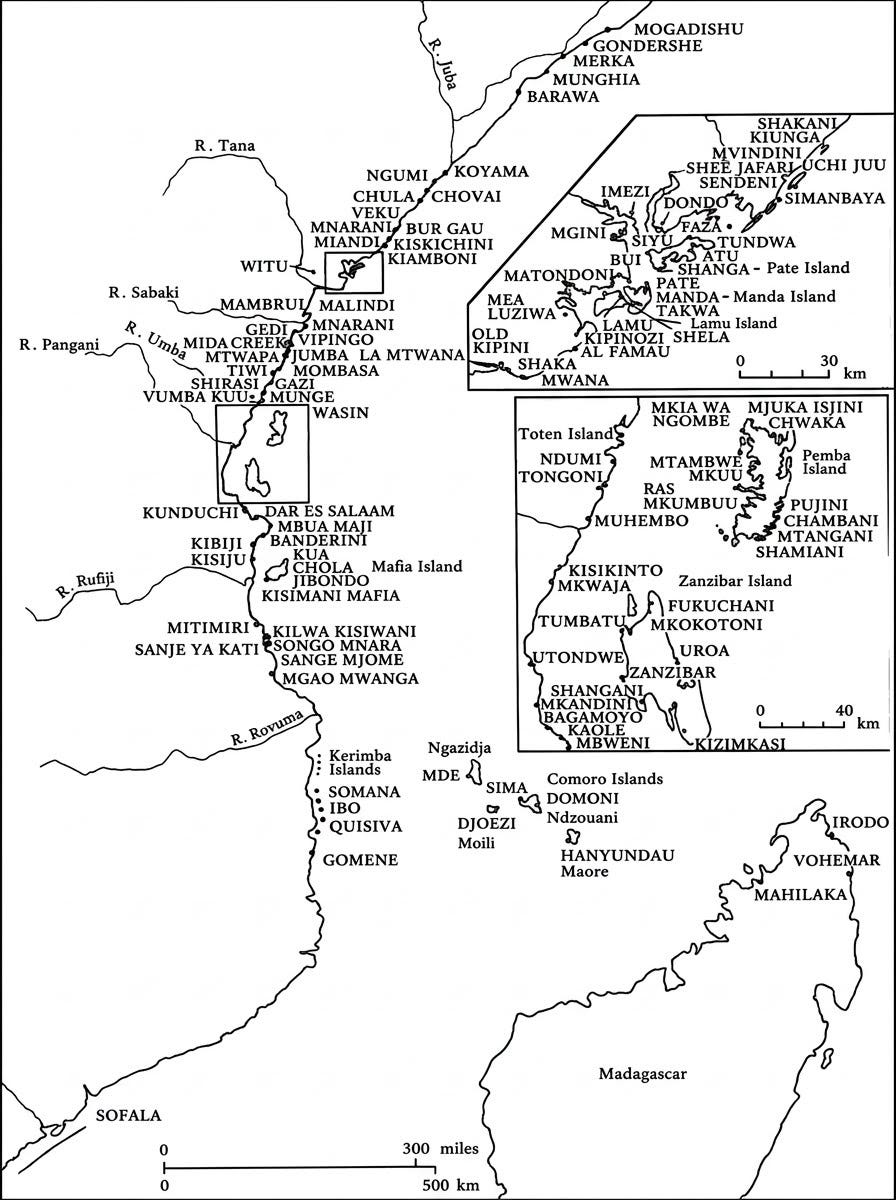
Map of the medieval Swahili Coast
Support AfricanHistoryExtra by becoming a member of our Patreon community, subscribe here to read more about African history, download free books, and keep this newsletter free for all:
Saints or Patricians? a sacred tomb in 17th century Sofala.
In 1606, while visiting the gold-trading town of Sofala (present-day Mozambique), the Portuguese friar João dos Santos recorded an interesting account of the veneration of an important local figure regarded as a saint by the town’s Muslims, despite what he considered to be the man’s rather lax observance of Islamic prohibitions.1
“Opposite the fortress of Sofala is an island on the other side of the river, called Inhansato. The former lord of this island was a very rich Moor (Muslim/Swahili2), named Muynhe Mohamed (Mwinyi Mohammed3), who was very friendly to the Portuguese inhabitants of Sofala, so much so that he would often eat and drink in their houses, partaking of everything, even though it might be pork, a thing strictly forbidden by his law, and he was particularly fond of ham and pork sausages, and still more so of wine, which is also prohibited by the said law.
Thus he made a mockery of his law in this and many other things, and he said that Mohamed never forbade wine or pork to the Moors.
When this Moor died, the Moors of Sofala made him a mosque in the island of Inhansato, in which they held his tomb in great veneration and respect, simply because he was a rich and honoured Moor, and these barbarous Moors considered these qualities sufficient ground for holding and honouring him as a saint, he being a Moor in name only.
This mosque was all hung with painted calico, the stones of the sepulchre were anointed with fragrant sandal, and around it were many braziers in which they threw incense to perfume the mosque. Above his grave quantities of rice and millet were strewn by the Moors, who petitioned him for prosperous harvests in return for this offering.
Opposite the door of the mosque was a half mast fixed in the ground. In this were many nails, upon which the Moorish sailors4 before undertaking any voyage hung pieces of oars, pulleys, or any cordage from their vessel, that this Moor might grant them a prosperous voyage, so that they offered him petitions and prayed to him as though he were a saint.”
While the Christian friar had his own reasons for discrediting the religious practices of this Swahili ruler, not least to justify the subsequent destruction of his mosque, his account provides some of the earliest evidence for the veneration of important figures’ tombs along the East African coast.
In the cosmopolitan urban communities of the East African coast, both spiritual and material wealth were regarded as signs of success and as blessings bestowed by God.
Just as “holy men” could possess baraka (blessings/spiritual power) through physical descent from the prophet (eg; sharifs) or by studying Islamic doctrine (e.g; walimu/scholars), a person who had wealth had baraka; the rich man is listened to because he enjoys a certain favor from destiny.5
As both a wealthy trader and a ruler, Mwinyi Mohammed of Sofala belonged to the latter category.
His tomb was part of an ancient tradition of commemorating prominent individuals through monumental structures, which eventually gave rise to the numerous tombs that dot the East African coast.
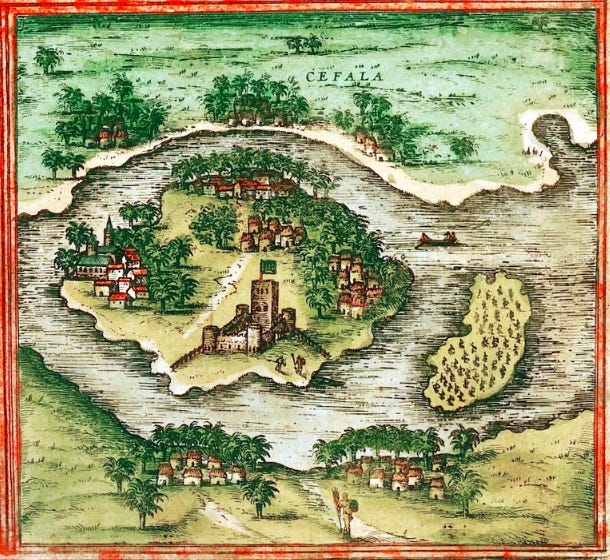
Sofala, Mozambique. Engraving by Franz Hogenberg; Georg Braun and Franz Hogenberg, Civitatis Orbis Terrarum, Vol. 1, 1572. (Sofala was taken over by the Portuguese, hence this castle at the center. Both the castle and the old town were submerged by the rising sea level in the 19th century and relocated to a neighbouring village that eventually grew into the modern town. An old tomb belonging to an important local figure was also translocated to the new town during the early 20th century, and is today a major pilgrimage site.6)
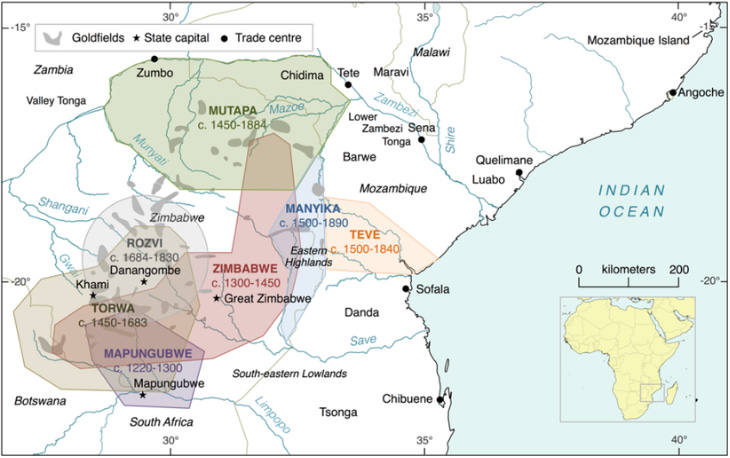
Sofala and the kingdoms of south-east Africa. (see: Dynamics of gold trade and consumption in South-East Africa and the Swahili coast )
The Swahili world extends roughly from Mogadishu in Somalia to Cape Delgado in Mozambique, including the offshore islands and northern Madagascar. (see map in the introduction)
Tombs can be found on numerous sites along this 2000 mile stretch of coastline. They are part of a larger tradition of building in stone, which appeared at the end of the first millennium and has contributed continually to the development of Swahili urban identity.
Swahili urban culture, and the built environment as its most visually dominating material testament, developed around Indian Ocean trade networks that linked the African mainland with the Middle East, India and China .
A considerable portion of the wealth accumulated through trade was invested in the construction of elaborate buildings, both private and public, as well as religious, ritual and mortuary monuments.
Swahili tombs present a challenge to anyone seeking to document and categorize their specific architectural forms and meanings. Cities that have survived from the medieval period have been largely rebuilt over the centuries, obliterating many of the ancient structures with later development.
Mortuary data for Swahili urban sites show that the dead were buried within or outside the towns, sometimes in a very central position respective to the settlement.
Tombs were constructed in isolation or in small clusters. They can be found in association with residential buildings, next to or near mosques, on open spaces among buildings or in the open courts of larger buildings.
Stone tombs represent a small fraction of the mortuary architecture of the coast, considering the number of potential burials. Many sites contain graves without superstructures that are visible on the surface.
In other Swahili settlements, especially in the northern regions along the Kenya/Somalia border, virtually all structures were built with perishable materials (see the image of Koyama below), leaving stone tombs as the only permanent constuctions that survive on the surface.7
Like all “stone” structures of the coast, the tombs are built with coral rag set in mortar of lime and earth, with surfaces plastered and cut coral employed for fine edges.
The tombs of the 13th–17th centuries were usually composed of a main aboveground cenotaph, underneath which the deceased was buried. The commonest aboveground structure features a four-sided low wall, generally rectangular in plan.
One or more walls of the tomb can be decorated or panelled, and some are richly decorated with carving and inscriptions with a few bearing inscriptions and dates related to the person buried. Some have surrounding walls cut in a step-like fashion. many have a series of niches for the display of imported porcelain or incense burners.8
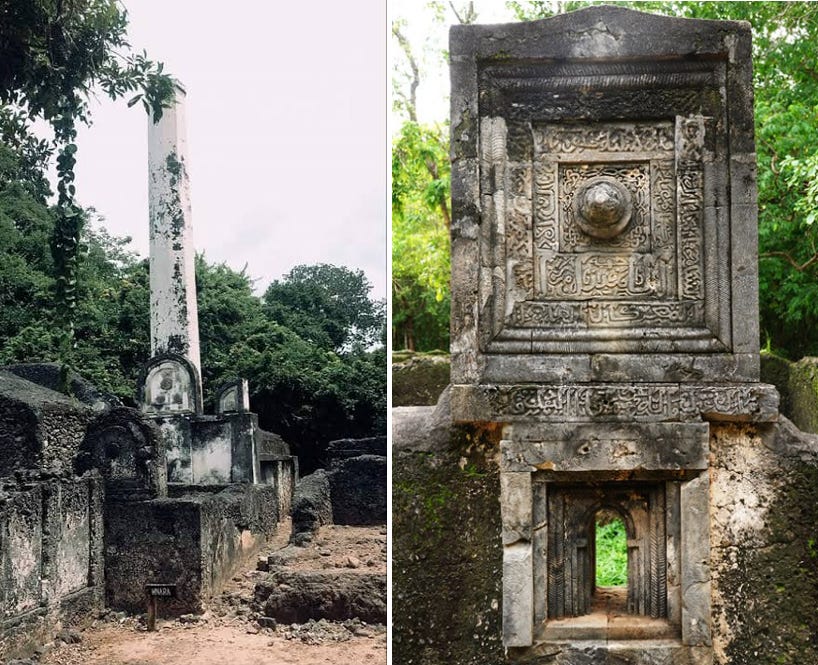
(left) The pillar tomb (A) at Mnarani, Kenya. Wilson (1980) pg 90, fig. 38. (right) Tombstone of tomb K at Mnarani, Kenya. Wilson (1980) pg 90, fig. 39.
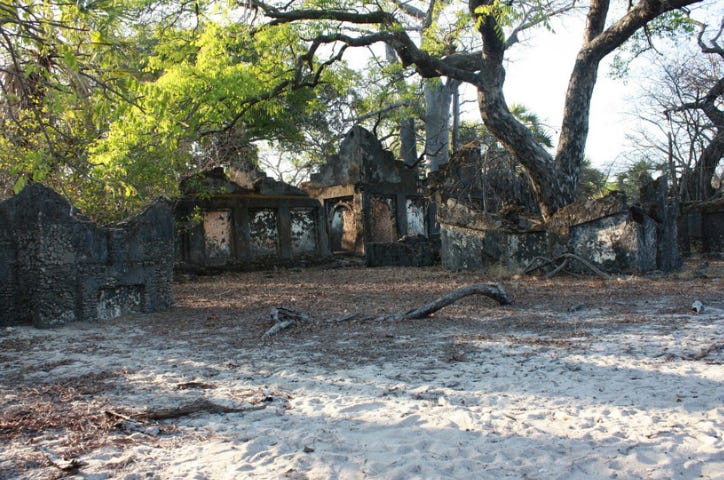
Mausolées d’Antsohéribory/Mazalagem Nova, Boeny island, Madagascar. Image by M.Pauly
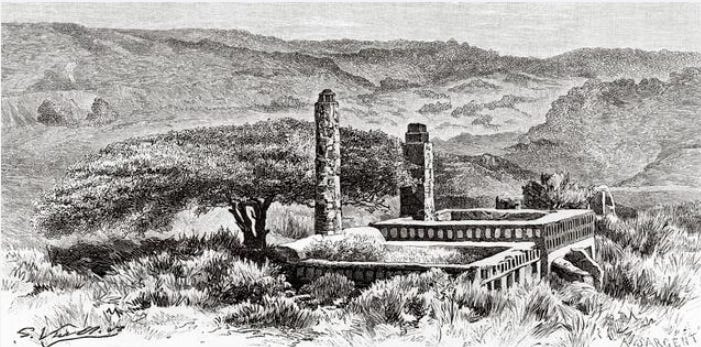
Pillar tombs in Koyama island, Somalia. Image by G. Revoil, 1882-3
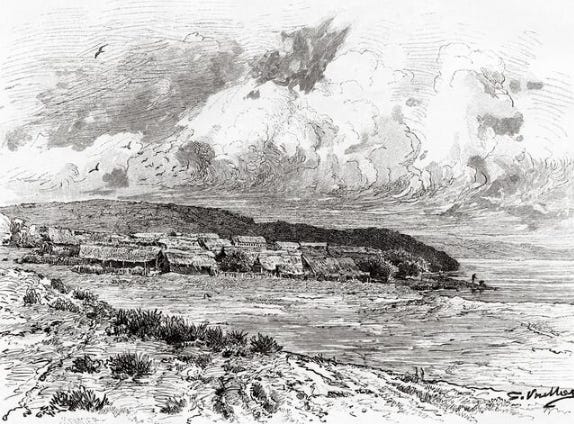
Koyama island, southern Somalia. Image by Image by G. Revoil, 1882-3.
The typology of Swahili tombs.
Wilson (1979) divided the tombs into different types, based on the main features found on their east walls.
The largest and most evenly distributed are the pillar tombs, characterized by a large pillar rising above the superstructure of the tomb. Next are the tombstone tombs, which characterized by masonry slabs with rounded tops rising from the east wall of the tombs. Some composite tombs combine the two features.
The other categories are of smaller tombs. They include step-ended tombs and roofed tombs. The roofed tombs may be domed, covered with a truncated pyramid or closed with a pitched roof.
Both the step-ended and roofed tombs are comparatively less numerous than the pillar tombs and tombstone tombs.9
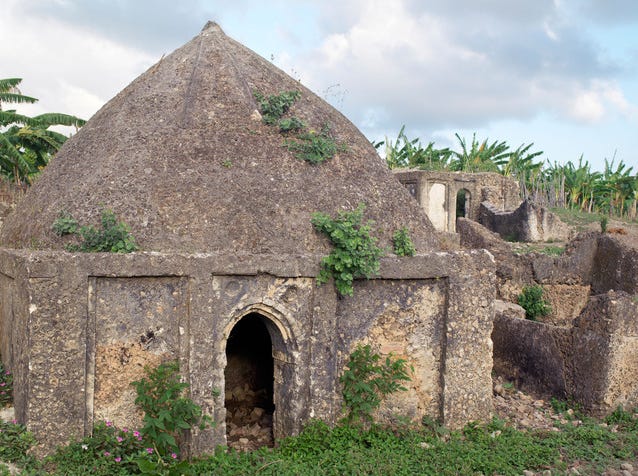
17th century tomb of Mwenya Bunu. Pate, Kenya. Alamy Images.
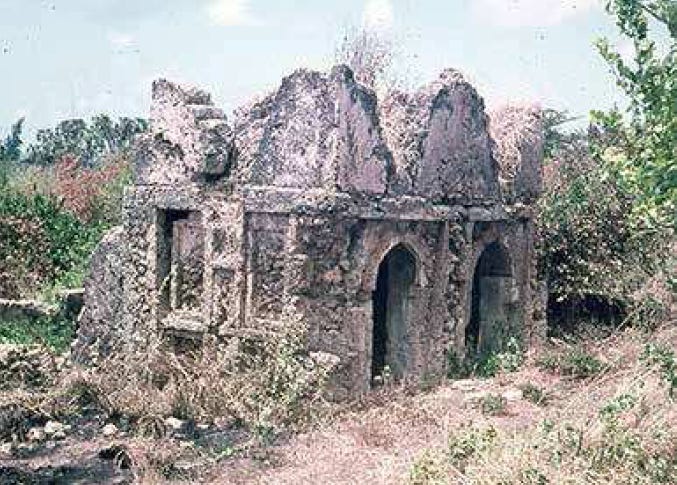
Domed Tomb. Ungwana, Kenya. Wilson (1978) pl. 49.10
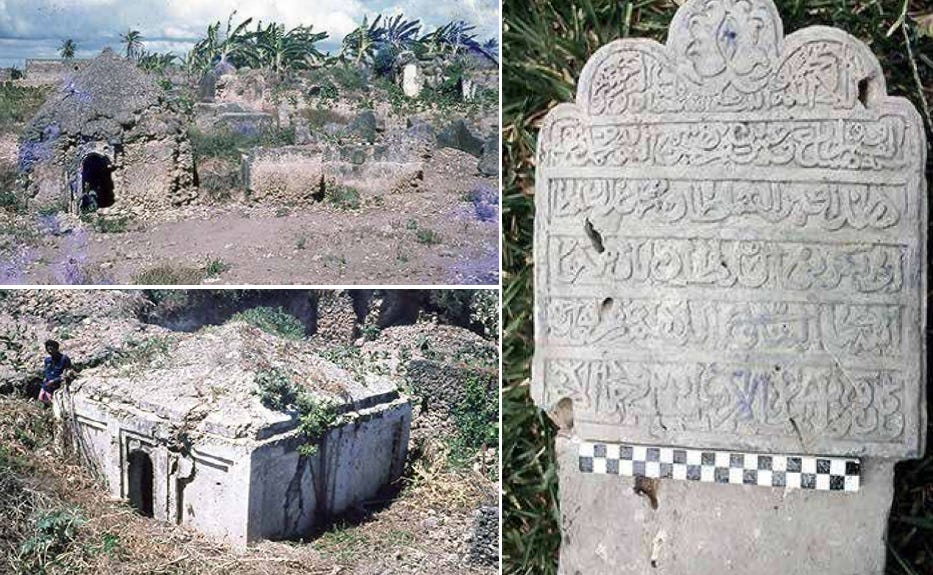
(Top Left) Ijumaa Cemetery, Pate, Kenya. (Right) Inscription 1: Tombstone of Sultan Muhammad (Fumomadi) of Pate. (Bottom left) Tomb in Northeast Pate. Images by Wilson (1978) pl. 103, 105, 106
The earliest structures were platform tombs that had a stone plinth with two or three steps that rested over the grave pit. At the east end there is often a raised block, with a sarcophagus-like head inset. This type is found at Shanga, Manda and the Sake Cemetery at Kilwa, and dates between the 11th and 13th centuries.11
According to the archaeologists T. Gensheimer and N. Chittick these early tombs are roughly similar in form to rectangular tombs at Siraf and Aden, suggesting an origin of this specific type of tomb from the Red Sea and Gulf regions.
However, from the 13th century onwards, Swahili tombs developed new architectural forms distinctive from both foreign and indigenous sources, the most notable of which were the enigmatic pillar tombs.12
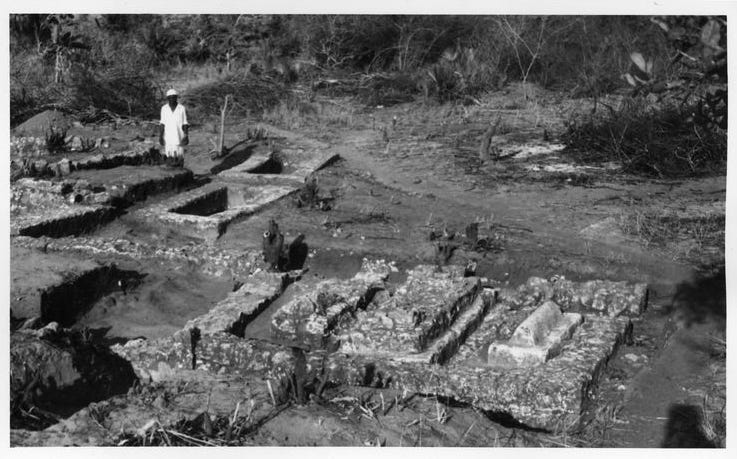
Sake Cemetery: General view, from North East. Kilwa Kisiwani, Tanzania. BIEA
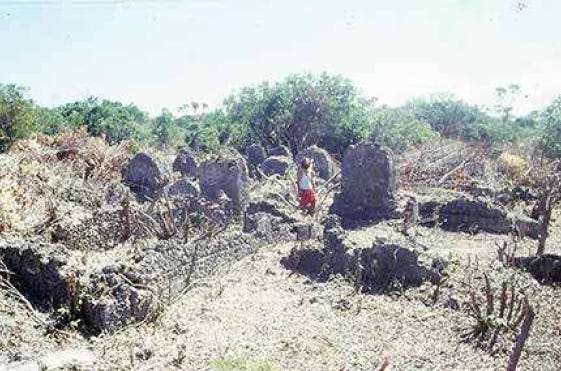
Rectangular tombs in the cemetery of Shanga, Kenya. Wilson (1978) Pl 118.
According to M. Horton, the first distinctive development was the addition of decorations on the top of the enclosure, including a parapet wall with stepped ends rising at each corner, probably by 13th century.
This was soon after followed by the creation of paneled tombs elaborated with square niches (Zidaka) and geometric decorations such as those found at Ishakani, Dondo and Omwe.
At Ishakani pillars occur in conjunction with large decorated enclosures and tombston tombs, suggesting that the pillar may have been little more than an additional decorative feature.
The earliest pillar tombs occur at Lamu and Shanga by the late 13th century, before spreading along the entire coast, with two distinctive styles to the north and south of Malindi.
In the south, the pillars are either square or octagonal and largely undecorated. The tombs are more compact, with corners that rise rather than step-ended. Examples are Mnarani, Gede, Ras Mkumbuu, Mkia wa Ngombe, Tongoni, Kaole and Dar es Salaam. These all date from the late 14th century onwards
Domed tombs appear by the mid 15th century, at Ungwana, Lamu and Omwe contemporary with the introduction of vaulted mosques. Later examples are found at Bur Gao (Somalia), the Malindi cemetary of Kilwa, and at Matondoni.13
After this innovation, these forms changed little in the succeeding centuries.
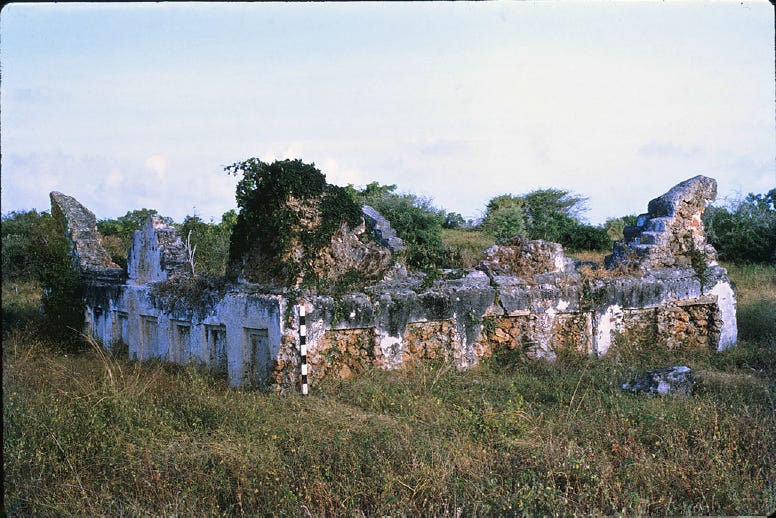
Step-end tomb, Kiunga, Kenya. image by BIEA
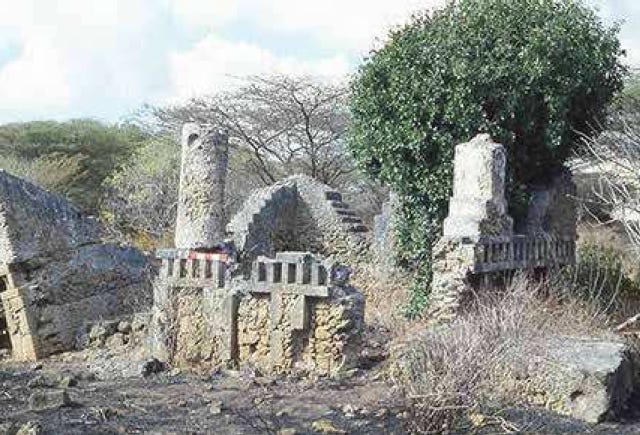
Tomb D. Kiunga, Kenya. Wilson (1978). Pl. 19
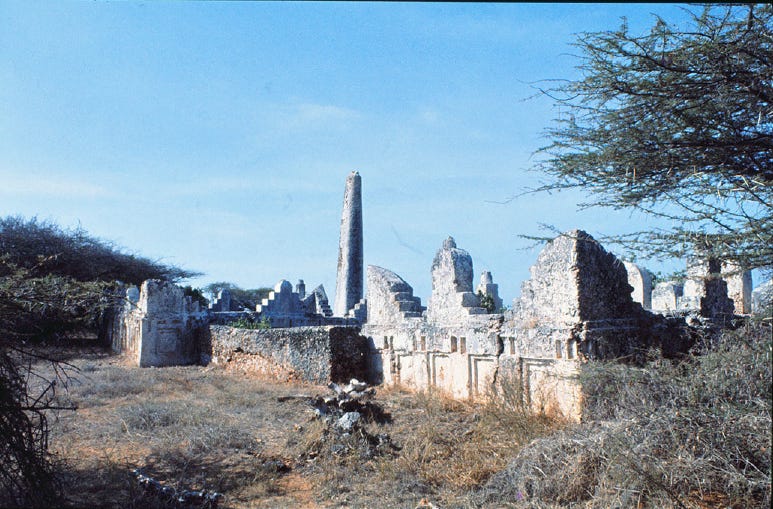
Tombs with round pillar in the middle. Ishakani, Kenya. Image by BIEA
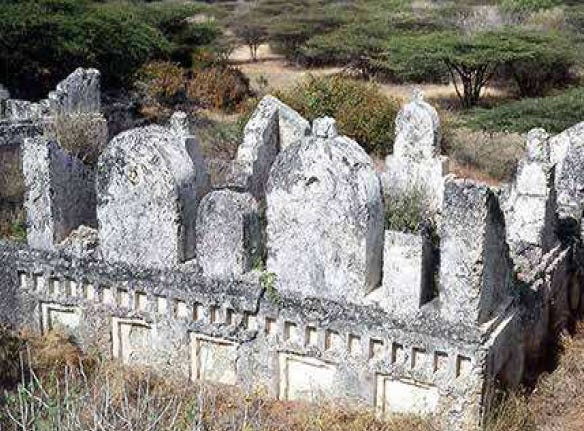
Tomb G. Ishakani, Kenya Wilson (1978) pl. 10
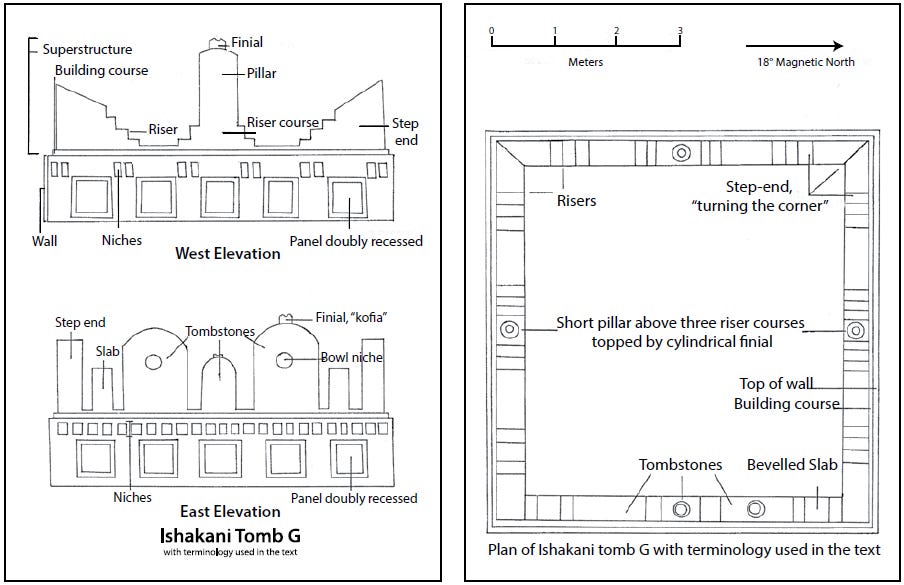
Tomb Terminology, Elevations and Plans, Ishakani Tomb G. Wilson (1978)
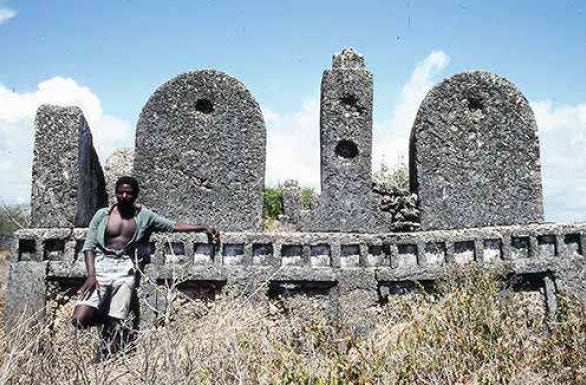
Tomb C. Ishakani, Kenya Wilson (1978), pl. 9
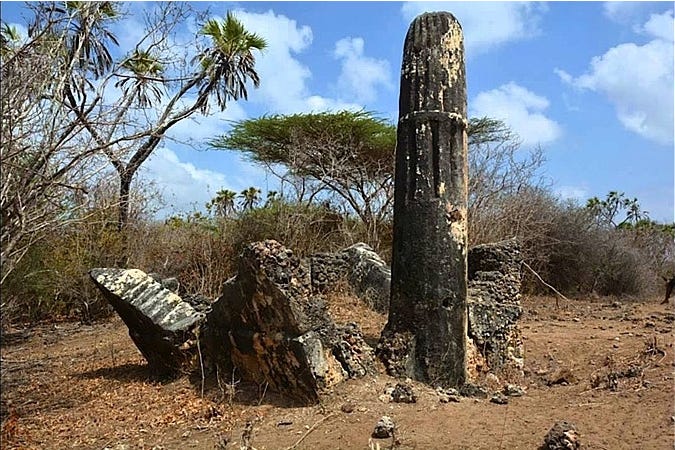
Shanga Pillar Tomb T 313. ‘Near the top of the basal section of the pillar is a celadon bowl 16 cms in diameter. Horton identified this as Longquan (Lung Ch’uan) northern Song, late thirteenth century, consistent with excavation levels at the tomb. He points out that this makes T 313 one of the earliest pillar tombs in East Africa.’
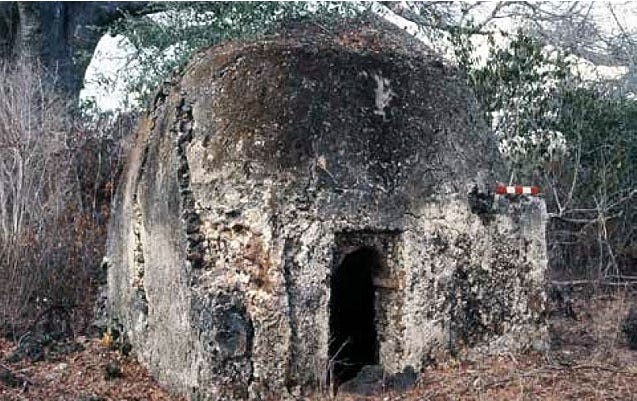
Domed Tomb D. Omwe, Kenya. Wilson (1978) pl. 27
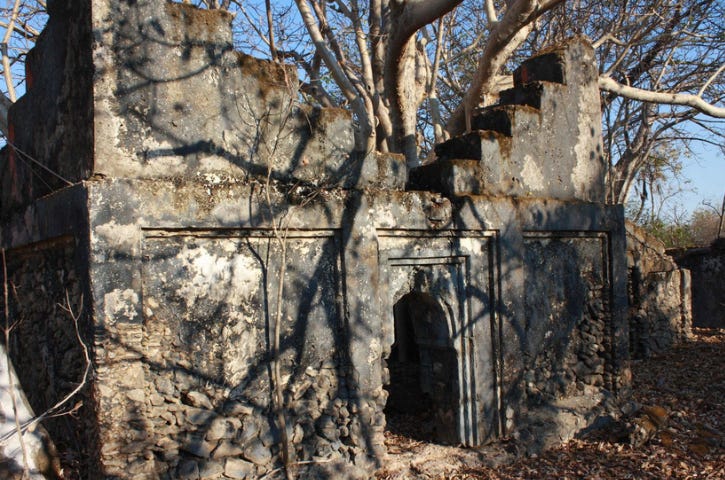
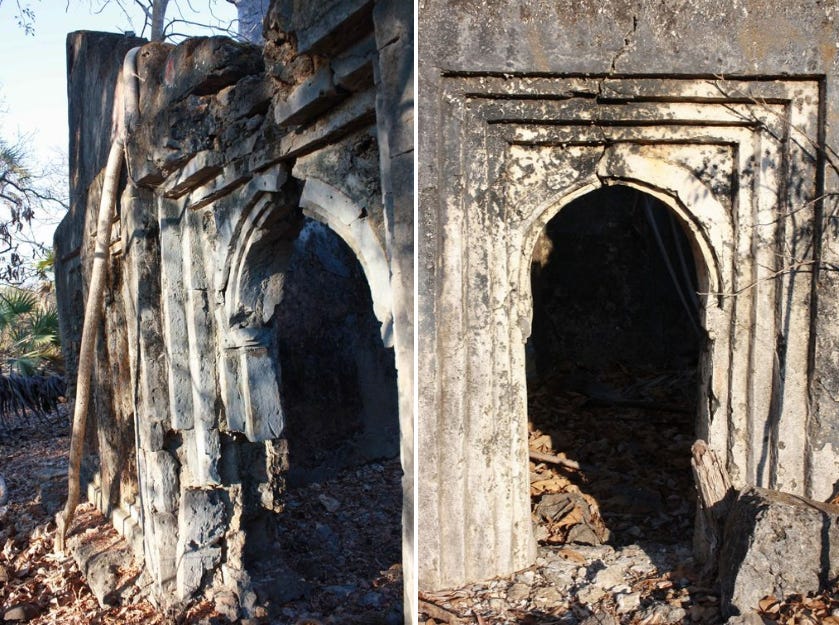
Mausoleums of antsohéribory (Mazalagem Nova), Madagascar. images by M.Pauly.
“Two sets of burials are particularly noteworthy. The first consists of a series of mausoleums with flanking wings. These structures remain relatively well-preserved, although their original domed vaults have since disappeared. The door frames of these mausoleums are crafted from carved coral (*Porites*) and decorated with stepped, flat moldings; each opening is topped by a horseshoe-shaped round arch.
The second necropolis is by far the most impressive. it was surveyed and studied by Pierre Vérin. It features funerary enclosures with molded panels, and two imposing mausoleums—once topped with domes—of which only the central pillars remain today. These pillars exhibit a characteristically Swahili architectural style, featuring a cubic base, an octagonal shaft, and a geometric capital with four semi-circular faces, reminiscent of the Ottonian capitals found in medieval Europe.”14
Chittick observes that the absence of pillar tombs at Kilwa is remarkable. It is presumed that most graves were simply marked by head- and foot-stones, as is the case with those within the enclosures in the Cemetery of the Sultans, believed to date from the 16th century.15
Interestingly, the 16th century Kilwa chronicle provides our earliest account of a pillar tomb on the East African coast, but locates it on the neighbouring island of Mafia, rather than in Kilwa itself.
The chronicle mentions that sultan Talut ibn al-Husain (the father and predecessor of the ruler who was met by Ibn Battuta in 1331 and is famous for constructing the ornate palace just outside city) was buried in the same “pillar tomb” that contained the graves of two faqīhs/jurists.16
The chronicle also indicates that most, if not all of, the amirs, qadis and faqīhs of Kilwa came from Malindi, including the father to the author of the chronicle.
Malindi was home to the tallest pillar tomb on the coast, which may explain this exceptional reference to a pillar tomb in the chronicle. A domed tomb found in the Malindi cemetery of Kilwa is also similar to those found along the northern coast.
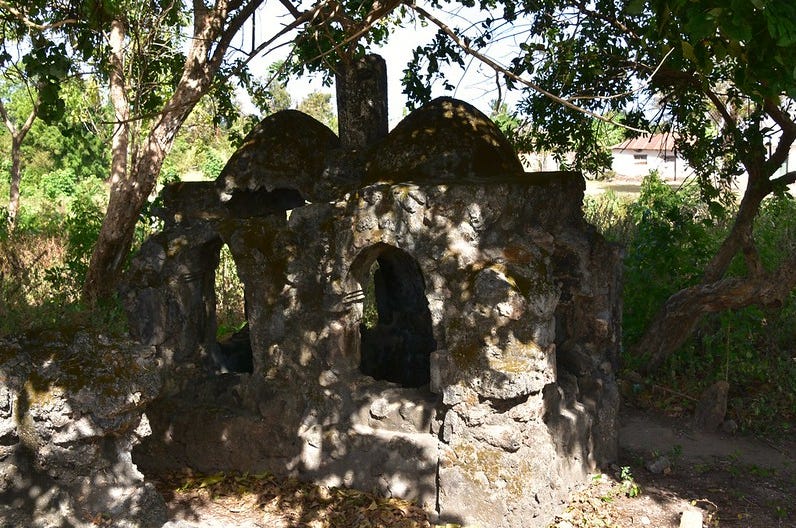
Small domed tomb with a short pillar at Kilwa, Tanzania, built for a prominent member of the Malindi family.
Ibn Battuta’s description of the East African coast in 1331 only refers to a tomb near the main mosque at Mogadishu, that belonged to the son of the ruling sultan:
“He went out into the courtyard of the mosque and stopped at the tomb of his son, which is there. He recited a passage from the Koran and prayed.”17
There are a number of inscribed tombs from Mogadishu and Barawa dated the 13th century.
However, the large, ornate tombs with pillars and domes are found further south near the Kenya border (see map in introduction), at the site of Bur Gao, and on the small islands of Koyama, Ngum, Chovai, and Chula. They mostly date to the 15th century and after, and were a later development of a tradition that emerged further south.18
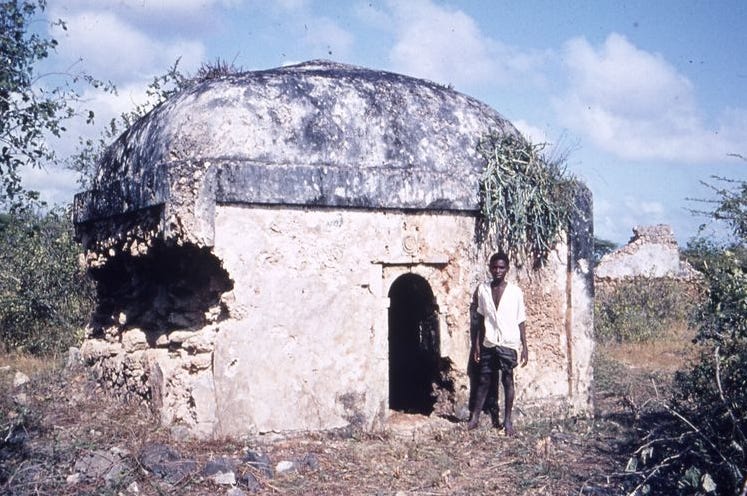
‘Chamber of Mohi ed-Din’ Bur Gao Site I, Image by BIEA
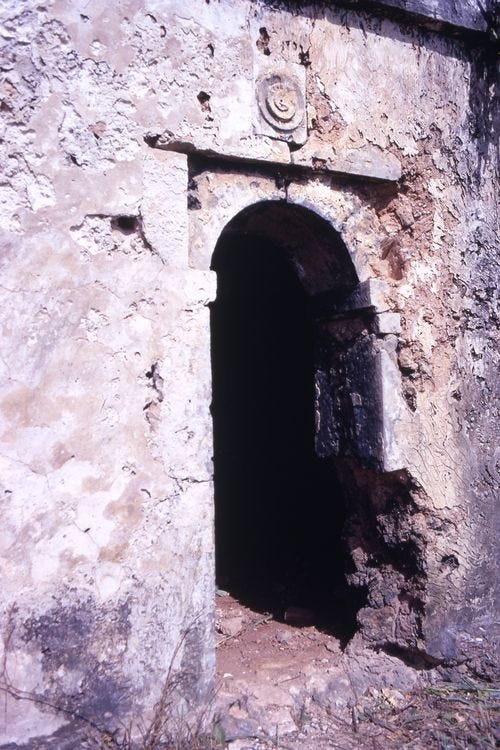
Doorway of Chamber of Mohi ed-Din. Bur Gao Site I, Image by BIEA
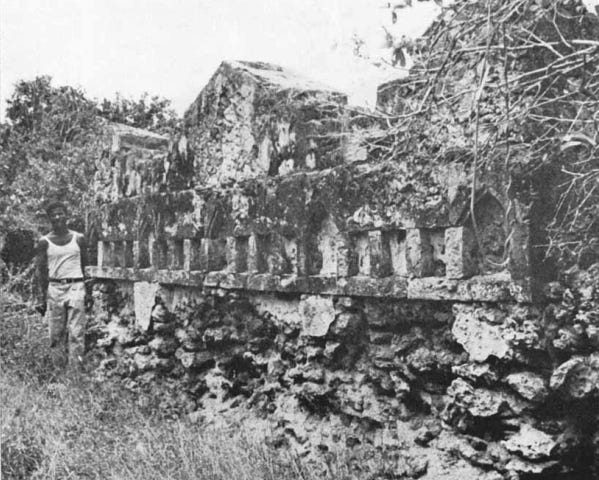
Bur Gao: Panel Tomb at Site II. Image by BIEA
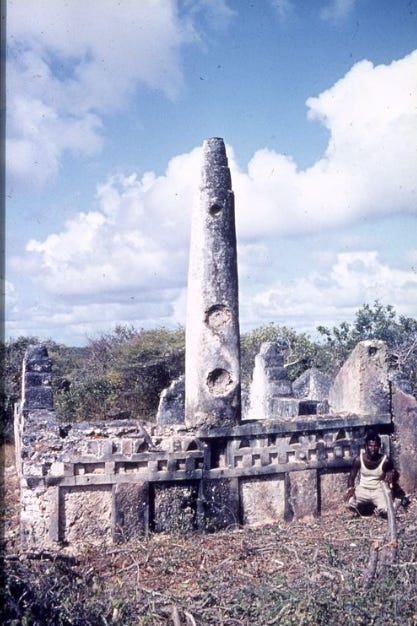
Pillar tombs, Site II, Bur Gao. Image by BIEA
The Swahili Pillar Tombs
The earliest pillar tombs might have been built around the 13th century on the Lamu archipelago, about one or two centuries after the broader phenomenon of tomb-building appeared.
They appear more or less simultaneously across the entire coast, and likely represent a local coastal development that quickly gained popularity. The two largest pillar tombs on the coast occur at Malindi and Mambrui, and are dated to the 16th century.
The tallest known pillar (now collapsed) was at the Mambrui site, and might have been 15 metres tall, about the height of a 5-storey building.19
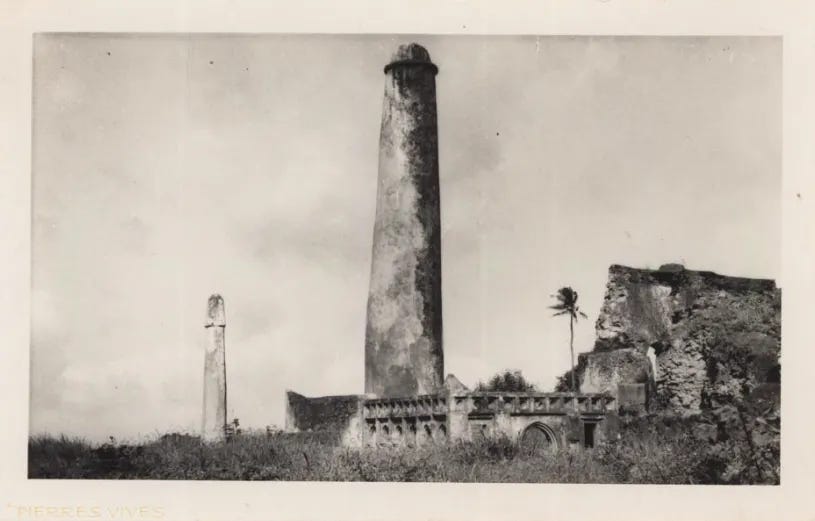
The great pillar tomb at Malindi, Kenya. Wilson (1980) pg 115, fig. 55.
The construction of monumental tombs within Islamic cultures has always been a problematic issue. Although the Quran is virtually silent on this issue, there are many hadiths (accounts of the words and actions of the Prophet) that argue against the practice.
Still, the construction of monumental tombs and the ritual visitation of these graves have a long history in the development of Islamic societies, based on traditions that regard the Prophet, angels, and saints/holy-men as intermediaries between God and ordinary believers.
Sunni veneration of buried “saints” developed as part of widespread popular Islamic practices, so that by the beginning of the 13th century tombs of holy men and women could be found throughout the Islamic world. Visitation and prayer offered at these sites were based on the belief that the baraka, or blessings and spiritual power that these saints radiated in life, would be continued after their death.20
By the 13th century the Muslim practice of honouring graves of holy men became widespread in Africa as well.
Yet in the muslim societies of Africa where monumental tombs are known, they typically take the form of a domed structure or qubba, eg in Egypt, Sudan; Ethiopia, Eritrea, and northern Somalia. On the East African coast, domed tombs appeared relatively late; during and after the 15th century.
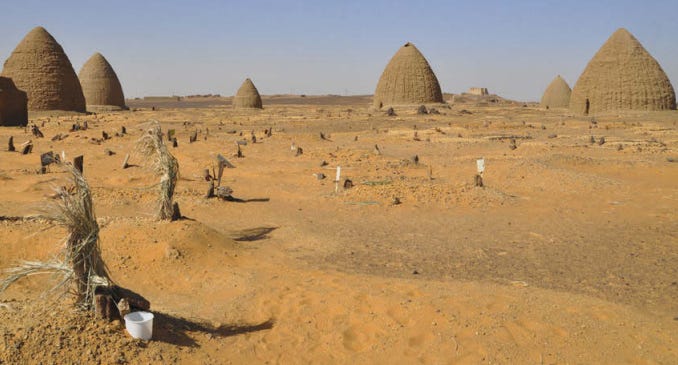
The Qubba (domed tombs) in the Muslim cemetery at Old Dongola, Sudan. Image by T. Fushiya
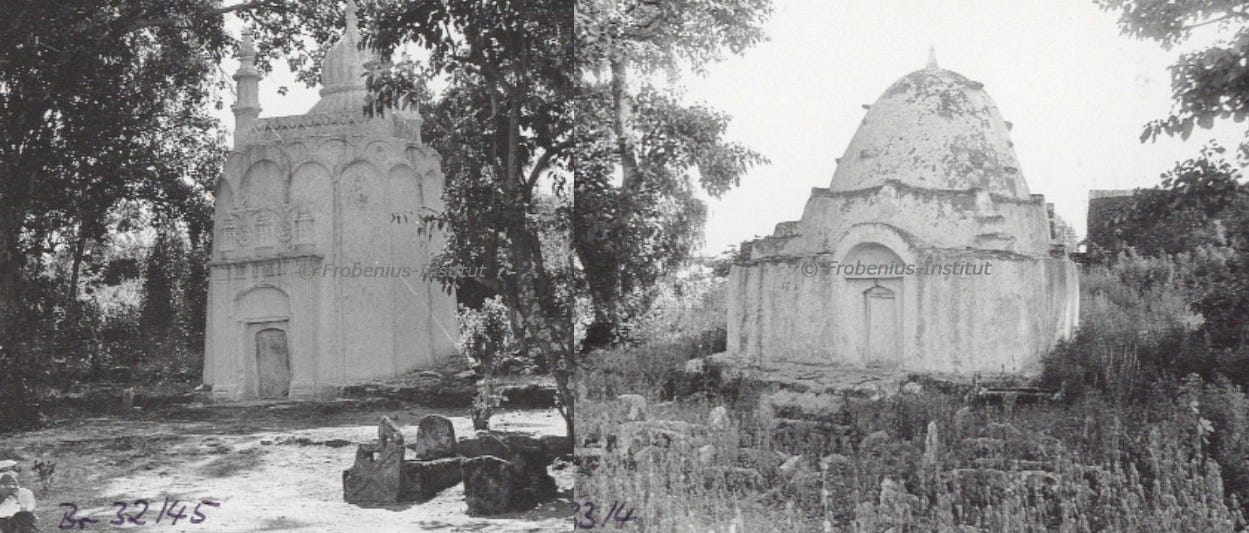
Saints’ shrines in Harar, Ethiopia, ca. 1972. Frobenius institute
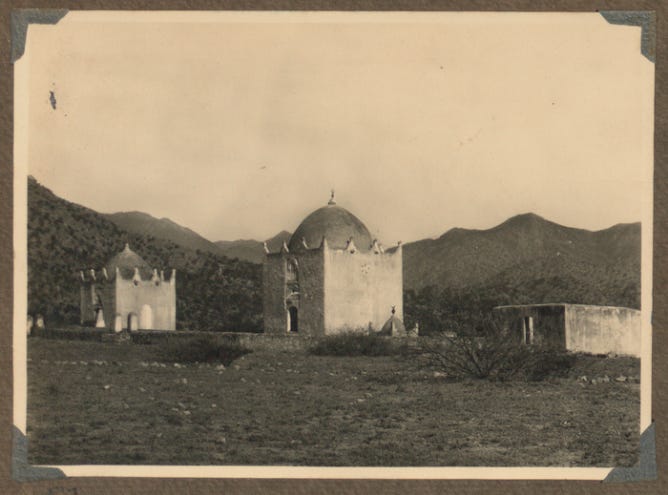
Old tombs in the vicinity of Keren, Eritrea. ca. 1943. Bristol archives
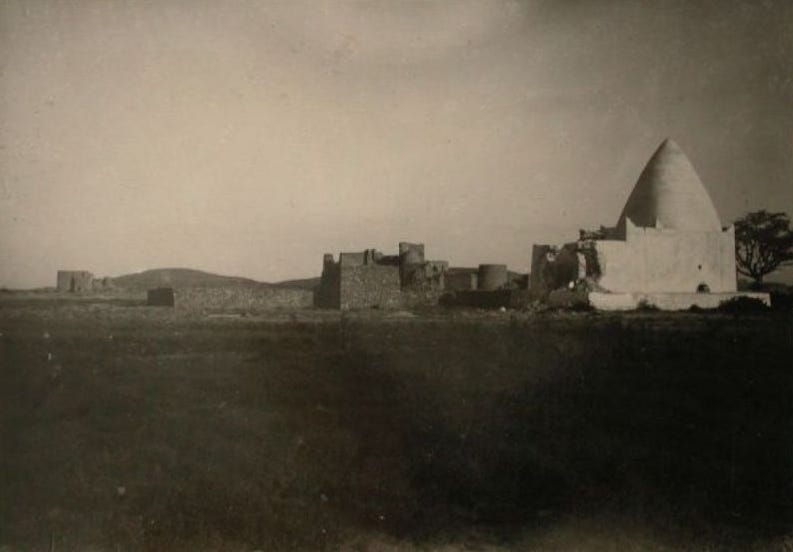
The Mullah’s Garresa (fort) and tombs. 1924, Taleh, Somalia. Archivio Fotografico della Società Geografica Italiana
The pillar tomb form thus represents a unique style of funerary architecture only found in East Africa.
According to Gensheimer although their architectural origins remain largely unknown, their placement within their larger cultural landscape speaks to a distinctively African context.
Evidence has shown that graves were placed in the central communal and ceremonial space within early Swahili settlements as far back as the 9th century. They thus represent an original indigenous settlement pattern.21
In a number of communities geographically close to the Swahili, tombs surmounted with pillars are found among the non-Muslim Mijikenda of inland Kenya who marked burials with small pillars (vigango).
Further back in time, stone monoliths of varying size often feature in Pastoral Neolithic (c. 4800–1200 BP) burial cairns and other forms of ‘megalithic’ complexes around Lake Turkana and in the central Rift Valley.
Although their relationship to Swahili-era practices is fairly tenuous, they point to the existence of a long-standing regional tradition among the pastoralist groups that some researchers argue contributed to the early formation of a Swahili identity.22
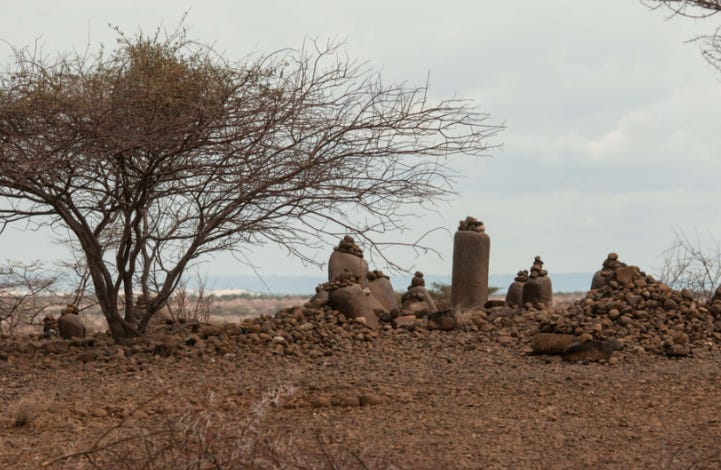
Kalokol pillar site, Late 3rd millennium BC. L. Turkana, N.W. Kenya.
João dos Santos’s 1609 account, for example, frequently compares the customs of the coastal Swahili with those of the interior peoples,23 especially their burial traditions, the veneration of the dead, and the marking of graves with standing stones.24
“All the Moors upon this coast, though they may be very poor and have not sufficient to eat during their lives, use every endeavour to have a piece of fine cloth or Indian muslin put by to serve them as a shroud when they die. They are also buried in the woods like the Cafres [interior tribes], and in the grave they put rice, millet, butter, and water in some vessel, and then cover the whole with earth.
They mark the grave with two stones, one at the head and one at the foot, which they anoint with sandal, a sweet-smelling powder, not only when the deceased is buried, but thereafter the relations come and anoint the stones with sandal and throw rice upon the grave, and some place a pot with burning coals and incense upon the grave, which perfumes the spot.
These Moors carry out their dead for burial upon the mats or beds upon which they die, and leave them upon the grave, and they are never used again, although they may be new, and there in time they rot away. They seem to have adopted this custom from the interior tribes, who all do the same thing.”
Just like the practice of annoiting the “stones of the sepulchre” with fragrant sandal was noted in the tomb at Sofala in 1609, the offering of perfumed stones is attested in the royal cemetery of Kilwa by Richard Burton, more than two centuries later in 1857:
“Around it lay the tombs of the Shirazi Shaykhs… strewed with small water-washed pebbles. This is an ancient custom of the country: a few days after the decease small stones are washed, perfumed, and sun-dried ; finally, they are strewed with prayers upon the tomb.”25
Further back in time, a 12th century account from the northern Swahili town of Barawa (in Somalia) by the Arab geographer al-Idrisi notes the importance of stone monoliths annointed with oil in local pre-islamic religious customs that are thought to be the precursor of the pillar tombs:
“We say that this sea is the Indian sea, and on its shore is the town of Barawa [Brava] the last in the land of the infidels, who have no religious creed but take standing stones, anoint them with fish oil and bow down before them.” 26
There’s further evidence for cultural continuity between the pre-Islamic and Islamic traditions that survived in a few communities in the early 20th century, and could represent the mortuary practices of the late Middle Ages when the tombs were built.
As Spencer Trimingham (1964) explains27:
“The ancestor cult survives in some form among all Muslims, other than detribalized, who have been converted within the past hundred years, and in an attenuated form among Swahili except those of the town.
Muslim Digo (A Mijikenda tribe in the hinterland of Mombasa) almost without exception, offer sacrifice at family graves and ancestral kayas, their original settlements now situated in the midst of almost impenetrable bush.
They are in charge of an hereditary guardian called simply mwana-ti, ‘the lord on the land’, the ordinary word for an ‘indigenous person’. In their inhabited settlements graves (mbira) are found in groups, those of men marked by a single stone, those of women by three, representing the cooking stones.
Shelters are often built over the graves of men and remain untended until the neglected koma shows its disapproval.
Among Swahili, other than townspeople, such rites take the form of tambiko ya gombo, that is, offerings at a mzimunzi or altar to ancestral spirits. Saada Salim bin Omar writes, ‘It is a general belief among many Africans in these parts that failure or disregard to perform this ceremony will make the spirits of ancestors come and cause trouble and sickness in the neglectful family’.
The spirit of a dead person is known as koma (evestrum). These spirits all inhabit kuzimu, the region of ancestral spirits, but visit their altars (mizimu, s. mzimu) and graves. Relations sometimes build a small shelter (kibanda) for the purpose, sometimes the altar is under a large shady tree, rock, cave, or ruin.”
Since the shaft is a basic architectural form and, given that the idea of erecting rocks, sticks, carved stakes, tusks, pillars or stelae is widespread, it may not be necessary to look for foreign inspiration in the genesis of the East African pillar tomb.
Perhaps pillars were simply raised, in the coral-stone medium the Swahili used frequently, to build an impressive and lasting monument for the deceased.28
As Gensheimer explains, monumental tombs and their associated rituals and placement may reflect indigenous African settlement patterns and traditional attitudes towards the spirits of the ancestors. The designs of the tombs also display the same architectural features found in Swahili houses and mosques29.
“According to the traditional beliefs of other coastal Bantu societies, spirits can often reside in graves, small huts or other special sites within the settlement and require offerings and sacrifices to be appeased.
Burials, particularly those of important community members, were traditionally placed at prominent sites within the village and in some cases near the house where the deceased lived, where they may be marked by vertical slabs of stone or wooden posts.
Similarly, some medieval Swahili tombs have been associated with domestic structures. At the House of the Dhow at Gedi, an oversized monumental tomb was built adjacent to the entrance, representing the final resting place of Sharif Hasan Saidi bin Abdullah, presumably the home’s last owner.
At the Palace at Gedi, in addition to a small tomb enclosure outside its formal entrance, there were no fewer than five and as many as seven tomb enclosures built within its inner courtyard beginning in the earliest stages of construction in the early fifteenth century.
The association of tombs and domestic structures can also be seen in the use of features such as arched openings with multiple rebates, flanking niches, and recessed panels above the openings, all of which are common architectural features found in stone-built Swahili houses.
Likewise the addition of inset glazed pottery on tomb façades may be similar to the display of imported ceramics within the inner spaces of the traditional Swahili houses.
The proximity and similarities in appearance reinforce the symbolic connection between monumental tombs and house forms, specifying the notion that such structures may have been conceived as literal houses for the dead.
Many tombs have entrances built into their façades, presumably to provide access to the burial, which at times is designated by a sarcophagus- like structure within the enclosure. In some tomb structures, this entrance was reduced to a symbolic image, represented as an opening, often arched, in the panels of the eastern façade.”
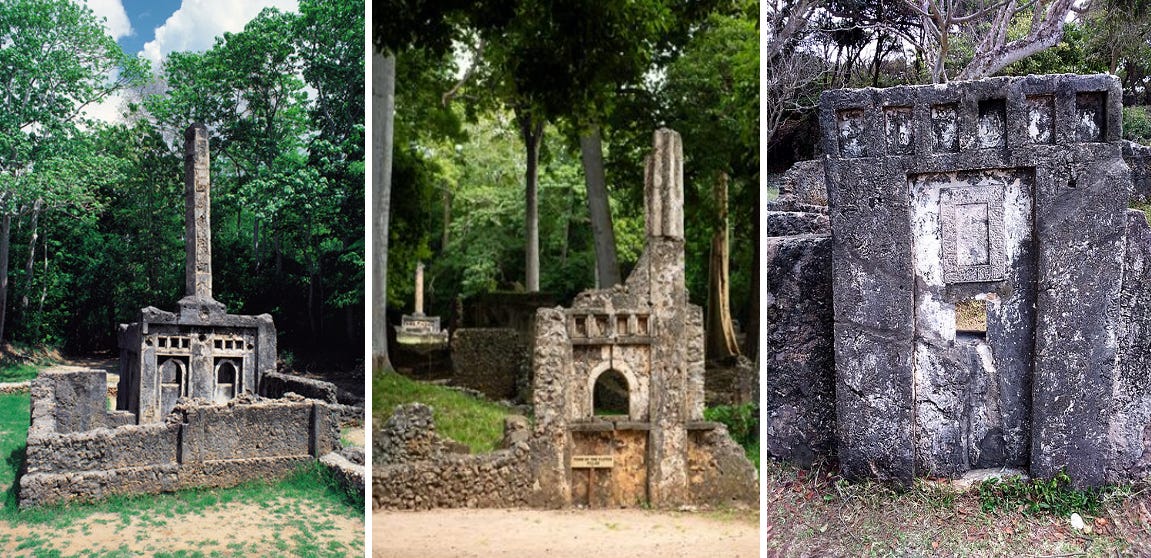
(left) The Pillar tomb at the palace of Gedi, Kenya. Wilson (1980) pg 108, fig. 51.30 (center) The Tomb of the fluted pillar, Gedi, Kenya. Wilson (1980) pg 108, fig. 52. (right) Tomb of the Plaque, Jumba la Mtwana, Kenya. (Wilson (1980) pg 60, fig. 21).
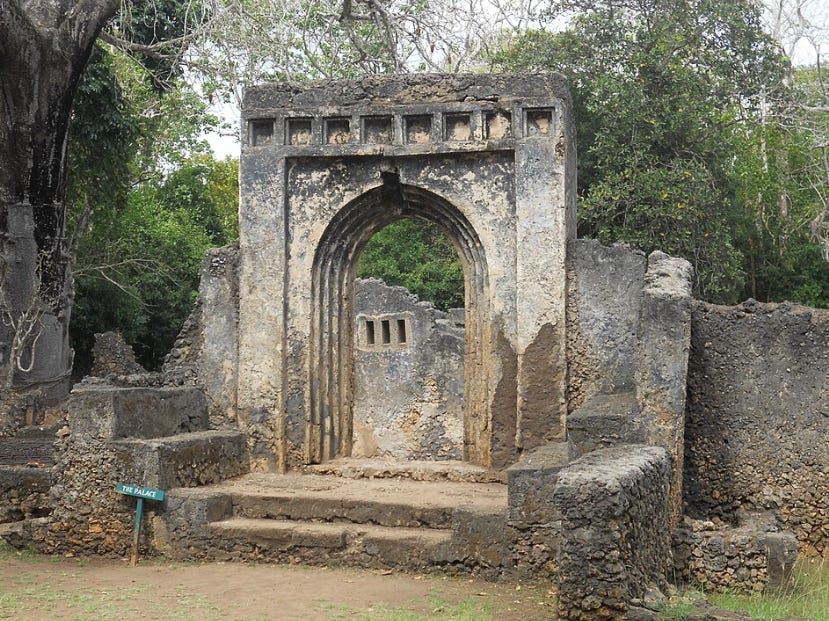
Monumental doorway to the so-called Palace of Gedi, Kenya, showing the use of decorative niches.
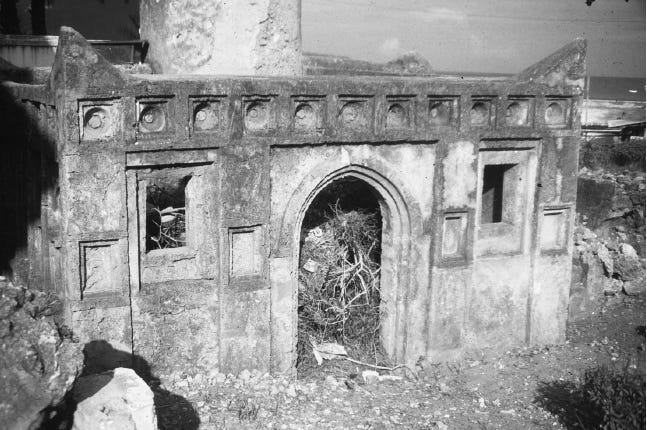
Pillar tomb at malindi, central Kenya coast displaying design motifs found in swahili domestic structures. Image by T. Gensheimer

Ruined house showing doorways made of carved coral, and niches. Shela, Lamu, Kenya, 16th century.
Ceremonies at the tomb itself probably took the form of prayers accompanied by food or other offerings and the burning of incense. White chickens were recently considered to be a particularly appropriate sacrifice.
Archaeological evidence of such practices is found, usually in the form of incense burners. For example, at the tomb at Omwe three incense burners were found as well as 19th and 20th century coins which were probably offerings.
At Mwana the pillar tomb seems to have been constructed with a hollow “chimney” in the pillar, access to which might have been gained from the front, which would make it a likely place to accommodate the burning of incense.31
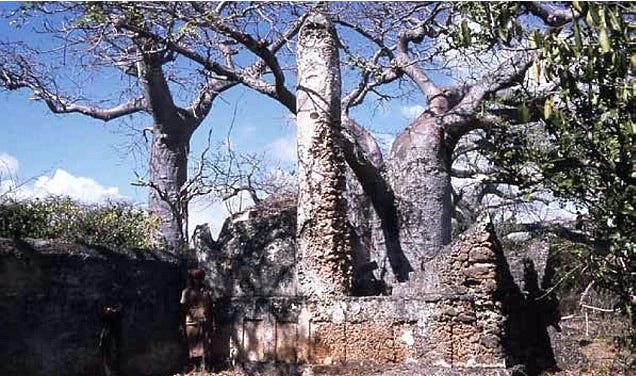
Tomb A. Omwe, Kenya. Wilson (1978) pl. 26
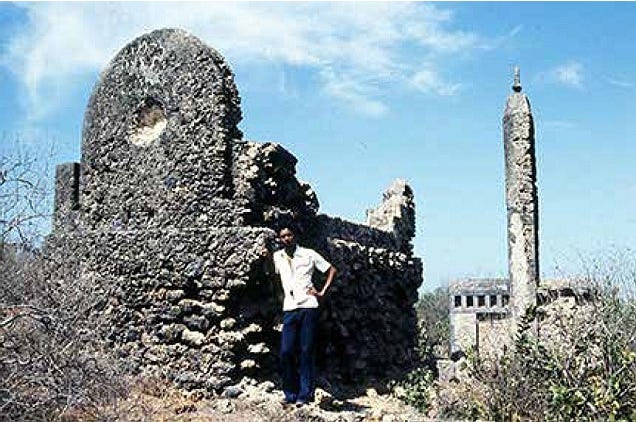
Tombs B and C, South Mainland Group. Mwana, Kenya. Wilson (1978) pl. 63
Some scholars however, challenge this link between the mortuary practices of the Swahili and their non-Muslim neighbors near the coast.
Given the absence of pre-Islamic grave stones at the coast itself, Horton points out that the earliest pillar tombs in the Lamu archipelago were fluted in section, with a design that resembles contemporary mihrabs.32
He argues that the importance of spirits in contemporary Swahili society is a much more recent development, along with the numerous cases of incense burners and other offerings found in the remains of tombs.33
While the tomb designs certainly resemble other forms of Swahili architecture including mihrabs of mosques, the practice of incense and leaving offerings at important tombs was well established along the coast at the time of dos Santos 1609 account.
Additionally, the importance of tombs as places for veneration of ancestors has been argued to more or less overlap with assertions of power, and the Muslim tradition of revering places connected with particular saints and social leaders.
The commemoration of ancestors was associated with processions, public events and display of allegiance and power. Tombs provided the settings for rituals of power negotiation, as at Vumba Kuu where the investiture of the diwan (or sultan) took place at the tomb of a prominent early ruler.34
Communal processions, with chanting and a dance called gungu, are associated with visitations to the grave of Shaha Msha ham bin Hisham, last ‘Shirazi’ ruler of Mombasa (d. 1592), before the Portuguese gave the city over to the ruler of Malindi.35
The election of a town’s ruler by a council made up of the town’s patricians was particularly elaborate, with gift giving and pilgrimages to the tombs of former rulers.
The tombs of the Shomwi of Kunduchi in Tanzania are a very good example of the elaborate marking of graves, with several pillar tombs, decorated with Chinese blue on white plates and surmounted by what appear to be turbans, as well as numerous huts and enclosures.
Inscriptions on these tombs date this use of this royal cemetery from 1670 to 1848, giving an indication of the span of this dynasty.36
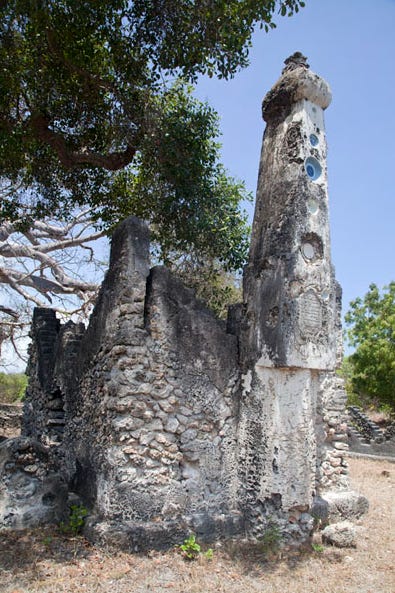
Pillared tomb at the graveyard of Kunduchi, Tanzania.
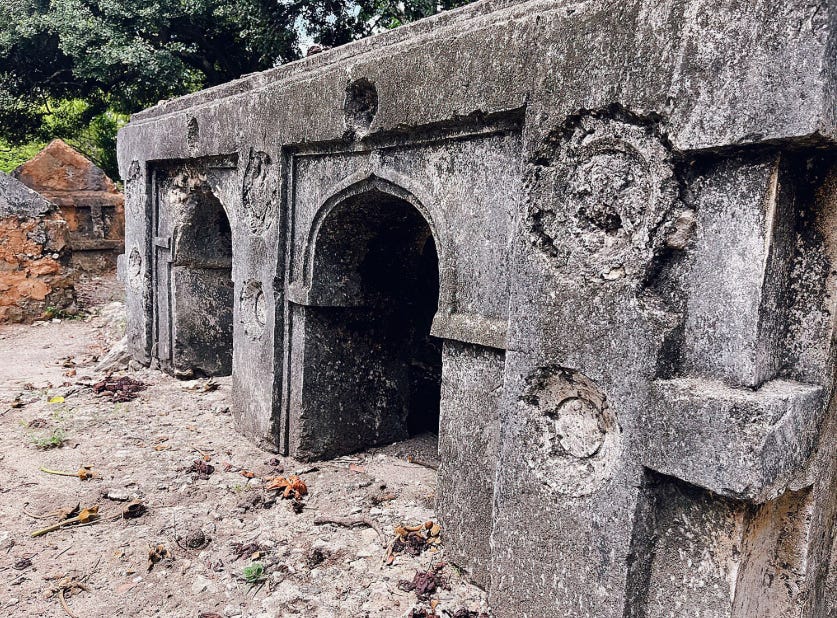
Tomb with Arches, Kunduchi Ruins. Images from Tanzania Tourism Gateways
These mortuary practices weren’t confined to the “republican style” city-states but were also found among the more centralized albeit smaller polities.
At Pemba, historical traditions regarding a tyrannical ruler known as Mkame Ndume (Swahili for “Milker of Men”), who was of both “shirazi” and “Segeju” origins (an interior tribe) and was adept in the use of magic, have been corroborated by the discovery of a subterranean shrine near his fortress-house at Pujini, that contained a siwa (ivory horn) and fingo pots said to contain magic.
His son was Haruni, known as Mvunja Pau (Swahili for “The Breaker of Sticks” ) whose 15th-16th century pillar tomb still survives at Chwaka on Pemba island, and is also decorated with a siwa.37
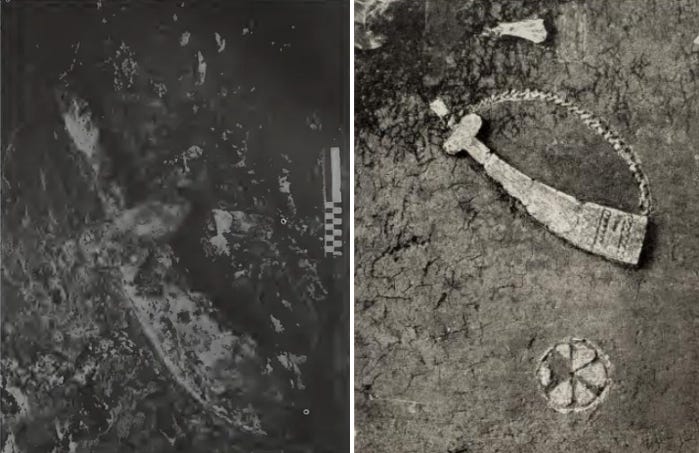
(left) Plaster relief of a side-blown horn or siwa, another emblem of Swahili kingship, on the ‘shrine’ at Pujini, Pemba Island, Tanzania. Image by James De Vere Allen. (right) Decorations on Haruni’s tomb at Chwaka, Tanzania. Image by Francis Barrow Pearce, ca. 1919.
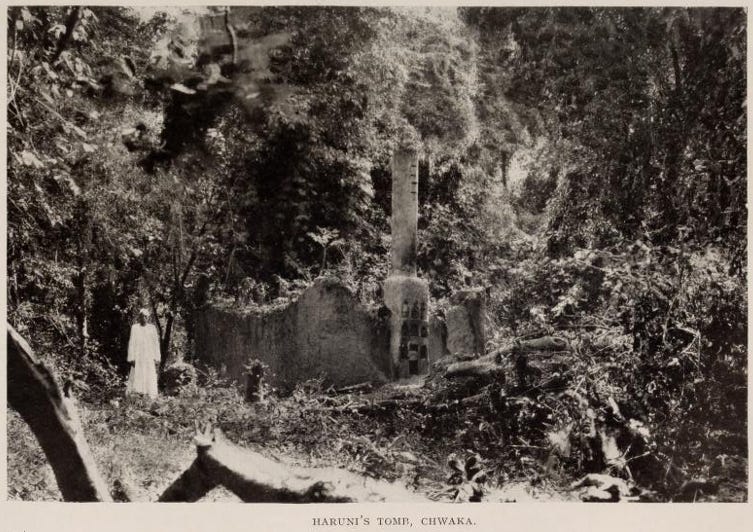
Haruni’s pillar Tomb at Chwaka. Image by Francis Barrow Pearce, ca. 1919.
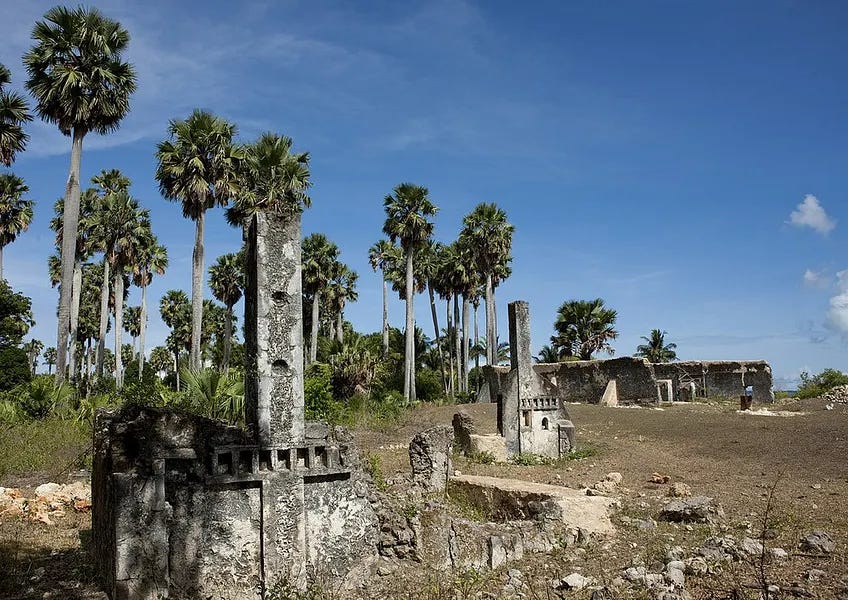
View of pillar tomb and graves, Ras Mkumbuu, Pemba.
Monumentality in the unique form of pillar tombs and their popularity demonstrated by the fact that on the northern Kenya coast almost 25% of recorded stone tombs are pillar tombs, might be explained within the context of the built environment.
In some locations where pillar tombs might have been visible from the sea, they served navigation purposes.38
While some pillars could have aided navigation, this was clearly a secondary function to the main purposes of the tombs, for the majority of the pillar tombs could never have been seen from the sea.
Dos Santos’s 1609 account indicates that Swahili sailors were using the “mast” next to the tomb of the saint for religious supplications, and not for navigation purposes.
Certain Swahili communities see ancestral tombs as proof of their ownership of a particular area.
Accordingly as tombs are indicative of land ownership and the local community, it is beneficial to build long lasting and grand stone tombs. This would be especially true for pillar tombs, which have a high visibility over the landscape.39
According to Wilson, the tombs thus served to reinforce the prestige and to validate the authority of the family or lineage of the deceased, to strengthen the kinship group and to maintain such persons in or admit them to positions of social, religious or political power.40
Ethnographic studies from the 19th century onwards suggest that Swahili identity has been considerably fluid, based on personal and group affiliations and allegiances, which are not based on place of birth, but by shared residence.
The great variety in the external appearance and decoration of pillar tombs likely further promoted their memorability. This explains why on sites where more pillar tombs were gradually added, their builders tended to opt for designs that differed from those already present in the town.41
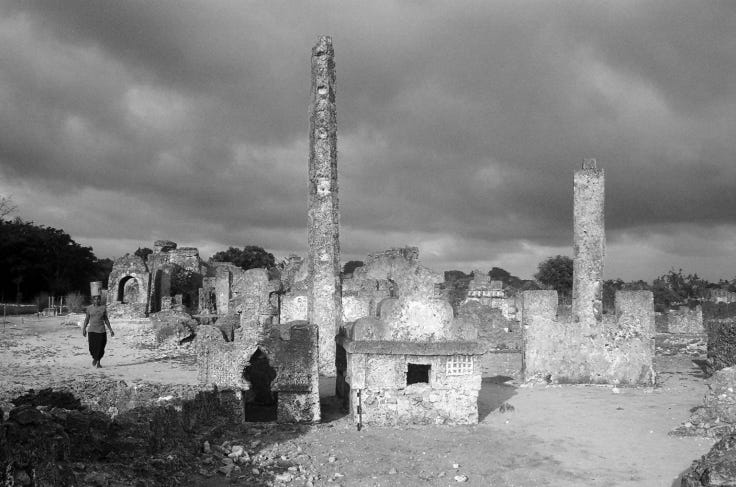
‘Kaole Ruins looking west showing the 13th- to 14th-century mosque and tombs decorated with plates and bowls and reef coral. A tomb bearing a tall pillar c. 10m in height dominates the cemetery and at one time many more of the tombs were decorated with plates and bowls cemented into their structure. Kaole Ruins are sited on the beach terrace and comprise several standing monuments, whose dates range from AD1400 to 1800.’ Image and caption by J.D. Pollard
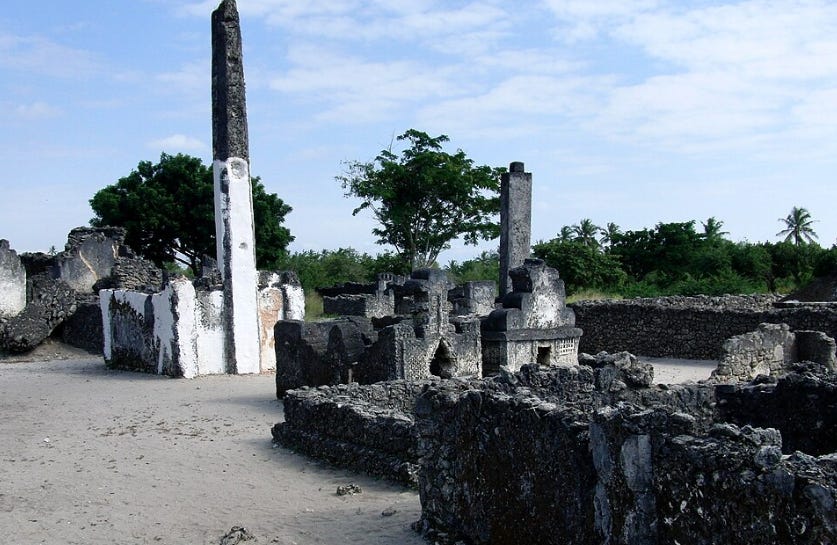
Kaole ruins near Bagamoyo, Tanzania. WikimediaCommons.
The Saints of the East African coast.
Certain tombs are known as the burial sites of sharifs or other holy men and women, and attract visitors and pilgrims who make prayers and present offerings such as food and burning incense at the tomb site.
A pillar tomb at Takwa, dated to 1682, is still the object of pilgrimage by the people of Shela on Lamu Island, who sail by dhow to Takwa to burn their incense and pray for rain and other favours.
Takwa was never mentioned by the Portuguese who controlled the coast during this period. It was probably the retreat of a holy man who lived there for a time with his disciples.42
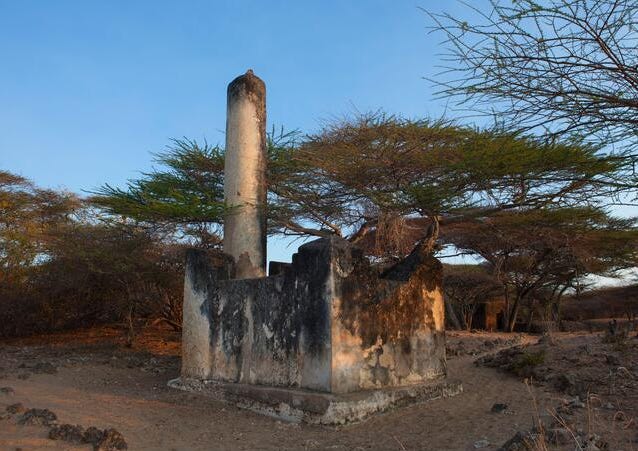
Takwa Pillar Tomb, Lamu island, Kenya. Alamy Images
At Tongoni in 1857, Richard Burton was taken on a tour of the old ruins by the Swahili, who showed him a number of tombs.
The largest of which was a roofed tomb belonging to notable, whose floor was “cleanly swept and garnished with a red and white flag.” He adds that “Other tombs bore cacophonous Wasawahili appellations embalmed in mortally bad Arabic epitaphs: these denoted an antiquity of about 200 years.”
Despite the reuse of an imported tile in one of the older tombs, which was “regarded with superstitious reverence by the Wasawahili” the tombs were relatively recent structures, broadly contemporaneous with the Portuguese period and later.43
Historical traditions from Tongoni indicate that the town’s founder was Makami bin Naamani, an exiled qadi of Kilwa, who occupied the deserted town with his family and partisans.44
The ruler of Tongoni was normally hostile to Mombasa and therefore friendly with the Portuguese. A lapse from loyalty occurred in 1631 when the Portuguese settlers were murdered at the instigation of Dom Jeronimo. There was still a ruler in 1728, during the brief return of the Portuguese, but there may have been a shift of population some time later which would account for the virtual desertion of Tongoni.45
Tombs were considered places where the baraka, or spiritual power, of the deceased still radiated from the grave after death, and which could bring blessings on those who revered the saint, or punishment for those who questioned his spiritual authority.
In 1856, a large expedition landed at Faza under the Omani Amir Hamid to take Siyu, which had now become the last major center of Swahili opposition at the coast, after the fall of Mombasa to Sultan Seyyid Sa‘id of Zanzibar.
The town was blockaded, the dhows in the creek being turned over to serve as forts. Sheikh Mataka, the ruler of Siyu, feeling that the end was near, consulted a sherif, who in turn consulted his grandfather, Sharif Mwenyi Said, who was buried in a tomb at Siyu.
The gentleman in the tomb reassured his grandson; the troops of Siyu carried out a counter attack, killed the Amir, captured his guns and stormed the dhow redoubts. Seyyid Sa‘id gave up the campaign against Siyu and sailed away.46
Around this time, Burton also mentions a similar tomb between Wasini and Pangani (near the Tanzania/Kenya border) where there was a tomb of a saint who’d saved his followers from attackers, although this time, from the interior.
The tomb became a site of veneration, with devotees leaving food and other offerings. When a Suri Arab from Oman who followed the fundamentalist Wahhabbi doctrine visited the tomb and discredited the religious credentials of the saint, his ship was reportedly wrecked in the same year.47
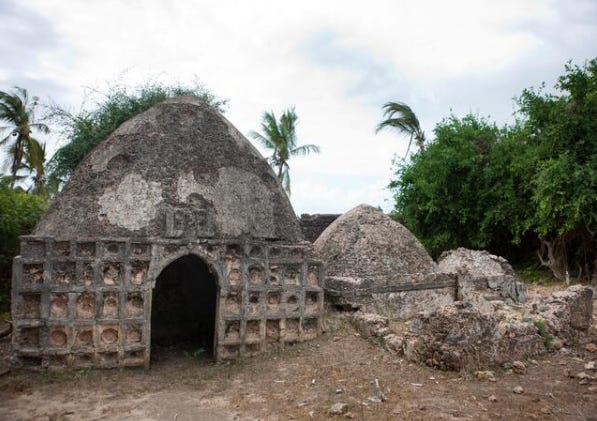
Domed tomb on Lamu Island, Kenya. ‘On the east face of the dome there is inset an inscription stone, a written date of A.H. 1270, (A.D. 1853-54).’ Wilson (1978, 135)
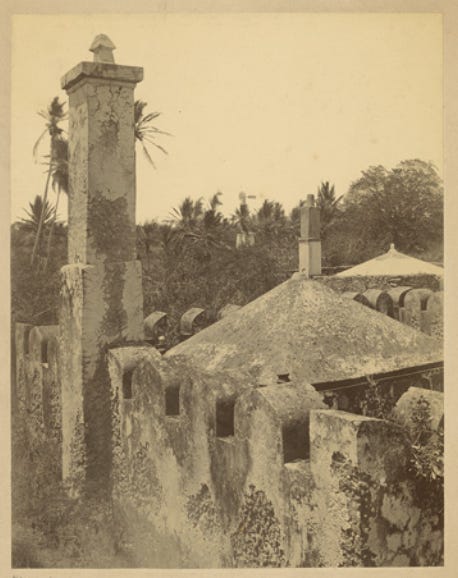
Old tombs in Bagamoyo, Tanzania. Deutschefotothek
Horton suggests that a revival in tomb building along the coast during the late 18th century may have been part of a wider reassertion of local identity in the face of settlement from the Omani Arabs at Zanzibar and other parts of the coast.
Ancient sites such as Tongoni, Kaole and Kunduchi, long abandoned were suddenly reused. New enclosures were added to old tombs, new cemeteries were established on old sites, and new forms of tombs such as ‘hut tombs’ and ‘pyramid tombs’ appeared.48
In the late 19th, opposition to veneration of holy men and their tombs came from the orthodox Arab puritans. They raised such an outcry against the building of a tomb to Seyyid Sa‘id that its construction had to be abandoned unfinished.
In 1896, they protested against the construction of the tomb of Sharif Musa, a native of Siyu, but with little effect. This tomb-mosque is visited by people of all sects to seek the saint’s baraka and make offerings of money, food and incense.
As they pass the tomb, dhow crews offer prayers and cast offerings into the sea, in a custom similar to that observed by the Frair João dos Santos nearly three centuries earlier.49
These ancient tombs remain to this day as enduring, if often overlooked, reminders of Africa’s distinctive and diverse architectural heritage.
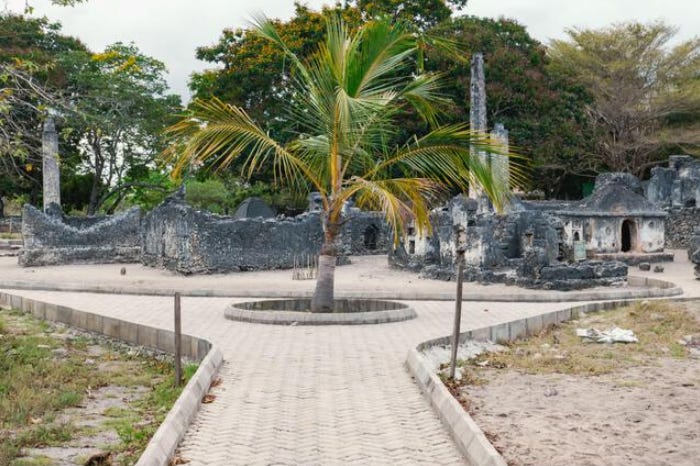
Kunduchi Ruins, Tanzania.
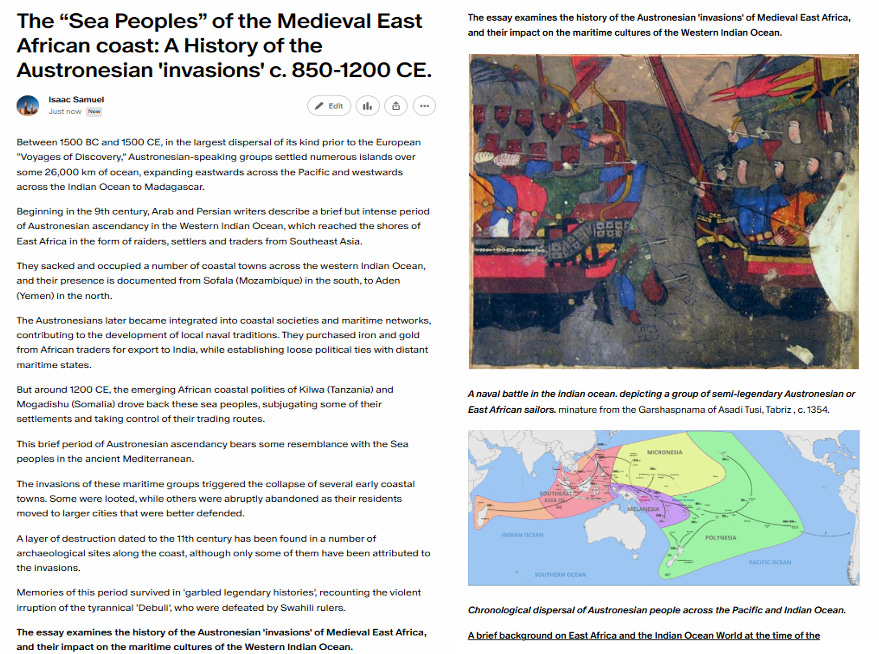
Beginning in the 9th century, historical sources describe a brief but intense period of Austronesian ascendancy in the Western Indian Ocean, which reached the shores of East Africa in the form of raiders, settlers and traders from Southeast Asia.
My latest Patreon Article demystifies the Austronesian invasions of East Africa, and why they suddenly stopped just as the Swahili became culturally and politically dominant along the coast.
Please subscribe to read more about it here:
Records of South-Eastern Africa : collected in various libraries and archive departments in Europe by Theal, George McCall, 1837-1919, pg 351-352.
dos Santos described the “moors” of the East African coast are “dark skinned” and that they resemble the interior tribes “in their customs” (pg 22)
In another section, he had noted that Moors as “almost like Cafres [interior tribes] both in their black colour and in their customs and conversation”; i.e they were Bantu-speaking Swahili (pg 119).
He later specifies that these ‘interior tribes’ of the southern coast as the “Mocarangas” (Ba-Kalanga) of the interior kingdoms like Mutapa and the Great Zimbabwe ruins, as well as the Botongas (Ba-Tonga) and “Macua” of the coast (pg 274, 304)
Les cités-États swahili de l’archipel de Lamu, 1585-1810 : dynamiques endogènes, dynamiques exogènes, by Thomas Vernet pg 407-408
About these, he writes: “The sailors of all these vessels are Moors, most of them black. They are barbarians, and very fond of wine ; and are only Moors in name and in the practice of circumcision, as they neither know nor keep the creed of Mohamed that they profess.”
Records of South-Eastern Africa : collected in various libraries and archive departments in Europe by Theal, George McCall, 1837-1919, pg 331
Horn and Crescent by Randall Pouwels pg 71-72, 75-76
Menace and perseverance at the dargah of Sofala: the transnational afterlife of a Mozambican saint’s tomb Pedro Pestana Soares
Pillar Tombs and the City: Creating a Sense of Shared Identity in Swahili Urban Space by Monika Baumanova pg 382, Men and monuments of the East African coast by James S. Kirkman, pg 50.
Pillar Tombs and the City: Creating a Sense of Shared Identity in Swahili Urban Space by Monika Baumanova pg 390-392
Swahili Houses and Tombs of the Coast of Kenya by James de Vere Allen and Thomas H. Wilson pg 35-40
Wilson, Thomas H (1978). The Monumental Architecture and Archaeology North of the Tana River
The Swahili World, Edited By Stephanie Wynne-Jones, Adria LaViolette pg 496
Research Notes: Monumental Tomb architecture of the Medieval swahili coast, by Thomas gensheimer, pg 108-109. Kilwa : an Islamic trading city on the East African coast by Neville Chittick, pg 238
The Swahili World, Edited By Stephanie Wynne-Jones, Adria LaViolette pg pg 496-497
Grandeur et décadence des Antalaotsy by Société d’Histoire et d’Archéologie de Mayotte
Kilwa : an Islamic trading city on the East African coast by Neville Chittick, pg, 240
The East African Coast: Select Documents from the First to the Earlier Nineteenth Century by G. S. P. Freeman-Grenville pg 40
The East African Coast: Select Documents from the First to the Earlier Nineteenth Century by G. S. P. Freeman-Grenville pg 29
An Archaeological Reconnaissance of the Southern Somali Coast by Neville Chittick
Pillar Tombs and the City: Creating a Sense of Shared Identity in Swahili Urban Space by Monika Baumanova pg 393
Research Notes: Monumental Tomb architecture of the Medieval swahili coast, by Thomas gensheimer Pg 109
Research Notes: Monumental Tomb architecture of the Medieval swahili coast, by Thomas gensheimer Pg 111
Pillar Tombs and the City: Creating a Sense of Shared Identity in Swahili Urban Space by Monika Baumanova pg 18-19
see footnote 2 above
A later account by Senhor Ferão, the Portuguese captain of Sena (in Mozambique) in 1810, also makes a similar comparison, observing that “To the east-south-east of Sofala, at about four hundred yards distance, is situated the Moorish town… The only circumstance that distinguishes them from the other inhabitants is refraining from pork, and rejecting all sorts of meat that is not killed by the hands of one of their sect. In their habits, customs, language, superstitions, songs, and dances, they imitate the native.”
Records of South-Eastern Africa : collected in various libraries and archive departments in Europe by Theal, George McCall, 1837-1919, Pg 371)
Records of South-Eastern Africa : collected in various libraries and archive departments in Europe by Theal, George McCall, 1837-1919, pg 223
Zanzibar: city, island, and coast by Burton, Richard Francis, Sir, 1821-1890, Vol 2, pg 359
Islam: Religion and society by Bernard Lewis pg 117
Islam in east Africa by J. Spencer Trimingham pg 115-116)
Swahili Houses and Tombs of the Coast of Kenya by James de Vere Allen and Thomas H. Wilson pg 41
Research Notes: Monumental Tomb architecture of the Medieval swahili coast, by Thomas gensheimer, pg 111-112
Wilson, Thomas H (1980). The Monumental Architecture and Archaeology of the Central and Southern Kenya Coast.
Swahili Houses and Tombs of the Coast of Kenya by James de Vere Allen and Thomas H. Wilson pg 33
The Swahili World, Edited By Stephanie Wynne-Jones, Adria LaViolette pg 497.
The Swahili: The Social Landscape of a Mercantile Society by Mark Horton and John Middleton, pg 71, 222, n.75
Finding Meaning in Ancient Swahili Spatial Practices Jeffrey Fleisher & Stephanie Wynne-Jones, pg 181-182
Islam in east Africa by J. Spencer Trimingham pg 94
The Swahili: The Social Landscape of a Mercantile Society by Mark Horton and John Middleton, pg 168-169
The Swahili: The Social Landscape of a Mercantile Society by Mark Horton and John Middleton pg 169. Swahili Origins: Swahili Culture & the Shungwaya Phenomenon by James de Vere Allen, pg 170-171
Pillar Tombs and the City: Creating a Sense of Shared Identity in Swahili Urban Space by Monika Baumanova pg 397
The Archaeology of Tanzanian Coastal Landscapes in the 6th to 15th Centuries AD: The Middle Iron Age of the Region by Edward John David Pollard pg 209
Swahili Houses and Tombs of the Coast of Kenya by James de Vere Allen and Thomas H. Wilson, pg 34
Pillar Tombs and the City: Creating a Sense of Shared Identity in Swahili Urban Space by Monika Baumanova pg 399
Swahili Houses and Tombs of the Coast of Kenya by James de Vere Allen and Thomas H. Wilson, pg 33-34. East Africa and the Orient: Cultural Syntheses in Pre-Colonial Times by H. Neville Chittick and Robert I. Rotberg., pg 243
Zanzibar: city, island, and coast by Burton, Richard Francis, Sir, 1821-1890, Vol 2, pg 133-134.
Islam in east Africa by J. Spencer Trimingham pg 21
Men and Monuments on the East African Coast by James S. Kirkman pg 188)
Men and Monuments on the East African Coast by James S. Kirkman pg 67
Zanzibar: city, island, and coast by Burton, Richard Francis, Sir, 1821-1890, Vol 2, pg 156-157
The Swahili World, Edited By Stephanie Wynne-Jones, Adria LaViolette pg 498)
Islam in east Africa by J. Spencer Trimingham pg 94-95.
The ideological conflict between the traditional Islam of the coast and the more fundamentalist Islam of recent Arab immigrants is examined in greater detail by Randall Pouwels in ‘Horn and Crescent’ pg 196-201