

Iron and iron weapons have long been associated with power and divinity across many ancient societies. West Africa, which is home to some of the oldest ironworking sites in the world, is no exception.
Ogun, the god of iron and war, is a major West African deity whose history spans several centuries and whose worship extends across multiple continents.
Associated with both the creation of civilization and its destruction, Ogun originated in Yorubaland, in present-day S.W. Nigeria, before spreading to the kingdoms of Benin and Dahomey, where his swordsmen and devotees entered the historical record.
As states expanded, armies clashed, and craftsmen migrated, this African deity became the ‘Vulcan of Black people,’ with shrines found in virtually every forge, and numerous adherents in Brazil, the Caribbean, and North America.
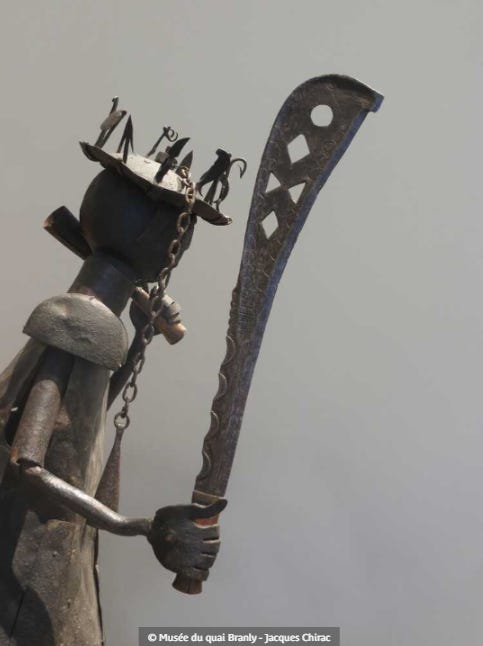
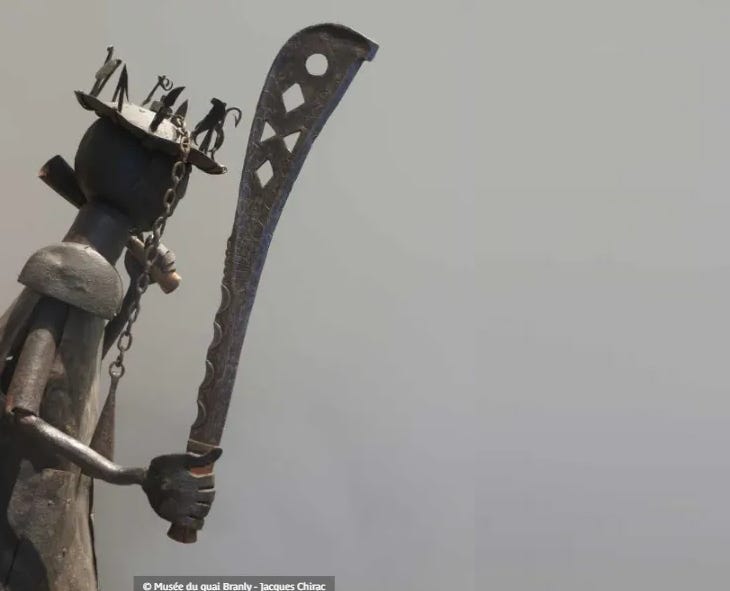
Ogun is best known through the massive, jagged iron swords that serve as his emblem, as well as a famous life-size iron sculpture of the deity that was looted by French colonial forces from present-day Benin.
This article examines the history of Ogun and his significance in the development of pre-colonial statecraft, religious systems, and warfare in West Africa.
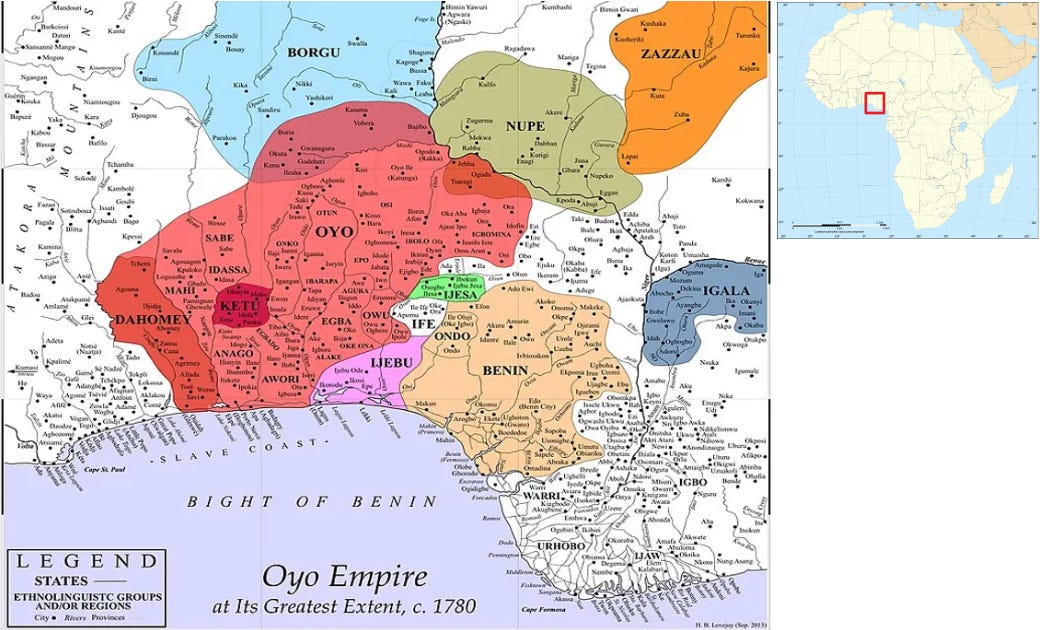
Map showing some of the kingdoms mentioned in this essay.
Support AfricanHistoryExtra by becoming a member of our Patreon community; subscribe here to read more about African history, download free books, and keep this newsletter free for all:
Slaying the serpent of Ouidah
In March 1727, the armies of the kingdom of Dahomey conquered the coastal kingdom of Ouidah, attacked the European forts, and took their occupants prisoner to the interior.1
Captain William Snelgrave, who recorded these events about a month later, reports that Ouidah’s capital was protected by a river “but instead of guarding it, these cowardly luxurious People, thinking the fame of their numbers sufficient to deter the Dahomes from attempting it, kept no set Guard.”
The only precaution the Ouidans took was to enlist supernatural protection.
They left the river crossing under the spiritual protection of their “principal God”, whose earthly manifestation was a type of serpent. This deity, known as Dangbe, was regarded as “a superior and excellent Divinity” according to the Reverend Father Labat in 1730.
But the power of the snake-god proved ineffective against the Dahomean soldiers, who simply crossed the river, defeated the army of Ouidah, slew the sacred serpents with their swords, and burned down the temple of Dangbe.2
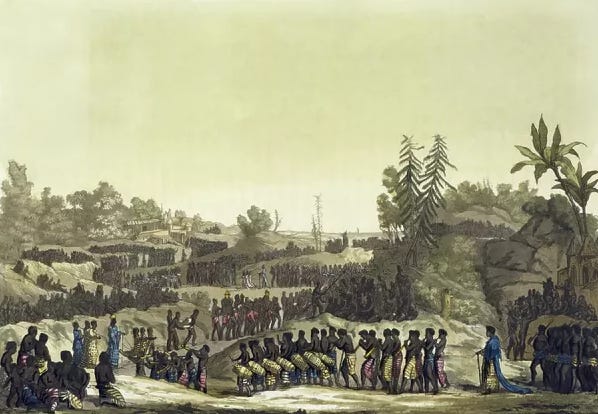
'Festa in onore del dio serpente' (Festival in honor of the Snake God), Ouidah. 19th-century engraving by Giovanni Antonio
According to Dahomean mythical beliefs, first transcribed in the late 19th century, humanity existed in hardship after the Sky god, Mawú, partitioned the universe. Mawú sent Gú (the god of metal and stone) and, in some accounts, Lísa (the Sun) to provide humans with tools to improve their environment.3
Gú, the god of metal, thus introduced organized social life to the kingdom and enabled its expansion and military prowess. Importantly, however, this god wasn’t native to Dahomey but instead came from the Yoruba kingdom of Oyo, which conquered Dahomey shortly after the latter’s conquest of Ouidah.
So powerful was Oyo’s military might that, with troops of horsemen armed with swords, it defeated Dahomey in the 1720 and 40s, despite the latter’s use of muskets taken from Ouidah, and forced it to pay annual tribute for nearly a century thereafter.
King Agadja of Dahomey (r. 1718-1740), who conquered Ouidah but later became tributary to Oyo, was married to a foreign queen, Hawnjile, who is credited with introducing the kingdom’s main gods: Mawu, Lisa and Gu.4
The royal control over the acquisition of the supernatural greatly bolstered the power of the monarchy.
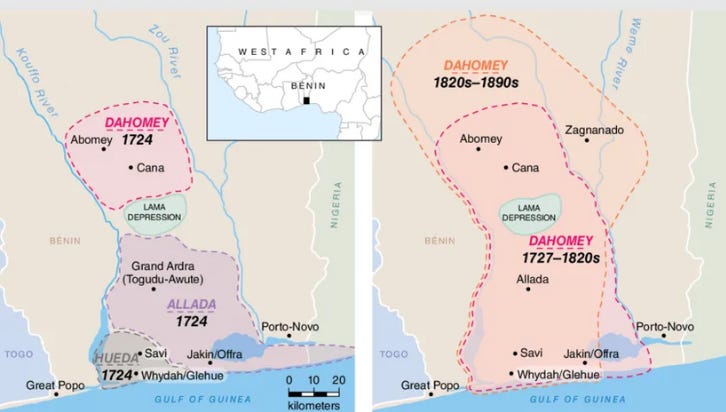
Map showing the expansion of the kingdom of Dahomey.
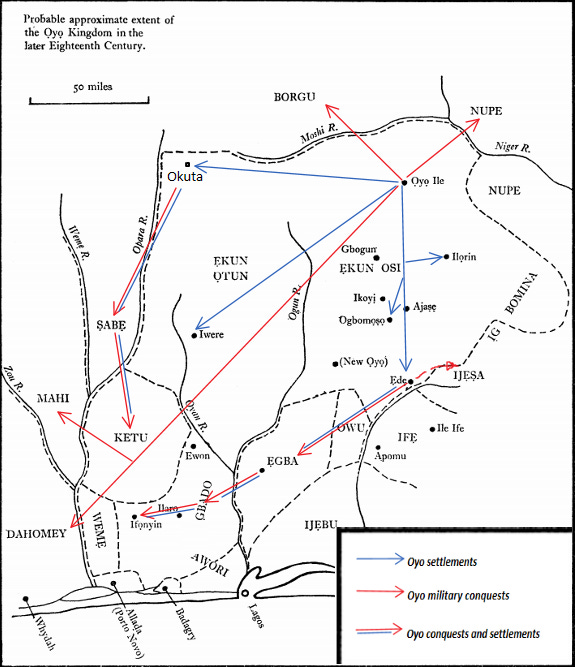
Map showing the settlements and military conquests of Oyo between the 17th and 18th centuries
The History of Ogun: “The Vulcan of Black People”
Historical evidence for the emergence of Ogun in Yorubaland is circumstantial, relying on symbolic and ritual evidence that today is appropriate only to him.
Traditional accounts suggest the deity arose in the eastern Yoruba-speaking kingdoms by the end of the Middle Ages, as the supply of iron increased and warfare expanded.
In the late-medieval kingdom of Ife (c. 1200-1500), a colossal drop-shaped iron sculpture weighing more than 50kg was found in the Ife palace’s Ogun Ladin shrine. Artisans created this massive sculpture over many years by layering red-hot iron bits, one on top of the other, to shape the whole.5
From this old kingdom, the deity soon after spread to the Edo kingdom of Benin.
This hypothesis is pictorially reinforced by a 16th-century brass plaque depicting a Benin warrior wearing miniature iron tools, which are considered the universal signature of Ogun. From Dahomey, a 19th-century life-size iron statue of Gu, discussed below, also carried miniature iron tools (a raised sword, pincers, hoe, arrow tip, knives, and hook)6
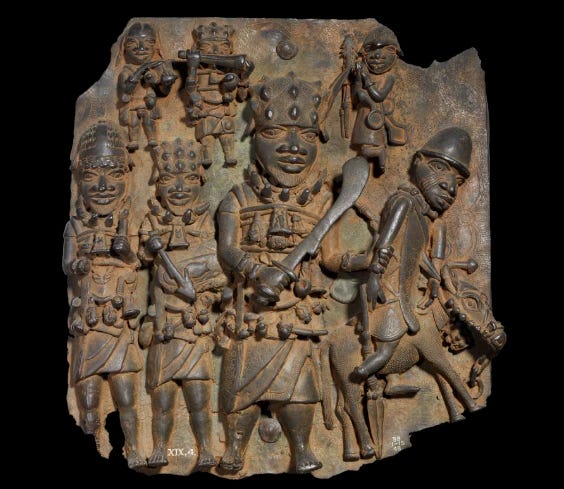
Royal brass plaque from the palace at Benin City, Nigeria. 16th century. British Museum number Af1898,0115.48. Warrior at far left wears miniature iron implements around his waist.
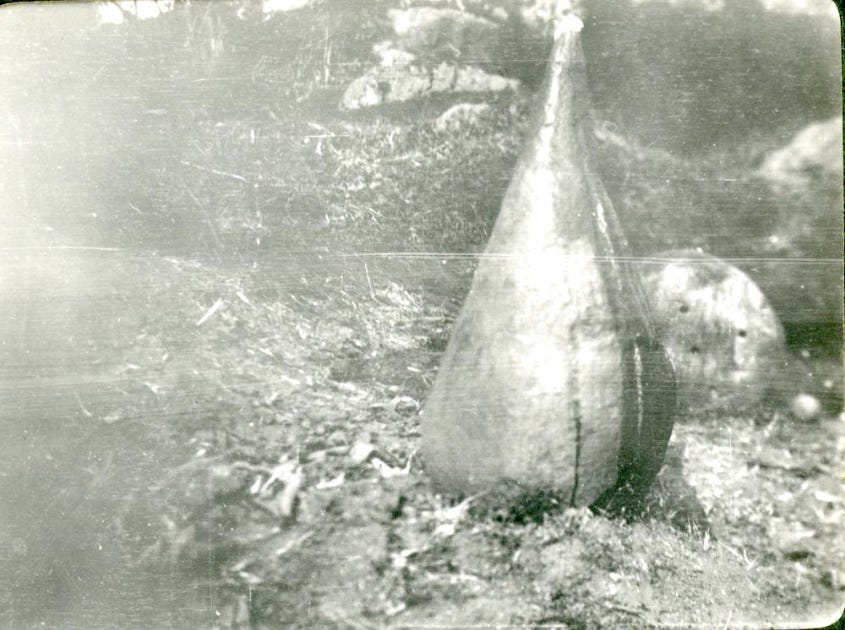
A drop-shaped lump of wrought iron weighing more than 50kg. Ife, Nigeria. c. 1910. British Museum number Af,A167.27
In 1603, a German surgeon aboard a Dutch merchant ship described a prewar sacrificial ceremony that, among other animals, included canines, which are exclusively associated with Ogun. This took place near the port town of Lagos, which was under the Kingdom of Benin, but linked to the inland kingdom of Oyo via overland trade routes.7
Ritual reenactments of battle between kings and town leaders have long figured in large civic pageants dedicated to Ogun in the kingdoms of Benin, Oyo, and Dahomey. In the kingdom of Benin, isiokhuo is the palace ceremony honoring Ogun in which warriors in military attire march in procession through the capital.8
Among the 16th-century Benin plaques, one depicts a warrior chief participating in Isiokhuo, wearing military garb, and raising an eben sword. His costume is distinguished by the basketry cap with a feather inserted on one side and the elaboration of his leopard-face tunic. He carries another sword beneath his left arm.9
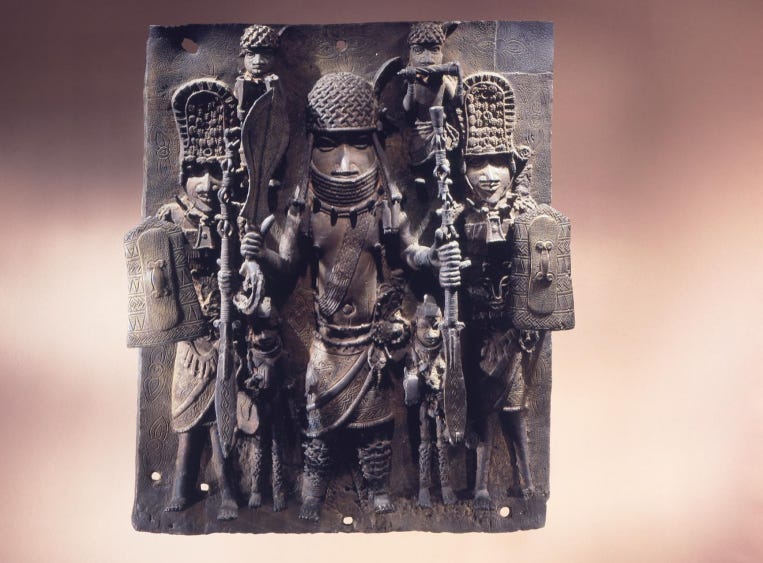
Royal Brass Plaque, Benin City, Nigeria. 16th century. Penn Museum Number AF2066.
‘Plaque with seven figures depicts a high-ranking general and his soilders and attendants at a festival dedicated to the god of war, Ogun. Two high-ranking soldiers flank central figure as he raises his eben, two musicians hold gongs and trumpet and two pages hold fan and implement.’
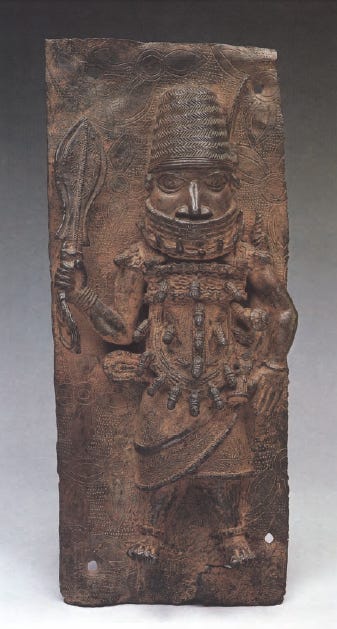
Plaque: Warrior Chief. Nigeria, Edo; Court of Benin, 16th–17th century. Brass (h. 16½ in. / 41.9 cm). Gift of Mr. and Mrs. Klaus G. Perls, 1991 (1991.17.11).
Beginning in 1845, more detailed accounts about Ogun in Yorubaland are found in the journals of CMS (Church Missionary Society) agents. Among the 778 references to the Orisa (deities) found across the region, Ogun was the third most popular orisa after Ifa and Esu.10
According to the historian J. D. Y. Peel:
“Ogun appears as god of iron in a more direct and unmediated sense than as god of war, since he is not merely of iron, in the sense of being the force or principle behind iron technology, but virtually iron itself, worshipped as a personal force.”11
Eg at Leke, a group of six men in an enclosure next to a house was worshipping Ogun as “twelve guns arranged horizontally in a row, an animal having been sacrificed to worship them.”
At Abeokuta in 1865-7, a German missionary encountered a family group gathered in a blacksmith’s shop for an oracular consultation: “Seven country hammers, the blacksmith’s tools, are set up erect, and he addresses each in turn, breaking kola as he does so. As the pieces fall, the answers are lucky or not. The sacrificial fowl is held up in front of the hammers.”12
J.A. Skertchly, who visited Dahomey’s capital of Abomey in 1871-2, and was the first to record the religious system of Dahomey with sufficient detail, provides a list of deities worshipped in the kingdom, albeit mostly concerned with the deities of the coastal province of Ouidah.13
The deities are ranked seemingly based on their popularity, rather than their importance to the royal court and army.14
The main deities were: Dangbe, Atin-bodun, Hu and Khevyosoh. To which are added Bo, Legba, Akwashi, Hoho, Gbwejeh, Ajaruma, Zo, Sapatan, Demen, Aizan, Agasun, Leh, Dohen, Nesu, Lisa, Agaman, Mau, Kpate, Kpase, Dan (Aido Hwedo?), Agbwetoh, Nate, Avreketeh, Tokpodun, Takpwonun, Kpo, Gu, and Afa (Ifa).15
Sketchly understood Gu to be the deity of blacksmiths: “The craft has a tutelary deity, the Guh, which is stuck up in a conspicuous place under the shed, and has offerings of water and a hasty pudding of maize-flour made to it every morning. The deity is often decorated with small hoes, knives, fetiche-irons.”16
However, Édouard Foà, who lived in the region from 1886-1889, ranked the god of iron much higher.
He refers to the deity by the Yoruba name Ogun and calls him “The Vulcan of Black people”:
“Ogoun, the god of war and hunting, is the one who governs the fate of armies. Sacrifices are offered to him before marching against the enemy or to give thanks after victory. He is not forgotten in defeat; one addresses him to make it more favorable in the future. He is the god of blacksmiths and of all those who work with iron professionally. He is the Vulcan of the Black people. His symbol is an axe in Dahomey and a sword or a piece of iron in Yoruba.”17
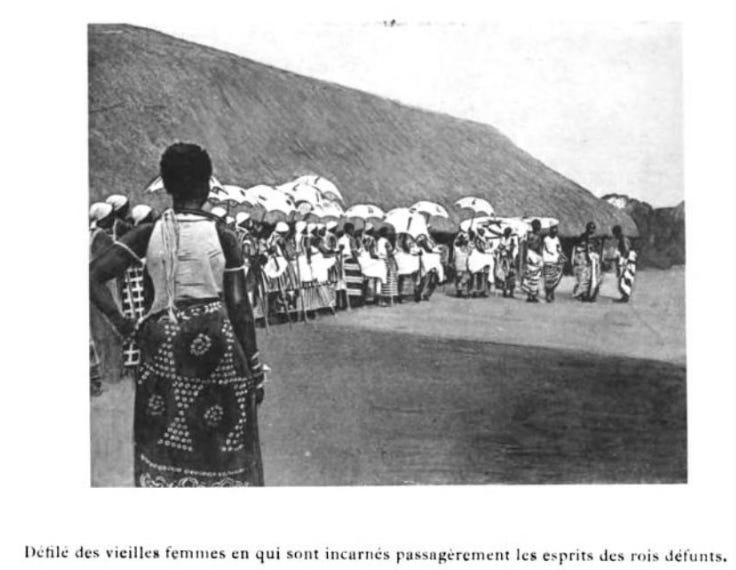
Procession of old women in whom the spirits of deceased kings are temporarily incarnated. Image by A. Le Herissé, 1911
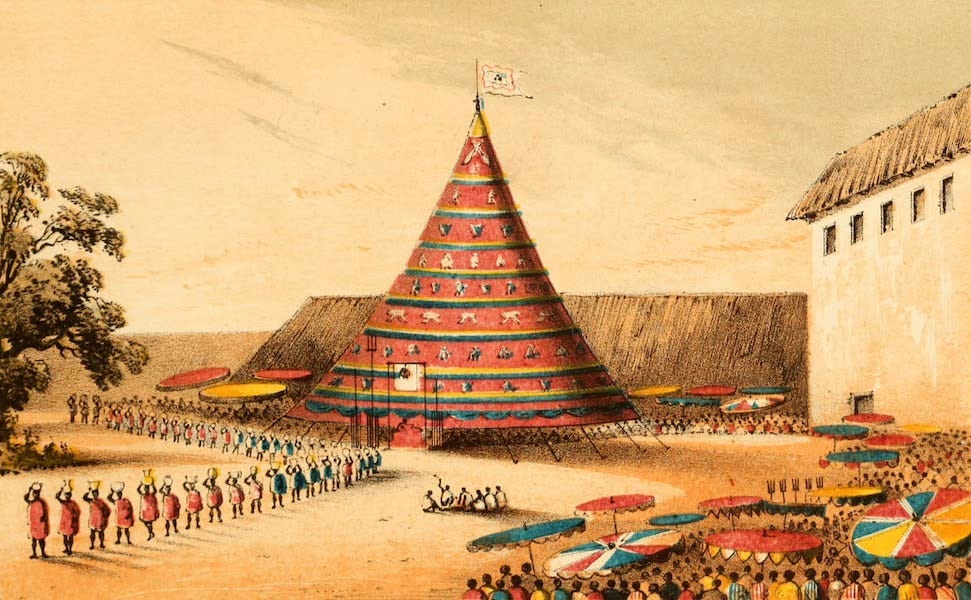
Procession of the King’s wealth, Abomey, 185. Illustration by Frederick Forbes

Section of Gezo’s Simbodji Palace. Illustration by Frederick Forbes
Theology and Philosophy of Ogun in West African cosmologies.
The unities that exist in the diverse body of Ogun representations found in many societies, both in West Africa and the Americas, are achieved not with the help of a supporting bureaucratic, codified apparatus, but through the power of custom.
Religious systems associated with Ogun are transmitted orally among priests, priestesses, and adherents, through the repeated telling of traditions, the performance of rituals, and the production and reproduction of emblems and icons.18
Focusing on pre-colonial West Africa, itinerancy was common among the coastal kingdoms, which established settler colonies in frontier districts, and moved conquered peoples to their capitals.
Intermarriage was a prime factor in the interaction of peoples of different kingdoms, the majority of whom claimed different origins and were very heterogeneous. The high level of mobility in the region no doubt facilitated the sharing of belief systems, and the ideology of Ogun was no exception.
Blacksmiths, who were given special treatment throughout West Africa, even between warring states, were highly mobile. They acquired significant ritual status and often revered the same deity as the military, whose soldiers were of equally diverse origins.19
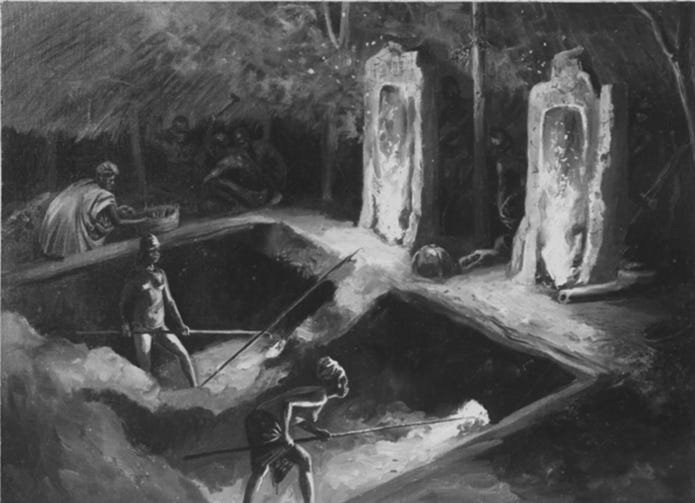
Two-story furnace. Olokun Grove, Ife, Nigeria. Drawing by Carl Arriens. Frobenius 1913.

Iron smelting at Oumalokho near the border of Mali & Cote d’ivoire, illustration by Louis Binger, ca. 1892.
Importantly, however, in these polytheistic societies, the spread of the worship of a deity such as Ogun does not take place at the expense of other faiths or other supernatural forces. All of the societies where Ogun flourishes are culturally and religiously plural societies wherein religious faiths parallel one another.20
For example, the snake-god Dangbe, who was the principal deity of Ouidah that was conquered by Dahomey, eventually became popular in the latter’s capital.
As Skertchly reports: “Though so powerful, its aid was insufficient to protect the Whydahs from the conquering Agajah; but the old worshippers still held faith in their deity, and were highly pleased when it was introduced at Abomey.”21
In West African cosmologies where Ogun is a central figure, destruction and creation are two aspects of a unity that cannot be broken into opposing parts:
‘Ogun is repeatedly linked to positive and negative deeds. He taught humans to use fire, make iron, build cities, centralize government, conquer neighbors, and create empires.
As a revolutionary warrior, he eliminates an old order so that a new one can be established. As a blacksmith, Ogun creates the tools and weapons that, when put to use by some occupational groups, increase productivity, but that also, when put to use by others, destroy the innocent.’22
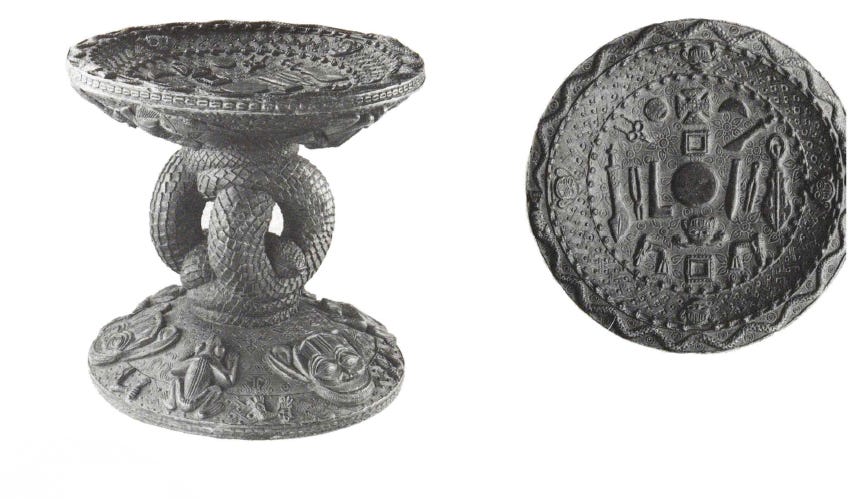
Benin, Nigeria. Royal brass stool. 18th century. Museum fur Volkerkunde, Berlin, IIIc20295.
“Through their intimate connection with hunting, agriculture, crafts, and even warfare, iron objects served as metaphors for civilization itself. This is vividly portrayed in the patterning of an eighteenth-century Benin royal brass stool.
The seat of the stool is divided into three zones. At the top is the cosmos, represented by the sun, the moon, and the cross—a Benin symbol of creation. At the bottom are depictions of the untamed wilderness: monkeys with snakes issuing from their nostrils, and the trunks of elephants grasping leaves. In the middle zone are symbols of civilization, which are products of the smith, including an anvil, hammer, knife, pincer, tongs, bellows, and blade.” 23
In Dahomey, the Azali quarter in the capital city of Abomey includes some of the quarter’s most prominent smiths, who appear to have promoted the fortunes of the Yoruba god of iron, Ogun, renamed Gu in Dahomey.
Gu was associated with the growing militarism of Dahomey after it had thrown off the suzerainty of Oyo during the reign of King Ghezo (1818–1858) and was honored through his commemoration in a famous iron sculpture of a god in human form.
The statue of Gu, which was taken by the French in the 1890s and ultimately made its way to the collection of Paris’s Musée de l’Homme is said to have been crafted by the founder of a prominent Yoruba-speaking lineage, a smith named Akati. An Akati ultimately became a member of the monarchy of Ghezo, serving as gau, minister of war, before he died in the 1851 assault on the walls of Abeokuta.24
Domestic smelting of iron ore, which is well attested in the archaeological record of the Abomey plateau before the 17th century, seems to have been replaced by imported iron in the latter period. However, as late as the 1880s, Iron ore deposits were still exploited in the northern regions, where the volume of imports was relatively low.25
Iron-working itself continued to flourish across the kingdom, and was centralised by the kings at Abomey, through the use of the priests of Gu, the god of iron.
There were twelve major forges; each watched over by an official called the felikpɔtɔ. Each had a device registered at the palace and stamped on its products. The iron workers in turn received much of their iron bars from the palace.26
Production figures of the smithies which did not make hoes were gathered through the priests of Gû, the god of iron. The King set a date on which Gû should be “given food to eat” (sacrifices) at all his shrines, and for this ceremony many roosters were placed at the disposal of the chief-priests of Gû.
At the same time, all Gû priests were notified that those who failed to participate in this rite by calling for their share of these fowls would be punished by the deity. As each priest arrived, he was asked how many smiths worked at the forge which he represented. In this way the ekpodeci, whose task it was to count the smiths, obtained the requisite information concerning the total number of forges in the kingdom.27
According to Edouard Foà ‘s 1895 account, in Dahomey, the blacksmith is also a jeweler; for the jewelry of the nobles is made of iron: “Warriors should only adorn themselves with iron,” the Dahomey nobles undoubtedly say. And the finest European jewelry leaves them cold.”28
While this claim is certainly exaggerated, since silver was also a common item of jewelry, it nevertheless demonstrates the significance of iron in the kingdom, and especially in the ideology of power.
Foa and other visitors note that the Dahomean blacksmiths make: agricultural tools as well as nails, hammers, bells, pliers, chisels, knife blades, chains, hairpins, gongs, umbrellas, padlocks, Dahomian sabers of all shapes, large cutlasses, daggers of all sizes, arrowheads of various shapes, and iron rifle bullets the size of buckshot.29
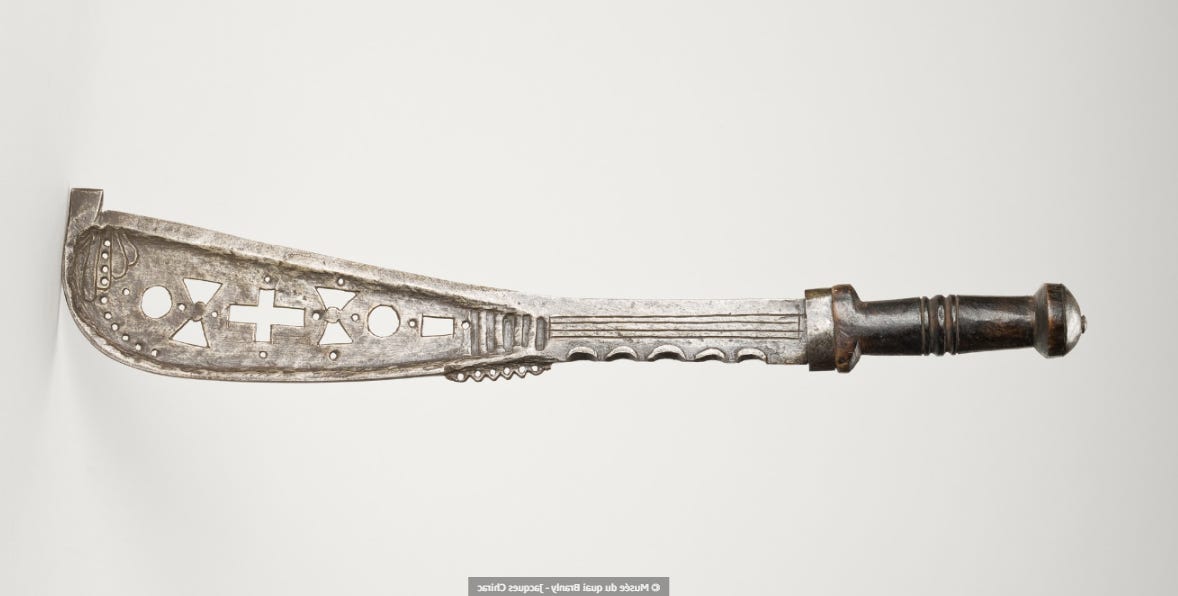
‘Sabre with an openwork blade; the careful work around the edge of the blade, decorated with circle and triangle motifs as well as a cross, makes this sabre a ceremonial weapon that was displayed during official ceremonies.’ 19th century, Ouidah, Benin. Quai Branly Museum, Inventory number: 71.1893.8.38.
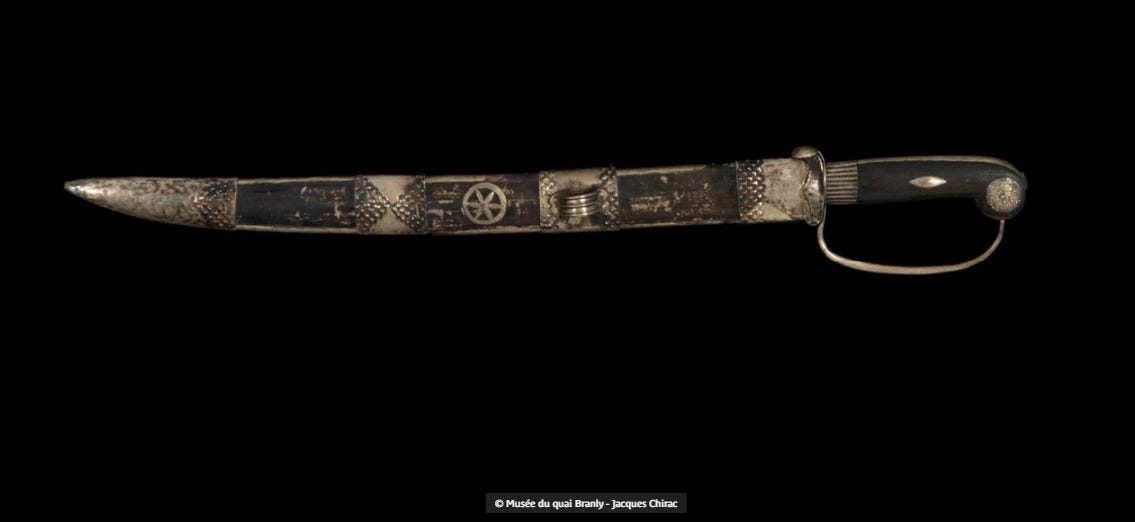
Sabre and its scabbard. It was offered by King Guézo (1818-1858) to Zoma-Donou, the primary deity of the royal family descended from the panther ancestor Agassou. 19th century, Benin. Quai Branly Museum Inventory number: 71.1936.21.35.1-2.
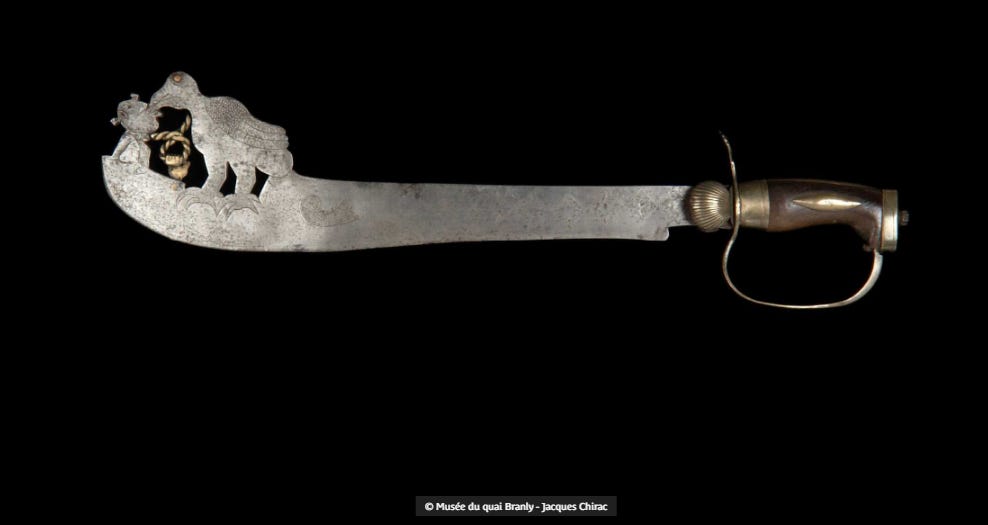
Sabre: Curved blade, zoomorphic ornaments. 19th century, Abomey, Benin. Quai Branly Museum Inventory number: 71.1931.49.7
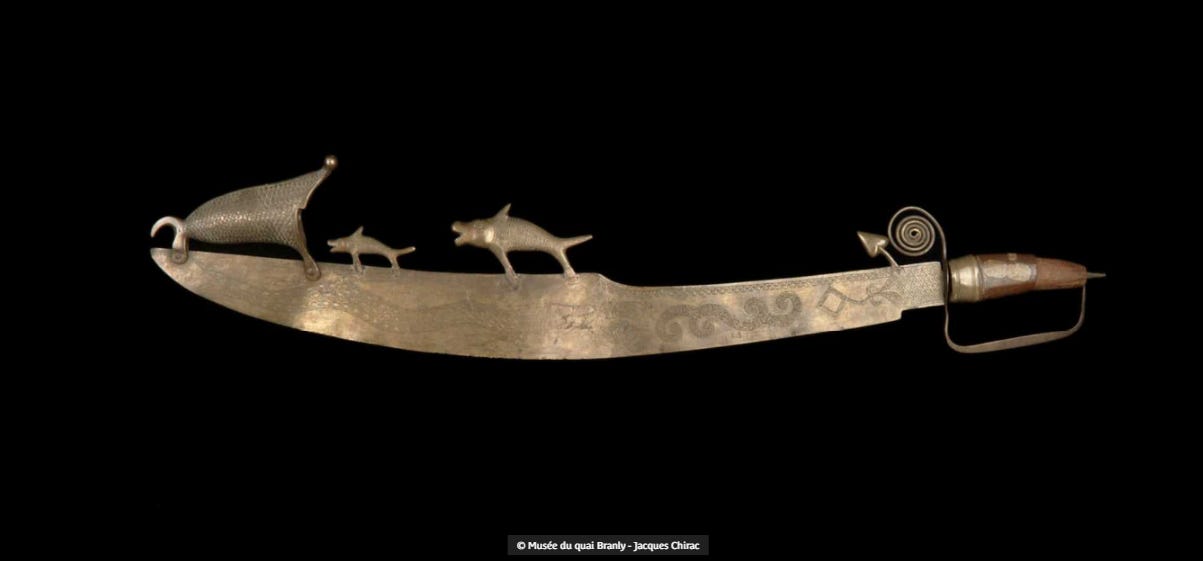
Sabre decorated with a fishing scene: two fish and an open fish trap. Abomey, Benin. c. 1962. Quai Branly Museum, Inventory number: 71.1962.59.48.
The Swords of Ogun
The iron sword of Ogun (ada Ogun) was perhaps his most meaningful symbol, for it condensed the twin meanings of aggression and civilization.
Symbols of Ogun, especially ceremonial swords and the dramatization of warfare, were important features of kingship paraphernalia and ritual throughout the region.
For example, the culmination of the coronation ceremony of the Alaafin of Oyo occurred when the Great Sword, the Sword of Justice, was placed in the king’s hands.
In many eastern Yoruba kingdoms, such as Ife, Ila, and Ire Ekiti, the annual Ogun ceremony was presided over by the king, who, holding a sword, joined in a mock battle.
In Benin, the annual Isiokuo ceremony was held in honor of Ogun. After performing rites, the Oba (King) and other participants, outfitted with war costumes, iron jewelry, and war weapons, then staged a series of mock battles.30
Several iron and brass objects from south-western Nigeria, mostly consisting of ceremonial swords with perforations and elaborately carved hilts, as well as royal staffs, were dedicated to the deity.
Brass was used for prestige objects because it’s the precious metal of the traditional Yoruba blacksmiths, denoting the extraordinary pomp and prerogative of the ruler and the chief.31
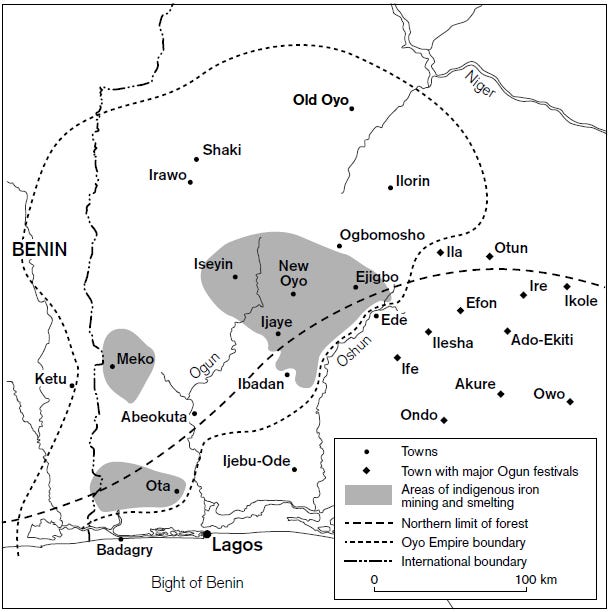
Yorubaland: Iron and Ogun, map by J. D. Y. Peel
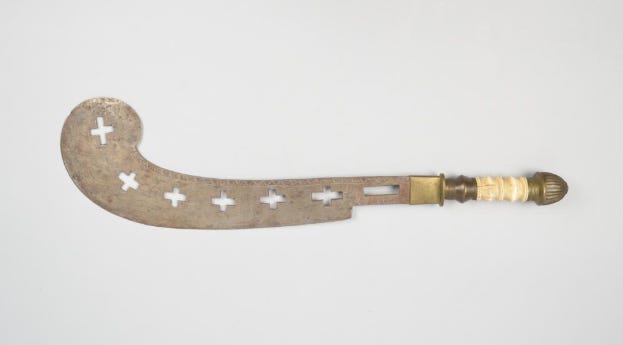
Ceremonial sword of Ogun: iron blade, with six openings ornamented round the edges, and handle of brass and ivory. 1874-8. Lagos, Nigeria. British Museum Af,+.887
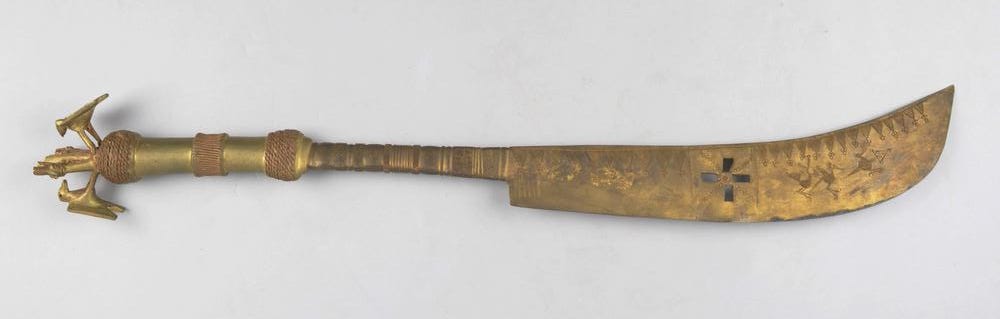
Brass sword of Ogun made of brass, cast and hammered with punched ornament; a cross pierced through the blade; the pommel with two birds. c. 1886, Nigeria. British Museum number Af1887,0808.1
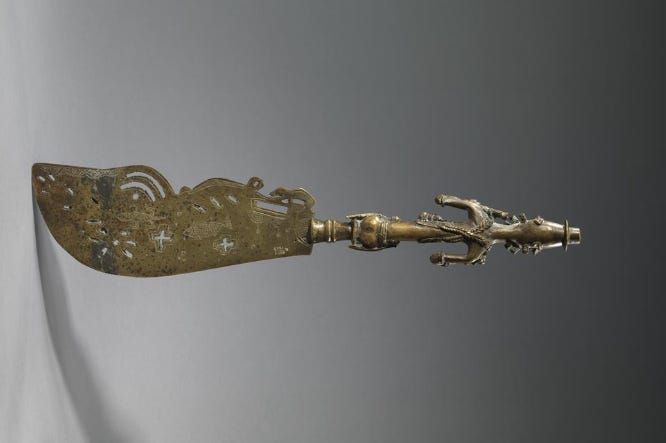
Ogun ceremonial brass sword or cutlass: handle cast in the form of a seated male figure, chased and perforated ornament on the blade. c. 1954, Yorubaland, Nigeria. British Museum number Af1954,23.218. (similar sword at Fowler Museum at UCLA; OBJECT ID X65.3613)
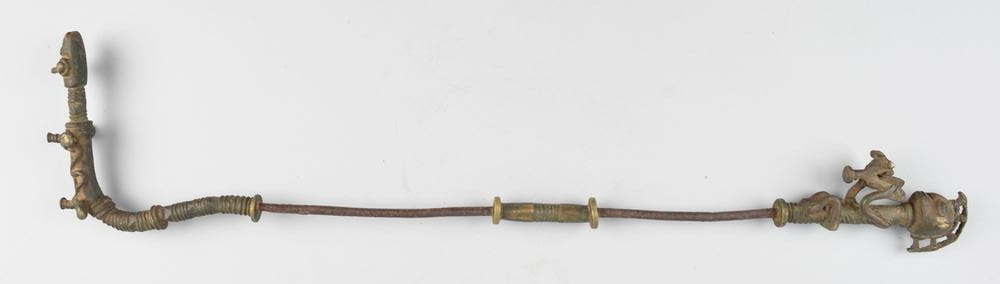
‘Iwana Ogun’ (Ogun’s rake): Ogun staff or baton, iron and brass, curved at one end, and with a bronze figure cast at the top. Obo, Yorubaland, Nigeria. British Museum number Af1971,18.1
In Yorubaland, Ogun doesn’t appear to have been portrayed in carved human form, despite the very personalized way in which he appears in myth, apparently because such a representation could only be inferior to iron itself.32
A similar tradition prevailed in Dahomey; Skertchy observed that “the Dahomans deny the corporeal existence of the deity …The deity must either be worshipped through the medium of an intervenor, who has a tangible form, or the religion must be reduced to anthropomorphism.”33
As Melville Jean Herskovits argues, “Gu is not a god in the sense of other gods, since he has no human or animal attributes, but that he is rather a “force.”34
At metallurgical sites dating to the 18th century, such as the Hoja site southwest of Abomey, fragments of metal, slag, and ore can be found on altars dedicated to Gu, which also suggests that the god was rarely portrayed in carved human form.
As for the anthropomorphic life-size sculpture of Gu, it appears to have been an exceptional phenomenon associated with the reign of King Ghezo (1818–1858), who is credited with further centralising the activities of craftsmen, especially blacksmiths, in the capital. Its carving is attributed to the above-mentioned Yoruba smith, Akati.35
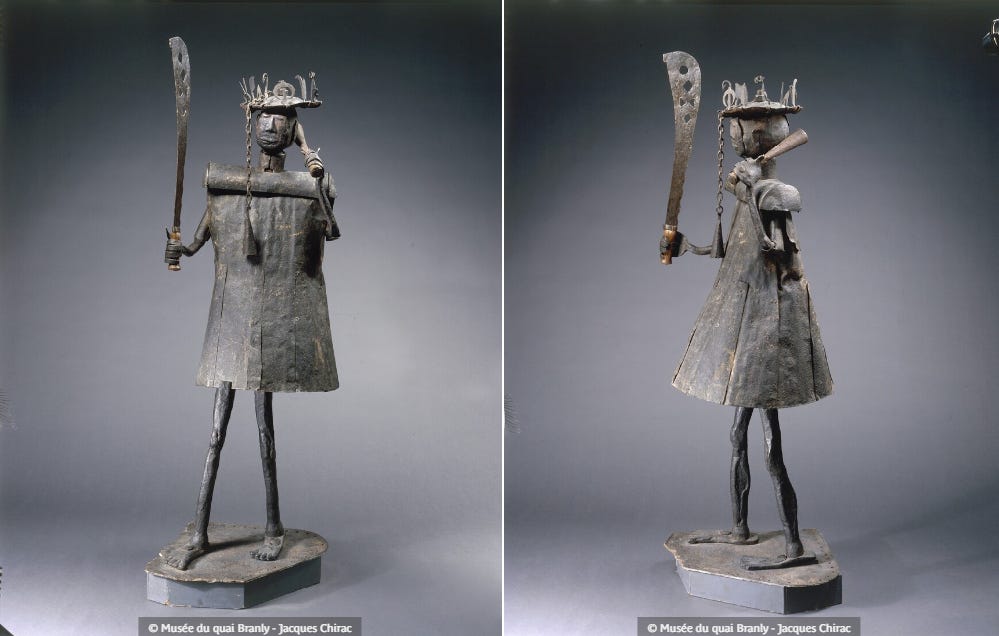
Sculpture dedicated to Gou. c. 1858. Abomey, Benin. Dimensions: 178,5 x 53 x 60 cm. Entre 100 et 150 kg 174 x 56 x 54,5 cm. Quai Branly Museum, Inventory number: 71.1894.32.1.
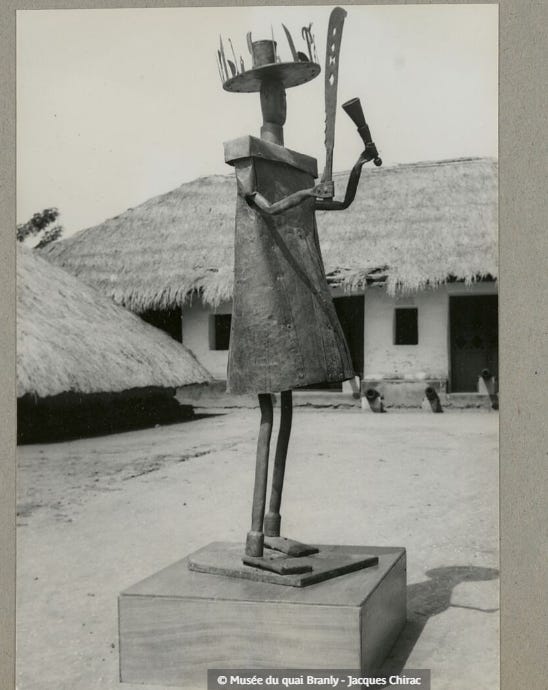
Caption on the mounting board of the Musée de l’Homme photo library: “Statue of the god Gou, god of war and weapons, in the courtyard of the Abomey Museum. This statue was created by Simon Akati, blacksmith, at the request of the curator of the Abomey Museum, Mr. d’Oliveira, in 1970, based on an original photograph from the Abomey History Museum.”
In the 19th century, the Fon of Dahomey developed an extensive tradition of metal sculpture in iron and brass, known as Asen, which are portable metal altars designed to receive libations during ceremonies dedicated to the spirits of ancestors or divinities.
However, these asen, which often feature human figures including known persons, were dedicated to deified kings, Ifa, the ‘god of wisdom’, as well as Asen made for royal houses and small personal Asen.36

Asen staff from Ouidah, mid-19th cent., Musée Barbier-Mueller, Hunter and Dog with man spearing a leopard, ca. 1934, Abomey museum. Brass sculpture of a royal procession, ca 1931, Fowler museum
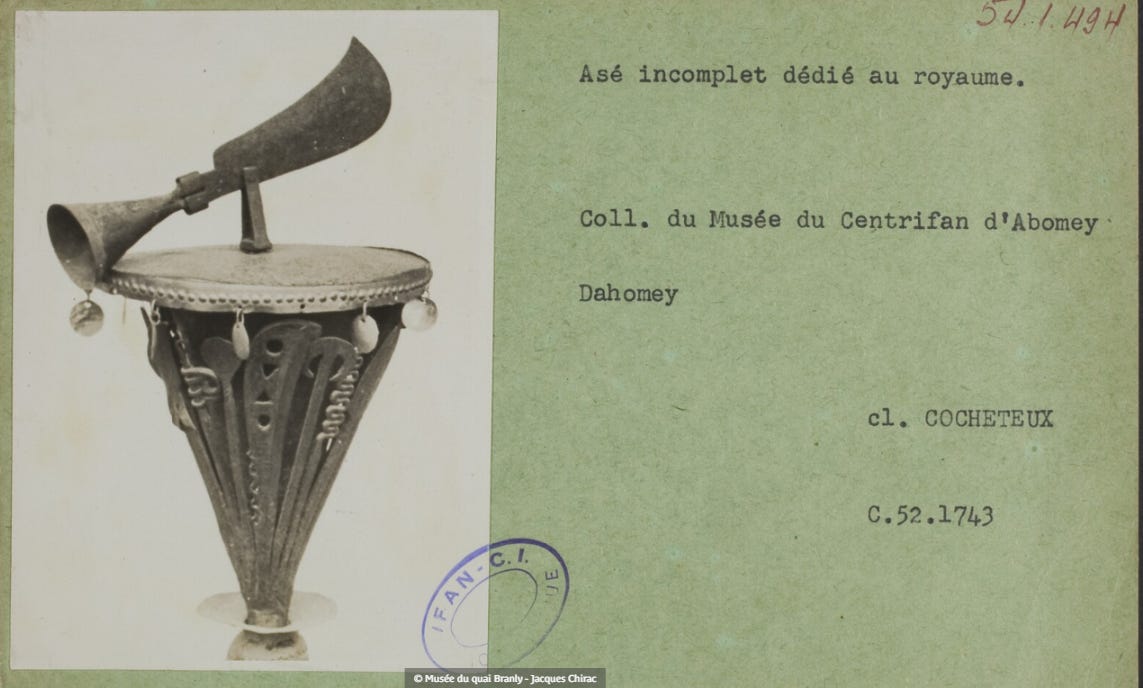
‘Incomplete Ase dedicated to the kingdom’ Various objects or animals are depicted on the sides; on the upper platform, decorated with round pendants, is a representation of a sword. c. 1952-1954. Benin. Quai Branly Museum. This rare asen may have been dedicated to Gu.
It’s thus evident that in Dahomey, as in Yorubaland, Ogun/Gu was most commonly attested in the form of weapons, specifically, ceremonial swords and sabers (despite the widespread use of firearms). These weapons were intended to attract the attention of the divinity and to receive offerings.
For Fon, the sword embodied their beginnings. Gu himself was perceived as a sword; he was a “‘force”’ with no head, only a great tool jutting out of a trunk of stone.
The Gubasa, a ceremonial sword, was his emblem. According to myth, when the creator came to earth, he held Gu in his hand in the form of a gubasa, and with it he cleared the forest and taught people to build houses and till the soil. The Gubasa is especially linked with King Glele, who adopted it for his coat of arms.37
Gubasa: A ceremonial sword, possibly belonging to the god Gou; added to his statue. c. 1850 and 1870. Quai Branly.
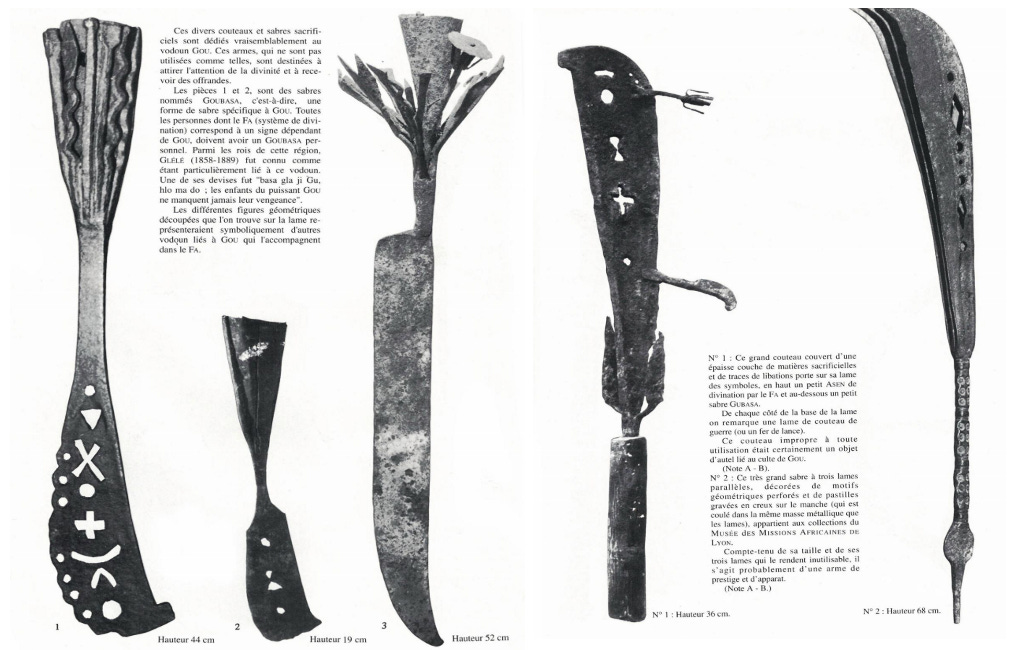
Left caption: Pieces 1 and 2 are sabers named Goubasa, that is to say, a form of saber specific to Gou. All persons whose Fa (divination system) corresponds to a sign dependent on Gou must have a personal Goubasa… The different cut-out geometric shapes found on the blade reportedly represent, symbolically, other vodoun linked to Gou who accompany him in the Fa.
Right caption: No. 1: This large knife … bears symbols on its blade, at the top a small Asen of divination by the Fa and underneath a small Gubasa saber. On each side of the base of the blade, one notices a war knife blade (or a spearhead). This knife, unsuitable for any functional use, was certainly an altar object linked to the cult of Gou.38
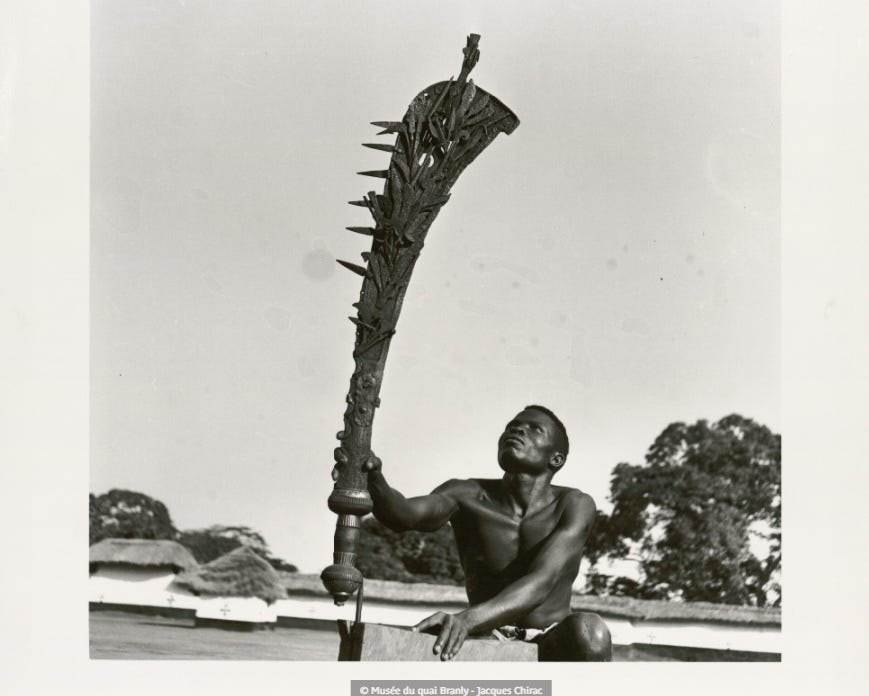
The sword of Gou (Ogoun of the Fon). c. 1948-1950. Abomey, Benin. Quai Branly Museum, Inventory number: 73.1999.6.91.
Epilogue: Ogun in modern Africa and the Americas.
Despite the Atlantic trade and the colonisation of West Africa, Ogun, the god of iron (and war), did not lose his efficacy among the coastal societies who continued to revere the ancient deity.
More than many other precolonial African gods, he has adapted to contemporary life and become increasingly visible to the public, especially in Nigeria, Benin, and across the Atlantic world.
According to the anthropologist Sandra T. Barnes:
‘One of the unanticipated processes in Africa and the Western Hemisphere is, as indicated, that African-derived religious beliefs prosper rather than decline. In Brazil alone, religious groupings that include Ogun have more than 30 million adherents, and they are spreading rapidly to Uruguay and Argentina, where there are scarcely any African descendants.
Ogun also moves along with Haitian and Cuban populations to New York, Florida, California, and Texas. Caribbean and West African religious practices are spreading to a growing body of English-speaking North Americans, and these new devotees hold ceremonies and have produced, after instruction by Cuban adherents, a theological treatise on African deities.’39
The popularity of Ogun continues in modern times and in changed conditions. There is no warfare, and if a god is out of work, he soon loses his claim to men’s attention.
But Ogun has ‘beaten his swords into plowshares’. He has become the deity of many lorry drivers and cyclists, who hang his favours on their vehicles and hope that the ancient god of metal will still protect them from accidents.
The ancient god of blacksmiths, hunters, and warriors is today the modern patron of cars, laptops, and phones, demonstrating the remarkable adaptability of African religious traditions.40
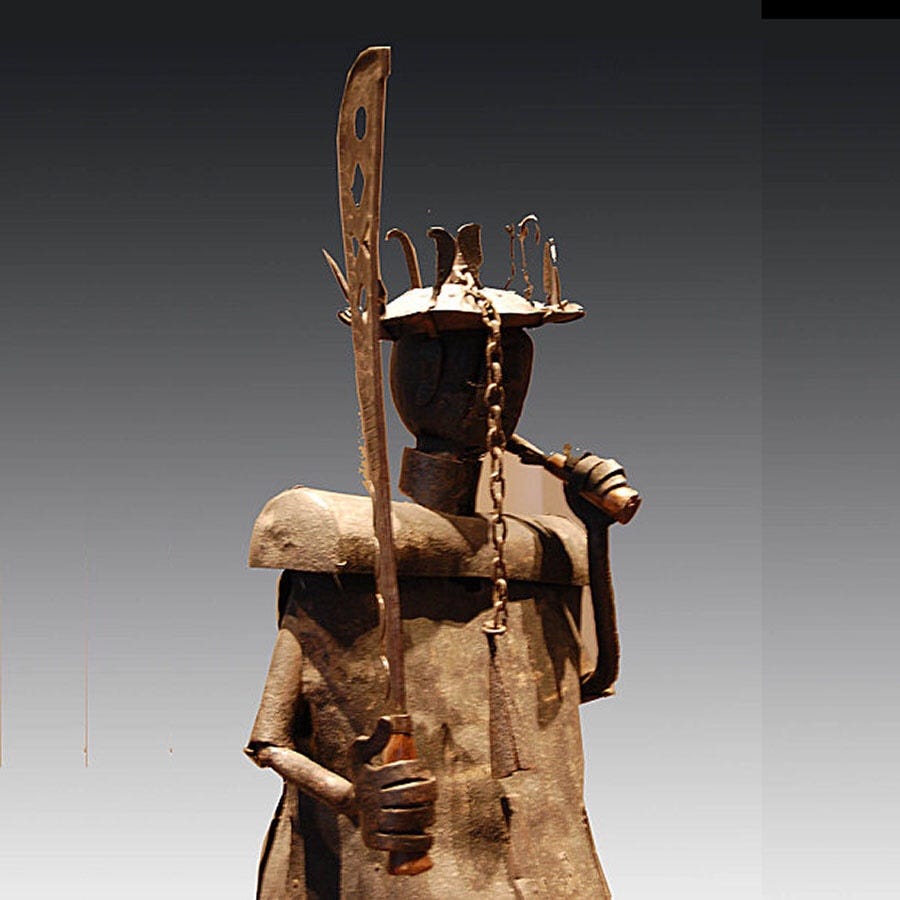
Statue of Ogun.
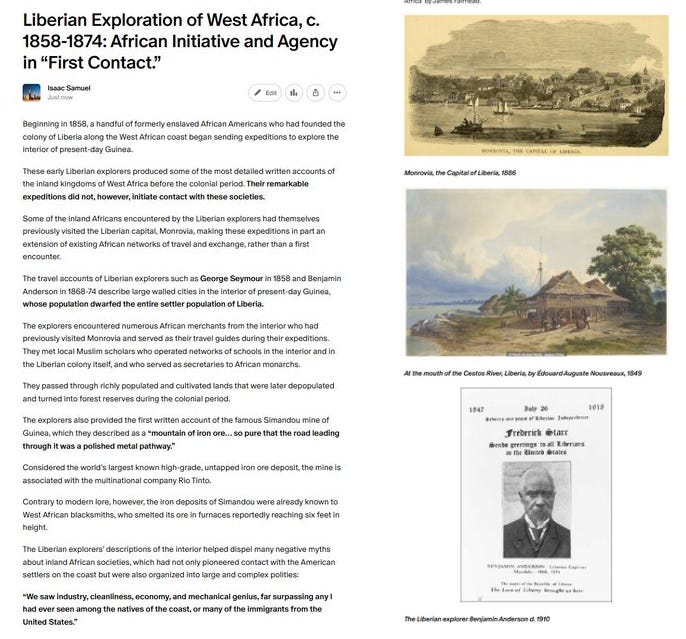
From 1858 to 1874, the Americo-Liberian explorers led expeditions into the interior of West Africa, encountering walled cities, mountains of iron ore, and well-travelled African scholars who ran networks of schools across the region.
Their accounts helped dispel many negative myths about inland African societies:
“We saw industry, cleanliness, economy, and mechanical genius, far surpassing any I had ever seen among the natives of the coast, or many of the immigrants from the United States.”
My latest Patreon article examines the historical significance of the 19th-century travel accounts of the Liberian explorers of West Africa.
Please subscribe to read about it here:
The Slave Coast of West Africa, 1550-1750: The Impact of the Atlantic Slave Trade on an African Society, by Robin Law, pg 282-286
A New Account of Guinea, and the Slave-trade by William Snelgrave, 1734. The black serpent who opened the Eyes of Man, by C Merlo pg 61-62
Dahomey: An Ancient West African Kingdom by Melville J. Herskovits, pg 159
Wives of the Leopard: Gender, Politics, and Culture in the Kingdom of Dahomey, by Edna G. Bay, pg 22, 91-93, 330 n.24
Art and Risk in Ancient Yoruba: Ife History, Power, and Identity, ca. 1300, by Suzanne Preston Blier, pg 67
Africa’s Ogun: Old World and New, edited by Sandra T. Barnes, pg 5-6, 63
Africa’s Ogun: Old: World and New, edited by Sandra T. Barnes, pg 6, 30
Royal Art of Benin: The Perls Collection in the Metropolitan Museum of Art, by Kate Ezra, pg 314
Royal Art of Benin: The Perls Collection in the Metropolitan Museum of Art, by Kate Ezra, pg 124
Africa’s Ogun: Old World and New, edited by Sandra T. Barnes, pg 266-267
Christianity, Islam, and Orisa-Religion by J. D. Y. Peel pg 56
Christianity, Islam, and Orisa-Religion by J. D. Y. Peel, pg. 57
This list is quite similar to the one provided by Alexandre L. d’ Albéca (1895) and included deified figures from Ouidah, e.g., Kpote/Kpase. d’ Albéca also emphatically states that the worship of Dangbe is “unique to Ouidah, Porto-Novo, and Grand-Popo. It is not encountered in the high country ie; Dahomey].”
La France au Dahomey, by Alexandre L. d’Albéca, 1895 pg 137-141,
for the gods of Ouidah, see: Ouidah: The Social History of a West African Slaving ‘port’, 1727-1892, by Robin Law, pg. 92-93
eg, the names of deified kings are conspicuously absent, while their priests are very prominent in the capital; in contrast, deified figures from Ouidah are mentioned by name.
Dahomey As It Is: Being A Narrative Of Eight Months’ Residence In That Country by J. A. Skertchly, 1874 pg 207-208
Dahomey As It Is: Being A Narrative Of Eight Months’ Residence In That Country by J. A. Skertchly, 1874 pg 466-474
Dahomey As It Is: Being A Narrative Of Eight Months’ Residence In That Country by J. A. Skertchly, 1874, pg 387-388
Le Dahomey histoire, géographie, moeurs, coutumes, commerce, industrie, expéditions françaises (1891-1894) By Édouard Foà, Pg 222
Africa’s Ogun: Old World and New, edited by Sandra T. Barnes, pg 14-15
Africa’s Ogun: Old World and New, edited by Sandra T. Barnes, pg 50-53
Africa’s Ogun: Old World and New, edited by Sandra T. Barnes, pg 10
Dahomey As It Is: Being A Narrative Of Eight Months’ Residence In That Country by J. A. Skertchly, 1874 pg 466
Africa’s Ogun: Old World and New, edited by Sandra T. Barnes, pg 17-18
Africa’s Ogun: Old World and New, edited by Sandra T. Barnes, pg 55
Wives of the Leopard: Gender, Politics, and Culture in the Kingdom of Dahomey, by Edna G. Bay, pg. 189- 190
The Precolonial State in West Africa: Building Power in Dahomey by J. Cameron Monroe, pg 38-42, 64. Le Dahomey: histoire, géographie, moeurs, coutumes, commerce, industrie, expeditions françaises (1891-1894), by Edouard Foà , pg 68
Dahomey: An Ancient West African Kingdom by Melville J. Herskovits, pg 126
Dahomey: An Ancient West African Kingdom by Melville J. Herskovits, pg 126
Le Dahomey: histoire, géographie, moeurs, coutumes, commerce, industrie, expeditions françaises (1891-1894) By Edouard Foà, pg 169
Le Dahomey: histoire, géographie, moeurs, coutumes, commerce, industrie, expeditions françaises (1891-1894), by Edouard Foà pg 126-128
Africa’s Ogun: Old World and New, edited by Sandra T. Barnes, pg 58-59
Black Gods and Kings: Yoruba Art at UCLA by Robert Farris Thompson, pg 6-9
Africa’s Ogun: Old World and New, edited by Sandra T. Barnes, pg 268
Dahomey As It Is: Being A Narrative Of Eight Months’ Residence In That Country by J. A. Skertchly, 1874, pg 465,
There were, however, representations of a few deities, most notably, Legba. A mission to Gelele, King of Dahomey, by R.F. Burton, Tylston, 1893, pg 51-52
An Outline of Dahomean Religious Belief by Melville Jean Herskovits, pg 15
Guerres, Vodun et organisation de l’espace au Danxomè d’Agaja (1708-1740) à Glèlè (1858-1889) by Samson Tokannou pg 3-6
Fer Noir d’Afrique de l’Ouest (1992) By André Blandin pg 185-193. The Precolonial State in West Africa: Building Power in Dahomey by J. Cameron Monroe, pg 212-217
Africa’s Ogun: Old World and New, edited by Sandra T. Barnes, pg 53, 57-58
Fer Noir d’Afrique de l’Ouest (1992) By André Blandin pg 194-195
Africa’s Ogun: Old World and New, edited by Sandra T. Barnes, pg 10
West African Religion: A Study of the Beliefs and Practices of Akan, Ewe, Yoruba, Ibo, and Kindred Peoples by Edward Geoffrey Parrinder, pg 34. Striking Iron The Art of African Blacksmiths by Allen F. Roberts and Marla C. Berns
this is why I love history. it is an eye opener. thank you.
I really enjoyed this article. I found the symbolism of Ógún very interesting (his association with civilization, destruction and creation). I just had a question. You mentioned that Iron was used for jewelry, but I was wondering if it was also used as currency?