

Christianity was present in Africa long before the imposition of colonial rule; however, it remained only one of several religious traditions, and despite centuries of sustained contact with Christian societies, its influence across the continent was relatively limited.
With the exception of Northern Africa, where the changes in religious affiliation were influenced by shifts in the political landscape of the Mediterranean world, most of the African continent remained under local authority. Consequently, the spread and adaptation of religious traditions were largely shaped by local rather than external actors.
Recent scholarship on African traditional belief systems has highlighted the scale, complexity, and antiquity of their cosmologies, ritual practices, and central deities.
The rainbow-serpent deities of West Africa and the Atlantic world, which were first documented at Ouidah (Benin) in the 17th century but likely originated in the Middle Ages, were spread by local priests across multiple kingdoms and venerated in a variety of modest temples.
In the Meroitic kingdom of Kush, religious life included the worship of the deity Isis, for whom several temples were constructed across the Nile valley. These institutions were maintained by a dedicated priestly class that played a central role in disseminating the cult of the “Mother of God” throughout the Roman world.
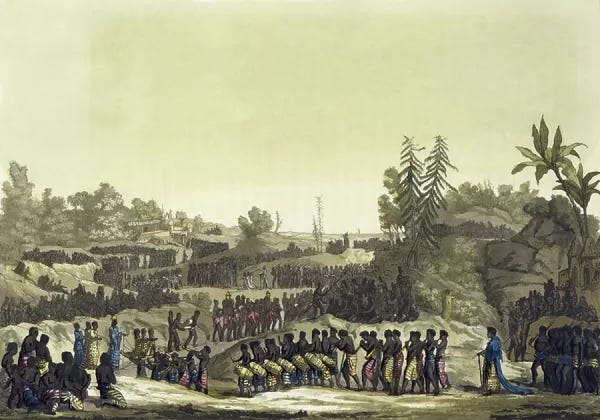
'Festa in onore del dio serpente' (Festival in honor of the God Snake), Ouidah. 19th-century engraving by Giovanni Antonio
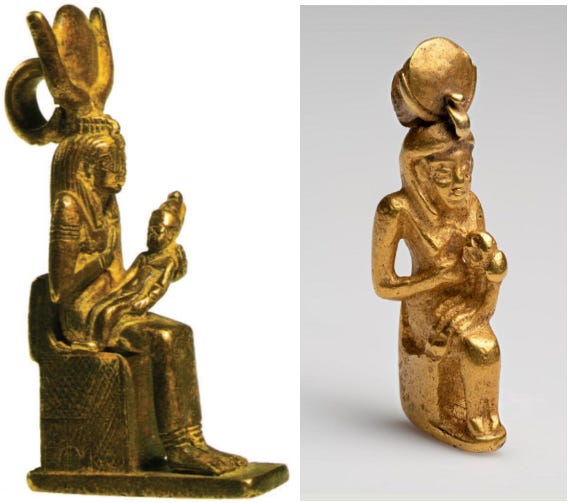
Amulet showing seated Isis suckling her son Horus. Nubian, Napatan period, 25th Dynasty, 7th century BC. Findspot: Meroe, Sudan. Amulet of Isis nursing the infant Horus, Nubian, Meroitic Period. Findspot: Sudan, Meroe. Boston Museum.
Similarly, the adoption of Islam across broad swathes of the continent is attributed to the expansion of commercial diasporas, such as the Jabarti in the Horn of Africa, The Swahili of the East African coast, and the Wangara of West Africa.
Christianity also flourished in this diverse religious milieu from classical antiquity through the early modern period. While earlier scholarship on classical Christianity emphasized the conversion of ‘pagan’ monarchs, more recent studies have shown that the spread of the religion was not the result of singular, transformative events but rather occurred through the gradual process of inculturation.
Inculturation refers to the adoption of Christian teachings and practices in a particular cultural context. The concept has been widely applied in studies of Christianization, not only in the Roman world but also in other ancient societies, including the kingdoms of Aksum and Nubia.
The conventional narrative of the Christianization of Aksum centers on the conversion of King Ezana in 340 CE, traditionally attributed to two Syrian captives at his court who had arrived during the reign of his predecessor, Ousanas.
However, the historian David Phillipson has argued that the adoption of Christianity in Aksum was a gradual process, “presented to the king and his diverse subjects with skill and selectivity.” Documentary evidence attests to the presence of Christians in the capital before Ezana’s conversion, while the king’s own inscriptions, initially framed in polytheistic language, suggest a cautious and incremental embrace of the new faith.1
Christianity was subsequently adopted by broader segments of the population and developed a distinctly Aksumite character, which was preserved and further elaborated from the Middle Ages through the modern period by the Tewahedo Church of Ethiopia and Eritrea.

The Garima Gospels, ca 330–650 and 530–660 CE. Tigray, Ethiopia. digitized by the Hill Museum & Manuscript Library.
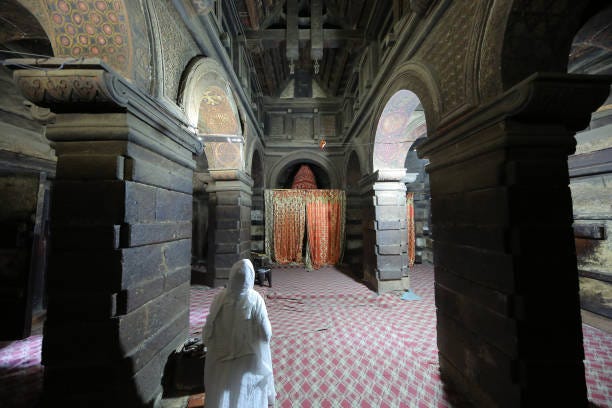
The church of Yemrehanna Krestos, Ahmara, Ethiopia.
Similar to Aksum, conventional church histories attribute the foundation of Nubian Christianity to Byzantine ecclesiastical initiatives, specifically the dispatch of Melkite and Monophysite missionaries to Nubia (Sudan) by Emperor Justinian and Empress Theodora in the 6th century CE.
However, archaeological and documentary evidence suggest that Christianity was present in Nubia more than a century earlier. Rulers were interred with Christian objects, and at least one prince bore a Christian name, Mouses. According to Salim Faraji, the reign of the Noubadian king Silko, whose victory inscription declares that “God gave me the victory,” laid the political and cultural foundations for the broader Christianization of Nubia.2
For most of the Middle Ages, from the 6th to the 14th century, Christianity flourished in the three Nubian kingdoms of Nobadia, Makuria, and Alodia, where it developed a distinctly Nubian character. Cathedrals and monasteries adorned with elaborate paintings were constructed at Dongola, Soba, and Faras, and Nubian Christian communities persisted as late as the 16th century, long after the political collapse of the three kingdoms.
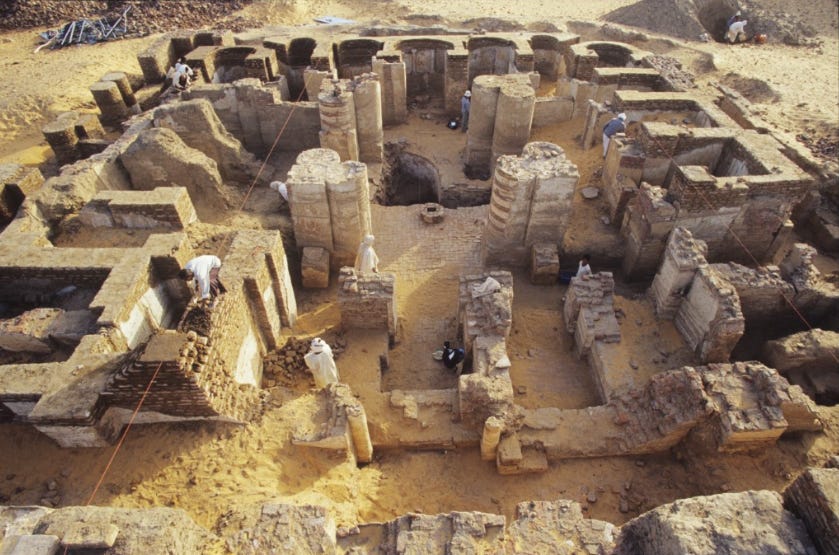
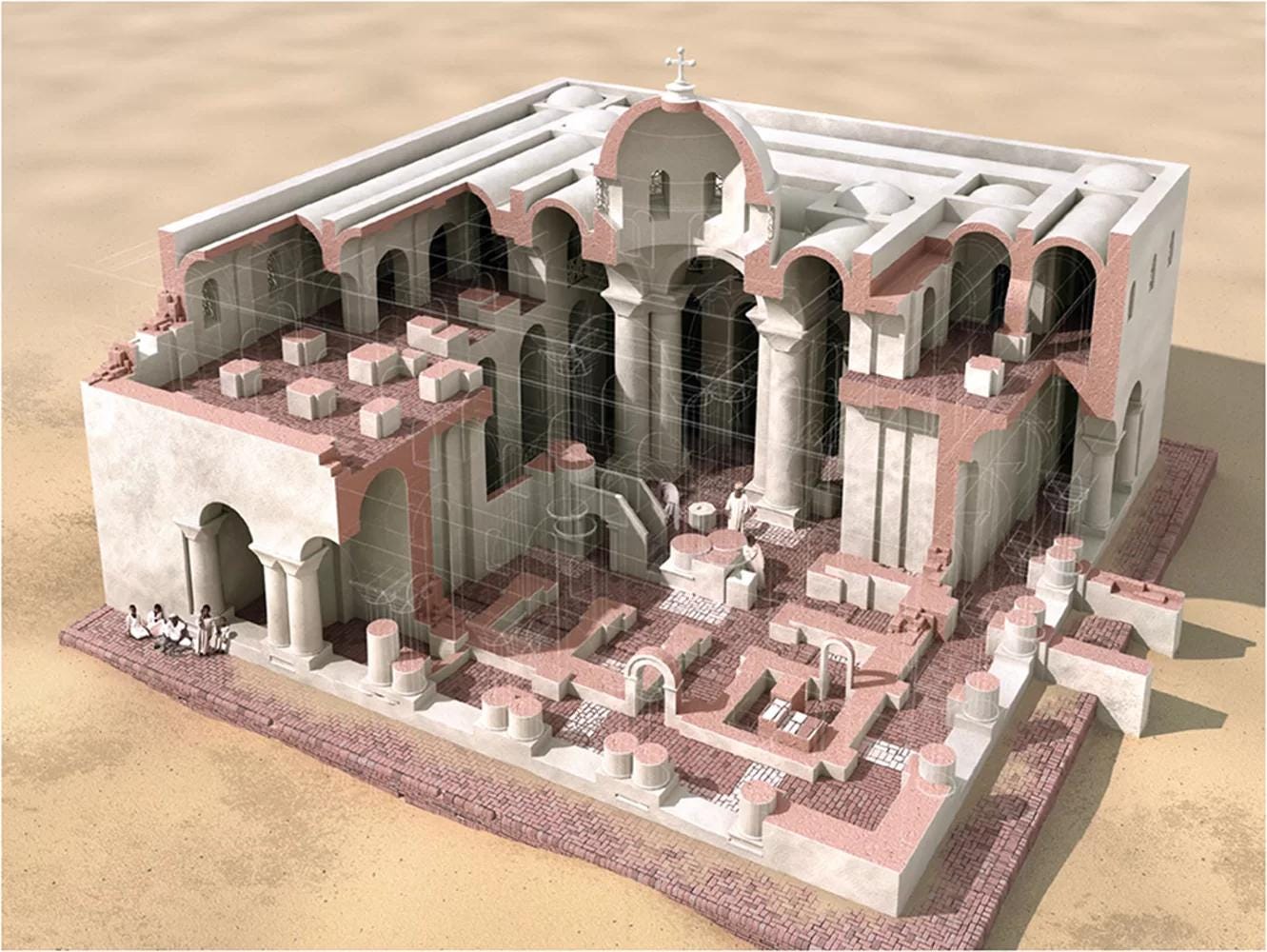
The medieval church of Bangnarti, Sudan. image by B. Żurawski
In the southern half of the continent, historical research on early Christian communities has largely focused on the Kingdom of Kongo, where Christianity endured for nearly five centuries. This contrasts with other societies, such as those along the Swahili coast (Kenya, Tanzania), Mutapa (Zimbabwe), and Ndongo (Angola), where the religion largely disappeared shortly after its introduction in the 16th century.
While earlier scholarship emphasized the practical and political motivations behind the rulers’ adoption of Christianity in Kongo, more recent studies have shown that its adoption as a popular religion was shaped by an ideological and iconographic synthesis between the pre-Christian belief systems of Kongo and 16th-century Catholic practices and traditions.
Once established, the Kongolese Church survived through the efforts of its rulers, laypeople, and ordinary subjects, who took the lead in shaping the religion according to their cultural context. According to Cécile Fromont, Kongo’s artwork “naturalized Christianity into a local discourse about the nature of the of the supernatural and the cycle of life and death and, in turn, transposed Kongo religious signs into visual expressions of Catholic thought.”3
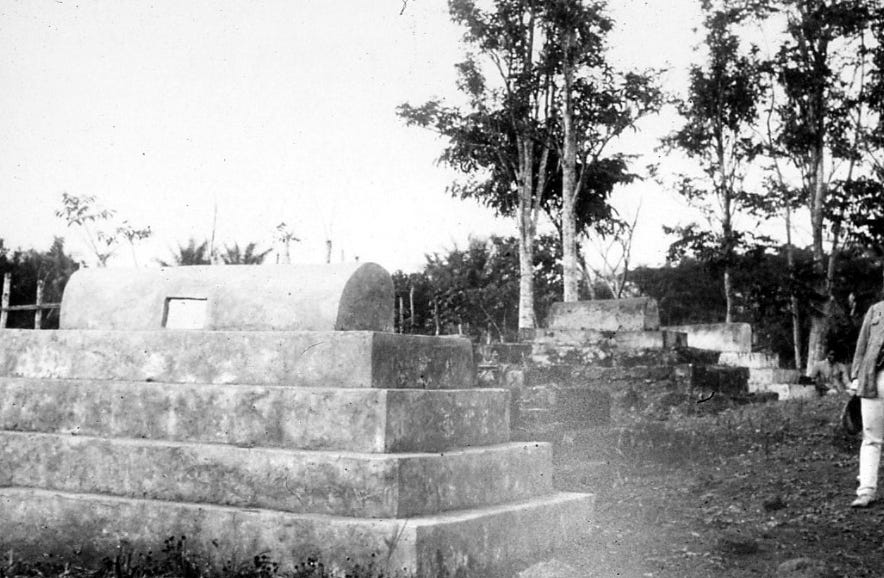
Tombs of the Christian kings of Kongo. Mbanza kongo, Angola.
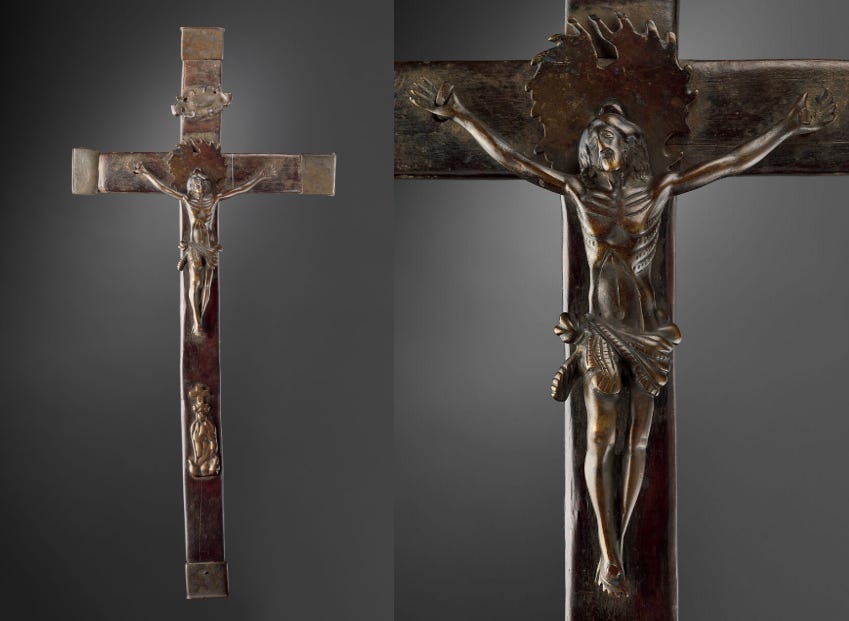
Crucifix. Kongo Kingdom 16th–17th century. Met Museum
The complexity of the adoption of Christianity in pre-colonial Africa is best illustrated by its early spread among the West African societies of the Upper Guinea (Senegal to Sierra Leone) and the Bight of Benin during the 16th century.
In these regions, local rulers and their subjects actively shaped a distinctly African form of Christianity. While they engaged with visiting priests and sent embassies to the Iberian kingdoms, the church was ultimately established and administered according to indigenous authority, reflecting a deliberate adaptation of Christian practices to local cultural, political, and social contexts.
These West African Christians harmonized existing beliefs and practices common to both West African and Catholic traditions, ensuring that the real institution of the church, both theologically and organizationally, remained under African control.
Once established, internal dynamics unique to each society determined whether the church was abandoned or continued to flourish. In some cases, these Christian polities endured for nearly four centuries after the religion’s initial introduction.
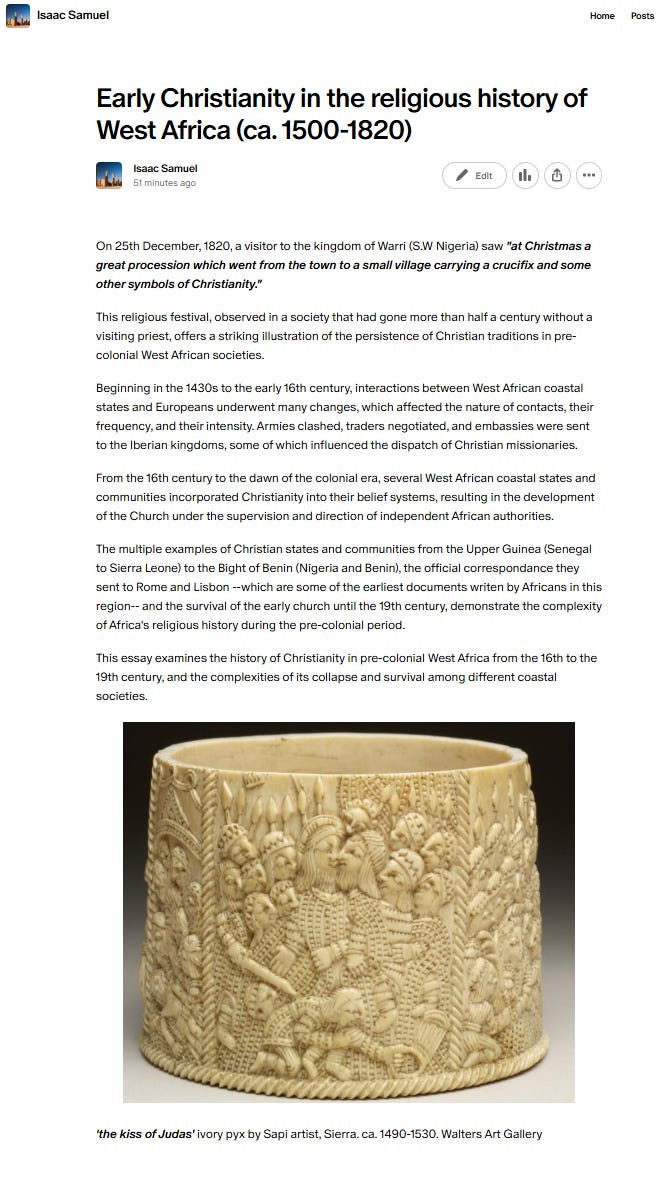
On 25th December, 1820, a visitor to the kingdom of Warri (S.W Nigeria) saw “at Christmas a great procession which went from the town to a small village carrying a crucifix and some other symbols of Christianity.”
This religious festival, observed in a society that had gone more than half a century without a visiting priest, offers a striking illustration of the persistence of Christian traditions in pre-colonial West African societies.
The history of Christianity in pre-colonial West Africa is the subject of my latest Patreon Article. Please subscribe to read about it here:
Foundations of an African Civilisation: Aksum and the Northern Horn, 1000 BC - AD 1300 By D. W. Phillipson. Church and State in Ethiopa 1270-1527 By Tamrat Tadesse
The Roots of Nubian Christianity Uncovered [and] the Triumph of the Last Pharaoh Religious Encounters in Late Antique Africa By Salim Faraji
The Art of Conversion Christian Visual Culture in the Kingdom of Kongo By Cécile Fromont
https://substack.com/home/post/p-184938874
It's interesting to observe that the Christianity in Nubia has flourished by the same political motivation that Mohammed has started a monotheistic religion in Arabic Peninsula and then founded the Islan Religion and, on the other side of Red Sea, Abyssinian Empire has converted to Christianity too: the convention of Roman Empire in Christianity has show that this new spiritual paradigm has arrived and empowered the civilizations. The tragic of all this millennial history is that Ethiopia has became a powerful empire, but Nubians has declined and submitted to a vassall relationship with Meca. The Tragedy of Kongo is just a revival of this assimetric relationship between the colonizer's and the colonizer's cristianities. Thanks for the instigator text