

Ancient Africa was a land of multiple literacies.
Near the end of the classical period in the 4th century CE, the four major ancient African writing traditions of; Demotic (in Egypt), Meroitic (Sudan), Libyco-Berber (Maghreb), and Ge’ez (Ethiopia and Eritrea), were all being used to write the African languages for which they had originally been invented.
Yet by the 14th century, most of the continent had adopted the Arabic writing system and language, which was the lingua franca of the Islamic golden age.
From Morocco to Mozambique and from Senegal to Sudan, African scholars produced a vast corpus of Arabic manuscripts that today constitutes one of the most important sources for reconstructing the continent’s history.
However, the acquisition of literacy in classical Arabic (fusḥā), in which most of these manuscripts were composed, was confined to the professional ʿulamāʾ (scholars), whose knowledge and writings were only accessible and comprehensible among their own class.
While their writings circulated widely across networks of competing centres of learning, membership in this class, which was considered the sole custodian and interpreter of the Muslim intellectual tradition, depended on the literate command of Arabic.1
In this largely Arabic scribal world, only a handful of African written languages remained.
These included Coptic among the Christian minority of Egypt (which retained its traditional script alongside bilingual Arabic translations), Old Nubian, whose literary tradition disappeared with the collapse of the medieval Nubian kingdoms; and the more restricted graphic traditions of Tifinagh/Tifinaɣ and Nsibidi, which survived primarily in the form of brief inscriptions.
Although writing in Ge’ez continued to flourish in the Christian kingdom(s) of Ethiopia, the language itself had no living speakers since the fall of Aksum. It was reduced to a liturgical language just like Latin in medieval Europe. For many centuries, literature in the successor languages of Ge’ez, ie; Ahmaric and Tigrinya, remained marginal as the bulk of manuscripts were written almost exclusively in Ge’ez.2

Copy of a Psalter written in multiple scripts and languages, 12th-14th century, monastery of Saint Macarius, Wadi al-Natrun, Egypt.3 Beginning with Ethiopic/Ge’ez on the extreme left column, followed by Syriac, Coptic in the center, Arabic on the right, and ending with Armenian.
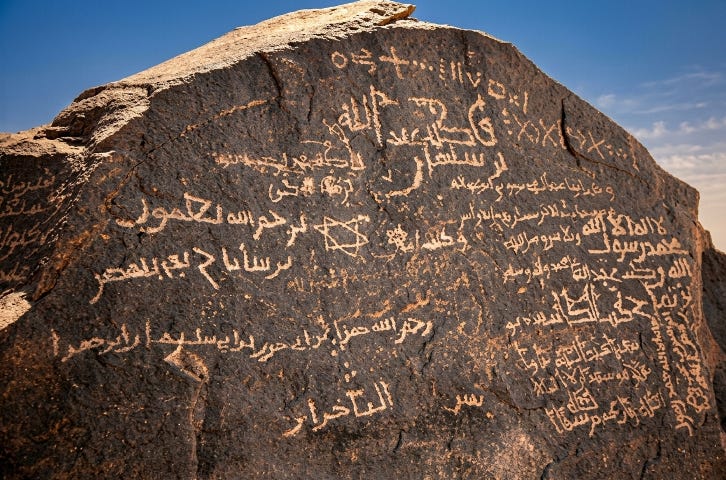
Arabic inscriptions (including one dated 1041 CE), and Tifinaɣ /Tifinagh inscriptions, side by side in the south-east Essouk cliffs, Mali.4
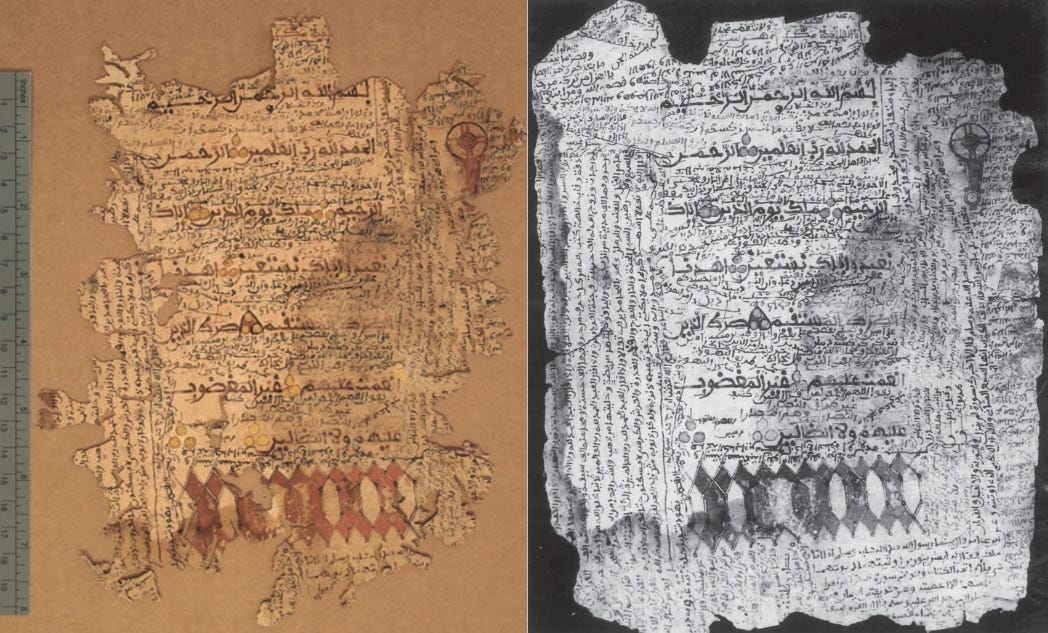
Quranic manuscript with glosses in Old Kanembu, ca. 1669 CE. Nigeria. ‘Imam Ibrahim Quran’ (manuscript 3ImI). Images by Dmitry Bondarev.5
Support AfricanHistoryExtra by becoming a member of our Patreon community, subscribe here to read more about African history, download free books, and keep this newsletter free for all:
Initially, written texts in African languages across the Muslim societies of the continent were confined to the margins of the Arabic manuscripts written by African scholars, and in brief inscriptions that contained non-Arabic names, titles, and phrases.6
However, by the 16th/17th century, African scholars began producing written compositions exclusively in their languages.
Most of the earliest known ajami manuscripts from the post-medieval period have been uncovered over the last 30 years, in the city of Harar (Harari language), in the Sous valley of Morocco (Tashelhiyt-Berber), in West Africa (Fulfulde and Hausa), in Madagascar (Atemoro-Malagasy), and along the East African coast (Swahili).
For the Tashelhiyt-Berber language, the earliest ajami manuscript is the Lεqayd n ddin of Ibrahim Aẓnag (d. 1597), described as ‘the oldest known manuscript text in Berber.’7 For Harari, the oldest ajami manuscript is the Kitāb alfarāyiḍ of Abdarrahman al-Araši and Tayyib al-Wanagi, which is variously dated to between 1595 and 1669.8
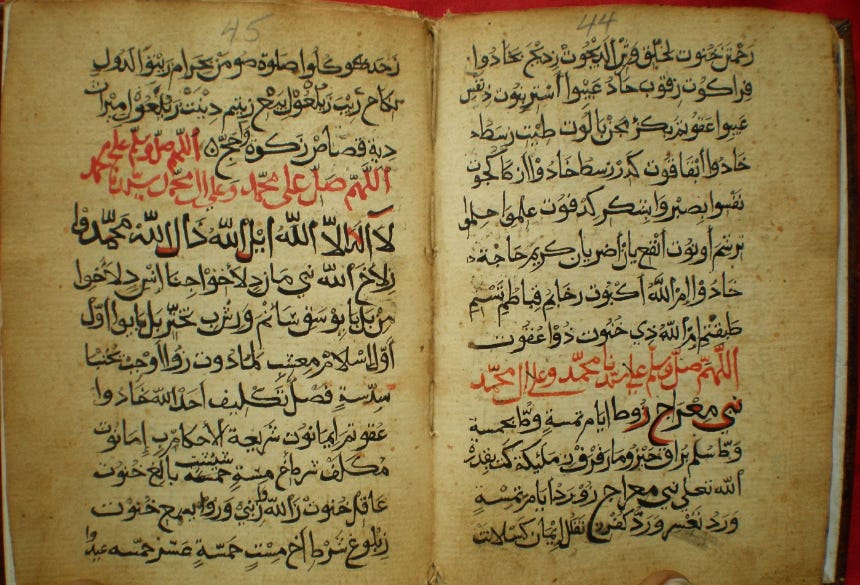
Copy of the Kitāb al-farāʼiḍ, ca. 18th century, Harar. Ethiopia. Sherif Harar City Museum. Images from HMML Reading Room.
For Atemoro-Malagasy, the earliest securely dated ajami manuscripts are a collection of Sorabe manuscripts at the Bibliothèque nationale de France, dated to 1590-1620, along with a local chronicle of the French invasion of Madagascar from 1659 to 1663. [See my essay on ‘The Sorabé script of Madagascar’ ]
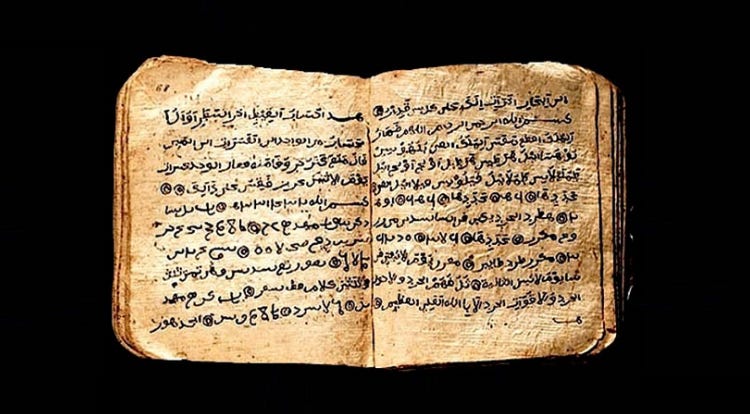
Sorabe manuscript MP 23. Antemoro, Madagascar. 17th century, BNF, Paris.
For Fulfulde, evidence comes from the theologian Muhammad al-Wali (fl. 1688), whose al-Manhaj al-farid is an Arabic translation of a popular Fulfulde commentary on the Sughra of al-Sanusi.9 [see: ‘The philosophical theology of Muḥammad al-Wālī (fl. 1688)’]
For the Hausa language, there are references to ajami texts by the scholars, ɗan Masani (d. 1667) and Abdullahi Suka (fl. mid-17th century), who are thought to have composed the texts; Wakar Yakin Badar and Riwayar Annabi Musa. But the earliest extant manuscripts date to the late 18th/early 19th century.10
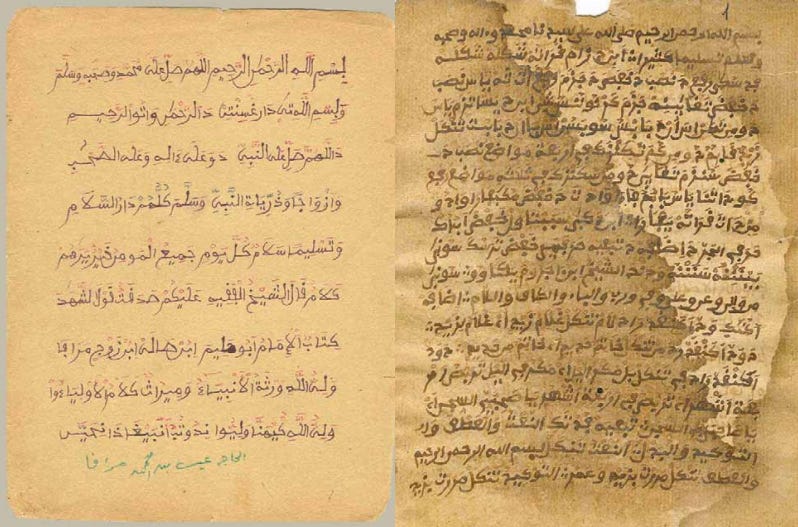
(left) Manuscript in the Zarma-Songhay language, written by Halim Marafa. (right) Hausa manuscript titled ‘Ajrumiya’. 18th-20th century. Institut de Recherches en Sciences Humaines, Niger.
For Swahili, the earliest known complete ajami manuscript is the Utendi wa Tambuka, dated 1728, but it represents a long-standing tradition, beginning with the “Siri al-asari” (The secret of the secrets) composed in 1663 by Mwana Mwarabu bint Shekhe.11 [See: ‘Poetry, Philosophy and History in Swahili literature’]
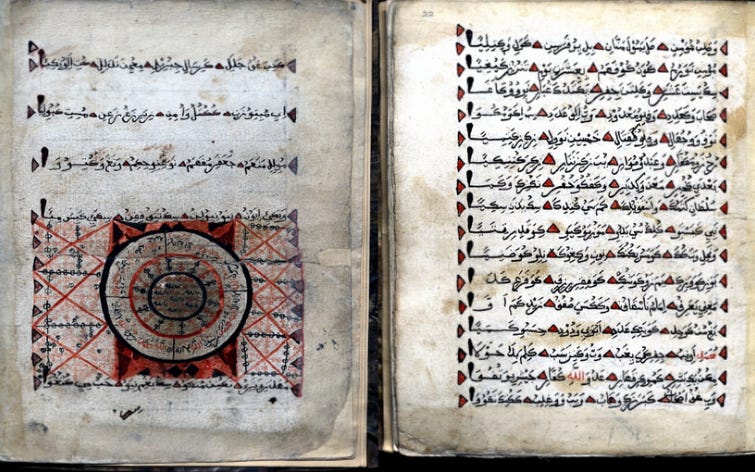
Copy of ‘Utendi wa Herekali’ by Muhamadi Kijuma. SOAS, London.
In Ethiopia, the earliest complete Amharic texts in the Ge’ez script also appear by the 17th century, mostly consisting of praise-poems and theological compositions that are based on an older literary tradition from the 14th/15th century. Significant writing in Amharic began in the 19th century, when it replaced Ge’ez as the main scribal language, including in theological writing.12
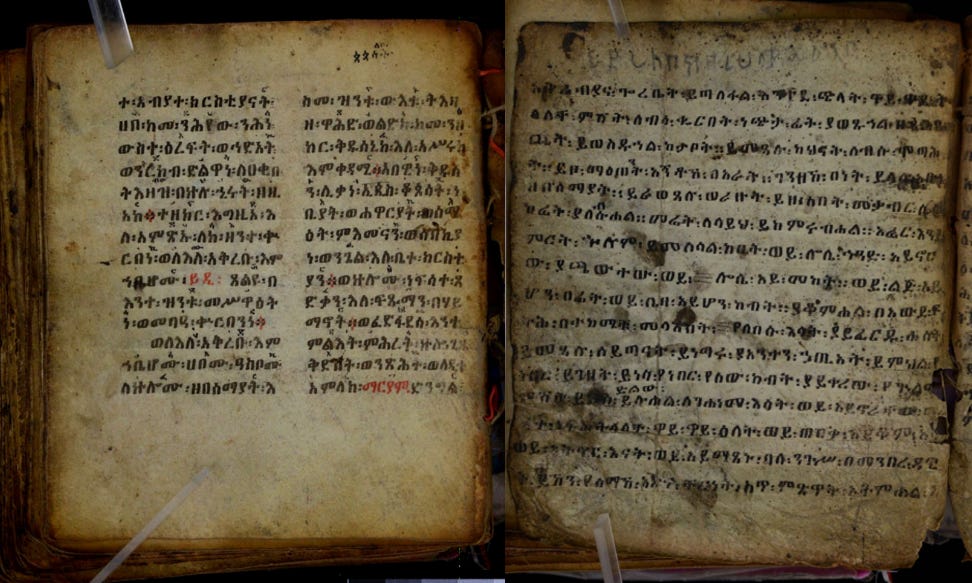
Amharic document MS MKL-008, ca. 1650-60, Läq̌ay Kidanä Mǝḥrät, Ethiopia. Image by M. Bulakh and D. Nosnitsin

Amharic manuscript on medicine with a list of diseases and treatments, 19th century, library of Ras Wassan Sagad of Shoa (r. 1808-1813), British Library.
These collections of Manuscripts written in African Languages challenge the persistent misconception that African languages were exclusively oral.
By the 19th century, Ajami written traditions had proliferated across the continent. Their expansion was closely associated with the broadening of the intellectual sphere beyond established scholarly elites, a process linked to the rise of political and religious movements that sought wider audiences, such as the Qadiriyya, Tijaniyya, and Sanussiyya brotherhoods.
At least 79 languages across the continent are known to have utilised the ajami script by the 19th and early 20th centuries.
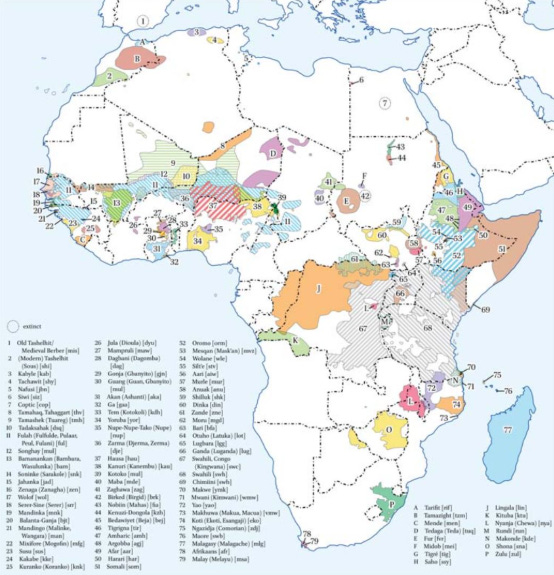
Languages that use the Arabic and Ajami scripts. Map by Meikal Mumin
In 19th-century Hausaland, for example, scholars undertook extensive projects to translate existing Arabic works into Hausa and Fulfulde while also producing original compositions in those languages. Among the most notable of these authors was the Hausa scholar and ethnographer al-Hajj Umaru, whose writings provide a rare indigenous perspective on the society and culture of his time13
The bulk of these were written so that non-elite audiences could understand Islamic theological and legal concepts, but they also include ‘secular’ works on medicine, history, and genealogy.14
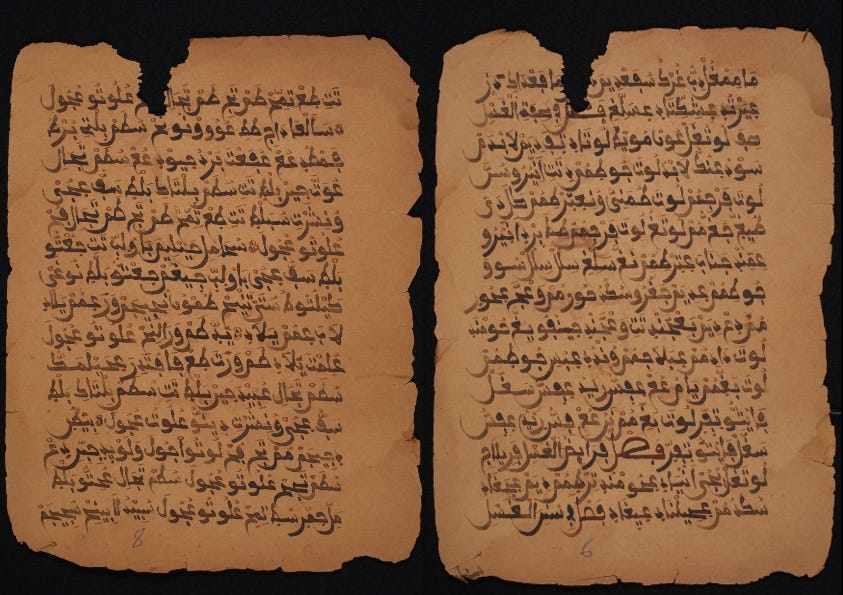
Fiqh manual in Fulfulde by Abd Allāh ibn Muḥammad. 18th-20th century. Mamma Haidara Library. Images from HMML Reading Room.
African languages, which were already used in administration, religion, commerce, and law, now developed a rich written tradition.
From early writings in the Afrikaans language (which was initially used by enslaved Muslims of South Africa before it was adopted by the Boers)15, to the Kabyle-Berber ajami manuscripts in Algeria16, and numerous societies in between, such as the Bamanakan, Mandinka, Yoruba, and Wolof.
Not coincidentally, several previously non-literate societies also invented their own writing systems during this period, which were exclusively used to transcribe their own languages.
The oldest of these are the Vai script of Liberia (ca. 1833) and Njoya’s script (ca. 1897) of the Bamum kingdom in Cameroon, which were followed by numerous scripts that appeared in the first half of the 20th century.17
Among these communities, language and script became closely intertwined as markers of cultural identity. Quite explicitly, the King of the Vai in Liberia recognised that his script “would soon raise his people” to the level of the literate Americo-Liberians and Mandinka scribes.
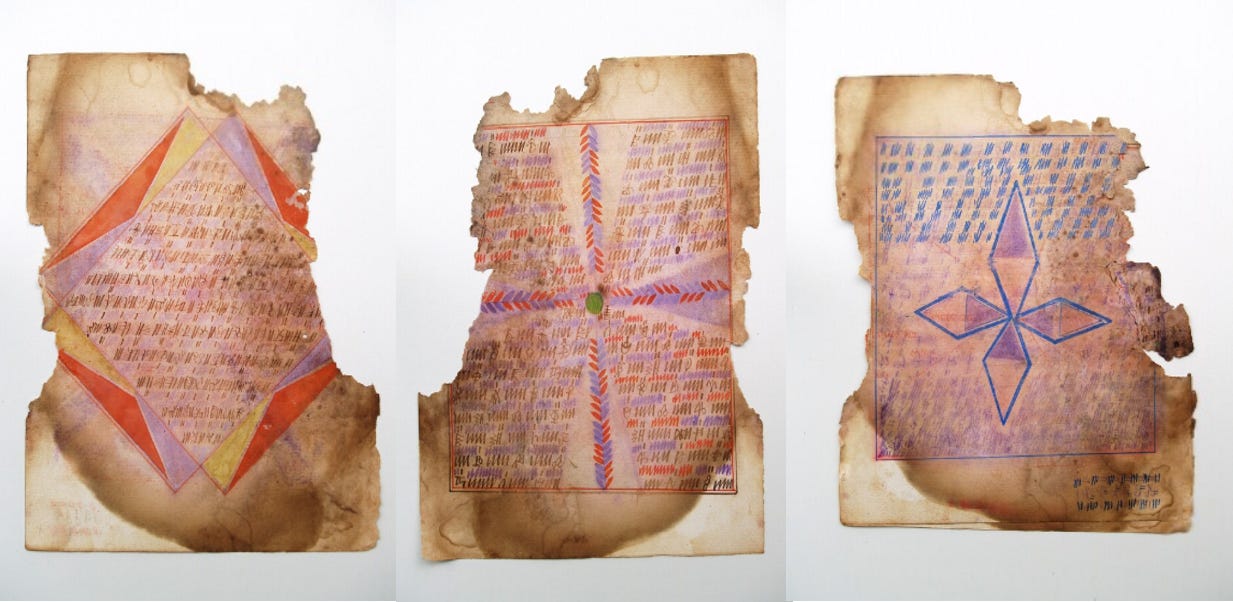
Chronicle of the Bamum kingdom, ca. 1900 CE, Archives du Palais des Rois Bamum, Fumban, Cameroon. EAP.
This dramatic expansion of African ‘vernacular’ literature continued into the colonial period, when many African languages were written in the Latin script, creating what the scholar Ali Mazrui describes as Africa’s ‘triple heritage’: the Indigenous, the Islamic, and the Western tradition.
The development of African vernacular literature, therefore, significantly predates the widespread adoption of Latin orthography, which represented the final stage of Africa’s literary efflorescence.
This dynamic history of writing in African languages is best illustrated by the emergence of Oromo literature in present-day Ethiopia during the 19th century.
Ethiopia has a long tradition of multiple writing traditions, which were, however, the exclusive domain of learned clerics associated with the Christian and Muslim courts of the dominant kingdoms.
The Oromo, who were ascendant during the 18th and early 19th centuries, soon adopted the Arabic, Ge’ez, and Latin scripts to compose some of the earliest works published in Africa by African authors.
The development of Oromo literature was, however, profoundly shaped by the changing political landscape of the region, particularly by the Oromo’s relationship with the reconstituted Christian kingdom of Ethiopia.
Between 1855 and 1974, the literary production of Oromo intellectuals evolved in response to these political tensions. As the Oromo language faced increasing marginalisation within state institutions, dissident scholars invented their own writing system, known as the Bakri-Sapalo script.
The complex history of Oromo literacy illustrates the significance of vernacular writing in African history as a powerful symbol of cultural identity.
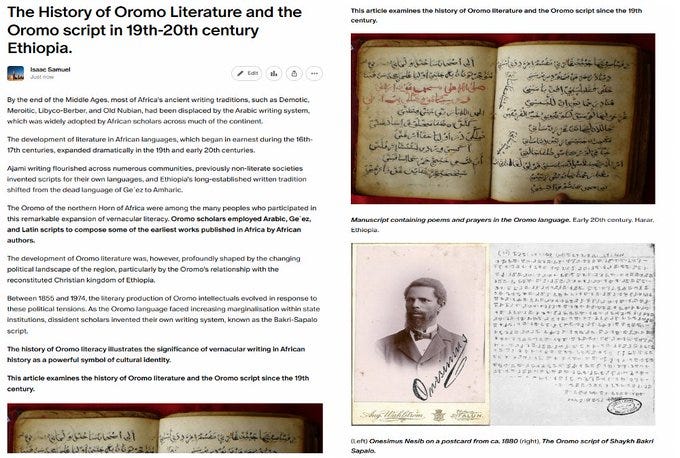
The History of Oromo Literature and the Oromo script in 19th-20th century Ethiopia is the subject of my latest Patreon article.
Please subscribe to read more about it here and support this newsletter:
The Trans-Saharan Book Trade: Manuscript Culture, Arabic Literacy and Intellectual History in Muslim Africa, edited by Graziano Krätli, Ghislaine Lydon. The Transmission of Learning in Islamic Africa by Scott Steven Reese.
A Companion to Medieval Ethiopia and Eritrea, ed. Samantha Kelly, pg 26. Encyclopaedia Aethiopica. Vol. 2, edited by Siegbert Uhlig, pg 732, Encyclopaedia Aethiopica. Vol. 1, edited by Siegbert Uhlig, pg 233, 238. Encyclopaedia Aethiopica. Vol. 2, edited by Siegbert Uhlig, pg 902.
Africa and Byzantium By Andrea Myers Achi pg 157, 165
Essouk - Tadmekka: An Early Islamic Trans-Saharan Market Town, pg 50
The language of the glosses in the Bornu Quranic manuscripts by Dmitry Bondarev. Islamic Education and Ample Space Layout in West African Islamic Manuscripts by Dmitry Bondarev
For a summary of these early Ajami inscriptions and glosses, see: TheʿAjamī script of Africa and the Sorabé manuscripts of Madagascar.
The chapter on pilgrimage in the work of the Berber author Ibrahim Aẓnag (D. 1597) By Harry Stroomer
Some Further Remarks on the Old Harari Kitāb alfarāyiḍ by G Banti. Encyclopaedia Aethiopica: Volume 2, edited by Siegbert Uhlig, pg 1029
Arabic Literature of Africa, Volume II: The Writings of Central Sudanic Africa, by John O. Hunwick, pg 34-35
Arabic Literature of Africa, Volume II: The Writings of Central Sudanic Africa, by John O. Hunwick, pg 29-30, 31-33. Creating Standards: Interactions with Arabic Script in 12 Manuscript Cultures, edited by Dmitry Bondarev, Lameen Souag, Alessandro Gori, pg. 253-254
The Arabic Script in Africa: Studies in the Use of a Writing System, edited by Meikal Mumin, Kees Versteegh, pg 320. Islamic Scholarship in Africa: New Directions and Global Contexts by Abdulkadir Hashim, pg 387
An Old Amharic poem from northern Ethiopia by Maria Bulakh and Denis Nosnitsin. Encyclopaedia Aethiopica. Vol. 1, edited by Siegbert Uhlig, pg 233, 238-9. Tedla Hailé, and the Problem of Multi-Ethnicity in Ethiopia by Richard Pankhurst, pg 83
A Geography of Jihad: Sokoto Jihadism and the Islamic Frontier in West Africa by Stephanie Zehnle, pg 60-65.
The Meanings of Timbuktu ed. Souleymane Bachir Diagne & Shamil Jeppie, pg 115-119
The Arabic Script in Africa: Studies in the Use of a Writing System, edited by Meikal Mumin, Kees Versteegh, pg 351-3. The Afrikaans of the Cape Muslims from 1815 to 1915 by Achmat Davids
Kabyle in Arabic Script: A History without Standardisation by Lameen Souag
The invention, transmission and evolution of writing: Insights from the new scripts of West Africa, by Piers Kelly, In ‘Paths into Script Formation in the Ancient Mediterranean’ edited by S. Ferrara and M. Valério
Great article as always Isaac. A few thoughts to consider on Swahili Ajami. It might be hard to trace the age and depth of written work due to the numerous Portuguese invasions and subsequent destruction that occurred between the 1500s and 1600s. I suspect we lost important documents and artifacts during these invasions, especially considering majority of the destruction happened at the two most prominent Swahili Cities at the time (Mombasa and Kilwa). In that case it makes sense to say "oldest surviving" or "oldest known" when referencing such documents. Additionally, I am not sure what language The Mombasa Chronicle is written in (should be Arabic or Ajami)...currently working on accessing it at SOAS and have personally never seen it, but that dates back to the 1300s. Might you have more information on this?
Really interesting piece. Does the ajami tradition not make the stronger argument here? The Timbuktu manuscripts are written in Arabic by a scholarly elite, so won't pointing to them keep the dependency story intact? I mean Ajami is different because it shows ordinary people writing in languages they actually spoke, spread beyond scholars precisely because the Sufi brotherhoods needed to reach mass audiences.