

In the opening decades of the 19th century, Africa witnessed the emergence of new economic and political dynamics that intersected with, and were in some areas the outcome of, external influences.
Over the course of the century, these developments completely reshaped the political and cultural geography of the continent, such that the forms of social organization found across much of the continent on the eve of colonial rule cannot be uncritically projected into earlier periods.
While some parts of the continent saw the continued expansion and consolidation of existing states without regional upheaval, such as the Gold Coast (Ghana) and the Great Lakes region of East Africa, much of the continent was significantly transformed by processes that amounted to a political revolution.
New models of leadership emerged, often based on merit rather than on dynastic inheritance alone. Political authority increasingly rested on qualities such as ideological vision, military skill, material ambition, and the administrative capacity to mobilize and sustain power.
A revealing example comes from the 19th-century Empire of Massina (in present-day Mali). In response to a nobleman’s request for appointment as a provincial governor, the state’s Governing Council wrote in reply:
“The Council does not contest your illustrious birth, nor your military achievements. However, it would be an issue to give you an office in which neither military merit nor origin matter. From administrators, we require piety and science. And, without insulting you, your piety is mild, and your science is non-existent.”1
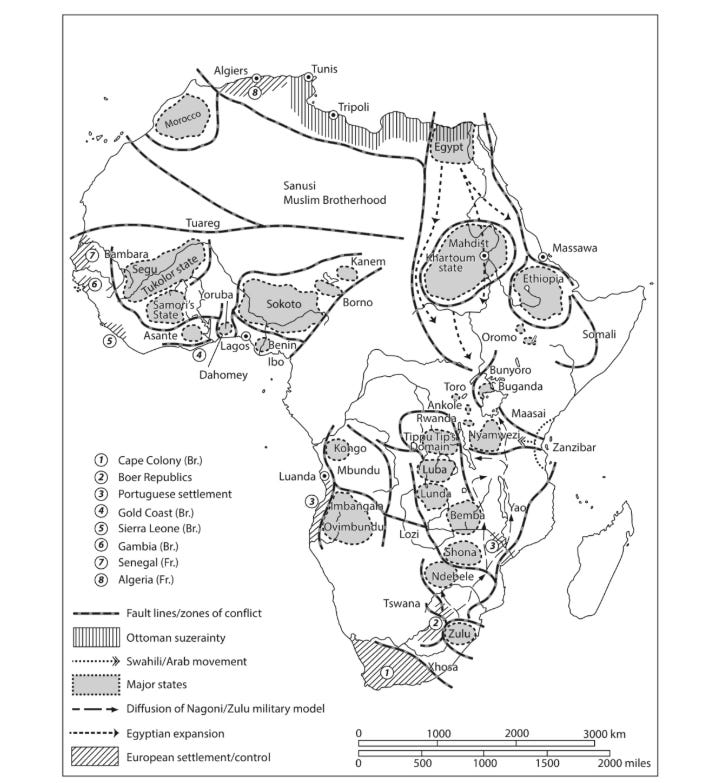
Revolutionary Africa in the nineteenth century. Map by Richard Reid.2
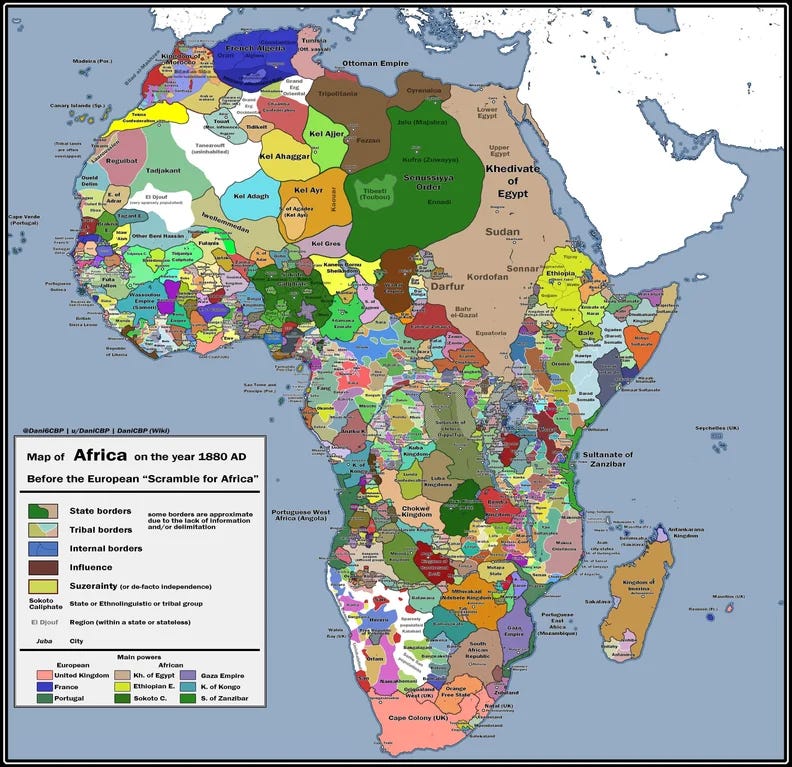
Map of Africa on the year 1880 AD.
Support African History Extra by becoming a member of our Patreon community. Subscribe here to read more about African history, download free books, and keep this newsletter free for all:
The political revolutions of 19th-century West Africa have been examined in greater detail by the historian Paul Lovejoy, who argues that they resembled contemporaneous revolutions across Europe and the Americas. In his interpretation, these movements were driven in part by efforts to curtail the social and political disruptions associated with the Atlantic slave trade.3
The establishment of theocratic states in this region, which began in the Senegambia and Upper Guinea region with the kingdoms of Futa Jalon and Futa Toro in 1775-6, accelerated in the 19th century with the founding of Sokoto in Northern Nigeria after 1804, and the empire of Massina in Mali in 1817.
The consolidation of these states generated far-reaching transformations in the political institutions, economic systems, and settlement patterns of neighboring regions.
In the old empire of Bornu in the Lake Chad Basin, the ancient Sayfawa dynasty was supplanted by the theocratic government led by Sheikh Al-Kanemi. In the Bambara empire of Segu (Mali), the ailing Diarra dynasty became a vassal of Massina and was ultimately absorbed by Umar Tal’s Tukulor state.
In S.W Nigeria, the weakening of the Oyo empire was intensified by Sokoto incursions, contributing to the rise of large Yoruba city-states like Ibadan, which attained a population of about 100,000 in 1851.4
New patterns of economic exchange stimulated significant growth in production, especially in the textile trade and the caravan trade in Kola. The ensuing prosperity was such that for the first time since the collapse of Songhai in 1591, large cities in the West African savannah rivaled the population of its former imperial capital, with Kano boasting a population of over 100,000 in 1896.5
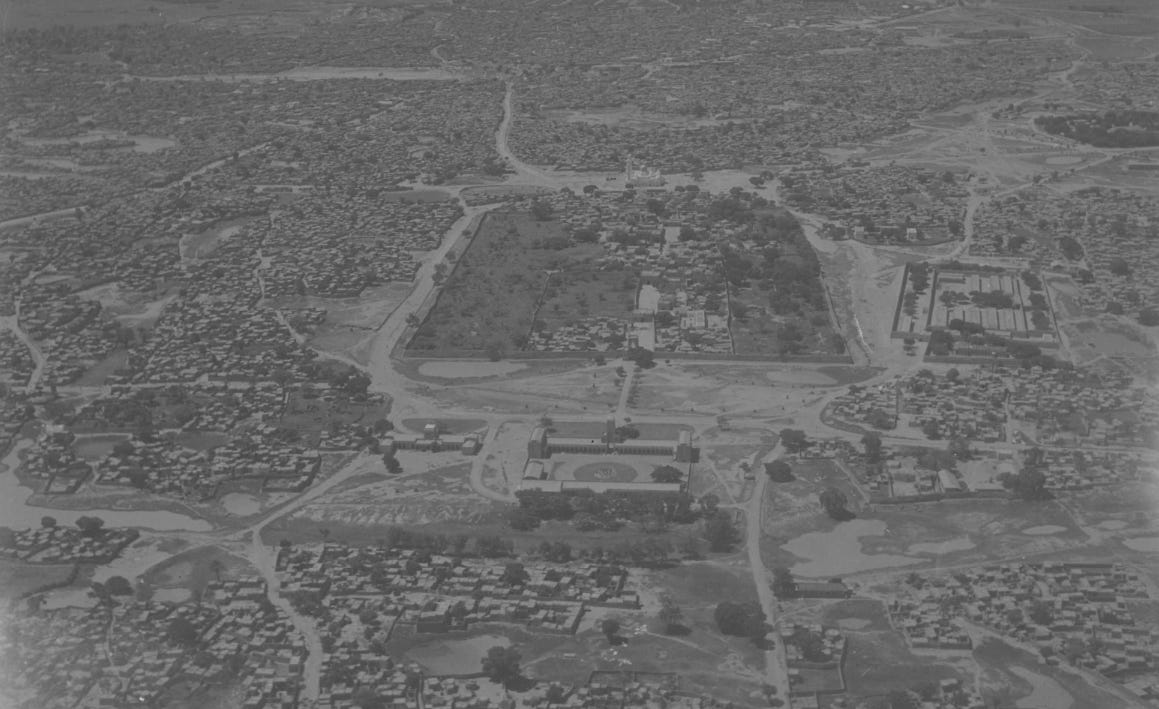
Aerial view of Kano, Nigeria, with the emir’s palace at the center. ca. 1930. Northwestern University.
In Sudan, the Turco-Egyptian era (1821-1885) and the Mahdist revolution (1881–1898), which succeeded it, represented new forms of political organization and administration that diverged significantly from the pre-existing monarchical systems of Funj and Darfur.6
Their economic structures were shaped by expanding global commercial networks and were more directly integrated into the Red Sea trade through the port city of Suakin.7 The governments were centralised in the twin cities of Khartoum and Omdurman, the latter of which boasted a population of over 150,000 in the late 19th century,8 while regional cities like El-Obeid numbered about 100,000 residents in 1891.9
In the northern Horn of Africa, a century-long period of regionalism in Ethiopia ended with the restoration of imperial authority under Tewodros II and his successors.
Although these rulers drew upon established traditions of political legitimacy, their reigns were profoundly shaped by the growing influence of foreign powers and shifting commercial and political dynamics in the Red Sea region during the first half of the 19th century.10
State consolidation and expansionism generated far-reaching changes among neighboring societies, including the Oromo kingdoms to the south, producing divergent outcomes that significantly altered their cultural and social institutions.11
These processes further stimulated external trade, contributing to the revival of established urban centers such as Massawa and Harar, while also encouraging the emergence of new cities, including Addis Ababa and Dire Dawa, the former of which had an estimated population of around 60,000 by 1903.12
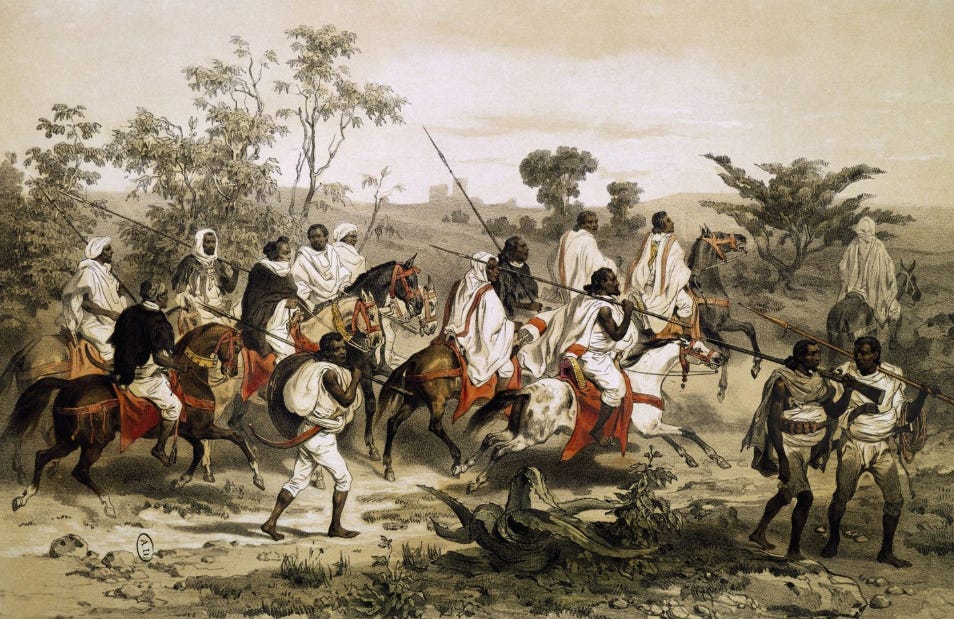
Abyssinian troops in the field. ca. 1839-1843, by Charlemagne Theophile Lefebvre.
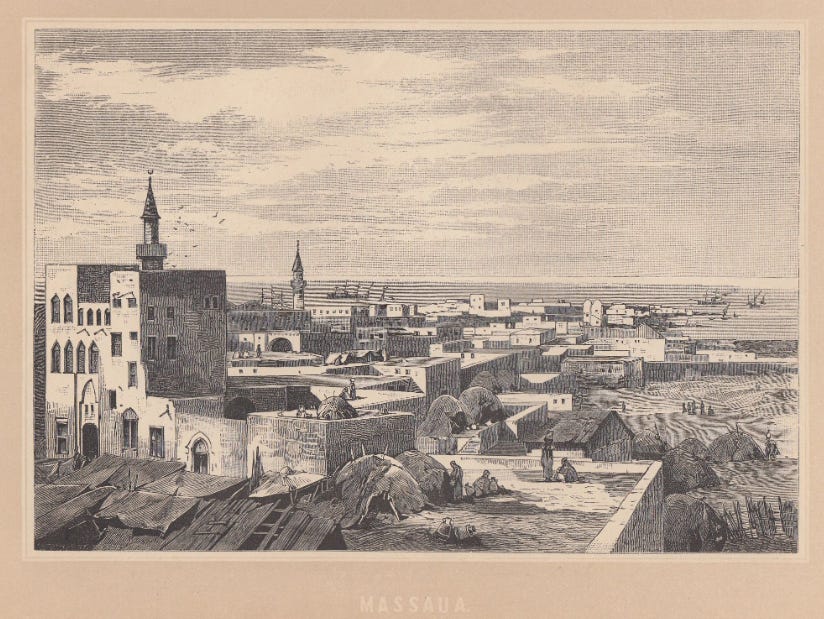
Massawa, Eritrea. ca. 1891
The rise of the Red Sea port of Aden (Yemen), and the Indian Ocean entrepot of Muscat (Oman), which became the capital of a major maritime empire, inaugurated a new era of commercial expansion in the early 19th century. The effects of this expansion were felt across a wide region, extending from Somalia and Mozambique to the interior of East Africa.13
In the north, the sultans of Majeerteen, who controlled a chain of fort-towns along the coast of Somaliland, signed commercial treaties with the sultans of Oman and Mukalla in Yemen, as part of the growing trade in grain and spices to the city of Aden.
In Southern Somalia, a new economic system linking the coastal towns of Benadir (Mogadishu and Brava) to the fertile hinterlands of the Shebbelle river, transformed the region into the “grain coast” of Southern Arabia, supplying the regions of Hadramaut and Oman.
The two coastal towns had experienced centuries of decline and were home to only a few hundred residents by 1811. Over the following decades, however, they underwent a marked revival: by the end of the century, each had grown to between 6,000 and 10,000 residents, and by 1935, the population of Mogadishu had expanded further to around 40,000.14
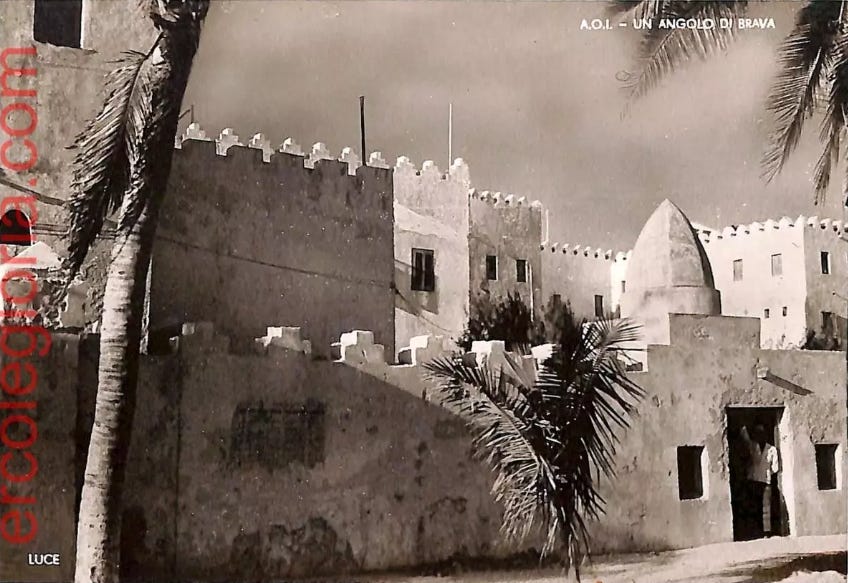
Brava (Barawa), Somalia.
Along the East African coast, the shift of Oman’s imperial capital from Muscat to Stone Town, Zanzibar (Tanzania), transformed what had been a relatively small Swahili town into a major commercial metropolis. The city rivaled and ultimately surpassed the older cities of Mombasa, Kilwa, and Lamu, growing to an estimated population of 100,000 by 1871.15
Zanzibar exerted a profound influence on the organisation of long-distance trade in ivory and textiles into the interior, which induced related developments among societies such as the Nyamwezi, where a number of states emerged during the mid-19th century, from central Tanzania to South-Eastern D.R.Congo.
In the kingdoms of the Great Lakes region, internal processes of political centralization were further intensified by these external commercial currents, especially in the kingdom of Buganda, whose capital at Mengo/Kampala, housed an estimated 70,000 residents in 1890.16 Caravans from Zanzibar travelled further East to Congo, where merchant-rulers like Tippu Tip established new forms of political authority over extensive territories.
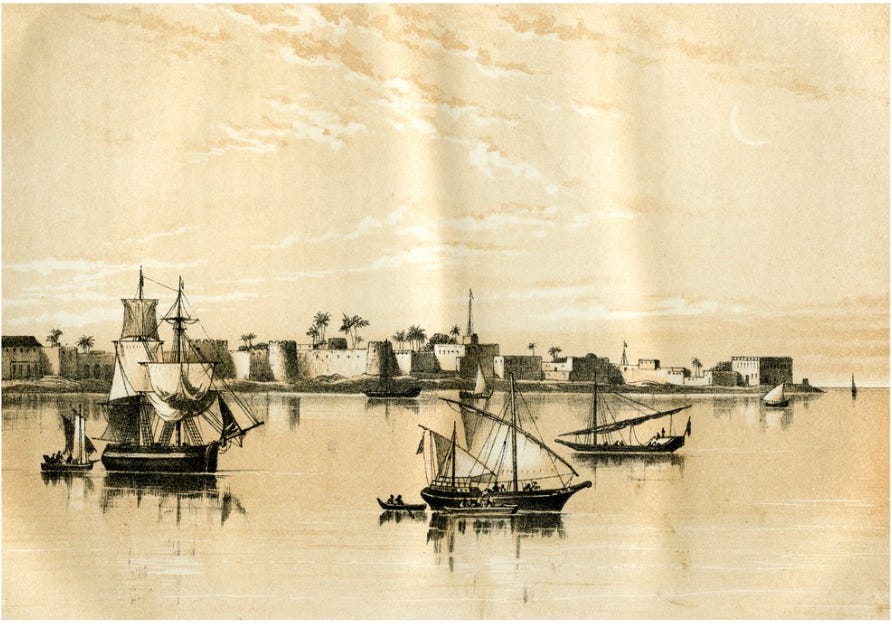
Zanzibar from the Sea, 1883
In Southern Africa, pre-existing patterns of social complexity contributed to the emergence of large, agglomerated capitals among the Tswana in the early 19th century. Towns such as Pitsane of the Ngwaketse kingdom (Botswana)17 and Kaditshwene (South Africa) rivaled the colonial capital of Cape Town, with about 20,000 residents.
These internal developments were further elaborated among neighbouring Nguni-speaking societies, where ambitious rulers introduced a series of political and military innovations that resulted in the formation of expansive states such as the Zulu and Ndwandwe kingdoms.18
Although external influences were relatively more muted in this region, the effects of expanding export trade through Delagoa Bay, as well as the movements associated with Boer migration from the Cape Colony, remain subjects of ongoing historical debate regarding their role in the political consolidation of the later kingdoms.19
The consolidation and expansion of these states during the so-called mfecane, influenced concurrent changes and population movements among neighboring societies.
The Tswana states of Ngwaketse, Kwena, and Ngwato became more centralized, as did the Swazi and Pedi kingdoms. New Nguni states of Matebele and Gaza were founded in Zimbabwe and Mozambique, while Sotho-speaking groups like the Makololo briefly ruled the old Lozi kingdom of Zambia.

Aerial view of Kaditshwene Hill. image by Gernot Langwieder
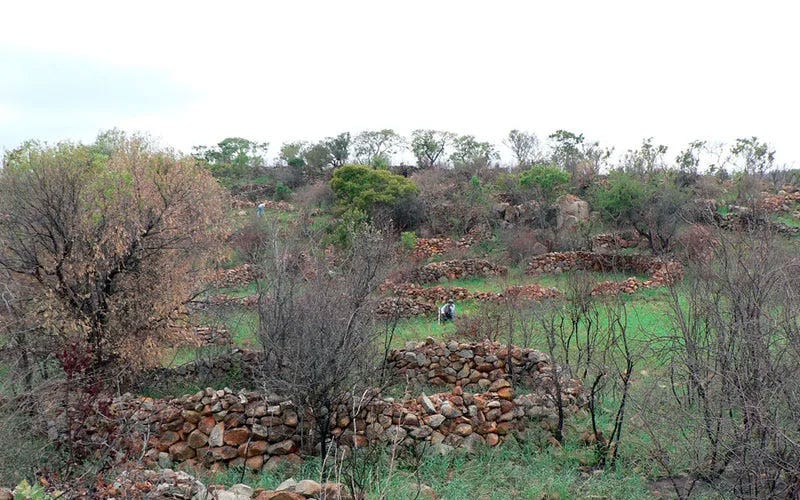
Kaditshwene ruins.
Economic growth and shifts in Africa’s political landscape created opportunities for groups that had previously been marginal, to become central actors in the revolutions that preceded the imposition of colonial rule.
This is best exemplified by the Chokwe of Central Africa (in present-day Angola and D.R.Congo), who went from a relatively obscure group on the margins of the great kingdoms of the Savannah to becoming the region’s most dynamic economic and military forces.
Originally, the Chokwe inhabited small, dispersed communities in what is today North-Eastern Angola. With the onset of the early 19th-century commodities boom, however, they emerged as the main suppliers of ivory, wax, and rubber to coastal markets, while also serving as mercenaries for the rulers of the Lunda Empire.
Within the span of roughly half a century, the Chokwe developed into one of the most formidable military forces in Central Africa. Their population expanded through processes of acculturation and migration, and they established large chiefdoms with fortified capitals.
By the 1870s, they had become influential power brokers within the Lunda political system, appropriating established aristocratic titles in what amounted to a political revolution.
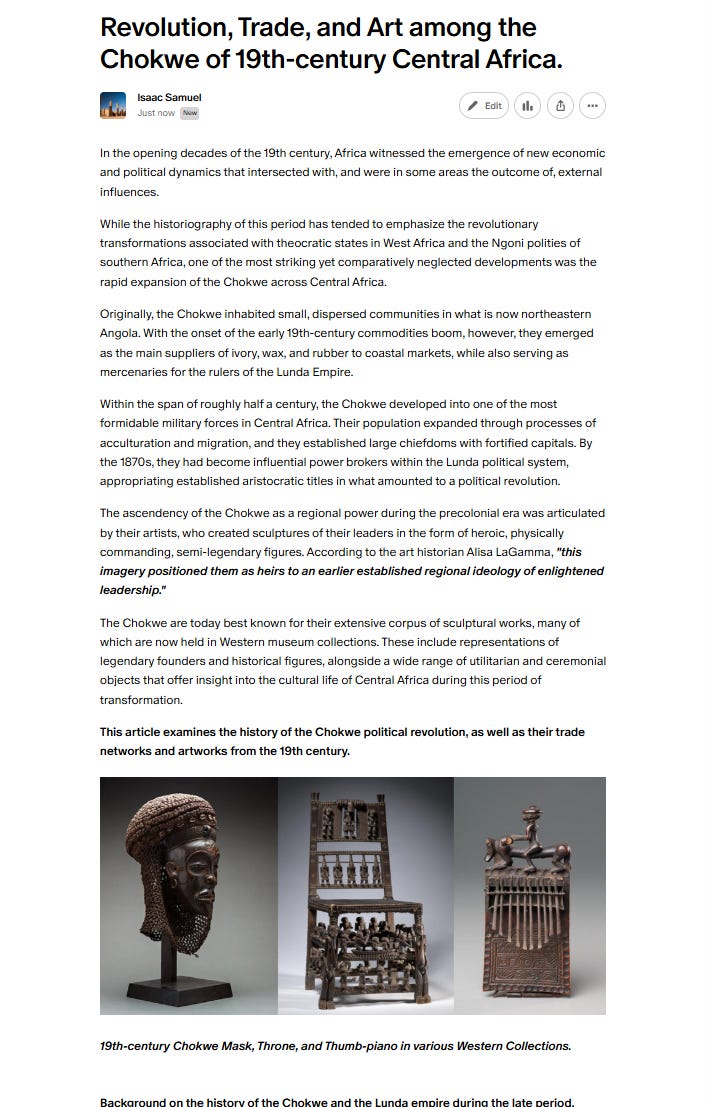
The ascendency of the Chokwe as a regional power during the precolonial era was articulated by their artists, who created sculptures of their leaders in the form of heroic, physically commanding, semi-legendary figures.
According to the art historian Alisa LaGamma, “this imagery positioned them as heirs to an earlier established regional ideology of enlightened leadership.”
The Chokwe are today best known for their extensive corpus of sculptural works, many of which are now held in Western museum collections. These include representations of legendary founders and historical figures, alongside a wide range of utilitarian and ceremonial objects that offer insight into the cultural life of Central Africa during this period of transformation.
The history of the Chokwe Revolution, Trade, and Artworks is the subject of my latest Patreon article. Please subscribe to read more about it here:
Sultan, Caliph, and the Renewer of the Faith: Aḥmad Lobbo, the Tārīkh Al-fattāsh and the Making of an Islamic State in West Africa By Mauro Nobili, pg 213
Taken from: ‘The African Revolution: A History of the Long Nineteenth Century By Richard Reid’. The book inspired the title for this essay, but the work itself, unfortunately, lacks the historical depth and scale required for this particular essay.
Jihād in West Africa During the Age of Revolutions By Paul E. Lovejoy
Seventeen years in the Yoruba country. Memorials of Anna Hinderer by Anna Hinderer pg 20
Hausaland Or Fifteen Hundred Miles Through the Central Soudan by Charles Henry Robinson pg 113
The Formation of the Sudanese Mahdist State: Ceremony and Symbols of Authority : 1882-1898 By Kim Searcy.
Some Social and Economic Aspects of Turko - Egyptian Rule in the Sudan, by Gabriel R. Warburg.
A Sketch of the Early History of Omdurman by F Rehfisch, Sudan Notes and Records, Vol. 45 (1964), pg 42-43
Ten Years’ Captivity in the Mahdi’s Camp, 1882-1892: From the Original Manuscripts of Father Joseph Ohrwalder By Josef Ohrwalder, Sir Francis Reginald Wingate, published by S. Low, Marston, 1882, pg 35
Tewodros as Reformer and Modernizer by Donald Crummey, On Yohannes IV, see: Greater Tigray and the Mysterious Magnetism of Ethiopia by Haggai Erlich, pg 29-56.
A History of Modern Ethiopia 1855 - 1974 By Bahru Zewde. The Ethiopians: A History by Richard Pankhurst. Oromia and Ethiopia: state formation and ethnonational conflict, 1868-2004 by Asafa Jalata. Economic history of Ethiopia, 1800-1935 by Richard Pankhurst.
How Shared Urban Citizenship Shaped Addis Ababa’s Early Development by Dominique Harre, pg 44-45. History of Ethiopian Towns: From the Mid-nineteenth Century to 1935, Volume 2, by Richard Pankhurst.
East Africa and the Indian Ocean by Edward A. Alpers. Trade and Empire in Muscat and Zanzibar: Roots of British Domination by Mohmed Reda Bhacker
Muqdisho in the Nineteenth Century: A Regional Perspective by EA Alpers, pg. 452-453. Translocal Connections Across the Indian Ocean: Swahili Speaking Networks on the Move by Francesca Declich pg 53-57. City profile, Mogadishu By Alberto Arecchi.
How I Found Livingstone Travels, Adventures, and Discoveries in Central Africa ; Including Four Months’ Residence with Dr. Livingstone By Henry Morton Stanley, 1890, published by Sampson Low, Marston, Searle, & Rivington, pg 17
Political Power in Pre-Colonial Buganda by Richard Reid pg 38
Settlements, landscapes and identities among the Tswana of the western transvaal and eastern Kalahari before 1820 by Fred Morton
Chapters 7 and 8, In ‘Kingdoms and Chiefdoms of Southeastern Africa’ by Elizabeth A. Eldredge
Mfecane Aftermath: Reconstructive Debates in Southern African History, edited by Carolyn Hamilton. Sources of Conflict in Southern Africa, c. 1800–30 by Elizabeth A. Eldredge. Tempest in a Teapot? Nineteenth-Century Contests for Land in South Africa’s Caledon Valley and the Invention of the Mfecane by Norman Etherington